The Great War: Britain’s Efforts and Ideals
2 August 2014
The most ambitious print project of the First World War
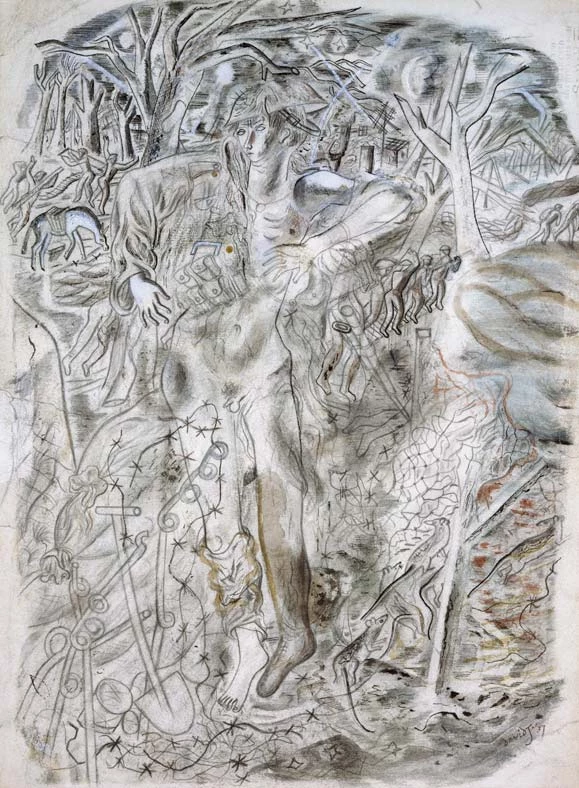
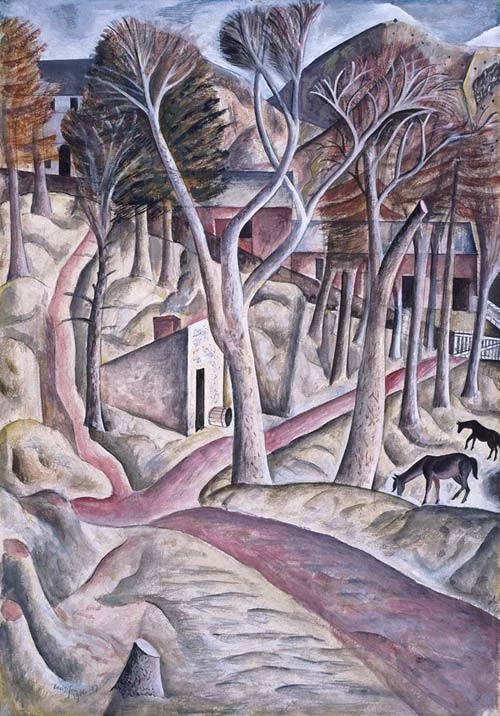
This exhibition presents the complete print series, The Great War: Britain’s Efforts and Ideals. These sixty-six prints were produced by the British government in 1917 as artistic propaganda with the aim of encouraging a war-weary public and raising support for the war effort.
Eighteen artists contributed to the series, including Augustus John, George Clausen and Frank Brangwyn – some of the most celebrated artists of the time.
As a government commission, the artists did not have full artistic freedom. They were given their subjects and each image had to pass censorship regulations.
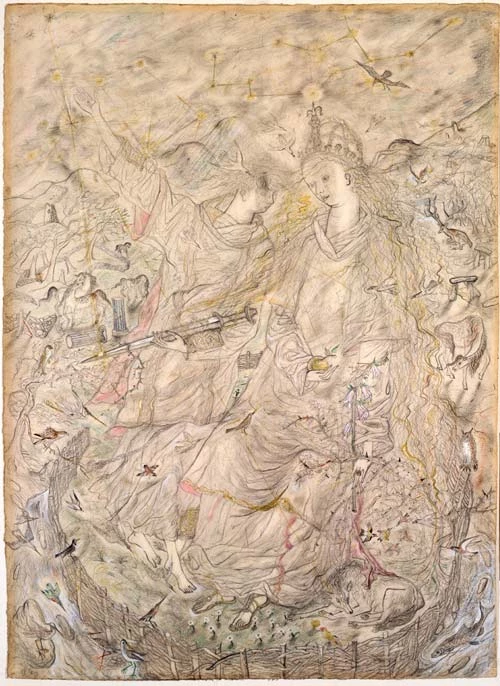
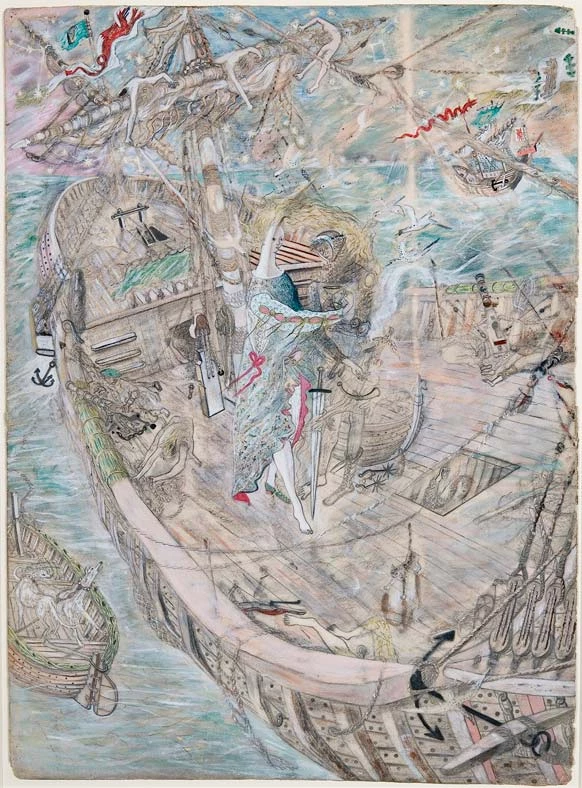
The prints are divided into two sets of portfolios, ‘Ideals’ and ‘Efforts’. The ‘Ideals’ address the question of why Britain was at war and what it aimed to achieve. These images are dramatic and symbolic, such as The Freedom of the Seas and The Triumph of Democracy. The ‘Efforts’ illustrate some of the activities of the war effort, the means by which Britain was to achieve the ‘Ideals’. The Efforts are separated into nine subject headings, each depicting a different activity or theme.
Producing and Exhibiting
These prints were commissioned by Wellington House, a government department secretly set up to produce propaganda. The project was managed by the artist Thomas Derrick (1885–1954), and the printing carried out under the direction of the artist and contributor F. Ernest Jackson (1872–1945). The printer was Avenue Press, London.
The contributing artists were paid well, each receiving £210 (about £10,000 today) with the possibility of further royalties from sales. The prints were a limited edition of two hundred. The ‘Efforts’ were sold for £2 2s 0d (£100) each and the ‘Ideals’ for £10 10s 0d (£500).
As a government commission, the artists did not have full artistic freedom. They were given their subjects and each image had to pass censorship regulations.
The series was first exhibited at the Fine Art Society, London in July 1917, followed by regional art galleries around Britain. It was also shown in France and in America, where the majority of the portfolios were sent to be exhibited and sold.
Contemporary Reaction to Prints
“The very soul of the war is to be read in the set of sixty-six brilliant lithographs.”
(The Illustrated London News, 1917)
These prints were commissioned as propaganda with the specific aim of raising civilian morale and manipulating public opinion towards the First World War in Britain and abroad. In 1917, after three years of hard fighting and unprecedented loss of life, the government needed a new way to maintain public support for the war. These prints were designed to remind people of the aims and objectives, and emphasise the importance of patriotic duty.
It is hard to know whether the prints were successful as propaganda. They were widely published when first exhibited in 1917. Some journalists supported the message, “To see these lithographs is a patriotic as well as an artistic duty” (Burton Daily Mail, Feb 15, 1918). Others were not so positive, “their efforts are in almost every instance sincere; yet the result is, on the whole, meagre and unsatisfying.” (The Daily Telegraph, 20 July 1917). In America, the reaction initially seemed positive, ‘they have been a revelation to American Fifth Avenue art patrons, dealer, critics…They put up British prestige’. However, prints sales there did not meet expectations and a loss was made on the project as a whole.
Lithography and the Senefelder Club
‘The most brilliant of the younger men are all now making remarkable lithographs…there is a genuine renaissance of the art’ (Joseph Pennell, 1914)
Lithography is a printing technique based on the principle that oil and water do not mix. An artist draws an image onto a smooth surface, traditionally a limestone, with a greasy material. Ink is then rolled onto the surface, it is attracted to the drawing, but repelled by the dampened un-drawn areas. Paper is laid down on the stone and run through a press. Different effects can be achieved using different greasy materials to draw. These can imitate a chalk or pencil drawing or even watercolour. Many of these prints were produced using a ‘transfer’ method, where a drawing made on special paper is transferred to the stone, rather than working on it directly. For colour lithographs, the artist begins with the design on a key-stone using one colour. Any further colours require a different stone, inked up and printed one on top of another.
Many of the contributing artists were members of the Senefelder club, a small club set up in 1908 to encourage and revive artistic lithography. It was named after the 18th century German inventor of the process. This portfolio was produced at a time of a revival of interest in the artistic opportunities of lithography.
Ideals

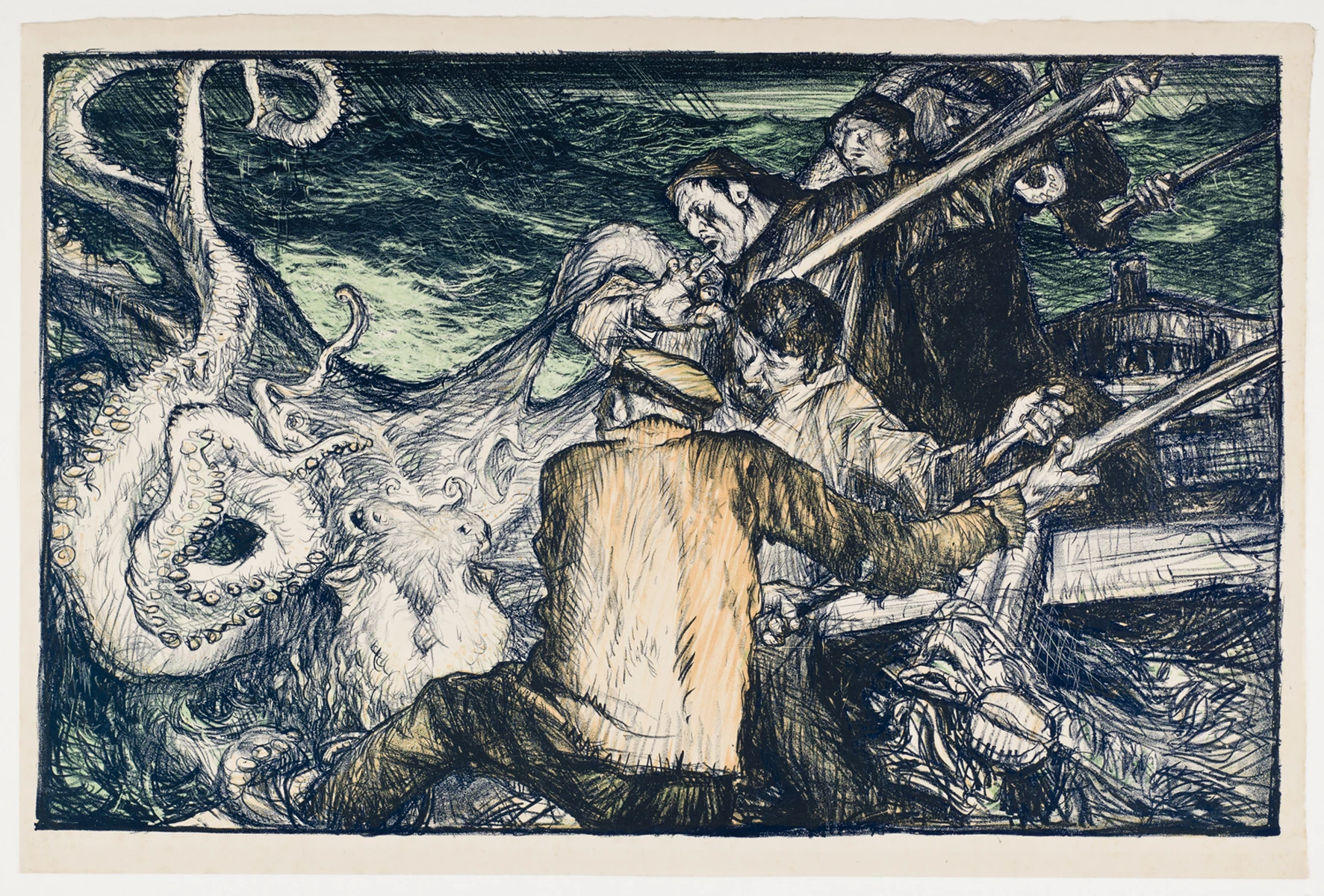
The Freedom of the Seas - Frank Brangwyn
The Reign of Justice - Edmund J. Sullivan
The Rebirth of the Arts - Charles Shannon
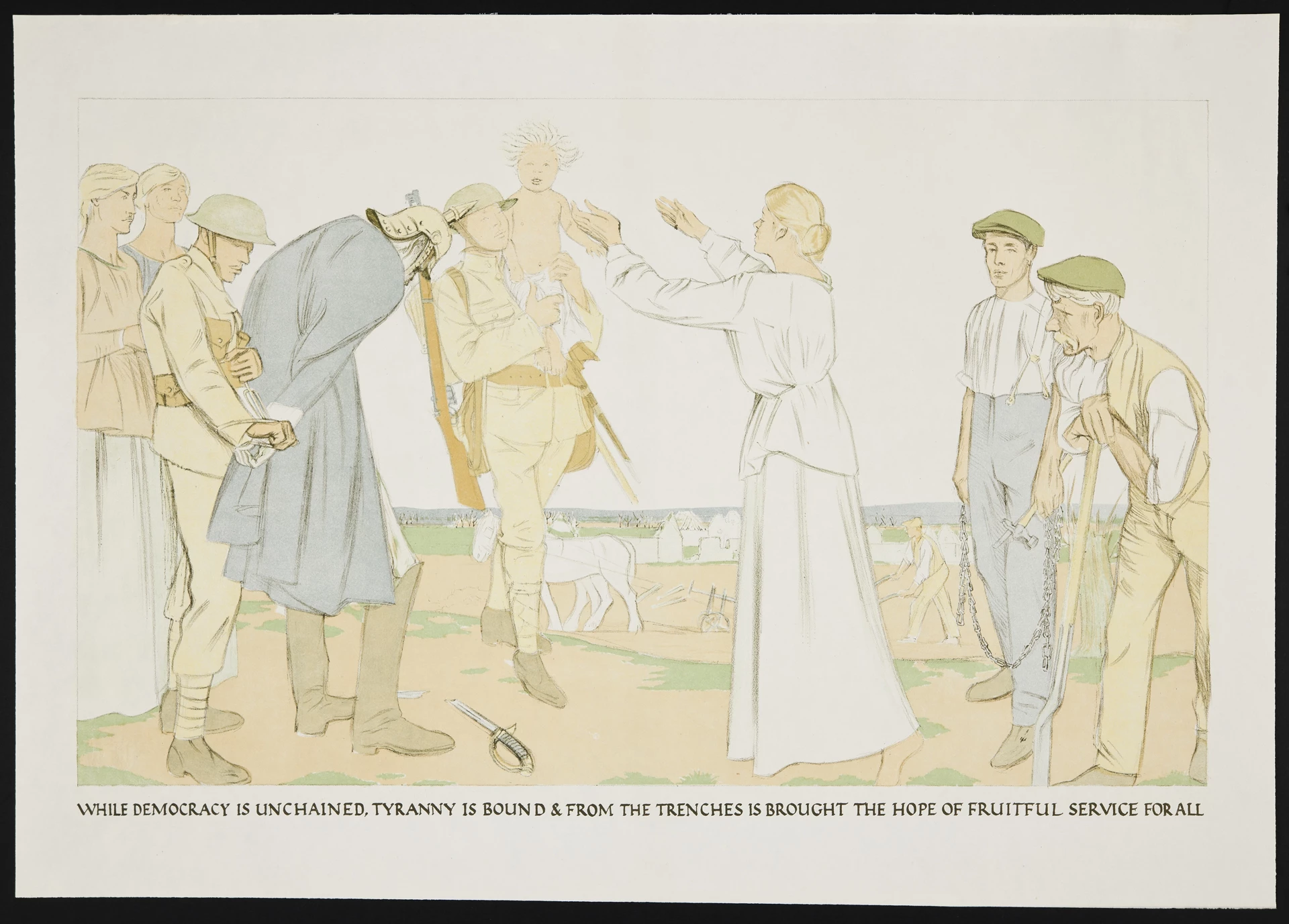
The Triumph of Democracy - William Rothenstein
Italia Redenta - Charles Ricketts
The End of War - Sir William Nicholson
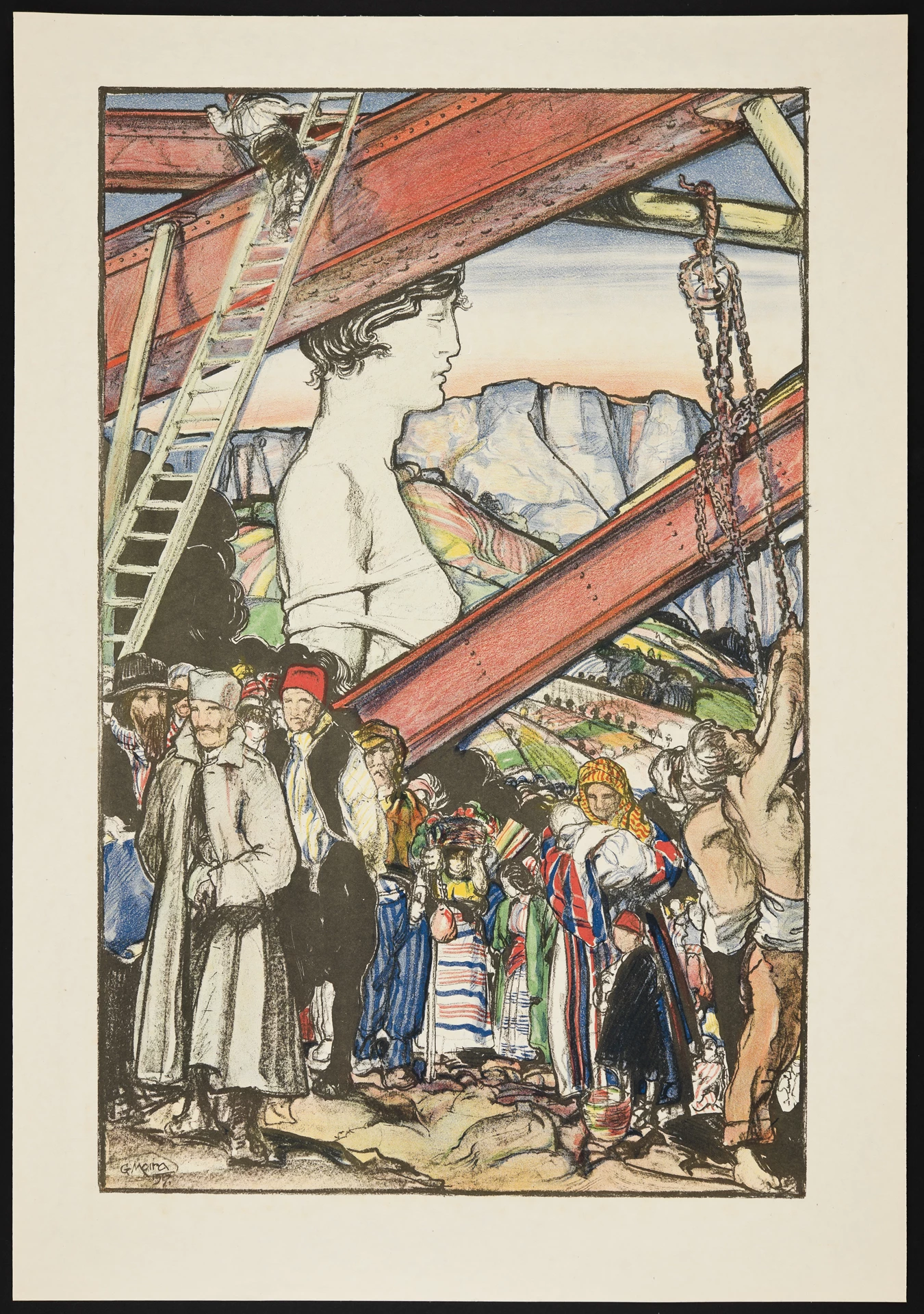
The Restoration of Serbia - Gerald Moira
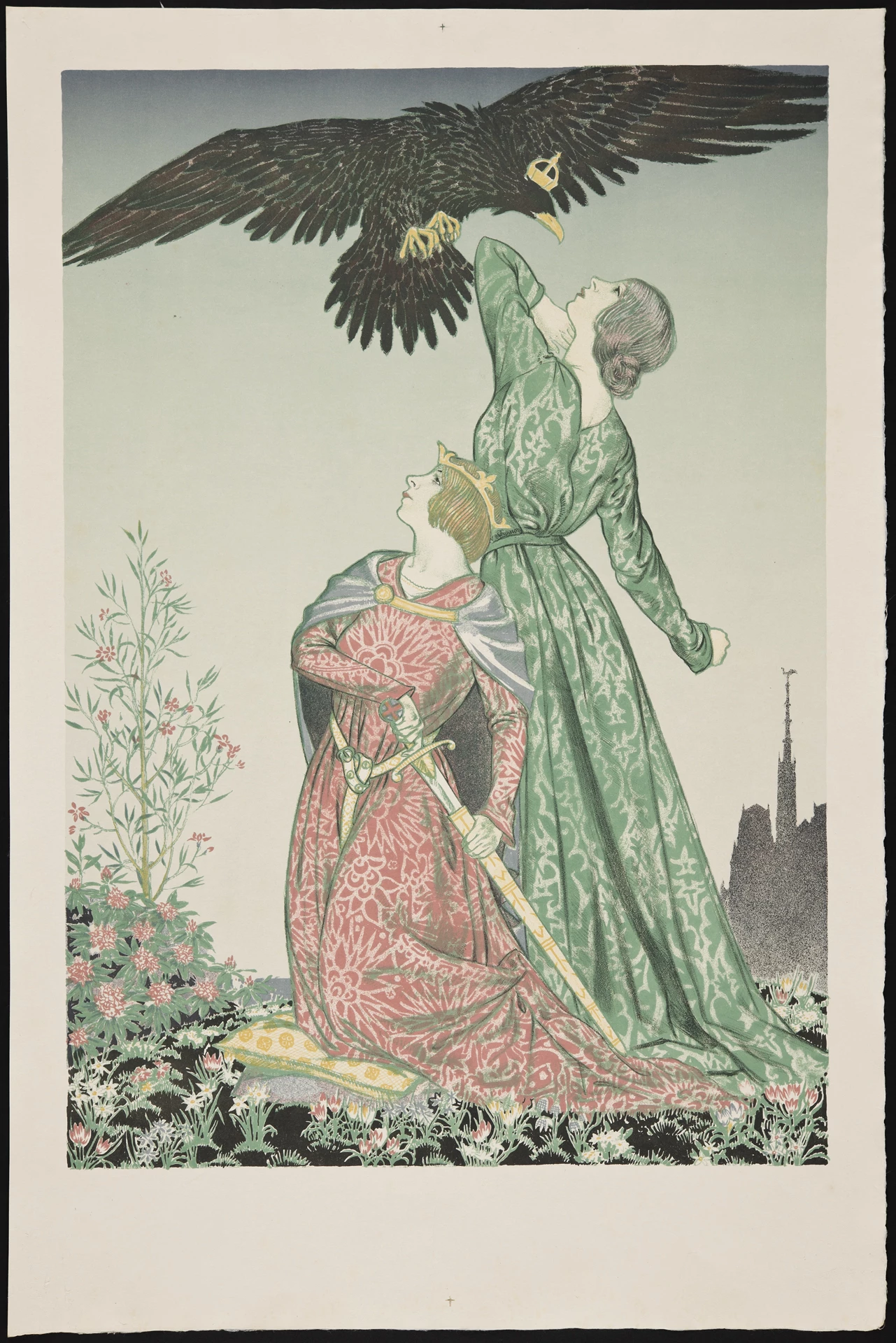
United Defence Against Aggression (England and France, 1914) - F. Ernest Jackson
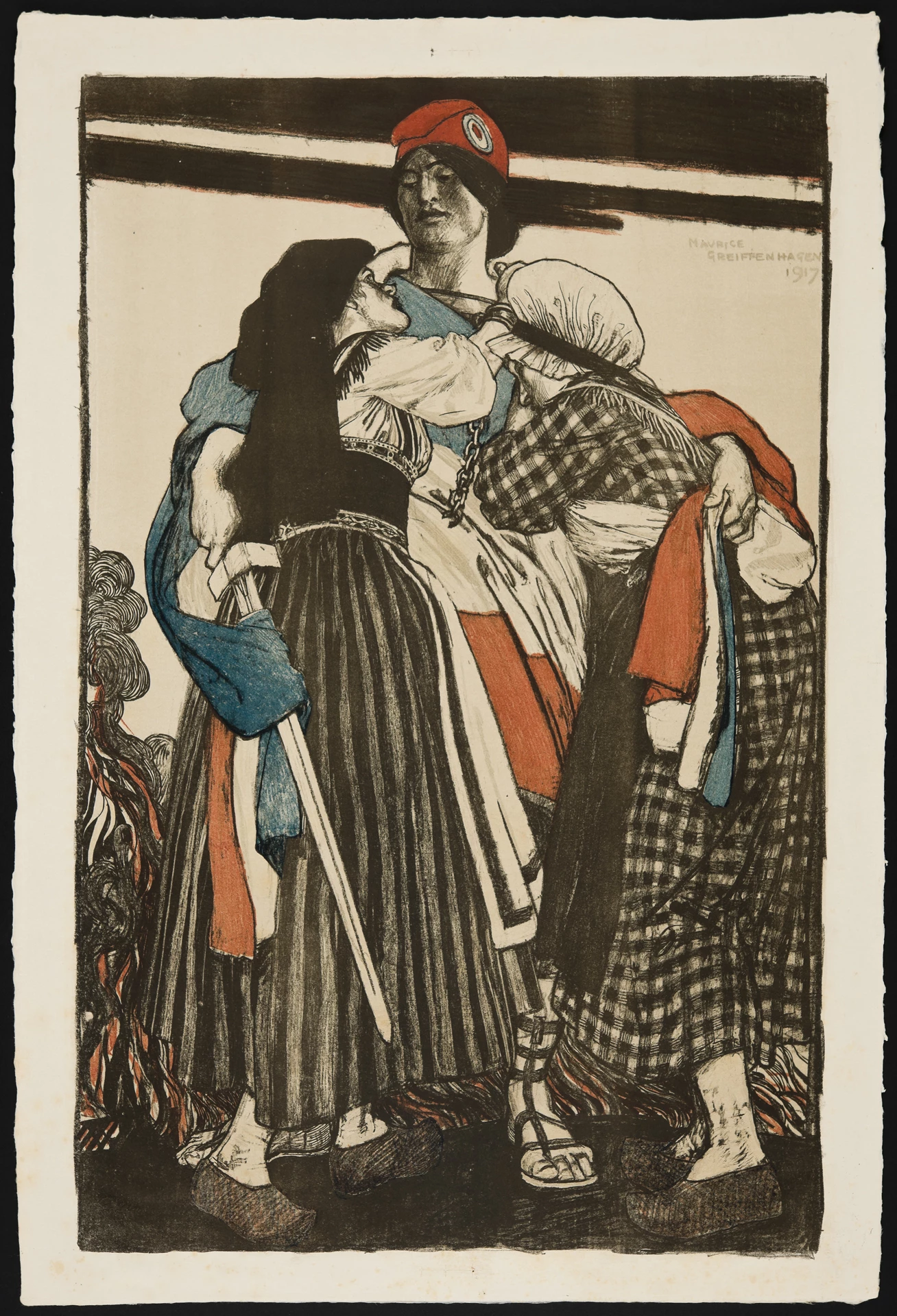
The Restoration of Alsace-Lorraine to France - Maurice Greiffenhagen
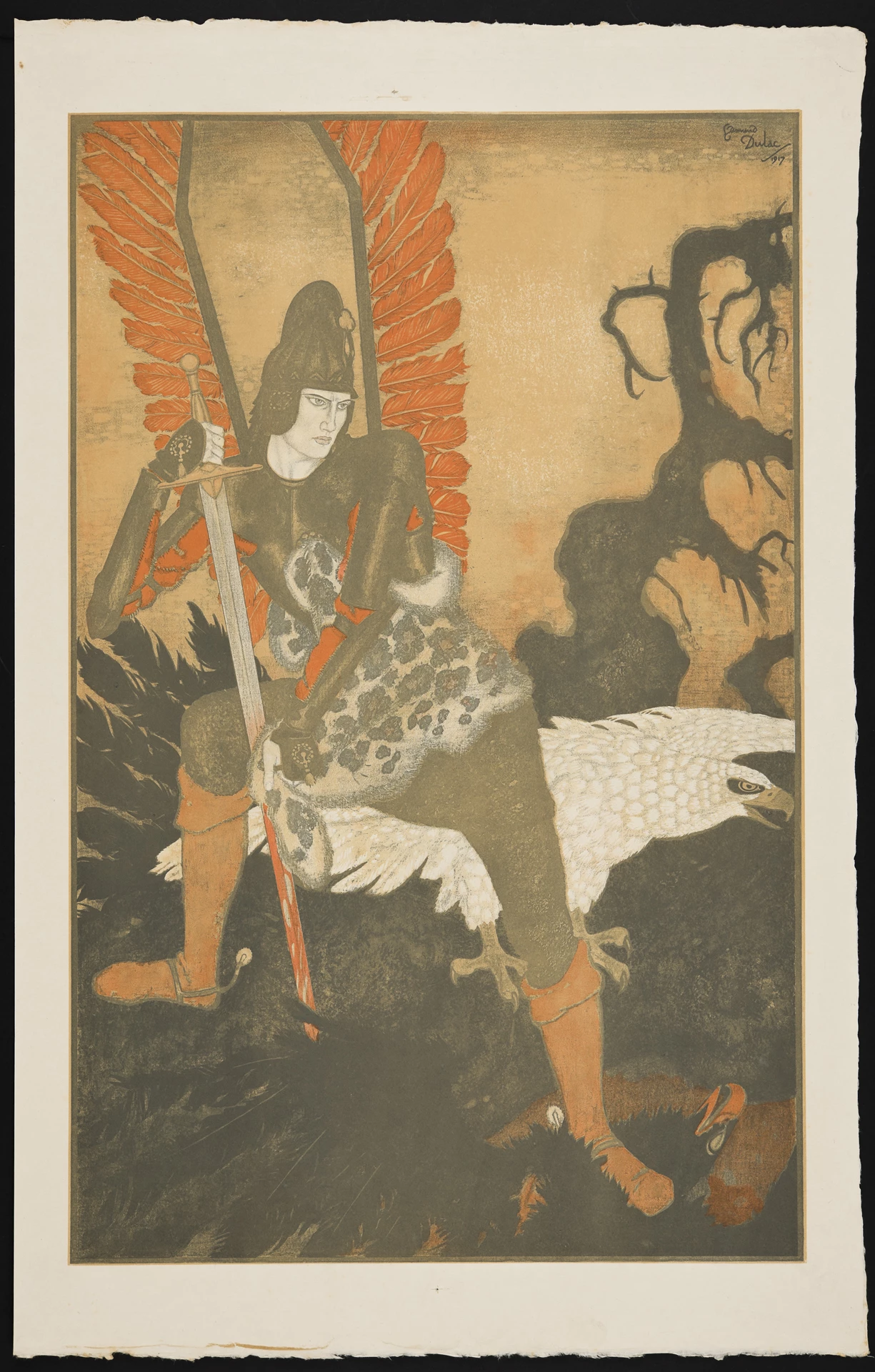
Poland a Nation - Edmund Dulac
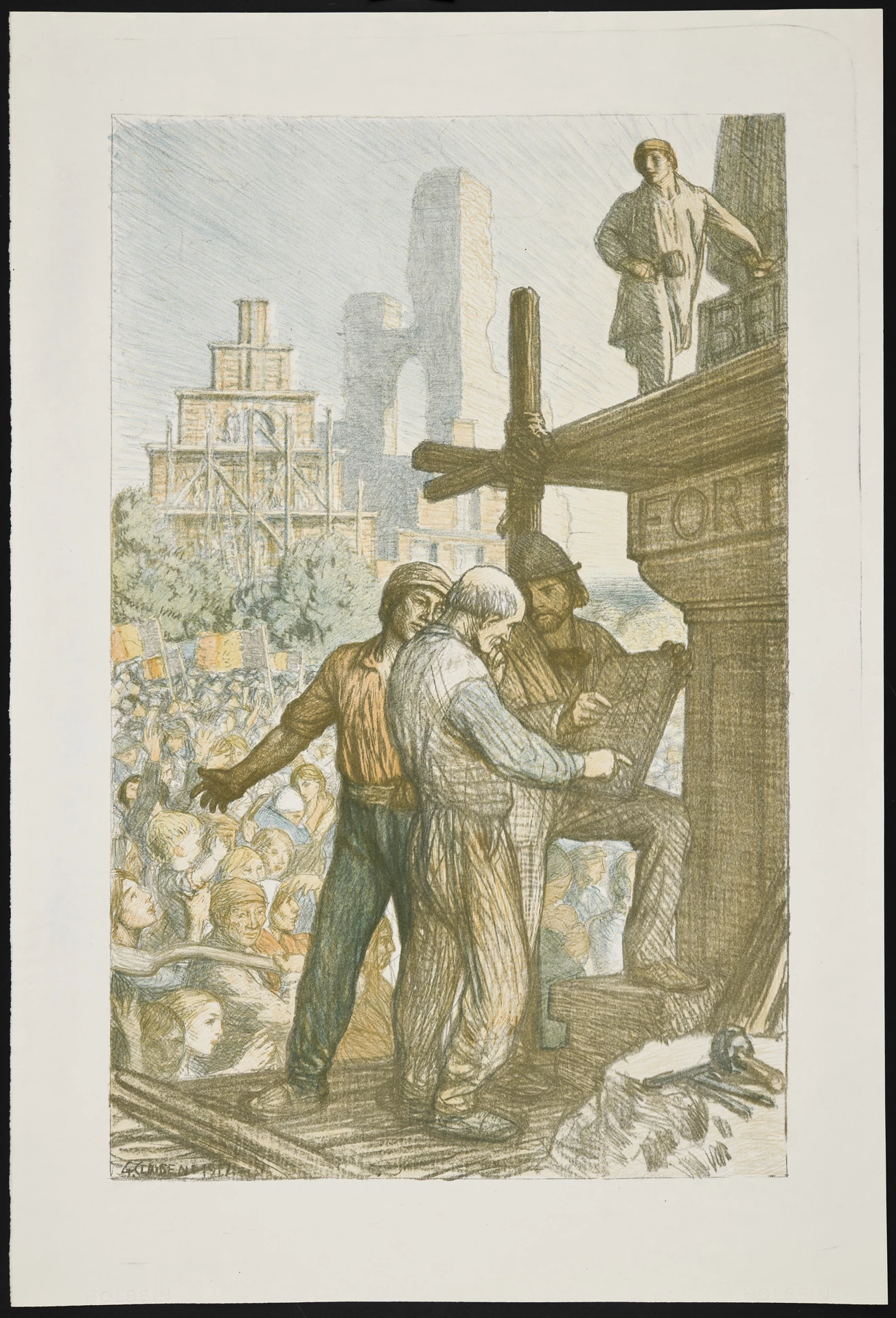
The Reconstruction of Belgium - George Clausen
The Dawn - Augustus John
“To lose sight of Britain's ultimate ideals of freedom and democratic justice is to reduce the present war to nothing less than a carnival of carnage” (Burton Daily Mail, Feb 15, 1918)
Twelve artists each contributed a large colour lithograph to this section. Some of the artists, including Brangwyn and F. Ernest Jackson, were accomplished lithographers, whilst for others, such as Clausen and Grieffenhagen, it was the first time that they had used the technique.
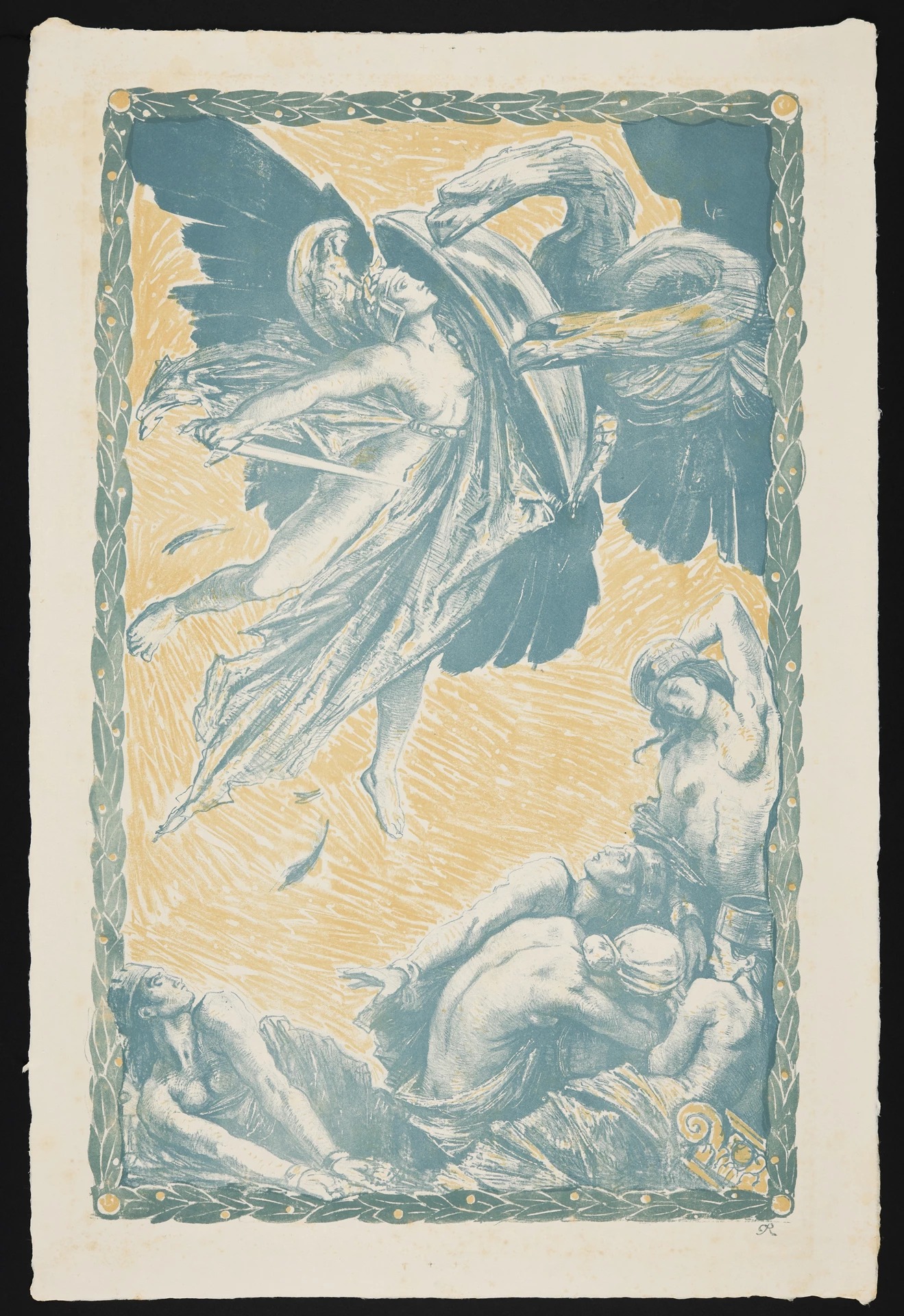
The Ideals express the aims and ambitions of the war through use of allegory and symbolism. Allegory is a traditional form of representation in art in which historical or mythological figures are used to communicate broader ideas and concepts. In Ideals, the message and meaning of the composition is referenced by the title of each work. Countries and concepts are represented as figures and forms. Although allegorical representation had been out of artistic fashion for some time when these prints were made, it was used here as a propaganda tool to emphasise the importance of the objectives. Through grandiose associations, the prints aimed to justify the means and realities of the war for ordinary people.
Although many people praised the project, The Ideals received some criticism for their idealistic portrayal of war.
Making Soldiers
Bringing in Prisoners - Eric Kennington
Over the Top - Eric Kennington
Into the Trenches - Eric Kennington
Ready for Service - Eric Kennington
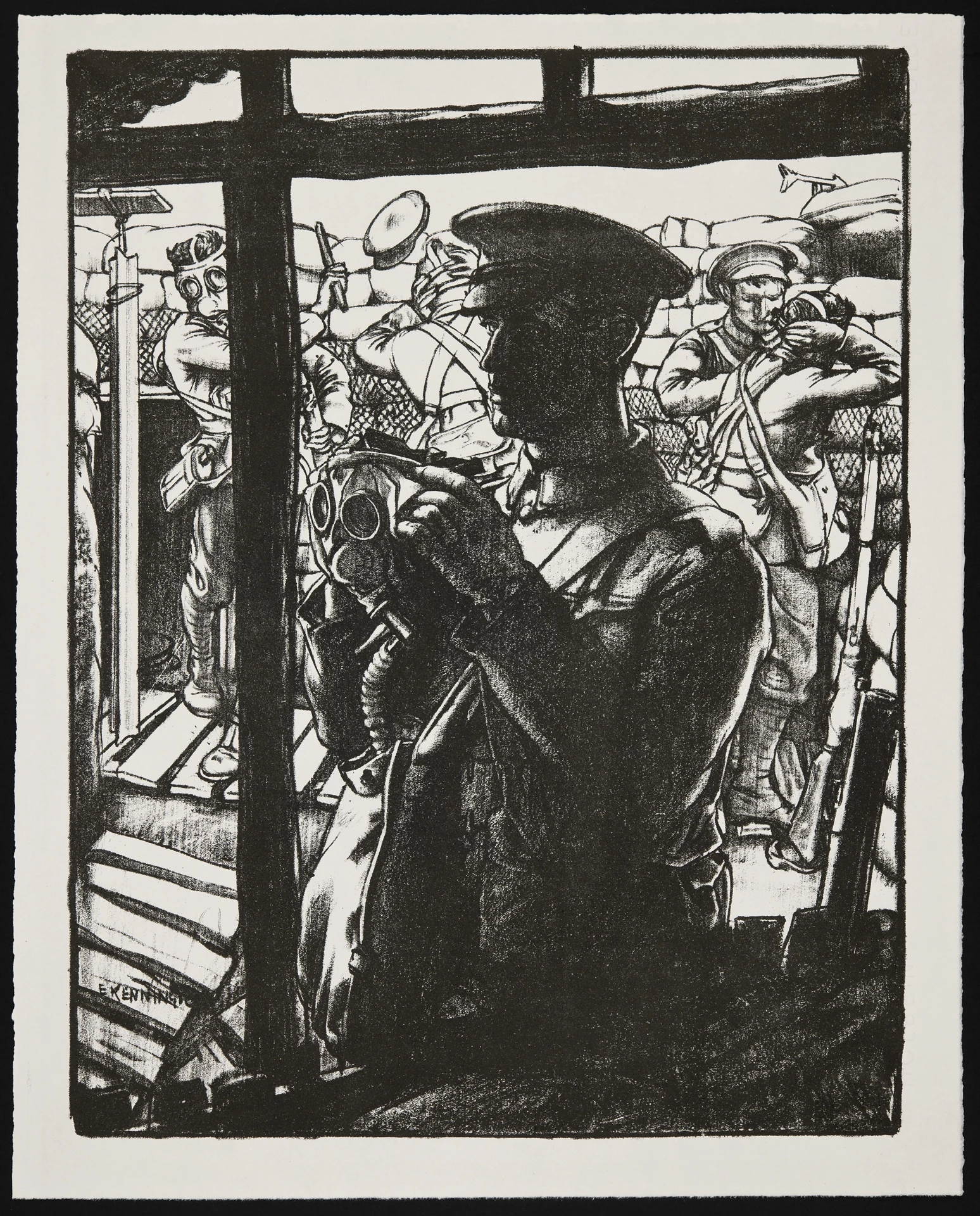
The Gas Mask - Eric Kennington
Bayonet Practice - Eric Kennington
Showing soldiers in training and at the Front, one journalist described these prints as capturing ‘the spirit of our new, young army’. Kennington was probably chosen for this subject as he had himself enlisted with the 13th (Kensington) Battalion London Regiment and fought on the Western Front, France, 1914-1915. He was wounded and discharged as unfit in 1915. These prints do not attempt to depict the horror and tragedy of war; as in most of his war art, Kennington instead champions the common soldier.
Kennington was born in Chelsea, London, the son of a well-known portrait artist. He studied at St Paul’s Art School, the Lambeth School of Art and the City and Guilds School. He was appointed an official war artist from 1917-1919 and again in 1940-1943, painting portraits of sailors and airmen.
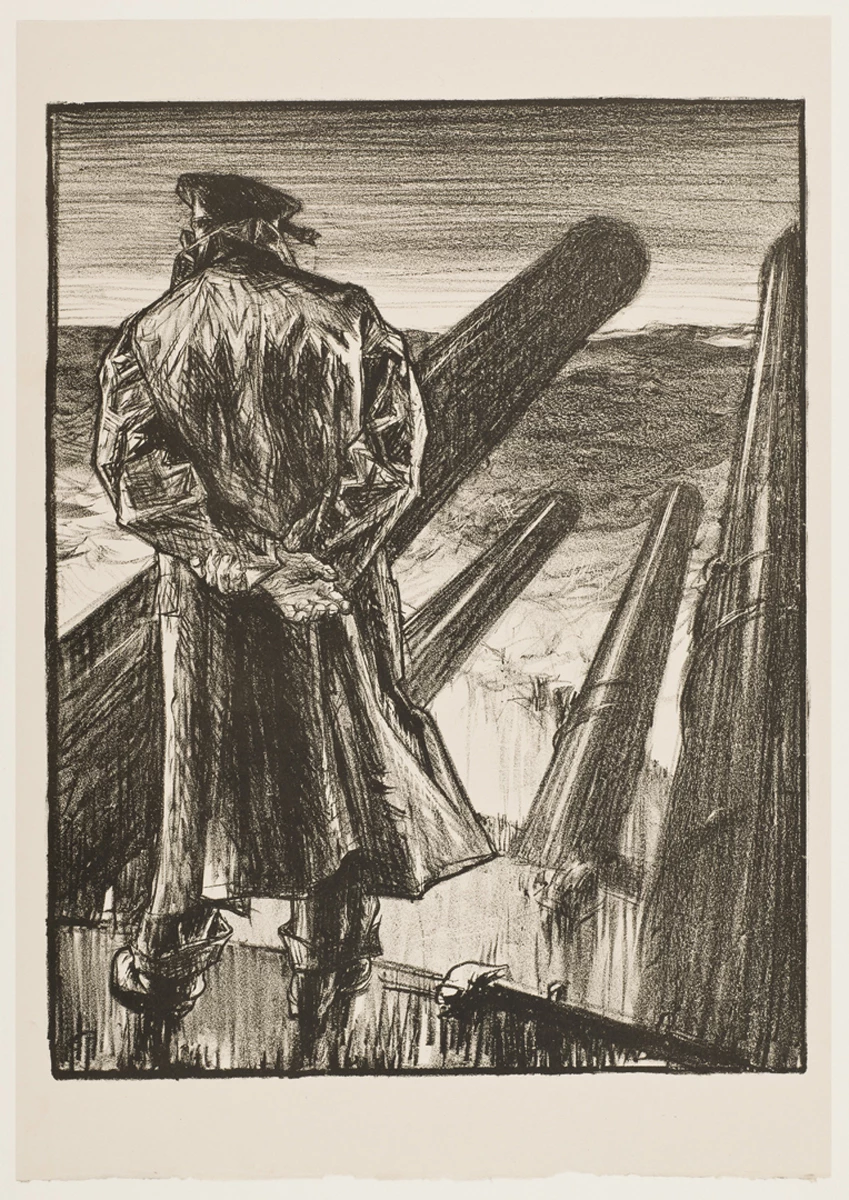
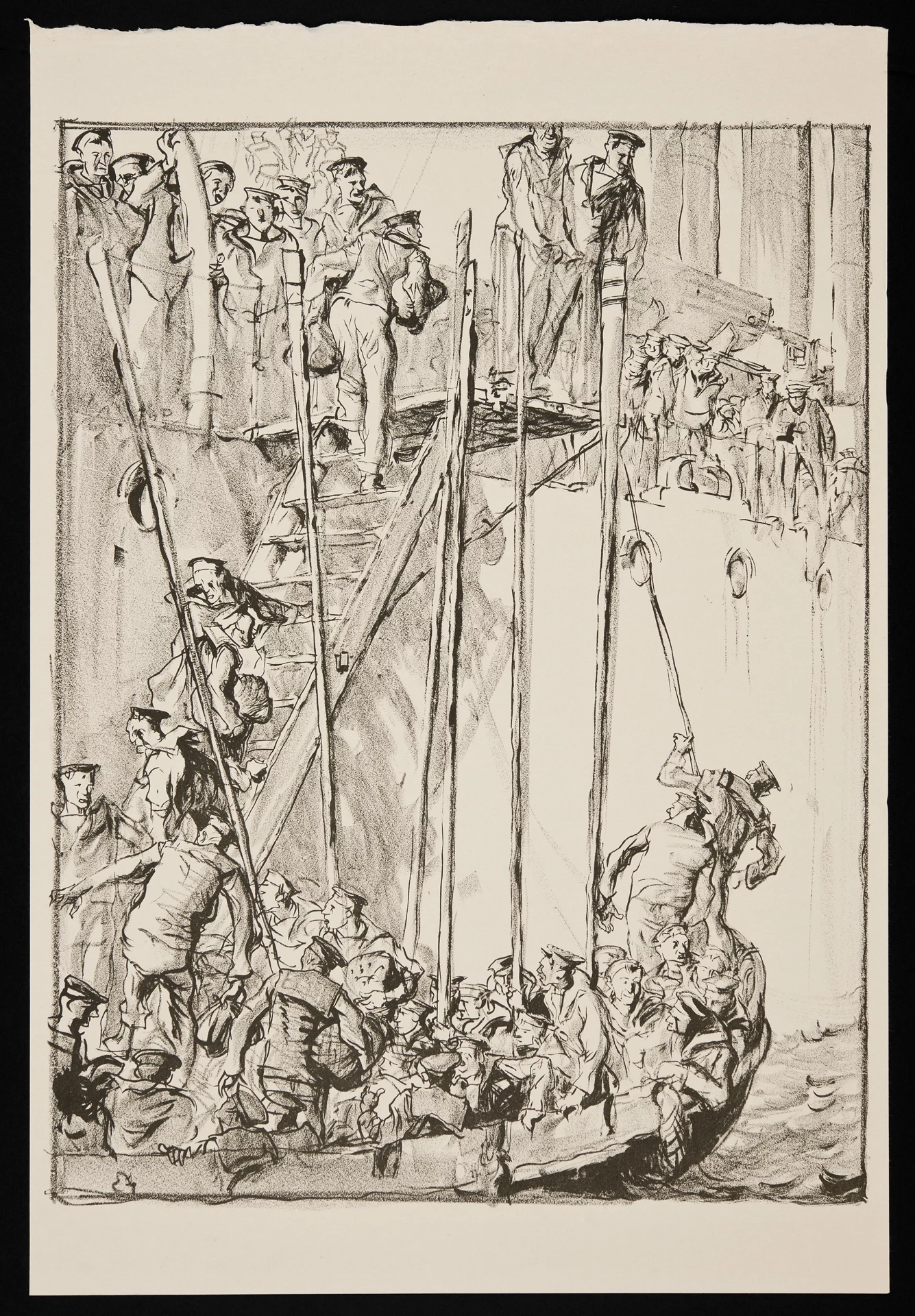
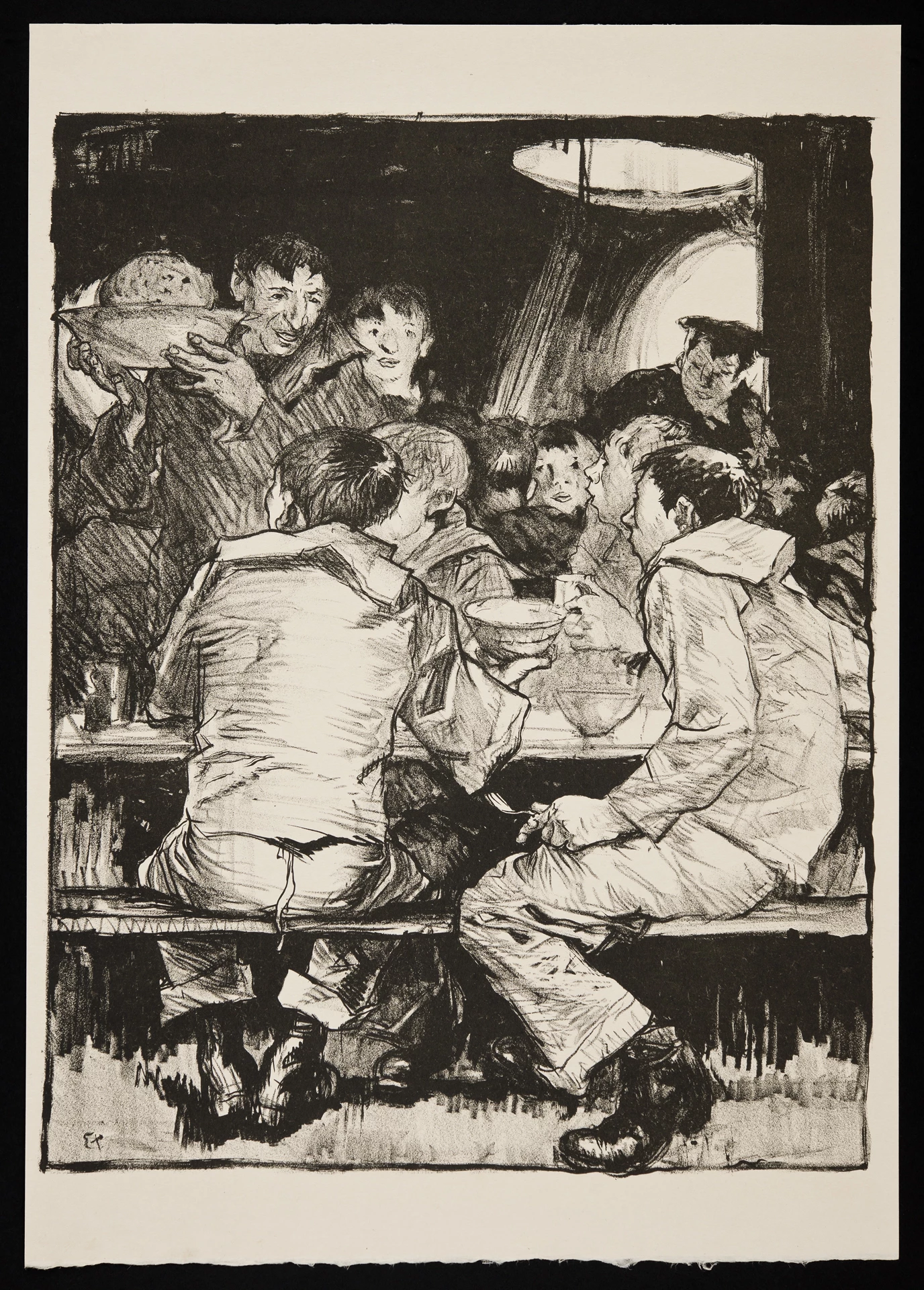
Making Sailors
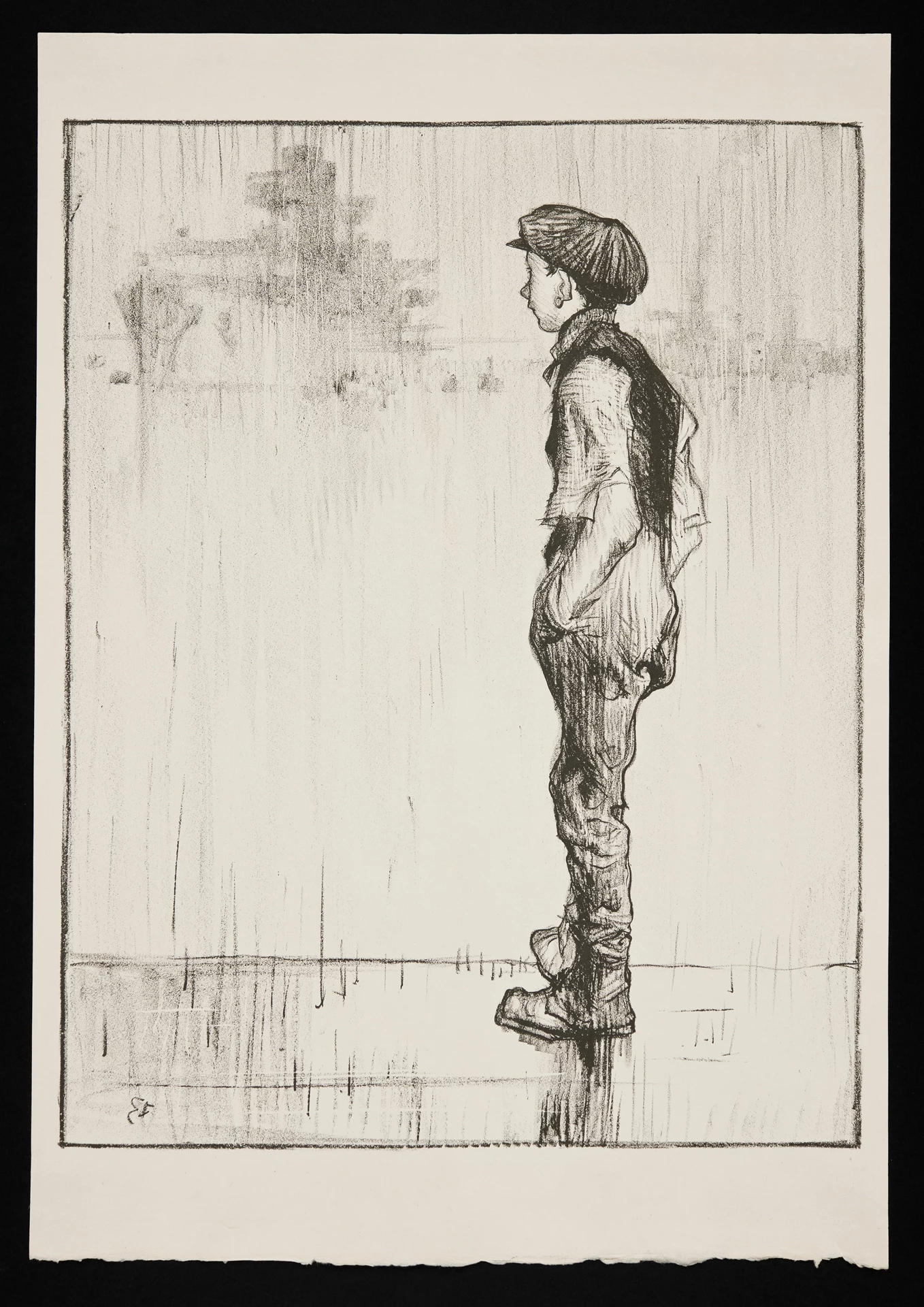
Youthful Ambition - Frank Brangwyn
The Gun - Frank Brangwyn
The Look-out - Frank Brangwyn
Going Abroad - Frank Brangwyn
Boat-drill - Frank Brangwyn
Duff - Frank Brangwyn
Brangwyn’s subject reflects his interest in the sea. In many of his prints he has exploited the particular quality of lithography that enables artists to create prints similar to sketches and drawings. Brangwyn was deeply affected by the destruction and loss of life in the war, particularly in Belgium, where he had been born. He was never appointed an official war artist, but produced many further lithographs to support various charities.
Brangwyn was born in Bruges to an Anglo-Welsh father and Welsh mother from Brecon. The family moved back to Britain and by the age of fifteen Brangwyn was studying under designer and socialist William Morris. As he became successful as a painter, etcher and lithographer, Brangwyn began to travel widely across the world. He had an international reputation at the time of undertaking this commission and was a member of the Senefelder Club, which promoted the medium of lithography.
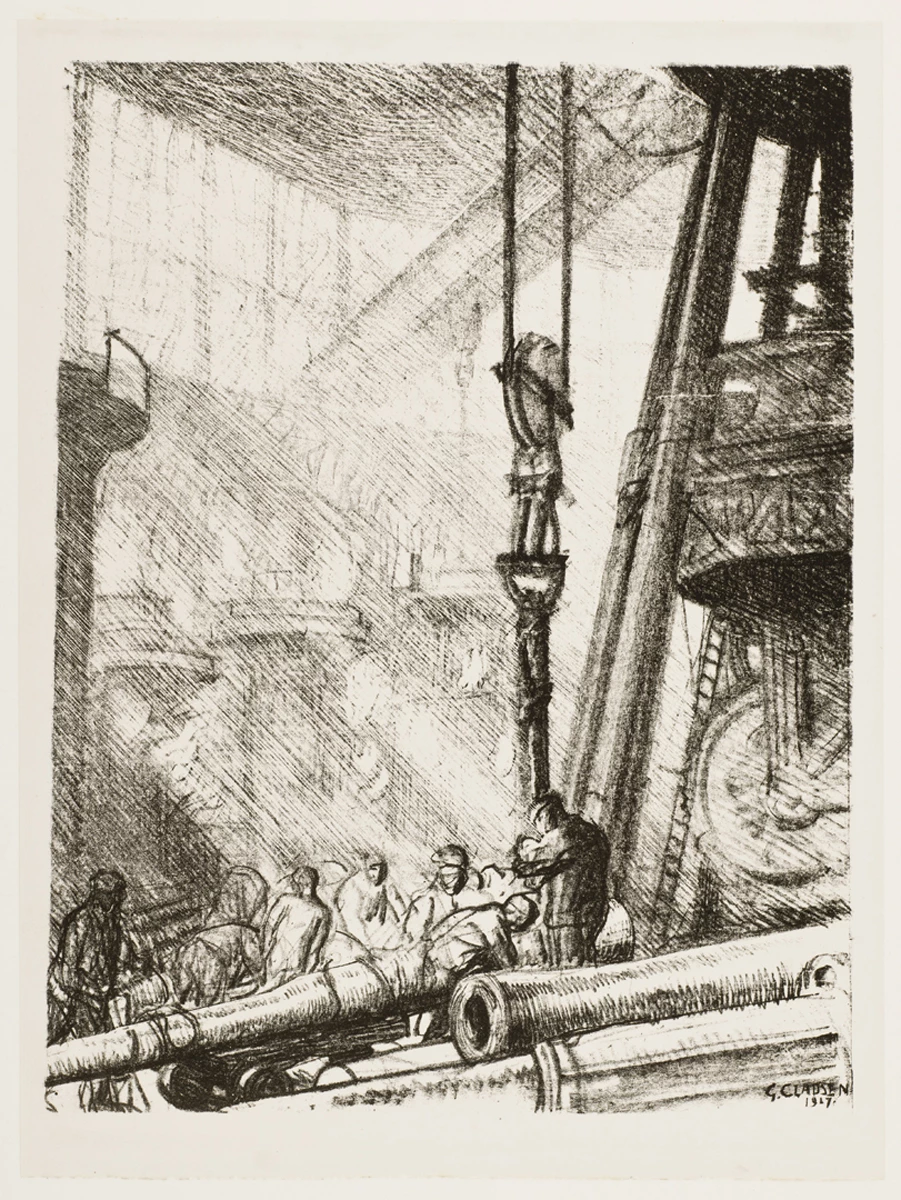
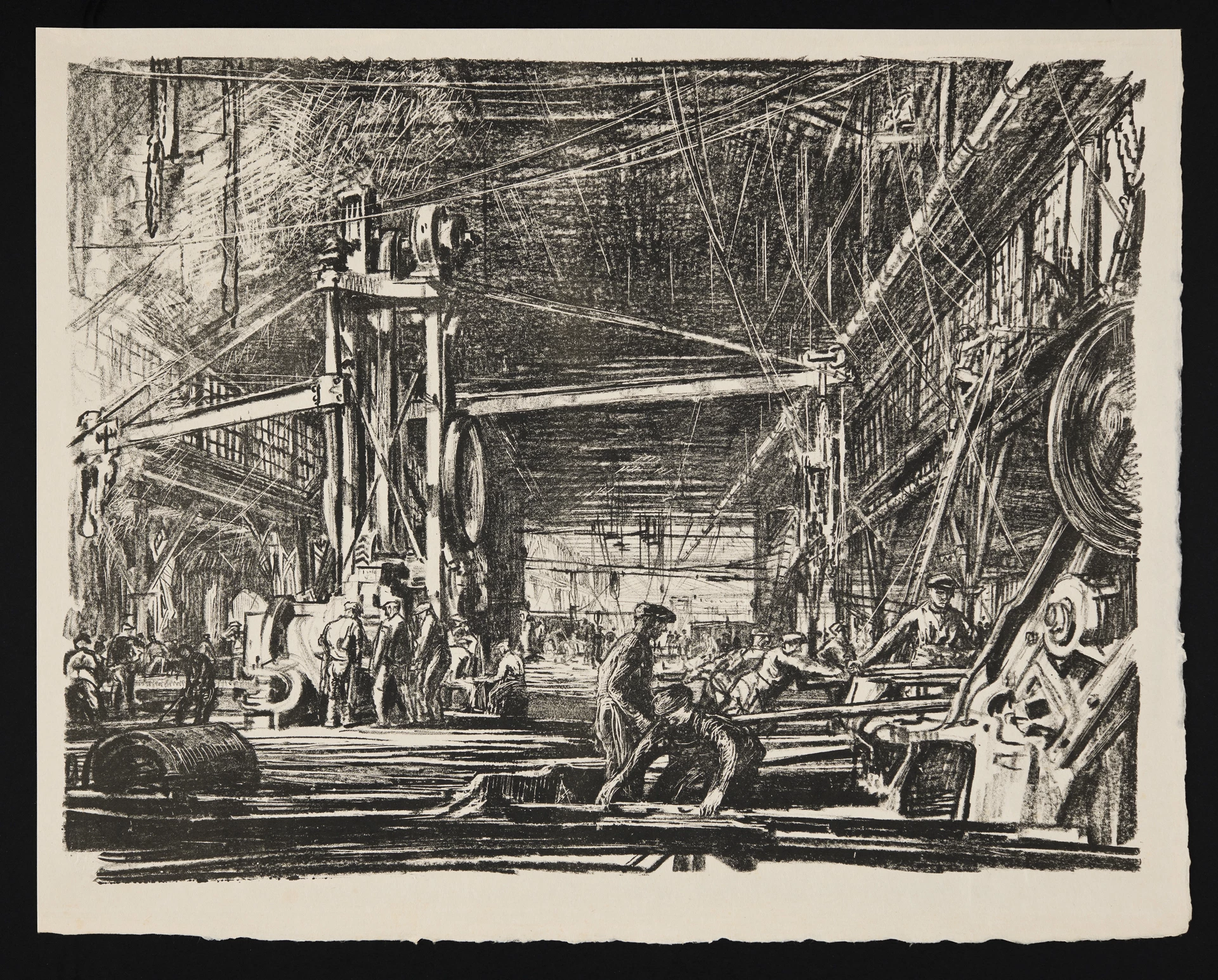
Making Guns
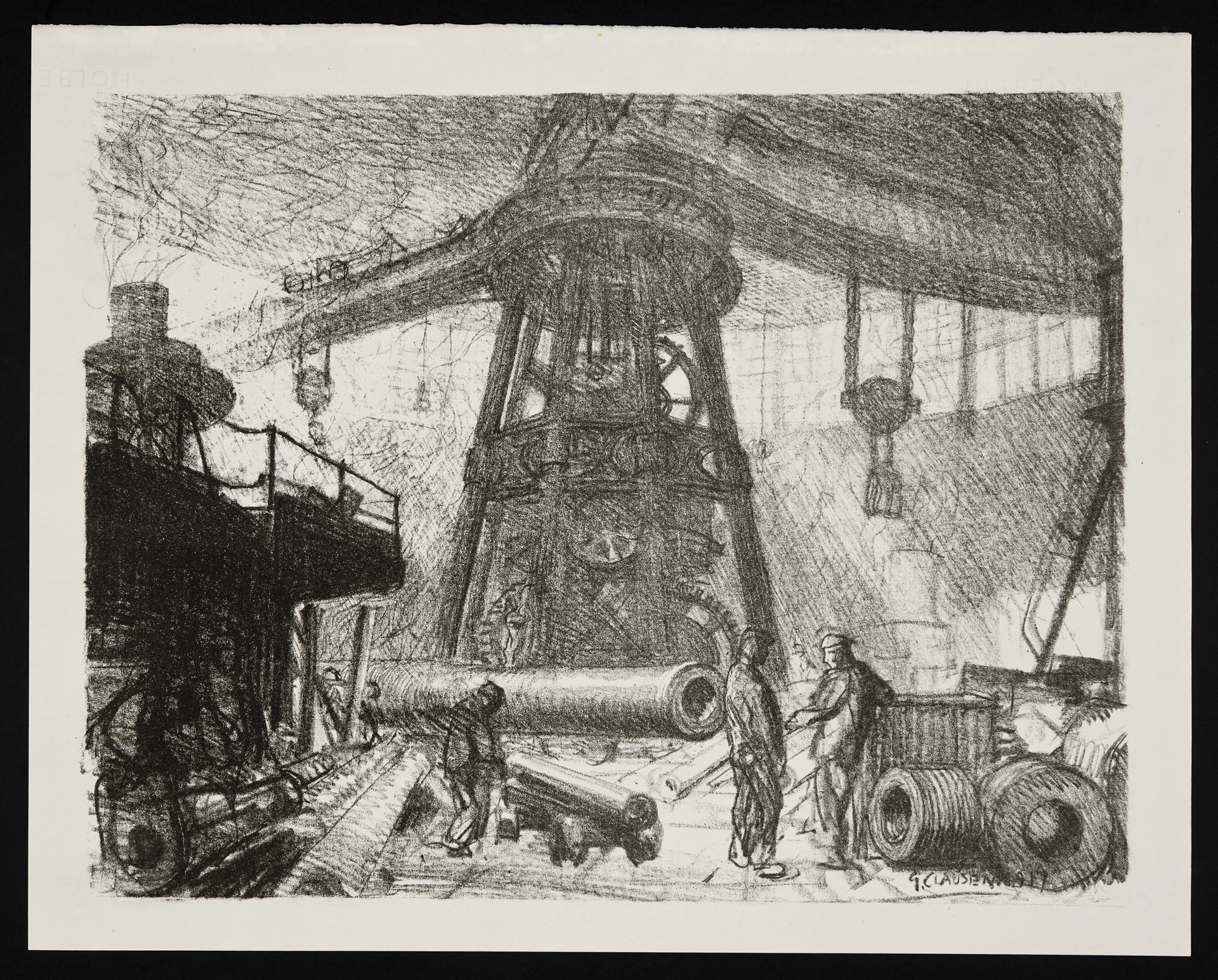
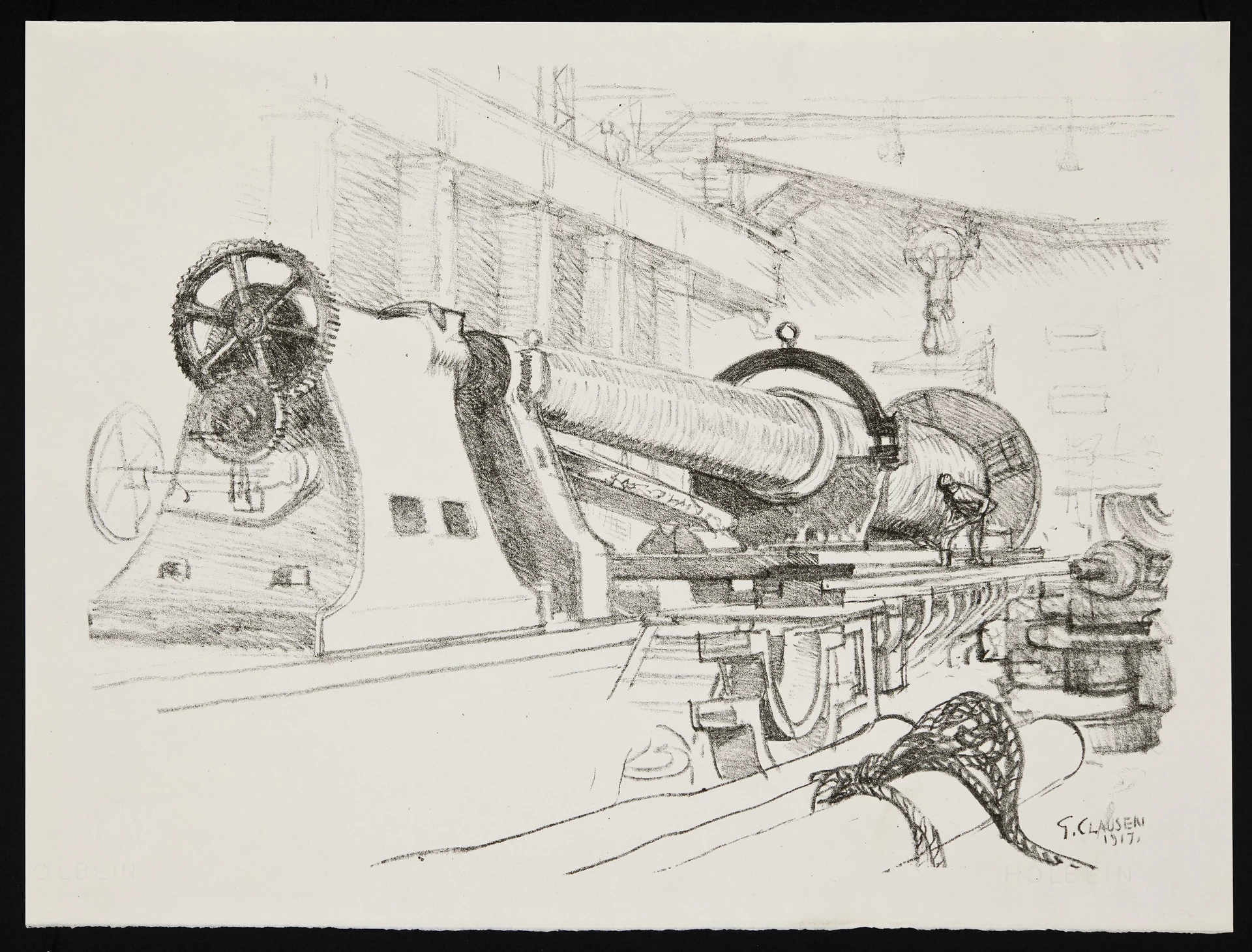
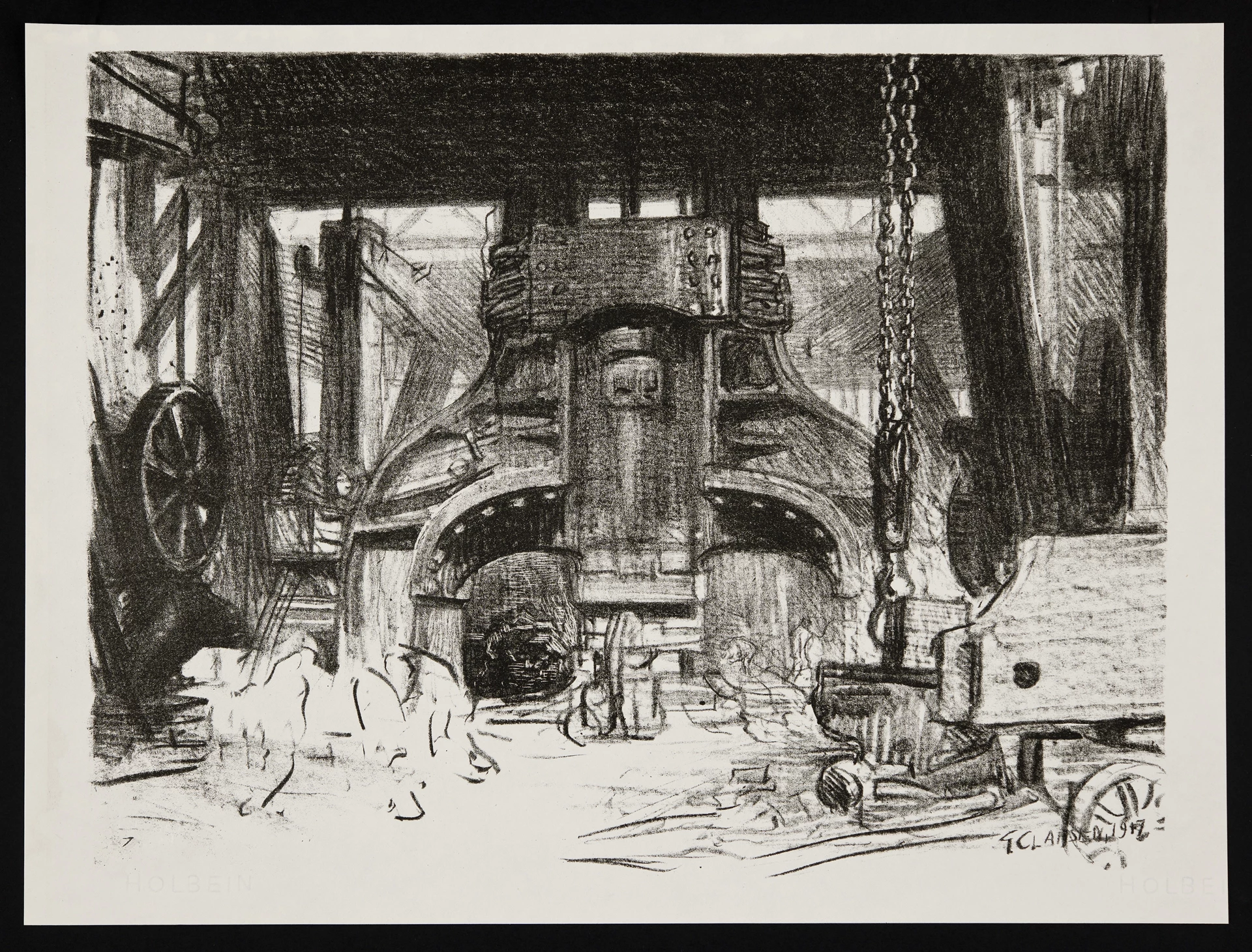
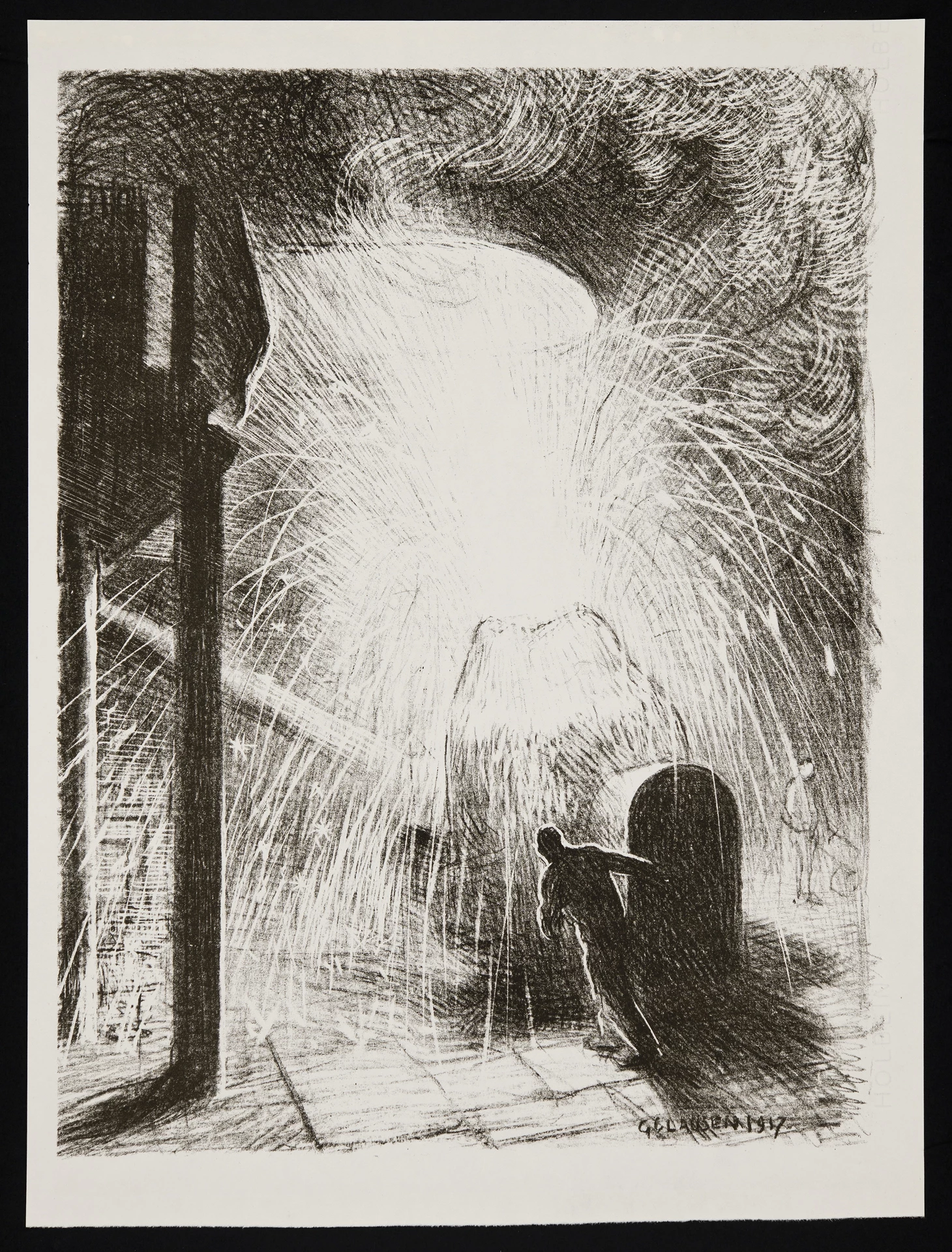
Lifting an Inner Tube - George Clausen
The Radial Crane - George Clausen
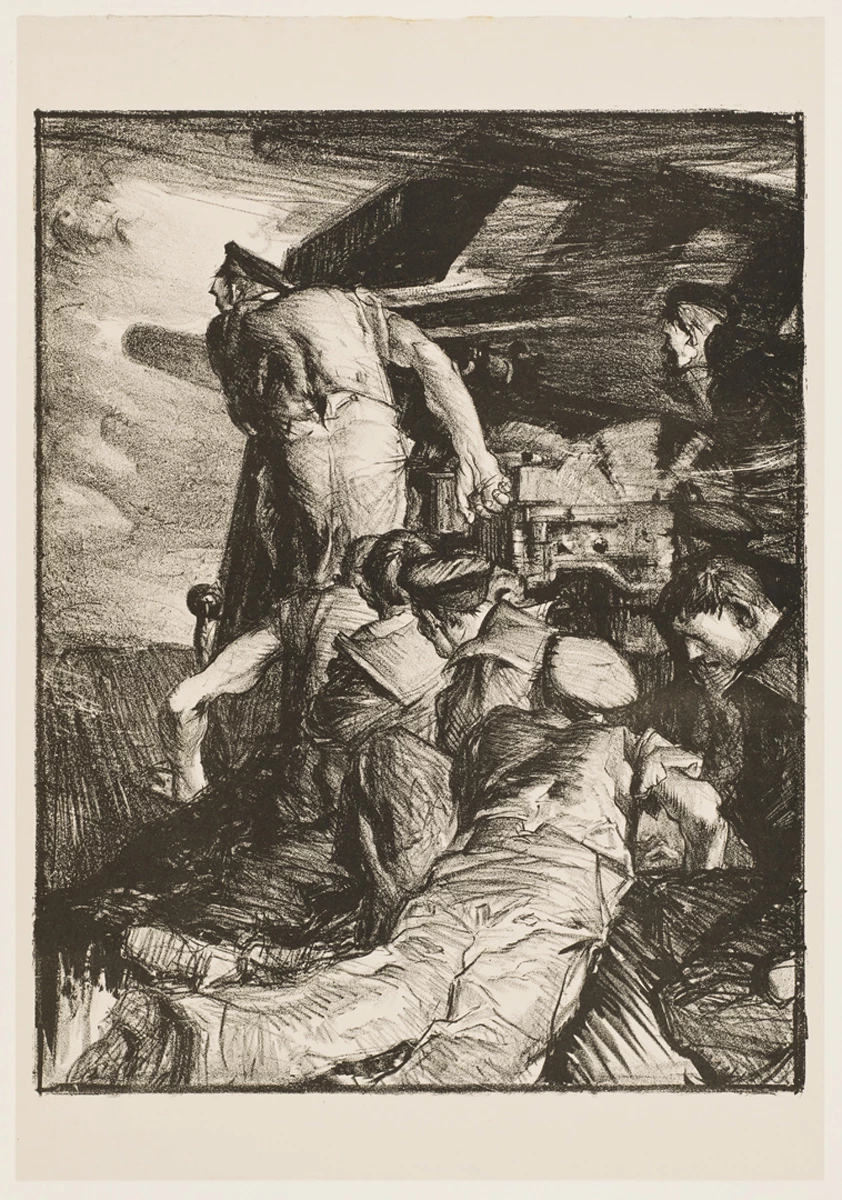
Turning a Big Gun - George Clausen
The Great Hammer - George Clausen
The Furnace - George Clausen
Where the Guns are made - George Clausen
Clausen researched this set of prints at the Royal Gun Factory, Woolwich Arsenal, London, which manufactured armaments, ammunition and explosives for the British Armed Forces. At its peak during the First World War it employed around 80,000 people and extended over 1,30 acres. Clausen was appointed an official war artist in 1917. As an older artist he did not go to the Front line, instead recording activities on the home front.
Clausen was born in London to George Clausen Senior, a decorative painter of Danish descent. He attended the Royal College of Art and South Kensington art schools, then the Académie Julian in Paris. He was a founding member of the New English Art Club and was elected Professor of Painting at the Royal Academy in 1904. He was knighted in 1927.
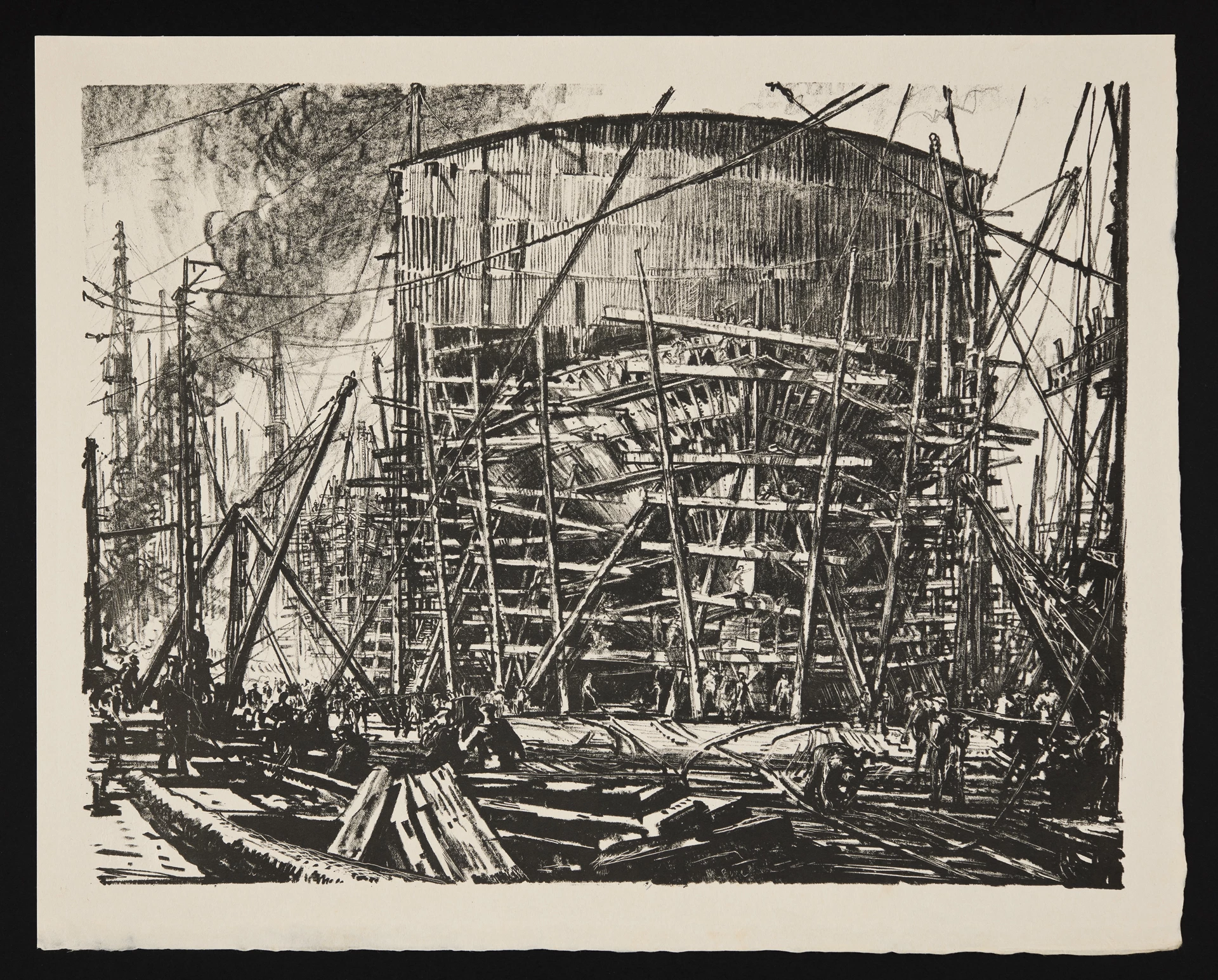
Building Ships
Ready for Sea - Muirhead Bone
A fitting-out basin - Muirhead Bone
A workshop - Muirhead Bone
A shipyard seen from a big crane - Muirhead Bone
On the Stocks - Muirhead Bone
A Ship-Yard - Muirhead Bone
Muirhead Bone was the first appointed official war artist. As one of Britain’s leading draughtsmen, he was renowned for the almost photographic detail he achieved in his drawings. As well as recording the war on the Front, Bone spent time on the Clyde in Scotland, documenting shipbuilding. He sketched with a notebook strapped to his hand. These prints show different stages in the building, as well as views of the yard, one from the top of crane. One journalist wrote that his series, ‘delights in the intricacies of scaffolding and mechanical contrivances’. These images were also published in a War Office publication, The Western Front, vol II, 1917.
Bone was born in Glasgow and studied at Glasgow School of Art. He settled in London in 1901. He was an official war artist in 1916-1918, and the official Admiralty artist in 1939-1946. Bone was knighted in 1937.
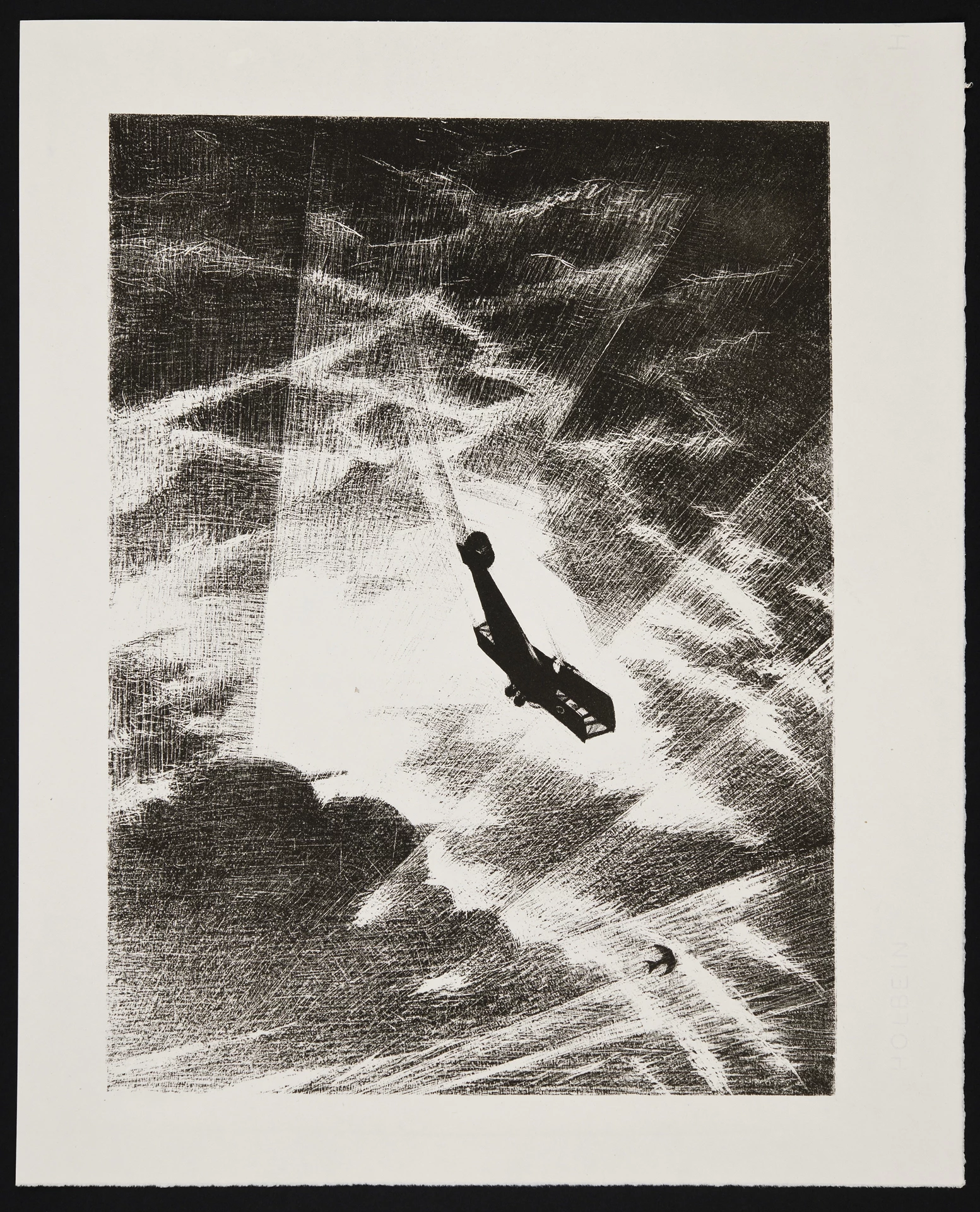
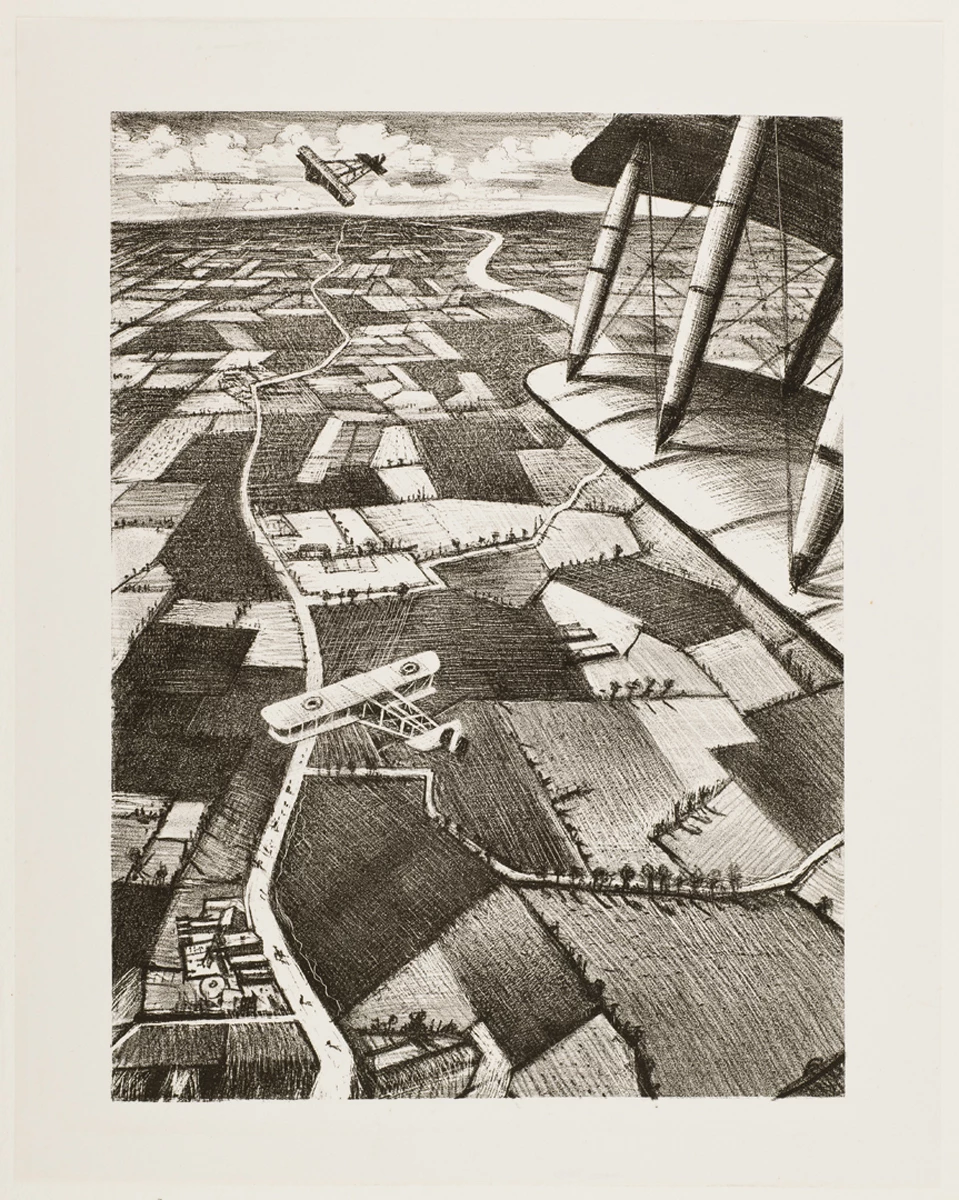
Building Aircraft
Swooping down on a Taube - Christopher Richard Wynne Nevinson
Banking at 4,000 feet - Christopher Richard Wynne Nevinson
In the air - Christopher Richard Wynne Nevinson
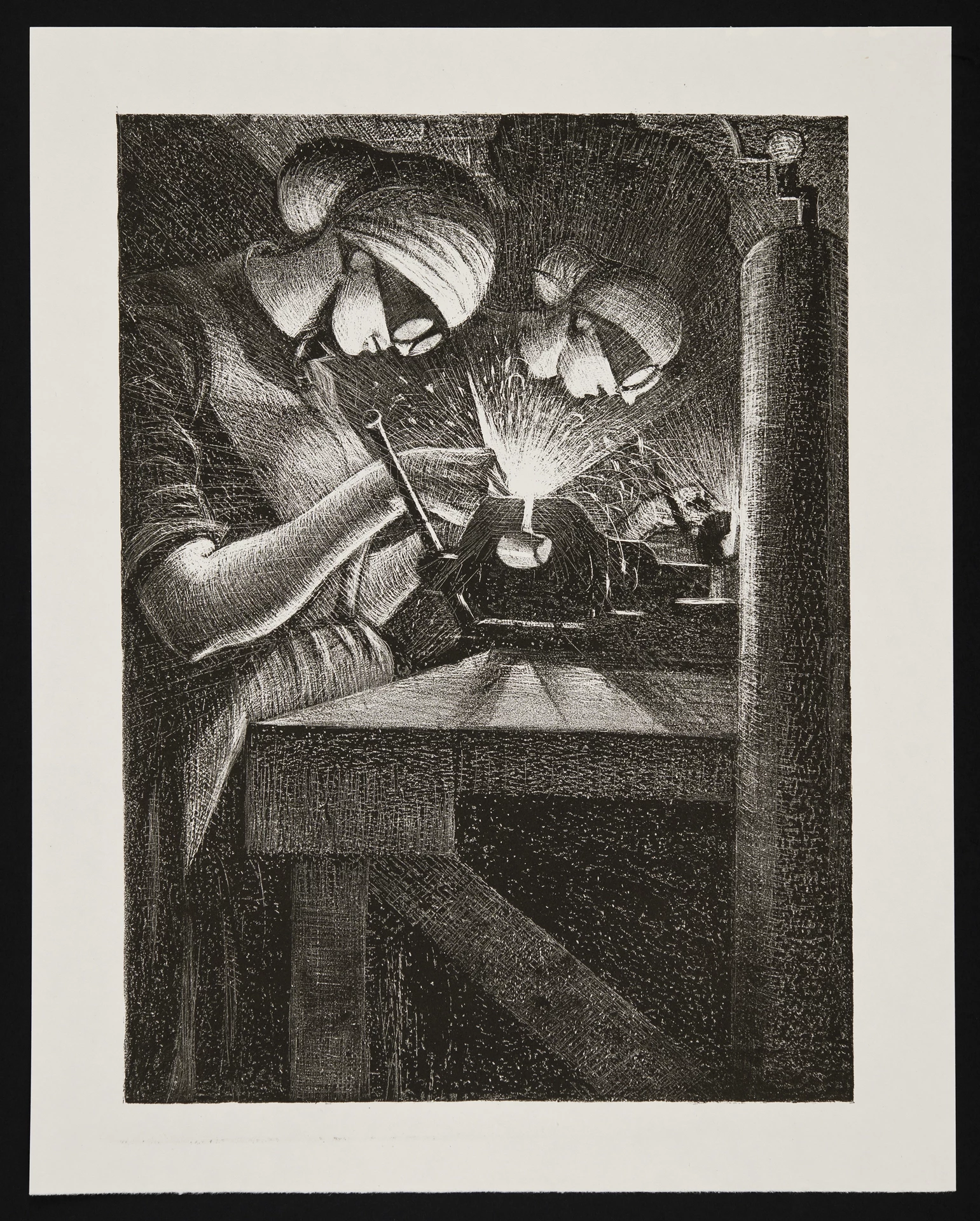
Acetylene Welder - Christopher Richard Wynne Nevinson
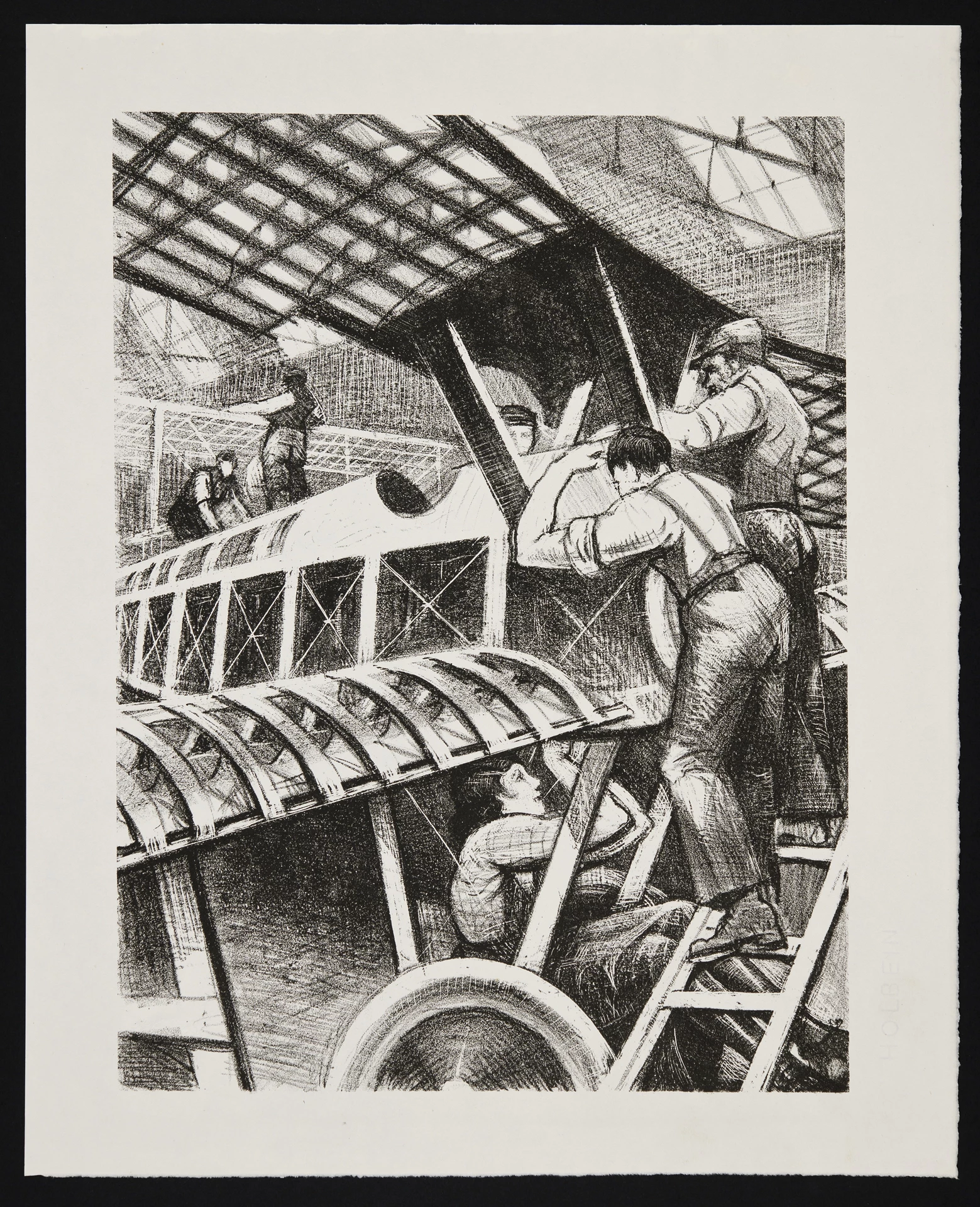
Assembling Parts - Christopher Richard Wynne Nevinson
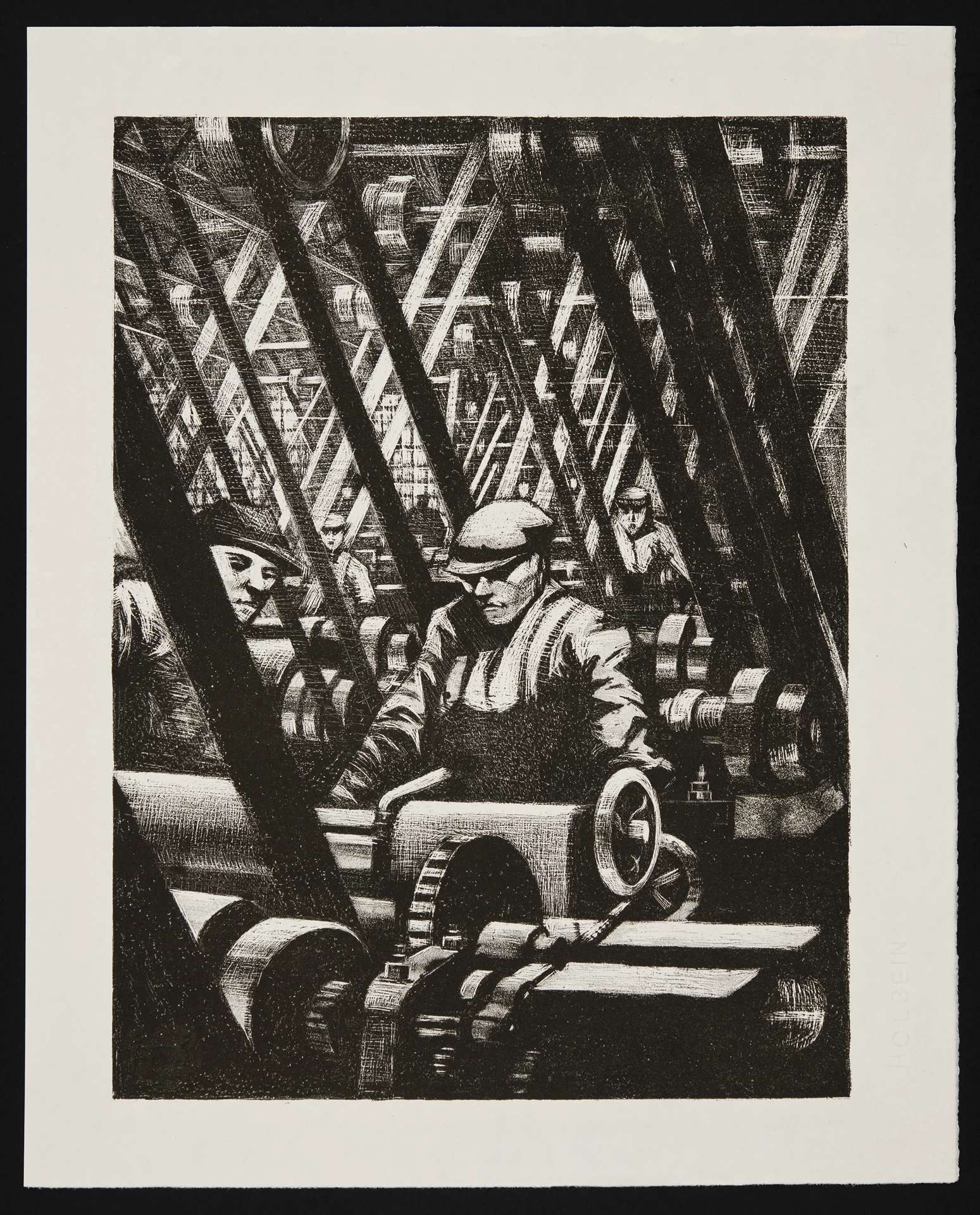
Making the Engine - Christopher Richard Wynne Nevinson
Nevinson’s prints were particularly admired when first exhibited. He ‘contrives to make the visitor almost giddy’, one critic wrote, another that he possessed ‘the power of expressing sensations rather than visual facts’.
Nevinson studied lithography under Ernest Jackson in 1912. At the outbreak of war he volunteered as an ambulance driver, an experience which deeply affected him. He was appointed an official war artist in 1917. These prints follow the process of building aircraft from making parts to assembly and flight. Acetylene Welder and Assembling parts both show the growing contribution of women workers.
Nevinson was born in London to the war correspondent and journalist Henry Nevinson. He studied at the Slade School and in Paris. He is one of the most renowned war artists of the period. His work was influenced by avant-garde European art movements such as Cubism and Futurism, yet slowly moved to a more realist style as he attempted to portray conflict.
Work on the Land
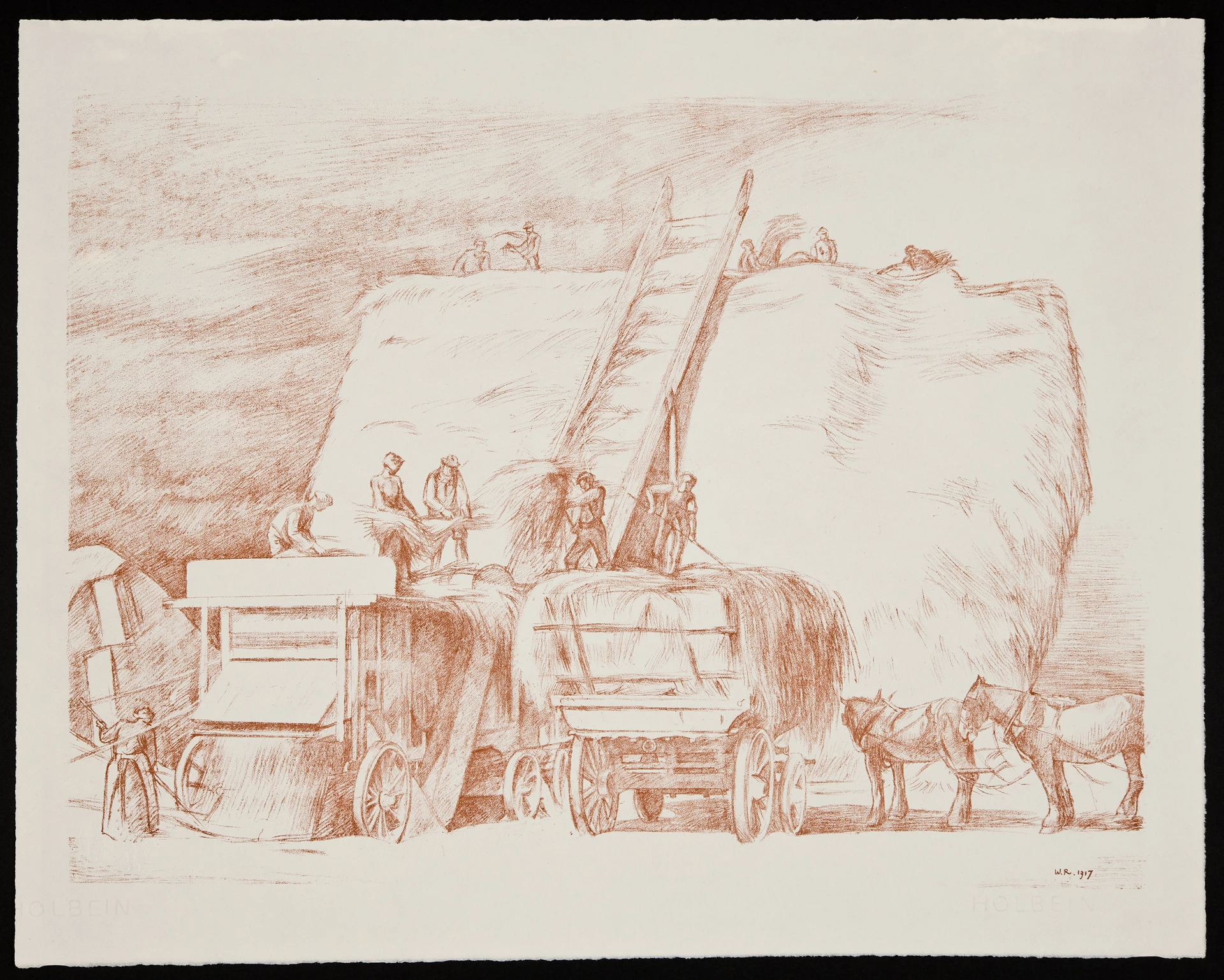
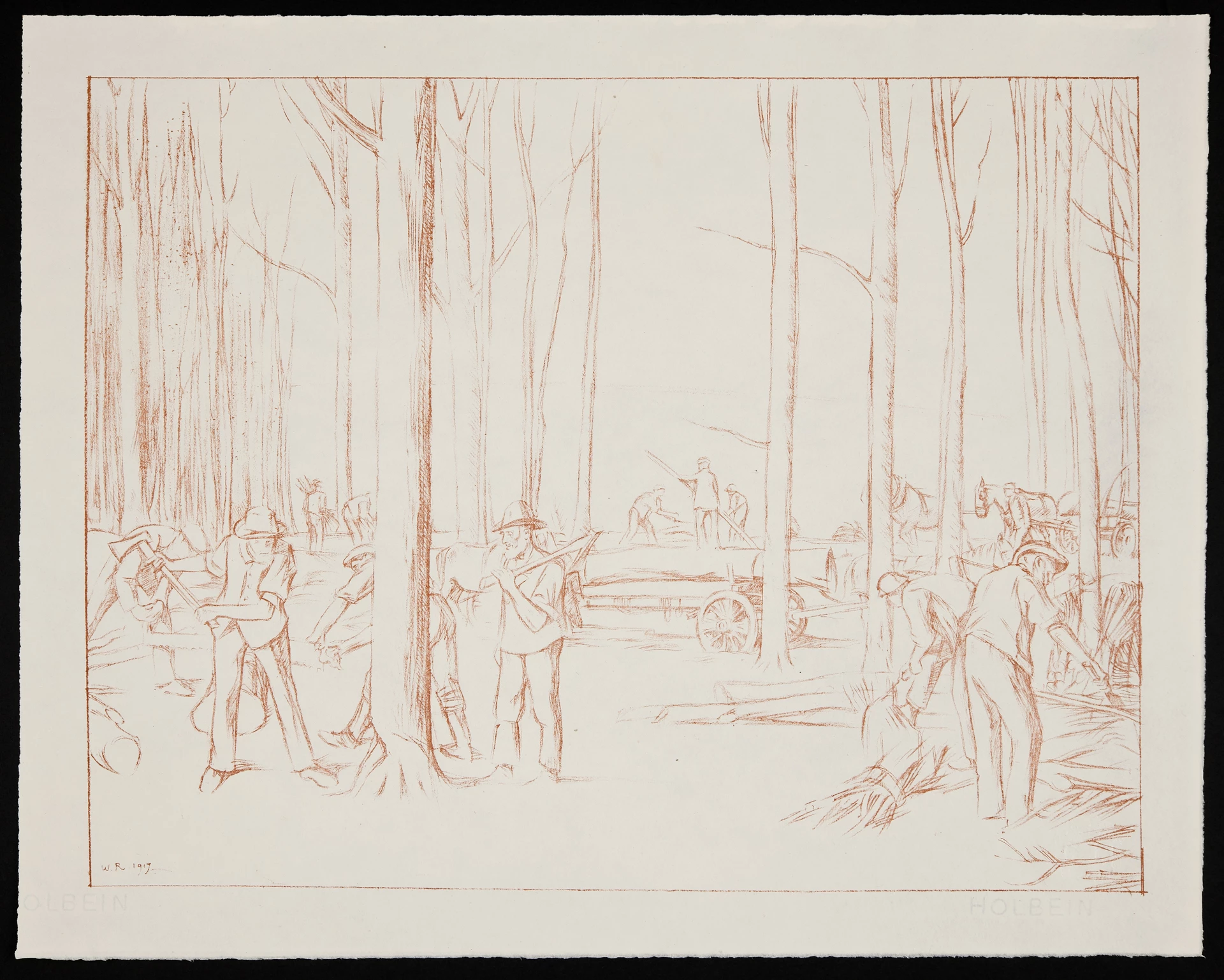
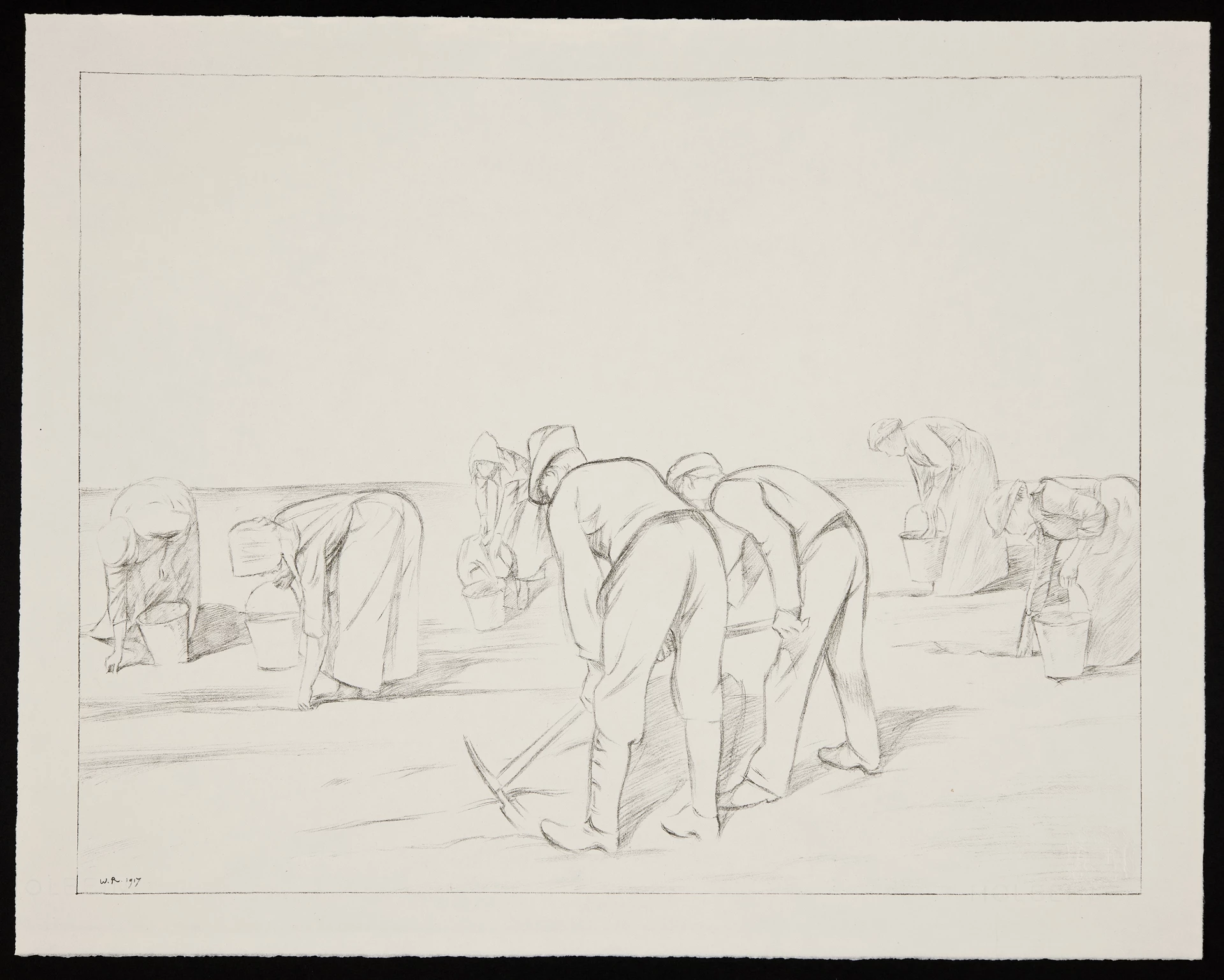
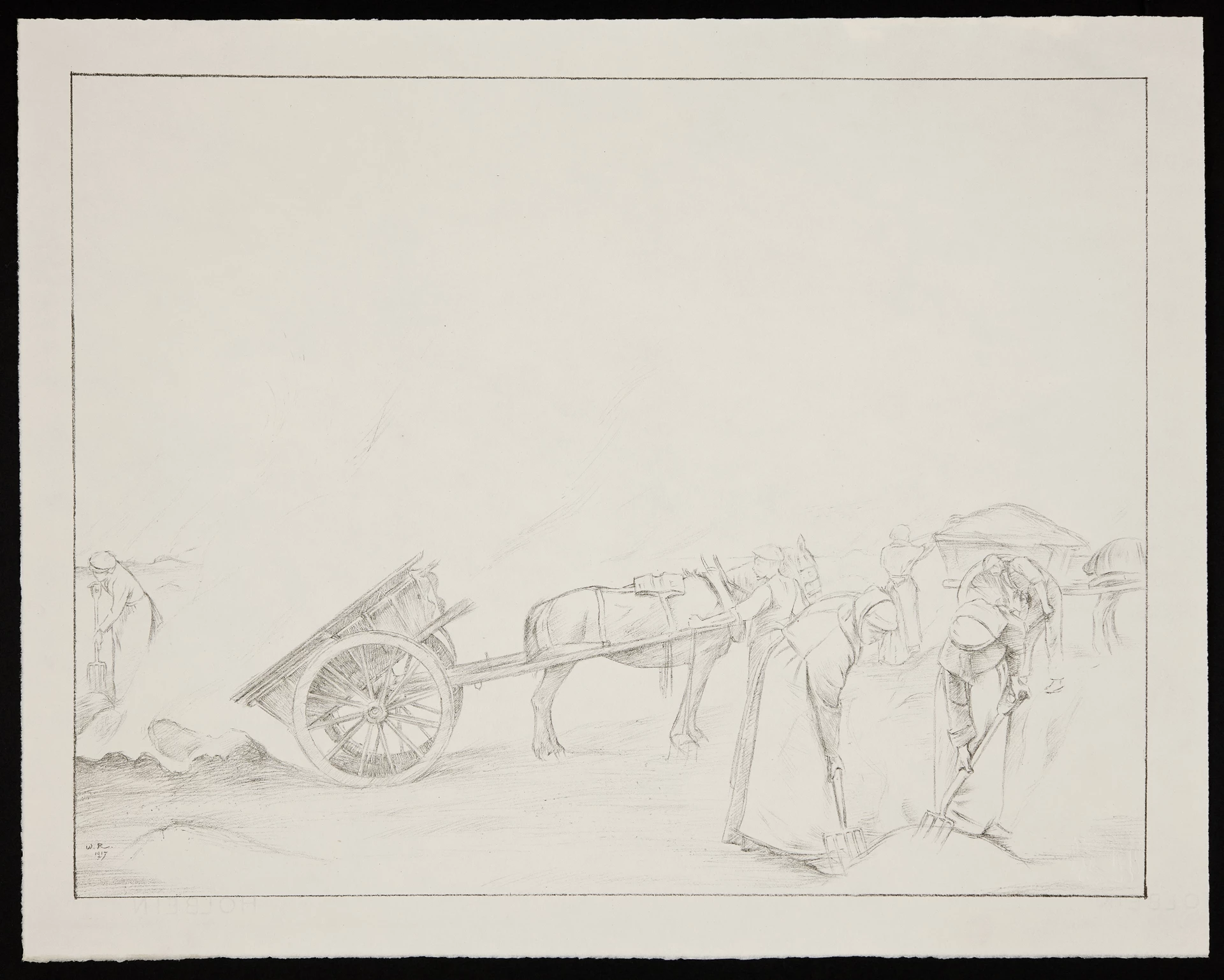
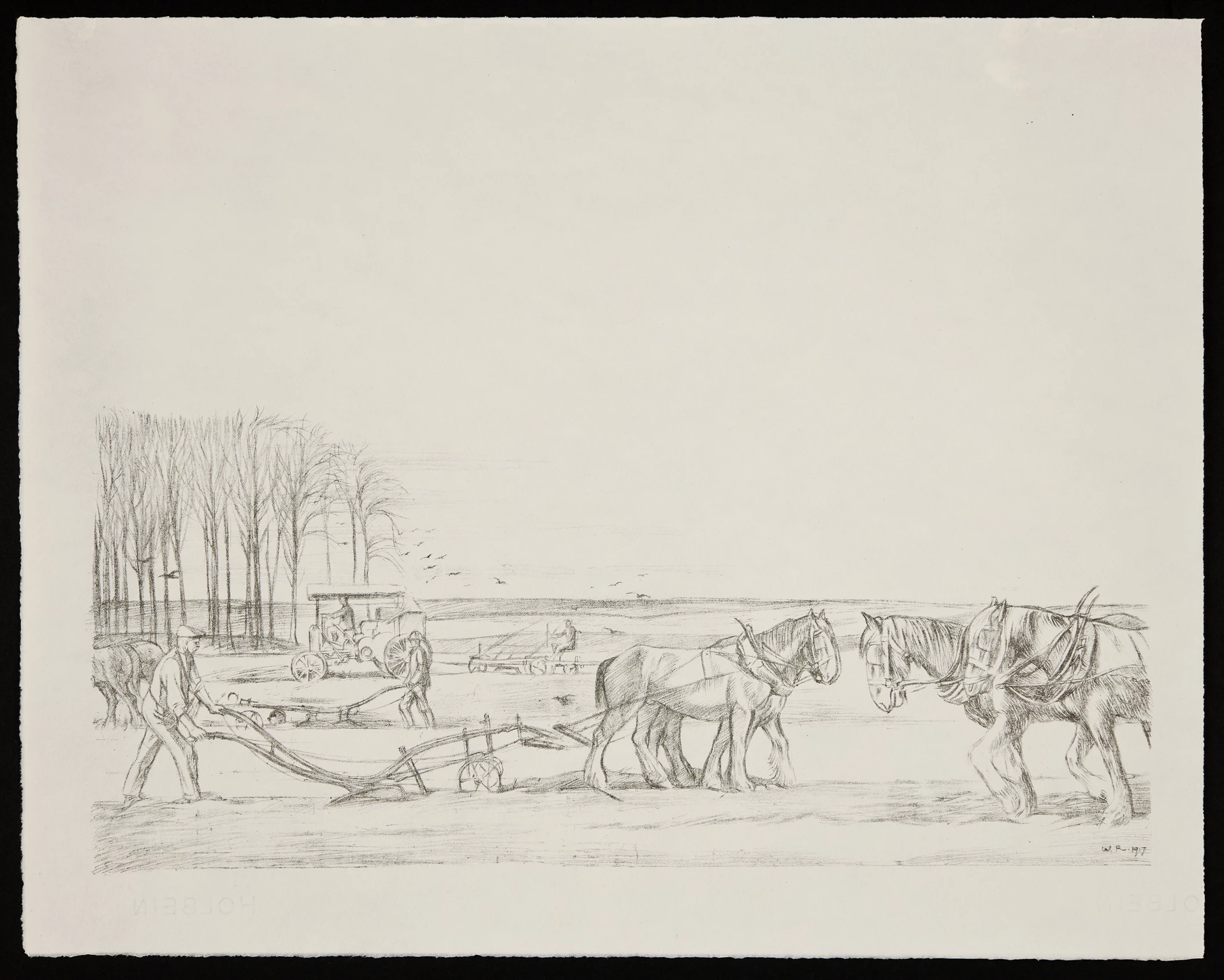
Threshing - William Rothenstein
Timber-hauling - William Rothenstein
Potato-planting - William Rothenstein
Burning couch-grass - William Rothenstein
Drilling - William Rothenstein
Ploughing - William Rothenstein
On 15th May 1917, Rothenstein wrote to Ernest Jackson, ‘I hope to have the 5th drawing finished early this week and the last next week. I will then come up to town and do what is needful to the stones’. He was not happy with some of his early work, writing, ‘somehow the lines seem poor and thin’. He decided to print some in a red/brown colour rather than black. These works are simple and understated, a contrast to the busyness and modernity of war shown in many of the other prints in the series. They take their cue from images of rural labour that characterised much landscape painting from the mid-nineteenth century onwards. They were probably drawn around Stroud, Gloucestershire, where Rothenstein was living.
Rothenstein was born in Bradford of German-Jewish descent. He studied at the Slade School of art, London and the Académie Julian, Paris. As well as being appointed official war artist to the British Army 1917-1918, he was artist to the Canadian army in 1919. Between 1920 and 1935 he served as Principal of the Royal College of Art and in 1931 he was knighted.
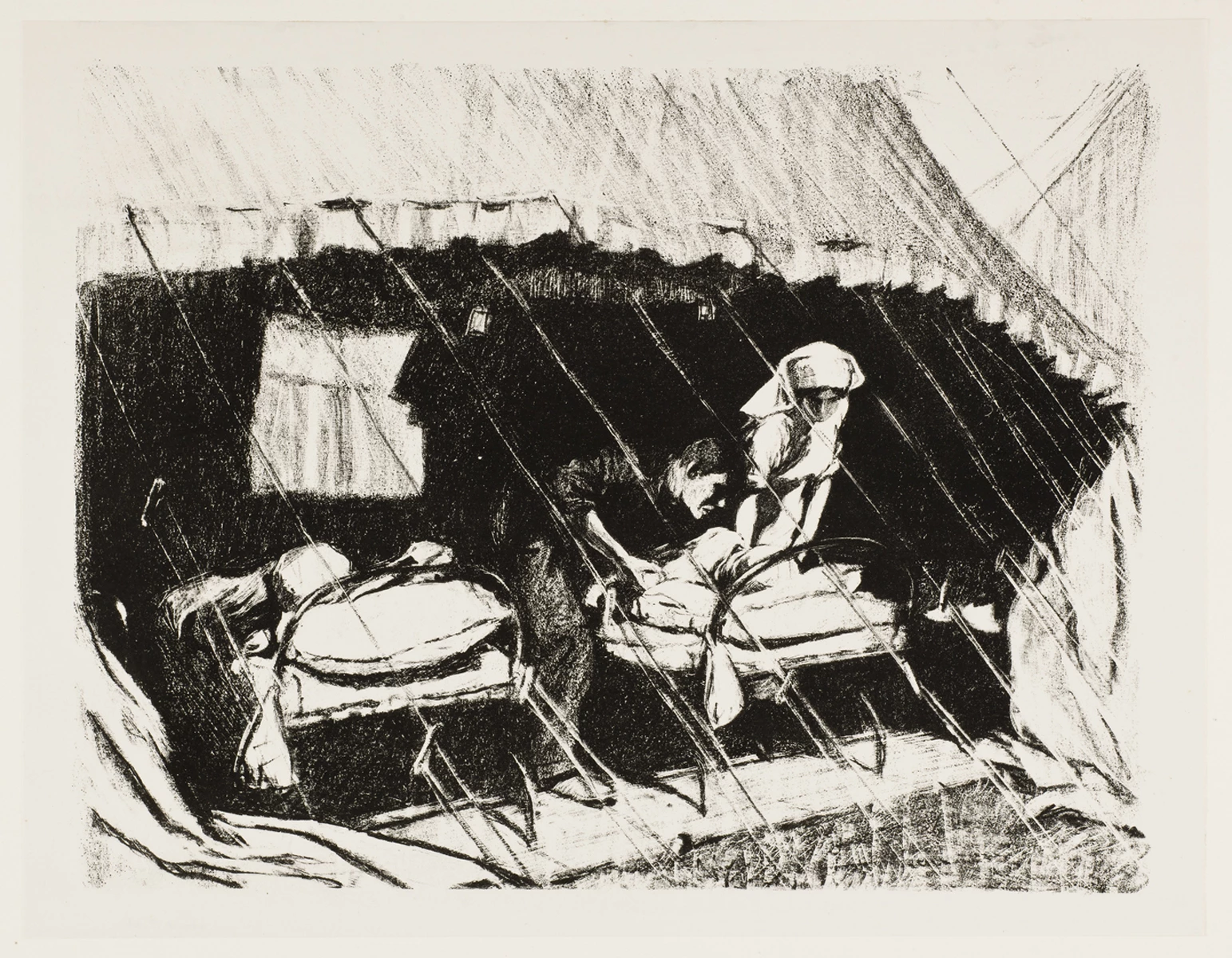
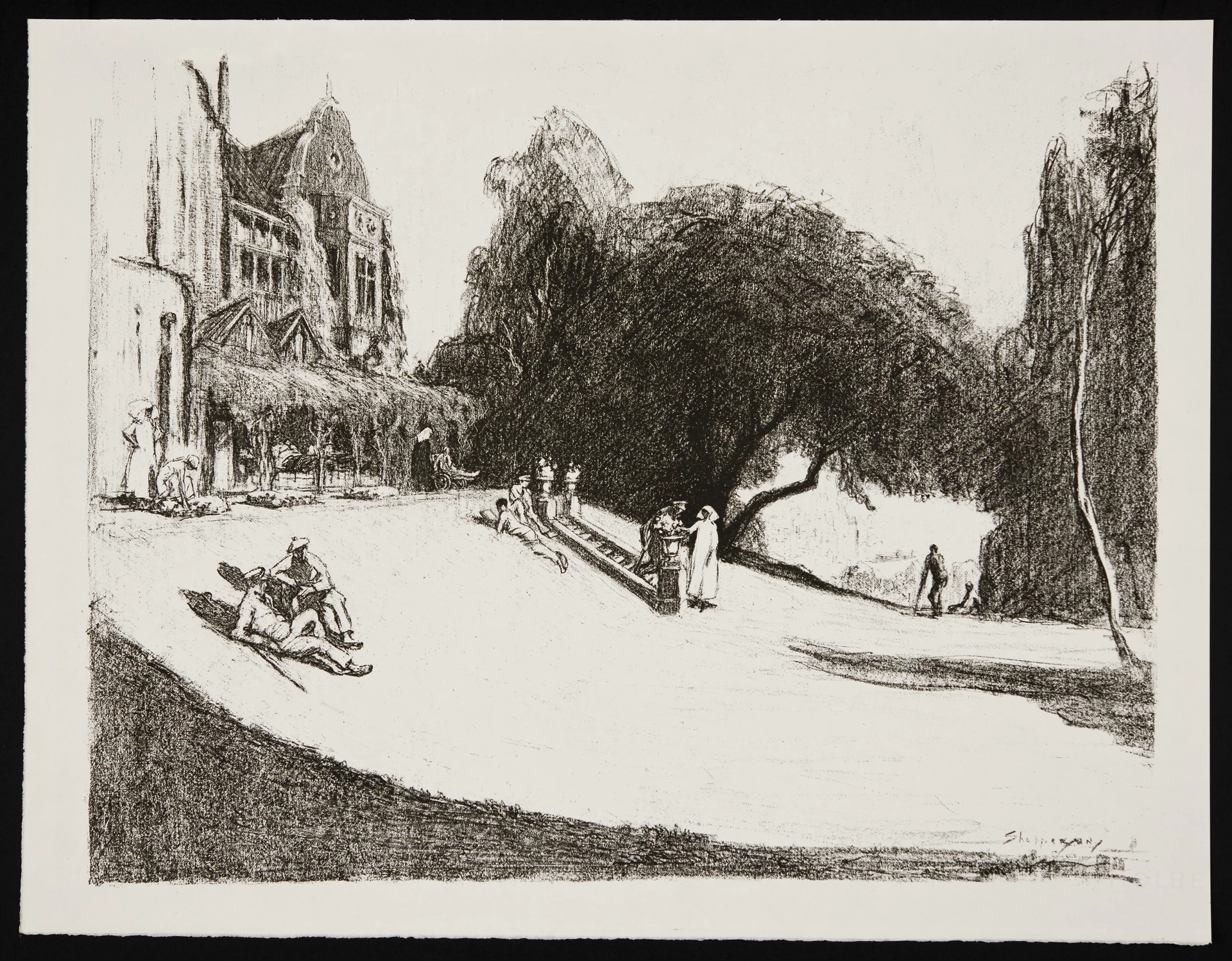
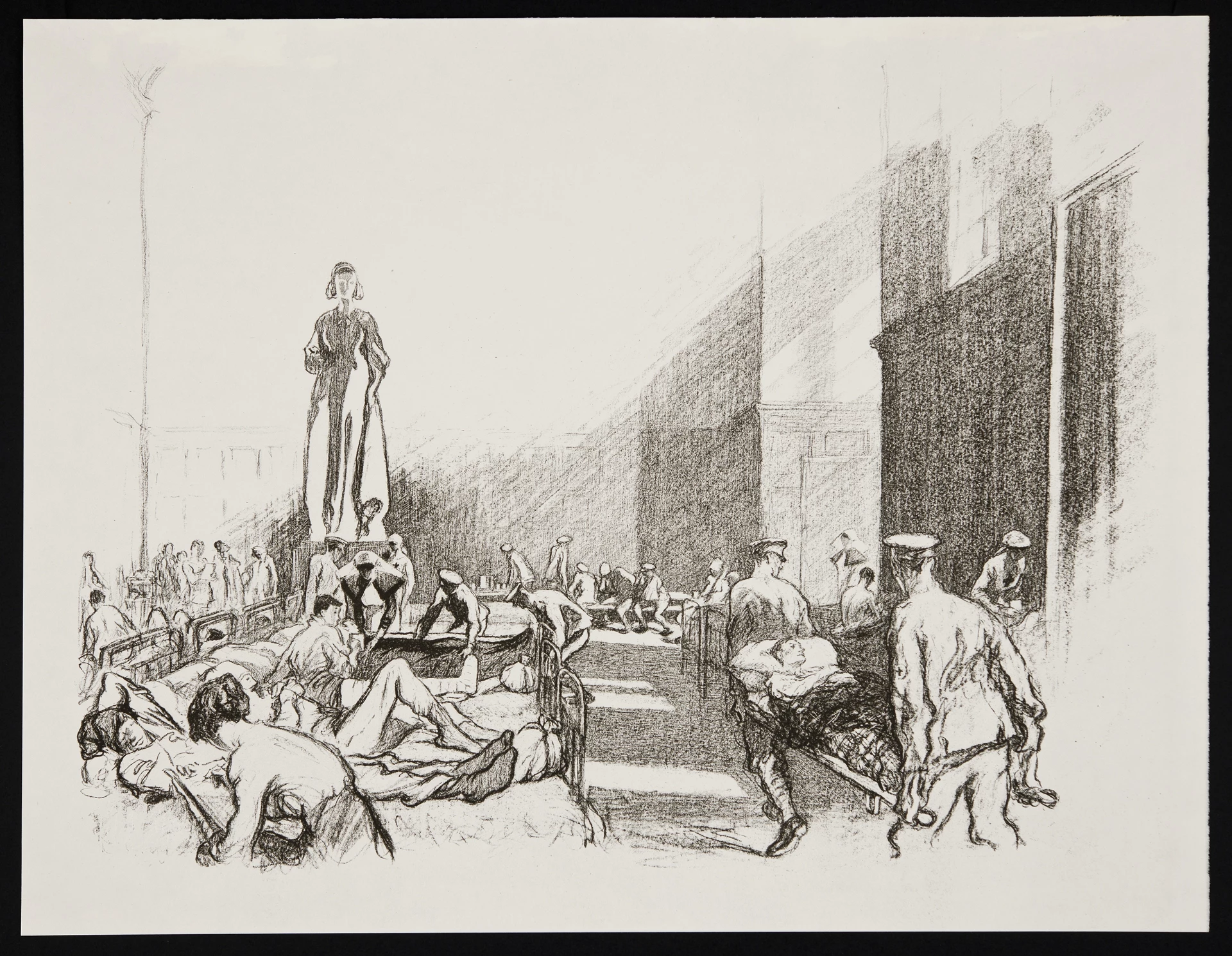
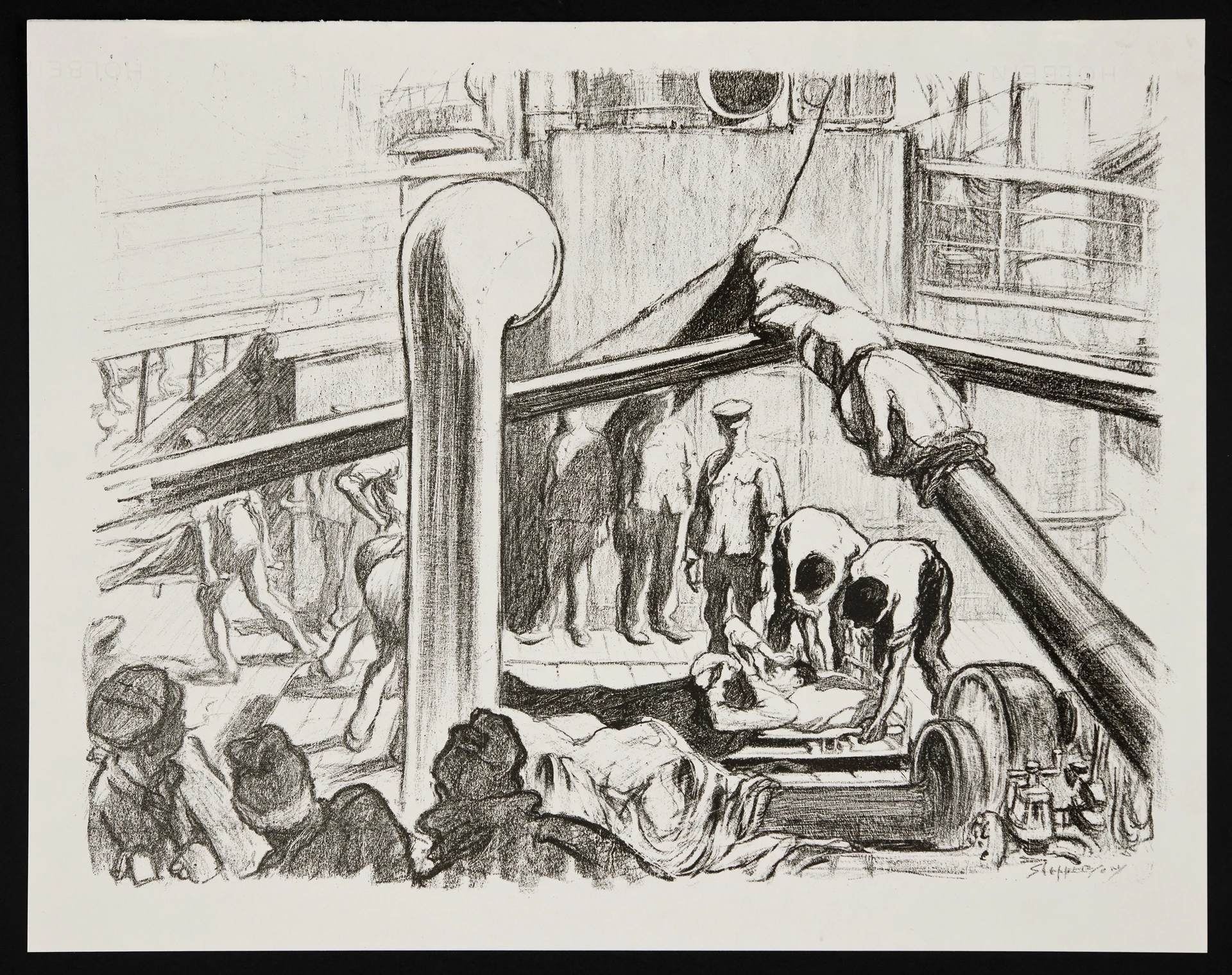
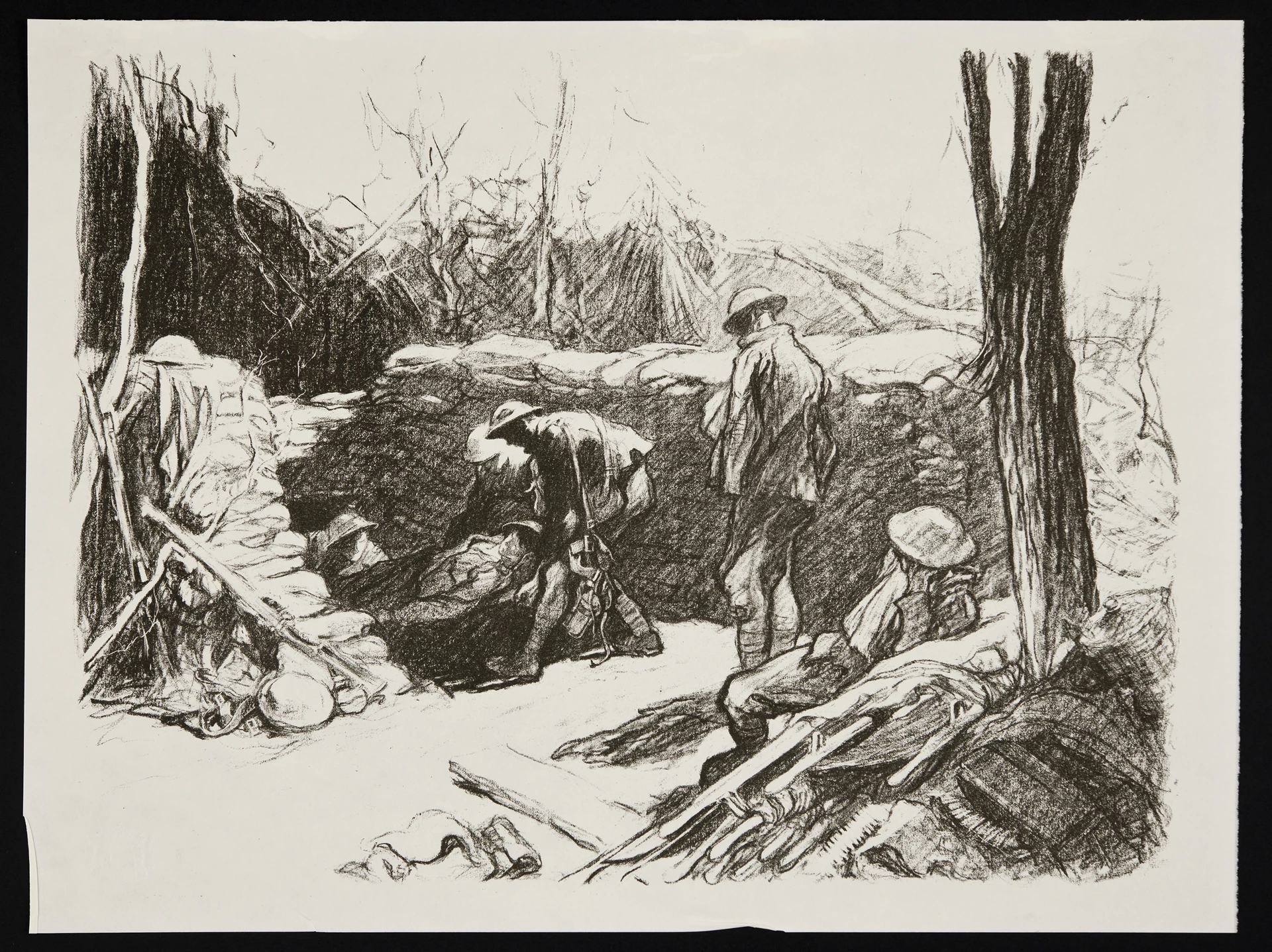
Tending the Wounded
Casualty Clearing Station in France - Claude Shepperson
Convalescence in England - Claude Shepperson
In Hospital in England - Claude Shepperson
Detraining in England - Claude Shepperson
On Board a Hospital Transport - Claude Shepperson
Advanced Dressing Station in France - Claude Shepperson
These prints follow the journey of a wounded soldier from the Front Line, through treatment, to convalescence back at home. The organisers initially asked the artist Henry Tonks (1867-1937), a surgeon before becoming an artist, to respond to the work of the medical services. However, Tonks found the paper supplied ‘entirely unsympathetic’for drawing and declined. Shepperson was later commissioned for the subject and produced a very well received series.
Shepperson was born in Beckenham, Kent, and was a successful water-colourist, pen and ink artist, illustrator and lithographer. Having given up law he studied art in Paris and London. He is well-known for his humorous drawings contributed to the Punch magazine between 1905 and 1920.
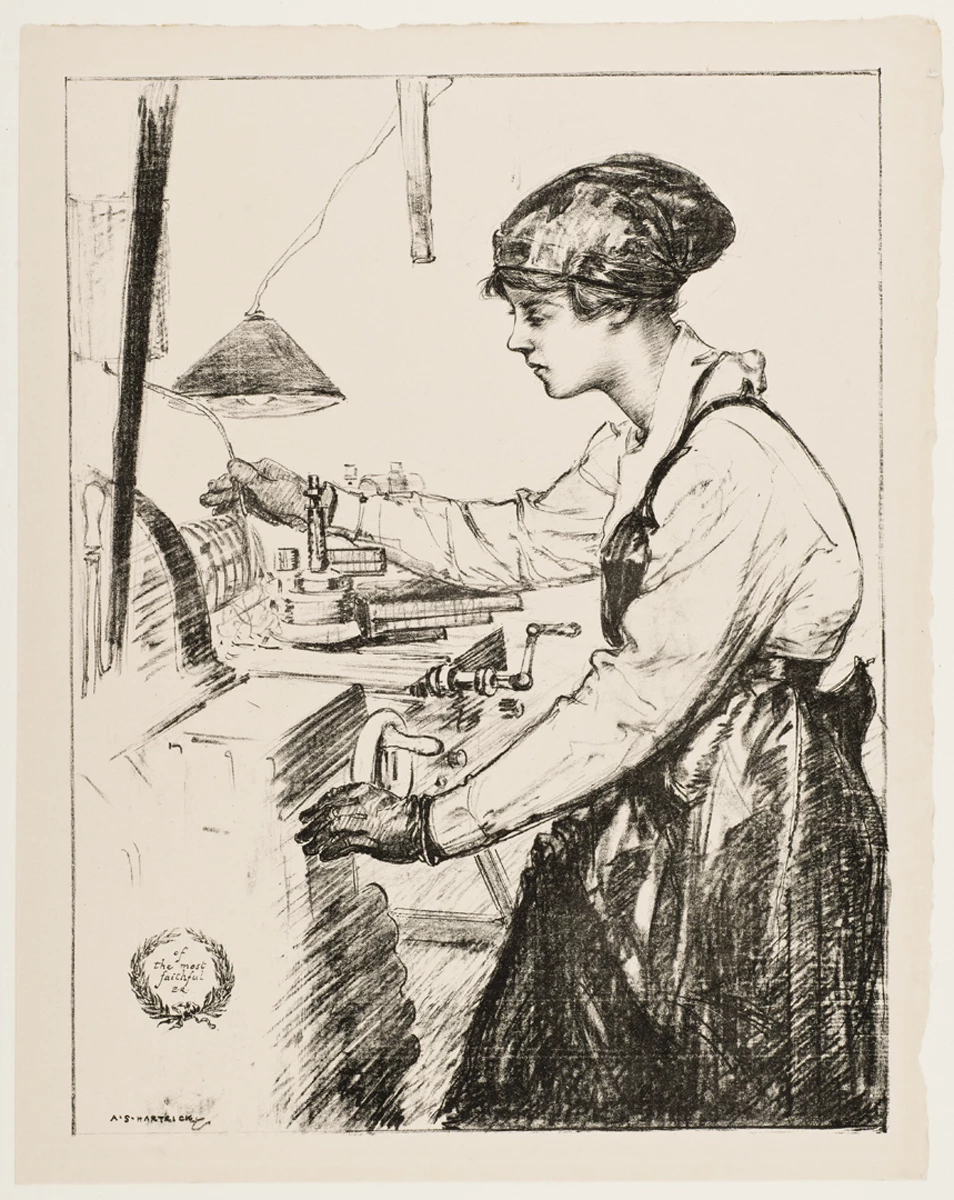
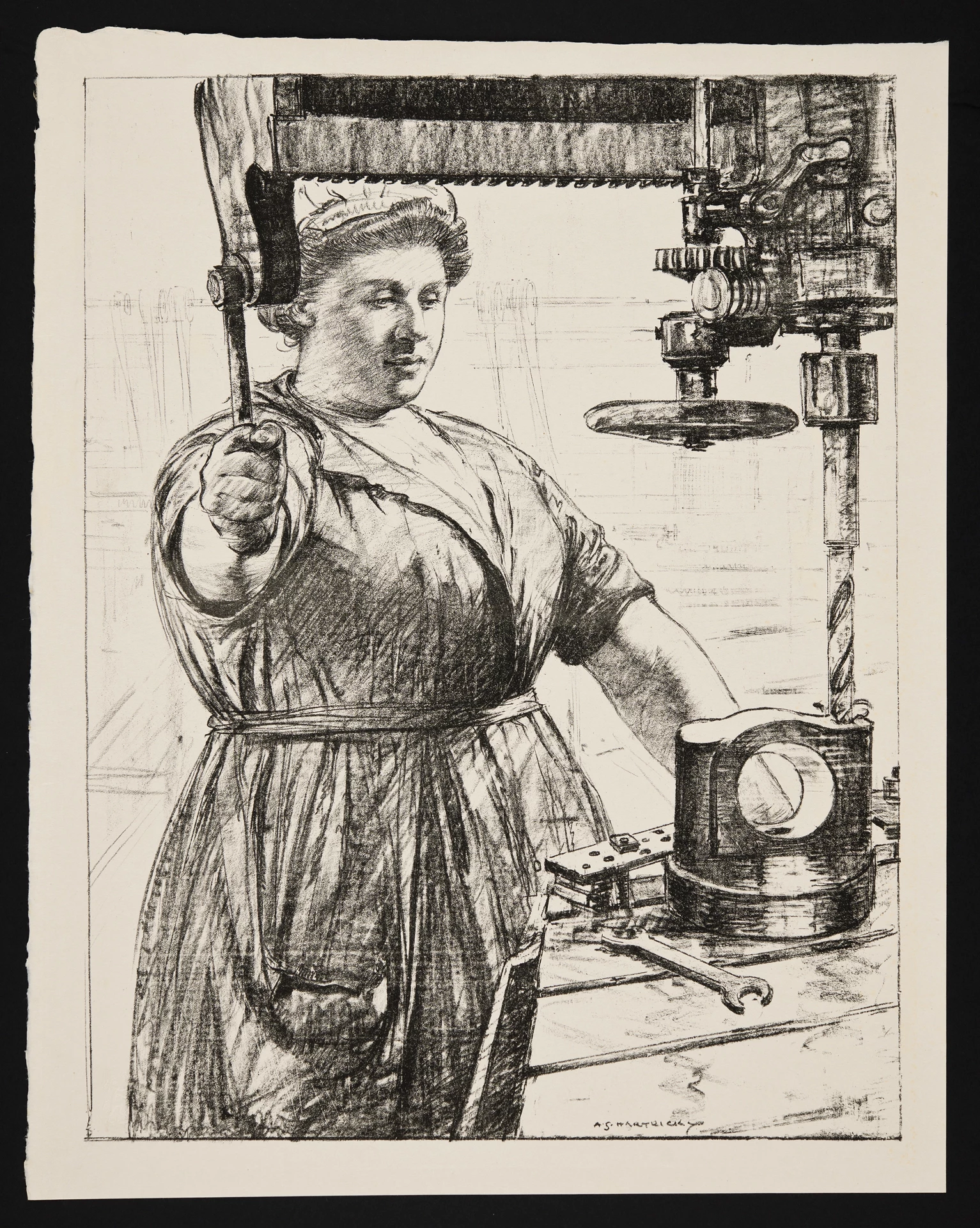
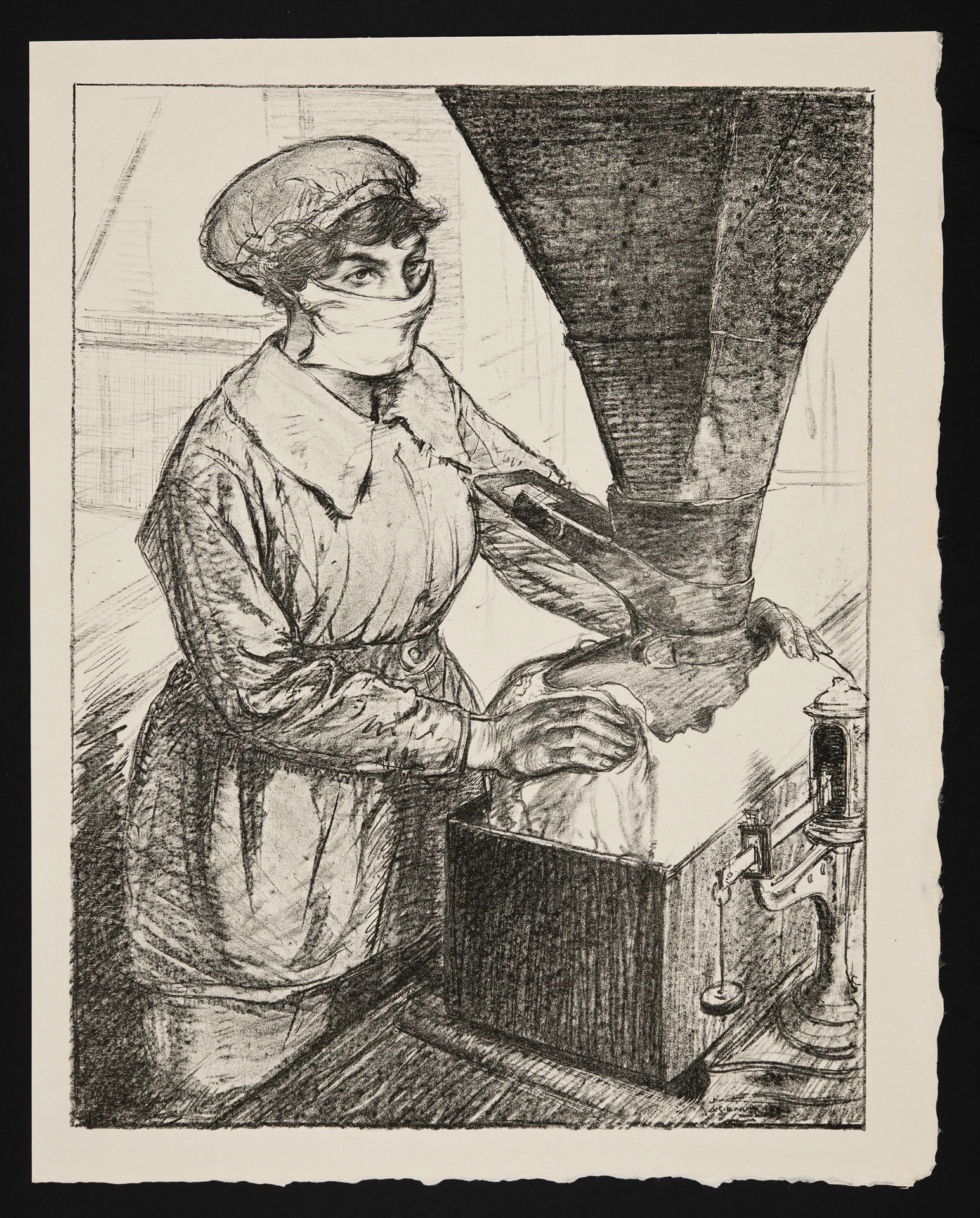
Women's work
On Munitions: Skilled Work - A. S. Hartrick
On Munitions: Heavy work (Drilling and casting) - A. S. Hartrick
On Munitions: Dangerous Work (Packing T.N.T) - A. S. Hartrick
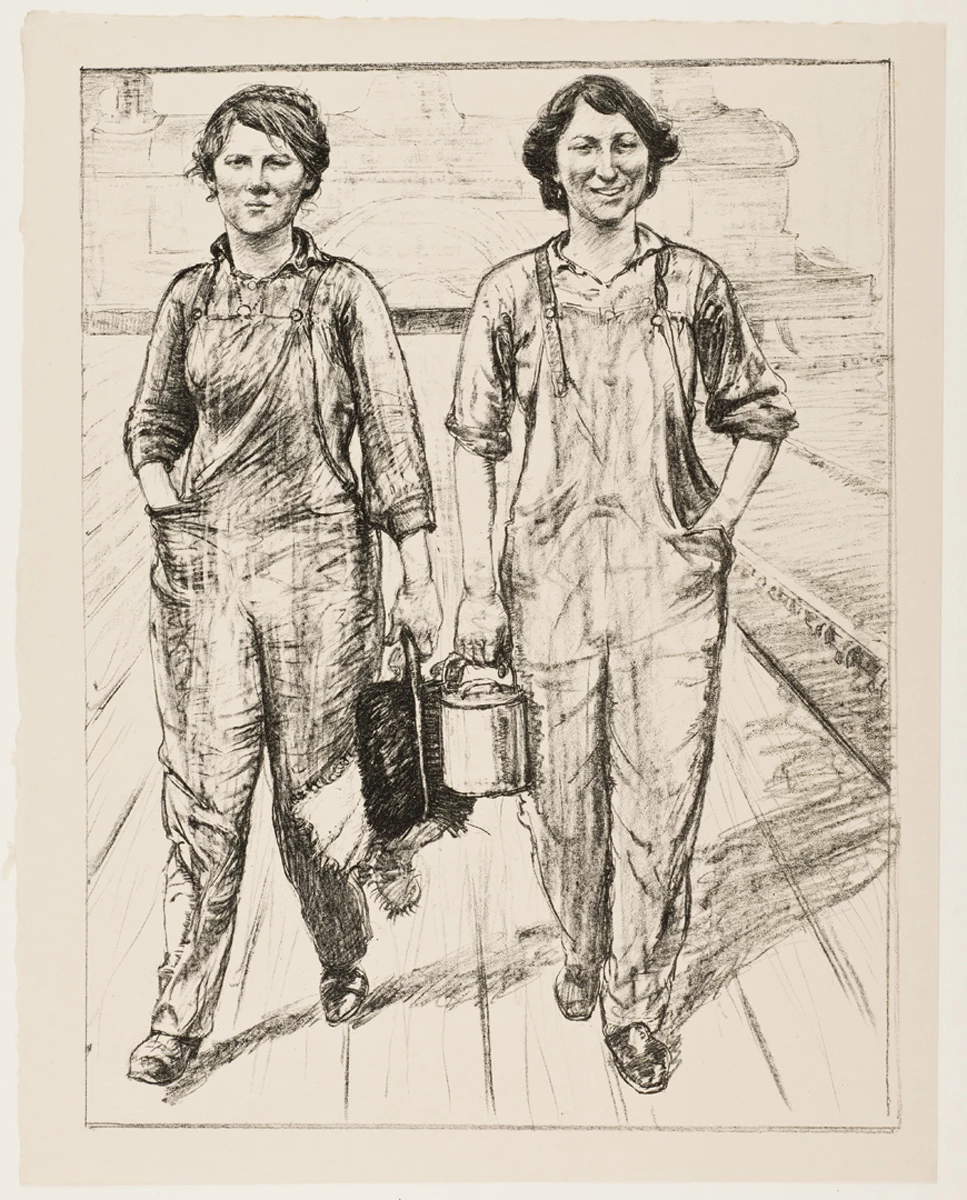
On the Railways: Engine and Carriage Cleaners - A. S. Hartrick
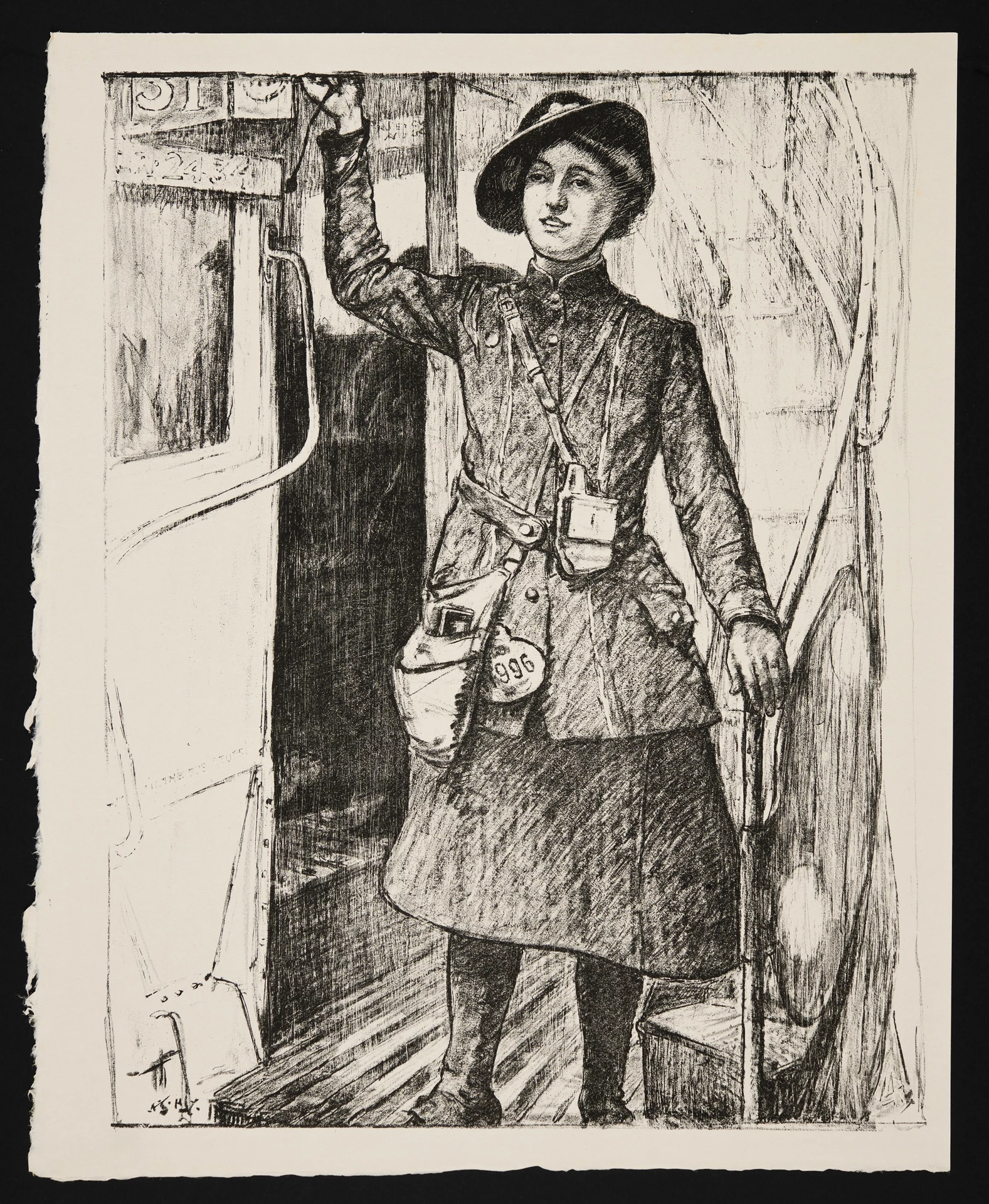
In the Towns: A bus conductress - A. S. Hartrick
On the Land: Ploughing - A. S. Hartrick
These prints record the vital contribution made by women as part of the war effort. When more men were required for fighting in 1915, there was a call to women to 'do their bit'. In taking on jobs in areas traditionally reserved for men the female workforce raised levels of production both in factories and fields. Although much of the work was both arduous and dangerous, the war allowed many women an unprecedented degree of freedom, and an opportunity to demonstrate their abilities in previously male-dominated spheres. Hartrick was sent to make studies on the spot, and many of the compositions seem deliberately posed - as propaganda images they give no indication of the hardships and hazards that women faced on a daily basis.
The artist and illustrator Hartrick was born in India and brought up in Scotland. He first studied medicine, before attending the Slade School in London, and art schools in Paris, exhibiting in the 1887 Paris Salon. In 1909 he became a founding member of the Senefelder Club. He also turned to teaching the method, writing an instruction book on Lithography As A Fine Art in 1932.
Transport by Sea
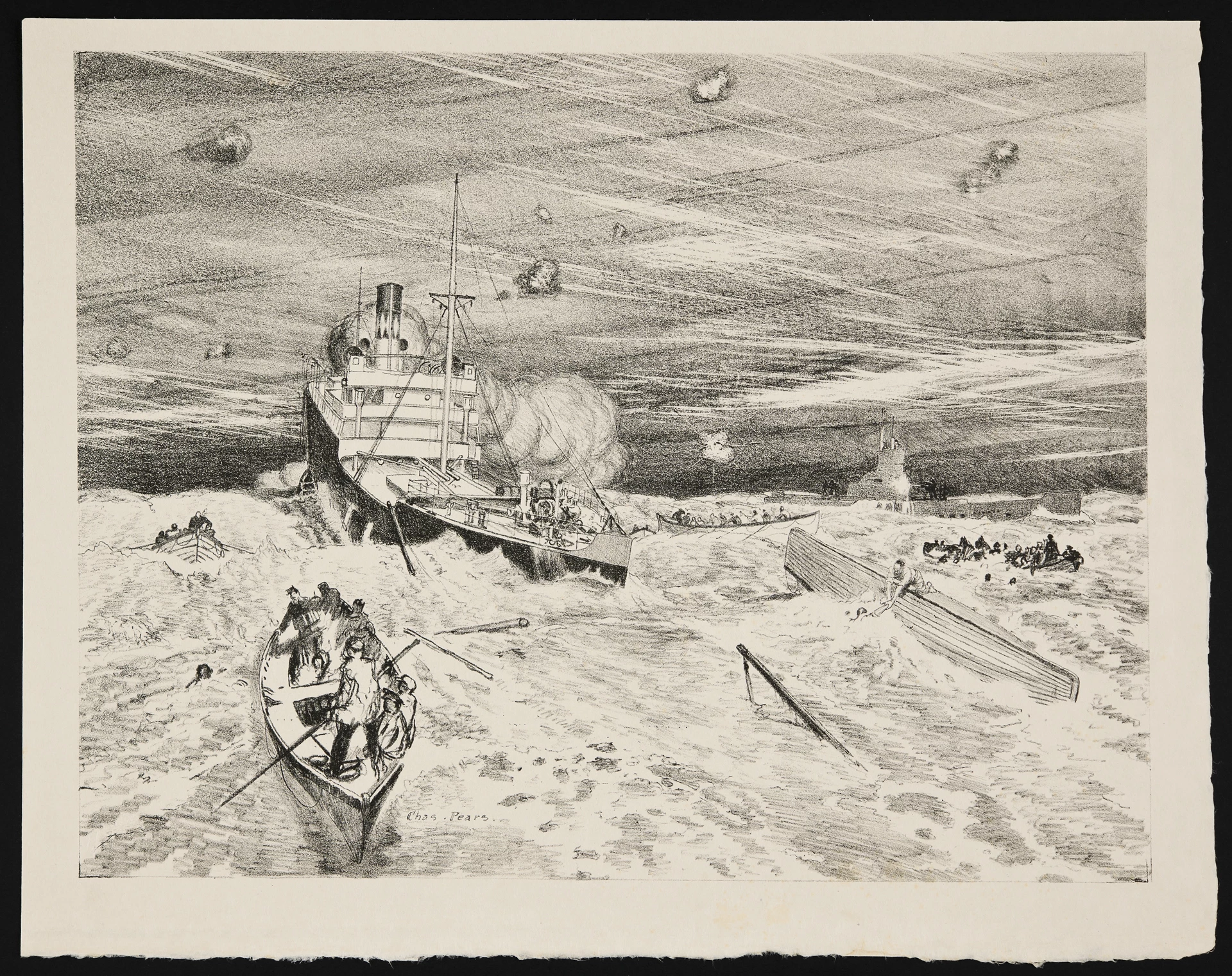
The Place of Safety - Charles Pears
Maintaining Forces Overseas - Charles Pears
Transporting Troops - Charles Pears
Supplying the Navy - Charles Pears
Maintaining Export Trade - Charles Pears
Maintaining Food Supplies - Charles Pears
The merchant navy undertook vital tasks during the war, supporting naval ships, transporting troops and carrying essential supplies. It was dangerous work and the fleet suffered great losses. Pears’ images capture the ships in great detail.
Pears was born in Pontefract, Yorkshire and, although he worked as a successful illustrator and lithographer, is best known for his marine paintings. During the First World War Pears was a commissioned officer in the Royal Marines, and worked as an official naval artist from 1914-1918, and again in 1940. Throughout his career he was also a popular poster designer, creating works for organisations including the London Underground.
Conservation
Each of the works has been treated in the Paper Conservation studio at Amgueddfa Cymru – National Museum Wales. Since their arrival at the Museum in 1919, the prints had been stored in their original mounts and folders for almost 100 years.
Many of the prints were foxed (reddish-brown spots) and dirty. This is a sign that the paper is in poor condition and without treatment, would continue to deteriorate.
Funding was sought to appoint a trainee Paper conservator to work on this project for five months. All the works were washed, pressed, repaired and re-mounted. They are now in the best possible condition and the new mounts provide excellent storage conditions. This conservation will ensure that they will be preserved for generations to come.
Research has also been carried out on the type of paper used for the prints. From the watermark ‘HOLBEIN’ we have discovered that the paper was made by Spalding and Hodge, a paper merchant and manufacturer whose paper mills were located in Kent.