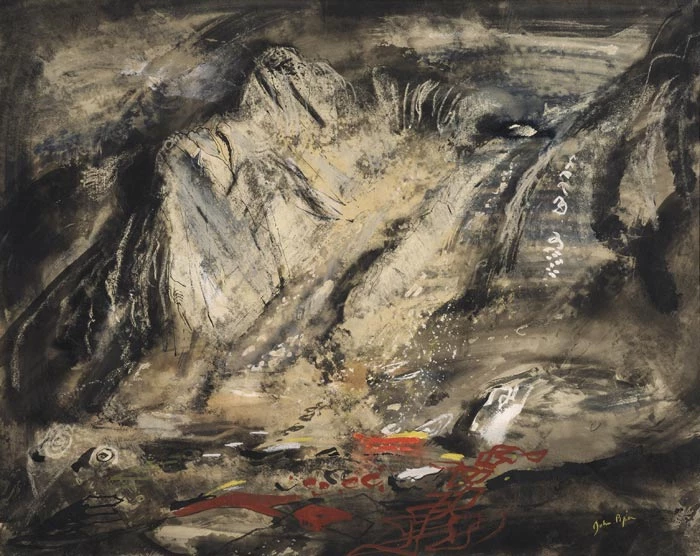
ink, watercolour & gouahce, c.1948
22 x 27 inches
Copyright John Piper Estate
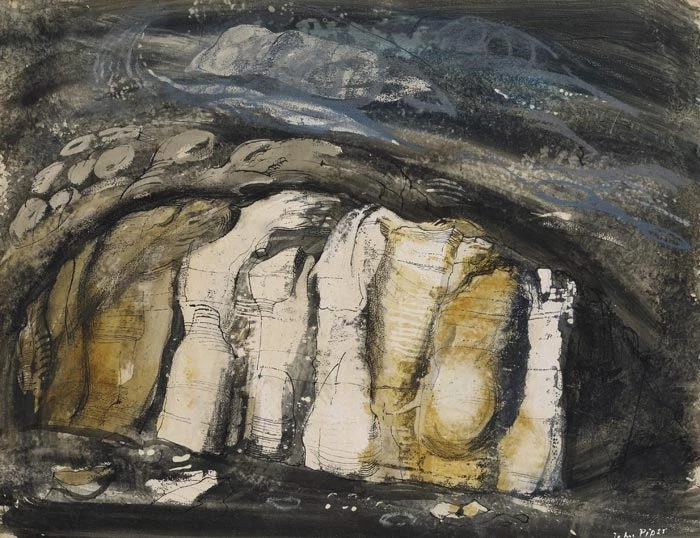
John Piper Rock formations
ink, watercolour & gouache, c.1948
21 x 27.5 inches
Copyright John Piper Estate
From around 1943 to 1950 John Piper undertook an intense artistic journey through the mountains of north Wales, conveying a passion and vision like none other seen before. There is an exuberance and brilliancy to the tones and hues, as well as sheer drama in each of the pictures.
One of the most versatile British artists of the twentieth century, John Piper's work encompasses portraiture, landscape, architectural studies, still life, ceramics and designs for theatre, stained glass and tapestry. Piper's interest in landscape and architecture extended to all areas of Britain, however his first significant encounter with North Wales came when he was working as an official war artist during the Second World War.
Manod Mawr Quarry: storehouse for priceless objects during the Blitz
In 1943 the War Artists Advisory Committee commissioned Piper to record the interior of Manod Mawr quarry. At the time it housed artworks from the National Gallery and the Royal Collection to protect them from bombing during the Blitz.
The dark conditions of the quarry were not suitable for painting or drawing and so the commission was abandoned. It did, however, provide the opportunity for Piper to explore North Wales. This sparked an intense period of recording the mountains of Wales.
Inspiration from Turner and Wilson
During the period Piper spent in North Wales, he often referred to the guidebooks and early geological texts of the eighteenth and nineteenth centuries as he travelled around the area recording the mountains. Not only did he admire their engraved illustrations, but they also provided a link to the artists of the period most admired by Piper, Richard Wilson (1714-1782) and J.M.W. Turner (1775-1851).
Church architecture from West Wales
Piper's painting trips to Wales did not start with Snowdonia or North Wales, but Pembrokeshire and Cardiganshire in 1936. The following year, he produced Five Chapels, 1937. The chapels depicted are: Emmaus, Llanon, Red Roses, Rhydygwyn and Tyrhos. These five collages were produced with torn and cut papers drawn and assembled. It shows his early interest in church architecture. He took a particular interest in the simple though neo-classical architecture of non-conformist chapels in Wales.
Piper in North Wales
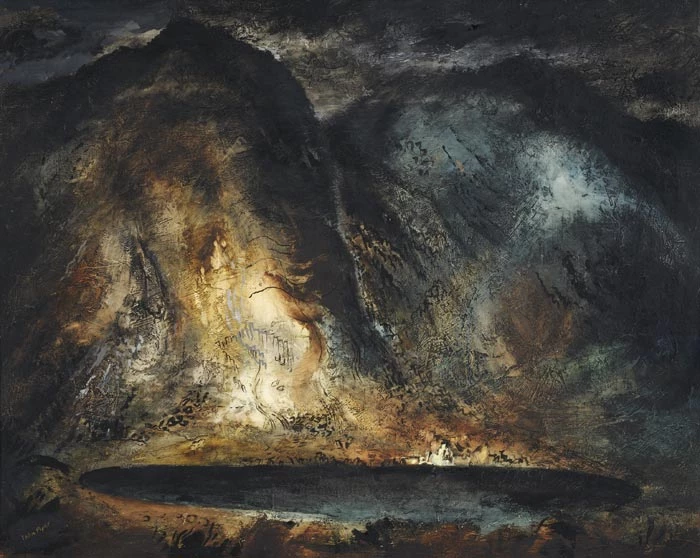
During the unsuccessful Manod Mawr commission, Piper began to explore north Wales and the locations painted by Wilson and Turner such as Cader Idris. This trip also brought him in close proximity to Aran Fawddwy, the subject of an impressive oil, The Rise of the Dovey, 1943-44. The title of this painting refers to Creiglyn Dovey, the lake in the foreground, which is the source of the River Dovey.
Turner painted a slightly different view of Aran Fawddwy in 1798 in a watercolour titled, A bridge over the Dyfi near Dinas Mawddwy, with Aran Fawddwy beyond (collection of the British Museum). The almost abstract nature, foreboding dark atmosphere and brilliant hues of light gold, yellow, blue and red in this work are very similar to Turner's style of painting. Upon the canvas is a layer of gesso, which has been painted on top of in oils. This gives the work this very rough texture, evoking a sense of the roughness of the rocks and the elements.
In 1945 John and his family rented a cottage named Pentre. There is a painting titled Nant Ffrancon Farm, 1950, which shows the house from the roadside. It is situated in the Nant Ffrancon valley, with a steep hill leading up behind the house. The property was sub-let to the Pipers for £35 a year. At the time there was a basic muddy track, rather than a concrete road, making the house almost inaccessible in bad winter weather conditions. Along with this, the house was at the foot of a steep hill, which caused the house to be flooded by heavy rain.
I felt then that I was seeing the mountains for the first time and seeing them as nobody had seen them before.
John Piper quoted in Richard Ingrams and John Piper, Piper's Places, London, 1986
John Piper The Rise of the Dovey
oil on canvas on board, 1944
27.5 x 34.5 inches
Copyright John Piper Estate
A stormy and wintery Snowdonia
The difficulties and hardships presented by living here, even though only for short periods at a time, encouraged the Pipers to move to another rented house called Bodesi around 1947. Bodesi is situated across the road from Tryfan facing the mountain and Llyn Ogwen. This was the landlord's hafod or summer house, so the Pipers had use of it for the rest of the year. This would account for most of Piper's paintings of Snowdonia being stormy and wintery.
Bodesi was well-placed and a flurry of paintings and drawings of Tryfan began. Jagged Rocks under Tryfan, 1949-50, is a wonderful example of Piper's attention to detail by selecting very particular rock formations on and around Tryfan. It depicts Tryfan Bach (little Tryfan) situated at the base of the mountain on its western side. Its jaggedness mimics that of its parent, Tryfan. White spirals drawn in gouache are most likely patterns left on rocks by lichen which has since detached. In the lower foreground are splashes of red and yellow, in some cases accentuating the shape of the rocks, in other areas denoting the 'chrome yellow and chrome orange lichen' Piper described in his notes.
The influence of nineteenth century guides to Snowdonia in Piper's work also encouraged him to write his own guide to the area. Unfortunately it never went beyond note form, which is now in the archives at Tate Britain.
Although Piper's dream of publishing a guide to Snowdonia never came to pass, it is justifiable to say that he provided an enthralling guide through his paintings and drawings. This series of work is considered by some to be the best of all his paintings. In the 1960s, the Pipers bought a house in Pembrokeshire called Garn Fawr and much of his Welsh work from this period onwards focuses on Pembrokeshire and South Wales. He would never work in North Wales with this intensity again.
Amgueddfa Cymru has one of the most exceptional collections of nineteenth-century French Art in the United Kingdom. Engaging with the turbulence of nineteenth century France and the relationship between the revolutions of the people and revolutionary developments in art, we take a fresh look at the Museum's collection of pre-Impressionist French paintings, researched and interpreted by postgraduate students from the University of Bristol.
The Century of Revolution
The turbulent social and political history of France during the nineteenth century led many artists to document the shifting realities and expectations of life. The 1789 French Revolution, which established the First French Republic, sparked a century of uprisings and uncertainty for the population. While some artists sought to represent current events, others looked to recapture lost traditions.
Revolution and the rise of Realism
From the seventeenth century, the state-run Academy of Fine Arts and its official exhibition, the Salon, led the direction of French art. During the nineteenth century, many artists began to challenge its approach, and to examine how the lives of the people were altered by the dramatic changes of the nineteenth century. Increasingly artists abandoned the biblical figures and Roman heroes that had previously dominated the walls of the Salon.
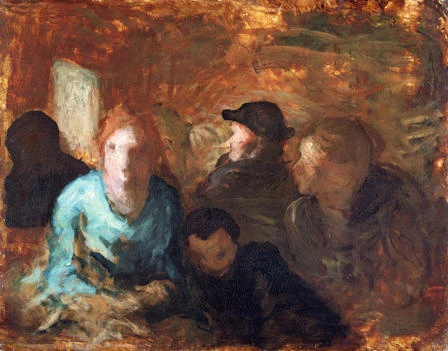
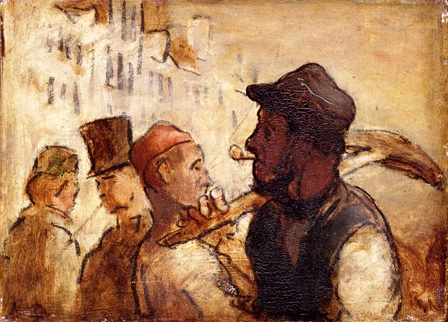
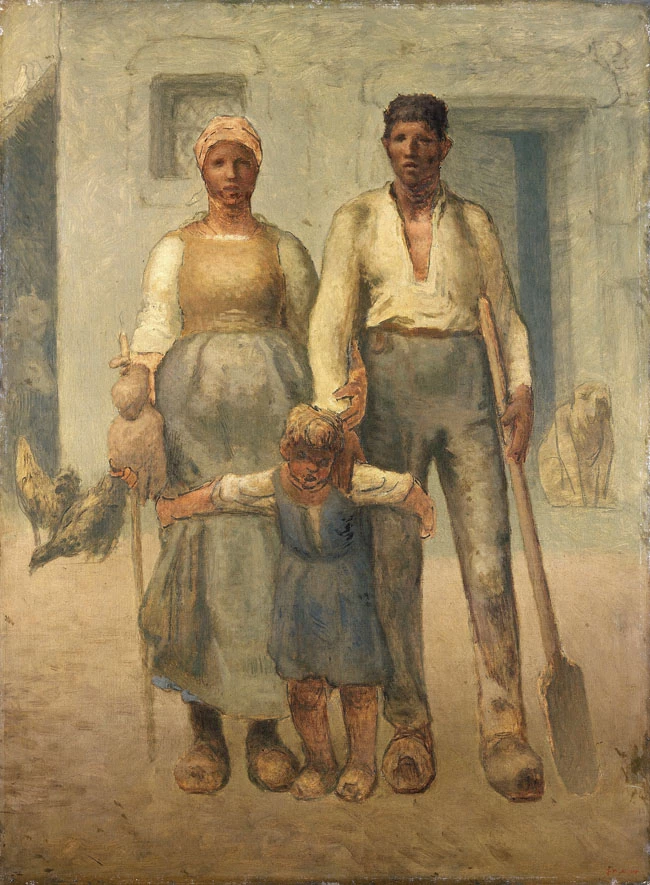
In A Third Class Carriage Honoré Daumier refers to a key invention of the century, the steam train. In contrast, Jean-François Millet's The Peasant Family depicts rural farmers and idealises the French countryside. While these are very different paintings their common theme is that they are representations of real, contemporary, humble life.
It was during this period that French artists first began to paint like this; an approach sometimes known as 'Realist' painting. These changes in subject matter laid the groundwork for much of Modern Art as we understand it today.
Political Unrest
The overthrow of King Charles X in the July Revolution of 1830 led to the July Monarchy of Louis-Phillippe, ousted in the Revolution of February 1848. The Second Republic gave all men a right to vote and promised democracy. However, a brutal suppression of the workers' rebellion demonstrated that frustration was still present. Daumier's Workmen on the Street indicates such tensions and his imagery criticised continuing class distinctions.
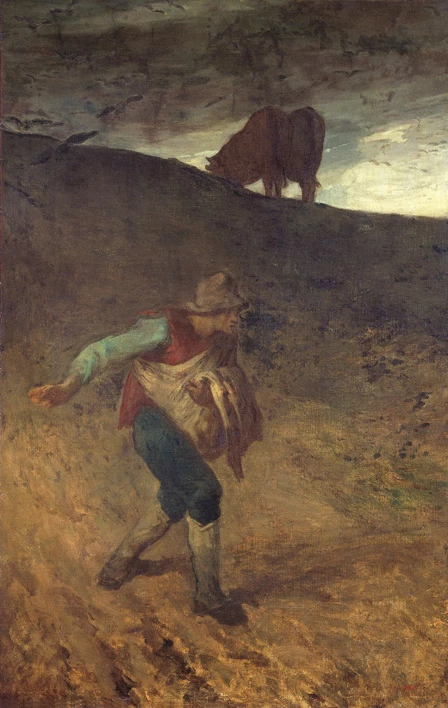
Millet's later The Sower highlights rural labour and peasant life. Agriculture was an ingrained part of the French national identity, however, Millet mourned the mass migration from rural areas into the cities.
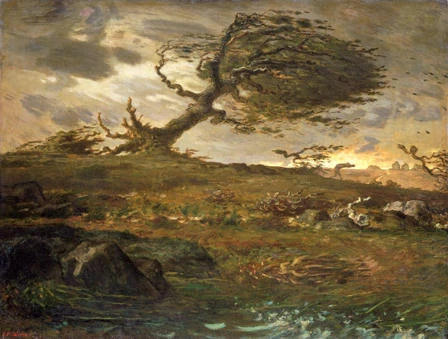
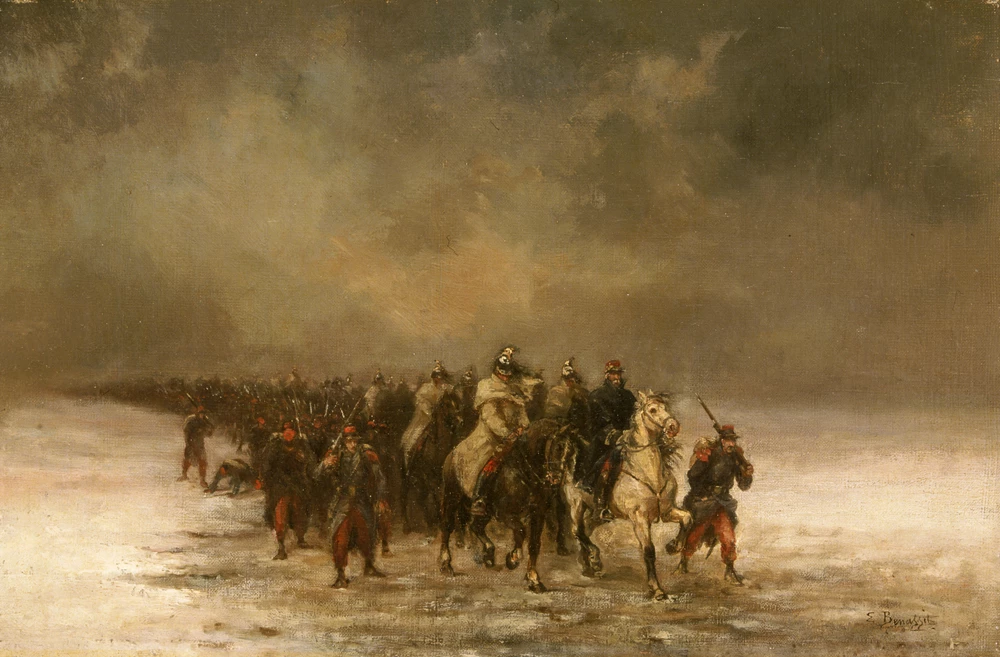
During the Franco-Prussian War in 1870 many artists went into exile in safer rural locations. Millet fled from Barbizon to the Normandy coast. He painted The Gust of Wind on his return; the frightening strength and power of the storm representing both change and the violence of war.
The Second Empire collapsed with France's defeat in 1871, causing a group of French radicals to briefly seize control of Paris in the 'Commune' of the same year. Soon quashed, it was replaced by the Third Republic.
The distress and loneliness within these desolate landscapes may be read as a response to the turbulent events in France at this time. Most importantly they show how political events shaped national identity and, in turn, its art.
The Peasant Family (1871-2)
Jean-François Millet (1814 - 1875)
Oil on canvas
The Davies Sisters Collection
During the second half of the nineteenth century, changes in class structure in France led to a growth in the wealth of the middle classes, known as the bourgeoisie.
In particular, they enjoyed paintings that showed themselves in the pursuit of leisure and inferred their new status in society. Artists responded by creating paintings to suit the tastes of this growing audience.
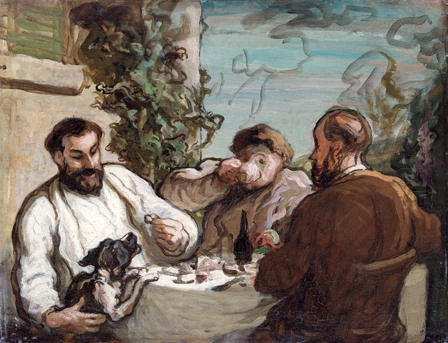
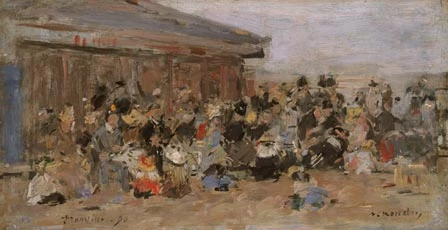
1804 saw the invention of the steam powered locomotive and within 50 years, railway lines were being constructed across France. Daumier's Lunch in the Country and Boudin's Beach at Trouville are depictions of bourgeois tourist activities.
In addition to reflecting revolutionary developments in tourism and transport, artists employed bright colour and loose linear structure to create an air of entertainment and recreation. Such revolutionary light effects and loose brushstrokes had a strong influence on the emerging style of Impressionism.
Women and Domesticity
Paintings of women feature significantly in the Museum's collection of nineteenth-century French paintings. It is, however, interesting to note that all these women were painted by male artists, so viewers are observing women from the perspective of the nineteenth-century man.
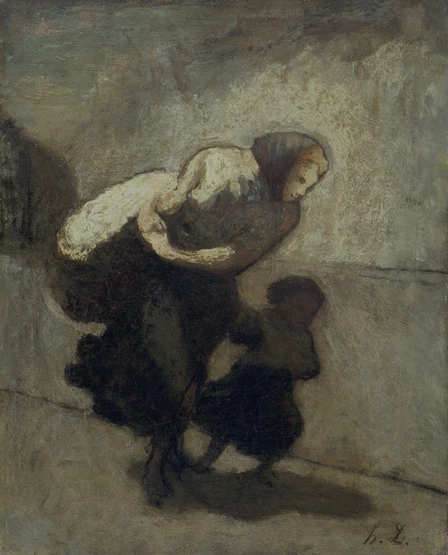
With this in mind we can begin to understand the role of women in society. Daumier's The Heavy Burden presents us with the activities of working class women, while the other paintings depict fashionable and delicate beauties of a higher social ranking. This shows us that class and gender divisions were still intact following the Revolution.
Society's expectations for women to be demure and feminine run through several of the paintings. Whether they are active and working or seated and passive can be seen as an indication of their situation within society.
Research and Reveal
Here we present four essays, giving a fresh look at the Museum's collection of pre-Impressionist French paintings, researched and interpreted by postgraduate students from the University of Bristol:
Researchers in Amgueddfa Cymru in collaboration with Concordia University, Montreal have uncovered new information about the life and work of the elusive 17th-century portrait painter, Thomas Leigh. It is now thought that there were two painters named Thomas Leigh – a father and son – but hopefully more paintings can be discovered helping to shed light on the life of these elusive family painters!
T. Leigh: the enigma
Researching the work of a little-known 17th-century painter can be a difficult task. In some cases all we have left of a painter’s life is the work left behind. Such was the case with Thomas Leigh.
In 1941, the art historian Maurice Brockwell sent out a plea for information on the 'obscure' painter T. Leigh. 'It is strange that we still know nothing about his origin, place and date of birth.. marriage, and death,' he wrote.1
At the time Leigh was known by signature alone, which appeared on six portraits including that of Robert Davies of Gwysaney. Even his first name was in doubt.
Since then research has uncovered several additional portraits by Leigh, bringing the total up to thirteen; and new evidence has emerged which gives us a tantalising glimpse into his life.
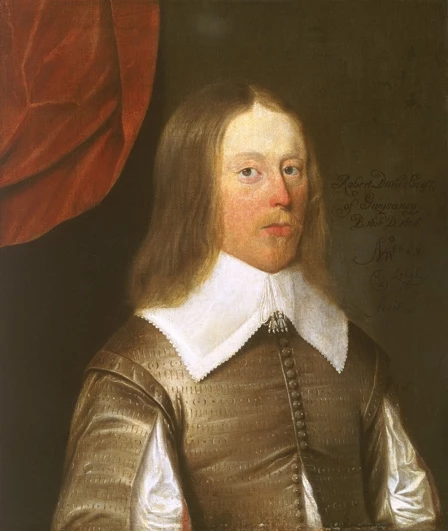
Fig.1: Thomas Leigh, Robert Davies III of Gwysaney, 1643, NMW A 20
Fig.2: Thomas Leigh, Anne Davies, 1643, NMW A 21
List of portraits by Thomas Leigh
Robert Davies of Gwysaney, 1643 (Amgueddfa Cymru, fig.1)
Anne Davies of Gwysaney, 1643 (Amgueddfa Cymru, fig.2)
Robert Davies of Gwysaney, 1643 (private collection)
Anne Davies of Gwysaney, 1643 (private collection)
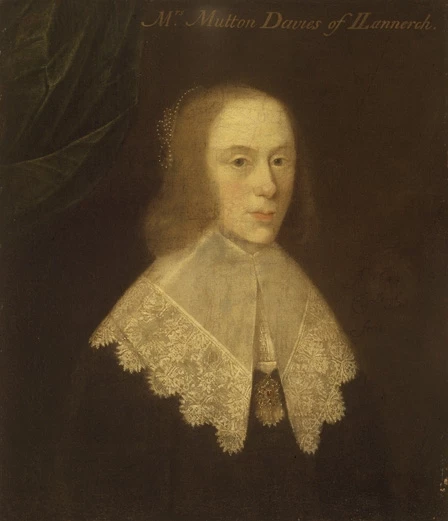
Eleanor Mutton, 1643 (private collection)
Margaret Lloyd of Esclus, 1643 (private collection)
Robert Ashley, c.1656 (Middle Temple Library, London)
Aston Cokayne, c.1635-40 (location unknown)
Unknown Lady called Countess of Derby, 1634 (location unknown)
Thomas Heyton, 1634 (National Trust, Trerice)
Isabel Heyton, 1634 (National Trust, Trerice)
David, 1st Earl Barrymore (location unknown)
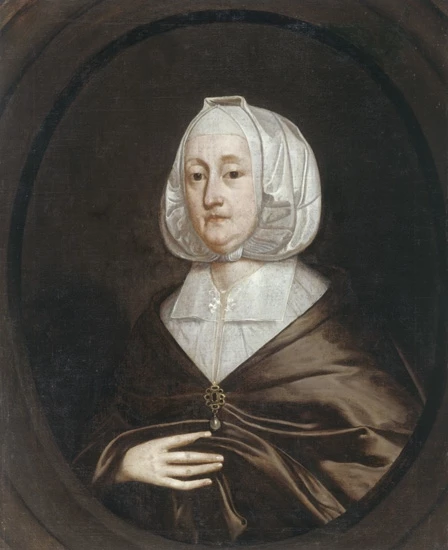
Fig.3: Unknown British artist, Lady Mutton, about 1640, NMW A 3742
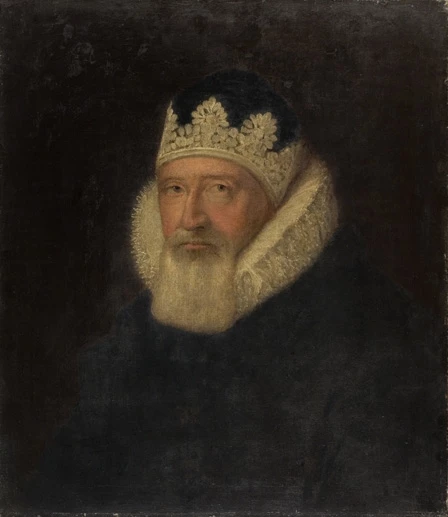
Fig.4: Unknown British artist, Sir Peter Mutton, 17th century, NMW A 3741
Fig.5: Unknown British artist, Llanerch, Denbighshire, Wales, c. 1667, Yale Center for British Art, Paul Mellon Collection B1976.7.115
In search of a forgotten painter
The process of rediscovering a 'lost' identity involves much trawling through original documents and inventories in local archives. Such searches can yield surprising results.
The earliest found reference tells us Leigh was in London in 1613/14, where he was twice called to court: firstly for setting a prisoner loose and secondly for getting into a dispute with a boatman! 2 Records indicate he then left London for Chester, where he began to work for established local painters, including John Souch.
A document found in the Cheshire archives produced an unexpected twist. There it is recorded that in 1642 the painter Edward Bellen took on two new journeymen: Thomas Leigh and his son.3 This new piece of evidence suggests that there were in fact two painters called 'T. Leigh', father and son, and that they worked together at one point.
A Cheshire man?
Evidence suggests that the Leighs not only worked in Cheshire, but most likely came from there too. We may never be able to firmly establish their identities however, as almost twenty Thomas Leighs are recorded as living there in the 17th century — and there may have been more!
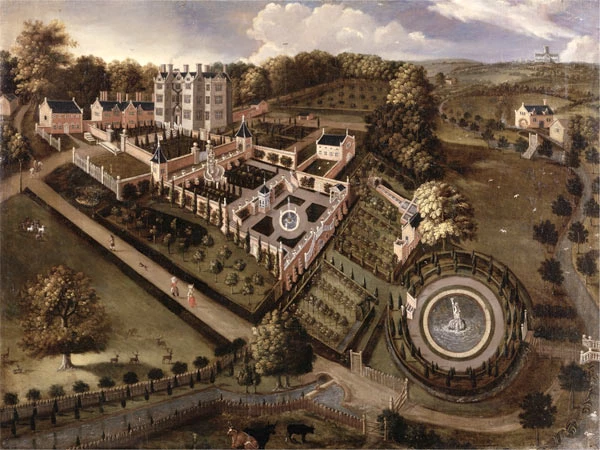
A large circle of painters were active in 17th-century Chester. Most painted houses, coats of arms and heralds, but the more ambitious tried their hand at portraiture, to meet a growing demand among the gentry for portraits to hang in their country houses.
Many portrait painters active in Britain during this period were foreign-born. They brought with them new styles and advanced painting techniques which influenced British painters. Leigh appears to have been influenced by the quiet naturalism of Cornelius Johnson, who was born to Dutch parents. Some believe he may even have trained under him.4
The Davies family portraits
Amgueddfa Cymru owns two portraits by Thomas Leigh — those of Robert Davies of Gwysaney, and his wife Anne (figs.1-2). Both were painted in 1643 to hang at Llannerch Hall, the home of Anne's parents, Sir Peter Mutton and his wife (figs.3-5). Leigh also painted Anne's sister Eleanor, but the current location of her portrait is unknown.
It was common practice for painters to produce copies of portraits for different members of a family, and Thomas Leigh painted identical versions of these to hang at Gwysaney, the Davies family estate.
We do not know why the Davies family commissioned this group of portraits at this point in time, but it may indicate a sense of family pride and achievement. Just a decade earlier Robert had married Anne - who was just 12 years old at the time - uniting the estates of Gwysaney and Llannerch.
Can you help?
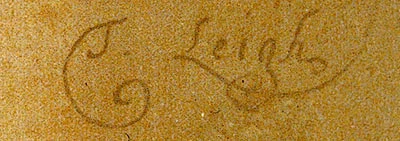
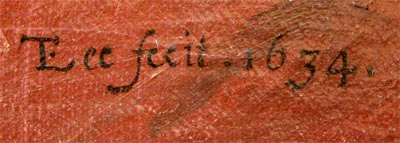
Few painters in the early 17th century signed their work, but two different signatures have been left behind by the Leighs. It is tempting to speculate that one is the signature of the elder Leigh, and the other of his son, but this is difficult to prove.
There are doubtless other portraits by Thomas Leigh waiting to be discovered. Have you seen his signature on a portrait other than those listed? It may provide the missing link which could shed more light on the life of these elusive family painters!
Signature 1
Signature 2 - Reproduced with kind permission of The National Trust, Trerice
Further Reading
Stephanie Roberts and Robert Tittler, ‘Discovering ‘T.Leigh’: Tracking the elusive portrait painter through Stuart England and Wales’, British Art Journal X1:2 (2010/11), pp.24-30
'Sessions, 1613: 28 and 30 June' and 'Sessions, 1614: 5 and 6 May', County of Middlesex. Calendar to the sessions records: new series, vol.1: 1612-14 (1935), pp. 117-154 and 400-452;
Chester Archive MS G17/2, Minutes of the Company of Painters, Glaziers, Embroiderers and Stationers of Chester 1620-1836, unpagenated vide 1642
J. D. Milner, 'Two English Portrait Painters', Burlington Magazine 29:165 (Dec. 1916), p.374
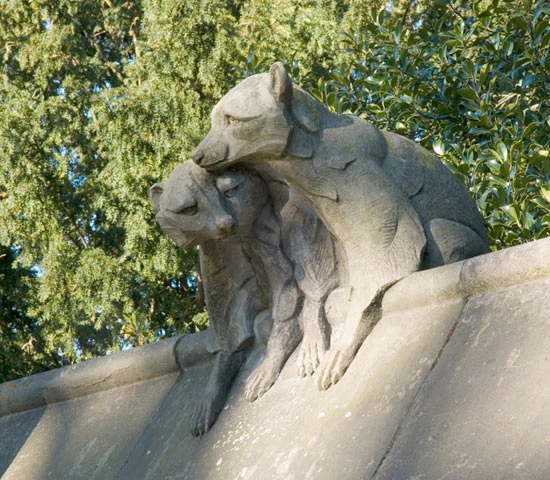
In 1881, William Goscombe John assisted in creating the sculptures for Cardiff Castle's Animal Wall
Edwardian Wales, newly wealthy from coal, iron and steel, provided rich opportunities for a sculptor. William Goscombe John's public monuments can be found all over Wales, but nowhere more than in his native Cardiff. He also modelled the prize medals still awarded by the National Eisteddfod today.
Making his way
He was born William John in Cardiff in March 1860. He assumed the name Goscombe from a Gloucestershire village near his mother's old home. His father Thomas John was a woodcarver in the workshops set up by Lord Bute for the restoration of Cardiff Castle. William joined his father at the age of 14, while also studying drawing at Cardiff School of Art.
In 1881 he went to London as a pupil assistant to Thomas Nicholls, the sculptor responsible for the Castle's Animal Wall. He continued his studies at the Kennington School of Art and, from 1884, at the Royal Academy Schools, where he was taught naturalistic modelling in clay in the French manner introduced in London in the 1870s by Jules Dalou.
He was an outstanding student, and travelled widely. He spent a year in Paris, including a period in Rodin's studio. In 1890 he returned to London and settled in St John's Wood.
His sculpture Morpheus, shown in the Paris Salon of 1892, clearly shows Rodin's influence.
The 'New Sculpture'
British sculptors of John's generation were trying to make sculpture more dynamic through the vigorously naturalistic representation of the human body. They represent the final flowering of a sculptural tradition that had its roots in the Renaissance, and was revitalised by Rodin and his contemporaries in mid nineteenth-century France. John followed the success of Morpheus with a statue of John the Baptist for Lord Bute, and by a group of life-size nudes including Boy at Play and The Elf. These show complete mastery of anatomical form.
By the end of the 1890s Goscombe John had firmly established himself, exhibiting his work both nationally and internationally. He was beginning to win big public commissions and in the years leading up to the First World War he was extremely busy.
Wales and the Empire
Although based in London, John was careful to position himself as Wales's national sculptor. In 1916 he contributed the central marble figure St David Blessing the People to a group of ten figures made for Cardiff City Hall. He also received commissions for portraits from the leading Welshmen of the day. John may have built his career on local patronage, but he attracted work from across the Empire, such as his tomb in Westminster Abbey to Conservative Prime Minister Lord Salisbury, and his equestrian statue of King Edward VII in Capetown.
His first major public sculpture was the King's Regiment memorial (1905) in the centre of Liverpool, incorporating soldiers from the regiment's history, including the vast Drummer Boy, which is his best-known work.
The Welsh and the Imperial came together in the commission for the regalia for the investiture of the future Edward VIII as Prince of Wales at Caernarfon Castle in 1911. John designed a crown, a ring, a sceptre and a sword that contained a 'Welsh' iconography of dragons, daffodils and Celtic interlace.
John had little sympathy with what he termed the 'Easter Island' style of modern sculpture, with its emphasis on direct carving in stone. Critical opinion was already beginning to leave him behind by 1914, but the First World War tragically brought new commissions for memorials, including many in Wales.
Goscombe John and the National Museum
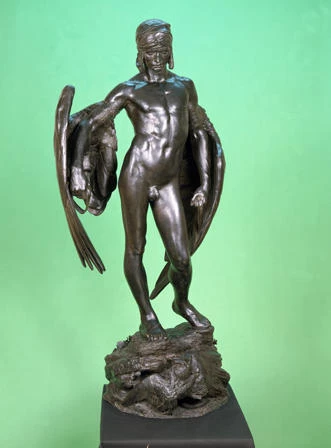
Goscombe John was one of the founding fathers of Amgueddfa Cymru. He served on the governing Council for over forty years, and played a major role in establishing the future direction of the art collection. As well as a complete representation of his own work, his gifts to the Museum included work by many of his fellows in the New Sculpture movement, among them the primary cast of Alfred Gilbert's Icarus, and by many other artists he admired.
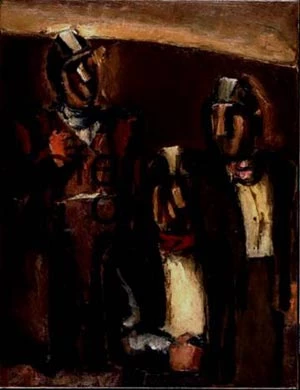
NMW A(L) 561
Josef Herman
Three Welsh Miners
About 1966
Oil on canvas
66 x 51 cms
On loan from the Derek Williams Trust since 1984
Copyright of Artist's Estate
Derek Mathias Tudor Williams F.R.I.C.S. (1929-1984) has been the greatest benefactor to Amgueddfa Cymru – National Museum Wales since Gwendoline and Margaret Davies.
Derek Williams was a modest and private man, based in Cardiff and Pontypridd as a chartered surveyor, who enjoyed many pursuits, including golf, opera, photography, but most of all collecting contemporary art. He gained immense satisfaction from building his collection and displaying it within his numerous residences.
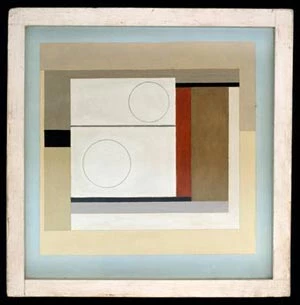
The collection contains a large number of works by the British neo-romantics, including Ceri Richards, John Piper, David Jones and Keith Vaughan. This element is supported by the work of other artists of this period such as Lucian Freud, Josef Herman, Ivon Hitchens, Graham Sutherland, Ben Nicholson and Henry Moore.
In 1984 Derek Williams died, requesting in his Will that his collection and the residue of his estate be held in trust, allowing his trustees to undertake the care and public display of the works of art, in addition to contributing to the enhancement of the collection. The Derek Williams Trust was formed by his executors in 1992, which in the following year made a formal agreement with the Museum to work together in order to fulfil the wishes of Derek Williams.
The Trust’s collection has since been on long-term loan to the Museum and there have been over fifty works added and more continue to be acquired every year. A number of pictures by leading painters of the 1970s, ‘80s and ‘90s, including Michael Craig-Martin, Craigie Aitchison, Sean Scully and Howard Hodgkin form a strong component of the new additions.
The original Derek Williams collection continues to be strengthened and consolidated by the purchase of major works by artists of the mid-twentieth century, among them Ceri Richards, Henry Moore, John Minton and Edward Burra. Interest in contemporary international art has been expressed through the regular purchase of works by artists featured in Artes Mundi.
Applied arts are not overlooked by the Derek Williams Trust as they possess an active interest in this area and have acquired eleven works of applied art over the last sixteen years, in addition to assisting the Museum with a number of acquisitions, particularly in the field of ceramics.
The Trust also has an interest in work by contemporary Welsh and Wales-based artists, which includes the purchase of work by Eisteddfod Gold Medal-winners.
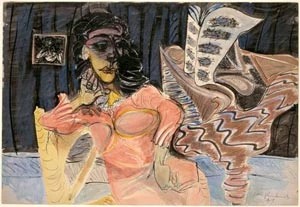
The great generosity and support of The Derek Williams Trust made possible many acquisitions of post-1900 art for the Museum’s own modern art collection, such as David Hockney, Stanley Spencer and Pablo Picasso.
NMW A(L) 561
Josef Herman
Three Welsh Miners
About 1966
Oil on canvas
66 x 51 cms
On loan from the Derek Williams Trust since 1984
Copyright of Artist's Estate