: Evolution & Extinction

The Ghost Orchid: one of Britain's rarest plants

3 July 2013

The Herefordshire Ghost Orchid, 2009

The Herefordshire Ghost Orchid, 2009

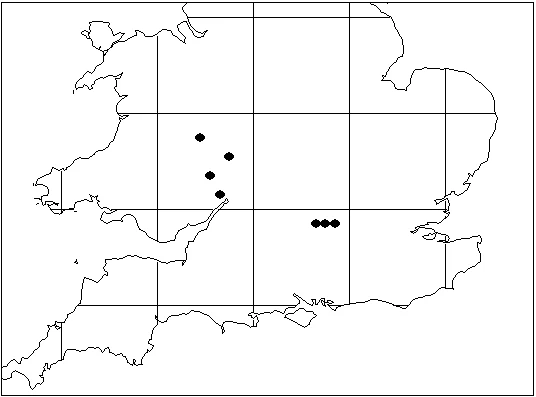
Distribution map of Ghost Orchids in Britain (all records: data courtesy of Botanical Society of the British Isles 2013).

Distribution map of Ghost Orchids in Britain (all records: data courtesy of Botanical Society of the British Isles 2013).

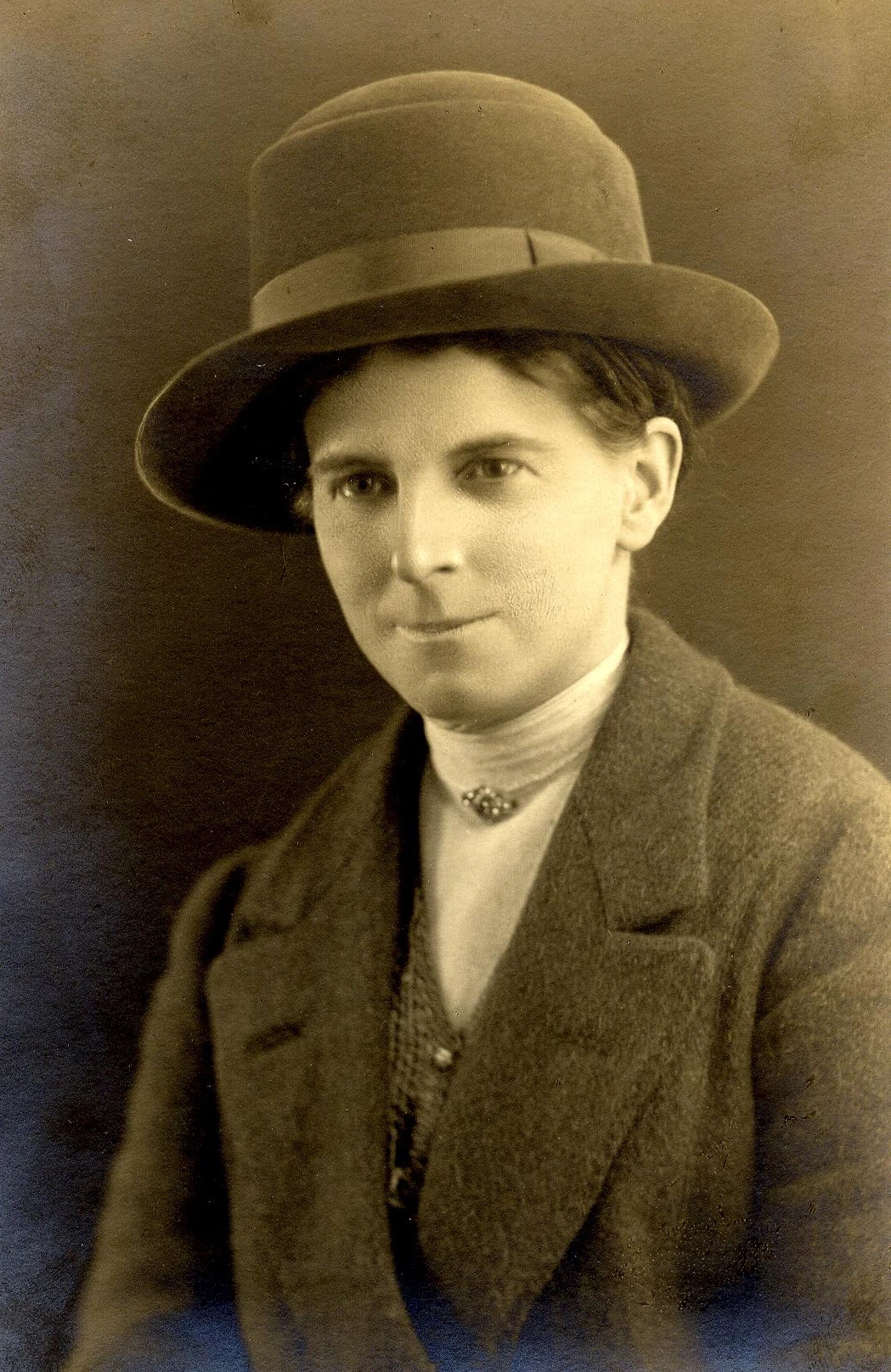
Eleanor Vachell, c. 1930.

Eleanor Vachell, c. 1930.

A 1953 Ghost Orchid collected by Rex Graham

A 1953 Ghost Orchid collected by Rex Graham

The 1982 Herefordshire Ghost Orchid preserved in formalin

The 1982 Herefordshire Ghost Orchid preserved in formalin

The Welsh National Herbarium at Amguedfa Cymru has a small - but very precious - collection of Ghost Orchids (Epipogium aphyllum Sw.); is this something to be proud of, or should they have been left in the wild? The answer lies in the donations to the Museum, and slugs...

Ghost Orchids are among the rarest plants in Britain. They have been found in about 11 sites in the Chilterns and West Midlands in England, but such is their rarity and the secrecy surrounding them that it is difficult to be sure exactly how many sites there are.

Regarded as extinct

Ghost Orchids were first discovered in Britain in 1854 but were only seen 11 times before the 1950s. They were seen regularly in a few Chilterns sites between 1953 and 1987 but then disappeared and were regarded as extinct until one plant was discovered in 2009. In most sites they have only been seen once, and rarely for more than ten years in any one site.

Ghost orchids - a fleeting occurrence in dark, shaded woods

Ghost Orchids get their name from their creamy-white to pinkish-brown colour and their fleeting occurrences in dark, shaded woods. The colour results from the absence of chlorophyll, as they are parasites of fungi associated with tree roots, and they do not need to photosynthesise their own food. They spend most of their lives as rhizomes (underground shoots) in the soil or leaf litter of woodlands, and flowering shoots only occasionally appear above ground. Even then, their small size (usually less than 15cm, rarely up to 23cm) and unpredictable appearance between June and October means that Ghost Orchids are rarely seen.

Until recently the only British specimen held by Amgueddfa Cymru was a scrap of rhizome collected for Eleanor Vachell in 1926 - her herbarium is one of the most comprehensive ever put together by a British botanist - who donated her collection to the Museum when she died in 1949. The story of how the fragment of Ghost Orchid was discovered is given in her botanical diary:

"28 May 1926. The telephone bell summoned Mr [Francis] Druce to receive a message from Mr Wilmott of the British Museum. Epipogium aphyllum had been found in Oxfordshire by a young girl and had been shown to Dr [George Claridge] Druce and Mrs Wedgwood. Now Mr Wilmott had found out the name of the wood and was ready to give all information!!! Excitement knew no bounds. Mr Druce rang up Elsie Knowling inviting her to join the search and a taxi was hurriedly summoned to take E.V. [=Eleanor Vachell] and Mr Druce to the British Museum to collect the particulars from Mr Wilmott. The little party walked to the wood where the single specimen had been found and searched diligently that part of the wood marked in the map lent by Mr Wilmott but without success, though they spread out widely in both directions... Completely baffled, the trio, at E.V.'s suggestion, returned to the town to search for the finder. After many enquiries had been made they were directed to a nice house, the home of Mrs I. ?, who was fortunately in when they called. E.V. acted spokesman. Mrs I. was most kind and after giving them a small sketch of the flower told them the name of the street where the girl who had found it lived. Off they started once more. The girl too was at home and there in a vase was another flower of Epipogium! In vain did Mr Druce plead with her to part with it but she was adamant! Before long however she had promised to show the place to which she had lead Dr Druce and Mrs Wedgwood and from which the two specimens had been gathered. Off again. This time straight to the right place, but there was nothing to be seen of Epipogium! 2 June 1926. A day to spare! Why not have one more hunt for Epipogium? Arriving at the wood, E.V. crept stealthily to the exact spot from which the specimen had been taken and kneeling down carefully, with their fingers they removed a little soil, exposing the stem of the orchid, to which were attached tiny tuberous rootlets! Undoubtedly the stem of Dr Druce's specimen! Making careful measurements for Mr Druce, they replaced the earth, covered the tiny hole with twigs and leaf-mould and fled home triumphant, possessed of a secret that they were forbidden to share with anyone except Mr Druce and Mr Wilmott. A few days later E.V. received from Mr Druce an excited letter of thanks and a box of earth containing a tiny rootlet that he had found in the exact spot they had indicated." [Source: Forty, M. & Rich, T. C. G., eds. (2006). The botanist. The botanical diary of Eleanor Vachell (1879-1948). National Museum of Wales, Cardiff.]

Eleanor shared the rootlet with her great friend Elsie Knowling, who also had a herbarium. Coincidentally, the two fragments have been reunited at the Museum after being apart for 84 years.

In 1953, Elsie's son Rex Graham stumbled across 22 Ghost Orchids in a Buckinghamshire wood, the largest colony of ever seen in Britain (Graham 1953). This was the first time that Ghost Orchids had been seen for 20 years and it made the national press. At the time Rex collected only three specimens, but over the next few years he collected more when they were found eaten off by slugs. Eventually Rex had four specimens for his own herbarium, to add to the scrap in his mother's herbarium. The Ghost Orchids were amongst the treasures in Graham & Harley herbarium, which was donated to Amgueddfa Cymru in 2010.

The third collection is the Museum's only specimen preserved in spirit (rather than being pressed and dried) so that the three dimensional structure of the flower can be seen. Dr Valerie Richards (formerly Coombs) was looking for wild orchids in Herefordshire in 1982 when she discovered a single ghost orchid in a new site. When she took a local botanist to the site a few days later, a slug had eaten through the stem. She picked it up and took it home and preserved it in formalin like the zoological specimens she had been used to working with during her university days. The specimen was kindly donated to the Museum in 2013.

The fourth and final collection resulted from the hard work and intuition of Mark Jannink combined with another hungry slug. Mark wondered if Ghost Orchids flowered more frequently after cold winters. He researched all previous Ghost Orchid discoveries - their preferred habitat, time of flowering and weather patterns - then staked out ten possible sites in the West Midlands, visiting them every two weeks throughout the summer of 2009, following the first cold winter for many years. Finally in September, he discovered one small specimen - causing great excitement amongst botanists, as the Ghost Orchid had been declared officially extinct in 2005! Mark returned several times over the next few days as the plant gradually faded and 'browned', until the stem was once again eaten through by slugs. The remains were collected and pressed, and donated to our herbarium shortly after.

So five of the seven British Ghost Orchids in Amgueddfa Cymru have been collected as a consequence of slugs, which are more of a threat than botanists. The Ghost Orchids are fully protected by law under the Wildlife and Countryside Act 1981 but nobody seems to have told that to the slugs!

We also have eight specimens from Europe, where Ghost Orchids are more widespread, though still rare. One of our best specimens was collected by W. A. Sledge in Switzerland.

You are welcome to visit the Welsh National Herbarium to see the Ghost Orchids, but don't expected us to reveal where they were found! And please leave your slugs at home.

Adapted for the website from the following article:

The Ghost Orchid Collection [PDF]
The scrap of Ghost Orchid rootlet in Eleanor Vachell's herbarium.  Also attached to the specimen are Dr George Claridge Druce's  (1924) account of it from <em>Gardeners Chronicle</em> series 3 volume 76, page 114 and two small sketches by Miss Baumgartner

The scrap of Ghost Orchid rootlet in Eleanor Vachell's herbarium. Also attached to the specimen are Dr George Claridge Druce's (1924) account of it from Gardeners Chronicle series 3 volume 76, page 114 and two small sketches by Miss Baumgartner.

Swiss Ghost Orchids collected by W. A. Sledge in 1955.

Swiss Ghost Orchids collected by W. A. Sledge in 1955.

The 2009 Ghost Orchid from Herefordshire.

The 2009 Ghost Orchid from Herefordshire.

References

  • Graham, R. A. (1953). Epipogium aphyllum Sw. in Buckinghamshire. Watsonia 3: 33 and tab. (http://archive.bsbi.org.uk/Wats3p33.pdf ).
  • Harley, R. M. (1962). Obituary: Rex Alan Henry Graham. Proceedings of the Botanical Society of the British Isles 4: 505-507.

For further information on Ghost Orchids see:

  • Farrell, L. (1999) Epipogium aphyllum Sw. page 136 in Wigginton, M. J. (1999) British Red Data Books 1. Vascular plants. 3rd edition. JNCC, Peterborough.
  • Foley, M. J. Y. & Clark, S. (2005) Orchids of the British Isles. The Griffin Press, Maidenhead.
  • Jannink, M. & Rich, T. C. G. (2010). Ghost orchid rediscovered in Britain after 23 years. Journal of the Hardy Orchid Society 7: 14-15.
  • Taylor, L. & Roberts, D. L. (2011). Biological Flora of the British Isles: Epipogium aphyllum Sw. Journal of Ecology 99: 878–890. http://onlinelibrary.wiley.com/doi/10.1111/j.1365-2745.2011.01839.x/abstract:

Ancient fossil meets modern technology

Christian Baars, 17 December 2012

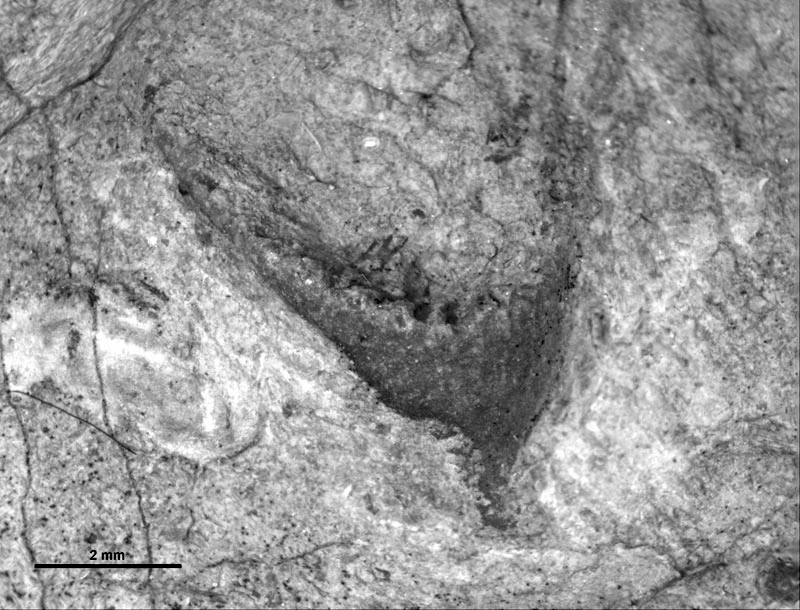
Part of a rock containing a fossil coral which is only just visible. Most of the fossil is hidden inside the rock.

Part of a rock containing a fossil coral which is only just visible. Most of the fossil is hidden inside the rock.

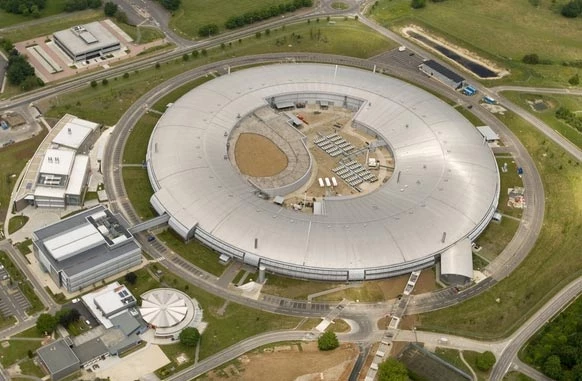
Diamond Light Source synchrotron facility at Didcot, Oxfordshire

Small fossils require large machines: the Diamond Light Source synchrotron facility at Didcot, Oxfordshire.

Fossils often need to be carefully prepared before they can be identified by palaeontologists and traditional methods can damage the specimen irreversibly. Scientists at Amgueddfa Cymru are experimenting with new technologies to study ancient fossils in minute detail with no damage to the specimen whatsoever.

The preparation of fossils for identification and study often requires the surrounding rock to be removed. A variety of tools are used for this, including specialist equipment such as pneumatic pens driven by compressed air and air-abrasive machines which work like miniature sandblasters. In some cases the surrounding rock can be dissolved away from the fossil

.

Destructive techniques

These preparation methods will reveal the surface of a fossil but to identify some specimens we must look inside them. Certain fossil groups are routinely examined using destructive techniques. For example, to study the internal structure of corals, bryozoans and brachiopods, specimens are cut up (sectioned) into slices so thin that we can shine light through them and examine them under a microscope. These slices are known as 'thin sections'.

Sometimes it is not desirable to remove the rock or to cut up the specimen. The fossil may be very delicate and break during preparation. Or, if the fossil is very rare, we would rather not use a destructive technique as it may be difficult or even impossible to replace the fossil.

Non destructive X-Ray tomography

In these instances, it is now possible to use X-rays to build up a virtual three-dimensional image. The technique is called X-ray tomography. As rock is much denser than living tissue, X-ray tomography of fossils requires a more powerful radiation source than a hospital X-ray machine. The Diamond Light Source Synchrotron at Didcot, Oxfordshire is one such facility, the only one in the UK. This machine is in the shape of a giant donut with a diameter of 300 meters. It accelerates charged particles (electrons) through sequences of magnets to almost the speed of light, producing the X-rays.

This method was recently used by Amgueddfa Cymru scientists to investigate a small fossil found in Ordovician rocks 462 million years old in Iran. It was half buried in the rock and appeared to be a solitary rugose coral. The conventional approach to identifying rugose corals – to slice into thin sections – was rejected because of the small size and rarity of the specimen. Instead we took it to Didcot for X-ray tomography.

The new technique worked very well and we managed to obtain spectacular 3D images, and even and virtual thin sections – without any damage to the fossil itself. From these, we determined the internal structure of the fossil and concluded that the specimen was indeed a coral, probably a species of the genus Lambelasma.

It is approximately 5 million years older than the earliest previously described rugose coral, making it a significant addition to our knowledge of early life on our planet.

Part of a rock containing a fossil coral which is only just visible. Most of the fossil is hidden inside the rock.

Successive images from synchrotron X-ray tomography reveal the internal structures of the fossil coral

See Also:

Read the latest news from Diamond Light Sourse website: Researchers discover earliest record of rugose coral

Microscopic designs: Ernest Heath's collection of Foraminifera

5 January 2012

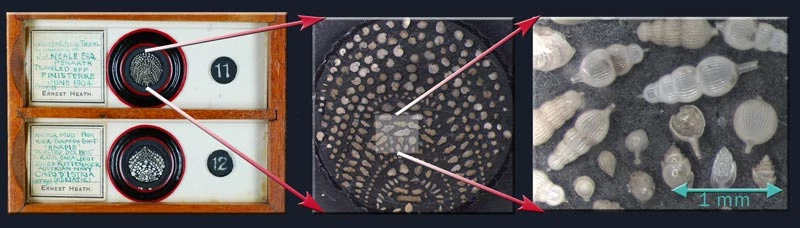
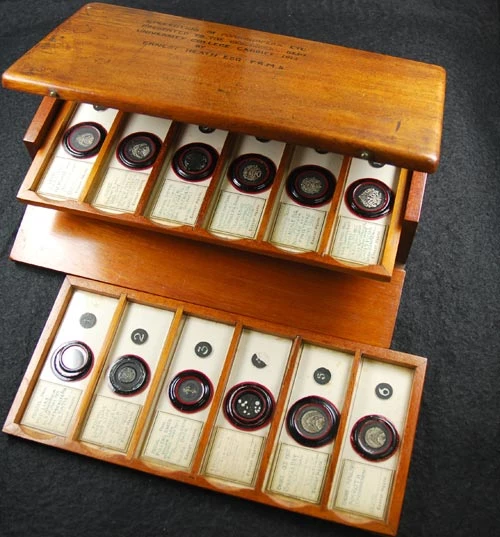
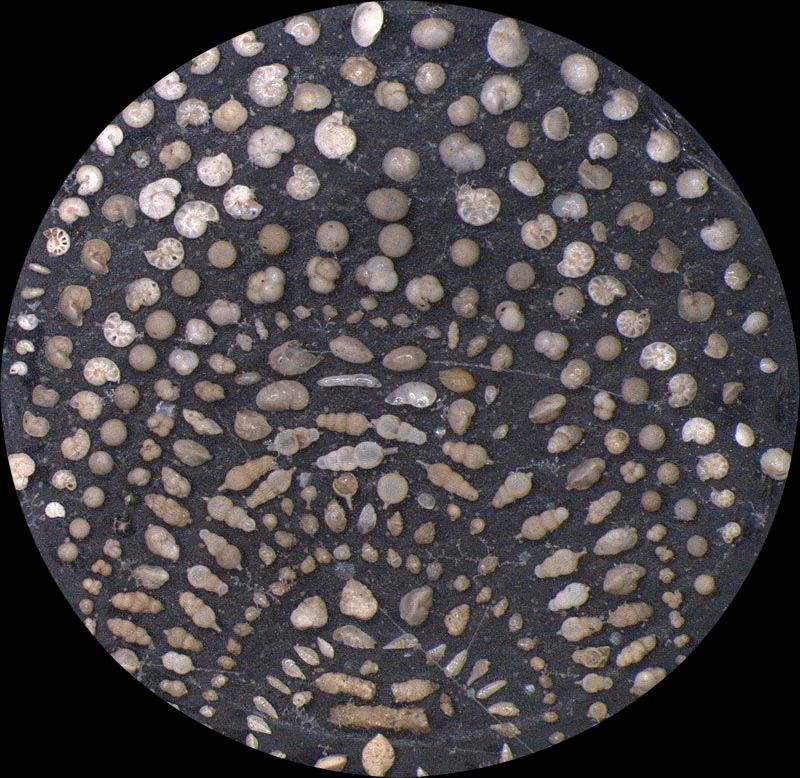
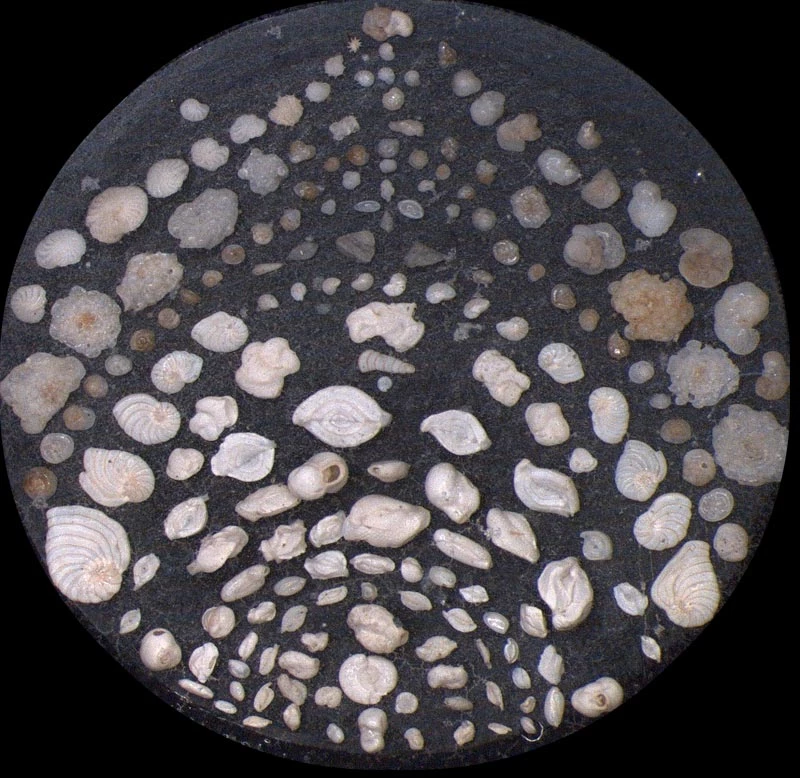
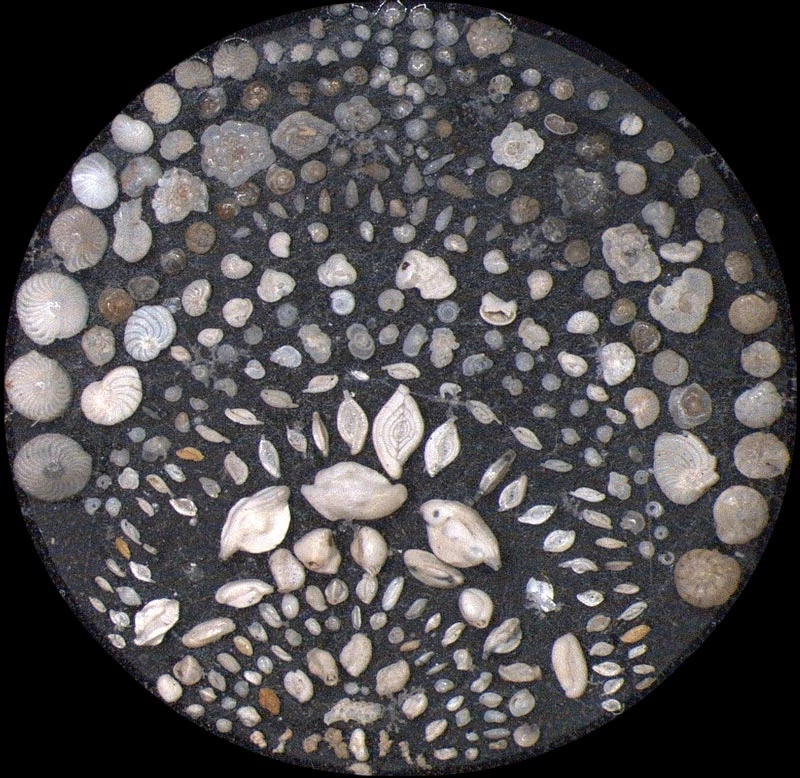
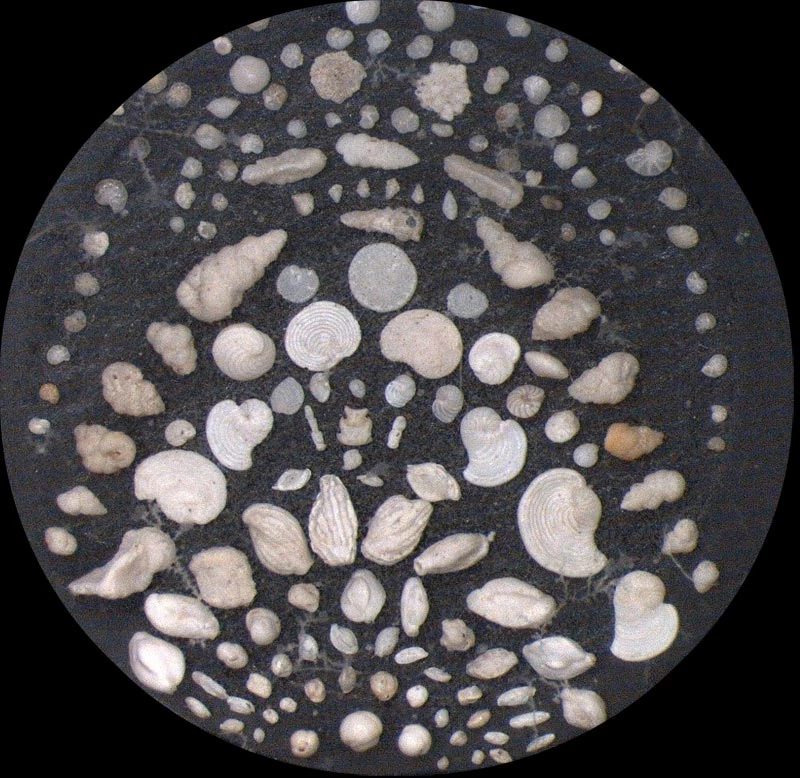
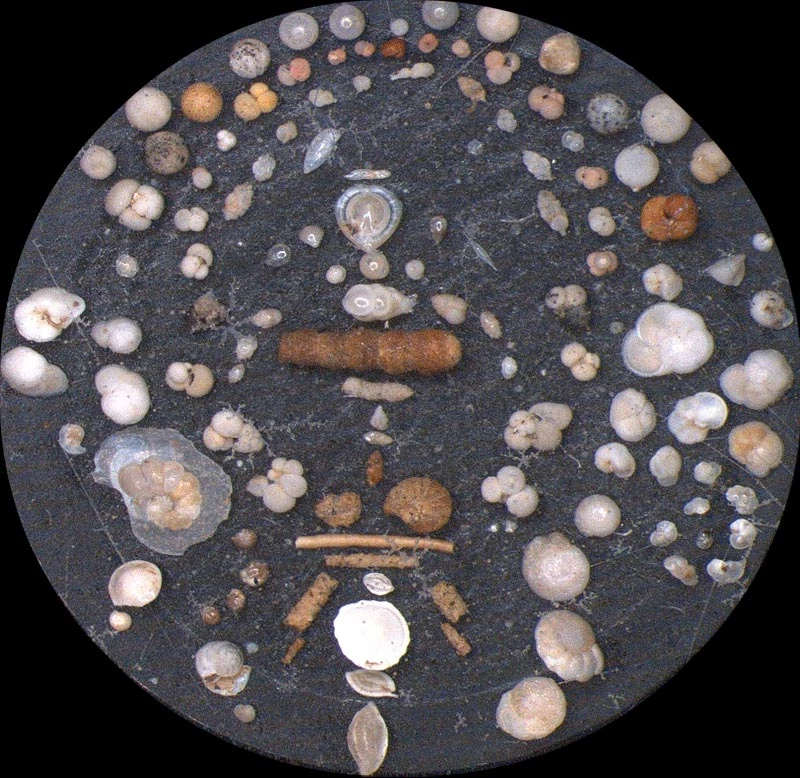
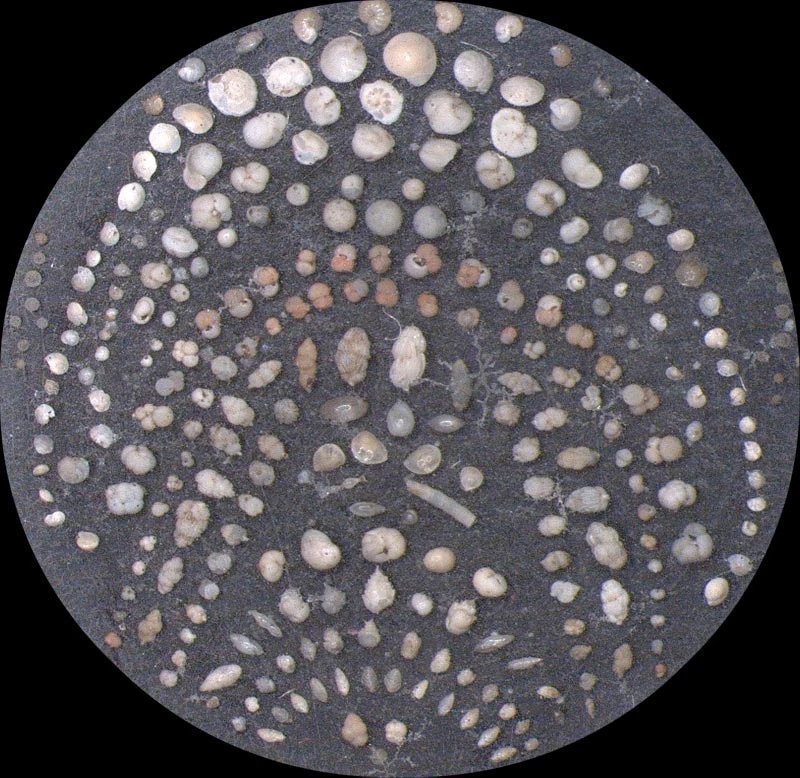
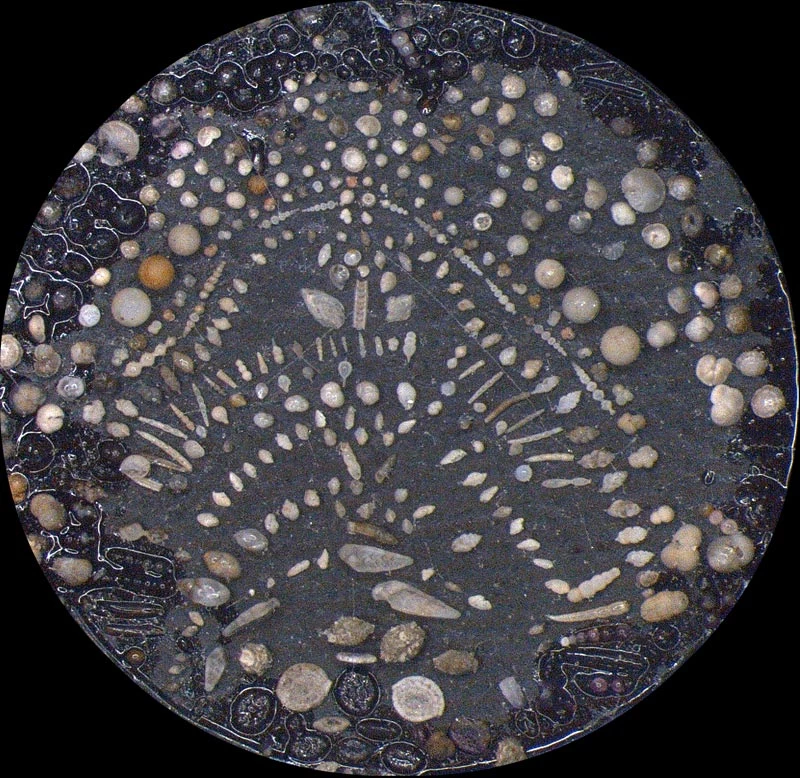
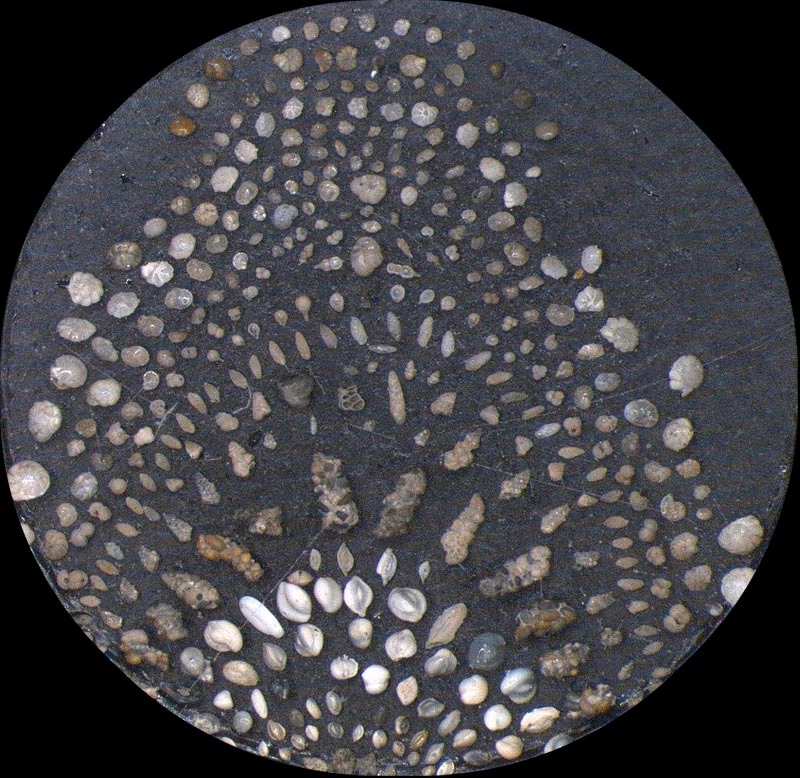
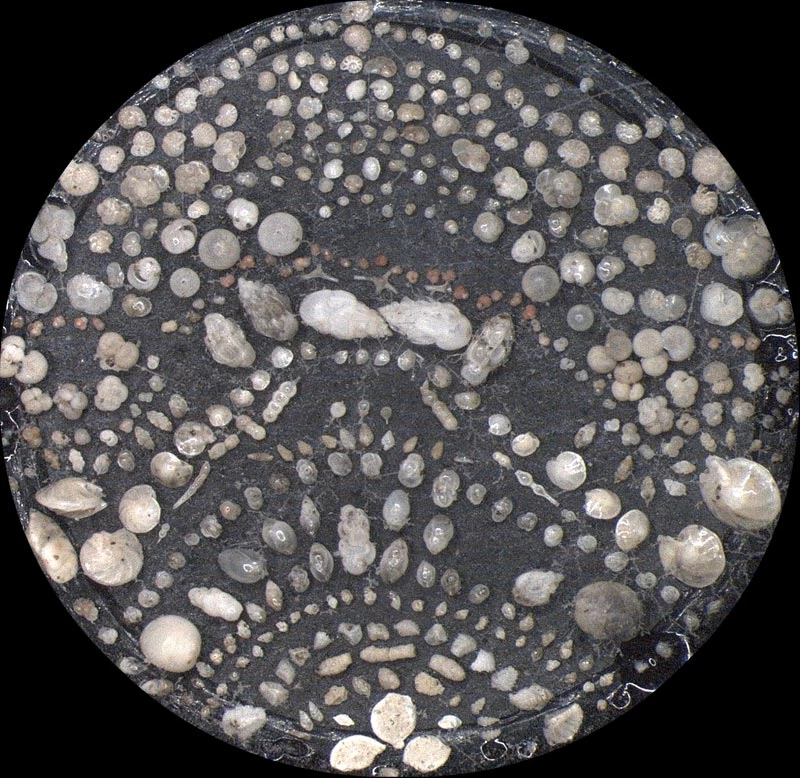
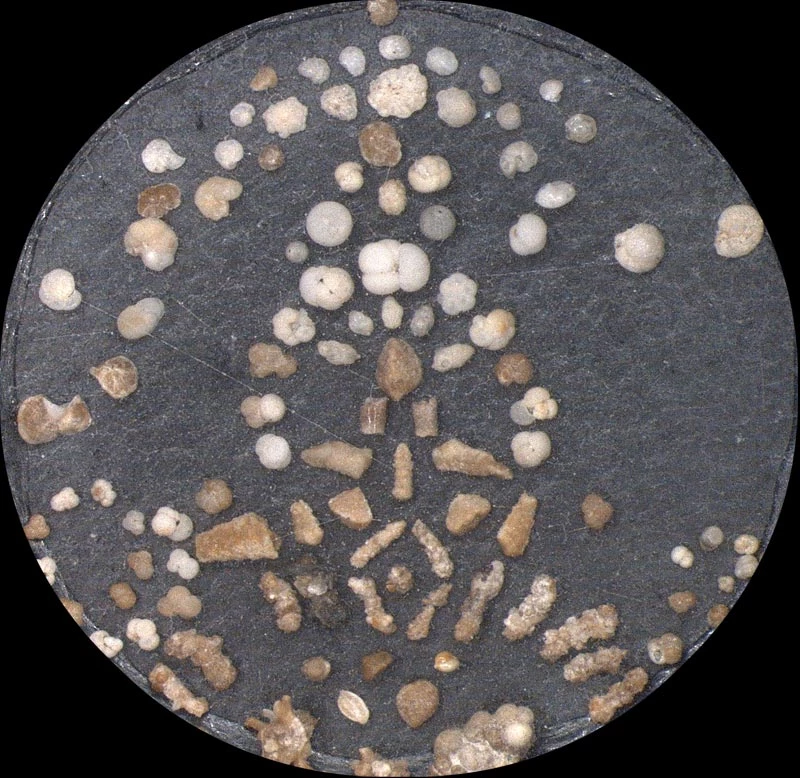
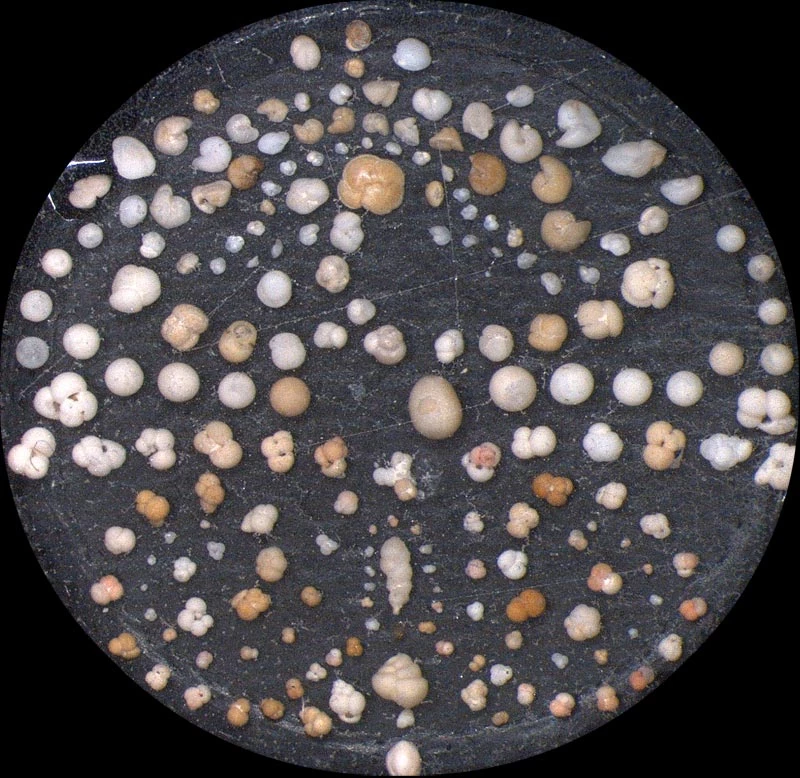
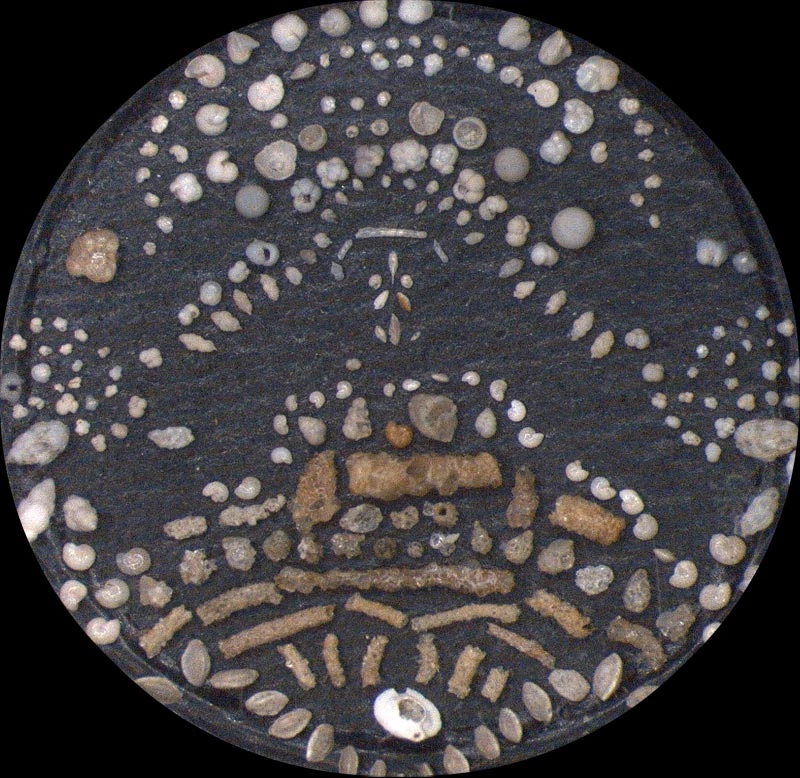
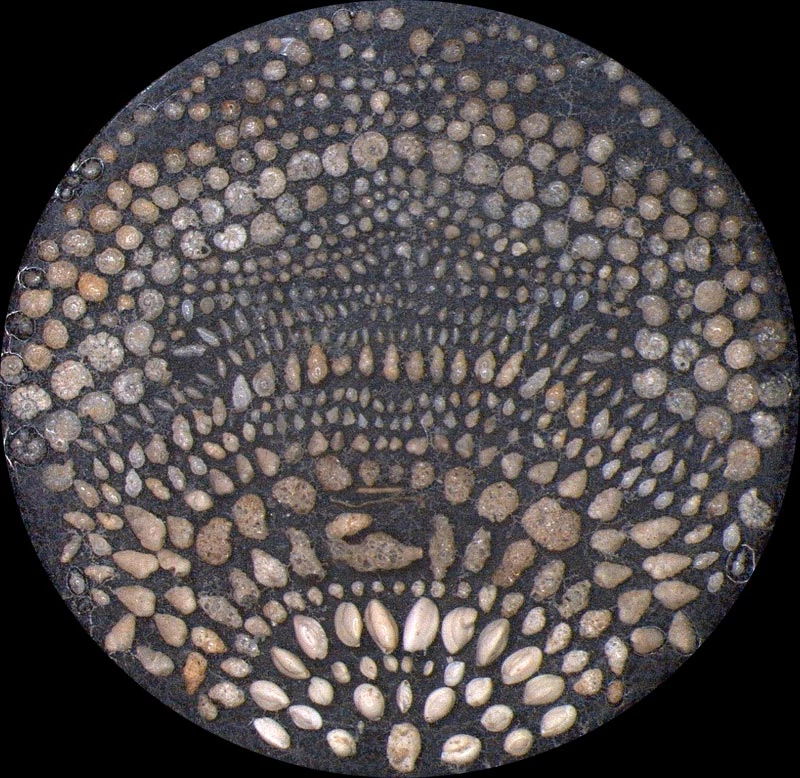
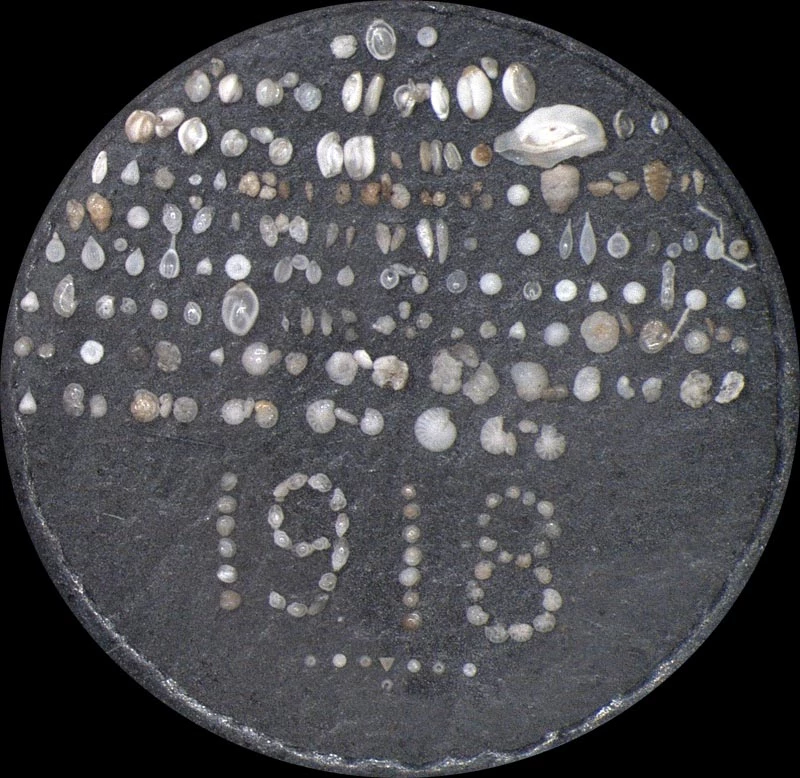
The Ernest Heath slide collection

The Ernest Heath slide collection

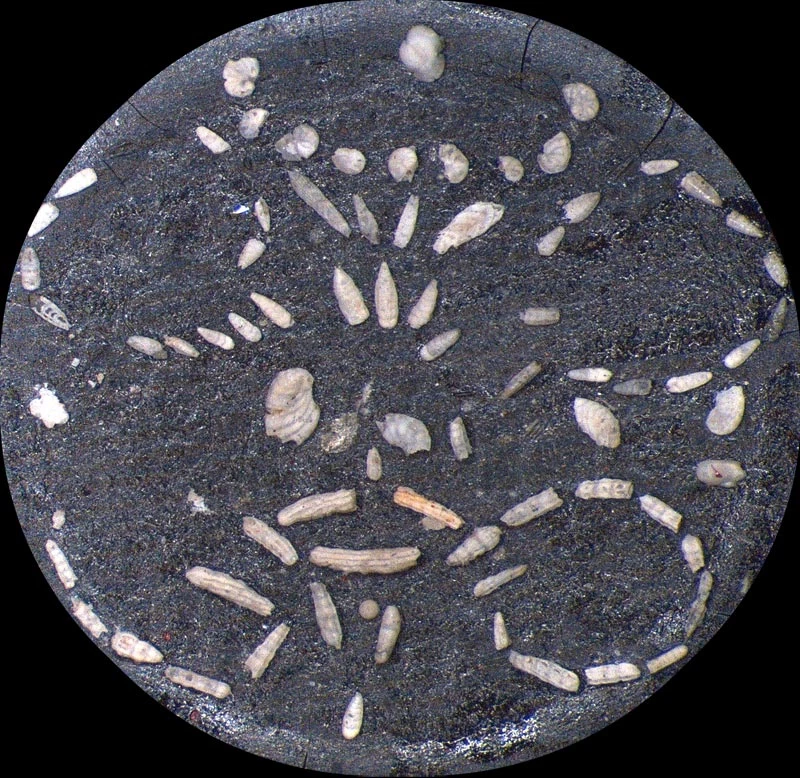
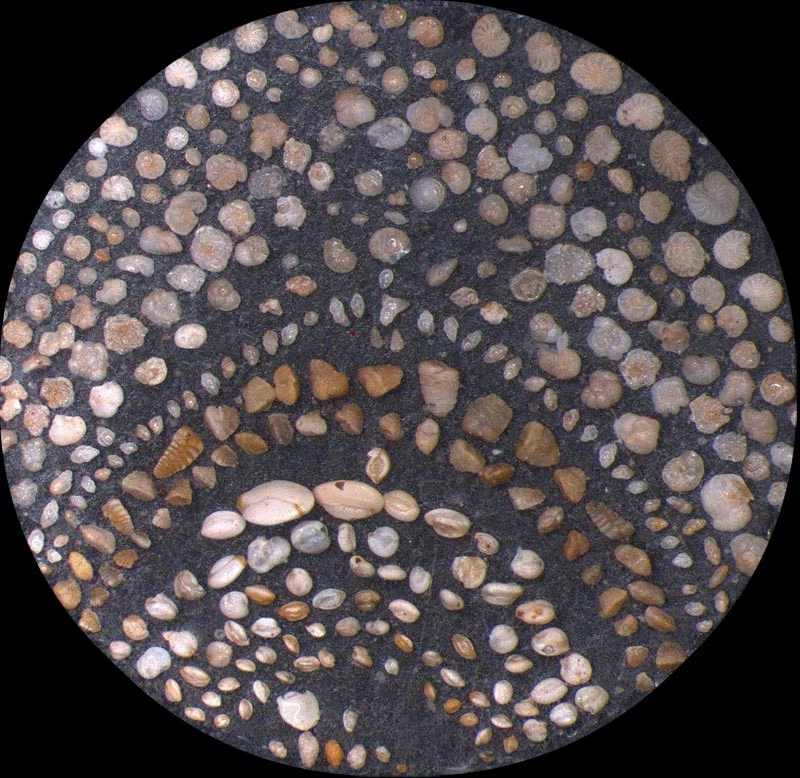
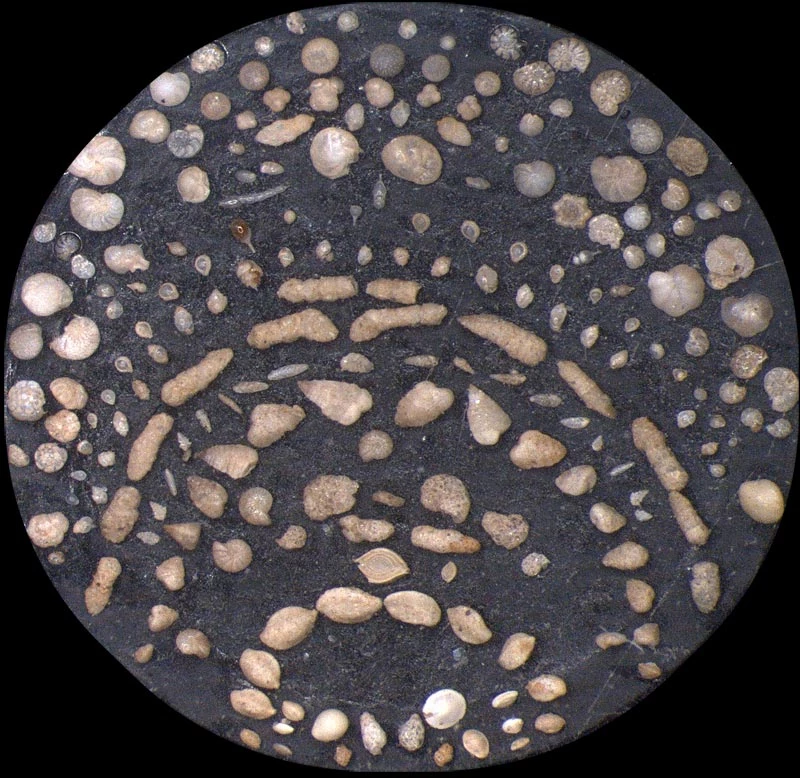
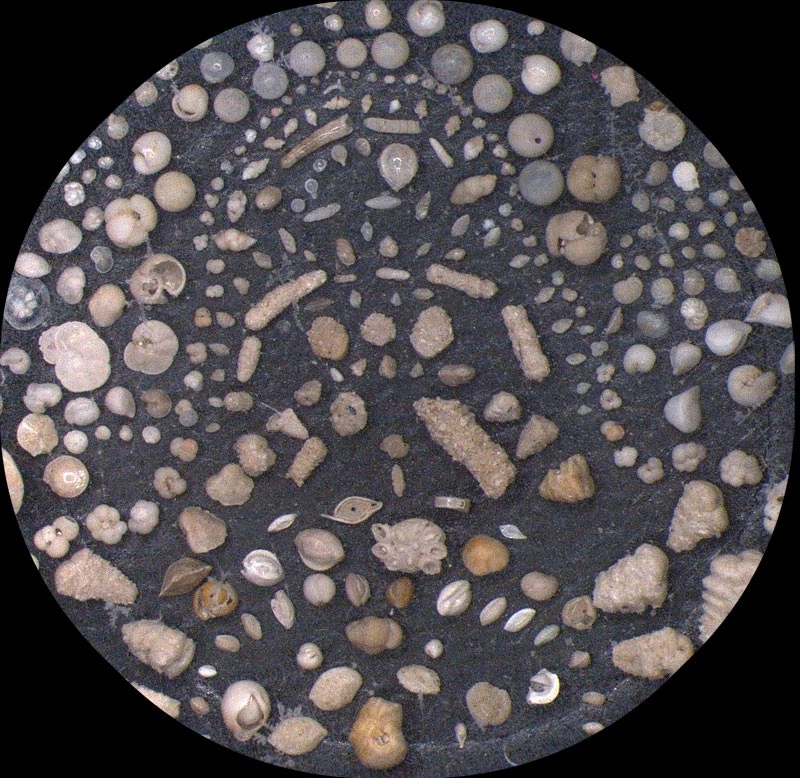
Would you have the patience to create tiny patterns like these?

Imagine yourself back in the early 1900's with no TV or internet for entertainment. Luckily affordable microscopes are the latest thing and you've started collecting weird and wonderful objects to look at. It's a popular form of entertainment to explore the natural world in miniature.

These wonderful microscope slides are mostly made up of foraminifera (forams), tiny animals which live floating near the sea surface or on the sea bed.

Ernest Heath: A fellow with a steady hand

The Ernest Heath slide collection

The Ernest Heath slide collection

They were created by Ernest Heath, probably using a wet paintbrush to pick the shells from samples of sand and mud. We don’t know much about him, apart from that he was a fellow of the Royal Microscopical Society, somehow got hold of deep-sea mud from around the world, and must have had a lot of time on his hands! Please contact us if you know anything else about him.

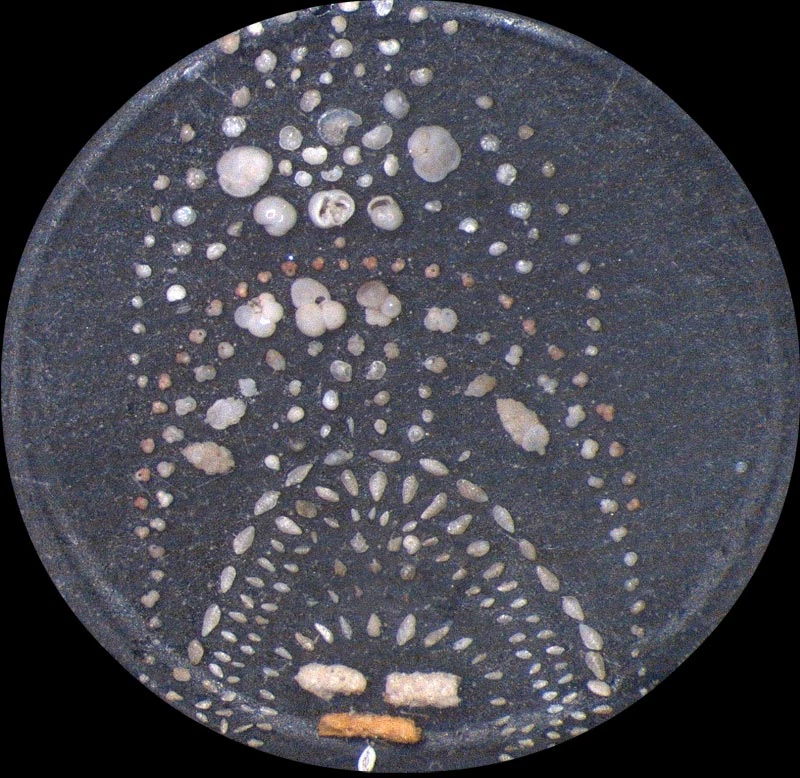
Museum experts in the Geology department have recently cleaned and restored this unique collection of beautiful slides.

Fossils from the birth of a new science.

Microscope slide before and after conservation

Microscope slide before and after conservation

Some of the forams were dredged by HMS Challenger on its voyage of discovery in 1872-1876. This was one of the first ocean-going scientific research expeditions and has been called the birth of oceanography, the study of the oceans. In fact we probably still know less about the ocean floor than we do about the dark side of the moon!

Click on the thumbnails below to view a selection of images from the collection

Archaeopteryx – the missing link between dinosaurs and birds?

Cindy Howells and Caroline Buttler, 13 October 2011

Archaeopteryx is an iconic fossil, often thought of as the ‘missing link’ between dinosaurs and birds. It was first described in 1861 by the German palaeontologist Hermann von Meyer (1801–1869). Since then Archaeopteryx has been the focus of controversy surrounding the origin of birds and their links with dinosaurs.

Only eleven specimens and an isolated feather have so far been found, all coming from a few quarries near the Bavarian town of Solnhofen in southern Germany.

Almost all of the specimens are from the Solnhofen Limestone, fine muddy limestones deposited in tropical lagoons about 150 million years ago near the end of the Jurassic Period. One was found in the overlying Mörnsheim Formation and is younger by perhaps half a million years.

Fossil of an Archaeopteryx skeleton with feather impressions.

Archaeopteryx specimen (Museum für Naturkunde, Berlin, Germany)

Discovery

In 1861 Hermann von Meyer published a description of a single fossil feather found in the Solnhofen Limestone and named it Archaeopteryx lithographica.

Archaeopteryx means ‘ancient wing’. Von Meyer also mentioned that ‘an almost complete skeleton of an animal covered in feathers’ had been found. After competition from other museums this skeleton was eventually bought by the British Museum along with other Solnhofen fossils for £700, then a huge sum of money.

In 1863 Richard Owen, Superintendent of the natural history collections at the British Museum, described and illustrated the specimen, declaring it be a bird with ‘rare peculiarities indicative of a distinct order’. The discovery of this remarkable fossil came just two years after the publication of Charles Darwin's book On the Origin of Species, which changed people’s perception of the natural world.

Archaeopteryx seemed to fit well with Darwin’s theory as it showed features of both birds and reptiles.

What did Archaeopteryx look like?

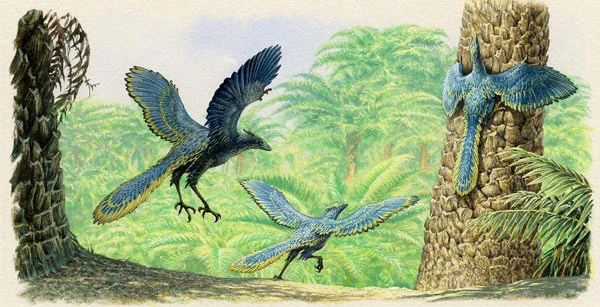
Archaeopteryx was a primitive bird with feathers, but its fossilised skeleton looks more like that of a small dinosaur. It was about the size of a magpie.

Unlike modern birds it had a full set of teeth, a long bony tail and three claws on its wing which may have been used for grasping branches. It lacked the fully reversed toes which enable many modern birds to perch. However, Archaeopteryx did have a wishbone, wings and asymmetrical ‘flight’ feathers, like a bird. It is likely that Archaeopteryx could fly, although perhaps not strongly.

Reconstruction of Archaeopteryx with blue and yellow feathers, perched on a branch.

Reconstruction of Archaeopteryx (© J. Sibbick)

The world of Archaeopteryx

Archaeopteryx lived on land near a series of stagnant and salty lagoons within a shallow tropical sea. Life in the lagoons was concentrated in the surface waters, as most of the lower levels were extremely toxic. It is possible that the only animals living in the lagoons were small floating crinoids (sea-lilies) and some fish.

Ammonites, shrimps, lobsters and starfish lived in the open sea nearby and were occasionally washed into the lagoons during storms. They did not survive for long in the lagoon waters. Horseshoe crabs have been found preserved at the end of a short trail of their own footprints. Very occasionally marine reptiles, such as ichthyosaurs and crocodiles, were also washed in.

Flying over the sea were pterosaurs and large insects such as dragonflies. These were blown into the lagoonal waters during these storms. A juvenile specimen of a small theropod dinosaur called Compsognathus has also been discovered in the same deposit, which must have been washed in from the land.

Illustration of three Archaeopteryx in a prehistoric forest: one flying close to the ground, another taking off from the ground and a third climbing a tree.

Reconstruction of Archaeopteryx (© J. Sibbick)

How did Archaeopteryx die and become preserved?

Although Archaeopteryx lived on land, occasionally some would have been caught up in storms as they flew or glided over the water. Waterlogged and unable to take off again, they would have drowned and sunk to the floor of the lagoon.

All of the known specimens display various characteristics of immaturity, indicating that none of the specimens was fully adult. This may have been the reason for their inability to survive storm events.

The carcasses were quickly buried by fine lime muds deposited on the lagoon floors. It is thought that one metre of rock today represents 5,000 years of deposition. The fossils of Solnhofen are exceptionally well preserved, due to the lack of disturbance from both predators and water movement. Within the fine-grained limestones, delicate features such as dragonfly wings or the feathers of Archaeopteryx can be found.

Further reading

Wellnhofer, P. 2009. Archaeopteryx the icon of evolution. Pfeil Verlag, Munich, 208 pp

Article by: Cindy Howells, Collections Manager (Palaeontology) and Caroline Buttler, Head of Palaeontology

Fossil life - on different scales

8 March 2011

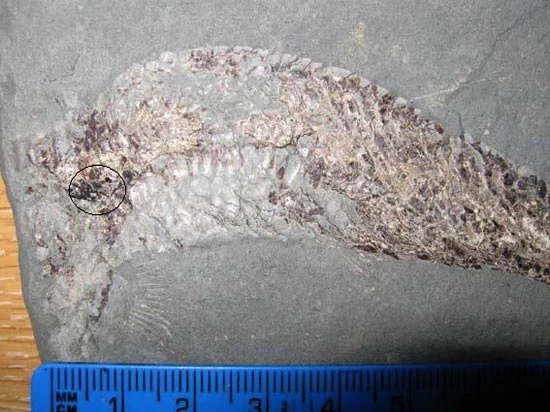
The fossil fish Pholidophorus; the circle shows the dark area where the fossil bacteria are preserved

The fossil fish Pholidophorus; the circle shows the dark area where the fossil bacteria are preserved

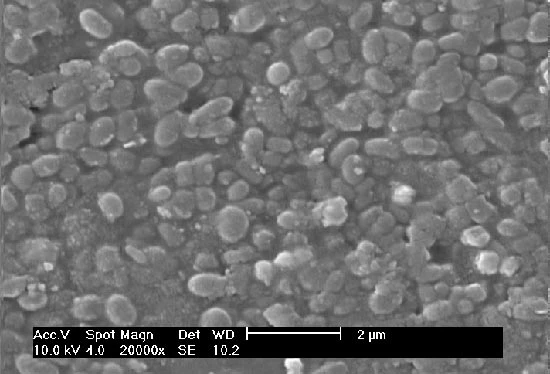
A close up of the fossilised bacterial colony, at a magnification of x20,000

A close up of the fossilised bacterial colony, at a magnification of x20,000

Fossils are the remains of ancient life. Most animal fossils are made of the hard parts of the body, such as bones, teeth, scales and shells. On rare occasions however, soft tissues, or even bacteria, can became fossilised.

A well preserved fossil fish from Somerset

The fossil fish illustrated here was found on Kilve Beach in north Somerset and although it is missing its head, the rest of it is well preserved. The fossil is about 11cm long and its scales outline the shape of the body. Faint traces of the front fins are also visible.

The fish is named Pholidophorus; it is an extinct animal that looked similar to a modern-day herring. Almost 200 million years ago, this fish died while swimming in the Jurassic sea that covered Somerset. As scavengers did not disturb the carcass after death, it became buried in fine sediment. This sediment eventually hardened to form the rock in which the fish became fossilised.

Microscopic detail reveals further fossilised remains

Although it is a fine example, this fossil fish preserves something even more remarkable. Scientists at Amgueddfa Cymru removed tiny fragments from the central area of the fossil to study them using an electron microscope. Zooming in on these fragments 20,000 times, some fine details started to emerge - a layer of tiny, rounded, elongate structures. These are the fossilised remains of bacteria.

Fossilised bacteria have been found in many localities around the world, most famously from fossils in South America and Germany. The bacteria are often preserved in calcium phosphate, because calcium is a common element in sediment, and phosphorus is found in the decaying tissues of animals.

How do we know these are fossil bacteria?

First, they are clustered together in colonies, and are a similar size and shape to modern-day bacteria.

Secondly, other very fragile cellular tissues, such as the cells of embryos, as found in the Cambrian rocks of China, have been documented .Fossilised muscle tissues can even preserve the internal details of cells, for example in Jurassic rocks in Brazil and Miocene rocks from Spain. The fossilisation of cells, including bacteria, is being observed more frequently as scientists look ever closer at the fossils in their collections.

Finally, on rare occasions, a thin dark layer of fossil bacteria occasionally traces the body outline of a fossil, revealing the shape of the fleshy tissues surrounding the skeleton, as in Eocene rocks from Germany. This tells us that fossilisation of the bacteria took occurred rapidly after the time of death.

It is becoming increasingly clear that bacteria play an important part in the processes of fossilisation, with the bacteria themselves sometimes being preserved.

Looking at a fossil, it is natural to wonder what kind of animal or plant it is, but some interesting discoveries can be made by asking what the fossil is actually made of. The answer, on close inspection, is often surprising and is the key to finding out how an organism became fossilised in the first place.