: The Fossil Record

When Antarctica went into the deep freeze

19 May 2008

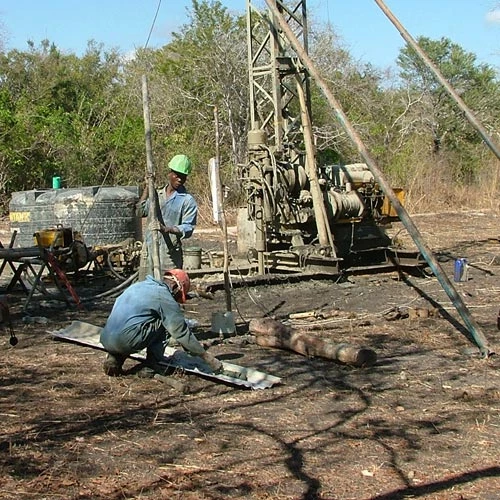
Sampling ancient mud cores in Tanzania

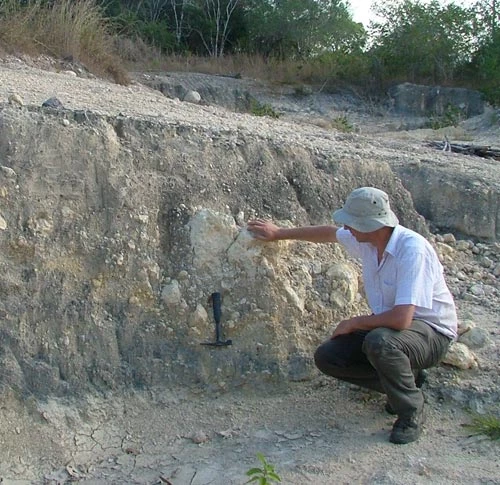
A member of the team looking at the top layer of sediment, deciding where best to sample to get different time intervals.

 Bringing up a core of mud from 34 million years ago

Bringing up a core of mud from 34 million years ago

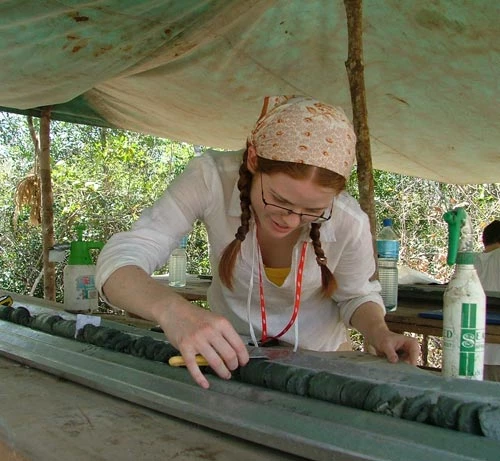
a scientist describing and sampling the core

After the core is brought up it is laid out for scientists to describe and take samples.

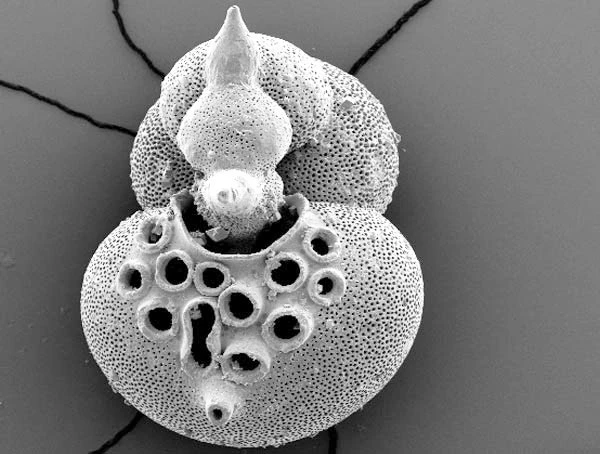
Extreme close up of the 35 million year old foram: Cribrohantkenina inflata.  discovered in the cores from Tanzania.

Extreme close up of the 35 million year old foram: Cribrohantkenina inflata. discovered in the cores from Tanzania. More images of these intricate forams can be seen in the 'Up close with Nature' gallery.

Scientists from Amgueddfa Cymru – National Museum Wales and Cardiff University have found new evidence of past climate change, which helps solve some of the mystery surrounding the appearance of the vast ice-sheet in Antarctica 34 million years ago.

Antarctica hasn't always been covered with ice – the continent lay over the south pole without freezing over for almost 100 million years. Then, about 34 million years ago, a dramatic shift in climate happened at the boundary between the Eocene and Oligocene epochs. The warm greenhouse climate, stable since the extinction of the dinosaurs, became dramatically colder, creating an "ice-house" at the poles that has continued to the present day.

Global cooling

Many climate scientists are involved in trying to figure out what caused this climate shift. This should tell us more about how the climate responds to major controls like changes in the Earth's orbit around the sun, and the concentration of greenhouse gases in the atmosphere.

Past climate changes can be recorded by studying tiny microfossils in layers of deep sea mud. Up until now, scientists found that the oceans appear to have warmed up during this big climatic shift. Their studies suggested that warming seemed to coincide with ice-sheets appearing in both Antarctica and the Arctic. This conflicting evidence, of warming seas while ice-sheets grew, doesn't fit in with computer simulations of the climate at the time; the computer models don't show ice to be present in the Arctic."

Tanzania drilling project

The solution to this icy puzzle has come from a surprising place – Tanzania in East Africa. The Tanzania Drilling Project team, including scientists from Amgueddfa Cymru and Cardiff University, have been recovering cores of ancient mud deposited on the seafloor millions of years ago (which has since been geologically uplifted into land).

The Tanzanian cores are special because large thicknesses of mud were laid down over a relatively short time, meaning that climate changes through time are seen in great detail. Also, beautifully preserved microfossils are found in the cores.

The Tanzanian cores provide the first really clear picture of how sea-level fall fits in with the climate shift.

Setting the record straight

The chemistry of the Tanzanian microfossils has been used to construct records of temperature and ice volume over the interval of the big climate switch. These new records show that the world's oceans did cool as the ice-sheets appeared, and that the volume of ice would have fitted onto Antarctica. So the computer simulations of climate and the past climate data now match up.

The focus now is to look for evidence of the ultimate cause of this global cooling. The prime suspect is a gradual reduction of CO2 in the atmosphere, combined with a 'trigger' time when Earth's orbit around the sun made Antarctic summers cold enough for ice to remain frozen all year round.

How it works

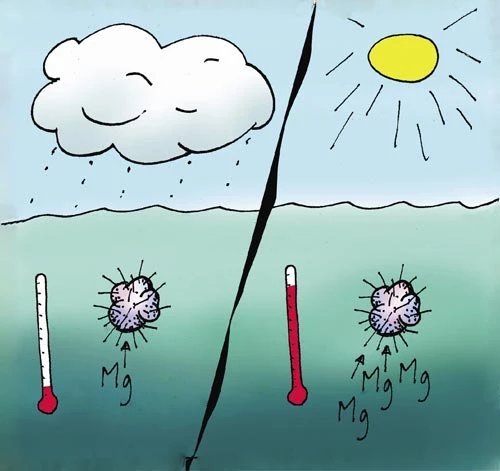
The shell chemistry of pin-head sized animals called forams can tell us how ocean temperatures changed through time. Forams are great tools for studying climates of the past, which helps us learn about the uncertainties of our future greenhouse climate.

1). Forams take chemical elements from the ocean into their shells, using more magnesium at warmer temperatures.

1). Forams take chemical elements from the ocean into their shells, using more magnesium at warmer temperatures.

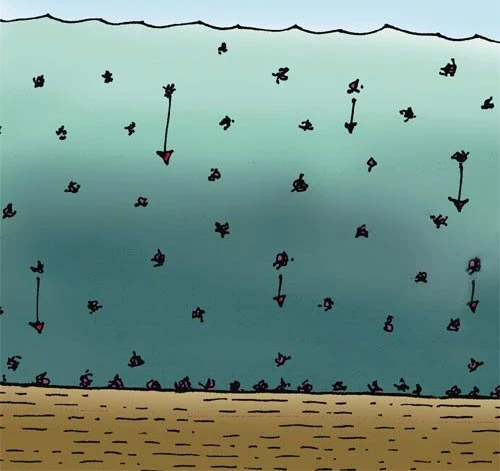
2). Dead forams fall to the sea floor and build up in layers of mud over millions of years.

2). Dead forams fall to the sea floor and build up in layers of mud over millions of years.

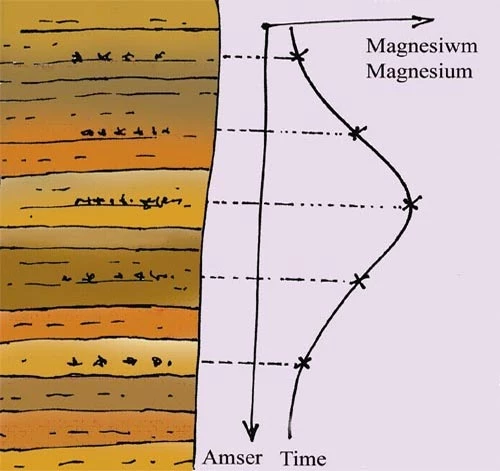
3). Today, going down through the mud layers is like going back in time.

3). Today, going down through the mud layers is like going back in time. If we can measure the magnesium content of forams going down through the mud, it gives us a record of how ocean temperature changed through time - more magnesium equals warmer temperature.

Further Reading

Lear, CH, Bailey, TR, Pearson, PN, Coxall, HK, Rosenthal, Y. Cooling and ice growth across the Eocene-Oligocene transition. Geology 36 (3), 251�254. 2008.

http://www.gsajournals.org/perlserv/?request=get-abstract&doi=10.1130%2FG24584A.1
Terror of the Silurian Seas

26 July 2007

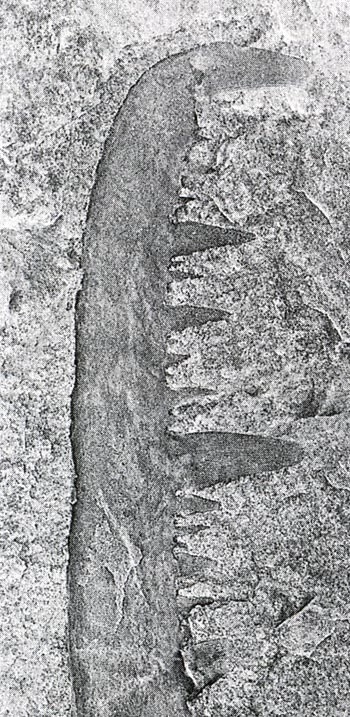
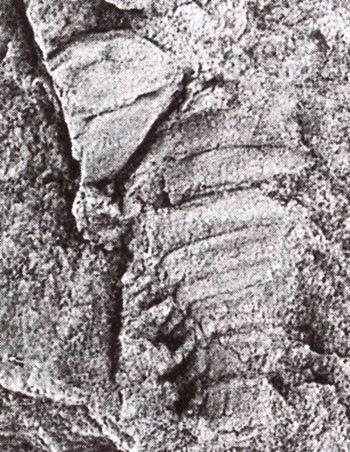
The eurypterid from Radnor Forest (x1.5)

The eurypterid from Radnor Forest (x1.5)

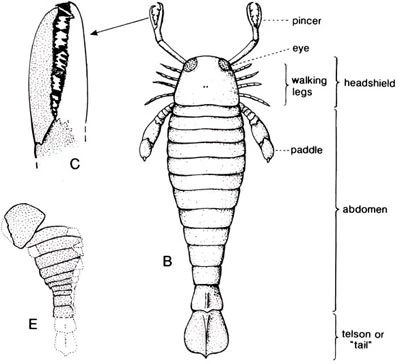
The reconstruction of the eurypterid from Radnor Forest

The reconstruction of the eurypterid from Radnor Forest

The small specimen from the Woolhope district (x3.5)

The small specimen from the Woolhope district (x3.5). Note that the headshield is displaced to the left.

Numerous specimens are brought in to the Department of Geology every year by the general public for identification. In most cases, these are common fossils or minerals, but from time to time something more unusual turns up, as happened in December 1989 when Mr Stephen Jenkins of Brecon produced a strange-looking fossil that he had found on the side of a forestry road in Radnor Forest.

A large scorpion-like animal

Although it superficially resembled a fish jaw with a series of pointed teeth of different sizes, careful examination led us to dismiss this possibility, and we eventually succeeded in tracking down what it was - half a pincer of an extinct, aquatic, scorpion-like animal called a eurypterid. A remarkable aspect of this specimen is its size - 64mm (2.5 inches) long, which indicates that it belonged to an individual that must have been around 70cm (27 inches) long. The rocks in which it was found in Radnor belong to the Ludlow Series of the Silurian System - about 420 million years old.

Despite their superficial resemblance to scorpions, eurypterids are not closely related to them, although they belong to the same general division of the arthropods - invertebrate animals with jointed legs that include spiders, crabs, lobsters and insects.

Flourishing from about 480 million years ago until their extinction 250 million years ago, most eurypterids are found in rocks that were deposited in fresh or brackish (mix of salt and fresh) water; only a few, including the Radnor Forest specimen, are from rocks of truly marine origin. It is possible, however that the specimen was washed out to sea from shallower waters that lay to the east of Radnor Forest.

Gigantic carnivores of the sea

The pincer belongs to a eurypterid genus named Pterygotus, which was an active swimmer. We can only speculate what might have been its prey, but it probably included primitive fish. The largest known specimens from other parts of the world are almost 3m (10 feet) long, and are the largest arthropods known. The specimen in Amgueddfa Cymru is not quite of those gigantic dimensions! The majority of eurypterids did not reach such a large size.

By coincidence, a short while after the pincer was brought into the Museum, another eurypterid was presented, this time with the 'body' section preserved. It was collected from slightly younger (400 million years old) Silurian rocks exposed near Woolhope (Herefordshire) by Dr. Paul Selden, formerly of Manchester University, and measuring only 0.9cm (0.3 inches) long, it is at the other end of the size scale. This is probably an immature specimen, and the full-grown animal might have been in the region of 10cm (4 inches) long.

Both specimens are now in the Museum collections, thanks to the generosity of their finders. Over the years the general public and academic colleagues have constantly enriched our collections, and donations of this kind remain an important source of material. You never can tell what might be brought in tomorrow...

A duckbilled dinosaur named Ruth

26 July 2007

Few visitors to National Museum Cardiff, and indeed few staff outside the Department of Geology, are aware that the spectacular duckbilled dinosaur Edmontosaurus, is known affectionately as 'Ruth'.

The logo for the Black Hills institute of Geological Research featuring Ruth the duck billed dinosaur from Amgueddfa Cymru

The logo for the Black Hills institute of Geological Research featuring Ruth the duck billed dinosaur from Amgueddfa Cymru

This name would seem to suggest that we know the sex of the 8-metre long specimen, although in fact there is no evidence to determine whether it is a male or female. Such evidence is not often available in fossils of this kind. So why 'Ruth'? The answer is quite simple and without any hidden scientific mysteries. It's because the specimen was found in a quarry in the Black Hills of South Dakota, USA, belonging to Mrs Ruth Mason.

The pet name was first used by the staff of the Black Hills Institute of Geological Research when they were excavating the dinosaur in 1986-7, in recognition of the many kindnesses shown to them by Mrs Mason. Following our purchase of the specimen, we learned very quickly of the name from the people who came over to reconstruct the skeleton for us, and we have continued to use this affectionate name in informal reference to the specimen.

The Black Hills Institute, based in Hill City, South Dakota is one of the leading companies in the world engaged in the collection, preparation and supply of fine quality mineral and fossil specimens, which are particularly attractive to museums for display purposes.

The Edmontosaurus on display in Cardiff is one of the finest examples of a 'duckbilled' dinosaur ever excavated, and was mounted by the Black Hills Institute in a wonderfully life-like pose based on our own particular design requirements. Such is the aesthetic beauty and dynamic realism of the specimen that the Black Hills Institute has incorporated the skeletal drawing into its logo: it forms both a striking image and a fine testament to the skill of the preparators.

From humble beginnings over 65 million years ago, Ruth has now achieved world-wide recognition in promoting the availability of geological display specimens, while also providing a unique experience for all those who visit her at National Museum Cardiff.

International fame for Wales's 'National Fossil'

26 July 2007

Paradoxides davidis

A specimen of Paradoxides davidis from Porth-y-rhaw, x 0.75. Amgueddfa Cymru collection

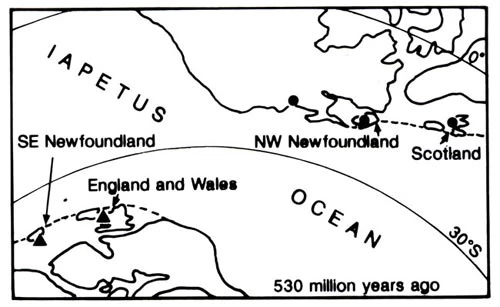
Stage one in the evolution of the north Atlantic area.

Stage one in the evolution of the north Atlantic area. Triangles indicate areas yielding 'Welsh' trilobites, with dots showing 'North American' forms.

Stages two in the evolution of the north Atlantic area.

Stage two in the evolution of the north Atlantic area. Triangles indicate areas yielding 'Welsh' trilobites, with dots showing 'North American' forms.

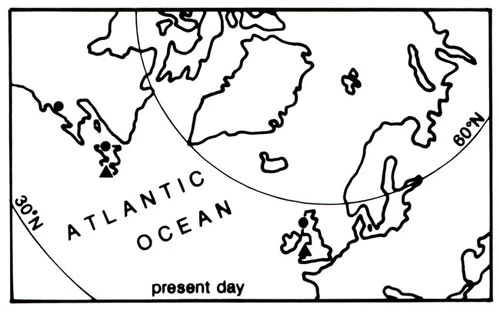
Stage three in the evolution of the north Atlantic area.

Stage three in the evolution of the north Atlantic area. Triangles indicate areas yielding 'Welsh' trilobites, with dots showing 'North American' forms.

Fossil collecting around the St. David's Peninsula, Pembrokeshire

In 1862 the well-known palaeontologist J W. Salter was collecting fossils in south-west Wales as part of his duties for the British Geological Survey. While examining coastal exposures by boat around the rocky St David's peninsula, Salter one day landed in a small inlet called Porth-y-rhaw, in the mistaken belief that it was Solva Harbour, only a short distance to the east.

His mistake turned out to be extremely lucky, because in the rocks of Porth-y-rhaw, he discovered the remains of one of the largest trilobites ever found (over 50 cm long), and this discovery ensured that the locality became established as a classic and well-known source of fossils.

Life in the sea hundreds of millions of years ago

The dark mudstones exposed there were deposited in an ancient sea some 510 million years ago, during what is now called the Cambrian Period - the name reflecting the fact that rocks of this age were first recognised and named in Wales by the early 19th-century geologists.

Porth-y-rhaw is one of a small number of sites in Wales where Cambrian fossils are reasonably well-preserved and easy to find, and in addition to Salter's giant trilobite it also yields many other kinds of these extinct marine arthropods of more usual dimensions (2-3 cm long).

A National fossil for Wales

The formal scientific name given by Salter to the giant trilobite is Paradoxides davidis, named after his friend David Homfray, an amateur fossil collector from Porth-madog. This trilobite is now one of the best-known from Britain, and is illustrated in numerous publications; choice specimens are among the prize possessions of many of our major museums, including the National Museum of Wales. Indeed, if there were to be a 'national fossil' for Wales, Paradoxides davidis would be the prime contender.

Worldwide Fame

Many specimens of Paradoxides davidis also occur in the Avalon Peninsula of south-east Newfoundland, in rocks of exactly the same age as those exposed in Porth-y-rhaw.

In this context, it is important to understand that in the Cambrian Period, the distribution of continents and oceans was quite different from that of the present day. At that time, Wales, England and south-east Newfoundland all lay on the southern side of an ancient ocean, called Iapetus, and were separated from Scotland and north-west Newfoundland, as shown on the accompanying map.

While the same kinds of trilobites occur in Wales and south-east Newfoundland, quite different ones are common to Scotland and north-west Newfoundland, providing evidence that they once formed parts of different continents.

Snowdon is born

Around 480 million years ago, movements in the Earth's interior caused the ancient Iapetus Ocean to narrow gradually and finally to disappear as two continental masses collided, leading to the formation of a high mountain range of which the Welsh, Scottish, Scandinavian and Appalachian mountains are the present day remnants.

The new Atlantic Ocean

Much later in Earth history, between 200 and 65 million years ago, the two continents began to pull apart again, leading to the formation of a new ocean that was to become the present day Atlantic. However, the new split was not along quite the same line as that along which Iapetus had closed, and left south-east Newfoundland with its 'Welsh' trilobites anchored to the rest of Newfoundland and North America, with Scotland and its 'North American' trilobites attached to the rest of the British Isles.

The occurrence of these same trilobites in areas that today are geographically remote emphasises the need for geologists to study fossils far afield if they are to interpret fully the ancient history of their own local pieces of the Earth's crust.

Dinosaur relatives swam in south Wales

26 July 2007

Amgueddfa Cymru holds fine specimens of prehistoric marine animals, related to the dinosaurs, that swam off the coast of south Wales. Specimens from Dorset illustrate how, once, an ancient sea linked the two areas.

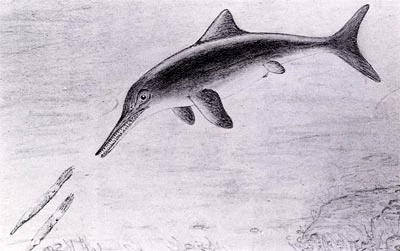
Reconstruction of an ichthyosaur chasing its squid-like prey

Reconstruction of an ichthyosaur chasing its squid-like prey

Tropical Wales

About 210 million years ago the small part of the Earth's crust that is now Wales lay well to the south of its present latitude, probably close to the northern tropics, where the land formed part of a huge supercontinent called Pangaea. Our climate was hot and humid, with much of Wales comprising barren uplands surrounded by desert-like mudflats. To the south, and spreading far across into Europe, was a series of large lakes.

Wales drowns

As the continents drifted northwards the crust broke up and at various times the seas rose and spread across the land. With these spreading seas came new marine animals that we now see fossilised in the rock record. Some of the most beautiful and spectacular are the marine reptiles known as ichthyosaurs (literally, 'fish lizards'), which were distant cousins of the land-living dinosaurs.

By 200 million years ago, early in the Jurassic Period of geological time, the sea covered southernmost Wales. On the sea-floor, a blanket of fine lime sands and muds was deposited, which have since been compacted into the horizontally bedded mudstones and limestones forming the familiar cliffs in the Lavernock area and extending westwards from Barry to Southerndown.

Abundant fossils

Ichthyosaur remains are not uncommon in these rocks, although they are mostly found as isolated teeth and bones. The fragmentation took place following the death of the animals, when the skeletons were broken up by currents and wave action. Only rarely have more complete specimens been found in south Wales. In contrast, rocks of the same age in Somerset and Dorset have long been known as a rich source of complete or almost complete ichthyosaur skeletons.

The early Jurassic sea extended from the shoreline area of southern Wales across south-west England and beyond to central Europe. In the progressively offshore, deeper-water areas to the south, wave action and coastal currents were weaker, so skeletons were more likely to sink to the sea floor and remain more or less intact. Even so, such skeletons are still found only comparatively rarely today, so we are very lucky to have several almost complete ichthyosaurs in our collections from Lyme Regis in Dorset. Some of the most impressive are on display in the exhibition Evolution of Wales at National Museum Cardiff.

The fact that 200 million years ago the sea was continuous from south Wales across to Dorset means that we can use these beautiful fossils to illustrate part of the history of our area. The Dorset fossils are the same species as those found in the Glamorgan cliffs, and the animals would have been swimming freely between the two regions.

The specimens on display show beautifully the streamlined, dolphin-like shape of the ichthyosaurs. They were adapted superbly for rapid swimming, with propulsion by a large, vertical tail and steering with four flipper-like paddles. Their diet probably consisted mostly of fish and squid.