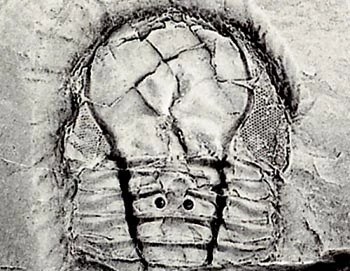
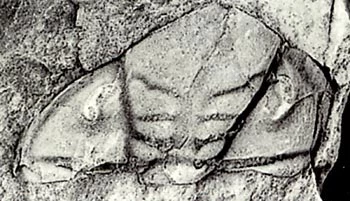
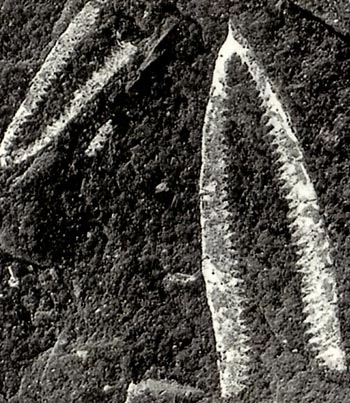
460-million-year-old relatives from Wales and Belgium reunited 26 July 2007 Didymograptus, a 'tuning-fork' graptolite of the kind found commonly in both areas. Pricyclopyge, a large-eyed pelagic trilobite that is widespread in Britain and northwest Europe. Headshield of Ormathops, a benthic trilobite endemic to Bohemia. Llanvirn Farm, Abereiddy, Pembrokeshire In the late 19th century, Henry Hicks, a surgeon from St David's, took up an interest in the ancient rocks of north Pembrokeshire. In 1881, he named the rocks at Abereiddi Bay the "Llanvirn Group", after a nearby farm. Today, this name is internationally recognized and is found in geological publications all over the world - fame indeed for a small farm on the windswept Pembrokeshire coast. Staff at Amgueddfa Cymru have been studying Llanvirn rocks and their fossils for over thirty years. In 2000, Dr R Owens of the Department of Geology was invited to examine fossils from rocks of the Llanvirn Series that are exposed in the Meuse valley in Belgium. Trilobite species found in these rocks were compared to those from the British Isles. Identical fossils from Wales and Belgium Fossils in Llanvirn rocks tend to be difficult to find without a good deal of time and effort. The graptolites and trilobites discovered in Belgium are all identical with those found in Wales and the Lake District. The Llanvirn rocks in which the fossils occur are understood to have been laid down in the deep ocean. During the Ordovician period when Llanvirn rocks were deposited, southern Britain, Belgium and northern Germany were all part of a small continent named Avalonia, separated from the vast continent of Gondwana by the Rheic Ocean. Blind trilobites Trilobites that are thought to have lived only on the sea floor (benthic species) tend to be confined to specific areas, but those thought to have swam the ocean waters (pelagic species) are widely distributed. One of the trilobite species found in Belgium has enormous eyes and is thought to be pelagic. This fossil is common in many areas. By contrast, another one, described originally by Hicks from Abereiddi, is blind, and is thought to have been benthic. However, it also has a wide distribution, which in this case is more difficult to explain. It could have spent a long time as a small larva, allowing it to drift around and causing a wider distribution of the fossils; alternatively it might have been pelagic, living in and around floating masses of seaweed. Ordovician rocks that are younger than those of the Llanvirn Series also crop out in the Meuse valley and these contain trilobite species that are also found in north Wales and northern England. These show that throughout the Ordovician Period, Belgium remained part of Avalonia. However, rocks that occur between these and the earlier Llanvirn rocks contain trilobites unlike those from Britain, but which closely resemble fossils from Bohemia. It is unlikely that part of Avalonia split away, moved closer to Bohemia and then merged back again. So why the similarity of these trilobites to those of Bohemia? The answer could lie in the underwater environment becoming more similar to that of Bohemia than to southern Britain. Although the relative longitudes of Bohemia and Avalonia are unknown, the distance separating the two areas must have been sufficiently close to allow the trilobite larvae to cross between the two and become widely distributed. The outcome of this work has been to confirm close fossil links across parts of Pembrokeshire and Belgium 460 million years ago, but also to highlight problems of fossil distribution that have yet to be fully resolved.
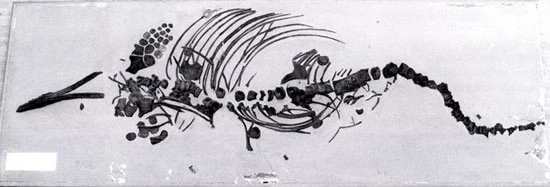
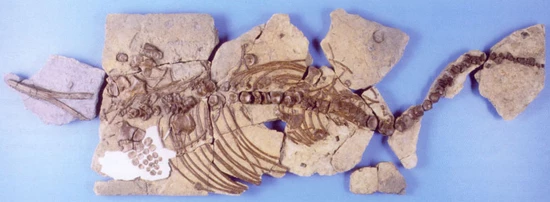
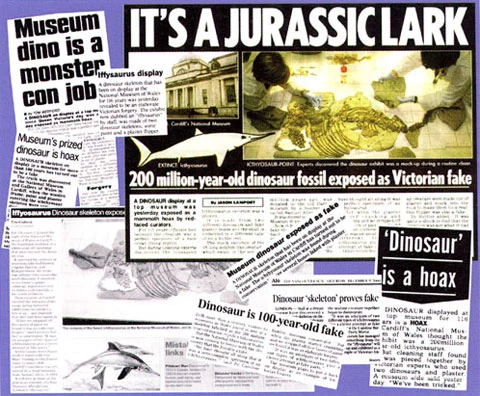
A Victorian fossil mystery 5 July 2007 The ichthyosaur specimen before conservation (1750 mm by 720 mm by 70 mm) Ichthyosaur after conservation showing head from separate individuals, and paddle bones set in plaster Press coverage of the story Routine conservation of the fossil collections at Amgueddfa Cymru, revealed a specimen that, on first examination, appeared to need a small amount of remedial work. What was to have been a small job turned into a major conservation project which attracted international media interest. The ichthyosaur The specimen in question is an ichthyosaur, a marine reptile that lived during the Mesozoic Era, 65-200 million years ago - the same time as the dinosaurs. They are similar to dolphins, with large eyes and distinctive long jaws with sharp teeth and limbs modified into paddles. The specimen was donated to the old Cardiff Museum in the 1880s and subsequently became part of the National Museum collections. It was originally mounted in plaster with a surrounding wooden frame and then both the plaster and the specimen were painted. The specimen was restored several times during the twentieth century, and this included new plaster and repainting. A label identified the species as Ichthyosaurus intermedius, collected from Street, Somerset, and described the skeleton as 'the greater part of a small individual preserved with but little disturbance of the bones' — a statement later found to be rather inaccurate. A detailed investigation of the specimen was undertaken and extensive damage was discovered, with cracks running through it. The plaster and wooden mount were in poor condition so the decision was made to remove all restoration and paint, and to get back to the original skeleton and rock. It was not a decision made lightly because we knew that the whole appearance of the specimen was going to be radically altered. Revealing the specimen Removal of the paint layers revealed that the missing ends of the ribs had been moulded in plaster and then painted to match the rest of the specimen, giving the false impression of actual bones. Study of X-rays taken of the specimen revealed an inconsistency in one section of the spine of the fossil; a dark shadow surrounded the bones. When the paint from this area was removed, it became clear that a channel had been carved in the rock and individual loose bones had been fixed into it with plaster. Beneath the paint it was discovered that the bones of the single preserved front paddle were also set in plaster. Holes in the surrounding rock suggest areas from which bones may have been removed before being relocated, but it is possible that some bones had been taken from other specimens. The biggest surprise came when the paint was removed from around the jaw; the rock was a totally different colour and type to the rest of the skeleton. Not only were there at least two individuals involved, but further study proved that the head and body were two entirely different species of icthyosaur! This was a specimen that had been considerably altered by the Victorian preparators. Re-displaying the conserved fossil Although the specimen was made up of two different species, it was decided that the head and the body should be kept together as originally intended. The plaster surrounding the paddle and a part of the ribs made from plaster were also left intact. A new light-weight support system was built. Instead of being displayed simply as a museum specimen, this ichthyosaur will be used to highlight the techniques used by some Victorian enthusiasts to 'restore', display and present fossil specimens and how painstaking conservation work today revealed the true nature of our specimen. Intense media interest was sparked when the Museum announced a public talk on the conservation of the specimen. This resulted in the story being covered in the national and international press in addition to television, radio and the internet, and included a live interview with ABC Radio in Australia!
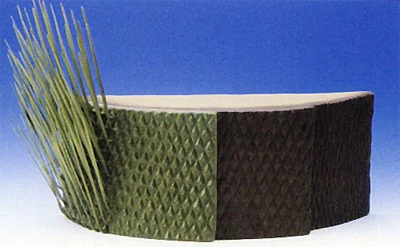
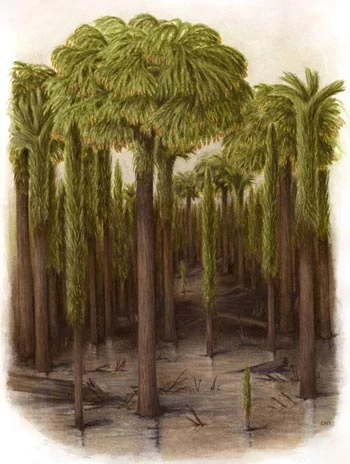
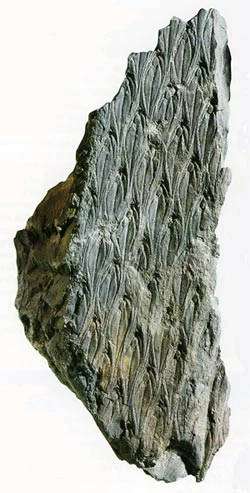
Wales's tropical rainforests 12 June 2007 Wax model of a cone from the Late Carboniferous giant club mosses. Wax model of a section of trunk from the Late Carboniferous giant club mosses. View over the late Carboniferous coal forests, showing the giant club mosses of the backswamp. Lepidodentron aculaetum fossil. Today, rainforests cover much of the tropics and there are large icecaps at the poles. An essentially similar arrangement has existed for the last 3 or 4 million years, but back in time, conditions were quite different to what we find today. 3-4 million years may seem a long time but, in the context of the 4700 million years of Earth's total history, it is not. If we look deeper into geological time, such as when dinosaurs roamed the Earth, conditions were quite different to what we find today. In only one other time in our geological past have conditions been similar to today's, with extensive polar ice and tropical rainforests &mdsh; what geologists refer to as Late Carboniferous, 300 years ago. We are of course no longer in the tropics, having drifted north to temperate latitudes. However, 300 millions years ago Wales was positioned right on the equator and was largely covered in lowland tropical swamp-forests. The dominant plants of these ancient swamps were giant club mosses. Club mosses still live today, as very small plants (hence the 'moss' part of their name), but these ancient forms were up to 40 metres high. Despite their size, they were not strictly trees, as their trunks were made up of soft cork-like tissue, not wood. This allowed the plants to grow extremely quickly, growing to their full size in as little as 10 years. The club mosses were not long-lived plants: they would grow to their mature size, reproduce (by spores, not by seeds as in most of today's trees) and then die. The colossal amount of dead plant-debris produced meant that the mud and silt in which they grew became very acidic, hindered the rotting of the plant tissue. The result was the build-up of thick peat deposits, which subsequently changed into the coal that has been mined in the coalfields of both north and south Wales. The Carboniferous tropical forests were one of the most powerful terrestrial 'sponges' in geological history for drawing carbon out of the atmosphere and burying it underground. By looking at how these forests changed in size (and thus how much carbon they extracted from the atmosphere) and comparing it with changes in the size of the polar icecaps, we can get a much better idea of how atmospheric carbon and global temperatures match up. One particular marked reduction in the size of the forests appears to have coincided with a shrinking of the icecap. To understand these global changes properly, we need to understand the causes and exact timing of the changes to the forests. To do this, we need to look carefully the changes in the composition of the vegetation as preserved in the fossil record and the changes in the geographical extent of the forests. The pioneering 19th century geologist Charles Lyell coined the expression, 'the present is the key to the past'. However, the message that the Late Carboniferous geological record is telling us is that the past may in fact be the key to understanding the present.