: Myths & Legends and Folklore

Ancient druids of Wales

3 May 2007

Ancient Druid: 'An Archdruid in his Judicial Habit' from Costume of the Original Inhabitants of the British Isles (1815) by Samuel Rush Meyrick and Charles Hamilton Smith.
An Archdruid in his Judicial Habit

from Costume of the Original Inhabitants of the British Isles (1815) by Samuel Rush Meyrick and Charles Hamilton Smith.

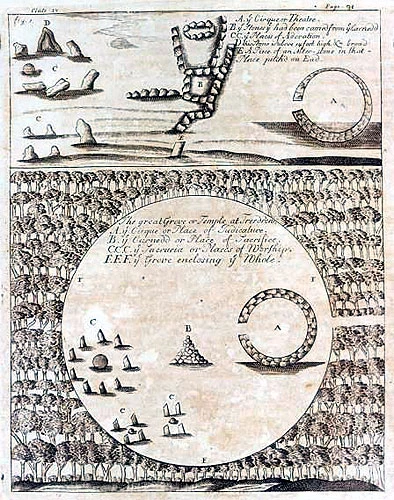
The alleged Druidical Temple of Tre'r Dryw (Anglesey) - prepared by the Revd Henry Rowlands (1723)

The alleged Druidical Temple of Tre'r Dryw (Anglesey) - prepared by the Revd Henry Rowlands (1723)

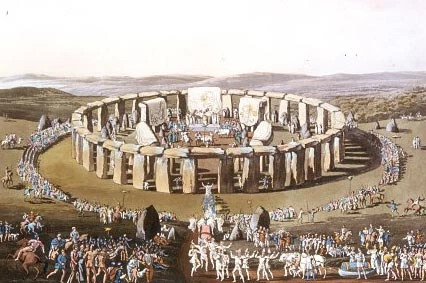
Druidic ceremony

Early 19th-century speculation on how a Druidic ceremony might have appeared at Stonehenge. We now know that Stonehenge was built some 1,500 years before the first historical reference to the Druids.

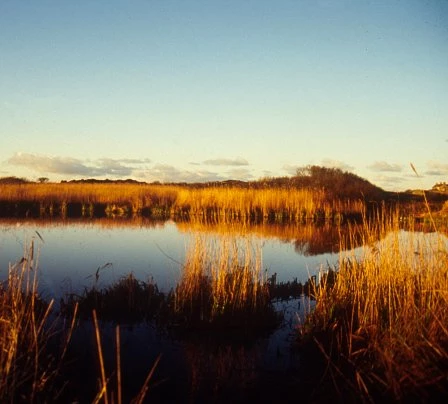
Llyn Cerrig Bach

Llyn Cerrig Bach (Anglesey). A large quantity of Iron Age metalwork was found in this lake during 1943. [Image © Philip Macdonald.]

Selection of metalwork

Selection of metalwork found in Llyn Cerrig Bach, including slave chains, bent swords, tools and chariot equipment.

Druids, the ancient priests of Britain and Ireland, have long intrigued and kindled the imagination of large popular audiences. The stereotypical image of the white-robed wise man, carrying perhaps a golden sickle and mistletoe, or clasping a white staff, remains strong with us today, the outcome of many centuries of thinking and invention. Yet what evidence do we have for these powerful but elusive figures?

The earliest mention of Druids comes during the 1st century BC, referring to druidae in Gaul (France) and Britain, who were wise men, observers of natural phenomena and moral philosophers. Similar to the druids were the bards (bardoi) - singers and poets, and diviners (vates), who interpreted sacrifices in order to foretell the future.

Druids and bards were common in medieval Welsh and Irish texts, probably giving account of much earlier oral tradition, passed on by word of mouth.

The visual appearance of druids - what they wore and what possessions they owned - is difficult to clarify. There are few illustrations or inscriptions of the time, whilst archaeology rarely provides certain answers. A druidic ceremony described by Pliny, in his Natural History, describes a white-robed druid climbing an oak tree to cut down mistletoe with a golden sickle.

Hywel Dda

In Wales, the roles and privileges of bards related to laws set down by Hywel Dda in the 10th century AD. During the 18th century, druids came to be seen as the ancestors of the bards, the praise poets, musicians and genealogists, who flourished in Welsh medieval society.

Human Sacrifice

A revival of interest in druids began during the Renaissance (14th to 16th centuries), when translations of Classical Greek and Roman texts became widely available. A number of sources describe the druids as performing human sacrifice. Places of worship were described as isolated wooded groves and near sacred pools and lakes. According to one source, the druidic groves on Mona (Anglesey) had the blood of prisoners drenched upon their altars.

Stonehenge

Some accounts suggested that the stone circles at Avebury and Stonehenge had been druidic temples. Similarly, a number of megalithic monuments on Anglesey were thought to be the temples and sacrificial altars of druids. However, with advances in archaeological understanding during the 19th century, it became clear that these monuments were built over 4,000 years ago, long before the appearance of druids. Nevertheless, modern druids and bards continue to meet within stone circles today.

Celtic rituals of the Iron Age

Archaeology does, however, provide evidence for the religious expression of Celtic Iron Age people. The tradition of offering gifts to the gods is well illustrated at the site of Llyn Cerrig Bach on Anglesey. Here, between 300BC and AD100, chariots, weapons, tools and decorated metalwork items were cast from a causeway or island into a small lake. Coincidentally, an account by the Roman author Tacitus vividly recounts the crushing of a druidic stronghold on Anglesey by the Roman army, leading some to infer that Llyn Cerrig Bach was a druidic site.

Other instances of Celtic Iron Age ritual have also been identified. For example, a probable sacrificial victim preserved in peat has been found at Lindow Moss in Cheshire (England). Recently, the famous Cerrig-y-Drudion bowl, elaborately decorated in the Celtic or La Tène art style, has also been convincingly interpreted as a ceremonial crown. This and a number of other crowns and regalia, found with burials or in temples in Britain, may have denoted priestly office.

In this prehistoric world, the power of the pagan Celtic gods was keenly felt, ever present and intermingled within everyday life.

Anglesey

The druids have long been associated with Anglesey in popular imagination. The historical evidence upon which this association is based is an account by the Roman author Tacitus, who wrote of the Roman conquest of Anglesey:

"On the beach stood the adverse array [of Britons], a serried mass of arms and men, with women flitting between the ranks. In the style of Furies, in robes of deathly black and with disheveled hair, they brandished their torches; while a circle of Druids, lifting their hands to heaven and showering imprecations, struck the troops with such an awe at the extraordinary spectacle that, as though their limbs were paralysed, they exposed their bodies to wounds without an attempt at movement. Then, reassured by their general, and inciting each other never to flinch before a band of females and fanatics, they charged behind the standards, cut down all who met them, and enveloped the enemy in his own flames. The next step was to install a garrison among the conquered population, and to demolish the groves consecrated to their savage cults; for they considered it a pious duty to slake the altars with captive blood and to consult their deities by means of human entrails." (Translated by John Jackson, published by William Heinemann, 1951).

Background Reading

Druids by A. Ross. Tempus Publishing (1999).

Exploring the World of the Druids by M. J. Green. Published by Thames & Hudson (1997).

Shrines & Sacrifice by A. Woodward. Published by Batsford (1992).

Tacitus: the annals By J. Jackson. Published by William Heinemann (1951).

The Bog Man and the Archaeology of People by D. Brothwell. British Museum Publications (1986).

The Druids by S. Piggott. Published by Thames & Hudson (1968).

Who was King Arthur?

26 April 2007

King Arthur has a strong link to Wales, but how much is known of the man and his times?

King Arthur has evolved into a legend. Tales and romances celebrated the king and his court in the imaginative literature of Europe. Did Arthur really exist? What was he like? To find answers, it is necessary to look at two equally important sources of information: historical texts and archaeology.

When did King Arthur live?

The first mention of Arthur is thought to be a reference in a line from the poem, 'Y Gododdin', the earliest known work of literature in Welsh. The poem is from the 6th century, when much of western Britain (Wales, northern England and southern Scotland) spoke Welsh; the earliest surviving written form of the poem dates to the 13th century. The reference to Arthur in this source may be no earlier than the 9th century, but it demonstrates the fame of Arthur among the Welsh at this time.

The most important of the historical texts is the Historia Brittonum, the 'History of the Britons', which gives the earliest written record of Arthur who 'fought against them [the Saxons] with the kings of the Britons but he himself was leader [Duke] of Battles', winning twelve battles. The earliest version of this history is dated about AD829-830.

The Annales Cambriae, or 'Welsh Annals', probably compiled in the mid 10th century, record the date of one battle, the Battle of Badon in AD518, and Arthur's death at Camlann in AD537-9. This suggests that if Arthur was indeed an historical figure, he probably lived in the 6th century.

Book of Aneirin

Page from a 13th-century copy of the Book of Aneirin. The Book of Aneirin records an attack by the British on the Saxons at Catterick (Yorkshire). Although the poem was written in the 6th-century, the reference to Arthur which it contains may have been added later. [Image © Cardiff Library]

Where is King Arthur buried?

Early Welsh literature has many wondrous tales which form an important part of the Arthurian tradition. There are portrayals of Arthur in anonymous Welsh poetry found in 13th and 14th century manuscripts. In one of the poems of the Black Book of Carmarthen, Englynion y Beddau ('The Stanzas of the Graves'), Arthur's grave is described as a great wonder because no one knows where it is located.

The greatest of the Welsh Arthurian prose tales is Culhwch ac Olwen. An English translation of this and eleven other Welsh tales appeared for the first time in the 19th century, publication The Mabinogion. Four other tales in this collection focus on Arthur - the 'romances' of The Lady of the Fountain (or Owain), Peredur, and Geraint son of Erbin, together with the Dream of Rhonabwy which presents a satirical view of Arthur and his world.

Map showing distribution of places mentioned in this article

Map showing distribution of places mentioned in this article

Archaeology

The second key source of information about Arthur is archaeology. Archaeological evidence for contact between Wales, Cornwall and the Saxon World takes many forms - from metalwork manufactured in an Anglo-Saxon style discovered in south-east Wales, to the distribution of early medieval pottery imported from the Continent and the shores of the Mediterranean.

Excavations at Dinas Powys, a princely hillfort near Cardiff occupied between the 5th and 7th-centuries, has informed us about the nature of a high status site in south Wales at this time. This site is contemporary with others like South Cadbury in Somerset and Tintagel in Cornwall (both with their own Arthurian traditions).

Pieces of glass from Dinas Powys (Vale of Glamorgan)

Pieces of glass from Dinas Powys (Vale of Glamorgan), a fort occupied between the 5th and 8th-centuries. These fragments come from vessels made in continental Europe. They illustrate the extent of trade between Wales and the wider-world at this time.

Caerleon's Roman amphitheatre

The Roman amphitheatre at Caerleon has been known as the site of King Arthur's court since the 12th century, but is there any evidence to prove this was the case?

In AD1405, the French army, which had landed at Milford Haven to support Owain Glyn Dŵr in his uprising against the English Crown, reached Caerleon in South Wales. Here they visited 'King Arthur's Round Table'. According to a French source (Chronique Religieux de St Denys), the French visited 'The Round Table' of Arthurian legend. The Round Table was in fact the Roman amphitheatre of the legionary fortress of Isca.

Geoffrey of Monmouth had identified Caerleon as the court of King Arthur in his fictional epic, the 'History of the Kings of Britain' in 1136. This identification, close to the area of his upbringing, has been described as 'the fruits of a lively historical imagination playing upon the visible remains of an imposing Roman city'. Some of Roman Isca was still standing in the 13th century.

Caerleon soon appeared in popular Welsh and French writings by Dafydd ap Gwilym, Chrétien de Troyes and others as 'Arthur's Court', sealing this identification.

Caerleon Roman amphitheatre.

Caerleon Roman amphitheatre. [Image © Steve Burrow]

Arthur's Stone

Some half dozen Welsh Stone Age megaliths are called 'Arthur's Stone', and his name has also been given to an Iron Age hillfort on the Clwydian Range, Moel Arthur, near Denbigh. According to one tradition, King Arthur and his knights lie sleeping in a cave below Craig y Ddinas, Pontneddfechan, in south Wales.

Maen Ceti, on Gower, south Wales.
Maen Ceti,

on Gower, south Wales. The massive capstone of this prehistoric burial chamber is known as Arthur's Stone. The king's ghost is said to emerge occasionally from beneath it.

Background Reading

Arthur in Medieval Welsh Literature by Oliver James Padel. Published by University of Wales Press (2001).

Arthur's Britain. History and Archaeology AD367-634 by Leslie Alcock. Published by Harmondsworth (1971).

The Arthur of the Welsh. The Arthurian Legend in Medieval Welsh Literature by Rachel Bromwich, A. O. H. Jarman and Brynley F. Roberts. Published by University of Wales Press (1991).

The Gododdin translated by A. O. H. Jarman. Published by Gomer Press (1988).

The Mabinogion, translated by Jeffrey Gantz. Published by Penguin (1976).

Painting Medieval Myths from Rome and Britain

22 February 2007

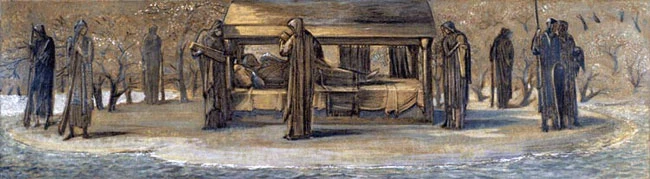
Two different medieval myths are represented in two works by the 19th century artist Sir Edward Burne Jones. The Wheel of Fortune (1882) and Arthur at Avalon (1890) are both in the collections of Amgueddfa Cymru.

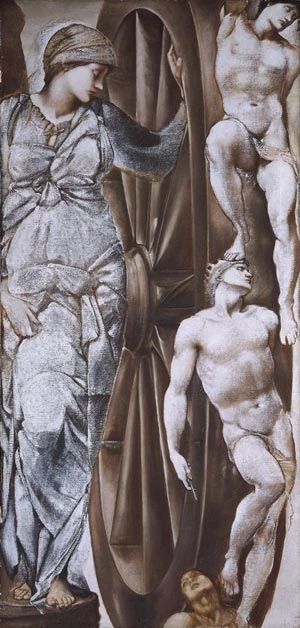
Wheel of Fortune, Burne Jones

This unfinished painting of about 1882 depicts the medieval theme of the wheel of fortune, which lifts or abases man as it is turned by the goddess Fortuna. The drawing of the nudes and the drapery of the goddess reveal the artist's careful study of Michelangelo.
Burne Jones.
Oil on Canvas.

The Wheel of Fortune is based on Roman mythology. For the Romans, the goddess Fortuna represented luck. However during the Middle Ages the idea of the wheel of fortune evolved from the writings of Boethius, a 6th century Christian martyr. In The Consolation of Philosophy, he wrote that the random turns life could take were all part of God's divine will and that man must accept the twists and turns of fortune.

It has long been a tradition in art to show gods as being larger than humans, and here Burne Jones represents Fortune as larger than the humans, who she turns on her wheel. He does show her blindfolded, as was usual, but with her eyes closed. Traditionally, the wheel has four figures on it. They represent four stages of life: "I shall reign", "I reign", "I have reigned" and "I have no kingdom". Burne Jones only depicted three figures on the wheel, but he maintained the idea of a reign by placing a crown on the head of the central figure.

The feminist author Camille Paglia has described this work as a sadomasochistic tableau, with "Fortuna turning her torture wheel of beautiful young men, languid with limbs stretched in sensual suffering". Although the men are accepting of their fate, how much choice do they have? The limbs are not so much stretched in sensuality but as an indication that you ascend by climbing over someone else and this in turn will happen to you. This is something Burne Jones felt personally. In 1893 he wrote "My Fortunes wheel is a true image, and we take our turn upon it, and be broken upon it."

But to wider Victorian society, where industrial fortunes meant one could rise in wealth and class and the British Empire was the most powerful in the world, this notion of rise and fall would have touched a nerve. If you are on top of the wheel, the next turn might place you at the bottom.

Burne Jones painted another myth with Arthur at Avalon. This myth is taken from Thomas Malory's famous poem of 1470 Morte d'Arthur ('The Death of Arthur'). Arthurian legends were popular with artists for many reasons. They were well known to the public and they contained brave knights, thwarted lovers and femmes fatales. Unlike the classical world, these heroes were Christians and, most appealingly, they were rooted in British history. Greece and Rome were all very well but a local hero was more likey to inspire future empire builders.

In Arthur at Avalon Burne Jones shows the scene of Arthur's death. After being mortally wounded in battle by Mordred (his son by his half sister), Arthur is taken to the Isle of Avalon in an attempt to heal his wounds. The name Avalon ("Afallon" in Welsh, meaning the isle of apples) perhaps related to the tree of knowledge, and it was believed to be a magical place. In the background of the painting we can see trees with blossom that could be apple trees. Authur ordered Sir Bedivere to give his sword Excalibur to the Lady in the Lake, but when Bedivere returned Arthur was gone. This has been taken to mean that Arthur might not be dead, only sleeping until he is needed again. The Arthurian legend not only continued to be a source of interest to artists throughout the 19th century, but continues to inspire artists, writers and film-makers today.

Arthur At Avalon, Burne Jones, 1890

Arthur At Avalon, Burne Jones, 1890