: Iron Age

Who were the Celts?

5 June 2021

The early Celts rarely wrote about themselves. To the Greeks, they were known as Keltoi, Keltai or Galatai and to the Romans Celti, Celtae and Galli.

The first mention of the Celts was made by the Greeks authors between 540 and 424BC. But the most valuable insights are provided by Roman authors. As the Roman world was expanding, they came in direct contact with the Celts on their northern borders, however, these classical texts are incomplete as they were often copied long after the event. Therefore, the information we have provides, at best, an occasional 'snapshot' of the Celts.

It is believed that the Celts were a collection of tribes which originated in central Europe. Although separate tribes, they had similar culture, traditions, religious beliefs and language in common.

What did the Celts call themselves?

We don’t actually know what the Celts called themselves. The name ‘Celts’ is a modern name which is used to describe many tribes of people who lived during the Iron Age. None of the Classical texts refer to the peoples of Britain and Ireland as Celts. Therefore, as the Celts were a collection of tribes, they were more generally known by the name of those tribes or societies as opposed to a collective nation or empire.

Where did the Celts come from?

Coin of the Roman Republic

Early sources place Celts in western Europe and also occupying land near the headwaters of the Danube River. Their home territories have often been traced to central and eastern France, extending across southern Germany and into the Czech Republic.

In 279BC the Celts were known to have looted Delphi, the sacred Greek site. Strabo (Geographer) recorded a meeting between the Celts and Alexander the Great in 335BC in the Balkans. Classical writers had recorded a large-scale migration of Celts soon after 400BC, this migration took the Celts from central Europe into Northern Italy and Eastern Europe.

Celts in Britain

It is believed that the Celts arrived at the shores of Britain at approximately 1,000BC and lived there during the Iron Age, the Roman Age and the post Roman era. Their legacy continues today where examples of the language, culture and traditions continue to exist.

Welsh Celts

Today, Wales is seen as a Celtic nation. The Welsh Celtic identity is widely accepted and contributes to a wider modern national identity. During the 1st centuries BC and AD, however, it was specific tribes and leaders which were named. By the time of the Roman invasion of Britain, four tribal peoples occupied areas of modern day Wales:

  • Ordovices (north-west)
  • Deceangli (north-east)
  • Demetae (south-west)
  • Silures (south-east)

To understand how Celts first came to be associated with Wales, we must turn to the historical development of Celtic linguistics (the study of languages).

What languages did the Celts speak?

Archaeologia Britannica

Tracing the beginnings of Celtic languages is difficult. Most agree that they derive from an earlier language known as 'proto-Indo-European'. This probably reached western Europe through the movement of peoples, possibly from Central Asia between 6000 and 2000BC. Unfortunately, there is little agreement over precisely when this occurred and when and how Celtic languages subsequently developed.

On current understanding, Celtic languages have their origins at some time between 6000 and 600BC, with the earliest known inscriptions in a Celtic language being found in Northern Italy and dating to the 6th century BC. George Buchanon, a 16th-century scholar, suggested that the peoples of continental Europe had once spoken a related group of Gallic languages. Since modern Welsh, Irish and Scots Gaelic were similar to these ancient languages, the people of Britain, it was argued, originally came from France and Spain.

A pioneering study by Edward Lhuyd in 1707 recognised two families of Celtic languages, P-Celtic or Brythonic (Welsh, Breton, Cornish) and Q-Celtic or Goidelic (Irish, Scots Gaelic, Manx). The Brythonic languages were assumed to have come from Gaul (France), whilst the Goidelic languages were given an Iberian (Spain, Portugal) origin.

During the 18th century, people who spoke Celtic languages were seen as Celts. The ancient inhabitants of Wales, were therefore increasingly known as Celts.

Celtic Languages

The native tongue of Wales (known as Cymru by the Celts), is Welsh. Welsh is a Celtic language and is still widely spoken in Wales and across the world. In Cornwall some (although very few) still speak Corning, which is from the same linguistic strand as Welsh and Breton.

In Scotland, the Scots Gaelic is also still spoken, although by not as many as Welsh speakers. The local affiliate to the BBC in Scotland is known as BBC Alba, which is the Celtic name for the region. It is also worth noting that the origin of the Bagpipes, a famous musical instrument from Scotland can be traced to Celtic times as well.

What did the Celts look like?

Warriors fighting.

Looking again at the recordings by Roman literature, the Celts were described as wearing brightly coloured clothes, with some having used blue dye from the woad plant to paint patterns on their bodies.

What did the Celts wear?

They are known for their colourful wool clothing and later on the Scottish Tartan. The clothes the Celts would wear showed status and importance within the tribe. The usual Celtic attire would include a tunic and a belt, as well as a long cloak and trousers which were fastened by a ’fibuale’.

In fact, many historians have noted that the Celts were one of the first people in Europe to wear trousers, the ‘fibuale’ would be clasps, which were used to fasten their trousers.

What did the Celts eat?

There were obviously no supermarkets during the time of the Celts, they would grow their own plants, farm and hunt animals for food.

Their diet would include, wild foods such as mushrooms, berries, nettles, wild garlic and apples they would also eat spinach, onions, leeks, carrots and parsnips, blackberries, gooseberries and blueberries. Hazelnuts and walnuts as well as grains for bread and porridge would also feature in their diet.

As for meat, they would hunt deer, foxes, beavers, wild boars and bears as well as farm domesticated animals such as chickens, goats, sheep, pigs and cattle. They would also fish for Salmon, Trout or Mackerel. They would also eat eggs from hens and wild birds, along with insects and honey from bees.

More information about the food the Celts would eat during the Iron Age can be seen in our Daily life of the Celts learning resource.

Celtic Art and Archaeology

Detail of triskele

The appearance of a new style of art during the 5th century BC and its later spread across much of Europe has frequently been interpreted by archaeologists as evidence for a common Celtic culture or identity.

Celtic art was recognised and named by British scholars during the mid 19th century. However, it was not until 1910-14 that the earliest objects decorated in this style were traced to a common cultural area of north-east France, southern Germany and the Czech Republic.

It was named the La Tène culture , after an important collection of decorated metalwork discovered at a site on the edge of Lake Neuchâtel in Switzerland. The spread of La Tène or Celtic art across Europe, including Britain and Ireland, was for a long time interpreted as invasions by Celtic people.

More recently, British archaeologists have become increasingly dissatisfied with the idea of Celts invading Britain and of a 'Celtic' society sharing language, art, religious belief and identity. There is little conclusive evidence amongst the archaeological remains for large-scale arrivals of a new people from the Continent.

The archaeology of the Iron Age in Britain is suggesting a mosaic of regional societies, each with their own distinctive identity. This is at considerable odds with a uniform Celtic culture.

Archaeologists have also become more critical of their own assumptions when interpreting Iron Age sites. The presence of La Tène art in Wales need not indicate invading Celts, it could equally show the spread of a fashion across many societies or suggest long-distance exchange contacts. At the same time, we now know that much of the later La Tène art is distinctively British in style and largely absent in Continental Europe.

Debate has surrounded the notion of the Celts since scholars first began to examine it, and this discussion is set to continue.

It is possible that future genetic studies of ancient and modern human DNA may help to inform our understanding of the subject. However, early studies have, so far, tended to produce implausible conclusions from very small numbers of people and using outdated assumptions about linguistics and archaeology.

Background Reading

Exploring the World of the Celts by S. James. Published by Thames & Hudson (1993).

The Celts: Origins, Myths and Inventions by J. Collis. Tempus Publishing Ltd (2003).

The Ancient Celts by B. Cunliffe. Oxford University Press (1997).

Uncovering our Collections: Half a Million Records now Online

26 March 2018

As we reveal half a million collection records for the first time, we look at some of the strangest and most fascinating objects from National Museum Wales Collections Online.

This article contains photos of human skeletal fragments.

The Biggest

We have some real whoppers in our collections - including a full-size Cardiff Tram and a sea rescue helicopter - but the biggest item in our collection is actually Oakdale Workmen's Institute.

Built in 1917, the Institute features a billiard room, dance hall and library - and is nowadays found in St Fagans National Museum of History.

Photograph from 1908 showing Horace Watkins in a very early, precarious-looking monoplane

Horace Watkins testing his monoplane in 1908

Many of the buildings in St Fagans are part of the national collection - meaning they have the same legal status as one of our masterpiece Monets or this coin hoard. The buildings are dismantled, moved, rebuilt - and cared for using traditional techniques, by the museum's legendary Historic Buildings Unit.
 

The Oldest


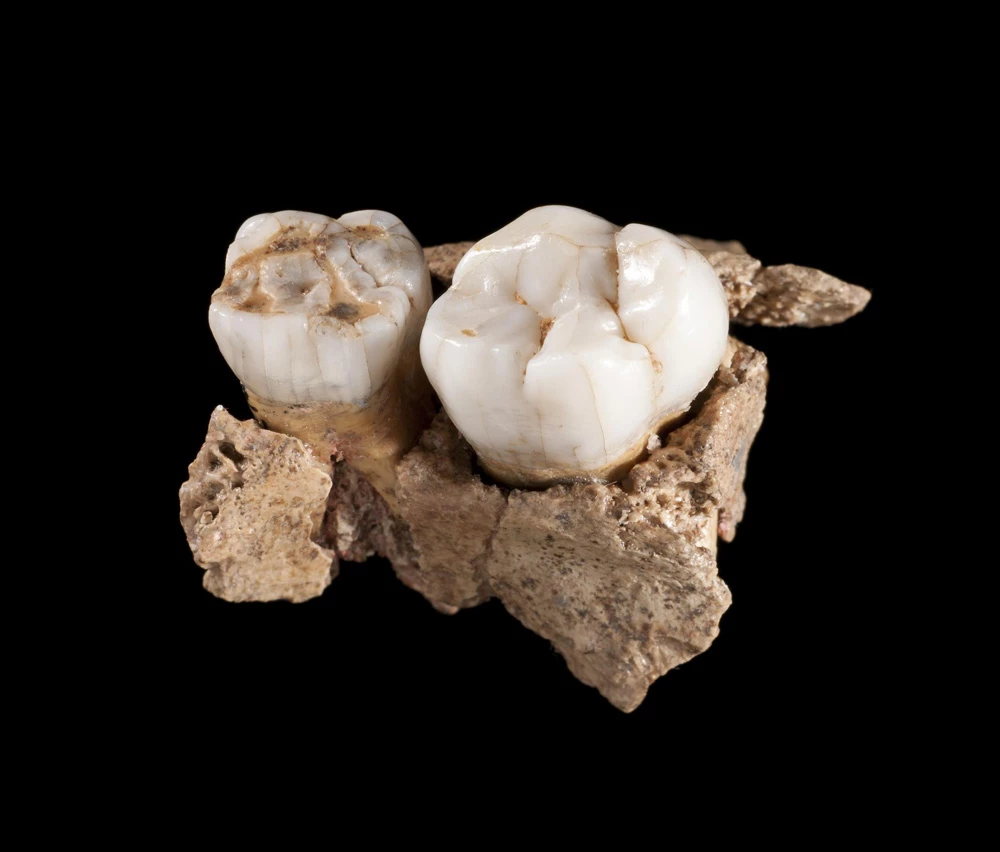
photograph of two teeth, belonging to a Neanderthal boy aged 8

The oldest human remains ever discovered in Wales

These teeth belonged to an eight year-old Neanderthal boy - and at 230,000 years old, they are the oldest human remains in Wales.

They were discovered in a cave near Cefn Meiriadog in Denbighshire, along with a trove of other prehistoric finds, including stone tools and the remains of a bear, a lion, a leopard and a rhinocerous tooth.

These teeth are among some of the incredible objects on display at St Fagans National Museum of History
 

The Shiniest

People in Wales have been making, trading and wearing beautiful treasures from gold for thousands of years - like this Bronze Age hair ornament and this extremely blingy Medieval signet.


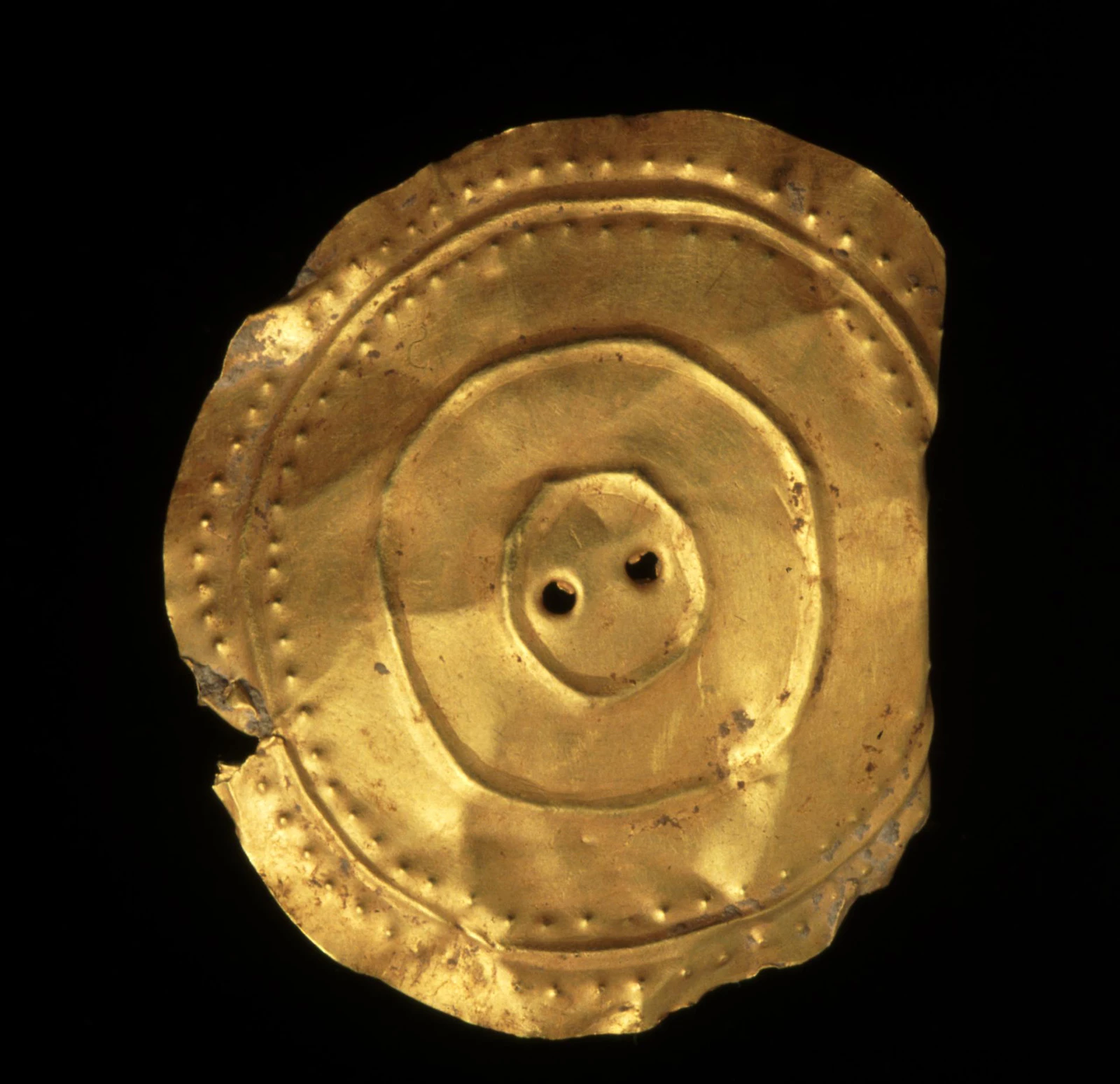
photograph of gold disc with repousse design

At around 4000 years old, this sun disc is one of the earliest and rarest examples of Welsh bling

One of the earliest examples of Welsh bling is this so-called 'sun disc', found near Cwmystwyth in Ceredigion.

Current research suggests that these 'sun discs' were part of ancient funeral practice, most likely sewn onto the clothes of the dead before their funerals. Only six have ever been found in the UK.
 

Most Controversial

At first glance, an ordinary Chapel tea service - used by congregations as they enjoyed a 'paned o de' after a service. A closer look reveals the words - 'Capel Celyn'. The chapel, its graveyard and surrounding village are now under water.


Photograph showing a cup and saucer with 'Capel Celyn' and a ribbon scroll design

Capel Celyn, in the Tryweryn Valley, is now underwater

Flooded in 1965 by the Liverpool Corporation, the Tryweryn valley became a flashpoint for Welsh political activism - creating a new generation of campaigners who pushed for change in how Welsh communities were treated by government and corporations.

Curators from St Fagans collected these as an example of life in Capel Celyn - to serve as a poignant reminder of a displaced community, and to commemorate one of the most politically charged moments of the 20th century in Wales.
 

Honourable Mention: an Airplane made from a Dining Room Chair

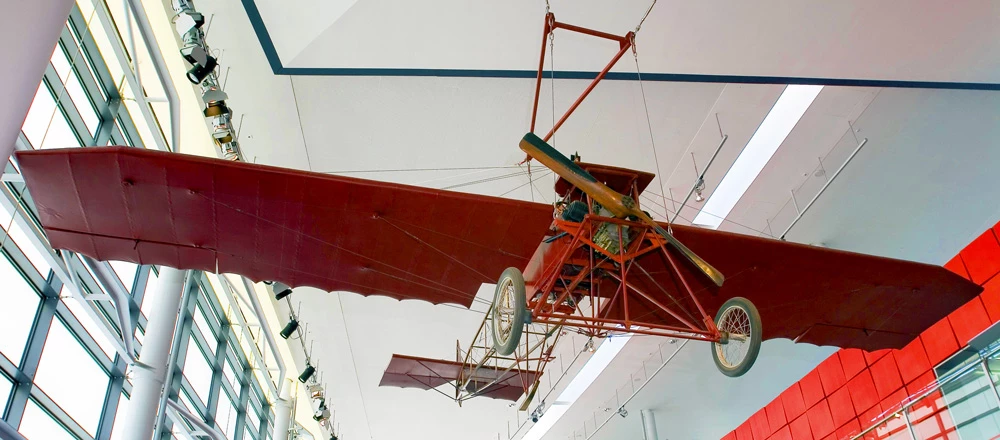
Made from a dining room chair, piano wire and a 40 horsepower engine, the Robin Goch (Red Robin) was built in 1909 - and also features a fuel gauge made from an egg timer.


photograph of a small, early twentieth century airplane with red wings

The Robin Goch (Red Robin) on display at the National Waterfront Museum

Its builder, Horace Watkins, was the son of a Cardiff printer - here he is pictured with an earlier, even more rickety version of his famous monoplane.
 

Photograph from 1908 showing Horace Watkins in a very early, precarious-looking monoplane

Horace Watkins testing his monoplane in 1908

Our collections are full of stories which reflect Wales' unique character and history. The Robin Goch is one of the treasures of the collection, and is an example of Welsh ingenuity at its best.

Half a Million Searchable Items

The launch of Collections Online uncovers half a million records, which are now searchable online for the first time.

“Collections Online represents a huge milestone in our work, to bring more of our collections online and to reach the widest possible audience.

It’s also just the beginning. It’s exciting to think how people in Wales and beyond will explore these objects, form connections, build stories around them, and add to our store of knowledge." – Chris Owen, Web Manager
 

Search Collections Online

Plans for the future

Our next project will be to work through these 500,000 records, adding information and images as we go.

We'll be measuring how people use the collections, to see which objects provoke debate or are popular with our visitors. That way, we can work out what items to photograph next, or which items to consider for display in our seven national museums.

Preparing and photographing the collections can take time, as some items are very fragile and sensitive to light. If you would like to support us as we bring the nation's collections online, please donate today - every donation counts.


Donate Today


We are incredibly grateful to the People's Postcode Lottery for their support in making this collection available online.
 

Ancient Drinking Culture: The Langstone Tankard

1 April 2010

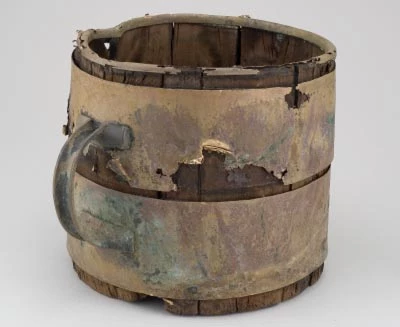
The Langstone tankard

The Langstone tankard

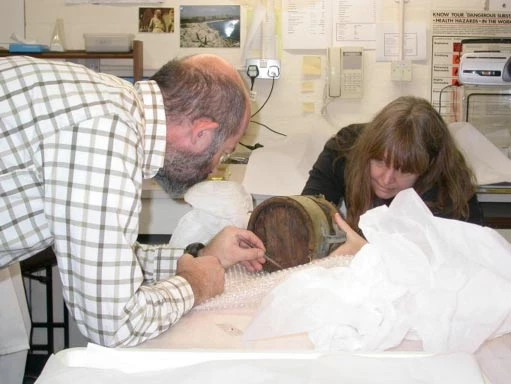
Taking wood samples from the tankard

Museum conservator Mary Davis and environmental archaeologist Nigel Nayling (Lampeter University) taking wood samples from the tankard. Microscope analysis has shown that the tankard was made of yew wood, a specially selected and very slow growing tree species.

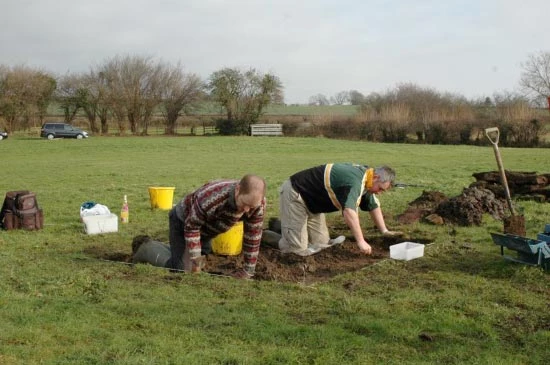
investigating the tankard find-spot

The finder, Craig Mills, and museum archaeologist Mark Lewis (National Roman Legion Museum at Caerleon), investigating the tankard find-spot

In December 2007, Craig Mills discovered a complete wooden tankard while metal-detecting in a field near Langstone, Newport. Around 2000 years old, this article presents this rare and exceptionally well-preserved drinking vessel, showing how museum conservation and research are helping to reveal its story...

The tankard

When full, the tankard would have held nearly four pints of beer or cider. It was held in two hands and was probably passed around a group as a communal drinking vessel. This vessel was made of six wood staves, slotted around a circular base-piece. Surrounding the outer face of the body are two bands of bronze sheet. The vessel has a cast copper-alloy handle, attached to the tankard wall by two pairs of rivets.

Dating to the Late Iron Age or early Roman times, the tankard has only survived because it was buried in a waterlogged soil, without contact with the air. As soon as it was taken out of the ground, it started to dry out with a real danger that it could shrink, crack and warp beyond recognition. Conservators spent much time and care, monitoring it, until it could be conserved. This was achieved by immersing it in alcohol (one more time!) to replace water from the cells within the wood. The alcohol was then replaced by ether (a very volatile substance), which evaporated easily from the wood's surface to leave the object 'dry'. Finally, the metal fittings were carefully cleaned and stabilised.

The significance of the find

Tankards were popular drinking vessels across western and southern Britain in the Late Iron Age and Roman periods. This is only one of six complete tankards to have survived in Britain and Ireland. The other example from Wales is the elaborately decorated Trawsfynydd tankard (Gwynedd), which was found around 1850 and also preserved in waterlogged peat. More common, are discoveries of just the bronze handles from tankards. The Langstone tankard is difficult to date accurately. The surviving handle, is very similar to a tankard handle discovered at the Roman fort at Loughor (Swansea). It was buried in a well, which was filled up during the second century AD. However, close examination of the Langstone tankard, suggests that this poorly fitted handle was a late replacement to an original, now missing. A localised tapering of the rim and delicate bronze pins remaining in the middle tankard wall are the surviving evidence for this early handle. This suggests that this tankard was made in the first or early second century AD (AD1-150).

Just a few metres away from the tankard find-spot a group of

two bronze bowls and a wine-strainer was found also by Craig Mills at around the same time. These near complete vessels were made during the Late Iron Age and decorated in the Celtic Art style. They were buried in a similar waterlogged and peaty layer, probably during the middle of the first century AD. This similar use, for straining and holding liquids, such as wine or medicine, suggests that this location held particular significance to their owners, who chose to bury their valued drinking gear here.

Written by Adam Gwilt, with a contributing team of Evan Chapman, Mary Davis, Mark Lewis, Mark Lodwick, Craig Mills & Nigel Nayling

Bowls in the Bog: the Langstone Treasure Revealed

23 March 2010

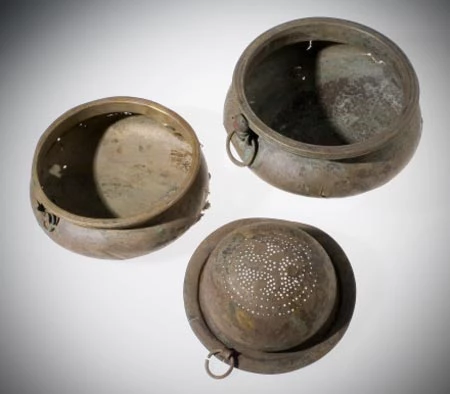
The hoard group of two bowls and a wine-strainer

The hoard group of two bowls and a wine-strainer

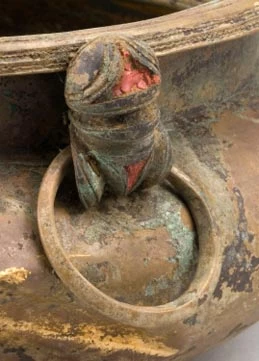
The decorated ring-handle fitting (escutcheon) on the large bowl

The decorated ring-handle fitting (escutcheon) on the large bowl

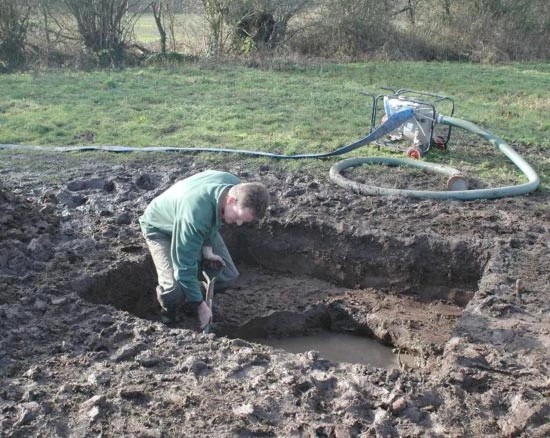
Investigating the waterlogged find-spot of the bowls and wine strainer

Investigating the waterlogged find-spot of the bowls and wine strainer. Undertaken as part of an ongoing treasure case by staff of the Portable Antiquities Scheme in Wales and of Amgueddfa Cymru — National Museum Wales

In December 2007, Craig Mills discovered two Late Iron Age bronze bowls and a bronze strainer, each decorated in the Celtic Art style. The finds were made while metal-detecting in a low-lying field near Langstone, Newport. This article presents these rare finds and shows how museum fieldwork and research are helping to tell their story...

The bronze vessels

This hoard of bowls with a 'wine-strainer' was once a drinking-set, for decanting and straining liquids. They may have been used for the preparation and drinking of newly fashionable Mediterranean wine. Alternatively, they may have been put to medicinal or religious use.

The bowls are round-bottomed with carefully formed rims. One is slightly larger than the other but the strainer sits comfortably in both. Each bowl has a decorated fitting below the rim, through which a ring was fitted for hanging and storage. The strainer has a wide brim and a rounded body with a ring for hanging. The base is decorated with a carefully designed strainer pattern, achieved by careful piercing with many small, circular holes. The perforation pattern forms three trumpet-shaped zones, surrounding a three-legged triskele motif. The triskele is an often repeated Celtic Art design on Iron Age metalwork in Wales.

The significance of the find

The two bronze bowls from Langstone were made during the Late Iron Age (50BC-AD60). Examples have previously been found across south western and south eastern England, sometimes in watery places and sometimes in graves. These, and another similar bowl fittings from Llantilio Crosseny (Monmouthshire), show that they were also used across south Wales. The Langstone discoveries provide a rare opportunity to follow up a recent discovery using modern archaeological techniques.

Wine-strainers of this form have previously been viewed as early Roman (AD75-150) in date, with examples known from Manorbier (Pembrokeshire) and Coygan (Carmarthenshire). However, this example, found with a set of Late Iron Age bowls, suggests they began to be made and used slightly earlier, probably between AD40-70.

Why were valued and complete vessels buried in a bog?

A few metres away from the hoard find-spot, a complete

wooden tankard of similar age was found at the same time. This suggested a place of particular significance, associated with drinking and the burial of drinking vessels.

Two small test-pits were excavated by museum archaeologists and revealed the exact places of these finds, within the same peaty layer. The vessels had been carefully placed into the edge of a low-lying bog or shallow lake. Nearby, at the centre of this bog, on a slightly raised island of gravel, is a known Roman villa site. However, this remote island setting is unusual for a settlement. It may first have been selected as an isolated place of religious significance, before later becoming an important place of residence in Roman times.

Offerings to the gods

Burying prized objects in lakes, rivers and bogs was a widespread practice across north-western Europe during the Iron Age. These places were chosen for ceremonies involving the giving of prestigious items to the gods, who resided in these places. The reasoning for this final act of burial may relate to a moment of stress experienced by a local Iron Age community. During the middle of the 1st century AD, the Silures tribe of south Wales was engaged in bitter and prolonged conflict with an advancing Roman army. Perhaps such gifts reveal an urgent measure, a call on the power of the Celtic gods against an invading force.

Written by Adam Gwilt, with a contributing team of Evan Chapman, Mary Davis, Mark Lewis, Mark Lodwick, Craig Mills & Nigel Nayling

Prehistoric feasting in south Wales

4 May 2007

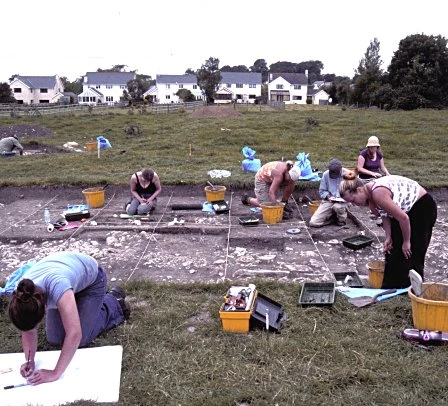
Excavations at Llanmaes in 2004.

Excavations at Llanmaes in 2004.

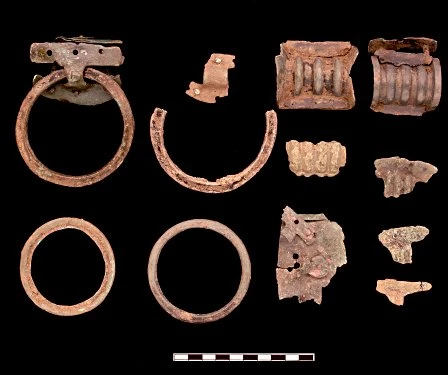
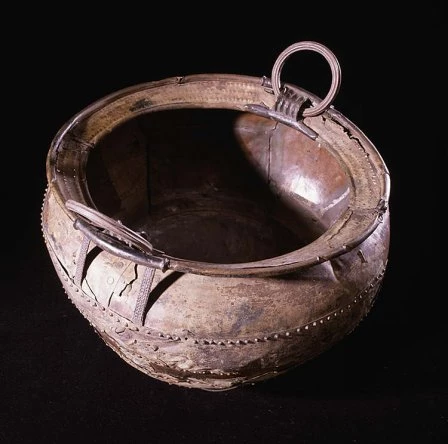
Handles and straps from cauldrons and bowls found at Llanmaes. Cauldrons were large bronze vessels used during feasts.

Handles and straps from cauldrons and bowls found at Llanmaes. Cauldrons were large bronze vessels used during feasts.

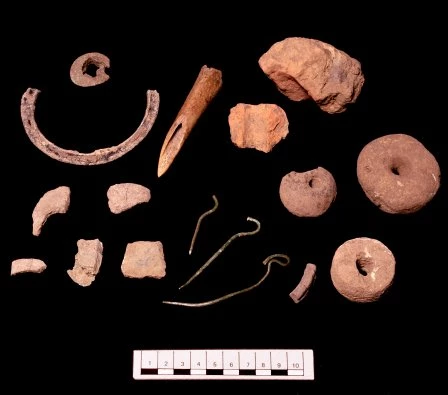
Finds from Llanmaes 2004: axe and cauldron fragments, swan's neck pins, spindle whorls and loom-weights.

Finds from Llanmaes 2004: axe and cauldron fragments, swan's neck pins, spindle whorls and loom-weights.

One of the two complete cauldrons from the Llyn Fawr hoard, Rhondda Cynon Taff.

One of the two complete cauldrons from the Llyn Fawr hoard, Rhondda Cynon Taff.

The discovery of a three-thousand-year-old settlement sheds new light on life in prehistoric Glamorgan.

In February 2003 a number of unusual metalwork items were unearthed at Llanmaes in the Vale of Glamorgan. The finds included bronze axes, horse harness fittings and fragments from bowls and cauldrons. Some of the bowls were of a previously unknown type.

Following the finds, the site was subject to excavations by Amgueddfa Cymru revealing a previously unknown prehistoric settlement, including a roundhouse and oval-shaped pits. One pit contained large broken pots of a style known to have been used between 1150 and 700BC. A large red deer antler had been placed over the pit - perhaps in a religious act, or possibly to mark the spot where the pits had once been.

Prehistoric wastepit

Above the roundhouse was a midden made of discarded domestic waste, now rotted down to form a dark soil. The midden also contained pottery from the Roman period, which began many hundreds of years later. This curious mixture of prehistoric and Roman finds makes it difficult to be sure how the settlement and midden were related.

Llanmaes as a feasting site

Apart from metalwork and pottery, the midden also contained many thousands of animal bone fragments, mostly of pigs. This is a very unusual discovery in Britain, where sheep and cattle tend to be more common. Perhaps Llanmaes was once a feasting site - pig was a favourite high-status meat at this time. More surprising still, human bones were also found in the midden, although no complete skeletons were recovered.

Items uncovered at the site are wide ranging. From bowls and cauldrons to dozens of fragments of bronze axes. Five swan's neck pins, elegant dress fasteners, spindle whorls and loom-weights used to make woollen garments, were also discovered. In addition, over 1,500 pieces of prehistoric pottery was collected - the largest collection of this date from south Wales.

Dating the settlement

All this suggests the site was probably settled between 800-500BC, with the possibility that settlement began as early as 1300BC. At a later date, it is likely that there was a Romanised farmstead nearby, although its precise location has not been determined.

These exciting discoveries are helping archaeologists to understand life at the very end of the Bronze Age when iron working had just been introduced into Britain.