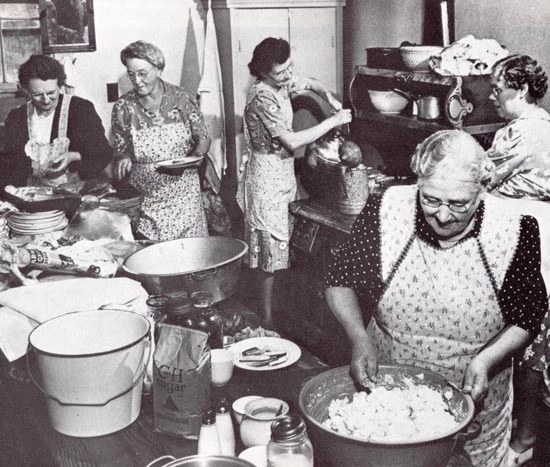
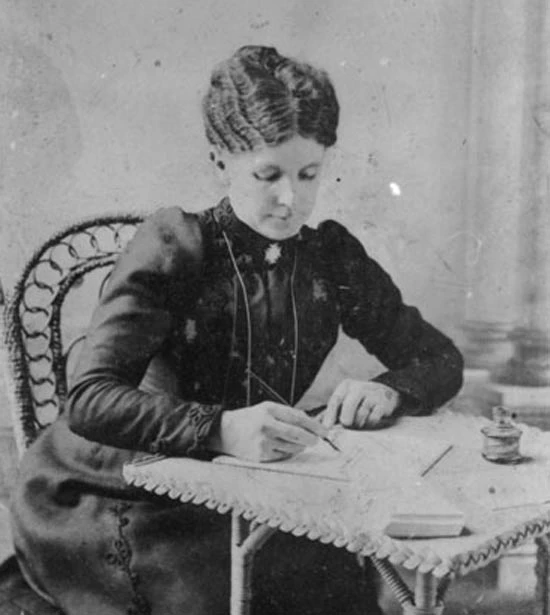
Working Abroad - Welsh Emigration: Women 19 September 2008 Preparing food for a Gymanfa Ganu (singing festival), Peniel Church, Pickett, Wisconsin,1946. The majority of industrial workers were men but women of course formed an important part of migrant communities. Often the men would travel ahead to a new country, to secure work and housing. They would then send for their wives and families to join them. The women had to support themselves and their children in the meantime and then make the long journey themselves. Women were very prominent in organizing community activities such as eisteddfodau, schooling and social reforms. Some women did work in industry. In Wales women were widely employed in tinplate works. In 1895 the Monongahela Tin Plate works in Pittsburgh, Pennsylvania employed a Welsh immigrant called Hattie Williams to train women for what was seen in America as men's work. This led to protests on both sides of the Atlantic. Women also played a part in other aspects of commercial life. In New Zealand, Mary Jane Innes (neé Lewis) of Llanvaches, Monmouthshire successfully ran her late husband's brewery business for many years.
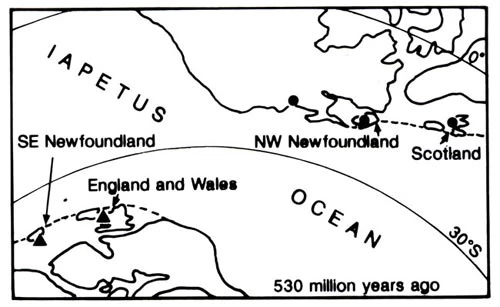
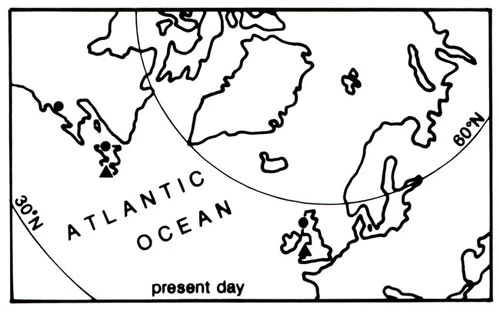
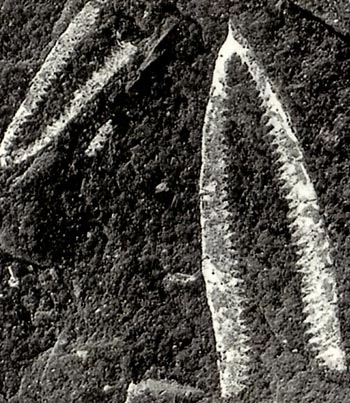
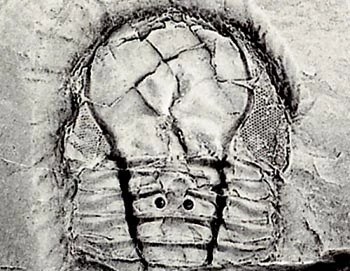
International fame for Wales's 'National Fossil' 26 July 2007 A specimen of Paradoxides davidis from Porth-y-rhaw, x 0.75. Amgueddfa Cymru collection Stage one in the evolution of the north Atlantic area. Triangles indicate areas yielding 'Welsh' trilobites, with dots showing 'North American' forms. Stage two in the evolution of the north Atlantic area. Triangles indicate areas yielding 'Welsh' trilobites, with dots showing 'North American' forms. Stage three in the evolution of the north Atlantic area. Triangles indicate areas yielding 'Welsh' trilobites, with dots showing 'North American' forms. Fossil collecting around the St. David's Peninsula, Pembrokeshire In 1862 the well-known palaeontologist J W. Salter was collecting fossils in south-west Wales as part of his duties for the British Geological Survey. While examining coastal exposures by boat around the rocky St David's peninsula, Salter one day landed in a small inlet called Porth-y-rhaw, in the mistaken belief that it was Solva Harbour, only a short distance to the east. His mistake turned out to be extremely lucky, because in the rocks of Porth-y-rhaw, he discovered the remains of one of the largest trilobites ever found (over 50 cm long), and this discovery ensured that the locality became established as a classic and well-known source of fossils. Life in the sea hundreds of millions of years ago The dark mudstones exposed there were deposited in an ancient sea some 510 million years ago, during what is now called the Cambrian Period - the name reflecting the fact that rocks of this age were first recognised and named in Wales by the early 19th-century geologists. Porth-y-rhaw is one of a small number of sites in Wales where Cambrian fossils are reasonably well-preserved and easy to find, and in addition to Salter's giant trilobite it also yields many other kinds of these extinct marine arthropods of more usual dimensions (2-3 cm long). A National fossil for Wales The formal scientific name given by Salter to the giant trilobite is Paradoxides davidis, named after his friend David Homfray, an amateur fossil collector from Porth-madog. This trilobite is now one of the best-known from Britain, and is illustrated in numerous publications; choice specimens are among the prize possessions of many of our major museums, including the National Museum of Wales. Indeed, if there were to be a 'national fossil' for Wales, Paradoxides davidis would be the prime contender. Worldwide Fame Many specimens of Paradoxides davidis also occur in the Avalon Peninsula of south-east Newfoundland, in rocks of exactly the same age as those exposed in Porth-y-rhaw. In this context, it is important to understand that in the Cambrian Period, the distribution of continents and oceans was quite different from that of the present day. At that time, Wales, England and south-east Newfoundland all lay on the southern side of an ancient ocean, called Iapetus, and were separated from Scotland and north-west Newfoundland, as shown on the accompanying map. While the same kinds of trilobites occur in Wales and south-east Newfoundland, quite different ones are common to Scotland and north-west Newfoundland, providing evidence that they once formed parts of different continents. Snowdon is born Around 480 million years ago, movements in the Earth's interior caused the ancient Iapetus Ocean to narrow gradually and finally to disappear as two continental masses collided, leading to the formation of a high mountain range of which the Welsh, Scottish, Scandinavian and Appalachian mountains are the present day remnants. The new Atlantic Ocean Much later in Earth history, between 200 and 65 million years ago, the two continents began to pull apart again, leading to the formation of a new ocean that was to become the present day Atlantic. However, the new split was not along quite the same line as that along which Iapetus had closed, and left south-east Newfoundland with its 'Welsh' trilobites anchored to the rest of Newfoundland and North America, with Scotland and its 'North American' trilobites attached to the rest of the British Isles. The occurrence of these same trilobites in areas that today are geographically remote emphasises the need for geologists to study fossils far afield if they are to interpret fully the ancient history of their own local pieces of the Earth's crust.

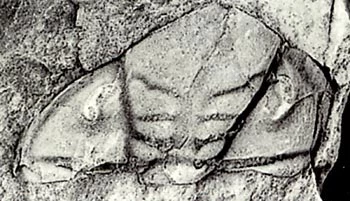
460-million-year-old relatives from Wales and Belgium reunited 26 July 2007 Didymograptus, a 'tuning-fork' graptolite of the kind found commonly in both areas. Pricyclopyge, a large-eyed pelagic trilobite that is widespread in Britain and northwest Europe. Headshield of Ormathops, a benthic trilobite endemic to Bohemia. Llanvirn Farm, Abereiddy, Pembrokeshire In the late 19th century, Henry Hicks, a surgeon from St David's, took up an interest in the ancient rocks of north Pembrokeshire. In 1881, he named the rocks at Abereiddi Bay the "Llanvirn Group", after a nearby farm. Today, this name is internationally recognized and is found in geological publications all over the world - fame indeed for a small farm on the windswept Pembrokeshire coast. Staff at Amgueddfa Cymru have been studying Llanvirn rocks and their fossils for over thirty years. In 2000, Dr R Owens of the Department of Geology was invited to examine fossils from rocks of the Llanvirn Series that are exposed in the Meuse valley in Belgium. Trilobite species found in these rocks were compared to those from the British Isles. Identical fossils from Wales and Belgium Fossils in Llanvirn rocks tend to be difficult to find without a good deal of time and effort. The graptolites and trilobites discovered in Belgium are all identical with those found in Wales and the Lake District. The Llanvirn rocks in which the fossils occur are understood to have been laid down in the deep ocean. During the Ordovician period when Llanvirn rocks were deposited, southern Britain, Belgium and northern Germany were all part of a small continent named Avalonia, separated from the vast continent of Gondwana by the Rheic Ocean. Blind trilobites Trilobites that are thought to have lived only on the sea floor (benthic species) tend to be confined to specific areas, but those thought to have swam the ocean waters (pelagic species) are widely distributed. One of the trilobite species found in Belgium has enormous eyes and is thought to be pelagic. This fossil is common in many areas. By contrast, another one, described originally by Hicks from Abereiddi, is blind, and is thought to have been benthic. However, it also has a wide distribution, which in this case is more difficult to explain. It could have spent a long time as a small larva, allowing it to drift around and causing a wider distribution of the fossils; alternatively it might have been pelagic, living in and around floating masses of seaweed. Ordovician rocks that are younger than those of the Llanvirn Series also crop out in the Meuse valley and these contain trilobite species that are also found in north Wales and northern England. These show that throughout the Ordovician Period, Belgium remained part of Avalonia. However, rocks that occur between these and the earlier Llanvirn rocks contain trilobites unlike those from Britain, but which closely resemble fossils from Bohemia. It is unlikely that part of Avalonia split away, moved closer to Bohemia and then merged back again. So why the similarity of these trilobites to those of Bohemia? The answer could lie in the underwater environment becoming more similar to that of Bohemia than to southern Britain. Although the relative longitudes of Bohemia and Avalonia are unknown, the distance separating the two areas must have been sufficiently close to allow the trilobite larvae to cross between the two and become widely distributed. The outcome of this work has been to confirm close fossil links across parts of Pembrokeshire and Belgium 460 million years ago, but also to highlight problems of fossil distribution that have yet to be fully resolved.
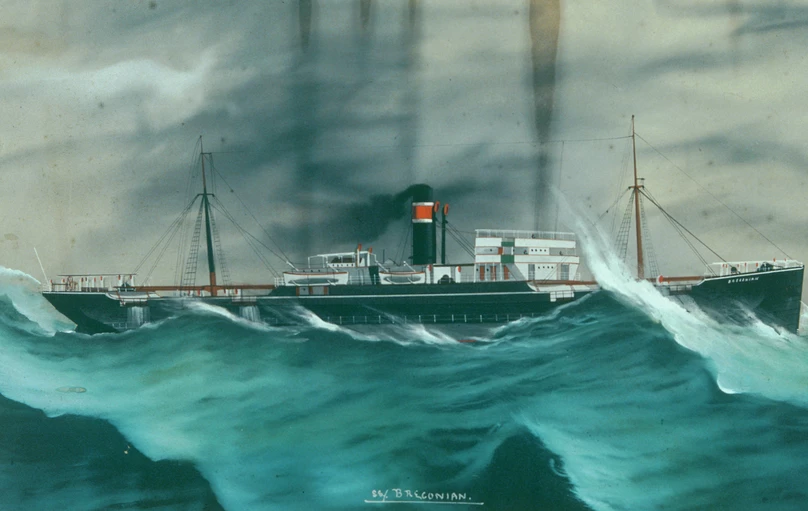
When Welsh ships sailed the seas 6 July 2007 Painting of the Breconian The Breconian The Breconian was built in 1906; she was registered in Aberystwyth and was sailed by Welshmen across the oceans of the world for thirty years. Her portrait, one of the industrial paintings of ships in Amgueddfa Cymru's collection, reveals a fascinating insight into days gone by. Ship Paintings The industrial collections house some 250 ship paintings. Few of these could be described as fine art, but they do provide an invaluable archive of Welsh maritime history. Most of these paintings are the work of Mediterranean 'pierhead painters' who, for a small sum, would produce simple colourful pictures of a vessel for the owner, captain or crew members. Originally, they were painted in pairs, one painting of the vessel on a calm sea and the other in a storm. What these paintings lack in artistic quality is made up for by their technical accuracy. These paintings became objects of pride and sentiment, as much to the ship's owner as to the captain's wife. A ship with a new design The painting of the Breconian is an unsigned storm-scene portrait. The steamship was built for John Mathias & Sons of Aberystwyth. She was unusual in that she had been built with a new, narrower deck, the turret-deck, superimposed upon the vessel's hull, extending from stem to stern. This new design made the vessel more profitable to operate. The design was so successful that 429 turret-deckers were built between 1892 and1911. The company that owned the Breconian began back in 1869 when John Mathias, an ambitious Aberystwyth greengrocer, decided to venture into shipowning, buying the schooner Miss Evans. In 1883 he moved from sail to steam, forming the Glanrheidol Steamship Company Limited. By the time that the Breconian joined the Mathias fleet, the business had been grandly renamed the Cambrian Steam Navigation Company Limited, with the seven ships of the line being named, rather unusually, after public schools. This led to seamen at Cardiff giving the company the nickname of 'the College line'. The Breconian, named after Christ College, Brecon, was the only vessel named after a Welsh school; the others being Etonian, Harrovian, Rugbeian and so on. Coal out, grain home Like most tramp steamers of the period, the Breconian would have sailed chiefly in the so-called 'coal out, grain home' trades, taking coal from south Wales across the world and returning with a cargo of cereals. She was manned mainly by Welshmen; in 1911, her master was Captain David Jones of Aberystwyth and 20 of her 28 strong crew came from Welsh coastal towns and villages. In 1917, The Breconian was sold to the Tyneside Line Limited of Newcastle and in 1926 she was sold on to a Genoese shipowner, Giovanni Bozzo, who renamed her Lorenzo Bozzo after his son. Six years later she was broken up. Today, only the painting remains to remind us of just one aspect of the flourishing Welsh maritime enterprise and the capable Welsh seamen who sailed the world's oceans.