: Wales in the World

Cardiff – Coal and Shipping Metropolis of the World

18 April 2007

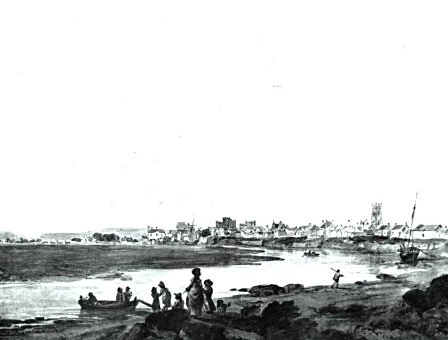
Cardiff: the pre-industrial port. Two sloops lying in the River Taff, as portrayed by Paul Sandby in 1776.

Cardiff: the pre-industrial port. Two sloops lying in the River Taff, as portrayed by Paul Sandby in 1776.

Cardiff: the industrial port. An aerial view showing the completed dock system about 1948.

Cardiff: the industrial port. An aerial view showing the completed dock system about 1948.

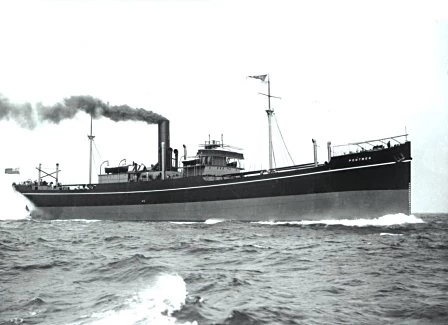
A typical Cardiff tramp steamer - the SS Pontwen, built in 1914.

A typical Cardiff tramp steamer - the SS Pontwen, built in 1914.

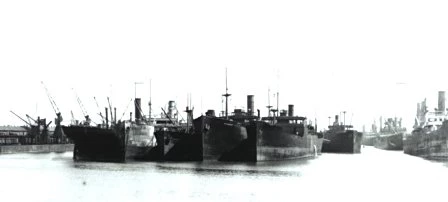
The age of depression. Laid-up ships in Cardiff docks about 1930.

The age of depression. Laid-up ships in Cardiff docks about 1930.

Cardiff: the port transformed. Modern retail developments now stand where Cardiff once exported coal to the world.

Cardiff: the port transformed. Modern retail developments now stand where Cardiff once exported coal to the world.

Second Marquess of Bute

In 1862, 2 million tonnes of coal were exported from Cardiff Docks ; by 1913, this had risen to nearly 11 million. This was the heyday of the coal industry before the depression of the 1930s.

Cardiff was the boom town of late Victorian Britain. For a few years before the First World War, the tonnage of cargo handled at the port outstripped that of either London or Liverpool. Yet in the late 18th century, Cardiff's trade was all transported by two small sloops sailing to Bristol on alternative days. So what had led to this transformation?

It was the growth of the iron industry in the South Wales Valleys that caused Cardiff to develop a port. In 1794, the

Glamorganshire Canal was completed, linking Cardiff with Merthyr, and in 1798 a basin was built, connecting this canal to the sea. Cardiff's foremost landowner, the 2nd Marquess of Bute, built West Bute Dock in 1839. Two years later, the Taff Vale Railway was opened.

Coal overtakes Iron

From the 1850s, coal began to replace iron as the industrial foundation of south Wales. South Wales steam coal was what oil is today, with yearly exports reaching 2 million tonnes as early as 1862. A further dock, the East Bute, was opened in 1859, but following the death of the 2nd Marquess in 1848, the Bute Estate trustees were over-cautious and reluctant to invest in new dock facilities.

Coal exports reach 9 million tonnes

Frustration at the lack of development at Cardiff led to rival docks being opened at Penarth in 1865 and

Barry in 1889. These developments eventually spurred Cardiff into action, with the opening of the Roath Dock in 1887, and the Queen Alexandra Dock in 1907. By then, coal exports from Cardiff totalled nearly 9 million tonnes per annum, much of it exported by locally-owned tramp steamers.

Tramp steamers and steamships

Cardiff's first steamship was the little Llandaff of 1865, and she was the first of a fleet of steamships that grew rapidly in the late 19th century. By 1910, there were some 250 tramp steamers owned at Cardiff. Each day, the owners would meet to arrange cargoes of coal for their ships in the opulent

Coal Exchange in Mount Stuart Square.

The coal export industry reached its peak in 1913, when 10.7 million tonnes of coal were exported from the port.

First World War

After the First World War, there was a significant increase in shipping in Cardiff, with 122 shipping companies in business in 1920. The boom proved short-lived, however; oil was growing in importance as a maritime fuel, and the terms of the Treaty of Versailles soon flooded Europe with cheap German coal. By 1932, in the depths of the depression, coal exports had fallen to below 5 million tonnes and dozens of locally owned ships were laid-up. It was an era of depression from which Cardiff never really recovered, and despite intense activity at the port during the Second World War, coal exports continued to decline, finally ceasing altogether in 1964.

Modern day Cardiff

Today, the port of Cardiff presents a very different picture from that existing a century ago. The waterfront has been totally transformed. Exclusive flats now stand where coal hoists once stood, and the rough and ready sailortown pubs have been replaced by sedate bistros. Only two docks, the Roath and the Queen Alexandra, remain in use, and just two shipping companies remain.

There is still some trade in timber, oil, and containers, but the days when the port was packed with tramp steamers, shrouded in coal dust as they loaded the 'black diamonds' of the valleys of south Wales, will never be seen again.

Background Reading

Cardiff and the Marquesses of Bute, by John Davies. Published by University of Wales Press (1981).

Cardiff Shipowners, by J. Geraint Jenkins and David Jenkins. Published by the National Museums & Galleries of Wales (1986).

Coal Metropolis: Cardiff, 1970-1914, by Martin Daunton. Published by Leicester University Press (1977).
Welsh slate discovered hundreds of miles from the quarries of North Wales

18 April 2007

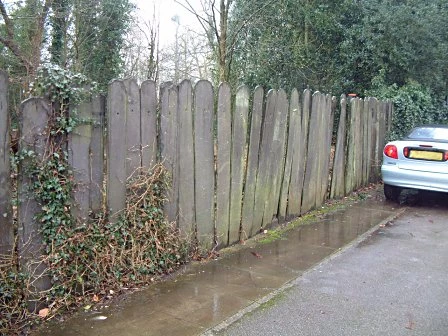
The slate pillar fence at Bisham (Windsor and Maidenhead)

The slate pillar fence at Bisham (Windsor and Maidenhead). Approximately 150m (164 yards) of this fence survives, although local residents remember it as once being significantly longer. The pillars of Bisham's fence typically extend about 180cm (5.9 feet) above ground level and must have a further 40cm (1.3 feet) or so below the ground. Each pillar is some 20cm (7.9 inches) in width and 3.5cm (1.4 inches) thick.

How did a slate pillar fence come to be built in the Thames Valley, 300km away from the slate quarries of north-west Wales?

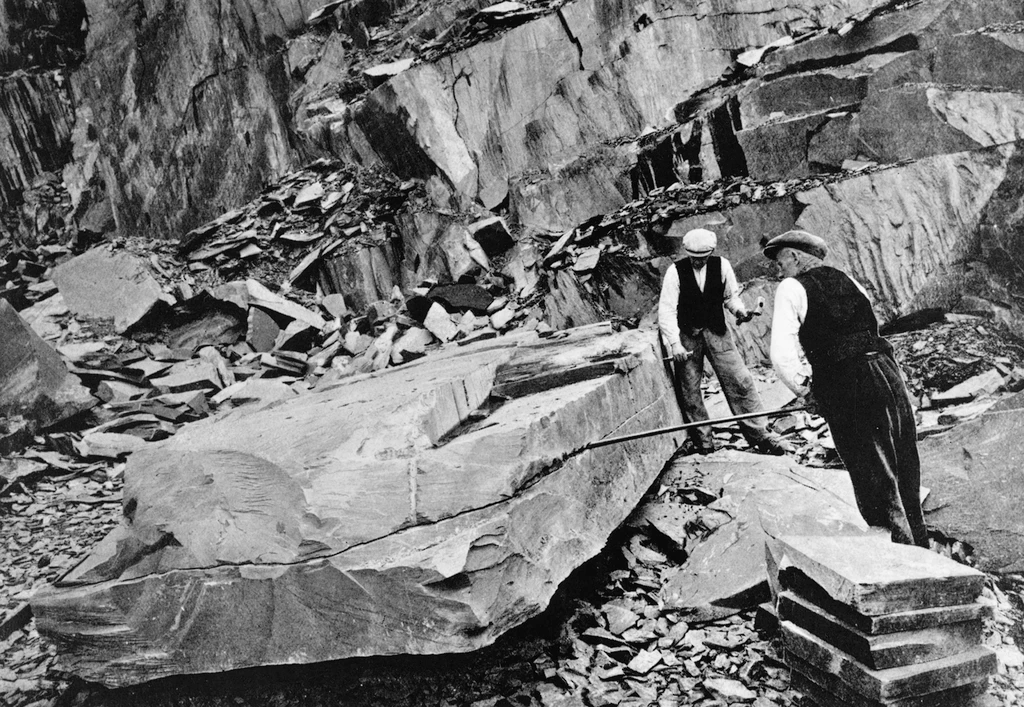
Slate pillar fences became common in north-west Wales from the middle of the 19th century. In 1861, the Penryhn Quarry at Bethesda, Gwynedd - one of the largest slate quarries in the world at that time - produced around 9,000 individual pillars. These pillars consisted of poor quality blue slate, typically about 150cm (4.9 feet) tall.

They were used to mark fields, gardens, railways lines and roads, with their simple construction being particularly well-suited to the harsh weather experienced by upland areas.

Despite their use around Wales's slate quarries, slate pillar fences are rarely found further a field. The discovery of a slate pillar fence at Temple House (now demolished) at Bisham, Maidenhead, is therefore extremely unusual. The bluish-purple colouring of the slate makes it certain that it was quarried in north-west Wales, probably at Penrhyn Quarry.

This raises the question of how a slate pillar fence came to be built almost 300km (186 miles) away from the source of the stone?

Temple House was built around 1790 for Thomas Williams, who owned the nearby Temple Mill copper works. Thomas Williams (1737-1802) was from north Wales originally and became the leading figure of the British copper industry. Williams employed the architect, Samuel Wyatt, to develop the Temple Mill copper works, and it is likely that Samuel also built Temple House.

Samuel Wyatt had very close links with the owners of the Penrhyn slate quarry. In 1782 he refurbished a building for Richard Pennant (later Lord Penrhyn), and in 1786 his brother became the general manager of the Penrhyn estate. This relationship ensured Samuel a regular supply of slates for his own business activities. In return, Samuel promoted the use of slate in the London area, using it for shelves, cisterns, lavatory-seats, window-sills and as a wall covering, as well as for roofing.

If the Temple House slate pillars had been supplied by Samuel Wyatt, their transport to Bisham could have been relatively simple. Even before the construction of a tramway from Penrhyn Quarry to the coast in 1801, there existed an efficient network of roads linking the quarry to the sea at Port Penrhyn.

From Port Penrhyn a fleet of vessels carried slate around the coast of the British Isles. The Wyatt family had an owning interest in many of these vessels. From London the cargo could be navigated up the Thames by barge.

There is therefore a great deal of circumstantial evidence linking the Bisham slate pillar fence with Samuel Wyatt and Penrhyn Quarry, and dating its construction to around 1790. But one aspect of the pillars' manufacture raises doubts about this. Some of the larger support pillars were clearly cut with circular saws - a technique which was not certainly used before 1805 and only became common from 1840.

One suggestion which unites these two strands of evidence is the possibility that the original fence was erected about 1790, but it had suffered from subsidence in the soft soil around Bisham. The result might have been a second order for Welsh slate around 1840 to rectify the problem.

The fence at Temple House may show evidence of the links between two of Wales's great industrialists, the copper magnate Thomas Williams and Richard Pennant of Penrhyn slate quarry, through the architect Samuel Wyatt. Both shared a common heritage, so what would have been more natural than for Thomas Williams and his architect to display the potential of Welsh slate beside his copper works at Temple Mill?

Background Reading

The Wyatts: an architectural dynasty by John Martin Robinson. Published by Oxford University Press (1979).

'Copper and Slate: Thomas Williams' Slate Pillar Fence at Bisham', by Dafydd Roberts. In The Marlow Historian, vol. 3, p16-21 (2003).

Medieval boat discovered in south Wales estuary

12 April 2007

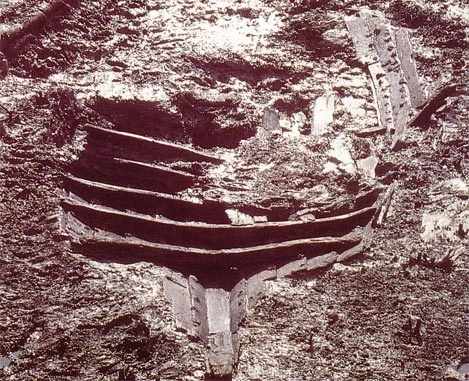
The remains of the boat in the mud

The remains of the boat in the mud

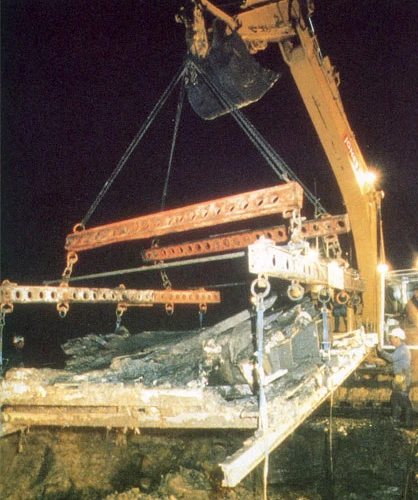
Raising the boat from the mud 4.00am August 27th 1995

Raising the boat from the mud 4.00am August 27th 1995

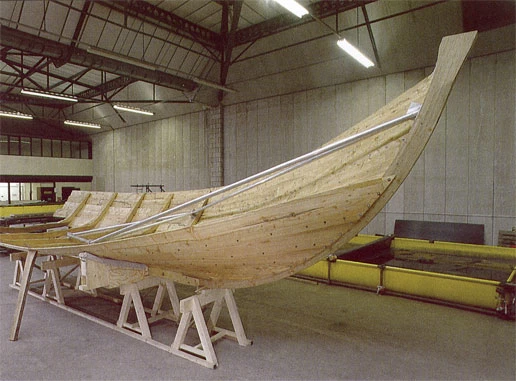
A reconstructed model of the Boat

A reconstructed model of the Boat

In 1994, the remains of a boat were discovered in the thick mud on the Gwent Levels, south Wales. Tests on the timber revealed that the boat dated from around 1194. Further excavation revealed that an intact portion of the vessel, 7.2m long and 3.9m wide, survived, making it the most important boat find of the Middle Ages in Britain for 25 years.

Lifting the Wreck

Recovery of the wreck was essential, but it could either be dismantled on site, or recovered intact. Dismantling could only be done in controlled conditions. However, the wreck was only accessible at low tide for a few hours at a time. The only reasonable course of action therefore was to retrieve the vessel intact.

Outside assistance in lifting the wreck was provided from the company building the nearby Second Severn Crossing, and over a period of seven tidal windows, day and night, a team of people worked tirelessly to dig tunnels underneath the vessel to build a cradle of aluminium beams. Extreme care had to be taken as the poor condition of the wreck made it vulnerable to disintegration.

The cradle was then attached to a lifting crane, the cables tightened, and the remaining sediment dug out. The vessel was successfully lifted at 4.00 in the morning before being transported to Cardiff, where it was placed in water to prevent the wood rotting further.

The remains were recorded and dismantled with each timber being drawn individually. The vessel was carrying iron ore at the time of sinking so had to be thoroughly cleaned using water and soft brushes to remove the iron salts from the ancient remains.

Since it was hoped that the boat could be displayed in its original form at the Museum, the timbers had to be conserved either in a way that would allow reshaping after conservation, or be moulded to shape before conservation. Both these methods have advantages and disadvantages:

Conserving the ancient wood

Waterlogged wood is conserved using a water-soluble wax, this means either immersing the timbers for five to ten years in a concentrated solution before being slowly dried in air; or immersed in a more dilute solution followed by freeze-drying to remove the water, producing a 'dry' product within one to two years.

The first method results in an object that is more wax than timber, with a non-wood like appearance, but the large amount of wax allows reshaping of the timbers. Freeze drying, on the other hand, produces a material which still has the appearance of wood as the amount of wax is much lower. However, the timbers are much more brittle than those treated by the first method and it is not possible to reshape the timbers.

Creating a Model of the boat

It was decided to reshape the timbers into their original form before conserving the wood and so a full-size model of the surviving structure had to be built to work out what the final shape of the timbers should be.

The model had to accurately replicate in three dimensions the lay-out and shapes of all the surviving timbers. The model could then provide a set of moulds to be constructed to shape and hold the planking during conservation.

After the remains were successfully reshaped, the timbers were conserved using the wax and freeze-drying treatment. The dried and stabilised timbers are now safely in the collections of Amgueddfa Cymru and research on the vessel continues, helping to place this important find within its historical context.

The art of the Japanese Tea Ceremony

22 February 2007

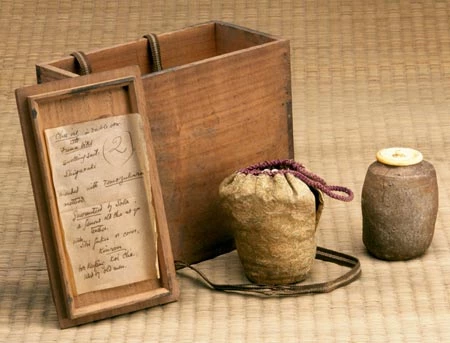
In 1915, several crates of textiles, lacquer, woodblock prints and utensils used for the Japanese tea ceremony (chanoyu), arrived at the Museum. These were sent from Japan by Bernard Leach, whose career as a potter was heavily influenced by his Japanese experiences. The items were previously undocumented and the purpose behind their acquisition was totally lost until 2001, when new archive discoveries made it possible to identify them.
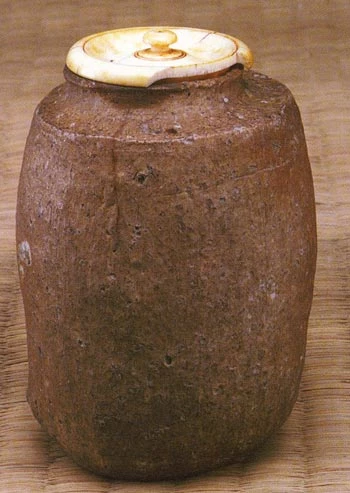
Chaire (tea jar), Shigaraki stoneware, probably late 16th century

Chaire (tea jar), Shigaraki stoneware, probably late 16th century

'...something unique'

When Bernard Leach first went to Japan he was a young artist just discovering Japanese pottery. However he was soon to become the pre-eminent British potter of the 20th century.

He did not doubt the value of the collection, describing it as 'something unique.' Taking advice from Japanese tea masters, he brought together objects of the type most valued in the Japanese chanoyu tradition, following principles established back in the 16th century. These dictate that the objects used should be simple and unpretentious, and contribute to the quiet sense of contemplation that a tea ceremony inspires.

The chaire (tea jar) sent by Leach displays these qualities perfectly. It is an example of the roughly made stoneware of Shigaraki, prized by tea connoisseurs since the 15th century. Guests would traditionally take pleasure in examining and praising such an object after the host had finished serving tea.

Recreating chanoyu

Chanoyu is an art of life, a highly ritualised act of hospitality. Objects are chosen, arranged and handled with meticulous care, so that the combination of objects and people, time and place, makes each ceremony a unique and unrepeatable occasion. Leach was insistent that this same regard was observed when the collection was displayed at the Museum in 1924.

Japanese traditions

Chanoyu objects collected by Bernard Leach

Chanoyu objects collected by Bernard Leach

When Leach was in Japan, the preservation of Japanese heritage was under considerable threat from rapid industrialisation and westernisation. Some saw the tea ceremony as a metaphor for traditional Japan, and Leach hoped that this acquisition could allow a better understanding between East and West.

In later life, Leach used his experience to act as a mediator between the cultural worlds of Western Europe and East Asia. However, we now know that the Japanese circles he moved in were themselves influenced by Western thinking and that his claims to have understood an authentic Japanese tradition should be treated with scepticism.

Nevertheless, Leach stands out as one of the key figures in the ongoing history of interaction between Europe and East Asia. It seems fitting that, just as these items are valued for their beauty and their antiquity, they are now also valued for their association with Leach himself.

Background Reading

Edmund de Waal, Bernard Leach (London: Tate, 1999);

Emmanuel Cooper, Bernard Leach: Life and Work (New Haven & London: Yale University Press, 2003);

Kakuzo Okakura, The Book of Tea (New York: Dover, 1964);

Paul Varley and Kumakura Isao (eds), Tea in Japan: Essays on the History of Chanoyu, (Honolulu: University of Hawaii Press, 1989)