: Coins, Money, Medals & Awards

Welsh miners digging for victory on the Western Front

Edward Besly, 1 October 2009

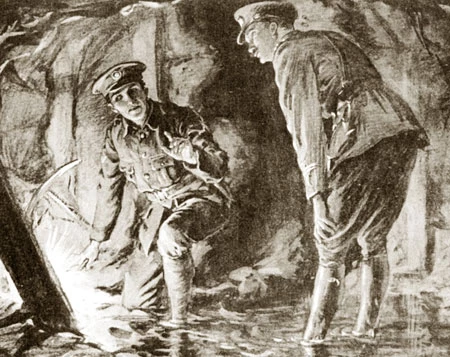
Artists' impressions of Edwards' mining exploits

Artists' impression of Edwards' mining exploits. From Deeds that Thrill the Empire, by courtesy of Dix Noonan Webb.

Medals awarded to Captain (later Major) Arthur Edwards.

Military Cross (1915), 1914 Star, British War Medal and Allied Victory Medal awarded to Captain (later Major) Arthur Edwards.

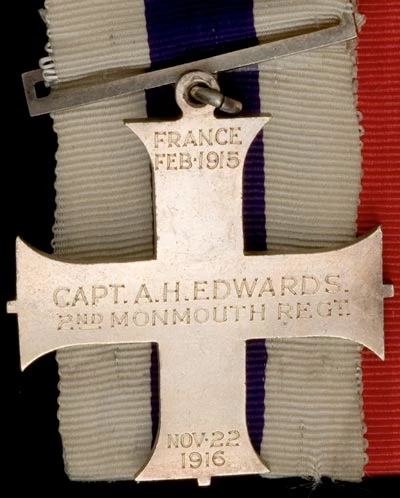
Details of the award engraved on the back.

Many recipients of the Military Cross arranged to have details of the award engraved on its back.

The trenches of World War 1

Captain Arthur Edwards from Blaenafon in south Wales oversaw the explosion of the first British mine on the Western Front in March 1915.

The First World War (1914-18) is famous for the trench warfare of the Western Front in France and Flanders. Huge armies faced each other in horrible conditions, preparing for the next big battle intended to break the stalemate.

Tunnelling and mining on both sides formed a significant part of this trench warfare, as each side tried to gain an advantage. Tunnels were dug underneath "no man's land" and under the enemy's trenches. They were then packed with explosives and detonated.

The dry chalk of the Somme was especially suited to mining, but it was also possible to mine in the sodden clay of Flanders. The experience and skills of Welsh miners played an important part in the construction of these mines.

Fighting the war underground

It was all started by Captain Arthur Edwards, a mining engineer who served in the 2nd Battalion of the Monmouthshire Regiment. In December 1914 the 4th Divisional Mining Party was formed, under Edwards' command.

In March 1915, after two months of tunnelling under enemy lines, the tunnels were evacuated, packed with explosives and detonated. The huge explosion caused buildings above ground to be destroyed — the tunnels were under buildings that were being used by enemy snipers.

On another occasion, German miners, tunnelling in one direction, broke into allied tunnels being dug in the opposite direction, resulting in fierce hand-to-hand fighting underground.

A Badge of Honour

In June 1915 Captain Arthur Edwards was awarded the Military Cross, a newly introduced decoration for captains and junior officers. He was also twice mentioned in despatches for gallant and distinguished service. He served through the War, including the first day of the Battle of the Somme (1 July 1916) before being badly wounded by a gas shell in June 1918.

His medals were acquired by Amgueddfa Cymru in 2006.
Welsh miners digging for victory on the Western Front

Edward Besly, 1 October 2009

The trenches of World War 1

Medals awarded to Captain (later Major) Arthur Edwards.

Military Cross (1915), 1914 Star, British War Medal and Allied Victory Medal awarded to Captain (later Major) Arthur Edwards.

Artists' impressions of Edwards' mining exploits

Artists' impression of Edwards' mining exploits. From Deeds that Thrill the Empire, by courtesy of Dix Noonan Webb.

Details of the award engraved on the back.

Many recipients of the Military Cross arranged to have details of the award engraved on its back.

Captain Arthur Edwards from Blaenafon in south Wales oversaw the explosion of the first British mine on the Western Front in March 1915.

The First World War (1914-18) is famous for the trench warfare of the Western Front in France and Flanders. Huge armies faced each other in horrible conditions, preparing for the next big battle intended to break the stalemate.

Tunnelling and mining on both sides formed a significant part of this trench warfare, as each side tried to gain an advantage. Tunnels were dug underneath "no man's land" and under the enemy's trenches. They were then packed with explosives and detonated.

The dry chalk of the Somme was especially suited to mining, but it was also possible to mine in the sodden clay of Flanders. The experience and skills of Welsh miners played an important part in the construction of these mines.

Fighting the war underground

It was all started by Captain Arthur Edwards, a mining engineer who served in the 2nd Battalion of the Monmouthshire Regiment. In December 1914 the 4th Divisional Mining Party was formed, under Edwards' command.

In March 1915, after two months of tunnelling under enemy lines, the tunnels were evacuated, packed with explosives and detonated. The huge explosion caused buildings above ground to be destroyed — the tunnels were under buildings that were being used by enemy snipers.

On another occasion, German miners, tunnelling in one direction, broke into allied tunnels being dug in the opposite direction, resulting in fierce hand-to-hand fighting underground.

A Badge of Honour

In June 1915 Captain Arthur Edwards was awarded the Military Cross, a newly introduced decoration for captains and junior officers. He was also twice mentioned in despatches for gallant and distinguished service. He served through the War, including the first day of the Battle of the Somme (1 July 1916) before being badly wounded by a gas shell in June 1918.

His medals were acquired by Amgueddfa Cymru in 2006. 

Article by: Edward Besly, Numismatist, Department of Archaeology & Numismatics. Amgueddfa Cymru.

A 'mystery' Victoria Cross and a stuffed parrot

26 April 2007

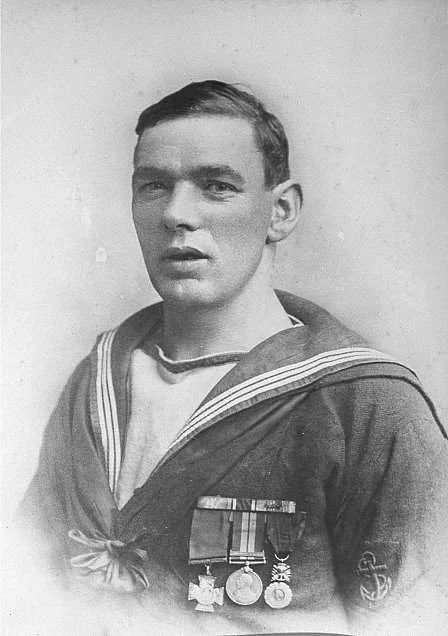
William Williams VC.

William Williams VC. Image © Kenneth Williams Collection.

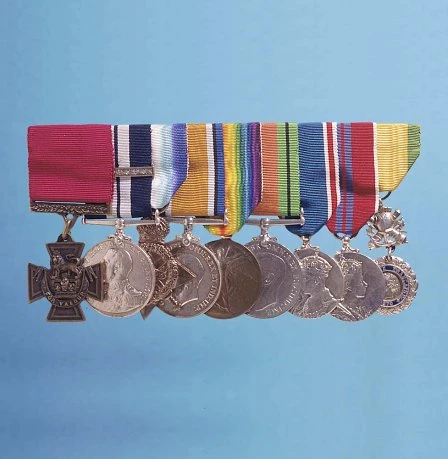
William Williams' medals.

William Williams' medals. Left to right: Victoria Cross, Distinguished Service Medal with second award bar, Great War service medals (1914-15 Star, War Medal, Victory Medal), Defence Medal 1939-45, Coronation Medals (1937 and 1953), France, Médaille Militaire.

In 1917 William Williams was awarded the Victoria Cross for his role in the sinking of a German submarine.

On 21 July 1917 an Anglesey seaman, William Williams, received the Victoria Cross, Britain's foremost gallantry award. The citation on the award read 'selected by the ship's company of one of H.M. ships to receive the Victoria Cross under Rule 13 of the Royal Warrant'.

This vague citation led this and other similar cases to become known as the 'Mystery VCs'. What lay behind it?

U-boats and Q-ships

During World War I (1914-18), the German Navy attempted to blockade Great Britain, using its submarine (U-boat) fleet to cut off food and vital supplies. One tactic used by Britain to trick the German submarines was to use armed ships disguised as merchant ships. These were known as 'Q-ships'. These ships went to great lengths to ensure that they were attacked, in the hope that the submarine would then surface and expose itself to the hidden guns of the Q-ships.

Williams served on several Q-ships and already held the Distinguished Service Medal for his part in the sinking of a German submarine in February 1917.

H.M.S. Pargust

Williams was awarded the Victoria Cross for his involvement in the sinking of the German submarine UC-29 on 7th June 1917. The H.M.S Pargust was torpedoed and the crew were seen to abandon their disguised Q-ship - complete with a stuffed parrot in a cage - but unknown to the Germans, a small number of men remained hidden on board.

For over 30 minutes, Seaman Williams held in place the starboard gun port, its releasing weights having been freed by the torpedo's explosion. His actions prevented premature exposure of the gun until the moment came to open fire when the German submarine eventually surfaced nearby.

The achievement of sinking UC-29 was recognized by the award of the Victoria Cross to H.M.S. Pargust, the first time a ship had been honoured under the Rule for rewarding an act of collective gallantry.

One officer (Lieutenant R.N. Stuart) and one rating were elected by the crew to receive the award. Williams, whose quick thinking and strenuous effort had saved the day, was the rating.

His distinguished career held one more twist: on 8 August 1917, H.M.S. Dunraven (Pargust's successor and another Cardiff ship) was sunk off the French coast after a five-hour battle with another submarine. Williams received a bar (second award) to his DSM for his gunnery work on this occasion: his third gallantry award in under six months!

William Williams was discharged from the Royal Naval Reserve in November 1918. He settled in Holyhead and was a founder member of the local branch of the British Legion. He died on 23 October 1965.

Background Reading

My mystery ships by G. Campbell. Published by Hodder & Stoughton (1928).

Sea killers in disguise by T. Bridgeland. Published by Leo Cooper (1999).

Welsh bard falls in the battle fields of Flanders

25 April 2007

"It was the last day of July, you see. The first day of probably the biggest battle that ever took place. The battle of Passchendaele".

(Simon Jones, 1975).

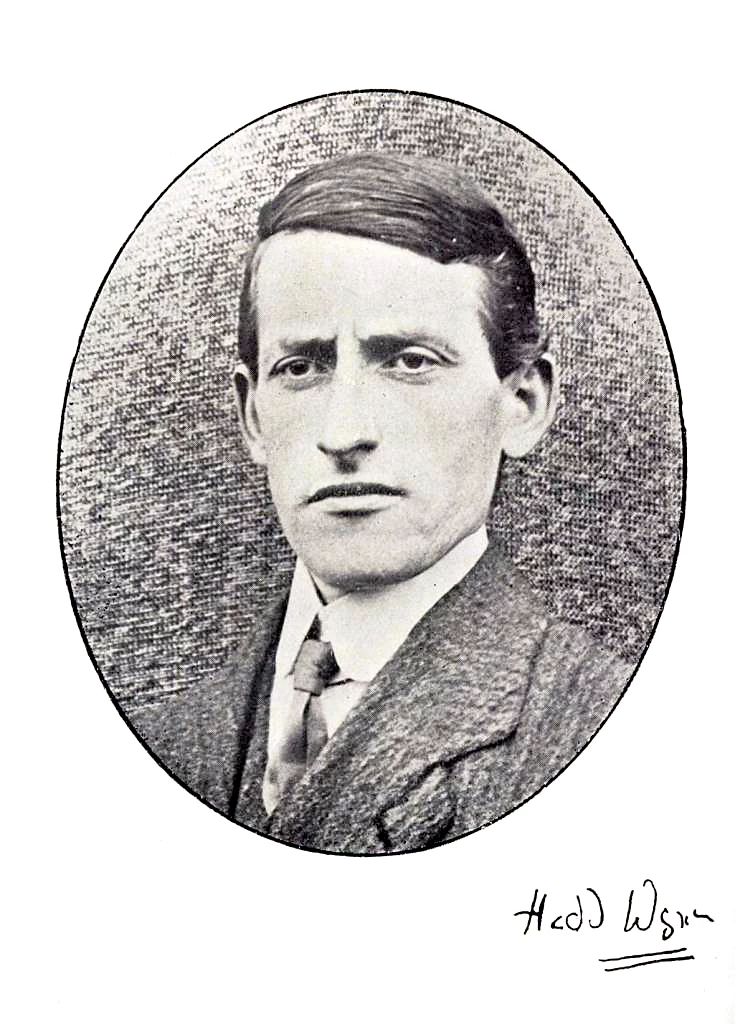
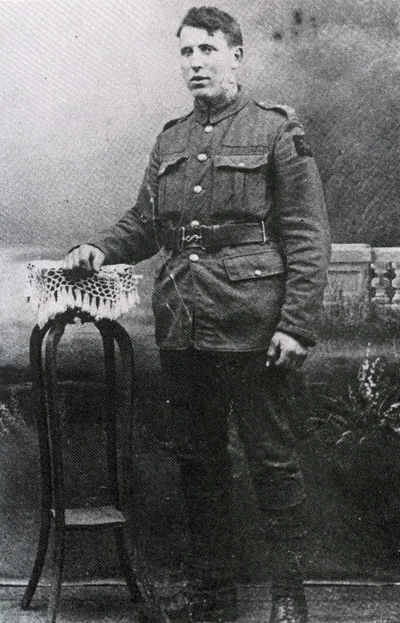
Over a quarter of a million Welshmen enlisted to fight in the First World War. Among them was the poet Ellis Humphrey Evans of Trawsfynydd, better known under his bardic name of Hedd Wyn. He was dispatched for active service in 1917. Just a few months later he was dead - killed in battle on the fields of Flanders.

The Black Chair

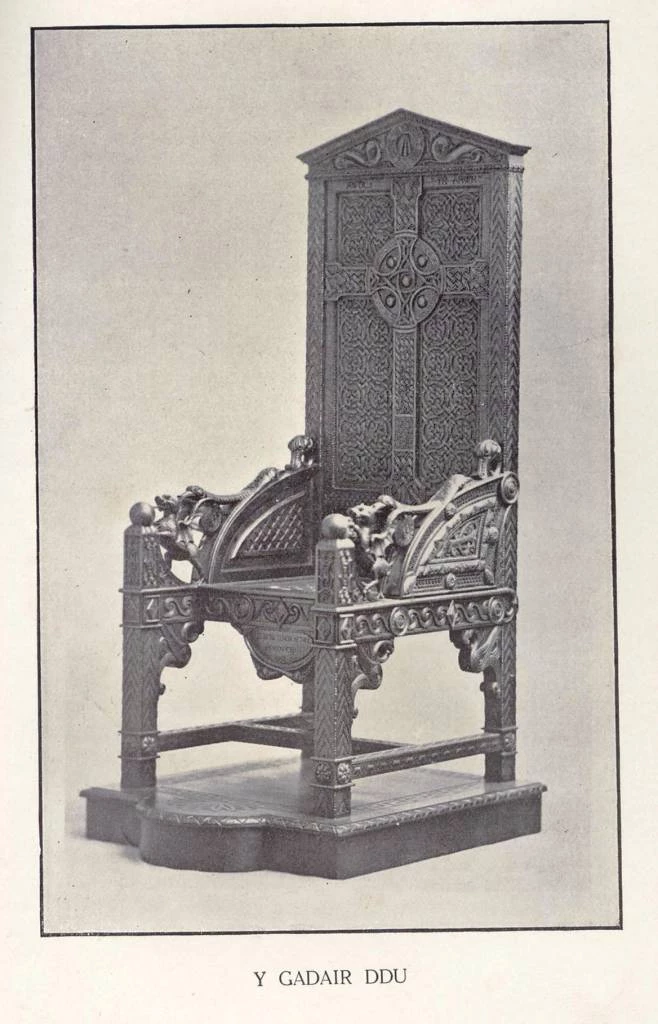
Six weeks later he was posthumously awarded the chair at the National Eisteddfod at Birkenhead for his poem Yr Arwr (The Hero) which he had completed shortly before his death. The chair itself was draped in black during the chairing ceremony, and has since been known as the Y Gadair Ddu (The Black Chair). By the age of 28 he had won four Eisteddfod chairs for his poetry.

Ellis Humphrey Evans (Hedd Wyn; 1887 - 1917)

Ellis Humphrey Evans (Hedd Wyn; 1887 - 1917)

The Black Chair

The Black Chair

Witness account

Mr Simon Jones of Aberangell, Mid Wales, served in the same regiment as Hedd Wyn, and witnessed his falling on the field of battle. Hear or read his account, as recorded by St Fagans National Museum of History in 1975:

AWC 4763. Recorded: 26.9.1975, by Robin Gwyndaf.
AWC 4764. Recorded: 26.9.1975, by Robin Gwyndaf.
 

"It was the last day of July, you see. The first day of probably the biggest battle that ever took place. The battle of Passchendaele. And we were going over the top at half past four. We started over Canal Bank at Ypres, and he was killed half way across Pilckem (Ridge). I've heard many say that they were with Hedd Wyn and this and that, well I was with him as a boy from Llanuwchllyn and him from Trawsfynydd. I saw him fall and I can say that it was a nosecap shell in his stomach that killed him. You could tell that. You couldn't stay with him - you had to keep going, you see.

When did you see him last, to speak to him?

Oh, it's difficult to say. Perhaps I spoke to him that morning, because if I saw him get killed, I must have been near to him. I remember well that we had an officer leading us called Newman, Lieutenant Newman. He was going in front of me, and I saw him fall on his knees and grab two fistfuls of dirt. Well there was nothing but dirt there, you see - the place was all churned up. He was dying, of course.

What did you do? Could you do something when you saw Hedd Wyn... ?

Nothing at all. No. There were stretcher bearers coming up behind us, you see. There was nothing - well, you'd be breaking the rules if you went to help someone who was injured when you were in an attack. Your business was to keep going.

How did you feel when you saw your friend fall?

Well I'll tell you straight. To be honest, you had no time to sympathise because you didn't know whether you'd be in the same situation as him in a couple of yards."

 
Simon Jones in the First World War

Simon Jones in the First World War

"I saw him fall and I can say that it was a nosecap shell in his stomach that killed him. You could tell that. You couldn't stay with him - you had to keep going, you see".

(Simon Jones, 1975).


Lost generation

Hedd Wyn was one of 32,000 soldiers to be killed in the attack on Pilckem Ridge. The devastated village of Passchendaele itself was not captured until 6 November, 98 days after the start of the battle. This slow advance over little more than five miles of ground was achieved with the loss of 310,000 Allied and 260,000 German lives.

The Black Chair remains a potent symbol of the devastating impact of the First World War on communities throughout Wales, and the unfulfilled potential of a whole generation of young Welsh men.

Heroic rescue for man dangling from girder 50 meters high

23 April 2007

Edward Medal for bravery

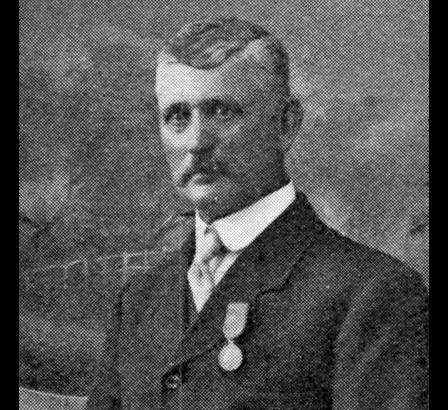
James Dally, wearing the Edward Medal. From the Great Western Railway Magazine, September 1915.

James Dally, wearing the Edward Medal. From the Great Western Railway Magazine, September 1915.

In October 1914 James Dally saved a colleague from a 52m fall from a viaduct. He was awarded the Edward Medal for his bravery.

On 28 October 1914, the Crumlin viaduct, near Newport, south Wales, was being painted by using a staging of planks timber supports. Around 5:00 pm, one of the supports broke, and the foreman, Mr Skevington, fell 52m (175 feet) to his death into the goods yard below. The second man, Thomas Bond, just managed to grip onto the main bridge structure in time, but was left dangling in mid air...

Heroic rescue

The Crumlin Viaduct. The location of the rescue is marked with a red dot.

The Crumlin Viaduct. The location of the rescue is marked with a red dot.

Bridgeman James Dally, of Crumlin, was nearby, supervising the operation. He immediately crawled out from the gangway on to the diagonal bracings - which were a mere eight centimetres wide:

"I asked him to swing his legs in an upward direction, so as to get them around the stretcher, if possible. This he succeeded in doing. I then got hold of Bond's legs; & told him to move one hand at a time & by that means he was drawn nearer to the gangway & when he was near enough I got a better hold of him, & eventually landed him safely on the gangway."

According to the London Gazette, "The man would probably have lost his life had it not been for the courage and presence of mind shown by Dally." Bond himself had no doubts: "I was suspended in the air; but if Mr Dally had not been on the gangway at the time, & taken the action he did I could not have saved myself... I owe a deep debt of gratitude to Mr Dally, for had it not been for the encouragement he gave me, & the prompt effort he made, I would have undoubtedly met the same fate as Mr Skevington."

Acts of courage in other industries

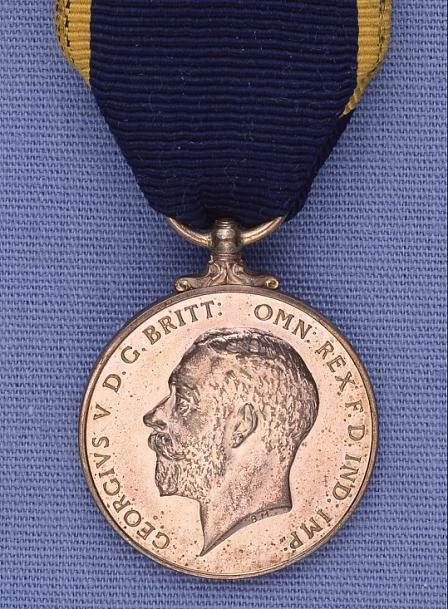
James Dally's Edward Medal, Industry, Second Class (bronze), front view.

James Dally's Edward Medal, Industry, Second Class (bronze), front view.

In the event, Dally was awarded the Edward Medal, which he received from King George V on 12 July 1916. This medal had been created in 1907 to reward "heroic acts performed by miners and quarrymen" and in 1909 its award was extended to acts of courage in other industries.

The Crumlin Viaduct was 512m (1,680 feet) long and rose some 60m (200 feet) above the valley of the Ebbw. The viaduct was opened on 1 June 1857 and by 1863 was part of the Great Western Railway network; it was demolished in 1965-66.

Background Reading

For Those in Peril, by Edward Besly. Published by the National Museums & Galleries of Wales (2004).

Gallantry: its public recognition and reward in peace and war at home and abroad by A. Wilson and J. H. F. McEwen. Published by Oxford University Press (1939).