: Coins, Money, Medals & Awards

An Albert Medal won in Cardiff 1919

23 April 2007

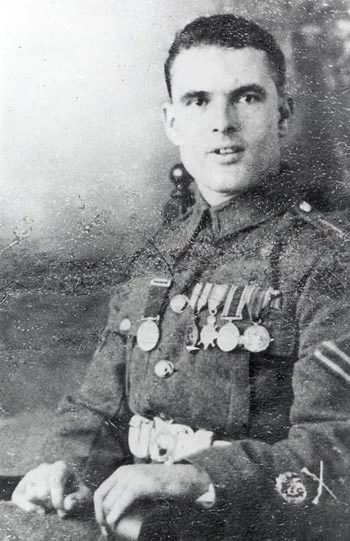
Walter Cleall, winner of the Albert Medal. Image copyright Kenneth Williams.

Walter Cleall, winner of the Albert Medal. Image copyright Kenneth Williams.

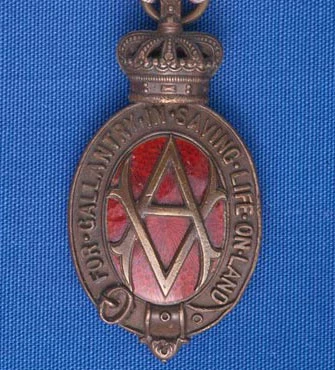
The Albert Medal (front view)

The Albert Medal (front view)

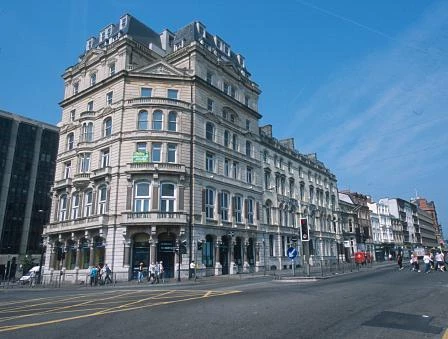
The Royal Hotel, Cardiff (photographed 2003).

The Royal Hotel, Cardiff (photographed 2003).

In 1919 Walter Cleall won the Albert Medal for gallantry in saving the life of Winnie Jones from a fire at the Royal Hotel, Cardiff.

On the afternoon of 11 August 1919, an off-duty chambermaid named Winnie Jones found herself trapped in her 6th floor room at the Royal Hotel, Cardiff, by a severe fire. The Fire Brigade's ladders could not reach her. A crowd had gathered and two men - Tom Hill and Walter Cleall - ran into the hotel to try to rescue her.

Somehow, Cleall reached the 6th Floor, but to get to the girl he had to smash a window and make his way round a narrow parapet, at places with a drop of nearly 30m (100 feet) to Wood Street, below. He then carried her back by the same route. As they left her room, the roof collapsed. Both the girl and her rescuer were later taken unconscious to hospital.

The whole event was witnessed by a London barrister, who happened to be in Cardiff that day. He promptly wrote to the Home Secretary (another barrister) and within two days of the event the Home Office was investigating whether to reward Cleall's bravery. The following March, Cleall was invested by the King with the Albert Medal, then Britain's senior civil gallantry award.

The Albert Medal was first awarded in 1866 for gallantry in saving life at sea. In 1877, it was extended to cover incidents on land, following the dramatic rescue of five miners who had been trapped underground for nine days at the Tynewydd Colliery in the Rhondda Valley. It rapidly became known as the 'Civilian Victoria Cross'. The creation of the George Cross in 1940 made the Albert Medal redundant, except as an occasional posthumous award, and in 1971 it was revoked. Its living holders were invited to exchange it for the George Cross. Walter Cleall was one of five who chose to donate their original award to the National Museum of Wales.

Background Reading

For Those in Peril, by Edward Besly. Published by the National Museums & Galleries of Wales (2004).

The 'legendary' treasure of Tregwynt

17 April 2007

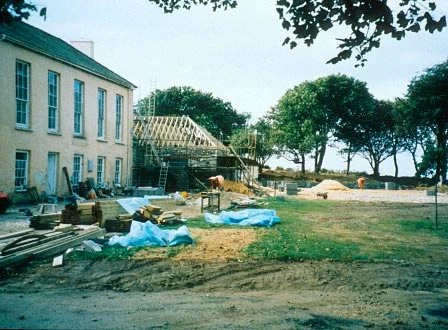
Tregwynt Mansion

Tregwynt Mansion, September 1996: the tennis court under construction.

The Tregwynt hoard

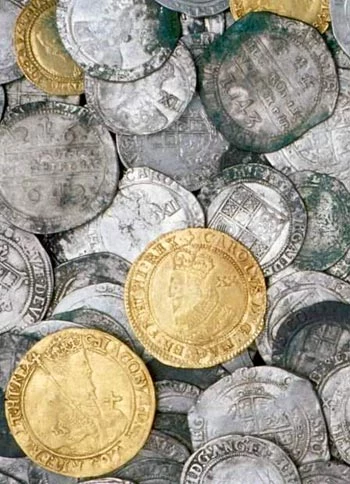
The Tregwynt hoard: a selection of the coins as found.

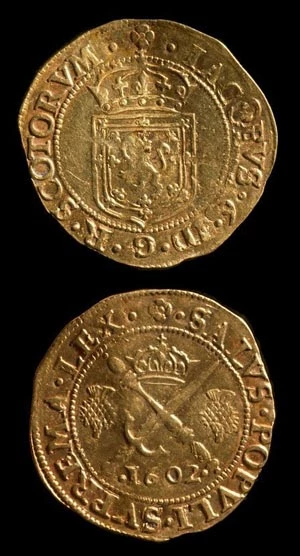
A Scottish Sword-and-Sceptre piece of James VI, 1602

A Scottish Sword-and-Sceptre piece of James VI, 1602. The money brought south by James in 1603 when he became King of England was made legal tender in England and Wales.

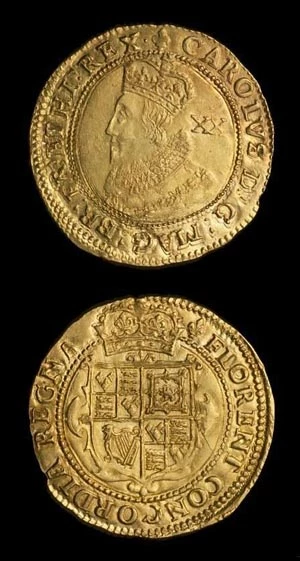
A gold Pound coin: a twenty-shillings piece of King Charles I (1625-49).

A gold Pound coin: a twenty-shillings piece of King Charles I (1625-49).

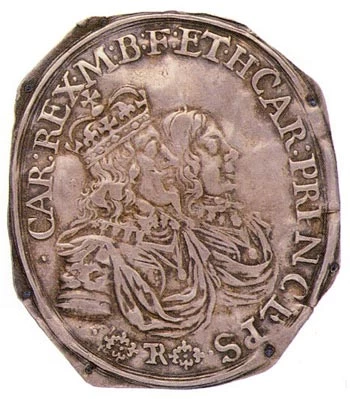
A silver half crown (2s 6d [12½p]) of Charles I, 1642

A silver half crown (2s 6d [12½p]) of Charles I, 1642. Struck at an emergency mint at Shrewsbury at the beginning of the Civil War, this was a day's pay for a cavalryman. On the back, the King promises to fight for the Laws of England, the Protestant religion and the Liberty of Parliament. Round the edge: 'Let God arise, let his enemies be scattered!'

Tregwynt Mansion, Fishguard, Pembrokeshire

Each year Amgueddfa Cymru receives a few chance finds of coins and tokens, but occasionally something more spectacular comes to light. On 17th September 1996, one of Wales' finest coin hoards was discovered.

The story begins in 1996 at Tregwynt Mansion, not far from Fishguard, Pembrokeshire, when the owners were building a tennis court. As they levelled the site and removed the topsoil, a few coins were uncovered. As more soil was removed, more coins were found and after a few days 87 silver and gold coins had been uncovered dating from the 16th and 17th centuries.

An initial news blackout on the discovery proved to be a wise precaution, since by mid October, further searching, helped by a hired JCB, brought the total to 33 gold and 467 silver coins, fragments of pottery, a sheet of lead, and a gold ring! At a coroner's inquest at Haverfordwest on 12th June 1997, the coins and ring were declared treasure trove.

The Museum was able to acquire the hoard with the aid of the Heritage Lottery Fund.

Why is the Tregwynt hoard special?

The Tregwynt Hoard is one of the finest coin hoards ever recovered from Wales. At the time of its burial it was worth £51 9s. (in today's terms perhaps around £10,000) - enough to pay fifty soldiers for about a month.

The hoard contains an unusually wide range of mid-17th century currency in gold and silver, including a gold crown (five shillings) dating back to the time of Henry VIII.

The coins cover a range of values and reigns: sixpences and shillings of Edward VI (1547-53), Philip and Mary (1554-8), Elizabeth I (1558-1603), The remaining English gold coins are of James I (1603-25) and Charles I (1625-49), but there is also one Scottish gold coin of James VI dated 1602, just before he became king of England.

Tregwynt is unusual in containing coins from no fewer than seven of the emergency mints operated by the royalists during the Civil War. There are also two very rare Irish coins: a half crown probably issued in 1642 by the rebel Catholic Confederacy, and a crown from an emergency Dublin issue of 1643, probably the first recorded find of this type in a Civil War context in England and Wales.

Dating the Hoard

The latest coin at Tregwynt is a single shilling bearing as its mint-mark a sceptre, in use during 1647 and 1648, so the hoard was buried no earlier than 1647.

Oliver Cromwell and the Battle of St. Fagans

Tregwynt is the first 'Civil War' coin hoard to be recorded from Pembrokeshire, and although the hoard's burial cannot be dated with any precision, it seems likely that the county was a major focus of the so-called 'Second Civil War' - a series of royalist risings during the first half of 1648. In February that year Colonel Poyer, a staunch parliamentarian, refused to hand over Pembroke Castle to Colonel Fleming, and by March was in revolt. The parliamentarians were driven out of Pembrokeshire and the royalists were only finally halted at the battle of St Fagans, near Cardiff on the 8th May 1648. The revolt brought Oliver Cromwell to west Wales in person to attack Pembroke Castle, which did not surrender until 11th July.

When, By Who and Why?

It is highly likely, therefore, that burial of the Tregwynt hoard relates to the events of 1648. Who owned it? This we shall never know for certain, but whoever it was never came back to collect it.

The occupier of Tregwynt at the time was Llewellin Harries, an important farmer who died in 1663 and had at least twelve children. As the hoard was buried in a pot covered by a lead sheet, in an outbuilding it suggests that one of the family was probably involved in its burial: but was it the owner?

In the confused times of civil war, almost anything is possible. There is some slight evidence that the Harries were royalist, but if so, they seem to have kept out of the way when it came to the post-war fines imposed on the King's supporters.

Three men named Harries fought for the king at St Fagans but none were definitely connected with Tregwynt. The gold ring, which is presumed to have belonged to the hoard, is a 'posy' (motto) ring inscribed 'Rather death then [than] falce of fayth' - but the meaning cannot be assumed, nor its owner identified.

The Tregwynt Legend

There has long been a legend of treasure at Tregwynt, of valuables supposedly hidden in a hurry when the 1797 French invasion at Fishguard interrupted a ball at the mansion. Reality has proved somewhat different. We shall never know the full story of the Tregwynt treasure, but it stands out as a fine example of the currency of Wales in the early modern period and a spectacular reminder of the disruption visited upon every community during the English Civil War.

Background Reading

'A Civil War hoard from Tregwynt, Pembrokeshire' by E. Besly. In British Numismatic Journal, vol. 68, p119-36 (1998).

'Welsh treasure from the English Civil War' by E. Besly. In Minerva, vol. 9(4), p49-51 (July/August 1998).

Distinguished Service - campaign & gallantry medals

30 March 2007

The medal collections of Amgueddfa Cymru

Silver 'Forlorn Hope' badge 1643 — this would have been sewn onto a sash or tunic.

Silver 'Forlorn Hope' badge 1643 — this would have been sewn onto a sash or tunic.

South Africa Medal 1877-79: '1428 Pte E. Jones 2.24th Foot'.

South Africa Medal 1877-79: '1428 Pte E. Jones 2.24th Foot'.

Sergeant Evan Jones, c.1917.

Sergeant Evan Jones, c.1917. He was born in Ebbw Vale in 1859 and enlisted in the Monmouth Militia in 1874, joining the 24th Foot in 1877. He served in South Africa, where on 23 January 1879 he was one of the tiny garrison that held Rorke's Drift against a massive Zulu attack. He later served in the Mediterranean, India and Burma, and remained in uniform with various units until 1920. He died in Welshpool in 1931.

The British medal collections of Amgueddfa Cymru were formed back in the 1920s thanks to gifts from two men.

In 1922, Colonel Sir William Watts donated his collection of 105 British naval and military medals, and in 1923 W. Lisle Bowles made generous gifts of similar medals.

From these, the Museum gained a representative collection of British military campaign medals, from the battle of Waterloo (1815), the first engagement for which all who took part received a medal, to the Great War of 1914–18 and beyond. However, only a small number of these military and gallantry medals had any Welsh associations.

In more recent years, therefore, occasional purchases and donations have concentrated on these two categories, our stated policy being to collect medals 'relating to the deeds of Welsh people'.

'Forlorn hope'

The earliest military award in the collection is a badge for the 'Forlorn Hope', dating from the English Civil War and awarded to selected troops who acted as vanguards. This was a Royalist award introduced in 1643 by Thomas Bushell, a mining engineer and master of the mint at Aberystwyth.

Civilian Heroes

The Albert Medal was introduced in 1866, at first awarded for gallantry at sea, but extended to the saving of life on land in 1877 to reward the heroes of Tynewydd Colliery, Rhondda, for the successful rescue of five colleagues trapped by flooding for nine days deep underground. Several Albert Medals relating to this incident are in the Museum's collection. When the Edward Medal was created in 1907 for gallantry in mines and quarries, one of the first two awards went to a Welshman, Henry Everson, of Penallta Colliery; the medal was donated to the Museum by his son in 1978.

From Albert to Edward to George

In December 1971, the Albert and Edward Medals were withdrawn, to be replaced by the George Cross. Of those who elected to exchange awards, seven chose that their previous medals be donated to the Museum. Two of these, Gordon Bastian and Eynon Hawkins, held the Albert Medal for gallantry at sea, having rescued fellow crewmen in torpedoed ships in 1943. Three 'land' Albert Medals are those of Walter Cleall; Cardiff policeman Kenneth Farrow, who attempted to save a small boy from drowning; and Margaret Vaughan, who as a schoolgirl saved a boy caught by the rising tide at Sully Island, near Barry, from drowning. Edward Medals were given to Bert Craig (Mountain Ash, 1922) and Thomas Thomas (Brynamman, 1933).

Heroism and Great Gallantry

In 1990, the Museum acquired three George Medals with Welsh connections.

The George Cross and George Medal were created in 1940, primarily as a response to the increased exposure of civilians to great danger during the Blitz. On 19 August 1940, the Royal Naval fuel depot at Llanreath, Pembrokeshire, was bombed and burned for seventeen days, destroying over thirty million gallons of oil. This was the biggest fire ever known in Britain. Norman Groom was one of 650 firemen who fought the blaze and one of three Cardiff men to receive the George Medal. Thomas Keenan, a nightwatchman, removed an incendiary bomb from the top of a tank containing 300,000 gallons of petrol at a depot in Ferry Road, Cardiff, on 2 January 1941.

The awards highlighted here form just the tip of a historical iceberg. Unlike those of any other country, Britain's campaign medals and most of its gallantry awards have, since the early 19th century, been impressed with the name (and for military awards the number, rank and unit) of their recipients. Even the millions of campaign stars and medals of the Great War of 1914–18 were individually named, though those of the Second World War were issued unnamed, presumably to save costs. Most medals are, therefore, starting points for historical research into the lives of individuals.