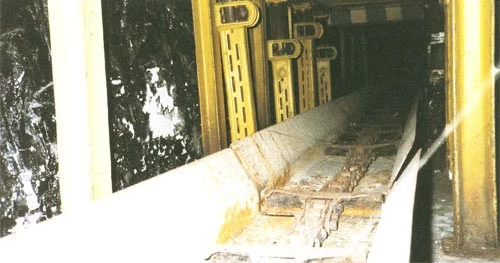
Moving a coalface to the museum 11 April 2007 When a miners' hospital closed in 2001, a working coalface that was used to exercise the patients for work again was dismantled and moved to the collections of Amgueddfa Cymru. Talygarn House Talygarn House: a view along the full-size model coalface Talygarn House, Pontyclun, south Wales, was a large stone mansion that became a hospital in 1880. The interior is decorated with wood panelling and painted ceilings. The house is surrounded by extensive parklands on which were grown, according to legend, specimens of every tree that can be cultivated in Britain. Talygarn as a Convalescent Home In October 1923, Talygarn House was opened as a miners' convalescent home, and in 15 years of its opening it had more than 41,000 patients. In 1943, the Miners' Welfare Commission was asked to organise a rehabilitation service for injured mineworkers. Due to a serious shortage of manpower at that time, it was vitally important for injured colliers to return to work as quickly as possible. For this purpose Talygarn House was purchased as a centre for the coalfields of south Wales. By 1964, 95% of patients treated at Talygarn returned to the mining industry. It continued to serve as a rehabilitation and physiotherapy centre until it was put up for sale in August 2000. Miner rehabilitation and the 'Model Mine' Due to the need to harden the men up to return to the collieries, a carpentry shop was provided where patients cut wood and sawed logs. Miniature stairs and static bicycles were available to exercise unused muscles. Talygarn House was also equipped with a grand 'Model Mine' in which patients could get used to working back in a mining environment. The structure was a long concrete tunnel supported by arch girders. The roadway was equipped with rails and the metal framework known as 'horseheads', which prevented falls of stone on a real coalface. Relocating the mine In 2001, the contents of the 'Model Mine' were donated to Amgueddfa Cymru as a 'permanent reminder to visitors of the work of the Talygarn rehabilitation centre'. The coalfaces were dismantled as if they were the real thing. Despite working in only four feet of height, the thirty-foot-long chain conveyor was successfully disassembled and removed. All the items were safely transported to the Collections Centre at Nantgarw. The Talygarn donation is a unique survival of a complete thirty-foot section of a typical semi-mechanised coalface of the early 1960s.
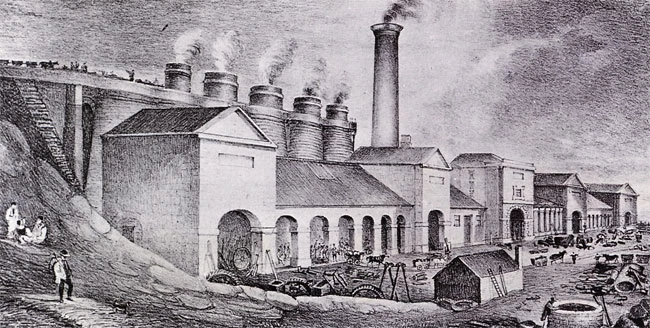
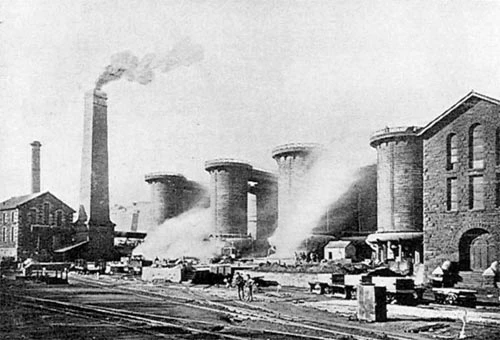
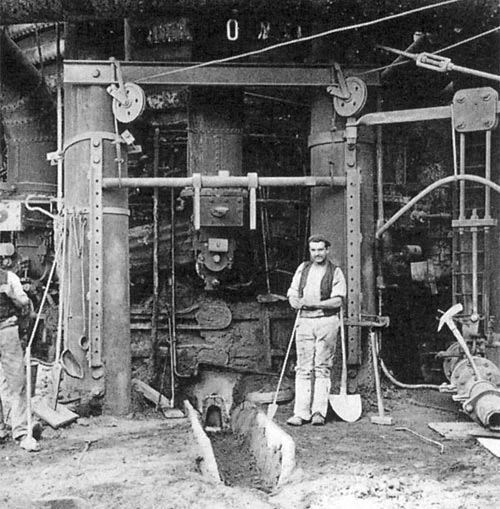
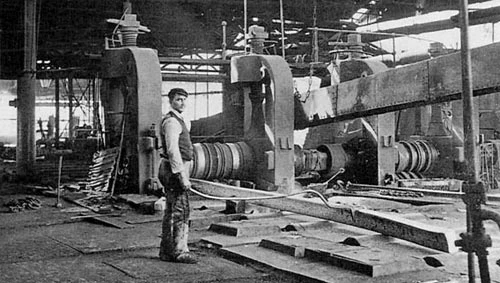
200 Years of Industrial Innovation at Ebbw Vale 10 April 2007 Abersychan Ironworks, 1866, run by the Ebbw Vale Co., 1852-83 Ebbw Vale blast furnaces, about 1900 Blast furnace Taphole, 1907 Steel works roughing mill, 1907 The Ebbw Vale Steel, Iron & Coal Company In the mid-19th century the Ebbw Vale Steel, Iron & Coal Company was one of the largest iron producers in South Wales and was of international importance, not only in terms of size, but also for technical innovation. 100 years later, the works were the first in Britain to introduce American-style steel and tinplate production techniques and before the closure of the site at the turn of the millennium it was the largest producer of tinplate in Britain. 1790, the first Blast Furnace Industry at Ebbw Vale extends back to 1790 when the first blast furnace was established. From 1796 to 1844 it was owned by the Harford family who built it into a successful concern. It supplied rails for the Stockton & Darlington Railway in 1829. At the same time, the company began experimenting with the use of locomotives, one of the first of the South Wales ironworks to do so. In 1848 the Ebbw Vale Company was formed and the works went from strength to strength, absorbing four other ironworks at Abersychan, Sirhowy and Pontypool. The first steel works in Britain The company experimented in changing over from wrought iron to steel in 1854, installing one of the first steel plants in Britain in 1866. The works declined in the 1870s and 1880s due to poor management, but the rapid expansion of the export coal trade kept the company afloat and saved the works from closure. 20th Century revival The iron and steel works was revived in the early 20th century which, combined with a booming market for Welsh steam coal, helped make the company the largest integrated iron and coal company in Wales. Closure and hardship By the early 1920s it was employing no fewer than 34,000 men. The company was increasing its debts to finance its expansion at a time when the steel and coal industries declined sharply. This ultimately led to the works' closure in 1929 and its collieries being sold off. Revival and expansion with Tinplate The great hardship and unemployment in the town caused the Government to site Britain's first steel stripmill at Ebbw Vale and the works were rebuilt in 1936-38 under the ownership of Richard Thomas & Company, Britain's largest tinplate manufacturer. The new works received a further boost in 1947 when Europe's first electrolytic tinplating line was installed. Largest tinplate producer on Britain Re organization in the steel industry following nationalisation in 1967 led to a run-down of steel making at Ebbw Vale, and the steel plant closed in 1978. Subsequently the works concentrated on tinplating and galvanising, becoming the largest tinplate producer in Britain. These works closed in 2002, ending over 200 years of industrial innovation at Ebbw Vale.
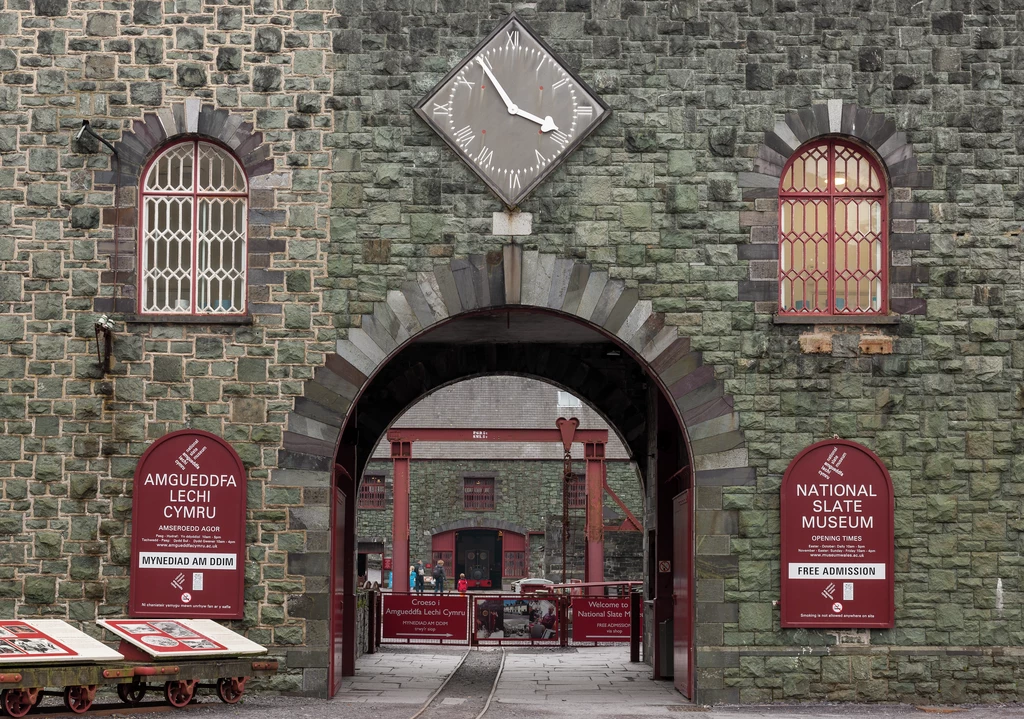
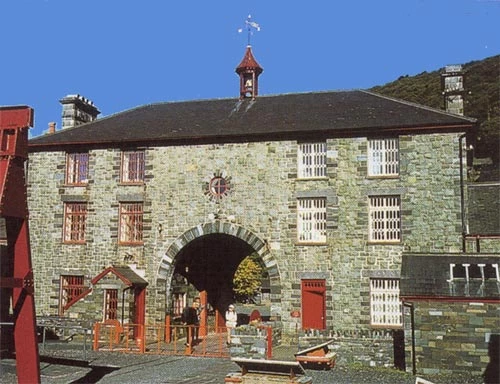
The old clock at the National Slate Museum in Llanberis, north Wales 22 February 2007 The clock above the entrance to the Welsh Slate Museum A distinctive feature of the National Slate Museum building is the diamond-shaped face of a clock on the front of the Museum. On the roofline above it is a small pagoda-like structure containing a bell and hammer, connected to the clock by a wire rope. The mechanism is installed on the second floor of the building. It was manufactured in Shropshire but it is not possible to read the date. Early photographs of the building, erected in 1870, do not show the clock, so it was probably not installed until the mid-1890s Timekeeper for quarry explosions The Museum is located within the Victorian workshops of the Dinorwig Quarry. The clock helped ensure the trains taking slate from the quarry to the Company's port at Port Dinorwic were always on time. The clock was more than simply a timekeeper for the workshops though. At some stage in its life, a series of electrical connections were added. At set intervals the clock transmitted an electrical signal to other parts of the Quarry's large site. This was to ensure that blasting happened on time. Such systems were usually marketed as 'pulsynetic clocks'. They were sold by well-known makers such as Gent, Leicester. At Dinorwig, however, a home-made, reliable solution was produced. 100-year-old graffiti A power supply was required to provide the electrical signals. This was supplied via wet cells, or accumulators, stored alongside the clock. One of the discoveries made when renovating this part of the building, in the mid-1990s, was the original graffiti on adjacent walls and panels noting the dates of battery charges. On June 10, 1909, for example, Willie Owen Williams and George Hughes charged the batteries. Cleaning the clock Although well cared for over the years, by 2001 the clock required specialist attention. J.B. Joyce and Company, the manufacturers, were still in existence. They were established at Whitchurch in Shropshire, and are still there over three hundred years later. Unfortunately, they have no records of individual clocks manufactured, but were prepared to visit the Museum to inspect the clock. The mechanism ended up being returned to the Joyce workshops where it was cleaned and serviced. The clock was then reassembled, brought back to the Museum and commissioned. Today the clock works smoothly and to a good degree of accuracy. Village timekeeper At a time when few people possessed watches, the clock installed in the Dinorwig Quarry workshops was a timekeeper for its surrounding community, with its bell being audible to most of those living in and around Llanberis. To quote one local author: 'Torrai ar y distawrwydd yn nhrymder nos, a chlywyd aml i glaf yn cwyno yn y bore,"Chysgis i ddim gwerth neithiwr - clywed yr hen gloc yn taro pob awr nes iddi 'leuo"' (It relieved the silence of the depth of night, and quite frequently one would hear of those who were unwell complaining the next morning, "I didn't sleep well last night - I could hear the old clock striking each hour until it dawned".) The old clock continues to measure the passage of time into the 21st century at Llanberis.
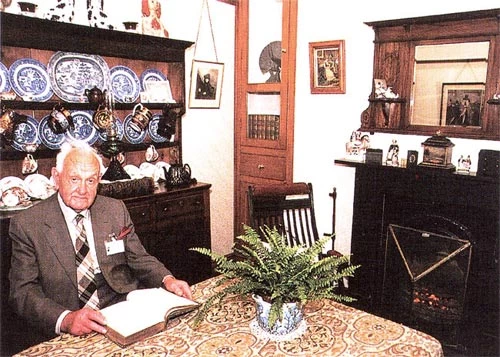
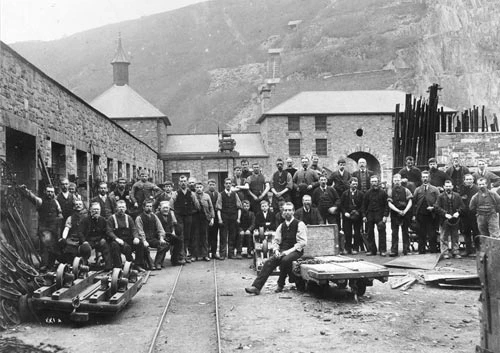
Nothing Went To Waste: memories of craftsmen at Gilfach Ddu 22 February 2007 The National Slate Museum, Llanberis.