The Library of the Cardiff Naturalists' Society

Kristine Chapman, 9 October 2017

This year the Cardiff Naturalists’ Society is celebrating its 150th anniversary. You can read about the history of the Society, and its close links with the National Museum here and here.


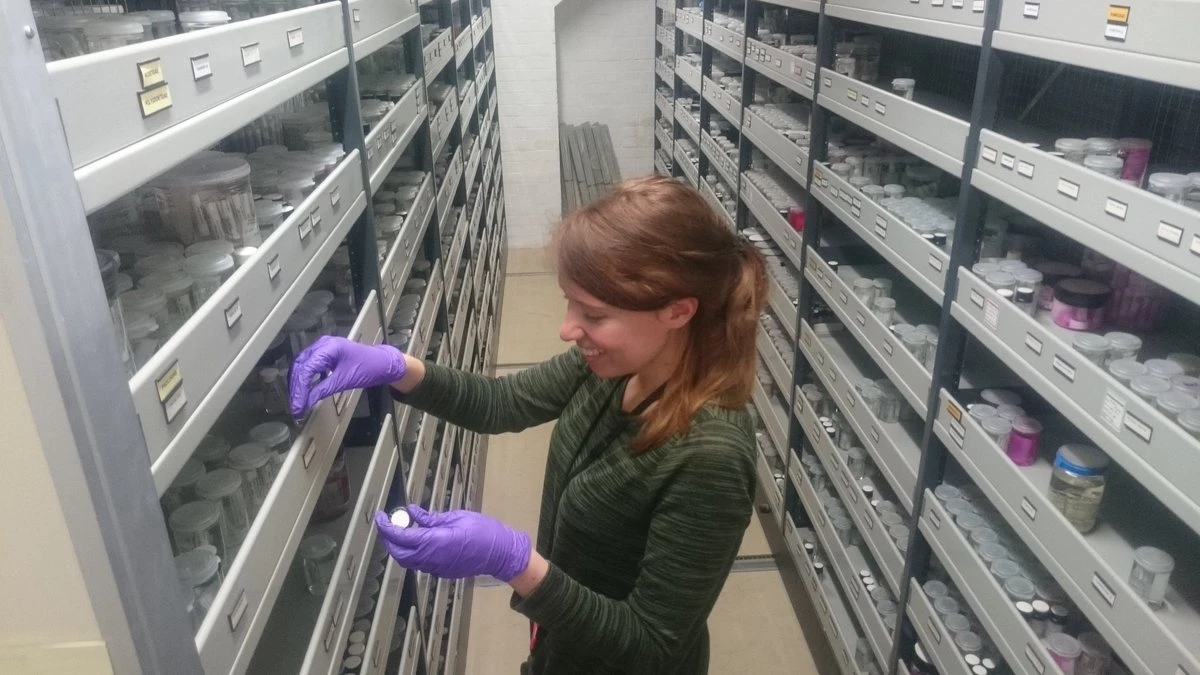
Right from the outset the Society amassed its own Library focusing on natural history, geology, the physical sciences, and archaeology.


Many of the publications in the Library were received as exchanges with societies and institutions around the world. They would send out copies of their Transactions, and then receive copies of those organisations’ publications in return. Some of the institutions and societies they were exchanging with included; the Edinburgh Botanical Society; the Wisconsin Academy of Sciences; the South West Africa Scientific Society; the Polish Academy of Science; the Royal Society of Tasmania; the Sociedad Geographia de Lima; and the Kagoshima University in Japan.


A number of the publications in the Library were later bound by William Lewis, a bookseller and stationer based in Duke Street in Cardiff. They all have beautiful marbled covers, endpapers, and a matching marbling pattern on the edges of the text block. Each one also has a bookplate with an embossed image of the Society logo, they are incredibly beautiful examples of bookbinding.


Not all the items in the Library were received on exchange, a great many were also the result of donations, especially by members. A lovely example is a copy of a second edition of An illustrated manual of British birds by Howard Saunders from 1899. Many of the pages contain annotations relating to whether the previous owner had encountered that particular species in the local area, such as spotting the nest of a pair of mistle-thrushes in Penylan in 1900. Unfortunately the signature of ownership is somewhat illegible, so it’s not possible to make out their name, all that we can tell is that they lived in Richmond Road in 1900.


There is also a copy of Claudia and Pudens, a book by John Williams published in 1848. The book was presented to the Society by C. H. James Esq. of Merthyr, and in it is attached a letter to T. H. Thomas (a prominent member of the Society) dated 1892. The letter discusses Roman remains in Cardiff, and advises Thomas not to get drawn in to the ‘Claudia myth’, a popular theory suggesting a Claudia mentioned in the New Testament was a British princess. The author of the letter is quite scathing about the claims, calling them “a ridiculous fabrication”.


In 1996 a copy of Castell Coch by Robert Drane, a founding member of the Society was donated to the Library. It was published in 1857, and is now quite rare, as according to John Ward (former curator at the Cardiff Museum, and the National Museum), Drane subsequently destroyed as many copies of this book as possible! The copy donated to the Society contains annotations throughout, correcting or commenting on the contents, and a listing of all the people the author presented with copies.


In 1925 the Society decided to place its Library in the Museum Library, with the following stipulations;

•              To the ownership of the Society’s Library remaining with the Society

•              To all accessions to the Society’s Library being entered in the Society’s register

•              To all accessions to the Society’s Library being stamped with the Society’s stamp

•              That members of the Society may enjoy the same privileges as at present in the matter of the volumes and periodicals belonging to the Society

•              That this proposal does not refer to the “Transactions”, offprints, and other publications of the Society


Later in 1927 they decided to make it a permanent deposit, provided the Museum agreed to the additional stipulations;

●     That members of the Society may enjoy the same privileges as at present in the matter of the volumes and periodicals belonging to the Society, and which may be received in the future in exchange for publications of the Society

●     The Museum will bear the cost of all binding, which shall be undertaken as and when, in the opinion of the Museum Council finances permit. There shall be no differentiation, in this respect, between the Museum Library and the Society’s Library.


Although the Society’s Library had been in the care of the Museum Librarian since that time, the Honorary Librarian had always been a member of the Society. But, from 1964 the Honorary Librarian was both a member of the Society and a member of staff in the Museum Library.


List of Honorary Librarians

R.W. Atkinson          1892-1902

P. Rhys Griffiths       1902-1906

E.T.B. Reece             1907-1911

H.M. Hallett               1911-1948

H.N. Savory               1949-1962

G.T. Jefferson           1962-1964

E.H. Edwards            1964-1970

E.C. Bridgeman        1970-1976

W.J. Jones                1976-1985

J.R. Kenyon              1985-2013

Swaps: David Hurn on Photography

29 September 2017

Swaps: Photographs from the David Hurn Collection runs from 30 September 2017 to 15 April 2018. This exhibition celebrates the major gift of photographs from David Hurn’s private collection and marks the opening of Amgueddfa Cymru’s first gallery dedicated to photography. Here are some short films from the exhibition:

The Collection

"The collection really didn’t start until 1958 I suppose. I started taking pictures in 1955, and in 1958 I was shooting pictures in Trafalgar Square, and there was another photographer who came up to me and said a very bizarre thing. He said “I think you might be a pretty good photographer”. Anyway, it turned out to be Sergio Larrain. I was looking at Sergio’s pictures and he gave me a couple of his pictures. And I realised how much I treasured not only the beautiful pictures, but there is something (which is in my opinion indescribable) about the connection between having the print that a photographer himself had okayed.

So I started to collect and then I started the idea of actually swapping a print. And so that’s what I started to do, and I had the confidence that I could go to photographers like Dorothea Lang and people like that. I then had the arrogance to meet her and say how much I liked her pictures, and I would love to swap a print. And I suddenly discovered that people like doing it.

I think the collection is a very personal collection. I think of the photographers that are in there; it would not be possible to have a better collection."

Dorothea Lange

White Angel Breadline, San Francisco, 1933.

"Dorothea Lange was one of the great photographers in the history of photography, who was very important particularly because of the pre-war pictures in the dustbowl.

I knew of Dorothea Lange and I happened to be in Chicago, and I knew that at that time she was living in Chicago, and so I literally went… I was now known a little bit as a photographer, and I just went to see her basically. I hadn’t thought about getting a print, it was before I swapped prints even. I saw her and she was showing me some prints, and I basically said “I love this picture” and she gave me the picture.

She did a wonderful book, it was done with her husband and it’s one of the most complete books which is the pointing out of a social problem. It’s a very beautiful book. It really shows you how a book can be laid out, and how the correct captioning and the correct text and the correct pictures can put together a very powerful argument for something, you know. It’s a very important book I think."

Henri Cartier-Bresson

French painter Henri Matisse at his home, villa 'Le Rêve'. Vence, France, 1944.

"Bresson was married to a wonderful photographer called Martine Franck. Martine had photographed on Toraigh Island which is a little island off the Irish coast, and photographed somebody called James Dixon who was a naïve painter there, and I had about three paintings by James Dixon because I’d also been to Toraigh island and photographed. I said ‘Ok, why don’t we swap the painting for a picture by Bresson and a picture by you?’ So I got two pictures for the painting.

So, the pictures arrived and I’ve got the two pictures – a wonderful, wonderful picture by Martine Franck. And then this appealed because it’s perhaps one of my favourite painters photographed by one of my favourite photographers. Later, after Henri had died I got an envelope through the post, and it’s from Martine, and it’s another one of the same picture, but it’s got a bend in the corner. I do actually have the note which is even more charming, and the note says ‘discovered this picture. It had obviously been damaged and Henri had realised that it was damaged, therefore had another print made’ because he didn’t make his own prints ever, they were always made by the same people, ‘and so I thought you might like this as well.’

It’s a beautiful portrait. It’s everything to me a portrait should do, you know."

Banner photograph by John Davies.

More info

Capturing the Past – Segontium Roman Fort in Photographs

Sarah Parsons, 21 September 2017

The photography department at Amgueddfa Cymru – National Museum Wales looks after images for all of the seven museum sites including the Archaeology department. That means taking new photographs of archaeological objects, and scanning historical photographs (e.g. prints and slides).

Here’s an example of how both are used.

Segontium Roman Fort, Caernarfon

These photos from the 1920s show the excavations at Segontium led by Sir Mortimer Wheeler, the then Keeper of Archaeology and later Director of National Museum Wales. They were scanned from glass plates. Here’s a few of the 102 images from this collection:

Black and white photograph of excavations

Cellar in the Headquarters building (praetorium)

Black and white photograph of excavations

Headquarters building (praetorium) during excavations in the 1920s

Black and white photograph of group of people visiting excavations

Sir Mortimer Wheeler (left) showing visiting dignitaries around the site including Lady Lloyd George (front right)

The photographs may be of use to modern archaeologists interpreting the site, but personally I like spotting the shadow of the photographer and his tripod (we’ve all managed to do that haven’t we?) and checking out those fabulous 1920s hats!

Here’s where modern photography comes in. The following images were taken recently of objects from the 1920s excavations.

Roman flagon

Flagon found at Segontium, but produced in Oxfordshire will be on display in the new galleries at St Fagans National Museum of History

Stone alter with latin inscription

The Goddess of war must have protected someone in their time of need, in return he vowed to dedicate an altar to her which was found in the strong room of the Headquarters building. It reads: To the goddess Minerva Aurelius Sabinianus, actarius, willingly and deservedly fulfilled his vow.

The images are digitally archived so that they’re accessible for use in exhibitions, publications, presentations and online.


Some of the finds from Segontium will be on display in the new galleries at St Fagans National Museum of History opening in 2018.

You can see more historic photographs here.

Learn more about Segontium Roman Fort on Amgueddfa Cymru’s website or on the Cadw website.

With support from the players of People’s Postcode Lottery, we’re working hard getting our collections online so you can search our object database and see information and images of the collections for yourself.

People's Postcode Lottery Logo

Stumped by a Spoon

Matthew Guiseppe Knight, 20 September 2017

Vibrant discussions are a usual part of the Saving Treasures project and the Amgueddfa Cymru archaeology department.

But I’m not sure we’ve ever had one about a spoon before.

In 2015, a Medieval silver spoon was brought into National Museum Wales; it was found while metal-detecting around Pembroke and can be dated to about the 15th century. The spoon has a rough engraved cross on the underside of the bowl and is in two pieces.

The handle, or stem, has been bent and twisted round, while the bowl has been folded in half and then in half again.

The question bugging us is: why?

Why deform this spoon so greatly?

The deliberate destruction and deformation of objects is not unknown in the Medieval period, though presently we can’t find any parallels for this object.

Many silver coins were, however, damaged for various reasons.

Folding a coin in half, for instance, had a ritualistic function; it was often performed as part of a vow to a saint to cure an affliction or ailment. The coin would then be taken and placed at a shrine. However, Portable Antiquities Scheme data shows that many appear to have been lost or buried in seemingly random locations.

So, we wondered, could the spoon have served a similar function?

Medieval silver spoons were often considered intimate possessions that were carried around much of the time. Dr. Mark Redknap at Amgueddfa Cymru has suggested the engraved cross may represent an ecclesiastical ownership mark. The deliberate destruction of a personal item may have held some significance to the owner, much as a prized possession would today.

Another explanation is that this represents material intended for the crucible, to be remelted and recast into another object. The breaking and recycling of objects is well-known since the Bronze Age. Viking hacksilver involved silver objects chopped and broken either for recasting purposes or as a form of currency, exchanging fragments based on weight.

Fragments of silver spoons are in fact known from hacksilver hoards from Gaulcross, Scotland, and Coleraine, Northern Ireland.

Of course, the Pembroke spoon was buried nearly a 1000 years later than the hacksilver hoards so it cannot strictly be compared. Nonetheless, it is reasonable to think the spoon was broken, folded and twisted into small, compact pieces that would fit more comfortably within a crucible.

We might not find many broken spoons because they were remelted into other objects. The weight of the spoon would comfortably produce other common Medieval objects, such as finger rings, mounts, and pendants.

We will probably never know the reason behind the destruction of this spoon. But it’s always nice to speculate.


Notes and Acknowledgements

The spoon was recently declared Treasure following the Treasure Act 1996 and will be acquired by Milford Haven Museum through the Saving Treasures: Telling Stories project. The full record for the object can be found here: https://finds.org.uk/database/artefacts/record/id/860650

My sincere thanks must go to everyone who engaged with our call for ideas on what this object represents on Twitter. In particular, I’d like to thank Sue Brunning for directing my attention to the hacksilver hoards mentioned in-text.

Providing Images to Help People Living with Dementia

Sally Donovan, 20 September 2017

A wonderful new book has been created by  Picture to Share. This dementia-friendly book is the first of this type that has been produced bilingually in both Welsh and English. 


Pictures to Share teamed up with us, The National Library of Wales, Alzheimers Society and the Welsh Poet Laureate to produce Hen Wlad Fy Nhadau, a beautifully illustrated book to help carers communicate with people living with dementia.  Pictures to Share have produced many books on this theme but this is the first to focus upon the Welsh language, in order to help people living with dementia whose first language is Welsh.

This was an opportunity to highlight the importance of the work we do to help people living with dementia as well as highlight our collections and showcase our commercial Picture Library. The images used in the book, Hen Wlad Fy Nhadau, portray many things which people in Wales can relate to, prompting discussion.

Dementia is a subject which many of our staff are passionate about, with many of the staff undertaking training to become a Dementia Friend in order to help enhance the visitor experience of people living with dementia.

After communicating with the editor Michelle Forster, we supplied the images and license to use them in order to comply with copyrights laws.  We have to issue a license to anyone who wishes to use our images. Pictures to Share invited us to Cardiff Library for their book launch in November 2016 to see the completed book, which was attended by staff from our Image Licensing, Photography and Translation departments. We were all very impressed with the end product which is now available at our shop at National Museum Cardiff and our on-line shop.

If you would like to use our images within a publication, please contact us at Image Licensing.
You can also purchase images for your home from our on-line shop.


Thank you to Cardiff Council for permission to use images from the book launch.