Falkland Islands 2013 January 16th update

Peter Howlett, 16 January 2013

Due to a technical hitch the sampling at Whalebone Cove was postponed. Low tide was in fact 2 hours later than I thought as I had subtracted rather than added 1 hour for summertime, oops! Instead I got on the road to make the tide in the north (which I had worked out correctly). Three hours in the car brought me to Race Point Farm near Port San Carlos. This is in the northwest of East Falkland and had a very rocky shore with some large crevices in the rocks. These crevices could be split open with a spade and inside, hiding in the built up silt, were some very large worms indeed of the family Eunicidae (also known as ‘bobbit worms’ – google the phrase and you’ll find some footage of relatives of these worms hunting). The biggest of these measured around 20cm in length and as these worms have jaws I kept my fingers well away from the bitey end! The wind was whistling around the shore and despite being summer, my fingers were certainly cold. There was plenty to find though with colourful paddleworms being particularly common (photo 1). My bed for the night was a surprisingly cosy caravan at Elephant Beach Farm slightly further north. Despite how this sounds it really was comfortable, being fully equipped with power, hot shower and cooker and, even better, a freshly baked loaf of bread and some fresh eggs from the hens outside my door to keep me going.

Port Salvador was the next port of call and after calling in on the landowner, Nick Pitaluga, for a chat, he very kindly offered to drive me up to near Cape Bougainville right on the north tip of the coastline to sample there. This had originally been where I wanted to go but the road does not go that far and I had no desire (or permission) to take the hire car off road. The bone-rattling drive there, mostly on a visible track but the last part just generally cross-country toward the sea, confirmed that I would never have made it even halfway there without a guide. The exposed coastline was unsurprisingly rocky with long ledges of rock running out from the shore (photo 2). The tides are very low right now and the ledges were exposed right down into the kelp zone, where the enormous blades (nearly 1cm thick) of Lessonia kelp draped themselves over the rock and were so heavy they could barely be moved out of the way (photo 3). Underneath, in the cool damp crevices I found long tubes cemented to the rock. These turned out to be the home of large sabellariid worms (Phragmatopoma sp. photo 4), a relative of which lives in the UK and is known as the honeycomb worm for the tubes and occasionally reefs, it builds. Out here, this worm also sometimes creates reefs although here the tubes were individual. The worms inside are large, over 5 cm in length. I didn’t find any specimens of this family last time I was here so this was a very exciting find for me. Several scaleworms were also found sheltering in the crevices (photo 5).

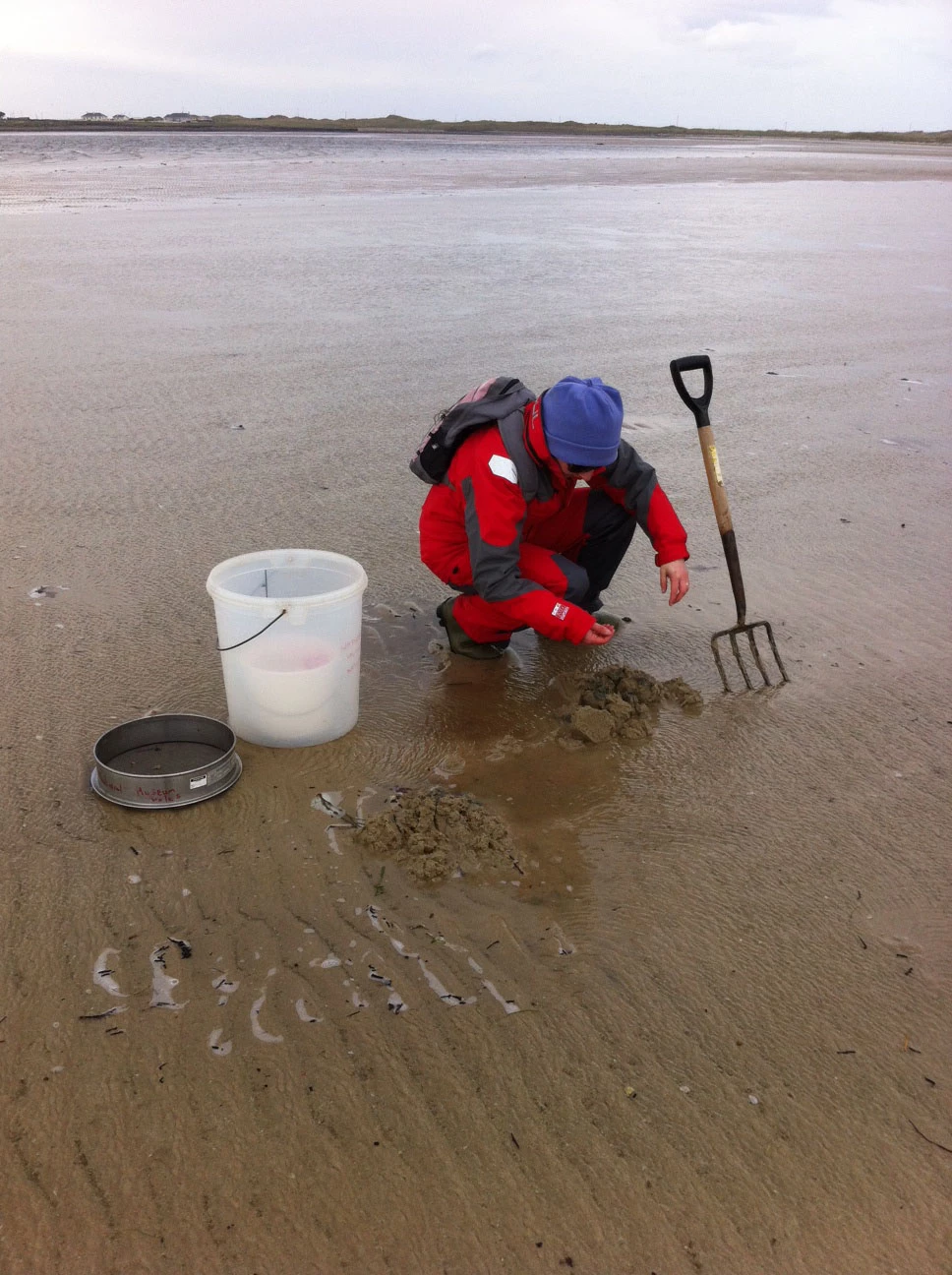
On the drive back to the settlement I could see the sandy shores near it now exposed by the tide. These looked interesting so I decided to go back to the area the next day to do some digging there. This turned out to be a very rich beach and it was easy to see why there were so many wading birds around. The shore was literally covered with worm-holes and casts (photo 6) and I spent 3 hours working my around and down the shore with the tide. The weather by this time had changed from occasionally sunny (constantly windy) with a need for suncream even though I was feeling mildly hypothermic to mostly sunny with a feeling that I really might actually need the suncream (still windy).

On the drive back to Stanley that evening I felt that the first few days collecting had gone well. My main current concern is the fact that everyone I meet keeps trying to feed me either tea and cake or tea and biscuits (occasionally both). I have now given up on my post-Christmas attempt to wean myself off sugar.

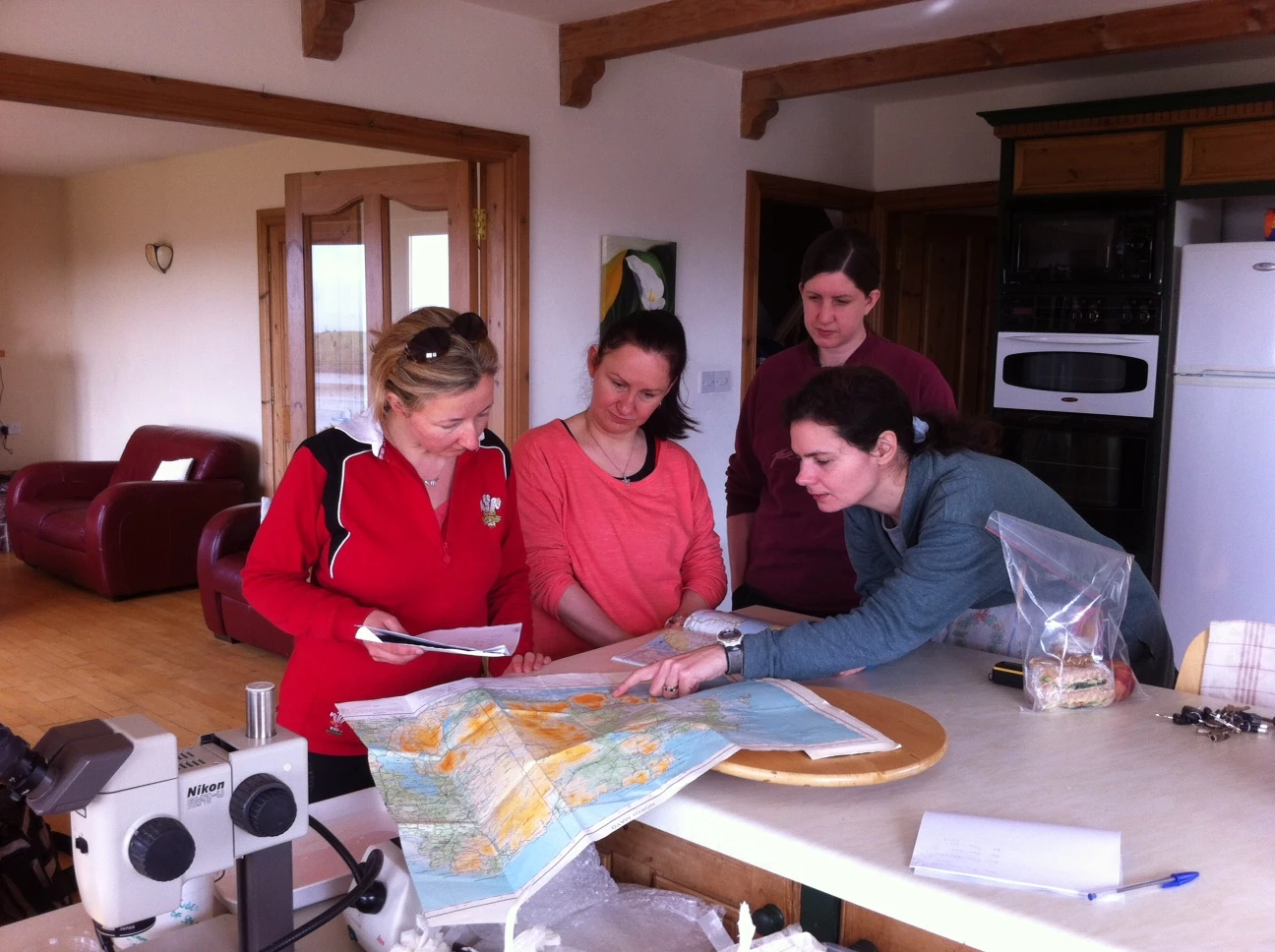
On Wednesday I made it to Whalebone Cove having now worked the tides out properly. Amazingly the wind had dropped (not stopped obviously) which helped the tide go out as low as possible. This was important because I was after some particular lugworms that are only found at very low water. I found these last time and they appear to be different to the others higher up the shore. However, I didn’t find very many before so I needed to collect more to be sure that differences I see are not just natural variation but a definite consistent difference in body form. The wind and tide were kind and allowed me to get what I needed so then it was back to the lab to inspect my catch. Photo 7 shows a map with the locations of the sites mentioned above.

Falkland Islands research 2013: January 11th

Peter Howlett, 14 January 2013

It hasn’t been the best start. It’s never a good sign when your plane stalls on the tarmac while taxiing to the runway and everything goes dark. As calls of ‘get the jump leads out’ echoed around the plane, the pilot turned the key again and off we flew, landing at Ascension Island 8 hours later. Sat in the middle row of seats I was unaware of the events outside the plane but as we stopped the pilot, with a slightly embarrassed tone, announced that we would be delayed getting off the plane. It quickly circulated, from those that had witnessed the event, that our wing was now jammed under that of the only other plane on the tarmac. Great. The next 12 hours were a long story that involved our plane being declared unserviceable (after being separated from the other plane) and then, surprisingly and not a little worryingly, it was suddenly serviceable again, we were herded back on and on we flew. The landing at Mount Pleasant airport was mildly bumpy in the gale force winds that greeted us at 1am, 10 hours later than originally due but at least we were there.

This time I am based at the South Atlantic Environmental Research Institute (SAERI) in Stanley, a new organisation that was created in early 2012. Its objective is to be a world class academic institute, based in the Falkland Islands, operating in the South Atlantic from the equator down to the ice in Antarctica, conducting world class research, teaching students, and building capacity within and between the UK South Atlantic Overseas Territories (UK OTs). The institute’s remit includes the natural and physical sciences (see http://www.south-atlantic-research.org).

Today I am just sorting out my itinerary and equipment and visiting the different facilities I will be using while I’m here. Then from tomorrow I’ll be back out on the beaches chasing worms. The first stop will be Whalebone Cove, a bay just outside Stanley that I visited last time. The lugworms I collected from there turned out to be very interesting indeed with a potentially new species involved and I would like to see if I can investigate those a little more. Then it’s a drive to the northwest for an afternoon tide.

It’s extremely windy here at the moment, even more so than usual, so I am hoping that this drops a little. It is sunny and warm though which is a nice change from the wet and grey weather I left behind and much better for sampling in.

The map of the Falkland Islands shows the sites I visited last year - this year I will mainly be sampling on the West Falkland.

New year, new shoots!

Danielle Cowell, 10 January 2013

Happy New Year Super Scientists! Hope you had a great break and are ready to get investigating!

At this time of year things start to get really exciting. Now is the time to watch your pots to see if anything is starting to grow. My daffodil shoots have already appeared! Anyone else got any yet? Please send me photographs if you do.

It could take another month or even six weeks until my flowers appear. It all depends on our weather - if it turns really cold then the growth will slow down. If it stays warm they will grow faster.

The next step... Please use my PowerPoint presentation to find out how to keep flower records. Remember each of you must let me know when your flowers open in order to receive your Super Scientist Certificates.

2012 was the second wettest year on record in the UK and the wettest ever in England, the Met Office announced.

The downpours that caused more than 8,000 homes and businesses to suffer flooding led to a total of 1,330.7mm of rain for the year, just 6.6mm short of the wettest UK year recorded in 2000 (1337.3mm).

Analysis by the Met Office suggests that the UK may be getting increasingly wetter as climate change causes warmer air to carry more water. Days of extreme rainfall – downpours expected once every 100 days – occurred every 70 days in 2012. For more info on this see this report from the Guardian.

Many Thanks

Prof.P


ExArc 2013 Conference

Sara Huws, 10 January 2013

It's been a while since I last blogged from St Fagans - there's been a glitch in the matrix and we still haven't quite got to the bottom of it. But we'll get there.

That's one way of apologising that there won't be any pictures with this post. Anyway, onwards:

This week, Amgueddfa Cymru and Cardiff University will be hosting the annual ExArc conference. ExArc, in this context, refers to Experimental Archaeology; a hands-on approach to learning about the past, which looks at the 'how?' of history, as well as the 'when?'.

ExArcers' work is in raw materials, painstaking detail and learning from mistakes as well as triumphs. The research they take part in can range from bronze-casting or iron-smelting using rudimentary tools; to recreating underwear or researching the practicalities of life in the past.

I have been lucky enough to learn a lot from ExArcers over the last few years, and so am very proud that St Fagans will feature in their visit down to Cardiff. We're known here for our hands-on approach, and I suspect we could learn an awful lot from these trailblazers!

While the conference is completely full, you can follow the discussion online using the hashtag #eauk2013.

The twitter stream is already full of interesting people, travelling here from all around as I type. If you're planning to attend, please do come and say hello. You will know me by my, erm, museum name badge?

Penblwydd hapus to Alfred Russel Wallace!

Julian Carter, 8 January 2013

Today, 8 January, marks the 190th birthday of the intrepid explorer and brilliant naturalist Alfred Russel Wallace. Born in 1823 in the village of Llanbadoc near Usk, Wallace went on to be one of the most celebrated scientists of his era.

Wallace spent much of his early working years as a civil engineer in the south Wales area, particularly in the Vale of Neath. This involved spending a great deal of time working outdoors, which allowed him to indulge in his growing passion for natural history.

Soon, inspired by the writings of traveling naturalists such as Alexander von Humboldt and Charles Darwin, Wallace set out on his own intrepid travels. These adventures started in the Amazon Basin and were followed later by his explorations of the Malay Archipelgo.

During these trips Wallace collected many thousands of birds, butterflies and beetles, many of which were new to science. The biological diversity he encountered inspired his thinking in many areas of biology such as the distribution and evolution of species. His brilliance did not go un-noticed and in 1858 he famously co-published the theory of evolution by natural selection with Charles Darwin.

During 2013 Amgueddfa Cymru – National Museum Wales, along with other museums and institutions across the world, will be marking the centenary of the death of A R Wallace in a celebration of his life and legacy. Keep an eye on our web site and blog for further information as we finalise details and dates. You will also be able to follow other events and exhibitions on the Wallace100 website.