: Industry - Workshop of the World

When Welsh ships sailed the seas

6 July 2007

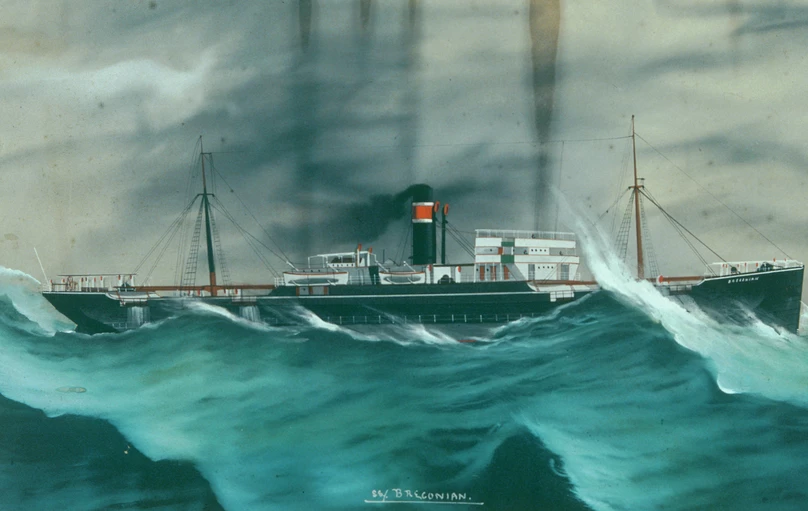
Painting of the Breconian.

Painting of the Breconian

The Breconian

The Breconian was built in 1906; she was registered in Aberystwyth and was sailed by Welshmen across the oceans of the world for thirty years. Her portrait, one of the industrial paintings of ships in Amgueddfa Cymru's collection, reveals a fascinating insight into days gone by.

Ship Paintings

The industrial collections house some 250 ship paintings. Few of these could be described as fine art, but they do provide an invaluable archive of Welsh maritime history. Most of these paintings are the work of Mediterranean 'pierhead painters' who, for a small sum, would produce simple colourful pictures of a vessel for the owner, captain or crew members.

Originally, they were painted in pairs, one painting of the vessel on a calm sea and the other in a storm. What these paintings lack in artistic quality is made up for by their technical accuracy. These paintings became objects of pride and sentiment, as much to the ship's owner as to the captain's wife.

A ship with a new design

The painting of the Breconian is an unsigned storm-scene portrait. The steamship was built for John Mathias & Sons of Aberystwyth. She was unusual in that she had been built with a new, narrower deck, the turret-deck, superimposed upon the vessel's hull, extending from stem to stern. This new design made the vessel more profitable to operate. The design was so successful that 429 turret-deckers were built between 1892 and1911.

The company that owned the Breconian began back in 1869 when John Mathias, an ambitious Aberystwyth greengrocer, decided to venture into shipowning, buying the schooner Miss Evans.

In 1883 he moved from sail to steam, forming the Glanrheidol Steamship Company Limited. By the time that the Breconian joined the Mathias fleet, the business had been grandly renamed the Cambrian Steam Navigation Company Limited, with the seven ships of the line being named, rather unusually, after public schools. This led to seamen at Cardiff giving the company the nickname of 'the College line'.

The Breconian, named after Christ College, Brecon, was the only vessel named after a Welsh school; the others being Etonian, Harrovian, Rugbeian and so on.

Coal out, grain home

Like most tramp steamers of the period, the Breconian would have sailed chiefly in the so-called 'coal out, grain home' trades, taking coal from south Wales across the world and returning with a cargo of cereals. She was manned mainly by Welshmen; in 1911, her master was Captain David Jones of Aberystwyth and 20 of her 28 strong crew came from Welsh coastal towns and villages.

In 1917, The Breconian was sold to the Tyneside Line Limited of Newcastle and in 1926 she was sold on to a Genoese shipowner, Giovanni Bozzo, who renamed her Lorenzo Bozzo after his son. Six years later she was broken up. Today, only the painting remains to remind us of just one aspect of the flourishing Welsh maritime enterprise and the capable Welsh seamen who sailed the world's oceans.
Heroic rescue for man dangling from girder 50 meters high

23 April 2007

Edward Medal for bravery

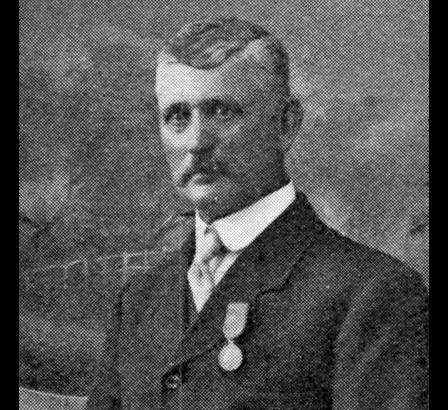
James Dally, wearing the Edward Medal. From the Great Western Railway Magazine, September 1915.

James Dally, wearing the Edward Medal. From the Great Western Railway Magazine, September 1915.

In October 1914 James Dally saved a colleague from a 52m fall from a viaduct. He was awarded the Edward Medal for his bravery.

On 28 October 1914, the Crumlin viaduct, near Newport, south Wales, was being painted by using a staging of planks timber supports. Around 5:00 pm, one of the supports broke, and the foreman, Mr Skevington, fell 52m (175 feet) to his death into the goods yard below. The second man, Thomas Bond, just managed to grip onto the main bridge structure in time, but was left dangling in mid air...

Heroic rescue

The Crumlin Viaduct. The location of the rescue is marked with a red dot.

The Crumlin Viaduct. The location of the rescue is marked with a red dot.

Bridgeman James Dally, of Crumlin, was nearby, supervising the operation. He immediately crawled out from the gangway on to the diagonal bracings - which were a mere eight centimetres wide:

"I asked him to swing his legs in an upward direction, so as to get them around the stretcher, if possible. This he succeeded in doing. I then got hold of Bond's legs; & told him to move one hand at a time & by that means he was drawn nearer to the gangway & when he was near enough I got a better hold of him, & eventually landed him safely on the gangway."

According to the London Gazette, "The man would probably have lost his life had it not been for the courage and presence of mind shown by Dally." Bond himself had no doubts: "I was suspended in the air; but if Mr Dally had not been on the gangway at the time, & taken the action he did I could not have saved myself... I owe a deep debt of gratitude to Mr Dally, for had it not been for the encouragement he gave me, & the prompt effort he made, I would have undoubtedly met the same fate as Mr Skevington."

Acts of courage in other industries

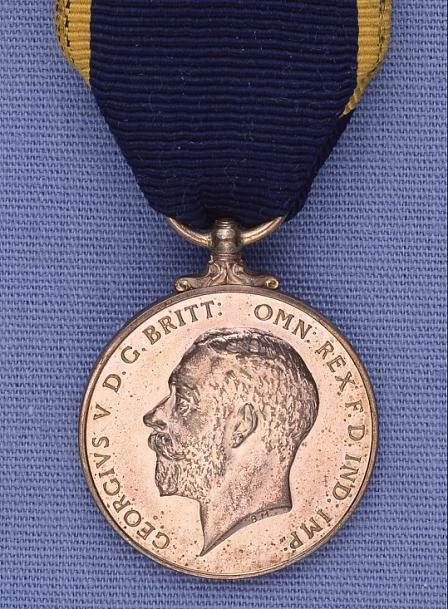
James Dally's Edward Medal, Industry, Second Class (bronze), front view.

James Dally's Edward Medal, Industry, Second Class (bronze), front view.

In the event, Dally was awarded the Edward Medal, which he received from King George V on 12 July 1916. This medal had been created in 1907 to reward "heroic acts performed by miners and quarrymen" and in 1909 its award was extended to acts of courage in other industries.

The Crumlin Viaduct was 512m (1,680 feet) long and rose some 60m (200 feet) above the valley of the Ebbw. The viaduct was opened on 1 June 1857 and by 1863 was part of the Great Western Railway network; it was demolished in 1965-66.

Background Reading

For Those in Peril, by Edward Besly. Published by the National Museums & Galleries of Wales (2004).

Gallantry: its public recognition and reward in peace and war at home and abroad by A. Wilson and J. H. F. McEwen. Published by Oxford University Press (1939).

The Brynmawr Experiment, 1929-40

23 April 2007

Brynmawr furniture

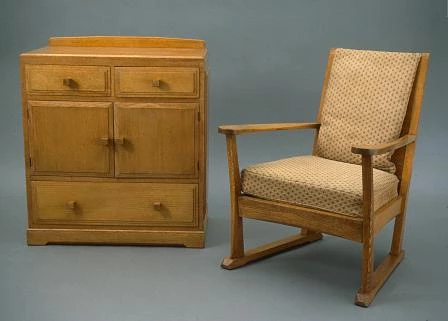
Talybont cupboard-chest and Ynysddu armchair by the Brynmawr Furniture Company.

Talybont cupboard-chest and Ynysddu armchair by the Brynmawr Furniture Company.

The 'Brynmawr Experiment' was an attempt by the Quakers to relieve the mass unemployment in the town of Brynmawr, south Wales in the early 1920s. They set up a small furniture-making enterprise that led to a major chapter in the social and artistic history of Wales.

The venture started in 1929, employing twelve local untrained men and later took on boys trained straight from school. Support came mainly from other successful Quaker companies - the first order was for 400 chairs for a Quaker school in York. Each chair cost £1 each (equivalent to £41 or $71 today). New equipment and machinery was bought with the profits

Paul Matt

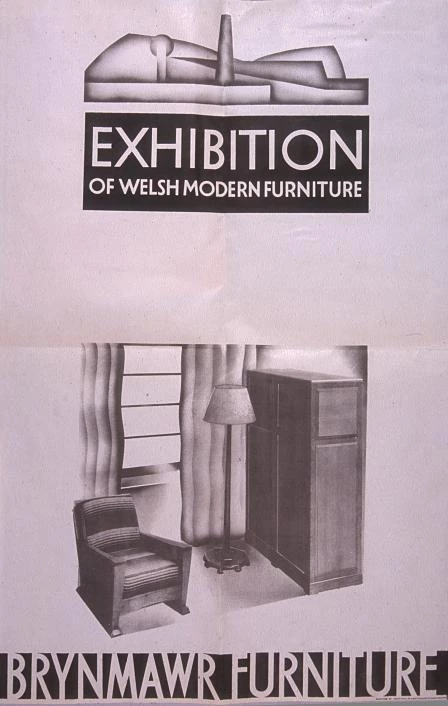
Advertising poster for the Brynmawr Furniture Company.

Advertising poster for the Brynmawr Furniture Company.

The success of Brynmawr furniture was mainly due to the designer, Paul Matt. He had served his apprenticeship under his father, a skilled designer and cabinet-maker in London.

Paul Matt designed furniture that was simple to construct, taking into consideration that the workers were initially all unskilled. The main timber used was imported oak, finished with a coat of clear wax which gave the furniture an overall simple and minimal appearance, in line with the Quaker philosophy.

Glossy catalogues and promotional leaflets emphasised the high quality and design of the products whilst providing sustainable employment for the local community. These ideals appealed to the middle and professional classes of the 1930s and the company made the furniture affordable to such professions.

'Welsh' furniture

David Morgan's department store opened in Cardiff in 1879. The store provided important support for the Brynmawr Furniture Company between 1932 and 1940.

David Morgan's department store opened in Cardiff in 1879. The store provided important support for the Brynmawr Furniture Company between 1932 and 1940.

Brynmawr furniture was available in large department stores such as Browns of Chester and Lewis's of Birmingham and Manchester. In 1938 the company had a permanent showroom in London's fashionable Cavendish Square.

Although successful in England, the company was also keen to promote Brynmawr furniture in Wales. David Morgan Limited, a well-known Cardiff department store provided exhibition space free of charge for the products and exhibitions were held at the National Eisteddfods.

The furniture was marketed as 'Welsh' and branded using Welsh place-names such as the Cwmbran chest, Llanelli table and the Cwm-du chair. This ensured a loyal following within Welsh professional and academic circles throughout the 1930s.

The advent of War

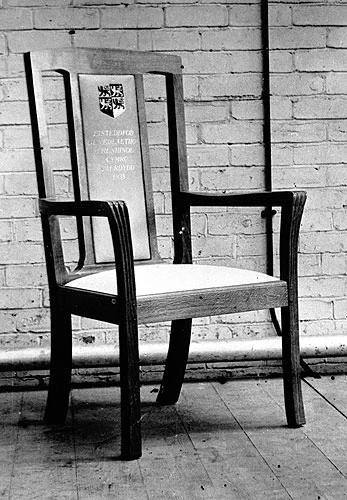
The Cardiff National Eisteddfod Chair, 1938 from the Bryn-mawr Settlement Factory.

The Cardiff National Eisteddfod Chair, 1938 from the Bryn-mawr Settlement Factory.

In 1936 Arthur Reynolds took over as designer from Paul Matt. Although production remained relatively unaffected, sales gradually declined in the late 1930s as the war approached. The advent of war also made it difficult to import materials therefore the Brynmawr Furniture Co. sadly had no other choice than to cease trading in 1940.

Background Reading

'Crafts and the Quakers' by Gwen Lloyd Davies. In Planet, vol. 51, p108-111 (July 1985).

'Utopian designer: Paul Matt and the Brynmawr Experiment', by Roger Smith. In Furniture History vol. 23, p88-94 (1987).

Lindsay Shen, 'Philanthropic Furniture: Gregynog Hall, Powys' by Lindsay Shen. In Furniture History vol. 31, p217-235 (1995).

Cardiff – Coal and Shipping Metropolis of the World

18 April 2007

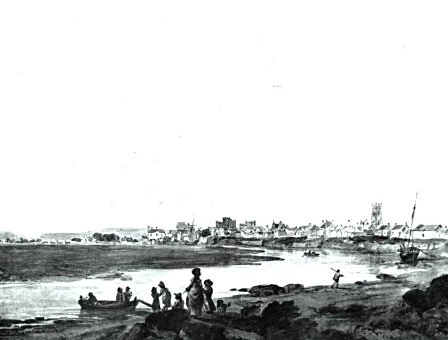
Cardiff: the pre-industrial port. Two sloops lying in the River Taff, as portrayed by Paul Sandby in 1776.

Cardiff: the pre-industrial port. Two sloops lying in the River Taff, as portrayed by Paul Sandby in 1776.

Cardiff: the industrial port. An aerial view showing the completed dock system about 1948.

Cardiff: the industrial port. An aerial view showing the completed dock system about 1948.

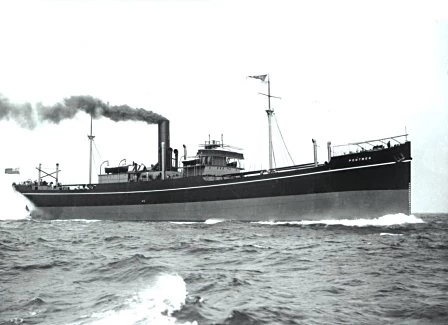
A typical Cardiff tramp steamer - the SS Pontwen, built in 1914.

A typical Cardiff tramp steamer - the SS Pontwen, built in 1914.

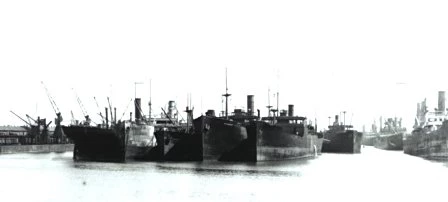
The age of depression. Laid-up ships in Cardiff docks about 1930.

The age of depression. Laid-up ships in Cardiff docks about 1930.

Cardiff: the port transformed. Modern retail developments now stand where Cardiff once exported coal to the world.

Cardiff: the port transformed. Modern retail developments now stand where Cardiff once exported coal to the world.

Second Marquess of Bute

In 1862, 2 million tonnes of coal were exported from Cardiff Docks ; by 1913, this had risen to nearly 11 million. This was the heyday of the coal industry before the depression of the 1930s.

Cardiff was the boom town of late Victorian Britain. For a few years before the First World War, the tonnage of cargo handled at the port outstripped that of either London or Liverpool. Yet in the late 18th century, Cardiff's trade was all transported by two small sloops sailing to Bristol on alternative days. So what had led to this transformation?

It was the growth of the iron industry in the South Wales Valleys that caused Cardiff to develop a port. In 1794, the

Glamorganshire Canal was completed, linking Cardiff with Merthyr, and in 1798 a basin was built, connecting this canal to the sea. Cardiff's foremost landowner, the 2nd Marquess of Bute, built West Bute Dock in 1839. Two years later, the Taff Vale Railway was opened.

Coal overtakes Iron

From the 1850s, coal began to replace iron as the industrial foundation of south Wales. South Wales steam coal was what oil is today, with yearly exports reaching 2 million tonnes as early as 1862. A further dock, the East Bute, was opened in 1859, but following the death of the 2nd Marquess in 1848, the Bute Estate trustees were over-cautious and reluctant to invest in new dock facilities.

Coal exports reach 9 million tonnes

Frustration at the lack of development at Cardiff led to rival docks being opened at Penarth in 1865 and

Barry in 1889. These developments eventually spurred Cardiff into action, with the opening of the Roath Dock in 1887, and the Queen Alexandra Dock in 1907. By then, coal exports from Cardiff totalled nearly 9 million tonnes per annum, much of it exported by locally-owned tramp steamers.

Tramp steamers and steamships

Cardiff's first steamship was the little Llandaff of 1865, and she was the first of a fleet of steamships that grew rapidly in the late 19th century. By 1910, there were some 250 tramp steamers owned at Cardiff. Each day, the owners would meet to arrange cargoes of coal for their ships in the opulent

Coal Exchange in Mount Stuart Square.

The coal export industry reached its peak in 1913, when 10.7 million tonnes of coal were exported from the port.

First World War

After the First World War, there was a significant increase in shipping in Cardiff, with 122 shipping companies in business in 1920. The boom proved short-lived, however; oil was growing in importance as a maritime fuel, and the terms of the Treaty of Versailles soon flooded Europe with cheap German coal. By 1932, in the depths of the depression, coal exports had fallen to below 5 million tonnes and dozens of locally owned ships were laid-up. It was an era of depression from which Cardiff never really recovered, and despite intense activity at the port during the Second World War, coal exports continued to decline, finally ceasing altogether in 1964.

Modern day Cardiff

Today, the port of Cardiff presents a very different picture from that existing a century ago. The waterfront has been totally transformed. Exclusive flats now stand where coal hoists once stood, and the rough and ready sailortown pubs have been replaced by sedate bistros. Only two docks, the Roath and the Queen Alexandra, remain in use, and just two shipping companies remain.

There is still some trade in timber, oil, and containers, but the days when the port was packed with tramp steamers, shrouded in coal dust as they loaded the 'black diamonds' of the valleys of south Wales, will never be seen again.

Background Reading

Cardiff and the Marquesses of Bute, by John Davies. Published by University of Wales Press (1981).

Cardiff Shipowners, by J. Geraint Jenkins and David Jenkins. Published by the National Museums & Galleries of Wales (1986).

Coal Metropolis: Cardiff, 1970-1914, by Martin Daunton. Published by Leicester University Press (1977).

Welsh slate discovered hundreds of miles from the quarries of North Wales

18 April 2007

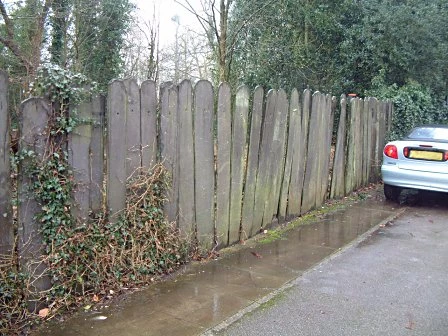
The slate pillar fence at Bisham (Windsor and Maidenhead)

The slate pillar fence at Bisham (Windsor and Maidenhead). Approximately 150m (164 yards) of this fence survives, although local residents remember it as once being significantly longer. The pillars of Bisham's fence typically extend about 180cm (5.9 feet) above ground level and must have a further 40cm (1.3 feet) or so below the ground. Each pillar is some 20cm (7.9 inches) in width and 3.5cm (1.4 inches) thick.

How did a slate pillar fence come to be built in the Thames Valley, 300km away from the slate quarries of north-west Wales?

Slate pillar fences became common in north-west Wales from the middle of the 19th century. In 1861, the Penryhn Quarry at Bethesda, Gwynedd - one of the largest slate quarries in the world at that time - produced around 9,000 individual pillars. These pillars consisted of poor quality blue slate, typically about 150cm (4.9 feet) tall.

They were used to mark fields, gardens, railways lines and roads, with their simple construction being particularly well-suited to the harsh weather experienced by upland areas.

Despite their use around Wales's slate quarries, slate pillar fences are rarely found further a field. The discovery of a slate pillar fence at Temple House (now demolished) at Bisham, Maidenhead, is therefore extremely unusual. The bluish-purple colouring of the slate makes it certain that it was quarried in north-west Wales, probably at Penrhyn Quarry.

This raises the question of how a slate pillar fence came to be built almost 300km (186 miles) away from the source of the stone?

Temple House was built around 1790 for Thomas Williams, who owned the nearby Temple Mill copper works. Thomas Williams (1737-1802) was from north Wales originally and became the leading figure of the British copper industry. Williams employed the architect, Samuel Wyatt, to develop the Temple Mill copper works, and it is likely that Samuel also built Temple House.

Samuel Wyatt had very close links with the owners of the Penrhyn slate quarry. In 1782 he refurbished a building for Richard Pennant (later Lord Penrhyn), and in 1786 his brother became the general manager of the Penrhyn estate. This relationship ensured Samuel a regular supply of slates for his own business activities. In return, Samuel promoted the use of slate in the London area, using it for shelves, cisterns, lavatory-seats, window-sills and as a wall covering, as well as for roofing.

If the Temple House slate pillars had been supplied by Samuel Wyatt, their transport to Bisham could have been relatively simple. Even before the construction of a tramway from Penrhyn Quarry to the coast in 1801, there existed an efficient network of roads linking the quarry to the sea at Port Penrhyn.

From Port Penrhyn a fleet of vessels carried slate around the coast of the British Isles. The Wyatt family had an owning interest in many of these vessels. From London the cargo could be navigated up the Thames by barge.

There is therefore a great deal of circumstantial evidence linking the Bisham slate pillar fence with Samuel Wyatt and Penrhyn Quarry, and dating its construction to around 1790. But one aspect of the pillars' manufacture raises doubts about this. Some of the larger support pillars were clearly cut with circular saws - a technique which was not certainly used before 1805 and only became common from 1840.

One suggestion which unites these two strands of evidence is the possibility that the original fence was erected about 1790, but it had suffered from subsidence in the soft soil around Bisham. The result might have been a second order for Welsh slate around 1840 to rectify the problem.

The fence at Temple House may show evidence of the links between two of Wales's great industrialists, the copper magnate Thomas Williams and Richard Pennant of Penrhyn slate quarry, through the architect Samuel Wyatt. Both shared a common heritage, so what would have been more natural than for Thomas Williams and his architect to display the potential of Welsh slate beside his copper works at Temple Mill?

Background Reading

The Wyatts: an architectural dynasty by John Martin Robinson. Published by Oxford University Press (1979).

'Copper and Slate: Thomas Williams' Slate Pillar Fence at Bisham', by Dafydd Roberts. In The Marlow Historian, vol. 3, p16-21 (2003).