: Industry - Workshop of the World

Moving a coalface to the museum

11 April 2007

When a miners' hospital closed in 2001, a working coalface that was used to exercise the patients for work again was dismantled and moved to the collections of Amgueddfa Cymru.

Talygarn House

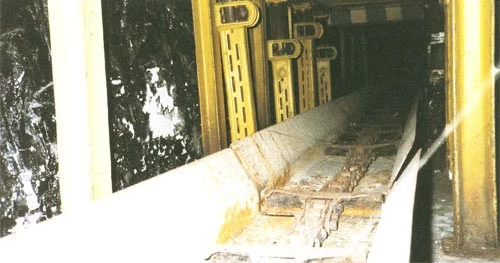
Talygarn House: a view along the full size model coalface

Talygarn House: a view along the full-size model coalface

Talygarn House, Pontyclun, south Wales, was a large stone mansion that became a hospital in 1880. The interior is decorated with wood panelling and painted ceilings. The house is surrounded by extensive parklands on which were grown, according to legend, specimens of every tree that can be cultivated in Britain.

Talygarn as a Convalescent Home

In October 1923, Talygarn House was opened as a miners' convalescent home, and in 15 years of its opening it had more than 41,000 patients.

In 1943, the Miners' Welfare Commission was asked to organise a rehabilitation service for injured mineworkers. Due to a serious shortage of manpower at that time, it was vitally important for injured colliers to return to work as quickly as possible. For this purpose Talygarn House was purchased as a centre for the coalfields of south Wales.

By 1964, 95% of patients treated at Talygarn returned to the mining industry. It continued to serve as a rehabilitation and physiotherapy centre until it was put up for sale in August 2000.

Miner rehabilitation and the 'Model Mine'

Due to the need to harden the men up to return to the collieries, a carpentry shop was provided where patients cut wood and sawed logs. Miniature stairs and static bicycles were available to exercise unused muscles.

Talygarn House was also equipped with a grand 'Model Mine' in which patients could get used to working back in a mining environment. The structure was a long concrete tunnel supported by arch girders. The roadway was equipped with rails and the metal framework known as 'horseheads', which prevented falls of stone on a real coalface.

Relocating the mine

In 2001, the contents of the 'Model Mine' were donated to Amgueddfa Cymru as a 'permanent reminder to visitors of the work of the Talygarn rehabilitation centre'.

The coalfaces were dismantled as if they were the real thing. Despite working in only four feet of height, the thirty-foot-long chain conveyor was successfully disassembled and removed.

All the items were safely transported to the Collections Centre at Nantgarw. The Talygarn donation is a unique survival of a complete thirty-foot section of a typical semi-mechanised coalface of the early 1960s.

200 Years of Industrial Innovation at Ebbw Vale

10 April 2007

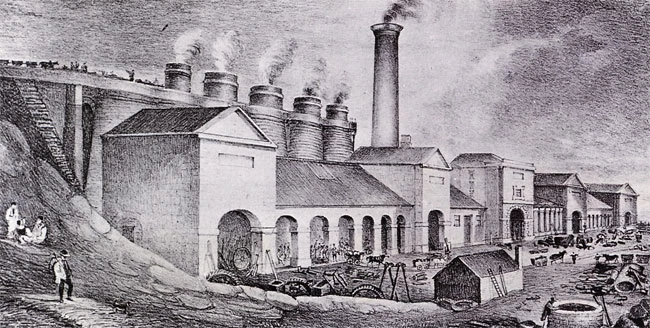
Abersychan Ironworks, 1866, run by the Ebbw Vale Co., 1852-83

Abersychan Ironworks, 1866, run by the Ebbw Vale Co., 1852-83

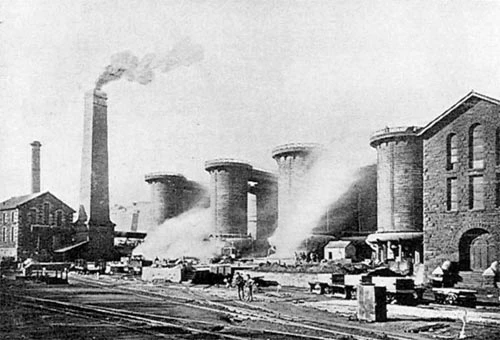
Ebbw Vale blast furnaces, about 1900

Ebbw Vale blast furnaces, about 1900

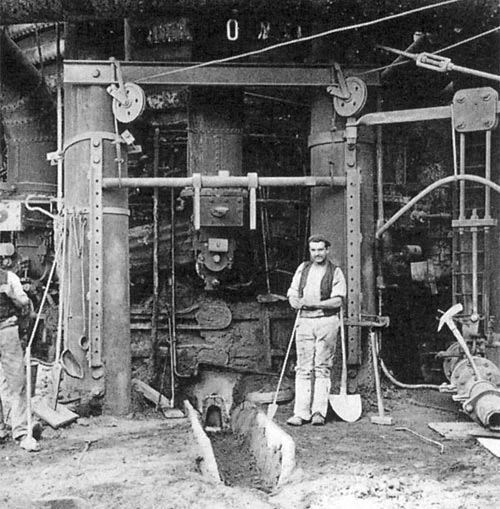
Blast furnace Taphole, 1907

Blast furnace Taphole, 1907

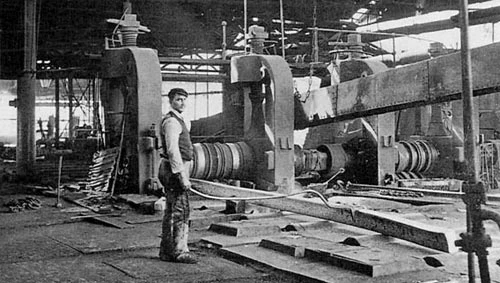
Steel works roughing mill, 1907

Steel works roughing mill, 1907

The Ebbw Vale Steel, Iron & Coal Company

In the mid-19th century the Ebbw Vale Steel, Iron & Coal Company was one of the largest iron producers in South Wales and was of international importance, not only in terms of size, but also for technical innovation.

100 years later, the works were the first in Britain to introduce American-style steel and tinplate production techniques and before the closure of the site at the turn of the millennium it was the largest producer of tinplate in Britain.

1790, the first Blast Furnace

Industry at Ebbw Vale extends back to 1790 when the first blast furnace was established. From 1796 to 1844 it was owned by the Harford family who built it into a successful concern. It supplied rails for the Stockton & Darlington Railway in 1829.

At the same time, the company began experimenting with the use of locomotives, one of the first of the South Wales ironworks to do so. In 1848 the Ebbw Vale Company was formed and the works went from strength to strength, absorbing four other ironworks at Abersychan, Sirhowy and Pontypool.

The first steel works in Britain

The company experimented in changing over from wrought iron to steel in 1854, installing one of the first steel plants in Britain in 1866.

The works declined in the 1870s and 1880s due to poor management, but the rapid expansion of the export coal trade kept the company afloat and saved the works from closure.

20th Century revival

The iron and steel works was revived in the early 20th century which, combined with a booming market for Welsh steam coal, helped make the company the largest integrated iron and coal company in Wales.

Closure and hardship

By the early 1920s it was employing no fewer than 34,000 men. The company was increasing its debts to finance its expansion at a time when the steel and coal industries declined sharply. This ultimately led to the works' closure in 1929 and its collieries being sold off.

Revival and expansion with Tinplate

The great hardship and unemployment in the town caused the Government to site Britain's first steel stripmill at Ebbw Vale and the works were rebuilt in 1936-38 under the ownership of Richard Thomas & Company, Britain's largest tinplate manufacturer.

The new works received a further boost in 1947 when Europe's first electrolytic tinplating line was installed.

Largest tinplate producer on Britain

Re organization in the steel industry following nationalisation in 1967 led to a run-down of steel making at Ebbw Vale, and the steel plant closed in 1978. Subsequently the works concentrated on tinplating and galvanising, becoming the largest tinplate producer in Britain. These works closed in 2002, ending over 200 years of industrial innovation at Ebbw Vale.

Distinguished Service - campaign & gallantry medals

30 March 2007

The medal collections of Amgueddfa Cymru

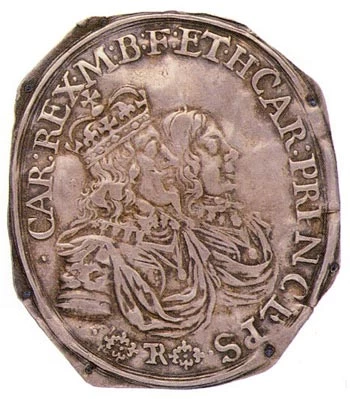
Silver 'Forlorn Hope' badge 1643 — this would have been sewn onto a sash or tunic.

Silver 'Forlorn Hope' badge 1643 — this would have been sewn onto a sash or tunic.

South Africa Medal 1877-79: '1428 Pte E. Jones 2.24th Foot'.

South Africa Medal 1877-79: '1428 Pte E. Jones 2.24th Foot'.

Sergeant Evan Jones, c.1917.

Sergeant Evan Jones, c.1917. He was born in Ebbw Vale in 1859 and enlisted in the Monmouth Militia in 1874, joining the 24th Foot in 1877. He served in South Africa, where on 23 January 1879 he was one of the tiny garrison that held Rorke's Drift against a massive Zulu attack. He later served in the Mediterranean, India and Burma, and remained in uniform with various units until 1920. He died in Welshpool in 1931.

The British medal collections of Amgueddfa Cymru were formed back in the 1920s thanks to gifts from two men.

In 1922, Colonel Sir William Watts donated his collection of 105 British naval and military medals, and in 1923 W. Lisle Bowles made generous gifts of similar medals.

From these, the Museum gained a representative collection of British military campaign medals, from the battle of Waterloo (1815), the first engagement for which all who took part received a medal, to the Great War of 1914–18 and beyond. However, only a small number of these military and gallantry medals had any Welsh associations.

In more recent years, therefore, occasional purchases and donations have concentrated on these two categories, our stated policy being to collect medals 'relating to the deeds of Welsh people'.

'Forlorn hope'

The earliest military award in the collection is a badge for the 'Forlorn Hope', dating from the English Civil War and awarded to selected troops who acted as vanguards. This was a Royalist award introduced in 1643 by Thomas Bushell, a mining engineer and master of the mint at Aberystwyth.

Civilian Heroes

The Albert Medal was introduced in 1866, at first awarded for gallantry at sea, but extended to the saving of life on land in 1877 to reward the heroes of Tynewydd Colliery, Rhondda, for the successful rescue of five colleagues trapped by flooding for nine days deep underground. Several Albert Medals relating to this incident are in the Museum's collection. When the Edward Medal was created in 1907 for gallantry in mines and quarries, one of the first two awards went to a Welshman, Henry Everson, of Penallta Colliery; the medal was donated to the Museum by his son in 1978.

From Albert to Edward to George

In December 1971, the Albert and Edward Medals were withdrawn, to be replaced by the George Cross. Of those who elected to exchange awards, seven chose that their previous medals be donated to the Museum. Two of these, Gordon Bastian and Eynon Hawkins, held the Albert Medal for gallantry at sea, having rescued fellow crewmen in torpedoed ships in 1943. Three 'land' Albert Medals are those of Walter Cleall; Cardiff policeman Kenneth Farrow, who attempted to save a small boy from drowning; and Margaret Vaughan, who as a schoolgirl saved a boy caught by the rising tide at Sully Island, near Barry, from drowning. Edward Medals were given to Bert Craig (Mountain Ash, 1922) and Thomas Thomas (Brynamman, 1933).

Heroism and Great Gallantry

In 1990, the Museum acquired three George Medals with Welsh connections.

The George Cross and George Medal were created in 1940, primarily as a response to the increased exposure of civilians to great danger during the Blitz. On 19 August 1940, the Royal Naval fuel depot at Llanreath, Pembrokeshire, was bombed and burned for seventeen days, destroying over thirty million gallons of oil. This was the biggest fire ever known in Britain. Norman Groom was one of 650 firemen who fought the blaze and one of three Cardiff men to receive the George Medal. Thomas Keenan, a nightwatchman, removed an incendiary bomb from the top of a tank containing 300,000 gallons of petrol at a depot in Ferry Road, Cardiff, on 2 January 1941.

The awards highlighted here form just the tip of a historical iceberg. Unlike those of any other country, Britain's campaign medals and most of its gallantry awards have, since the early 19th century, been impressed with the name (and for military awards the number, rank and unit) of their recipients. Even the millions of campaign stars and medals of the Great War of 1914–18 were individually named, though those of the Second World War were issued unnamed, presumably to save costs. Most medals are, therefore, starting points for historical research into the lives of individuals.

A portrait of a Welsh Squire and his children, by Johann Zoffany, distinguished painter to George III

22 February 2007

There are many portraits of well-known Welsh figures in the art collections of Angueddfa Cymru. However, the Museum also collects portraits of lesser-known people as they can be important works of art in their own right. The study of these portraits often sheds new light on when and how their subjects lived and adds to our understanding of art in the past.

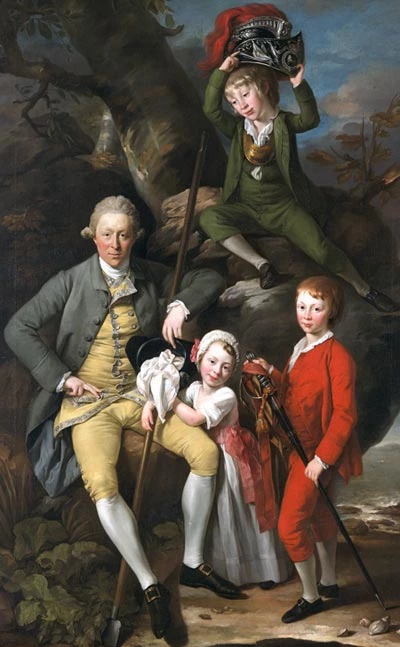
During the past 20 years several distinguished 18th and early 19th century portraits have been acquired by the Museum, including Henry Knight of Tythegston with his three children, painted by Johann Zoffany (1733-1810) in about 1770.

Henry Knight of Tythegston with his three children by Johann Zoffany

Henry Knight of Tythegston (1738-1772) with his Children

Johann Zoffany (1733-1810)
Henry Knight of Tythegston (1738-1772) with his Children.
c.1770 - oil on canvas

The portrait shows the Glamorganshire squire Henry Knight (1738-1772) with his three children Henry, Robert and Ethelreda. Henry was a soldier in the 15th Light Dragoons, and his older son is shown trying on a helmet of that regiment. Henry Knight's father, Robert Knight (1711-1765), inherited the Tythegston estate of the Lougher family through his mother in 1732. Henry divorced from his wife in 1771, then a difficult and expensive process requiring a private Act of Parliament. The painting might have been commissioned to represent Henry Knight's decision to leave the military in order to care for his children. In the picture, he is dressed in civilian clothes, but he holds an infantry officer's spontoon, thrust blade-first into the ground. His sons hold his sword, gorget and helmet. The picture's seaside setting is probably a reference to Tythegston, a couple of miles from the coast, between Bridgend and Porthcawl. The tree motif, frequently used in Zoffany's family groups, allows all the figures to be given equal importance. Showing the boys playing with arms and armour belongs to a tradition that can be traced back to the Renaissance.

Johann Zoffany

This is one of Zoffany's largest family portraits (measuring 240 cm x 149 cm), and is a surprisingly ambitious commission for a Welsh squire of modest means. Zoffany, one of the most distinguished British painters of the reign of George III, was famous for his informal styles. One of his best-known pictures, Sir Lawrence Dundas with his grandson, shows the 17th century Dutch masterpiece The Calm by Jan van de Cappelle, also in the Museum's collections.

Born near Frankfurt and trained in Rome, Zoffany moved to London in 1760. Lord Bute, George III's first prime minister, probably introduced him to the Royal Family, where he became the favourite painter of Queen Charlotte. The King nominated him a member of the Royal Academy in 1769. The appeal of Zofanny's work lies in his ability to catch a likeness and his astonishing attention to detail. His perspective, however, can be faulty, and here the helmet held by the older son is clearly too large.

Purchasing the portrait for the Museum

The picture is in a remarkably good state of preservation. X-ray examination reveals that the artist reworked the head of Robert Knight (the younger son dressed in red), but there are only a few other minor changes to the design, and most of the composition was laid on quite thinly. The picture was loaned to the Museum from 1940 until 1958. When it was offered for sale at Sotheby's in 1999 its acquisition by the Museum was a priority. The purchase was made possible by generous donations from the bequest of June Tiley, the Heritage Lottery Fund and the National Art Collections Fund.