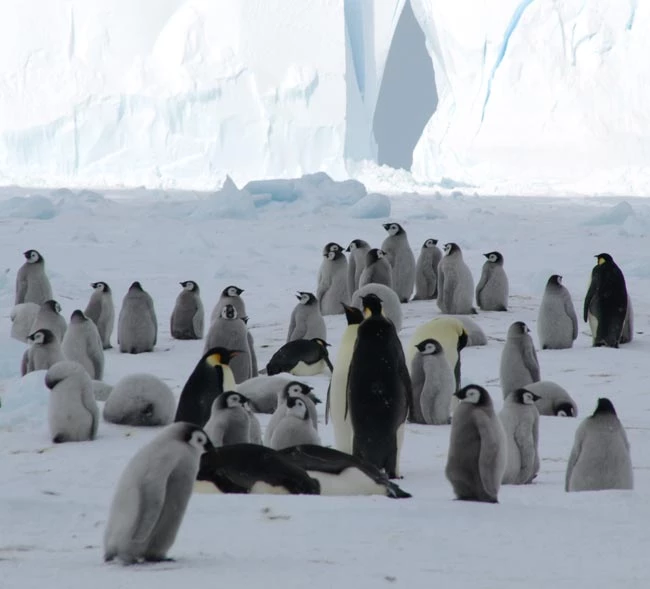
Tom Sharpe's Antarctic Diary 2012-01-03 John Rowlands, 3 January 2012 Tuesday 22 November 2011Overnight we sailed across McMurdo Sound and pushed into the fast ice along the coast of the mainland. It was a beautiful day today, except where we wanted to be - in the mountains.There, low cloud meant the helicopters couldn’t fly. So instead we spent the morning walking on the ice around the ship. Our presence attracted the attention of a group of Emperor penguins who were just as interested in us as we were in them. They were definitely there to have their pictures taken! They leapt in and out of the water, waddled back and forth, stood, posed and almost smiled for our cameras.By early afternoon the weather showed signs of improvement, so we flew across the fast ice and into the Taylor Valley, one of the Dry Valleys. These are remarkable features, the largest ice-free area in the continent. Taylor Valley was discovered by Scott on his first expedition while returning from a sledging trip to explore the Polar Plateau with Edgar Evans from Rhossili on Gower.The Dry Valleys are a polar desert where the rocks are smoothed and sculpted by sand blown by katabatic winds which hurtle down from the Antarctic ice sheet at speeds of up to 200 mph. They attract a lot of scientific attention, especially from NASA, as this is probably the closest we have to a Martian landscape and climate. It was a real thrill to experience this incredible landscape.The valley is strewn with moraines with huge variety of rock types. Two geologists from Scott’s last expedition, Frank Debenham and Griffith Taylor, explored this valley and collected from these moraines. This gave them samples of rocks from deeper into the Transantarctic Mountains which they did not have time to explore.Wednesday 23 November 2011After a bright sunny night, we awoke to find ourselves back in the fast ice of Ross Island, this time offshore of Cape Evans. Visiting Shackleton’s Hut was wonderful, the Dry Valleys exceptional, but today was very much the icing on the Ross Sea cake, and for most of us, the whole reason for this trip - a visit to Captain Scott’s hut, the hut from which he left for the South Pole and to which he never returned.Almost buried in snowdrifts, the hut has a powerful presence, seeped as it is in Antarctic history. Stepping through the door was a strange experience. In front of me was a large room that I knew well, but I was seeing it for the first time in colour. I know this hut from the famous photographs of Scott’s expedition photographer, Herbert Ponting.I was standing where he stood, at the end of the long table, when he took the picture of Scott’s birthday. I stood between the sleeping bags of Teddy Evans and Edward Wilson, from where Ponting photographed Scott sitting at his desk. I saw the empty Tenements, the bunks of Apsley Cherry-Garrard, Birdie Bowers, and Captain Oates, and could visualise them there, as in Ponting’s photograph. Above Oates’ bunk - his pinups: pictures of horses and dogs. Atkinson’s laboratory, his test tubes and equipment still on the bench; the Geologists’ Cubicle, with rocks on the floor beneath Frank Debenham’s bunk; Ponting’s darkroom, still smelling of developer and fixer; the Stables where Oates cared for the ponies, and the stove he used to heat their chaff; Clissold the cook’s galley with its stove, utensils, and canned foodstuffs; and, dividing the hut, a wall of crates of Coleman’s mustard, Fry’s chocolate and other supplies. All of these are still where Ponting photographed them a century ago.Of course, a feeling of sadness and tragedy pervades this hut; it is almost tangible. Almost exactly 100 years ago, Scott, Oates, Bowers, Wilson and Edgar Evans left this building and set out for the South Pole and a frozen death.Less well known is that this hut was used by Shackleton’s Ross Sea Party who were laying the depots for his doomed crossing of the continent in 1916. Three of their number lost their lives on the ice near here. A forlorn, poignant pencilled scribble beside a bunk records “Loses to date Hayward, Mack, Smith”. In their memory, their colleagues erected a wooden cross on Wind Vane Hill near the hut.The setting of the hut was enhanced by some suitable weather today; kind enough at times to allow our helicopters in, but showing how quickly the weather can change here. Snow showers, fine spindrift, a driving wind and windchill of -10oC reminded us what conditions here can be like, even less than a month from midsummer.
Tom Sharpe's Antarctic Diary 2011-12-22 John Rowlands, 22 December 2011 Monday 21 NovemberWe've continued to push south, although by a rather round about route to avoid the thickest pack ice, and passed 77o south latitude.On the western horizon we had an incredible view of the Victoria Land coast of mainland Antarctica and the Transantarctic Mountains. To the south we could see Ross Island and Mount Erebus, the most southerly active volcano on earth.We eventually broke through into a large area of open water as we entered McMurdo Sound. As we sailed along the west coast of Ross Island, we headed for a small bay at Cape Royds and ran the ship up onto the fast ice - thick sea ice attached to the land. From there it was a short helicopter ride ashore.A walk of a few hundred metres took us to a sheltered little cove where, protected from the winds by a ridge of glacial moraine, there stood a small wooden building. This was the base hut of Ernest Shackleton's Nimrod Expedition of 1907-1909. A major conservation project by the New Zealand Antarctic Heritage Trust has recently completed work on the hut and its contents, and they've done a magnificent job. Tins of food are still stacked on the shelves, sledges rest on the rafters, clothing and sleeping bags lie on the beds, and crates of supplies are piled against the outside wall. To stand in this hut is awe inspiring.On this expedition, Shackleton pioneered a route which Scott would later follow through the Transantarctic Mountains, and got within 97 nautical miles of the South Pole. Although he knew he could be the first to reach the South Pole, he turned back. He realised that if they continued they would not have enough food to make it back alive.Shackleton took several scientists with him, one of whom was a St Fagan's born geologist, T.W. Edgeworth David, then Professor of Geology in Sydney. Based at this hut, David led the first ascent of Mount Erebus, 3795 metres high, and also led another team on a long sledging journey up onto the Polar Plateau to reach the South Magnetic Pole.We had time to see the hut and take a walk to the most southerly penguin colony in the world, on the coast around Shackleton's hut. The Adelie penguins here provided an extra source of food for the expedition.Instead of flying back to the ship, I opted to hike back across the fast ice to retrieve some marker flags we had laid out as a walking route in case the weather turned. This is perfectly safe as long as you keep a look out for tide cracks - fissures in the ice caused by tidal movement.Their dangers were demonstrated when my hiking companion immediately fell into one. Luckily he went down only a couple of feet. It was just as well, as he had the rescue line.
Mapping Hendre'r Ywydd Sara Huws, 22 December 2011 A quick post just to show you this map I've been working on, which is an attempt to explore the 1500s landscape of Llangynhafal and beyond. You'll find pinpoints to buildings nearby which could have been standing at the same time as our Hendre'r Ywydd. It is an incomplete map, but it will evolve, I hope. To make it, I combined public domain data from Coflein, Ordnance Survey, the St Fagans Archive, google and the North Wales Dendrochronology Project*.I hope to add more information about the buildings themselves, including photos and dating, as I find it. I should also note that the captions in Welsh will be translated as the map progresses.You can use the zoom tool to travel outwards from Hendre'r Ywydd's original site: View Llangynhafal 1510 in a larger map* Dendrochronology=a fancy term for tree-ring dating.
Finding Hendre'r Ywydd Sara Huws, 20 December 2011 I have grown very fond of Hendre'r Ywydd Uchaf. I can smell wood-smoke in the office and it's got me looking forward to Spring, when I'll hopefully be spending more time there, getting to know the building from the inside out. Even if you have visited St Fagans many times, you may not have stayed a long while in there. It is quite a bare building, partly due to the fact that furniture from its period of construction – the early 1500s – need more TLC than can be provided in an outdoor display, and so are tended to in the galleries. Also, there's no chimney, so it can be quite a troublesome building to work with, and even visit, if the smoke is not behaving as it ought to. The fire behaving nicely at a recent living history demo, with Sally Pointer It's a timber-framed building, moved here from Denbighshire in the 1960s but lived in, quite comfortably it seems, until 1954. I hope to find out more about the place, and how it was used, by using a variety of skills and sources. After cooking and interpreting in there over the summer, I'm really looking forward to getting my hands dirty and seeing how it works as an Early Tudor household.Moving headlong into a Tudor way of life at this time of year may be ill-advised (especially since I have no saltfish and this year's attempt at storing apples has been fuzzier than anticipated), so I'm taking the time to pore over sources relating to the building and its original context. Dismantling Hendre'r Ywydd Uchaf, c. 1964. The 1500s frame had been left almost unaltered - a corrugated roof, chimney, glass windows and that chap with a cigarette being the most noticable modern additions. There's so much material to explore. Scholars and local historians have written widely on a range of families, buildings, industries and events from Denbighshire in the Early Modern period. I have on my desk a great big pile of articles, ready to be marked with pink and yellow stripes. But you've got to start somewhere. I decided first to find the building's original location. It's somewhere around here... Hendre'r Ywydd was originally built in the parish of Llangynhafal, near Rhuthun. I am quite familiar with the area, but had never been able to put my finger on the house's original site; remembering instead the high hedges and spaghetti-thin roads of Dyffryn Clwyd. Thankfully, for every building we move, we create an archive of its context and original location. These archives are usually second-to-none: Numbering a doorway, St Teilo's Church (1985) Unfortunately, on this occasion, our forebears did not think to leave enough clues in there to allow for easy pinpointing. Rifling through photos of cruck frames, cow stalls and hazel matting, I came across two shadows of evidence. A copy of a copy of a copy of an 1830s tithe map with no scale, and a transparency with no key. Both featured a strip of land which tapered at one end. This was where, in 1508, Hendre'r Ywydd Uchaf was built. Map drawn by member of Ffoulkes family. Hendre'r Ywydd is at the bottom left of the strip of land. It takes a while to get your eye in, so I google-mapped the parish to see if there were any surviving field systems like the one featured on both maps. Going in cold was a bad idea. I remember when all this were just fields... I resolved to have another go once I'd chipped away a little more. It was tempting to rely on google maps for place names and postcodes, but our landscape has changed so much, and in fits and starts, since 1500, that the information was of no use for this particular task. Or at least, if the information looked useful, there would be no simple way of checking its veracity. I stared at the shapes on the tracing, trying to memorise the placement of streams, trackways and field systems. Tracing of undated map, showing original location of Hendre'r Ywydd Uchaf In the midst of all these abstract shapes, I called to mind another thread of research I'd been doing, using the Royal Commission's Coflein Database. In trying to build up a bit of context, I've been looking at other surviving houses from the area, reading up on their construction and dating. Coflein supplies you with an OS grid reference for every recorded historic building and monument in Wales. You can look at the Coflein archive for Hendre'r Ywydd here.I still had in my possession a grab-bag of data. Some abstract shapes, some numbers and some very powerful satellite data courtesy of google and NASA. Thankfully, I didn't have to go far in order to make sense of it. Our library at St Fagans has a cache of Ordnance Survey maps, and the grid reference narrowed it down substantially, as you'd expect. The detail of their maps is mesmerising, and after some careful examination and help from our Curator of Historic Buildings, we pinpointed the location, in amongst a few other houses, confusingly also called Hendre'r Ywydd. Detail, showing Llangynhafal Parish and Hendre'r Ywydd (1956). Here' "Hendre'r Ywydd" is also used as a name for the hamlet itself. Mapping courtesy of Ordnance Survey. On closer inspection, someone possessing a disregard for conventional, proper, archive-based behaviour had been there before us and marked the map with a tiny blob of red ink.When I had been brought round with some smelling-salts, I applied the information I'd gathered to the satellite map, and was finally able to find that little strip of land. It's still intact, to a degree, and still maintains a tapered side, as we see on the map. The road twists slightly just as it does in the drawings: Hendre'r Ywydd, Llangynhafal (1508-1964) The last thing I wanted to do, after this, was pay it a visit. I find the house replaced with a field of corn. Uninspiring as it may appear, this is where I happily find my feet, as I venture into 1500s Denbighshire. You can visit, too, by clicking here:View Llangynhafal 1510 in a larger map
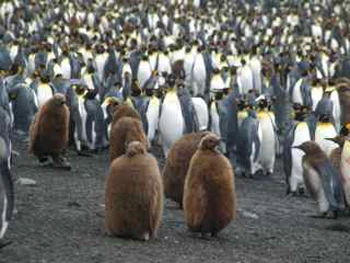
Tom Sharpe's Antarctic Diary 2011-12-15 John Rowlands, 15 December 2011 Saturday 19 NovemberToday began grey, overcast and cold, with light snow falling on the ship. We’ve now been breaking our way through the pack ice of the Ross Sea for three days, picking our way south through whatever open leads or thin ice present themselves.On the southern horizon, in places, open water shows up as dark reflections on the underside of the cloud - a ‘water sky’. In other places, we see ice blink, where the clouds are brightened by the presence of the sea ice beneath. Our navigation through the pack is aided by satellite positioning; Scott relied upon dead reckoning and the sun to chart his progress.This afternoon we sighted land for the first time in five days. Away to the west we’ve had our first glimpse of the continent of Antarctica. The faint, white, distant mountains rise to over 3500 metres. Appropriately, one of the first we see, Mount Murchison, is named after a geologist who worked in Wales 180 years ago.We set course for the mainland, a point called Cape Washington, but the pack ice is too thick, even for our icebreaker. Instead, we’re continuing south, deeper into the Ross Sea, in the hope of breaking out of the pack and into a polynya, which satellite pictures show lies to the south of us.Sunday 20 NovemberIt’s been slow getting through the pack ice, but we’ve finally made it to Franklin Island, at 76o south.The ice is thick around the island, but we got within 5 miles of it, so we took the helicopters and landed on the sea ice at the foot of steep black cliffs. From there we hiked about a mile and half south across the ice to a large colony of Emperor penguins at the southeastern end of the island. These are the stars of the movies March of the Penguins and Happy Feet. They walk long distances across the ice to breed, and after the egg is laid it is transferred to the male who then stands on the ice through the severe Antarctic winter holding it on his feet.The males in the colony huddle together against the cold. The march of the penguins was first observed by Captain Scott on his first expedition. Their chicks are some of the cutest things on the planet and infitinely photogenic. We have a couple of examples of Emperor penguins in our collections in Cardiff, including one presented to us by Lt Teddy Evans of Scott’s last expedition, and that will be in January.