Collections & Research

Andrew continues the bell making experiments

Steve Burrow, 23 July 2009

Festival of British Archaeology 2009

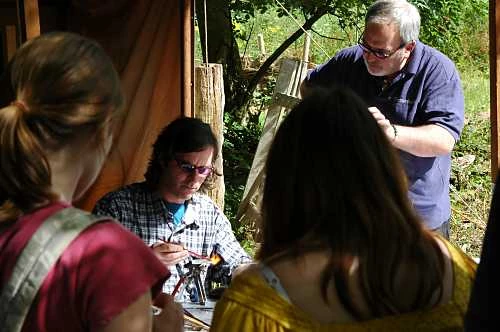
On Tuesday, Andrew Murphy, blacksmith at St Fagans continued the challenge to make a replica of an early medieval bell, begun by Tim Young earlier in the week. While Tim, had worked on brazing the body of the bell, Andrew worked on the handle. This is a loop which passes into the bell so it can be held from the top, while the bell’s clapper hangs from a hook inside.


Andrew had several attempts at replicating the shape of the original bell’s handle over the course of the day, with each attempt getting closer to the form we were after, and the event was enjoyed by the public throughout the day.

Animations in a roundhouse

Ian Daniel, 21 July 2009


Visitors have flocked to the Celtic Village over the last couple of days to join with us in celebrating the Festival of British Archaeology. For me so far there have been several highlights. On Sunday people found shelter from the rain in the stone roundhouse, where in the dark the artist Sean Harris projected his animation film Dadeni onto the earth beaten floor. People are used to experiencing animations on TV, computers or in a cinema. Such an experience proved moving, eerie and played upon the senses. The moving images evoked past mythologies. You almost felt as if you had gathered with the ancestors around a warm fire and cauldron to share their stories, safe from the rain.


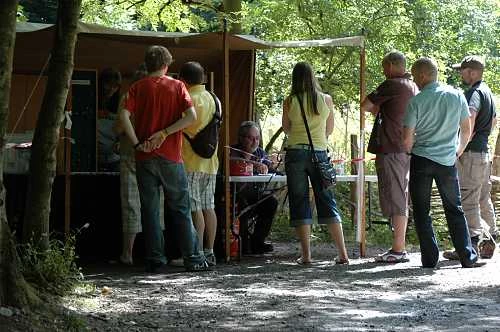
Tim Young and his team built a forge outside the Village. Their experiments in recreating the lost art of making Early Christian handbells drew the crowd. Tim felt, ‘It was a successful weekend. We were trying to understand the technique not to produce a finished product. If we were going to do this for ten day's solid we'd be getting it right completely by the end. As it is we've cracked how to do the hearth - that's great, I like it - but we need to build on it.’


Mark Rednapp, from the archaeology department here, was with them. I asked him about his thoughts, ‘The wonderful thing about experimental archaeology is that you leap from one idea to the next, one experiment to the next. Many things have passed through my mind: the skill needed to judge the temperature and timing, the amount of manual labour involved in keeping the bellows going, which remind us of early medieval slavery, but also of the apprenticeships learning from an early age by experience.’


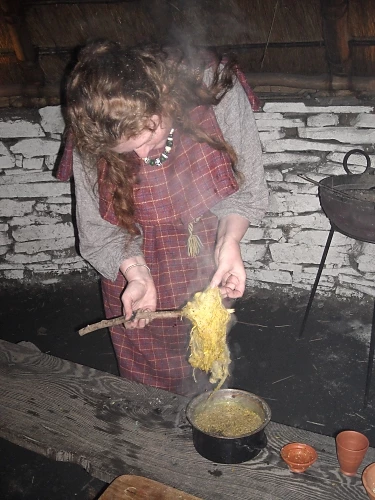
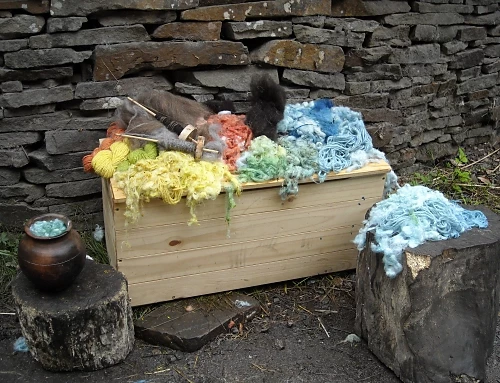
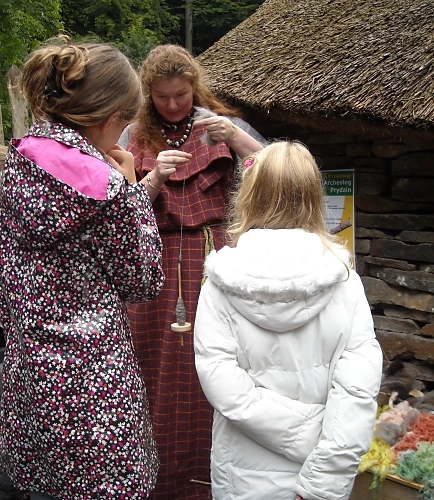
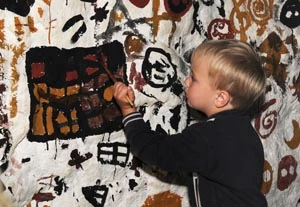
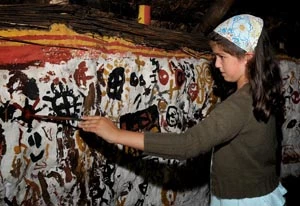
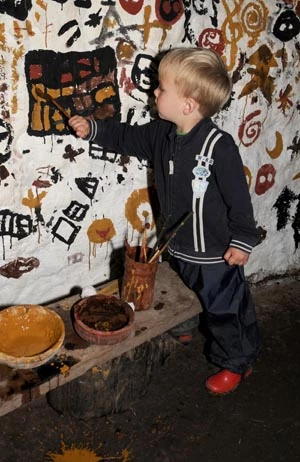
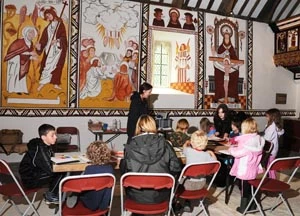
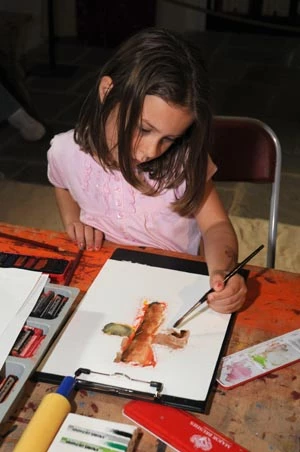
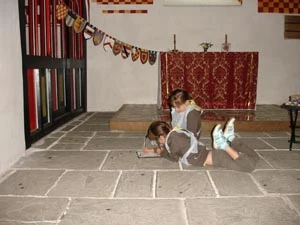
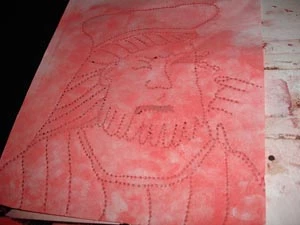
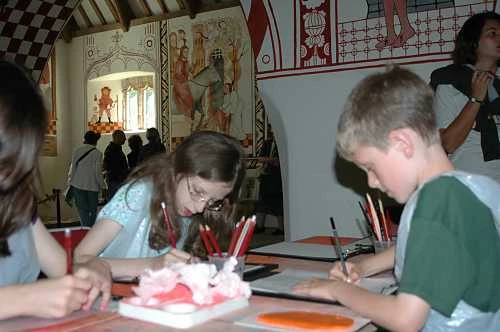
The Festival continues until 2nd of August. Come and join my workshops ‘Colouring the past’ in the Celtic Village this weekend, the 25th and 26th of July.

Piecing together the past

Chris Owen, 21 July 2009

Festival of British Archaeology 2009

Today’s events at National Museum Cardiff were Shadow Puppetry and Pottery Sorting.

I won’t write too much about the Shadow Puppet workshops because I covered these in a previous post – suffice it to say that they continued to be hugely popular with children, a fact demonstrated by the quantity of cut up paper and bits and bobs left behind when the crowds finally cleared.

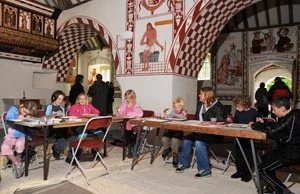
The Pottery Sorting was a new thing though. Here, visitors were helping museum staff with the real business of archaeology. Back in 2002, an excavation was carried out at Llandaff Cathedral School in Cardiff and a very large quantity of 13th and 14th-century pottery was found. This was all brought back to the museum and staff have slowly been sorting it out. But there are only so many hours in a day and this is an awful lot of pottery so, as part of last year’s National Archaeology Week, we asked the public to help us make sense of it all. The event was so popular – and we still had so much pottery left over – that we ran it again this year.

So, with the help of about a hundred children and adults, Sian and Louise from the museum’s archaeology department spent today sorting the broken pottery into different types: glazed and unglazed, rims, bases and decorated pieces.

It proved to be a surprisingly addictive activity, with one girl staying to help out for over an hour, and a visiting Californian potter finding herself drawn into the challenge of grouping the sherds, and trying to track down elusive joins between pieces. Sadly, no joining pieces were found but, as Sian said: “there’s always tomorrow”.

And tomorrow the team will be joined by Mark Redknap, the museum’s medievalist who will be helping to make sense of it all.

Shadow puppets

Steve Burrow, 20 July 2009

Festival of British Archaeology 2009

Last Saturday, Sean Harris ran a Shadow Puppet workshop at National Museum Cardiff converting the main hall into an animation studio.

I wasn't able to go to the first day myself - which is why this posting is so late - but colleagues who were helping at the event took some photographs.

For those who missed it, but would like to join in the free family fun, the workshops continue ever day until 24 July.

Click here for details.

Last day of the bell casting

Steve Burrow, 20 July 2009

Festival of British Archaeology 2009

Tim Young’s attempts to replicate an Early Medieval church bell continued beside the Celtic Village today with the help of a team of volunteers who answered any questions that visitors to the museum had about the project.

It’s an industrial-sized operation, with gigantic bellows hanging from a wooden frame, and fire roaring from the furnace. Its aim was to coat a wrought iron bell with bronze in a process known as brazing. This involves encasing the bell, wrapped with strips of bronze, inside a clay mould and placing it in the fire. As the temperature rises the bronze melts and spreads over the surface of the bell giving it a fine, orange / yellow sheen.

Yesterday the problem was that the fire was too hot and the iron burnt out, today the problem was the exact opposite. Tim had two bells ready to go in their clay casings. Wary from yesterday’s experience he took one out a little early and the bronze hadn’t melted. Then it was a race against time to raise the temperature of the fire, while stocks of charcoal began to run low.

Thanks to vigorous bellow’s work, and some extra charcoal from Andrew Murphy, the museum’s blacksmith, the temperature was raised and the bronze melted on the final bell. Success! Partly. A crack in the side of the clay casing meant that part of the iron burnt away again, and some of the bronze escaped. Even so, Tim and his team have proved their approach works.

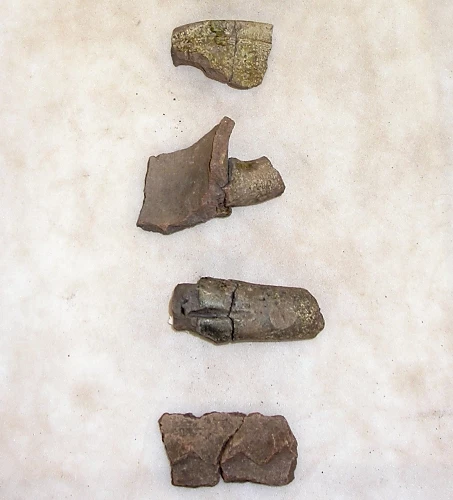
Better still, alongside the bell casting, they also tried to braze three Early Medieval iron strap slides which Andrew made based on an example from Llangorse, near Brecon. As you can see from the photographs, they had one great success, one partial success, and a near miss. With a little filing, the best of these should make a great display piece to set beside the original in the museum’s archaeology gallery.