: Collections & Research

Wales and the Sea

David Jenkins, 16 February 2018

What does ‘Wales and the Sea’ mean to me?

Well, quite simply, it’s a huge part of who I am!

Through my late father, I am the nephew, grandson, great nephew, great-grandson and great-great grandson of seafarers from the Ceredigion coastal village of Aber-porth.

They were all part of the massive, disproportionate even, contribution that Welsh seafarers made to the British merchant fleet during the two centuries 1750-1950.

Almost all reached the rank of master mariner, and over the centuries they commanded vessels that ranged in size from little coastal smacks that brought culm and limestone to Aber-porth in the 19th century, to the largest bulk carrier under the Red Ensign in the late 1960s.

One of them lies deep in the cold waters off Newfoundland where he drowned after his ship struck an iceberg. Another lies buried in the British cemetery at Chacarita in Buenos Aires, where he died whilst the Cardiff tramp he commanded was discharging Welsh coal to power Argentina’s railways and meat packing plants. Another had to deal with a murder on his ship after a dispute between two crew members over a gambling debt got way out of hand.

But mine is just not a story about seafaring men.

Communities like Aber-porth, where, at any one time in the early 20th century, up to half the village’s male population might be away at sea, were matriarchal communities, where strong women brought up families single-handed and endured the absence of their loved ones over extended periods. It is difficult to fathom the anguish and worry that they must have experienced on countless stormy nights, with thousands of miles of forbidding seas between them and their loved ones.

Nevertheless, there were advantages to being a captain’s wife! If their husband’s ship was in an UK or near-continental port, they would often travel to meet them for a brief interlude of conjugal company, taking advantage of their visits to sample the best shops with the latest fashions in Cardiff, Newcastle or Glasgow - even Antwerp or Hamburg!

And the wives of master mariners were always accorded the respect ashore that their husbands had at sea – my great-grandmother would always have been addressed as Mrs. Captain Jenkins!

With such an ancestry as this, it is ironic that accidents of employment meant that I was brought up miles from the sea in the heart of Montgomeryshire; visits to relatives in Aber-porth, when we fished for mackerel and set lobster pots, were confined to school holidays!

Montgomeryshire is my mother’s ancestral home; members of her family have been farming in the north of the former county since Elizabethan times at least, and one might think that the sea had little impact on their daily lives.

Nevertheless, in the mid-1880s, they had to leave their home, Ty Ucha' in the village of Llanwddyn, because the River Efyrnwy was being dammed to provide water for Liverpool, then at the height of its commercial success as one of Britain's foremost ports.

The impact of the sea extends far beyond our coasts, so this year’s event should be an event for all of Wales, not just our coastal communities.

Dr David Jenkins, Honorary Research Fellow.

The early bird catches the worm

Kimberley Mills, 7 February 2018

....... quite literally in some cases!

Last week saw us head up to Berwick-upon-Tweed to sample for species of marine bristle worms, the shovelhead worms (Annelida: Magelonidae). The aim was to collect enough of these burrowing animals from under the muddy sand at low tide that we could contribute to our collections and additionally place some in our laboratory tank for live observations.

After closely examining one species of shovelhead worm at the museum (Magelona alleni) for the majority of the first seven months of my professional training year (PTY) from Cardiff University, and successfully finding out some exciting new behavioural traits (in press), I find myself wanting to expand not only my own knowledge, but becoming eager to contribute more to our overall understanding of these fascinating and somewhat enigmatic creatures. The more science we uncover, the more well known these species, who perhaps do not receive the same attention as some of the bigger vertebrates, become. I see this as a crucial factor to raise awareness for a preservation of the natural world in our future.

With this mantra circling around my head, my enthusiasm was bursting as we drove to the beach on our first day of sampling. Low tide was just before 8am, meaning leaving our cottage, full gear in tow, at around 6.30am. No problems, I thought. I’m ready for that chilly Northern January air. Bring. It. on. Assembled with so many layers that we lost count, we clambered out of the car ready to get onto the beach, undeterred by the eerie super moon and snow battering our windscreen as we drove to our destination that morning. We were looking for two species of Magelona in particular, Magelona johnstoni and Magelona mirabilis, known to occur in abundance in this location, where George Johnston first describer of the the latter species lived and collected worms (you can learn more about the fascinating life of George Johnston and what he accomplished at these sites: https://en.wikipedia.org/wiki/George_Johnston_(naturalist), http://www.raysociety.org.uk/userfiles/File/Johnston%20essay.pdf).

Our first dig looked promising, revealing many of the now familiar milky white, almost stringy, teeny tiny strands of magelonids. As we gently prised them out of the sand and put them into test tubes, by using seawater to gently wash the surrounding sand away in our hands, it occurred to me my hands were starting to go a little bit numb in the icy water. I thought I obviously wasn’t quite as seasoned at this as Kate, my museum mentor. Luckily we had hand warmers at the ready to dive our hands into after each dig. However, as we dug more and more both of us felt our hands turn to popsicles, and let me tell you, anyone who has ever tried to get a worm that is only a few millimeters in length into a test tube does not want popsicle hands. Over the next few hours our feet slowly turned into matching ice cubes, until we had to call it a day. Luckily for us, we had the same scenario to play out all over again the next morning.

 What I haven’t mentioned yet is that despite the somewhat crisp weather, we saw some of the most breathtaking sunrises, with only the odd oystercatcher and redshank to accompany us. Along with this, we were further rewarded by the pure amount of magelonids present in such small spaces, meaning our collection was plentiful and we could take the animals back to our make-shift laboratory at our accommodation for identification, which is when you really start to see what the fuss is about with these worms. The stringy white appearance you see from afar turns into an elegant, ethereal-like animal under the microscope, with complex morphological features. Perhaps, most notably, long, flowing palps that arise near to the animal’s mouth. The number we collected means observations in the laboratory can now be started for new research. George Johnston’s description of the abundance of the animals here sure hasn’t changed much in well over 100 years. Ultimately, the moral of the story is that sometimes, the more changeling the environment, the more recompense. Who knows, maybe one day we’ll be worm hunting in the Artic!

Catch up with some other tails of a PTY student

Bronze Age discovery dishes the dirt on Swansea's heritage

Alice Pattillo, 2 February 2018

Swansea has a whole host of treasures just lying within its midst, from the Red Lady of Paviland to the 4200 year old flint dagger that formed the basis for Saving Treasures; Telling Stories first Community Archaeology project, ‘The Lost Treasures of Swansea Bay’. With the rip roaring tides, miles of beaches and hidden caves waiting to be discovered, you’d expect the sea (for which the city is named) to occasionally stir up something significant; but what about an unassuming Welsh livestock farm? Doesn’t sound like the setting for a major archaeological discovery, does it? Suprisingly, that’s exactly where local man, Geoff Archer, picked up one half of a Middle Bronze Age copper-alloy palstave axe mould dating somewhere between 1400-1200 BC.

It was over two decades ago when Geoff first picked up a metal detector, having first taken it up as a hobby after he got married. But it wasn’t until he retired last year that he was able to really get out into the field, and armed with a pair of wellies and a brand spanking new detector, he decided to venture to one of his old jaunts – a farm not far from his home.

“Over the last few nights I’d been thinking about going to the farm and something was telling me to go to the right hand side of it, just to walk the fields,” he explains, “so that’s what I did.” After traipsing around in the mud for a few hours, Geoff stumbled upon a patch of uneven terrace he couldn’t help but investigate.

Unearthing History

“I got to the lumpy, bumpy parts, had a couple of signals – nothing much.” But then Geoff had another signal, “a cracking signal” and realised it was time to dig around in the dirt to find out what it was. Figuring it would just be another case of random odds and sods, or a coke bottle lid (they find an abundance of litter!) he was surprised to hear a clunk.

“I hit this bloomin’ great big stone, so I dug around it, lifted up a clod of earth” and underneath yet another stone he noticed something interesting inside the muddy cave, something not made of rock. “What the heck’s that?” he thought, picking up the oddity with care. 

“I pulled it out and on the back end of the mould there’s, like, ribs.” This prompted Geoff to recall a discovery he made about 15 years ago, when he wasn’t so rehearsed in Bronze Age metalwork.

“Going back, must be about 15 years ago, I found an item - I didn’t know what it was. I wasn’t experienced enough then. So this item, I took it home and I put it in the garage, as most detectorists do!” He had a feeling it was important but wasn’t sure why.

After a few years of picking the item up off his work bench and trying to decipher its meaning, Geoff decided to take it up to the kitchen and do some research. “So I started buying books to research Roman, believe it or not, alright? So, I bought this book and I was looking through it. I got to the part for the Stone Age, read that. Then I got to the Bronze Age, and I turned a couple of pages and there was the item I’d found! Bronze Age Axe Head. My jaw just dropped, right? And the Bronze Age Axe Head had ribs on the outside.”

Devastatingly, Geoff has misplaced the axe head, which he is now, more than ever, desperate to locate – and even more upsetting still, it’s the same type of axe as the mould he discovered 15 years later would have been built to make. “It’s what they call a loop, I think it’s got two loops on this one, each side, where they used to put, if you can imagine, the Bronze Age axe head. It’s flat, but this part at the back, its round and they put it over the wood and then they loop it, they tie it onto the wood to secure it.”

Monumental findings

When Geoff uncovered the mould, he immediately realised its importance thanks to his previous finding – but he still wasn’t entirely certain of what it was he’d discovered. “On the inside of the mould, there’s like a round piece, like in the middle part. I honestly thought at that time that it was a bit off a tractor, because it was so… the engineering of it, the precision engineering of it! But in the back of my mind I was thinking it can’t be off a tractor because it’s got these ribs at the back from this Bronze Age axe that I found.”

After digging out some modelling clay and experimenting, he came to the realisation that what he’d found was an axe head mould. Geoff phoned up one of his buddies at Swansea Metal Detectorist Club for a second opinion and after a positive diagnosis by them both, he took it along to a club meeting.

“As it so happened, it was our ‘Find of the Month’ meeting!” Geoff explains. “So I won find of the month for the artefact and Steve, our Finds Liaison Officer, said ‘you’d better show this to someone in Cardiff because they are going to be interested.’ So, photographs were sent to Cardiff [National Museum of Wales] and they wanted to see it. I went with Steve to Cardiff and the mould’s been there ever since!”

Mark Lodwick, the Portable Antiquities Scheme (PAS) Cymru Co-Ordinator at The National Museum of Wales in Cardiff confirmed Geoff’s identification and has recorded the item so it can be used in further research and study.

Under the Treasure Act, the mould isn’t classed as ‘treasure’, so why is it so special? “It’s the only one that’s been found in South West Wales,” Geoff enthuses, “and it’s the second one that’s been found in Wales. The other one was found in a hoard of axes in Bangor in the 1950’s, so this is the first one that’s been found since then!”

Preserving the past

Geoff is in utter disbelief that he was the one to stumble across the important artefact, which has been conserved at the National Museum of Wales, Cardiff, but, eventually he’d like it to end up back home at Swansea Museum.

Having reported the axe mould to the museum, Geoff sees this as an important part of his role as a treasure hunter. Letting other people view the item, he says, “gives other people a chance to understand about their locality, of what’s been going on.”

“I think it opens up a new chapter in [Swansea’s history]. There’s a bit of history regarding the Bronze Age but to find something like an axe making product in Swansea, which has never been found before - it opens up a new chapter of where these people were living and how far were they living on the fields of that farm,” explains Geoff. “That’s my quest now I suppose, is to try and find out – keep walking the fields and I might find the other half, I don’t know.”

With hopes of the axe mould ending up in Swansea Museum, Geoff is keen that people will be interested in viewing his remarkable find. “The more publicity it gets the better!” he says. “The more people who know about this the better as far as I am concerned, because it’s the first one to be found in South West Wales and the second one to ever be found in Wales – so don’t tell me that’s not important.”

To discover more about Swansea’s Bronze Age history and see some fascinating Neolithic archaeological artefacts visit Swansea Museum, entry is free!

Words: Alice Pattillo

Meet Morgie!

Caroline Buttler, 26 January 2018


The discovery of the Welsh dinosaur Dracoraptor showed us that dinosaurs lived in the Jurassic of south Wales 200 million years ago. However if you went back to that time you would also have seen little shrew-like mammals hiding in the undergrowth, these are the very earliest mammals.


The bones and teeth of these tiny, furry creatures are preserved in caves and fissures in rocks, where perhaps they were sheltering, or even hibernating during cold winters. Fossils of these minute mammals were first found in a quarry in south Wales seventy years ago. Palaeontologists have pieced together the fragile bones to reconstruct what the animals would have looked like. One early mammal has been named Morganucodon which means "Glamorgan tooth”


New research undertaken at Bristol University, funded by the Natural Environmental Research Council, used powerful X-rays to scan these tiny bones making it possible to piece together the fragments digitally. Then, using modern mammals as a guide, palaeontologists digitally recreated muscles on scanned images of the skeleton. Bristol scientists used computer simulations to work out how a skeleton worked. By looking at their teeth they could tell that some early mammals were able to crunch insects with hard wing cases, while others could only bite softer ones.


We have a new display in our Insight gallery highlighting this research which includes an amazing model of Morganucodon, made by palaeoartist Bob Nicholls. It looks unbelievably lifelike and answers to the name Morgie!

Interview: Wrexham’s treasure volunteers

Alice Pattillo, David Burton, Jill Burton, 11 January 2018

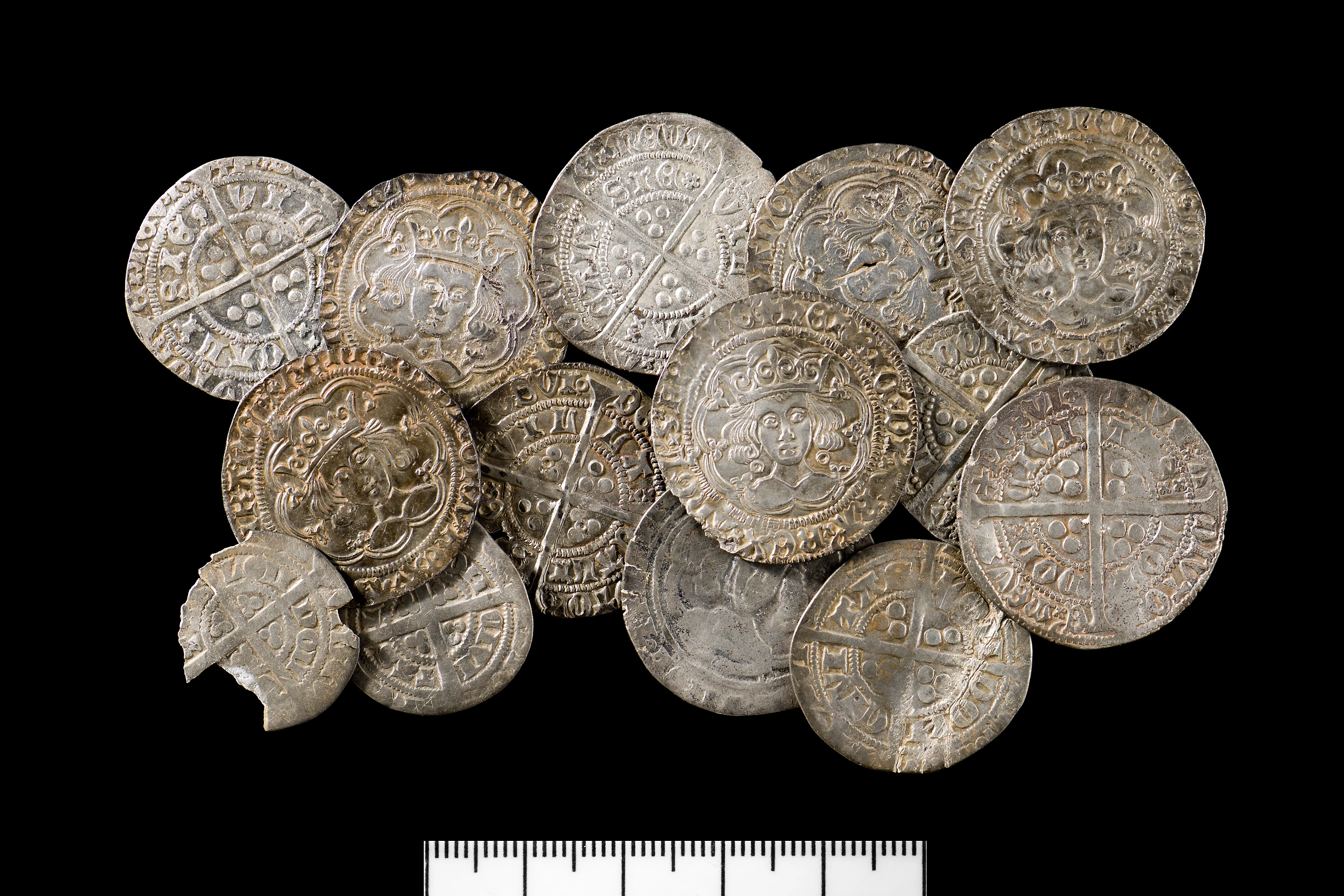
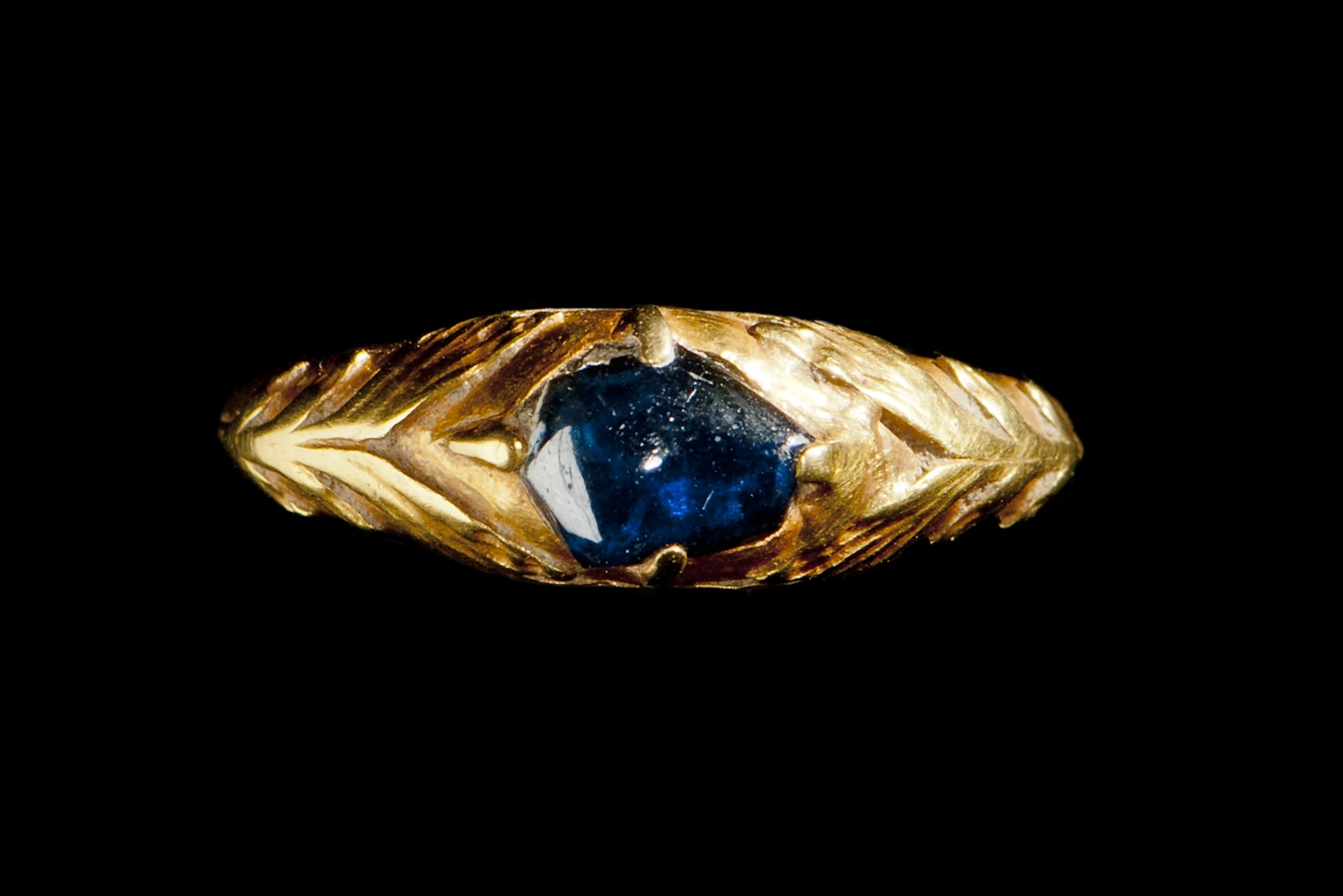
Following Wrexham Museum’s recent acquisition of the Bronington Hoard, a collection of 15th century gold and silver coins and a gold and sapphire ring found by local metal detectorists, the Saving Treasures; Telling Stories Project helped fund the Buried in the Borderlands Community Archaeology Project.

The project, which goes on display in March, focuses on working with and inspiring the local community to investigate and produce creative responses to the historic objects discovered right under their noses.

David and Jill Burton are part of the Maelor heritage society set up by the museum, a group of volunteers who research and help to exhibit the Bronington findings. We caught up with them to talk about the project.

Why were you drawn to the project?

We have enjoyed the opportunity to be involved with the “Buried in the Borderlands" project as volunteers with the Wrexham Museum team. Initially it was curiosity that took us along to the community meeting in the local pub to find out about more about the hoard that had been discovered in a field not far from where we live. This was followed up with meetings at the museum and the exciting chance to examine at close quarters the coins and ring that had been discovered. 

The hoard consists of 52 coins and a gold ring with a sapphire stone, all buried in approximately 1465. The hoard has been dated to a period of history we knew little about, the Wars of the Roses and we were intrigued what effect the conflict had had on our local area. 

What does your voluntary work involve?

Our “homework" between meetings was the opportunity to research into settlement and ways of life in the Maelor area 550 years ago and the politics of the time. Out limited knowledge of old coins, their designs and production, was helped by attending an excellent Numismatics Day at Wrexham Museum with the chance to listen to top quality speakers from the Royal Mint and the Fitzwilliam Museum amongst others.

What’s your favourite aspect of being involved with “Buried in the Borderlands”?

We enjoyed using the information we had discovered to put together a brief for designers of the popup information boards which would accompany displays and were delighted to see the resulting ideas come to fruition.

But I think our favourite part of the project was helping museum staff take a sample of the hoard and the completed information boards “on tour”, to three venues in the area where the hoard had been discovered, a community centre, a school hall and a heritage centre. At all three places we were met with interest and enthusiasm by visitors of all ages.

We loved having the time to chat, to explain and to listen to theories on why our visitors thought the hoard had been buried. We met 387 people on these days, some were local historians, some metal detectorists, some local residents and farmers but we especially enjoyed talking to the children who loved seeing “real treasure” and had the most imaginative theories as to its origins.

What does the future hold for the project?

We look forward to the next stage in the New Year when we can help with ideas for the designs for the permanent exhibition of the Bronington Hoard in Wrexham Museum, and of course the grand opening when for the first time we will see our local hoard all displayed together for everyone to appreciate and enjoy.

Interested in getting involved? Contact Wrexham Museum directly to find out more.