: Collections & Research

Christmas Gift Ideas from Yesteryear

Sarah Parsons, 20 December 2017

Don’t know what to get the children for Christmas this year? How about a little inspiration from the museum collections. Some of these items are going to be on display in the new galleries at St Fagans National Museum of History in the autumn of 2018.

Miniature toy sewing machine

Accession No: F82.51.63

Got any budding sewers in your family? This lovely little sewing machine belonged to Margaret Eckley of Sully who played with it as a child in the 1930s. It is hand operated and decorated with an image of Little Red Riding Hood. It comes with an instruction manual too.


Set of toy soldiers

Accession No: 56.313.134 – 154

You could try the classic set of toy soldiers? These came from Brecon. Did they march all the way? They were donated to the museum in the 1950s and probably belonged to the donor’s children, who were born in the 1890s.


Corgi Toy Tractor

Accession No: F00.27.9

You could try the ever popular Corgi toy range. This tractor was played with in Cardiff in the 1950s – 1960s.


Welsh Costume Doll

Accession No: 30.316

This doll dressed in traditional Welsh costume was played with in the middle of the 19th century. She must have been a treasured item, she was in the donor’s family for eighty years. To see more Welsh costume dolls visit the People’s Collection Wales website.


Lego Christmas set

Accession No: 2000.194/1

Would Christmas be complete without Lego? Here’s Father Christmas with his sleigh made in the Lego factory in Wrexham.

These objects are not on display at the moment, but you’ll soon be able to see them on our website along with many of our Art, Archaeology, Industrial and Social & Cultural History collections. Thanks to the players of People’s Postcode Lottery for support with this ongoing work.

If there is a specific object you want to see at any of our museums, check that it’s on display first, and if it’s not, you can always make an appointment to view it.

People's Postcode Lottery Logo

Christmas Traditions

Lowri Jenkins, 20 December 2017

Christmas day is less than a week away and for most of us our tree and decorations are up, Christmas cards posted or messages sent via social media, presents purchased, turkey ordered and Christmas pudding made or bought - these are still popular christmas traditions in 2017 but why do we practice many of these rituals?

Decorations

We have decorated our houses at this time of year since Pagan times. Pagans used evergreens to acknowledge the winter solstice and it reminded them that spring was on it's way. Pope Julius I decided on the 25th of December as the birthday of Jesus, and as this date fell within the Pagan celebrations, some of the Pagan traditions were absorbed into the Christian calendar, including decorating with evergreens and particularly holly. For Christians evergreens came to symbolise God's life everlasting and holly came to represent Jesus's crown of thorns at the Crucifixion, and the berries respresented his blood. Other evergreens also had significance: Ivy as a clinging plant symbolised us holding on to God for support; Rosemary was believed to be the Virgin Mary's favourite plant and laurel represented success and especially God's success in conquering the devil. Holly and ivy were also seen to be representative of a man and woman, holly being prickly and masculine, and trailing ivy being feminine. Whichever was brought into the house first indicated which gender would assume the upper hand for the following year! It was unlucky to bring evergreens indooor's before Christmas Eve and remove them before the 12th night.

In rural Wales homes were usually decorated with evergreens in the early hours of Christmas morning to while away the hours before attending the Plygain service at the parish church, which consisted of an early morning service at somewhere between 3am and 6am and in which soloists and groups sang carols. Candles were also made to light the way to the church and to decorate the inside. Pagans used candles as a decoration to represent the sun and Christians to commemorate the presence of Christ. Before the advent of electricity, candles were used to decorate Christmas trees.

Click here to hear “Parti Fronheulog” and others singing “Addewid rasusol Ein Duw”. Recorded by St Fagans National Museum of History (or the Welsh Folk Museum as it was called at the time) in Llanrhaeadr-ym mochnant Vicarage, following the Plygain Supper held there at the beginning of January 1966.

https://www.peoplescollection.wales/items/738256

Christmas Trees and Other Decorations

There is evidence to suggest that Christmas trees were used as decoration in the U.K. as early as the 1790's and its triangular shape had significance, as it represented the connection between the father, son and holy spirit. Its use became most popular however in Victorian times, when Queen Victoria and Prince Albert used a tree to decorate Windsor Castle in 1841, and in 1848 a picture of the family appeared in the London Illustrated News with a decorated tree.

It was in the early 1920's that evergreens were gradually replaced by artificial decorations, predominantly in the industrial areas, towns and cities. Mass produced decorations became cheaper and more readily available. As early as the 1880's shops such as Woolworths began to sell decorations, sweets cakes and ribbons. It was also during the 1920's and 1930's that Christmas presents began to be wrapped.  It was in 1882 that the first electric tree lights appeared in New York, just three years after the introduction of the light bulb.

During the war paper chains became popular as they could be assembled at home and in the 1950's artificial trees became available.

At St Fagans National Museum of History we decorate many of our buildings every year with appropriate decorations according to the age and area of the building. Here are some images.

Although the "Penny Post" was first introduced in 1840 by Rowland Hill, it wasn't until Sir Henry Cole printed a thousand cards for sale at a shilling each in his art shop in London at Christmas time that the idea of sending Chistmas cards emerged as a popular idea. Sending cards became more widespread in 1870 when people could send cards for a halfpenny, as the blossoming of railways made postage cheaper. The Victoria and Albert Museum holds a card sent from Cwrt-yr-Ala in Cardiff in 1844.

Here are some images of Christmas cards from the St Fagans collection

Traditional Christmas Fare

Christmas time wouldn't be complete without the usual over indulgence in rich food. Traditionally the Christmas pudding would be made 5 weeks before Christmas, and in Wales it was customary for all members of the family including children and servants to stir the pudding mixture, often mixed first by the head of the household. In the pudding mixture tokens would be placed such as a a wedding ring; a button; a thimble or a sixpence. If the stirrer found the wedding ring it would foretell the finder's imminent marriage; the finding of a button for a young man would foretell his batchelerhood and the thimble for a young woman an indication of spinsterhood. The sixpence was a symbol of good luck.

Other traditional Welsh foods made at Christmas would be toffee ("cyflaith") made by boiling butter, treacle and sugar to a high temperature and then stretching and rolling the cooling mixture (requiring hard work on the part of the stretcher!). The recipe did vary according to the region. Here's a short film from our archive of this type of toffee being made.

https://www.youtube.com/watch?v=26bDQqRQICY

Merry Christmas!


Himalayan balsam invasion in South Wales

Amy Wyatt, 13 December 2017

Shwmae,


I am a Biology Undergraduate at Cardiff University and today I am just over two months into my professional training year placement within the Botany section, Department of Natural Sciences at the National Museum Wales. Plant life of all sorts has always delighted me, and when an opportunity to work in Wales’s largest herbaria arises, you grab it by both hands! So far, my experience has been nothing short of extraordinary. Working with and learning from a team of respected and experienced botanists has been the highlight of my stay so far, rivalled only by the history and scientific value that this department holds behind its doors.


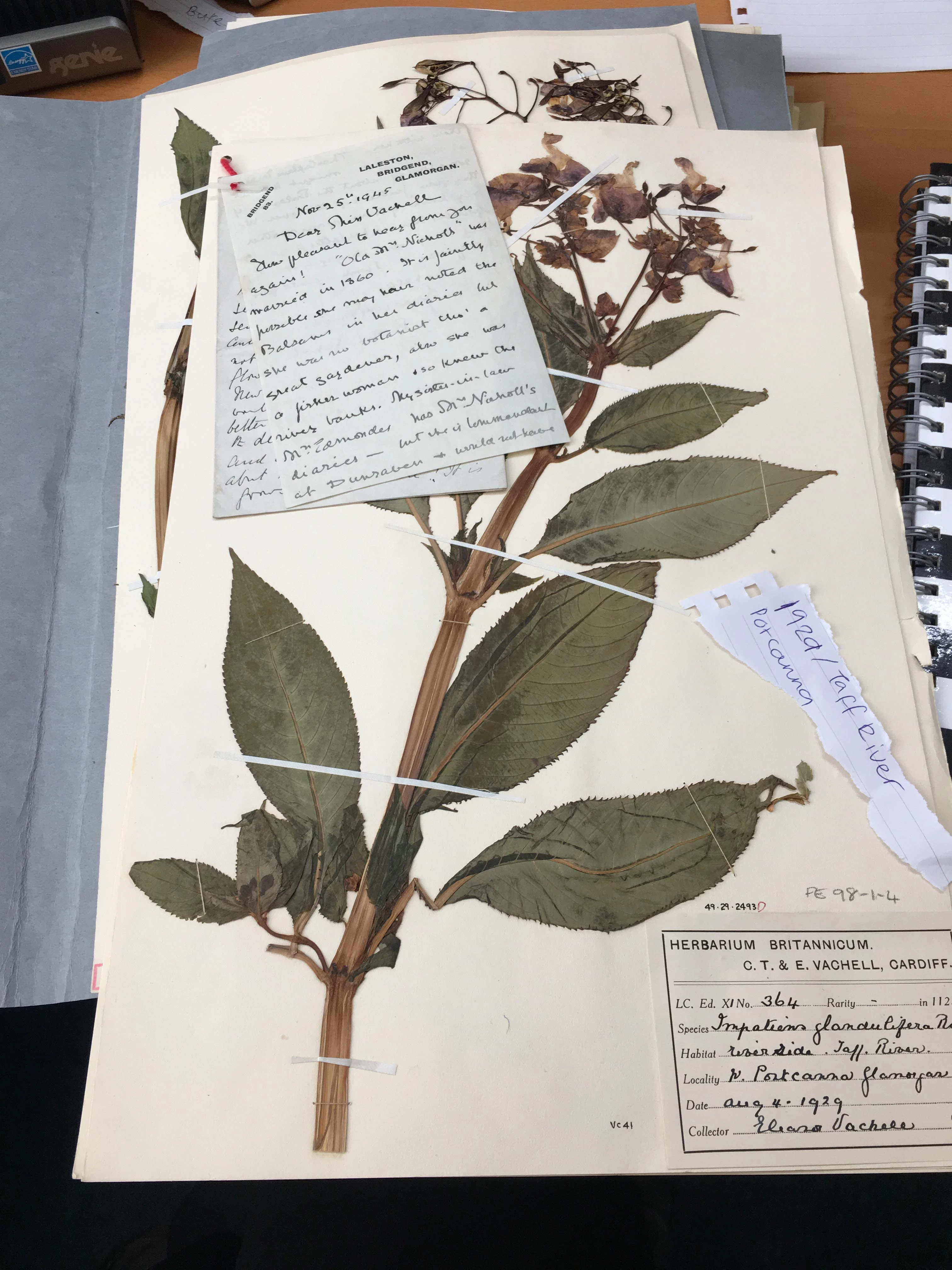
The project I am working on involves studying the highly invasive annual plant Impatiens glandulifera,-Royle, or Himalayan Balsam as it is commonly known. Himalayan balsam, like so many other invasive plants found in Britain today was introduced by the Victorians as a botanical curiosity. First contained in botanical gardens, its high growth rate and reproductive output mean that now, it is found in almost every area of Britain. Himalayan balsam can reach heights of 3 metres and produce up to 2500 seeds per plant, often forming dense populations along river banks throughout the UK. Buoyant seed pods mean that seeds are easily transported in river systems, and seeds don’t have to germinate the following year after set, they have a two-year dormancy period whilst they wait for the right growth conditions. The life traits of Himalayan balsam mean that it has become incredibly invasive in the UK, with it being listed as a Schedule 9 plant in the Wildlife and Countryside Act; i.e. it is illegal to plant or otherwise cause it to grow in the wild.


My project involves studying specimens to see if any morphological traits have changed since its introduction into the UK in 1839, and looking at variation between populations of Himalayan balsam in the South Wales area. So far, much of my time has been spent conducting field work! I have been out collecting specimens of Himalayan balsam using a plant press. Specimens are randomly chosen from their habitat, mounted between a folded bit of thin paper called a ‘flimsy’, making sure that all leaves and flowers are flat and arranged in a way that their features can still be studied. Acid free card is placed between specimens and they are mounted into a plant press, straps are then wrapped around the plant press and pulled as tight as possible before it is placed in a specialist drying oven. After the specimens have been in the drying oven for between 5-7 days, they are then placed in a freezer for 4 days to kill any insects, bacteria or fungal spores that may have contaminated specimens.


After the drying and freezing process is over, specimens are ready to be examined and studied! So far, I have spent most of my time in the field collecting information such as number of seeds, flowers, height, colour of flowers, type of habitat, light levels, whether population is managed or not, etc. I plan to use this information to compare differences between sites where I. glandulifera is found in the South Wales area, and whether there are discrete differences between these populations. This will involve molecular work in the lab; potentially looking at differences in the number of ‘microsatellites’ between populations. ‘Microsatellites’ are repetitive DNA sequences and by directly comparing the number of repeats of microsatellites we can learn more about the diversity within and between local populations.


I am collecting a large data-set for I. glandulifera in the South Wales area, looking at different morphological characteristics of the plants, as well as collecting measurements from the habitat it was collected from. Measurements include light levels, tree cover, habitat type, whether the population was managed etc, with the ultimate goal of allowing me to see if these different habitat variables impacts how I. glandulifera grows. After I have collected specimens from different habitat types, their morphological characteristics can be analysed. This will involve imaging software to look at traits like leaf area, leaf width, leaf length, flower length, leaf shape, and microscopy work looking at stomatal density, size of ‘guard cells’ that make up a plant’s stomata and pollen structure (picture). Once I have collected measurements from I. glandulifera collected in 2017, I can then look at specimens of I. glandulifera in the herbarium collected in the 1900s to see if there has been a change in any of these morphological traits in the past 100 years. If there has been a change, what is happening, are the leaves larger or smaller? Are plants taller or shorter? Do they produce less or more flowers? These are the questions I am hoping to answer with my research, and in doing so produce some answers on how we can begin to tackle this unwelcome invader.


It has been a very exciting and enjoyable few months in the herbarium I have had opportunities that most people would only dream of, and each day I spend here I learn something new from the experienced curators I have surrounding me. The herbarium is something to be treasured, plant records frozen in time that contain a wealth of information just waiting to be discovered. And this resource is here for you to explore and enjoy too, just contact one of the herbarium team to make an appointment (https://museum.wales/curatorial/botany/staff/). Everything here fills me with sheer joy, and it is an absolute pleasure to wake up each day knowing that I am spending my time in such a wonderous place. I don’t look forward to leaving this gorgeous establishment, but I look forward to seeing what wonders this herbarium has in store for me, and what answers it can provide me on my path to stop invasive species here in Wales.


Buried in the Borderlands with Wrexham Museum

Leon Thomas, Tom Price and Rhianydd Biebrach, 13 December 2017

What’s it all about?

‘Buried in the Borderlands’ is a brilliant Community Archaeology Project at Wrexham Museum, funded by the Saving Treasures; Telling Stories Project.

It’s based on the recent acquisition of a hoard of 15th century gold and silver coins and a gold and sapphire ring, known as the Bronington Hoard, found by local metal detectorists.

The project is working with the local community, inspiring creative responses to the material heritage on their doorstep, which will go on display in March 2018.

This post introduces two museum volunteers who have been working on the project.

Leon and Tom’s story

Hello everyone, we’re Leon and Tom. We’ve been working recently on the very exciting Buried in the Borderlands project with Wrexham Museums and Archives.

The two of us are currently studying AS Levels at The Maelor School, Penley. I (Leon) am studying Biology, Chemistry and Maths whilst Tom is studying Politics, English Literature and Psychology.

But we have one subject in common, that’s History!

We’ve both always loved history, from learning about the World Wars, to the history of Wrexham county. That’s why we are thrilled to be volunteering with the Bronington Hoard.

We get to learn about the history of the Maelor, complete our Community Challenge for the Welsh Baccalaureate, and work with all our Friends at Wrexham Museum. Win, win, win.

We’ll keep you up-to-date with our progress as part of our Blog every 1 to 2 weeks.

We look forward to your feedback and hope you’re as ecstatic as we are for the arrival of the Bronington Hoard in March 2018. 


Stori Leon a Tom

Helo bawb, Leon a Tom ydym ni. Rydym ni wedi bod yn gweithio ar brosiect cyffrous Yn Gudd yn y Gororau yn ddiweddar gydag Amgueddfa ac Archifau Wrecsam.

Mae’r ddau ohonom ni’n astudio Lefel AS yn Ysgol Maelor ar hyn o bryd. Rydw i (Leon) yn astudio Bywydeg, Cemeg a Mathemateg tra bod Tom yn astudio Gwleidyddiaeth, Llenyddiaeth Saesneg a Seicoleg.

Ond mae gennym un pwnc yn gyffredin, sef Hanes!

Mae’r ddau ohonom ni yn mwynhau hanes, o ddysgu am y ddau Ryfel Byd, i hanes bwrdeistref Wrecsam. Dyna pam ein bod wrth ein boddau yn gwirfoddoli gyda Chelc Is-y-Coed.

Rydym ni’n cael dysgu am hanes Maelor, cwblhau Her y Gymuned ar gyfer Bagloriaeth Cymru, a gweithio gyda’n ffrindiau yn Amgueddfa Wrecsam. Mae pawb ar eu hennill.

Fe fyddwn ni’n eich diweddaru gyda’n cynnydd yn rhan o’n Blog bob 1 i 2 wythnos.

Edrychwn ymlaen at glywed eich adborth a gobeithio eich bod chi'r un mor hapus â ni y bydd Celc Is-y-Coed yn cyrraedd ym mis Mawrth 2018. 

Talking about pest management in a museum - by Charlotte Martin

Christian Baars, 12 December 2017

When Dr Christian Baars, the Senior Preventive Conservator at National Museum Cardiff, contacted me to ask me take part in his project, I’d never really thought about the work going on behind the scenes at a museum. I’d been on a tour I mean, beyond the ticket desk, café staff, security guards and perhaps cleaners if you’re there right to the end of the day. But have you ever thought about the work that goes into maintaining collections and displays? I doubt it.

Conserving the historic exhibits is one of the largest behind the scenes jobs. There are many things that can damage the artefacts, such as light, air pollution and moisture. But for a big collection of stuffed animals, such as in Cardiff, one of the big problems is pest insects. Lots of different insects, such as carpet beetles and clothes moths, like to eat dead animals. Dr Baars showed me some of the pinned insect collection, which are falling apart or disappearing because one of the beetles has got in to eat them.

We wanted to show the visitors that fighting these insects is a huge job and so we set about making a video that showed the damage the beetles can do. Luckily, Dr Baars had a dead mouse in the freezer (as you do!) which would do just the job. I added some beetle larvae to the dead mouse and left it in a box to be eaten. I used a time lapse camera to film the process of the mouse being devoured by the beetle larvae.  

The resulting video is on the right hand side of this page. Evidently, the mouse is getting progressively smaller as the larvae munch through its body. Now imagine this happening to the woolly mammoth, or the foxes, or any other amazing object at the museum. This is what museum conservators work hard to prevent and this is why we wanted to spread the word.

Once the video was finished, I showed it to museum visitors and asked people to tell me what they thought it was about. Most people had not heard about conservation in museums before nor about the damage insects may cause, even though some had experience with moths or similar insects at home. One visitor described it as fascinating. Another reminded me that “dead things always make good exhibits!” People certainly enjoyed the “gross factor” of a video of a decomposing mouse!

Yet the most important result for me was the finding that everyone wanted to learn more about what goes on behind the scenes at museums. Both adults and children understood the significance of the work. An adult visitor said “once it’s dead and in a case, you don’t really think about it about what happens after”, highlighting the need and the interest in what goes on to make a museum exhibit happen. And a younger visitor exclaimed “imagine you had a billion year old thing and it just got ate… I would very sad”. I couldn’t agree more.

While the purpose of this project was to educate museum visitors about pest management in museums, I think this experiment shows there is an enthusiasm for knowing more about the hard work of museum staff beyond those you see when you visit. In Cardiff visitors can come for free, but in a world where every institution is fighting for funding, we need to show the public that our work is vital and worth every penny. We showed that it is simple to raise awareness and that the work of conservators is worth an exhibit or two all of its own.


Charlotte @scicommchar undertook this project as part of a 'Learning Lab' placement while studying for a MSc degree in Science Communication at the University of the West of England. The University contact was Andy Ridgway, Senior Lecturer in Science Communication and Programme Leader MSc/PGCert in Science Communication, @AndyRidgway1. Many thanks also to Rhodri Viney, the National Museum's Digital Content Assistant, for help with producing the video.

Find out more about Care of Collections at Amgueddfa Cymru - National Museum Wales here and follow us on Twitter.