Rare Viking object rescued after 900 years underwater
17 April 2007

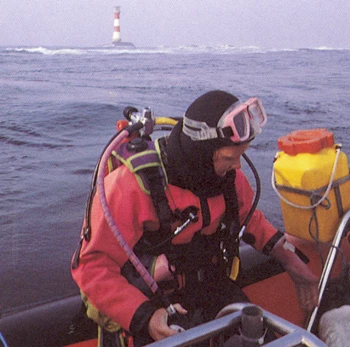
Diving operations on the Smalls Reef (1992)
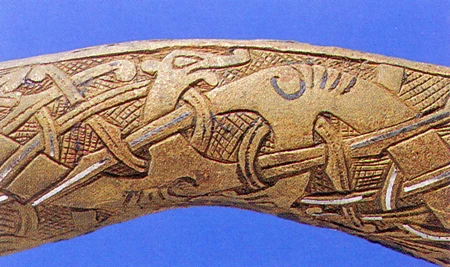
Detail of an animal in profile depicted on one side of the Smalls sword guard.
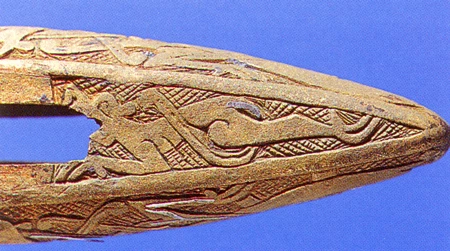
Detail of beast on the top of the Smalls guard.
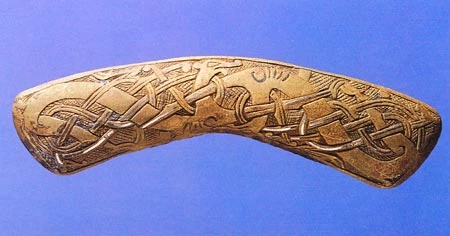
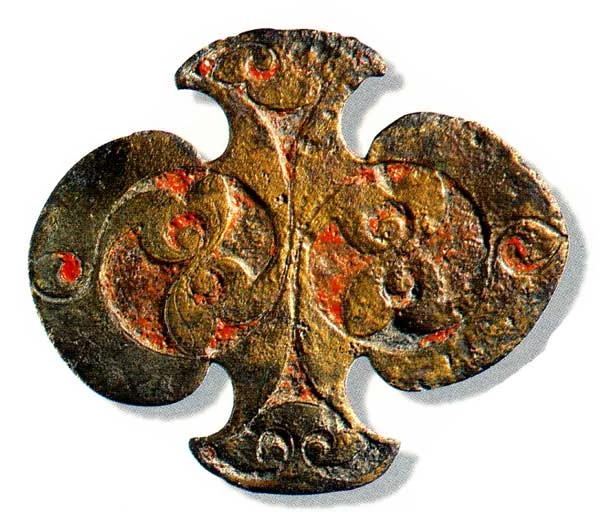
The Smalls Sword, ca. AD 1100.
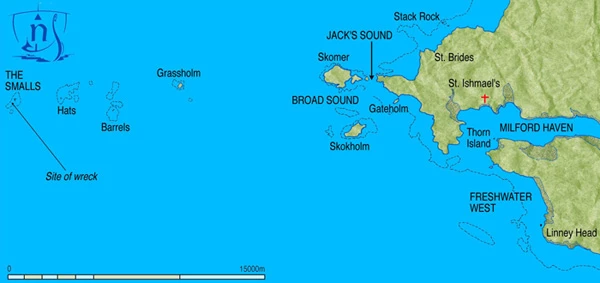
The location of the Smalls Reef in South-west Wales
Amgueddfa Cymru holds one of the most remarkable examples of late Viking art ever to be found in Wales. The discovery of the lower guard of a Viking sword, dated to about AD 1100, was made by a sports diver in August 1991. The findspot lies off The Smalls Reef - some 13 miles due west of Skomer island (Dyfed), the nearest landfall being the island of Grassholm, approximately 7 miles due east. This makes it one of the most remote archaeological sites in Wales.
Cast in brass and finely decorated
The sword guard is cast in brass, each side being finely decorated with a pair of stylised animals in profile, interwoven with thin, snake-like beasts. On the top of the guard two animals with open jaws bite the position of the grip which once projected through the guard, but has now perished. The main areas of ornament are inlaid with silver wire, and the background was originally filled with a black inlay called niello, to form a handsome design of gold, black and silver appearance.
Urnes style decoration
This decoration is in a style known as Urnes, which took its name from the decoration of a small wooden church built at Urnes in western Norway in about AD1060. The new find, with its elegant, refined animal profiles, reminds us that the Vikings were not only pirates and raiders, but also craftsmen and creators of art which, based on animal forms, were full of vigour and vitality. Its ornament is related to metalwork produced in Ireland from the second half of the 11th century, where it caught native imagination, as can be seen in the famous Cross of Cong (dated about 1123) and St Manchan's Shrine (12th century).
Following the identification of the find, the site was designated under the Protection of Wrecks Act 1973, which aims to prevent unauthorised interference on wreck sites considered to be of archaeological, historic or artistic importance. Such was the rarity of the discovery that the Museum was granted a licence to survey the site.
The logistics of such an investigation were formidable, with large swells frequently rolling in from the Atlantic and smashing onto the exposed rocks. In spite of these difficulties, it was possible to inspect the area and make complete video and photographic records of the underwater environment of the reef, and the likely context of the find.
The discovery of a prized possession in such a location is unlikely to represent a casual single loss, but rather the capsize and loss of a vessel, probably Viking, on one of the long-distance sea-routes at some point during the period of frequent attacks by the Dublin fleet on wealthy centres such as St. David's and Bristol. The ship was a dramatic symbol of Viking culture, and to judge from other Viking finds, the vessel carrying the sword may have measured between 13 and 28 metres in length - either a large, slender, fast ship for warfare, or a broader, sturdier vessel for the long-distance transport of people and cargoes.
Many ships were lost on the Smalls before the advent of navigational aids such as radar and lighthouses, and any vessels wishing to travel to Ireland from the south coast of Wales still need to keep a course well to the south of the 'Hats and Barrels' to be sure of clearing the hazardous rocks, inbetween the islands of Skockholm, Skomer and Grassholm, themselves all being Scandinavian names.
The rarity of this find, the quality of workmanship and the nature of the findspot are all factors which help shed light on the ancient operations of Norsemen around the Welsh coast.