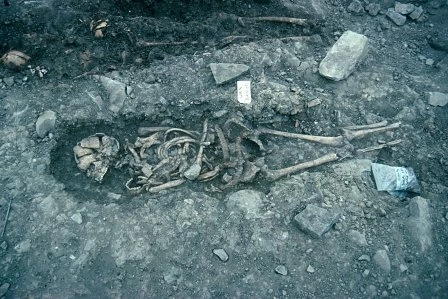
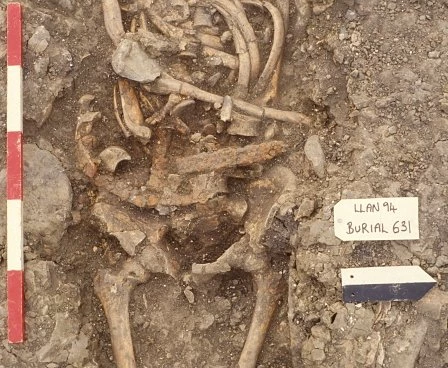
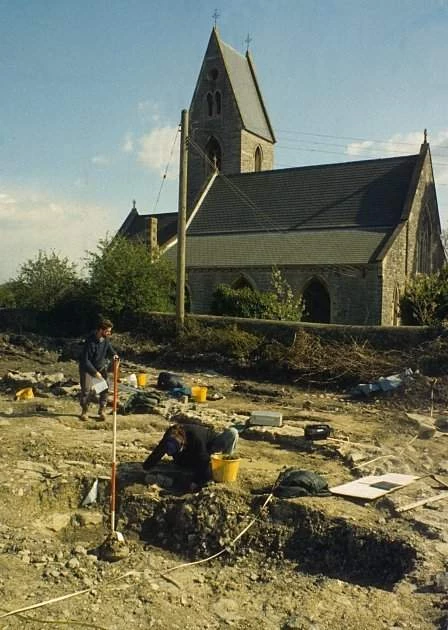
The suffering of burial 631 2 May 2007 Excavations in progress in 1994 in part of the cemetery of St Dochdwy's monastery. Burial 631 as discovered. Detail of the iron belts around the waist of burial 631. The iron belts during conservation work undertaken by a team at Amgueddfa Cymru. In 1994 archaeologists excavated the largest collection of early medieval burials yet found in Wales, as well as evidence for an unusual burial practice. Ideal Homes Wales Ltd had contracted archaeologists from Cotswold Archaeology to excavate land earmarked for a new housing development in Llandough (Vale of Glamorgan). The site was situated just outside the churchyard of the present parish church - reputedly the site of the early medieval monastery of St Dochdwy - the excavation discovered over 800 burials dating from the 4th- to the 11th-century AD. Careful study of the skeletons has shed fresh light on the population of Wales at this time. One grave in particular was exceptional. Burial 631 Burial 631 lay in the middle of the cemetery. The skeleton was that of a young man, aged between 25 and 35, and about 1.75m tall (5.75 feet). Radiocarbon dating of the bone suggested that he died between AD340-660. However, it was not his antiquity that made him special, but rather the two iron straps he wore around his waist. The ends of these straps were secured behind his back. The tapered iron ends passed through lugs and were hammered over by a second person, making it impossible for the wearer to remove the straps unaided. Clearly this was more than a fashion accessory, but what other functions could it have served? It has been suggested that the straps may have been worn as an act of penitence - a fitting purpose in the context of a monastic community. Similar cases are certainly known in the Middle Ages. For example, there was a visionary monk at the monastery of Much Wenlock (Shropshire) in the early 8th century called Begga, who wore 'an iron girdle about his loins for the love of God'. An alternative explanation is that the iron bands served as a hernia belt. Roman texts first record the use of hernia belts on the Continent. Examples have also been excavated from 6th- and 7th- century burials in France, Germany, Switzerland and Spain. So which interpretation is correct - penitent's belt or hernia truss? The answer is likely to be a little of both. During the early medieval period the endurance of suffering was seen as a path to heaven. So enduring the pain of a hernia may in itself have been in part an act of penitence from which the wearer of these two belts hoped to reap a reward in the afterlife. Background Reading 'Llandough' by A. Thomas and N. Holbrook. In Current Archaeology, vol. 146, p73-7 (1996). 'An early-medieval girdle from burial 631', by M. Redknap. In N. Holbrook and A Thomas 'An early-medieval monastic cemetary at Llandough, Glamorgan: excavations in 1994', Medieval Archaeology 49 (2005), 53-64.
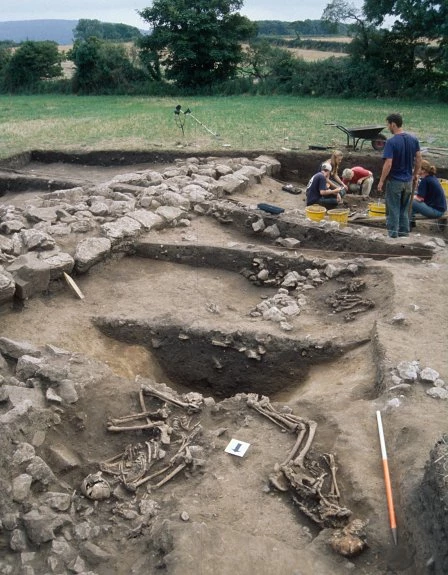
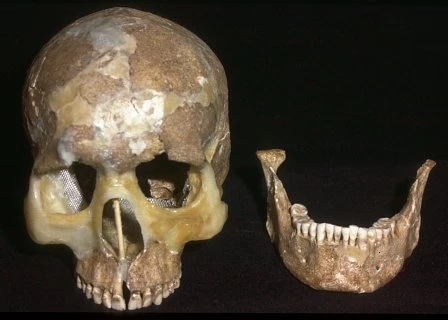
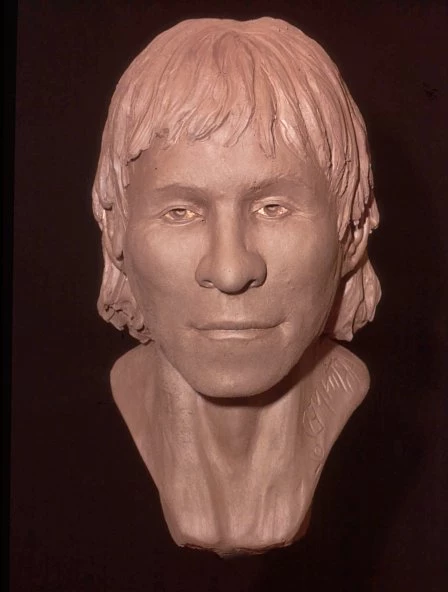
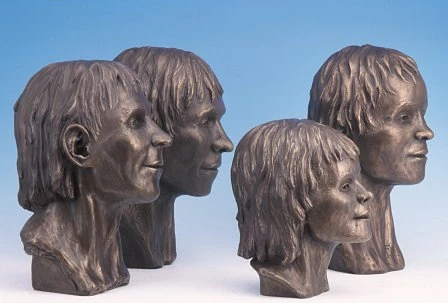
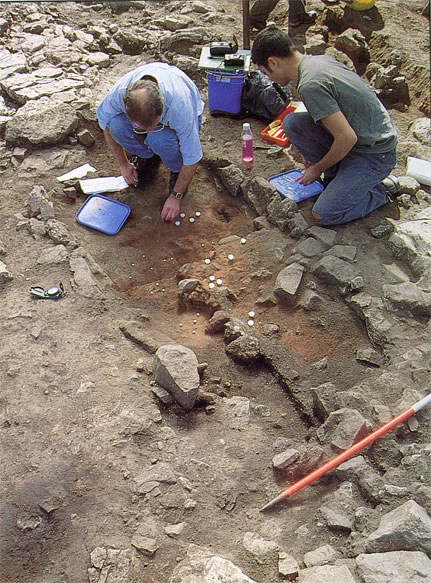
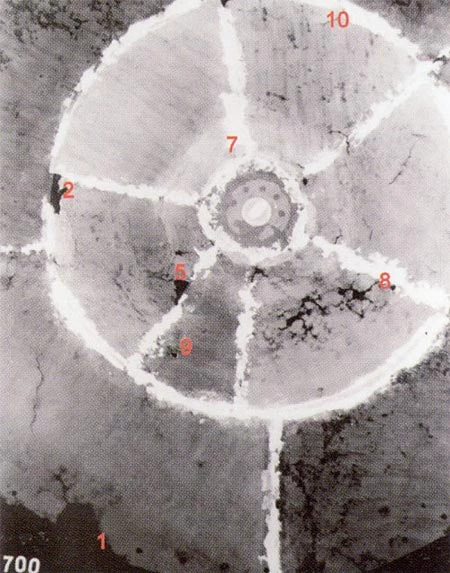
Science brings to life the witnesses to the Viking-age in North Wales 1 May 2007 Excavating the enclosure ditch and skeletons at Llanbedrgoch (Anglesey). To the left of the image are the lower courses of the settlement's defensive wall. Two of the skeletons can be seen lying in the upper levels of the ditch that lay outside this wall. The skull of burial 5. This skull was in pieces when discovered and has since been reconstructed. Photo by the School of Art and Medicine, University of Manchester. The face of burial 5 after recreation. Photo by the School of Art and Medicine, University of Manchester. Four of the five faces from Llanbedrgoch, cast in brass. Excavations by the National Museum of Wales on the early medieval settlement at Llanbedrgoch on Anglesey, North Wales, have unlocked details of life in 9th- and 10th-century Wales. Scientific techniques have allowed the faces of four of those that lived there to be recreated from their skulls. A puzzling discovery In 1998, an unexpected discovery was made on the west side of the settlement. Five human skeletons were found in the upper level of a filled-in ditch immediately outside a defensive wall that surrounded the settlement. Contrary to usual Christian practice, all skeletons were aligned with their heads either to the north or south rather than to the east possibly influenced by the position of the wall. They appear to have been casually buried in shallow graves. Three of the bodies had been buried individually, but there was one double burial in which an adult male (approximately 23-35 years old) had been thrown directly on top of a child (approximate age 10-15 years old). The adult male's arms may have been tied behind his back and he may have suffered a blow to the left eye with a sharp object. Another older adult male (35-45 years old) appears to have been placed face down, turned to left, body slightly twisted, and he may have had his wrists fastened in front of his body. In the case of three of the burials, the bodies were covered by scattered limestone blocks and smaller rubble, probably derived from the collapse of the enclosure wall. This suggests they were buried shortly before the abandonment of the site. The Llanbedrgoch skeletons date to the second half of the 10th century, a period when Vikings on the Isle of Man effectively controlled Gwynedd, and may have had bases on Anglesey. The circumstances of burial and lack of Christian orientation have led to speculation that these individuals were victims of raiding. The precise circumstances of their deaths may never be known, but they may have been the victims of military activity by Vikings in their search for wealth, perhaps in the form of hostages or slaves. The Llanbedrgoch skulls show a number of similar features, including horizontal eye fissures, square jaws and adherent ears (they were lacking ear-lobes). Some of these features suggest a genetic relationship between the individuals. Either they belonged to the same families or the individuals came from a small gene pool. Not only has the site produced a wealth of evidence for settlement layout, buildings, artefacts and standards of living on a high status site - it has also provided the remains of people who once breathed and walked there. Background Reading Vikings in Wales: an archaeological quest by Mark Redknap. Published by the National Museums & Galleries of Wales (2000).
Vikings on Anglesey 1 May 2007 Llanbedrgoch on Anglesey is home to one of Wales' most interesting archaeological sites from when the Vikings invaded Wales. Research at this site by Amgueddfa Cymru has helped reveal the nature of Viking Age life that has puzzled scholars for decades. Excavation in progress on building 1 in 1997 The site was discovered in 1994 after a number of finds were brought to the Museum for identification. These included an Anglo-Saxon penny of Cynethryth (787-792 AD), a penny of Wulfred of Canterbury (about 810), and three Viking lead weights. From Neolithic to Roman After detailed excavation and research, the complex history of the site began to be unravelled. The site appears to have been a focus of activity from as early as 3300 BC, a period when most of the large burial chambers on Anglesey were built. Several items of pottery, radiocarbon dated to around 240 to 450 AD, show activity at the site during the Roman period. The Site Activity at the site can be broken up into a number of phases. A ditch was found measuring 2m wide and 1m deep. Further excavation uncovered post-holes cut into bedrock thought to represent a platform of a house. Items recovered suggest that the ditch is pre-Viking. It is at this time that a large timber hall, represented by large post pits, probably belongs. This timber building appears to have been replaced in the late 9th or early 10th century by at least two halls, last used between about 890 and 970. To the east was a large hall or barn, measuring about 8m by 12m, dated to around 855-1000 AD. A small section of stone paving to the west marked the entrance to a third, slightly smaller building. Ploughing has removed any clear evidence for the walls but a 10th century fine bronze buckle and an iron knife blade with angled back were recovered. A rubbish dump at the south-west corner of the site contained a few artefacts, including a Northumbrian styca (penny) of Archbishop Wigmund (about 848 - 58), socketed iron tools for leatherwork, mounts and bucket bindings. The area then appears to have returned to agriculture, which in time removed all surface traces of the former settlement. Like sites elsewhere, it is situated on a carefully selected, sheltered location, about 1000m from the sea. Forming one of the largest collections of this kind from Wales, the objects found at the site are remarkably well preserved. Coin and other evidence suggests an early period of economic growth at Llanbedrgoch from the late 8th century. In the 10th century, the settlement appears to have been at its peak, with harvesting of crops, keeping of livestock, the presence of craftsmen, and contact with Viking merchants arriving in ships. The enclosure at Llanbedrgoch appears to be the key to unlock further secrets and reveal the nature of Viking Age settlement which has puzzled scholars for decades.
Who was King Arthur? 26 April 2007 King Arthur has a strong link to Wales, but how much is known of the man and his times? King Arthur has evolved into a legend. Tales and romances celebrated the king and his court in the imaginative literature of Europe. Did Arthur really exist? What was he like? To find answers, it is necessary to look at two equally important sources of information: historical texts and archaeology. When did King Arthur live? The first mention of Arthur is thought to be a reference in a line from the poem, 'Y Gododdin', the earliest known work of literature in Welsh. The poem is from the 6th century, when much of western Britain (Wales, northern England and southern Scotland) spoke Welsh; the earliest surviving written form of the poem dates to the 13th century. The reference to Arthur in this source may be no earlier than the 9th century, but it demonstrates the fame of Arthur among the Welsh at this time. The most important of the historical texts is the Historia Brittonum, the 'History of the Britons', which gives the earliest written record of Arthur who 'fought against them [the Saxons] with the kings of the Britons but he himself was leader [Duke] of Battles', winning twelve battles. The earliest version of this history is dated about AD829-830. The Annales Cambriae, or 'Welsh Annals', probably compiled in the mid 10th century, record the date of one battle, the Battle of Badon in AD518, and Arthur's death at Camlann in AD537-9. This suggests that if Arthur was indeed an historical figure, he probably lived in the 6th century. Page from a 13th-century copy of the Book of Aneirin. The Book of Aneirin records an attack by the British on the Saxons at Catterick (Yorkshire). Although the poem was written in the 6th-century, the reference to Arthur which it contains may have been added later. [Image © Cardiff Library] Where is King Arthur buried? Early Welsh literature has many wondrous tales which form an important part of the Arthurian tradition. There are portrayals of Arthur in anonymous Welsh poetry found in 13th and 14th century manuscripts. In one of the poems of the Black Book of Carmarthen, Englynion y Beddau ('The Stanzas of the Graves'), Arthur's grave is described as a great wonder because no one knows where it is located. The greatest of the Welsh Arthurian prose tales is Culhwch ac Olwen. An English translation of this and eleven other Welsh tales appeared for the first time in the 19th century, publication The Mabinogion. Four other tales in this collection focus on Arthur - the 'romances' of The Lady of the Fountain (or Owain), Peredur, and Geraint son of Erbin, together with the Dream of Rhonabwy which presents a satirical view of Arthur and his world. Map showing distribution of places mentioned in this article Archaeology The second key source of information about Arthur is archaeology. Archaeological evidence for contact between Wales, Cornwall and the Saxon World takes many forms - from metalwork manufactured in an Anglo-Saxon style discovered in south-east Wales, to the distribution of early medieval pottery imported from the Continent and the shores of the Mediterranean. Excavations at Dinas Powys, a princely hillfort near Cardiff occupied between the 5th and 7th-centuries, has informed us about the nature of a high status site in south Wales at this time. This site is contemporary with others like South Cadbury in Somerset and Tintagel in Cornwall (both with their own Arthurian traditions). Pieces of glass from Dinas Powys (Vale of Glamorgan), a fort occupied between the 5th and 8th-centuries. These fragments come from vessels made in continental Europe. They illustrate the extent of trade between Wales and the wider-world at this time. Caerleon's Roman amphitheatre The Roman amphitheatre at Caerleon has been known as the site of King Arthur's court since the 12th century, but is there any evidence to prove this was the case? In AD1405, the French army, which had landed at Milford Haven to support Owain Glyn Dŵr in his uprising against the English Crown, reached Caerleon in South Wales. Here they visited 'King Arthur's Round Table'. According to a French source (Chronique Religieux de St Denys), the French visited 'The Round Table' of Arthurian legend. The Round Table was in fact the Roman amphitheatre of the legionary fortress of Isca. Geoffrey of Monmouth had identified Caerleon as the court of King Arthur in his fictional epic, the 'History of the Kings of Britain' in 1136. This identification, close to the area of his upbringing, has been described as 'the fruits of a lively historical imagination playing upon the visible remains of an imposing Roman city'. Some of Roman Isca was still standing in the 13th century. Caerleon soon appeared in popular Welsh and French writings by Dafydd ap Gwilym, Chrétien de Troyes and others as 'Arthur's Court', sealing this identification. Caerleon Roman amphitheatre. [Image © Steve Burrow] Arthur's Stone Some half dozen Welsh Stone Age megaliths are called 'Arthur's Stone', and his name has also been given to an Iron Age hillfort on the Clwydian Range, Moel Arthur, near Denbigh. According to one tradition, King Arthur and his knights lie sleeping in a cave below Craig y Ddinas, Pontneddfechan, in south Wales. Maen Ceti, on Gower, south Wales. The massive capstone of this prehistoric burial chamber is known as Arthur's Stone. The king's ghost is said to emerge occasionally from beneath it. Background Reading Arthur in Medieval Welsh Literature by Oliver James Padel. Published by University of Wales Press (2001). Arthur's Britain. History and Archaeology AD367-634 by Leslie Alcock. Published by Harmondsworth (1971). The Arthur of the Welsh. The Arthurian Legend in Medieval Welsh Literature by Rachel Bromwich, A. O. H. Jarman and Brynley F. Roberts. Published by University of Wales Press (1991). The Gododdin translated by A. O. H. Jarman. Published by Gomer Press (1988). The Mabinogion, translated by Jeffrey Gantz. Published by Penguin (1976).
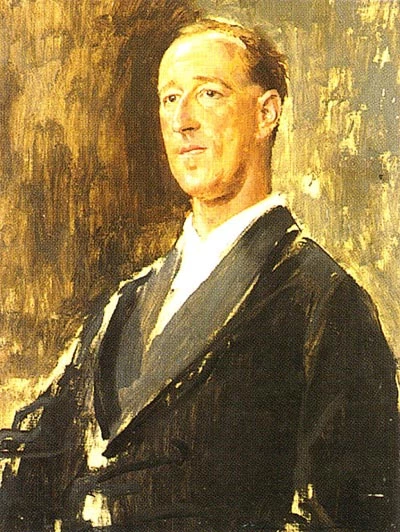
Trick or Treat? Ancient collection at Amgueddfa Cymru found to be modern 17 April 2007 At the beginning of the twentieth century, the president of Amgueddfa Cymru, Lord Howard de Walden, formed a remarkable collection of ancient European arms and armour. The collection included a number of classical pieces - helmets, swords, spearheads, belts and armour that were mainly Greek and Roman - or so it was thought until work at Amgueddfa Cymru discovered otherwise... The collection comes to Amgueddfa Cymru Portrait of Lord Howard de Walden (1880-1946) Etruscan bronze 'helmet' embellished with gold showing half of the false patina removed X-Ray of helmet In 1945, Lord Howard offered to lend seventy-nine 'antique bronze objects' to the Museum. Following his death in 1946, his son donated the collection to the Museum. In 1990 research by a Russian scholar had shown that some items from this collection had almost certainly been made in a jeweller's workshop in Odessa, south Russia between 1890 and 1910. Further investigation has revealed some of the objects to be totally genuine, but others reveal signs of being 'improved' or even manufactured more recently from antique metal parts fashioned into classical forms. In order to meet the demand for classical antiques during this period, it was quite common to produce a particular object using ancient pieces from a number of sources, or in other words, a pastiche (a work of art that imitates the style of some previous work). There are also a number of fakes, where the metal used was wrong for the period of the object. Lord Howard de Walden was well aware of this, for when the loan to the Museum was being organised, he wrote 'there are certain pieces you may not wish to have, such as...several specimens of doubtful authenticity'. Bronze 'helmet' One such object that Museum conservators examined was a helmet, made of bronze and decorated with gold, apparently dating from the third century B.C. The helmet was X-rayed to determine the condition of the metal and the extent of the corrosion, as well as to reveal its construction. However, the X-ray uncovered much more than was originally expected, for dense solder lines could be clearly seen criss-crossing the image. The helmet had undergone considerable restoration work in recent times; cracks had been filled with solder and holes patched with metal. To disguise these recent repairs a fake patina (the sheen on an object produced by age and use) mimicking corroded bronze had been applied over the top. Analysis of the metal revealed that the bronze helmet was in fact old, and even the patches of metal used to repair the holes were ancient. However, there were indications that the gold was modern. The investigations concluded that the helmet had been repaired and embellished with gold that would have increased its value and made it more desirable to collectors. This work may have been carried out at the turn of the twentieth century. Should the modern repair work be removed or conserved? In the end, it was decided to remove half the false patina in order to reveal the repair work below, for it was felt that the alterations were now part of the history of the object and could shed light on techniques employed at the time the helmet was collected. Study of this important collection not only throws light on the ancient technology of the genuine pieces of classical arms and armour, but also the practices of the antiquities market a century ago.