: After the Middle Ages

Early herbals - The German fathers of botany

John R. Kenyon, 4 July 2007

Amgueddfa Cymru has a number of pre-1701 books in the Museum's Library, including two incunables (books printed before 1501) of Pliny's writings on natural history from 1481 and 1487.

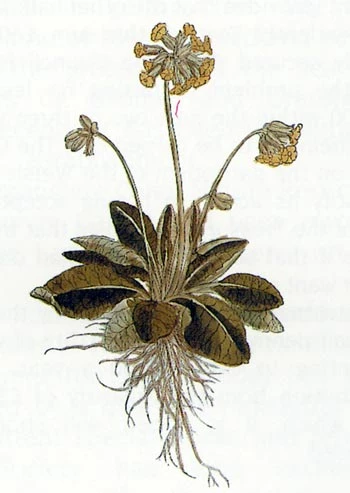
The cowsip as depicted in Fuchs's De Historia Stirpium

The cowsip as depicted in Fuchs's De Historia Stirpium

Part of an early German herbal annotated in Welsh and English, once in the possession of Morris Owen

Part of an early German herbal annotated in Welsh and English, once in the possession of Morris Owen.

There are also a number of 16th- and 17th-century 'herbals' in the collection. Among these are examples of the works of three men who have been described as the 'German fathers of botany', namely Hieronymous Bock (1498-1554), Otto Brunfels (1489-1534) and Leonhard Fuchs (1501-1566).

Herbals

Printed herbals give details of plants along with what illness each one could cure. What made the work of these three men stand out in particular is that many of the descriptions and illustrations of the flowers in their books were, on the whole, based on first-hand evidence in the field, and not copied from other writers.

Hieronymous Bock (1498-1554)

As Bock's herbal of 1539 was unillustrated, it forced him to provide detailed and accurate descriptions. The Museum holds a later, illustrated edition, from 1552. Although the opening pages are missing, the main body of the text is complete, along with fine hand-coloured illustrations.

Most of the woodcuts simply show the plants themselves, but occasionally birds and man are shown, such as the rather crude depiction of the effects on eating a fig!

Otto Brunfels (1489-1534)

The work of Otto Brunfels in the Library is the second volume of Herbarum Vivae Eicones (1531). The title translates as 'living picture of plants' and the author was one of the first to turn to nature itself as the source of his illustrations for a book.

Leonhard Fuchs (1501-1566)

The Library holds two books compiled by Fuchs, namely De Historia Stirpium (1542) and Plantarum Effigies (1549). Although only some of the descriptions of the plants are by Fuchs, the majority being taken from other books, it is the quality of the illustrations that makes this herbal one of the great books of the 16th century.

The Plantarum Effigies is a pocket-sized version of the 1542 volume to be used in the field; it has very little text, apart from an index to the plants depicted, and with each woodcut the name of the plant is given in three or more languages, usually five (Greek, Latin, French, Italian and German).

Other great herbals of the same period are housed in the Library of Amgueddfa Cymru, notably the works of Rembert Dodoens (1516-1585) and John Gerard (1545-1612).

Rembert Dodoens (1516-1585)

Dodoens' herbal was published in Flemish in 1554. The Museum holds the first English edition of 1578 translated by Henry Lyte, including new material which Dodoens himself had sent to Lyte for incorporation in the new edition.

John Gerard (1545-1612)

One of the most famous herbals written in English is Gerard's The Herball (1597). Head gardener to many properties in and around the London area, Gerard was also responsible for the gardens of William Cecil, Lord Burghley, Elizabeth l's Secretary of State and Lord Treasurer, and it was to Cecil that Gerard dedicated his great work.

The Library has a copy of the 1633 edition, along with the original work itself.

Other herbals in the collection include an incomplete German example dating to the first half of the 16th century. It was once in the possession of a Morris Owen of Caernarfonshire who added in ink, around 1767, the names of the various plants in Welsh; the English equivalents are also given in most cases.

This book, and the other herbals, remain of great interest to this day, and are examined in particular by those who study the history of botany and pharmacy, as well as by students of the history of the printed book.
English silks worn in Tredegar House

8 May 2007

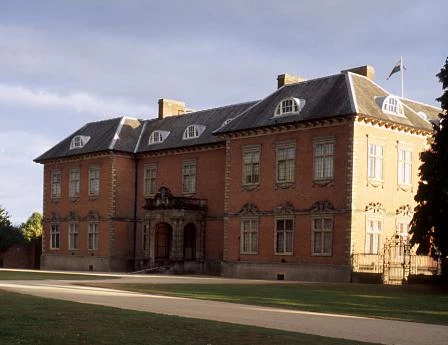
Tredegar House and Park. The house and grounds are now in the ownership of Newport County Council. Many rooms have been restored and are open to the public. Image © Steve Burrow.

Tredegar House and Park. The house and grounds are now in the ownership of Newport County Council. Many rooms have been restored and are open to the public. Image © Steve Burrow.

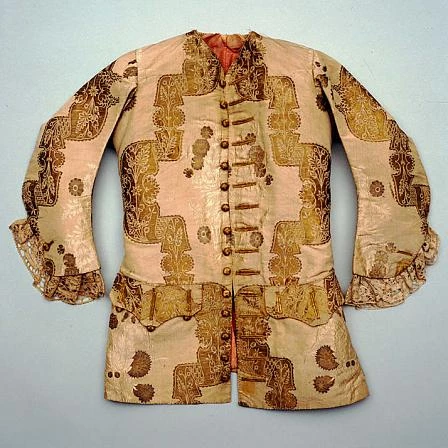
Man's short coat, dating to the early 1720s. The fabric is white taffeta with a lace pattern.

Man's short coat, dating to the early 1720s. The fabric is white taffeta with a lace pattern.

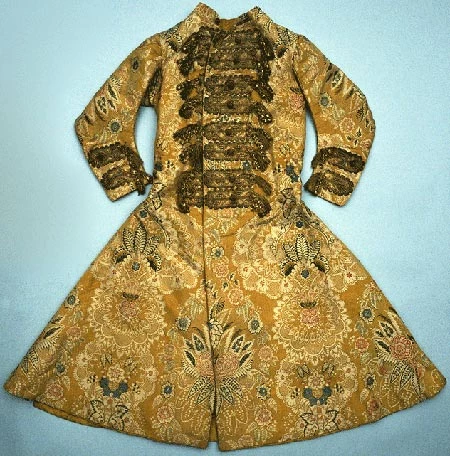
This coat was probably worn by Sir William Morgan. It is of yellow lace pattern silk, dated to about 1725, and is of either English or French origin.

This coat was probably worn by Sir William Morgan. It is of yellow lace pattern silk, dated to about 1725, and is of either English or French origin.

Silver embroidered blue damask court mantua (an open fronted gown with an elaborate train), made in the 1720s.

Silver embroidered blue damask court mantua (an open fronted gown with an elaborate train), made in the 1720s.

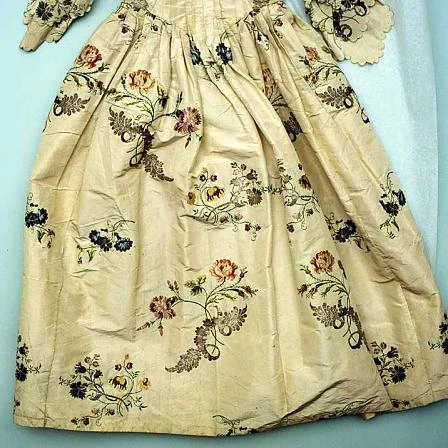
An English silk robe and petticoat, dating to about 1745-47.

An English silk robe and petticoat, dating to about 1745-47. Although this has been remade, the fabric survives in good condition. It has a yellow taffeta ground with white cannelè stripes and is brocaded with roses in coloured silks.

In the 18th century a gentleman's rank in society could be discerned from the quality of his house or his clothing - status was declared by the wearing of costly silks, lace or gold thread. Silks woven in the flourishing silk industry of Spitalfields in London and elsewhere were bought by Welsh families and brought to Wales to furnish their homes, dress themselves, and impress their neighbours.

The Morgans of Tredegar House, later Lords Tredegar, were one of the wealthiest families in Wales. They used rich silk furnishings in their home, as described in the inventory of 1698:

"4 green Silke Damask chequer curtains flowred with gold colour and lined with white chequer silke with double valiance, foot valiance, teaster and quilte imbroidred with Silke frings."

In the same bedroom there were four window curtains of white damask and seven silk cushions matching the bed hangings, all protected by a suite of orange dust covers.

In addition, the Morgans dressed themselves in the finest and most fashionable woven damasks and brocaded silks, some of which are now housed at St Fagans National History Museum, donated in 1923 by Lord Tredegar. Most date to the middle of the 18th century.

One robe and petticoat of French origin may have belonged to Martha Morgan, wife of Thomas Morgan, part of the Mansel family of Margam (and later of Penrice), one of the wealthiest families in the county. Thomas Morgan was succeeded by his brother, who considerably added to the estates. When his son, Sir William Morgan, inherited in 1719, he was able to embark upon a very flamboyant way of life.

In 1724 Sir William married Lady Rachel Cavendish, daughter of the Duke of Devonshire, who brought with her a dowry of £20,000. A number of items from Tredegar House date from between 1720 and 1731, when Sir William died. All of these garments match Sir William's reputation for extravagance - his annual expenditure in 1725 amounted to £37,418 (over £3.8 million or .9 million in today's terms) - and all would almost certainly have been bought in London.

Lady Rachel survived her husband for fifty years, and when her only son died unmarried in 1763, she lost a battle in the courts and her brother-in-law Thomas Morgan succeeded to the estate. Most of the remaining Tredegar garments belong to this period and were probably worn by Lady Rachel or Jane, the grand-daughter of John Morgan (born 1731), who had married in 1758 and was later to inherit the estate.

Since none of the Tredegar silks post-date Lady Rachel's life it is tempting to conclude that they all belonged to her and were packed away after her time, only being rediscovered by the family for their fancy dress possibilities during the following century.

A court mantua

This pictured garment had been remade and worn as fancy dress, probably during the 19th century. In 1971 it was returned to its original form, with the help of the late Janet Arnold. The later stitching was removed, which involved unpicking bust darts and the removal of stitching where the train had been caught up in several places, presumably in order to hide the fact that part of it had been cut away. The petticoat itself had not been altered.

This is a very grand robe which would have been worn for presentation at court. Lady Rachel Morgan was certainly sufficiently important to have worn it.

Background Reading

Social conditions at Tredegar House Newport in the 17th and 18th centuries, by M. R. Apted. In Monmouthshire Antiquarian, vol. 3:2, p124-54 (1972-3).

Tredegar House by David Freeman. Published by Newport Leisure Services Department (1982, revised edition published 1998).

Silk designs of the 18th century in the collection of the Victoria & Albert Museum by Natalie Rothstein. Published by the Victoria and Albert Museum (1990).

Woven Textile Design in Britain to 1750 by Natalie Rothstein. Published by the Victoria and Albert Museum (1994).

A court mantua of c. 1740 by Janet Arnold. In Costume (Journal of the Costume Society), vol. 6, p48-52 (1972).

The wreck of the Ann Francis

8 May 2007

A detail of Christopher Saxton's Map of Glamorgan, 1578

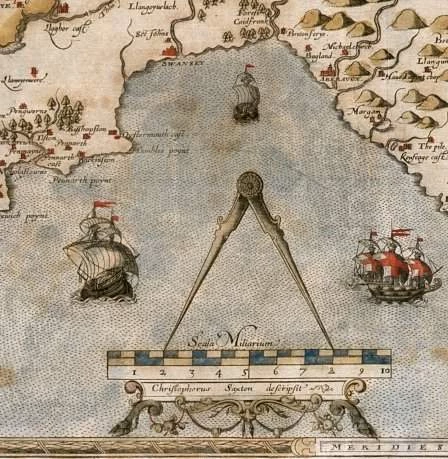
A detail of Christopher Saxton's Map of Glamorgan, 1578, showing the coastline from Oxwich on Gower (left) to Margam (upper right).

Spanish gold and silver coins of Ferdinand and Isabella (1479-1504)

Spanish gold and silver coins of Ferdinand and Isabella (1479-1504). Coins continued to be minted in their names long after their deaths, until the 1550s.

Talers: large silver coins from Germany.
Talers

: large silver coins from Germany. This group includes issues of the Electors of Saxony, Counts of Stolberg, Langraves of Leuchtenberg and the cities of Cologne and Herford. The modern word 'Dollar' originates from Talers

A gold San Vicente of John III of Portugal (1527-57); the reverse (right side of image) depicts the saint holding a martyr's palm and a model ship.

A gold San Vicente of John III of Portugal (1527-57); the reverse (right side of image) depicts the saint holding a martyr's palm and a model ship.

Navigational dividers from the wreck of the Ann Francis.

Navigational dividers from the wreck of the Ann Francis.

Spanish coins, navigational tools and a whistle- are these the remains of the 16th-century vessel, the Ann Francis?

For many years, coins and other objects have been found on Margam Beach in Glamorgan. Many are of relatively recent date, but there is a noticeable concentration of coins dating from the middle of the 16th century.

Most of these coins are silver: of Ferdinand and Isabella of Spain and from a number of states of the German Holy Roman Empire. There are a few copper coins of John III of Portugal (1521-57) and even two spectacular gold coins - one Spanish and one Portuguese. Throw in sets of navigational dividers, lead sounding weights and a bosun's call (whistle) and what have you got? A shipwreck.

Most of the coins date from the 1530-1557. It is known that a French ship was lost in December 1557 at Oxwich on the Gower, 21km (14 miles) to the west - but is there no suitable wreck closer to Margam?

Well, a 16th-century wreck is known at Margam, but not in 1557. On 28 December 1583, the Ann Francis, the newest and biggest ship belonging to the King's Lynn merchant Francis Shaxton, ran aground on Margam Beach.

The ship was promptly plundered by the local inhabitants, until agents of the local landowners restored order and themselves laid claim to the goods. In due course Shaxton learnt of his ship's fate and after lengthy legal battles recovered some of his goods - anchors, cannon, cables and money.

Usually, coins are a good pointer to the dates of wrecks, so why do they suggest a much earlier date here? One answer, of course, may be that there really was a separate wreck at Margam in 1557, though we have no other evidence for one. But it is known that the Ann Francis carried a lot of money, probably the proceeds of selling a cargo of grain in Spain and/or Portugal.

The coins, of types that were by now obsolete, acted simply as silver bullion, which in normal circumstances would have been taken to the Mint in London to be converted into coin of the British realm. The ship lost its way on the return leg of the voyage and the silver never made it to London.

Background Reading

'Wreck de Mer and dispersed wreck sites: the case of the Ann Francis (1583)' by M. Redknap and E. Besly. In Artefacts from Wrecks edited by M. Redknap, p191-208. Published by Oxbow Books (1997).