Ancient Wales

Voices from Medieval Wales (AD 1070s- 1500s)

16 March 2010

Introduction

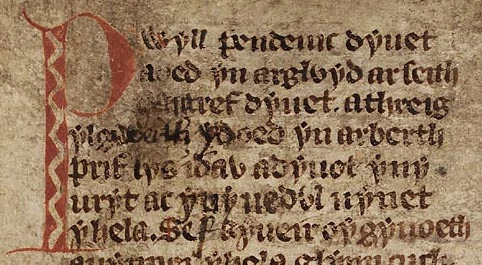
An extract from the White Book of Rhydderch, mid 14th century

An extract from the White Book of Rhydderch, mid 14th century

Many different languages were heard in Wales during the early medieval and medieval periods. People from other countries invaded, came here to work or had prolonged contact through trade.

These passages were recorded in 2007 for new archaeology galleries at National Museum Cardiff. These modern recreations of what these lost voices may have sounded like illustrate differing degrees of linguistic exchange in Wales, and further perspectives on creative thoughts, words and deeds from these early periods.

Anglo-Norman

Letter of John Peckham to King Edward, describing the death of Llywelyn ap Gruffudd in 1282. Anglo-Norman reading by David Trotter

Anglo-Norman was written and spoken by a small elite following the Norman invasion.

After the conquest of Wales by Edward I, Anglo-Norman was introduced as the language of the incoming ruling class in Wales. It survives in a small number of literary texts and in administrative and legal documents. There is some influence, too, of Anglo-Norman on the Welsh language.

This example is from a letter of John Peckham, Archbishop of Canterbury (about 1230-92) to King Edward I, describing the death of Llywelyn ap Gruffudd in 1282.

Transcription of the audio passage:

Sire, sachez ke cues [ceus?] ke furent a la mort Lewelin truverent au plus privé lu de sun cors menue choses ke nus avoms veues; entre les autres choses il i out une lettre deguisé par faus nuns de traysun. E pur co ke vus seyez garni, nus enveyum le transcript de la lettre a le eveske de Ba, e la lettre meymes tient Eadmund de Mortemer, e le privé seel Lewelin, e ces choses vus purrez aver a vostre pleysir, e ço vus maundum pur vus garner, e nun pas pur ce ke nul en seyt grevé, e vus priums ke nul ne sente mort ne mahayn pur nostre maundement, e ke (s) ce ke nus vus maundums seyt secré.

English translation:

Lord, know that those who were at the death of Llywelyn found in the most secret part of his body some small things which we have seen. Among the other things there was a treasonable letter disguised by false names. An that you may be warned, we send a copy of the letter to the bishop of Bath, and the letter itself Edmund Mortimer has, with Llywelyn's privy seal, and these things you may have at your pleasure. And this we send to warn you, and not that any one should be troubled for it. And we pray that no one my suffer death or mutilation in consequence of our information, and that what we send you may be secret.

Source: R. Griffiths (ed.) 1986, 1282. A Collection of Documents (National Library of Wales), 12-13; English translation by Charles Trice Martin.

Anglo-Norman reading by Professor David Trotter, Anglo-Norman Dictionary, Aberystwyth University.

Middle Welsh

Old Welsh developed into Middle Welsh around 1100. Spoken Welsh included a variety of dialects, such as Gwyndodeg (the speech of Gwynedd) and Gwenhwyseg (the speech of Gwent). The written language was used for religious literature, legal texts, works on medicine, heraldry and farming as well as prose sagas and romances. Medieval Wales remained overwhelmingly Welsh speaking.

We have here an example of Middle Welsh taken from one of three cywyddau by the professional bard Iolo Goch (about 1320-98) praising Owain Glyn Dŵr. This one praises his court at Sycharth.

The cywydd (plural cywyddau) is one of the most important metrical forms of Welsh poetry, consisting of a series of seven-syllable lines in rhyming couplets, using a form of harmony known as cynghanedd. It was the favourite metre of the poets of the nobility.

Iolo's patrons included high-ranking churchmen as well as Anglo-Welsh and Welsh noble families.

Transcription of the audio passage:

Llys Owain Glyn Dŵr

Naw neuadd gyfladd gyflun,
A naw gwardrob ar bob un,
Siopau glân glwys cynnwys cain,
Siop lawndeg fal Siêp Lundain;
Croes eglwys gylchlwys galchliw,
Capelau â gwydrau gwiw;
Popty llawn poptu i'r llys,
Perllan, gwinllan ger gwenllys;
Melin deg ar ddifreg ddŵr,
A'i glomendy gloyw maendwr,
Pysgodlyn, cudduglyn cau,
A fo rhaid i fwrw rhwydau;
Amlaf lle, nid er ymliw,
Penhwyaid a gwyniaid gwiw,
A'i dir bwrdd a'i adar byw,
Peunod, crehyrod hoywryw;
Dolydd glân gwyran a gwair,
Ydau mewn caeau cywair,
Parc cwning ein pôr cenedl,
Erydr a meirch hydr, mawr chwedl;
Gerllaw'r llys, gorlliwio'r llall,
Y pawr ceirw mewn parc arall;

English translation:

... nine symmetrical identical halls,
and nine wardrobes by each one,
bright fair shops with fine contents,
a lovely full shop like London's Cheapside;
a cross-shaped church with a fair chalk-coloured exterior,
chapels with splendid glass windows;
a full bakehouse on every side of the court,
an orchard, a vineyard by a white court;
a lovely mill on flowing water,
and his dovecot with bright stone tower;
a fishpond, hollow enclosure,
what is needed to cast nets;
place most abounding, not for dispute,
in pike and fine sewin,
and his bord-land and his live birds,
peacocks, splendid herons,
bright meadows of grass and hay,
corn in well-kept fields,
the rabbit park of our patriarch,
ploughs and sturdy horses, great words,
by the court, outshining the other,
stags graze in another park...

English translation by Dafydd Johnston (D. Johnston 1993, Iolo Goch: Poems, Gomer.

Middle Welsh reading by Professor Peter Wynn Thomas, Cardiff University.

Middle English

The Norman Conquest destroyed the literary high culture of Anglo-Saxon England. The Middle English that was increasingly widely used again after about 1200 was grammatically much changed from Old English, and had absorbed many Norse and Anglo-Norman words. English was the usual language of most of the towns founded by Norman and English rulers in Wales. Large numbers of Middle English words passed into Welsh.

This example of Middle English comes from the medieval romance 'Sir Cleges'. Sir Cleges is the tale of a spendthrift knight reduced to poverty and restored to prosperity, against a background of Christmas festivities.

It was composed in the late 1300s/early 1400s, probably in the north-west Midlands.

Transcription of the audio passage:

Sir Cleges and his son gent
The right waye to Cardiffe went
Uppon Cristemas Daye.
To the castell he cam full right
As they were to mete dy?t,
At noun, the soth to saye.
In Sir Cleges thow?t to goo,
But in pore clothyng was he tho
And in sympull araye.
The portere seyd full hastyly:
"Thou chorle, withdrawe þe smertly,
I rede the, without delaye —

'Ellys, be God and Seint Mari,
I schall breke thyne hede on hig?t!
Go stond in beggeres row?t.
Yf þou com more inward,
It schall þe rewe afterward,
So I schall þe clow?t.'
'Good sir,' seyd Sir Cleges tho,
'I pray you lat me in goo
Nowe, without dow?t.
The kynge I have a present brow?tt
From hym þat made all thynge of now?t;
Behold all abow?t!'

English translation:

Sir Cleges and his fine son took the road straight to Cardiff on Christmas day. He went directly to the castle, as they were sitting down to eat, at noon to tell it true. Sir Cleges meant to go in, but he was poorly dressed then, and in simple costume. The porter very quickly said 'You churl, take yourself off smartly, I tell you, without delay, or by God and Holy Mary I'll break the crown of your head. Go and stand in the crowd of beggars. If you come further in, you'll regret it afterwards. I shall hit you so hard'. 'Good sir', said Sir Cleges then, 'I pray you, let me go in now, without doubt. I have brought the king a present from him who made everything from nothing. Look all around.'

Source: D. Speed (ed) 1987, '4. Sir Cleges', Medieval English Romances Part One (Department of English, University of Sydney), 169-92.

Middle English reading and translation by Professor John Hines, Cardiff University.

Flemish (Middle Dutch)

Flemings came to England with the army of William the Conqueror, and during the 1100s as merchants and colonists for new towns. The most famous group of colonists are the Flemings of south-west Wales (Pembrokeshire and Ceredigion). Flemings retained their identity as a group and their language for several generations until the early 1200s. By then they had transformed the character of areas of Dyfed.

This example of Flemish comes from the 'Roman van Walewein'. Roman van Walewein is an Arthurian story which appears to be a Flemish invention and in which Walewein (Gawain) is the main character. The central theme in the story is the quest for a flying chess-board which appeared at Arthur's court (and disappeared again).

Transcription of the audio passage:

Die koninck Arthur zat t'enen male
Te Carlioen in zine zale
Ende hild hof na konink zede
Alzo hi menigwerven dede
Met een deel zire man
Die ik niet wel genomen kan:
Ywein ende Percevaal,
Lanceloot ende Duvengaal
Entie hoofse Walewein;
Zijn gezelle was daar negein.
Ook was daar Keye, die drussate.
Daar die heren aldus zaten
Na den etene ende hadden gedwegen
Alzo hoge liede plegen,
Hebben zi wonder groot vernomen;
Een schaak ten veinstren inkomen
Ende breedde hem neder uptie aarde.
(...)

English translation:

King Arthur once was seated
in Caerleon in his hall
and held court as kings do
and as he did frequently
with a number of his men
who I cannot name all.
Yvain and Perceval,
Lancelot and Duvengal
and the courtly Walewein;
who was there without peer.
Also Kay was there, the steward.
When these lords sat there
after a meal, and had washed (their hands)
as gentlemen use to do,
they witnessed a great wonder:
A chess-board came in through the window
and alighted on the floor.
(...)

English translation/source: D. F. Johnson and G. H. M. Claassens (eds) 2000, Roman van Watewein. Arthurian Archives. Dutch Romances. Vol. 1 (Cambridge); Flemish reading by Lauran Toorians.

Text by Mark Redknap with Peter Wynn Thomas, Diarmait Mac Giolla Chríost, John Hines, David Trotter, Lauran Toorians
Voices from early medieval Wales (AD 400s -1070s)

15 March 2010

Introduction

Inscription on 9th century monument from Glamorgan

Latin inscription on a 9th century monument from St Illtud's Church, Glamorgan. The cross was erected by Houelt (Hywel) for this father Res (Rhys).

Many different

languages were heard in Wales during the early medieval and medieval periods. People from other countries invaded, came here to work or had prolonged contact through trade.

Recorded in 2007, these modern recreations of what these lost voices may have sounded like illustrate differing degrees of linguistic exchange in Wales, and further perspectives on creative thoughts, words and deeds from these early periods.

Old Welsh

Wales is the only part of the British Isles in which a version of the Brythonic language has been spoken without a break down to the present day. Brythonic is the mother language from which Welsh, Cornish and Breton evolved. It developed into Old Welsh during the 500s and 600s.

The example of Old Welsh which you can hear on this page is an extract from a series of englynion, or three-line verses, written down in the 800s and known as the Juvencus poems. It is the lament of a lone soldier, whose only companion is a mercenary from the Continent who does not speak his language. While they can fight together, communication is limited.

Professor Ifor Williams thought the word franc denoted a 'foreign mercenary soldier', comparing it to the Irish francamais for the same. If the word refers to someone originally from the Carolingian Empire, he would have spoken a form of Gallo-Romance (or if from the eastern areas, perhaps Germanic).

Transcription of the audio passage:

Niguorcosam nemheuaur    henoid
Mitelu nit gurmaur
Mi am [franc] dam ancalaur.

Nicanãniguardam nicusam    henoid
Cet iben med nouel
Mi amfranc dam anpatel.

Namercit mi nep leguenid    henoid
Is discirr micoueidid
Dou nam riceus unguetid.

English translation:

I shall not talk even for one hour tonight,
My retinue is not very large,
I and my Frank, round our cauldron.

I shall not sing, I shall not laugh, I shall not jest tonight
Though we drank clear mead,
My Frank and I, round our bowl.

Let no one ask me for merriment tonight,
Mean is my company,
Two lords can talk: one can only speak.

English translation after Ifor Williams. Source: R. Bromwich (ed.) 1980, The Beginnings of Welsh Poetry. Studies by Sir Ifor Williams D. Litt., LL.D., F.B.A. (University of Wales Press), 89-121; Old Welsh reading by Peter Wynn Thomas

Latin

Most educated Romano-British were bilingual. Latin was the language of law, government, business and literature in Roman Wales. Latin remained the international language of the highest status throughout the early medieval and medieval periods. It was the language of Christian texts, liturgy and education.

The audio track is a reading of the Vulgate version of the Lord's Prayer, read by Beatrice Fannon.

Transcription of the audio passage:

PATER noster, qui es in caelis,
Sanctificetur nomen tuum.
Adveniat regnum tuum. Fiat voluntas tua, sicut in caelo et in terra.
Panem nostrum quotidianum da nobis hodie,
Et dimitte nobis debita nostra sicut et nos dimittimus debitoribus nostris.
Et ne nos inducas in tentationem, sed libera nos a malo.
Amen.

English translation:

Our father, who art in heaven,
Halloed be thy name,
Thy kingdom come, thy will be done on earth as it is in heaven
Give us this day our daily bread
And forgive us our trespasses as we forgive those who trespass against us
And lead us not into temptation but deliver us from evil.
Amen.

Old Irish

Old Irish was probably brought to Wales by settlers from Ireland while Britain remained a Roman province. The Irish were especially numerous throughout west Wales.

It is likely that spoken Irish came to an end in Wales during the 600s but the language has left its mark on many Welsh place-names and on the Welsh language.

This example of Old Irish is from The Scholar and his Cat, a poem scribbled on a manuscript in Austria in the early 800s. The scholar reflects on his life; Pangur is his cat's name.

Transcription of the audio passage:

Meisse ocus Pangur Bán,
Cechtar nathar fria shaindán;
Bíth a menma-sam fri seilgg
Mo menma céin im shaincheird.
Caraim-se foss, ferr cach cló,
Oc mo lebrán léir ingnu;
Ní foirmtech frimm Pangur Bán,
Caraid cesin a maccdán.

Ó ro biam, scél cen scís,
I n-ar tegdais ar n-oendís,
Táithiunn díchríchide clius
Ní fris tarddam ar n-áithius.

English translation:

Myself and White Pangur are each at his own trade; he has his mind on hunting, my mind is on my own task.

Better than any fame I prefer peace with my book, pursuing knowledge; White Pangur does not envy me, he loves his own childish trade.

A tale without boredom when we are at home alone, we have — interminable fun — something on which to exercise our skill.

English translation by D. Greene and F. O'Connor (D Greene&F. O'Connor (ed and trans) 1967, A Golden Treasury of Irish Poetry A.D. 600-1200 (Macmillan, London, Melbourne and Toronto), 81-3; Old Irish reading by Dr Diarmait Mac Giolla Chríost, Reader, School of Welsh, Cardiff University.

Old Norse

Norse was the Scandinavian language of the Vikings. It was still quite similar to English, and these two languages assimilated in the Viking-settled areas of northern and eastern England. There are many place-names of Norse origin around the coasts of Wales.

The audio extract is from a Norse skaldic poem by Þorkell hamarskáld celebrating the victory by Magnus Barelegs at the Battle of the Menai Straits (AD1081). In 1081 a combined Welsh and Norwegian force defeated the Normans at the Battle of the Menai Straits. Viking court poet Þorkell hamarskáld celebrates the victory, in particular the role of Norwegian king Magnós berfœttr (Magnus Barelegs). The poem would have been composed and performed orally around or soon after AD1100.

Transcription of the audio passage:

Dunði broddr á brynju.
Bragningr skaut af magni.
Sveigði allvaldr Egða
Alm. Stọkk blód á hjalma.
Strengs fló hagl í hringa,
Hné ferð, en lét verða
Họrða gramr í harðri
Hjarlsókn banat jarli.

English translation:

Arrow drummed on mail-coat. The chieftain shot forcefully. The mighty ruler of the people of Agder bent his bow. Blood sprayed on helmets. Bowstring-hail flew into ring-mail, the troop fell, and the prince of the people of Hordaland caused the earl to be slain in a hard fight for land.

English translation by Judith Jesch. Source: J. Jesch 1996, 'Norse historical traditions and the Historia Gruffudd vab Kenan: Magnós berfœttr and Haraldr hárfagri' in K. Maund, Gruffudd ap Cynan. A Collaborative Biography, 117-47.

Old Norse reading by Professor John Hines, Cardiff University.

Old English

The Anglo-Saxons who settled in England after the end of Roman rule spoke the Germanic language, which gradually diverged from its Continental relatives. The Anglo-Saxon period saw frequent military raids from England into Wales and vice versa. However the long border marked by Offa's Dyke also saw more constructive relationships and shared interests.

This example of Old English comes from The Anglo-Saxon Chronicle (the Worcester Manuscript. British Library MS Cotton Tiberius Biv, ff. 3-86). A cleric records the consequences of a Viking raid on Wales in AD 915.

Transcription of the audio passage:

Her on þissum geare wæs Wæringwic getimbrod; ond com mycel sciphere hider ofer suðan of Lioðwicum; ond twegen eorlas mid, Ohtor ond Hroald; ond foron þa west abuton þæt hi gedydon innan Sæfan muðan; ond hergodon on Norð Wealas aeghwær be þam staðum þær hi þonne onhagode; ond gefengon Cameleac bisceop on Iercingafelda; ond læddon hine mid him to scipe; ond þa alysde Eadweard cyning hine eft mid feowertigum pundum.

English translation:

Here in this year Warwick was built, and a great raiding ship-army came over here from the south, from Brittany, and with them two jarls, Ohtor and Hroald, and then went around west until they got into the mouth of the Severn, and raided Wales everywhere along the banks where it suited them, and took Cameleac, bishop of Archenfield, and led him to ship with them; and then King Edward ransomed him back for forty pounds [of silver].

English translation/source: Michael Swanton 1996, The Anglo-Saxon Chronicle (London: Dent, J. M.).

Old English reading by Professor John Hines, Cardiff University.

The face of a 6,000-year-old man

Steve Burrow, 22 January 2010

The Penywyrlod Head

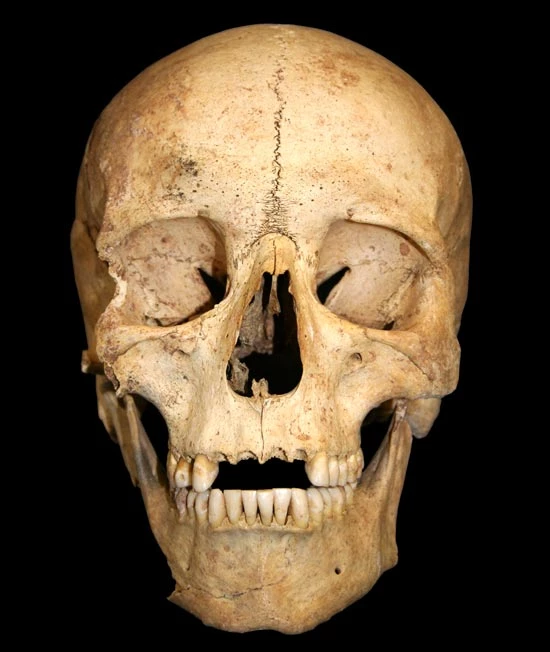
The Penywyrlod Skull

The Penywyrlod Skull.
One of the few complete Stone Age skulls yet to have been discovered in Wales.

A rare Stone Age skull discovered in a burial mound in Powys has given scientists the opportunity to reconstruct the face of a 6,000-year-old man, revealing that he was no hulking cave man but in fact very similar looking to modern man.

In June 1972 at Penywyrlod, near Talgarth in Powys, a farmer began to quarry loose stone blocks from a grassed-over mound in one of his fields. The stone was to provide hardcore for his farmyard. It didn't take long before he came upon some larger stone slabs which lined a hole leading deeper into the mound. Within this chamber were piles of human bone.

Prehistoric burial mound

The farmer contacted Hubert Savory, an archaeologist at the National Museum and an expert in prehistoric burial mounds, and Savory came to see the new find as soon as he could. This discovery must have come as a considerable surprise to him as archaeologists had been mapping burial mounds in this part of Wales for generations. Yet here was the largest and best preserved example in Powys — it had been completely missed!

An excavation revealed that the mound was a type of tomb in use from around 3,600 BC. It consisted of a rectangular stone mound which widened at its southeast end. Here the walls of the mound bowed inwards to create a forecourt. Piercing the sides of the mound were several stone-lined chambers, like the one the farmer had found.

A complete skull

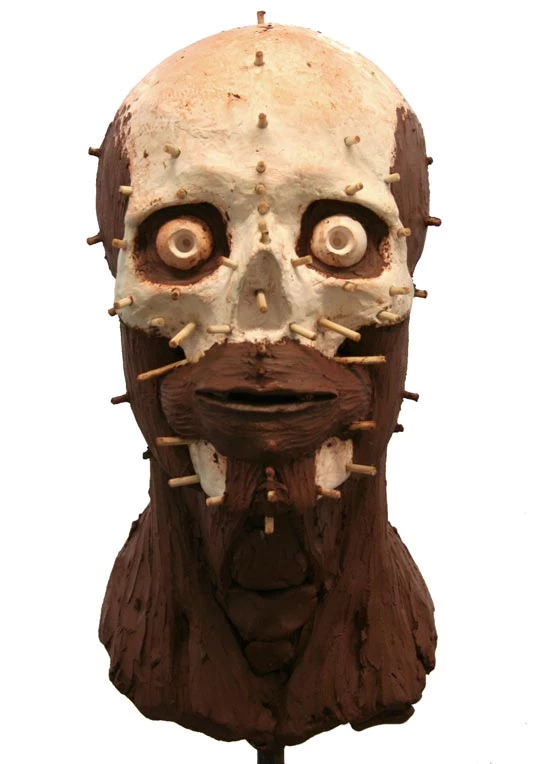
The skull, partway through the reconstruction process

The skull, partway through the reconstruction process carried out by Caroline Wilkinson of Dundee University.

By the time the excavation finished, the remains of at least six people had been found in the tomb chambers. But the star find was a complete skull — a very rare discovery — which belonged to a man who had died in his mid-20s.

The skull reveals no obvious cause of death, although it does tell us something about the man. His teeth were in good condition, but his nasal bones were slightly crooked and he had suffered from an inflammatory scalp disorder. The bones of his skull had also failed to fuse completely — the result of an inherited condition which would have caused him no inconvenience but would have given him a broader forehead than normal for the time, and a dimpled chin.

Facial reconstruction

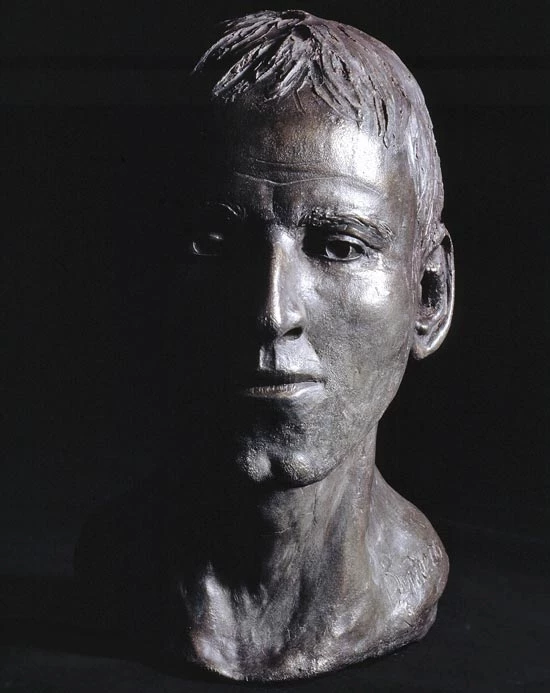
The finished face

The finished face, cast in bronze resin and currently on display in the Origins Gallery of National Museum Cardiff.

As a skull, the man's story ends there, but in 2005 Caroline Wilkinson from Dundee University was commissioned to produce a forensic reconstruction of his face. Caroline's work involves taking a plaster cast of the skull and positioning pins on it to indicate the likely depth of flesh at a number of key locations. These depths are based on measurements from the faces of modern people of similar racial type. Clay is then used to build up the layers of muscle, before skin and hair are added. The style of hair cut and facial hair is of course subjective.

The figure revealed is startling. This was no hulking cave man; 6,000-year-old man looks as modern as anyone walking the streets today. The people who built this tomb and buried their dead in a pile of bones may have followed cultural traditions that seem strange to us, but they were not primitives. We are not better than them, just different.

Article author:

Dr Steve Burrow, Earlier Prehistorian, Department of Archaeology & Numismatics, Amgueddfa Cymru

How coal cooled the climate 300 million years ago

Christopher Cleal, 1 June 2009

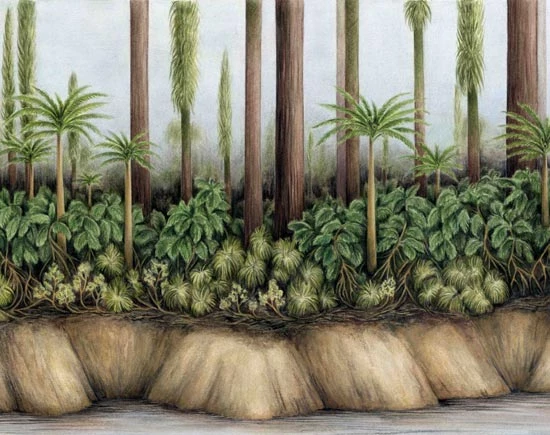
Reconstruction of the levee of a river that flowed through the tropical wetlands 300 million years ago

Reconstruction of the levee of a river that flowed through the tropical wetlands 300 million years ago. The plants growing on these levees are often found as fossils in the rocks associated with coals in Wales. Painting: Annette Townsend.

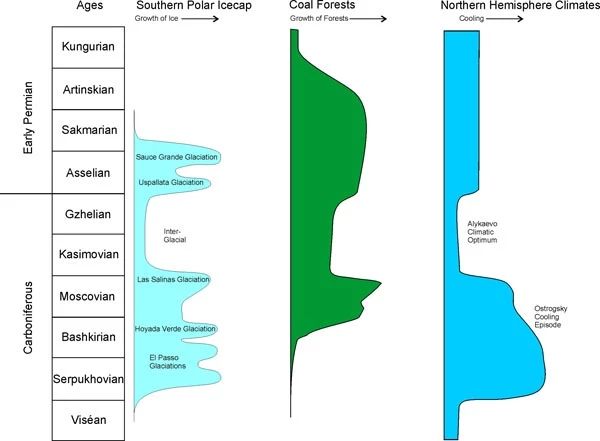
Coal Forests varied with time

A comparison of how the area of coverage of the Coal Forests varied with time with evidence of changing climate in late Carboniferous and early Permian times.

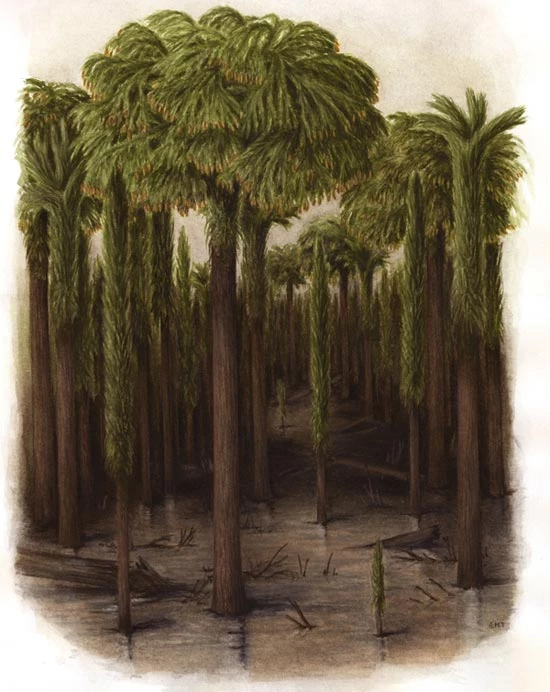
Reconstruction of giant lycophytes growing in tropical wetlands of Wales, about 300 million years ago.

Reconstruction of giant lycophytes growing in tropical wetlands of Wales, about 300 million years ago. Note that there are plants in different stages of their life-cycle. Painting by Annette Townsend.

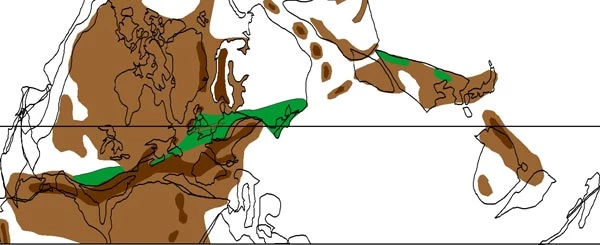
A map of the tropical lands about 300 million years ago

A map of the tropical lands about 300 million years ago, showing mountains (dark brown), lowlands (light brown) and wetlands where peat was being deposited (green).

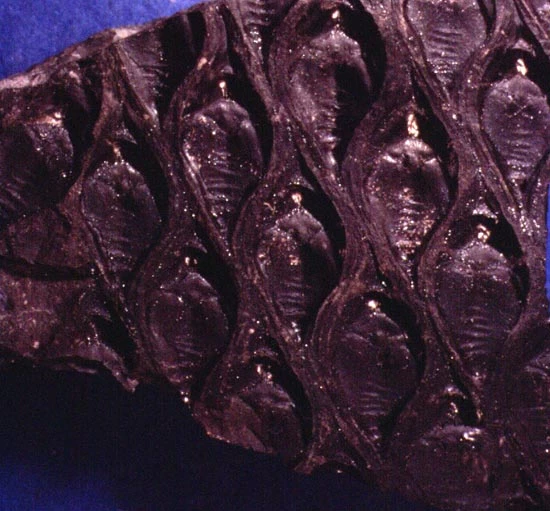
Bark from the trunk of a Late Carboniferous giant lycophyte

Bark from the trunk of a Late Carboniferous giant lycophyte, found at the Risca Colliery in south Wales. The diamond-shaped structures on the surface, which are about 1cm long and 0.5cm wide, are where the leaves were originally attached.

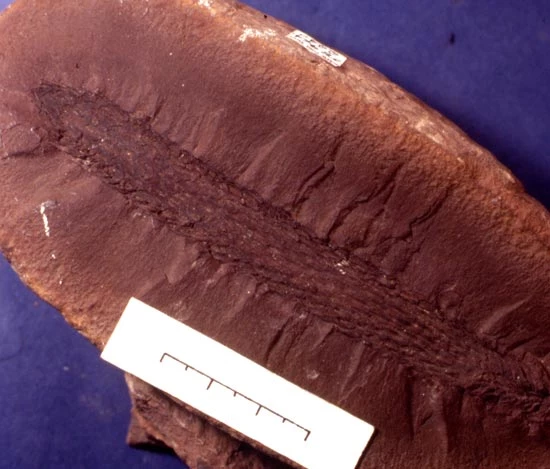
A cone from a Late Carboniferous giant lycophyte

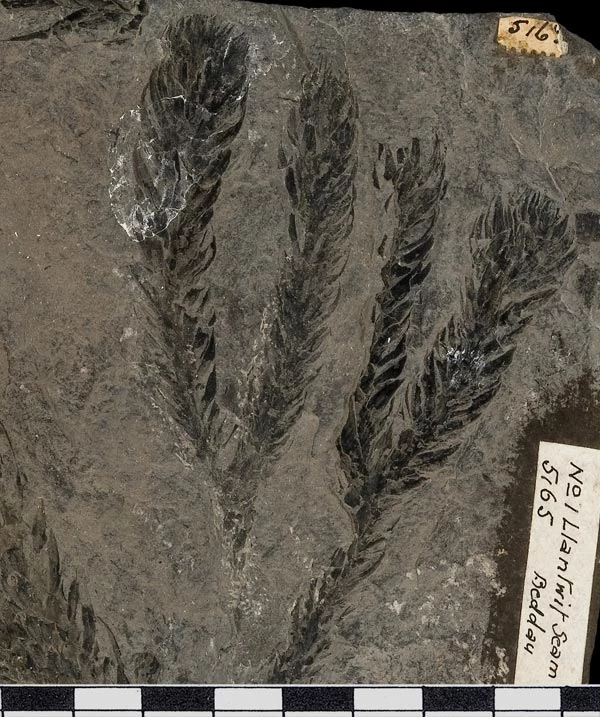
A cone from a Late Carboniferous giant lycophyte, found in an ironstone nodule in south Wales. These cones produced spores. The scale is marked in centimetres.

The leafy shoot of a giant lycophyte from the Upper Carboniferous Llantwit Beds of Beddau, south Wales.

The leafy shoot of a giant lycophyte from the Upper Carboniferous Llantwit Beds of Beddau, south Wales.

South Wales has the best-exposed coal-bearing rocks in Europe. Scientists at Amgueddfa Cymru are leading an international team of specialists investigating how the formation of this coal affected the composition of the ancient atmosphere.

What is coal?

Coal is what is left of peat when it has been compressed and heated, so that virtually all that remains is carbon.

The coalfields in Wales are the remains of part of a wetland forest that extended over large areas of the tropics, about 300 million years ago (the Late Carboniferous Period). These are known as the Coal Forests.

There is also evidence of extensive ice cover over much of the land around the southern pole at this time. This is in fact the only other time in the geological past, other than the last 2 million years or so, when there has been this combination of extensive tropical forests and polar ice. Looking at the Late Carboniferous world therefore provides valuable insights into how plants, climate and atmosphere might be interacting in our present-day world.

Plants of the Coal Forests

The Coal Forests were quite different from anything growing today. The main plants were tree-like lycophytes ('club mosses') that could grow up to 50m tall.

Unlike a modern tree, most of the trunk of these giant lycophytes did not consist of wood, but of soft cork-like tissue (periderm). This allowed the plants to grow to their full size in as little 10 years.

Also unlike modern trees, when these lycophytes had reached their full size, they reproduced by producing cones, and then died.

Life, death and carbon

Because these plants grew so quickly and then died, vast quantities of peat accumulated on the forest floor. This eventually formed the coal found in the coalfields of Wales and other parts of Europe, as well as North America and China.

All plants obtain carbon for growth from the atmosphere. These forests are thought to have been responsible for extracting nearly a hundred thousand-million tonnes (100 gigatonnes) of carbon from the atmosphere every year, and would have had a profound influence on the composition of the atmosphere during Carboniferous times.

The contraction of coal forests and global warming

The Coal Forests habitats remained essentially stable for about 10 million years. Then they contracted in size, probably due to changes in drainage patterns in the wetlands where they grew.

This coincided with a marked increase in global temperatures. Most notable was a significant contraction of the ice sheet in the southern polar regions, which has been recognized in the rocks of both Australia and Argentina.

It seems that the contraction of the Coal Forests caused the amount of carbon (as CO2) to build up in the atmosphere, and that this caused temperatures to increase through a greenhouse effect.

South Wales Coalfield

There are Late Carboniferous coalfields across Europe, North America and China. However, the South Wales Coalfield is particularly important as it shows one of the most complete successions of rocks in which the remains of the Coal Forests are preserved. It has also yielded an excellent fossil record of plants, as well as of animals including insects, spiders and freshwater molluscs.

It is also one of the few places in Europe where these rocks are exposed at the surface. In most other places, the geology of these coal deposits has to be investigated in underground mines — an increasingly difficult thing to do as mines are progressively closing.

The geological record of the South Wales Coalfield has therefore played an important role in developing our understanding of the evolution of the Coal Forests, especially through the work of Welsh geologists such as Emily Dix and David Davies in the 1920s and 1930s.

More recently, scientists at Amgueddfa Cymru have been investigating how the south Wales forests changed in composition with time. This has been done by looking at changes in species diversity in the plant fossil record, and at the evidence from pollen and spores extracted from the rocks.

This suggests that the Coal Forests were remarkably stable habitats for most of the time they existed in south Wales, at least until they contracted and caused the increase in global temperatures.

Further reading

  • Cleal, C. J. & Thomas, B. A. 1994. Plant fossils of the British Coal Measures. Palaeontological Association, London.
  • Cleal, C. J. & Thomas, B. A. 2005. Palaeozoic tropical rainforests and their effect on global climates: is the past the key to the present? Geobiology, 3, 13-31.
  • Thomas, B. A. & Cleal, C. J. 1993. The Coal Measures forests. National Museum of Wales, Cardiff.

The sound of the Neanderthals

Elizabeth Walker, 14 May 2009

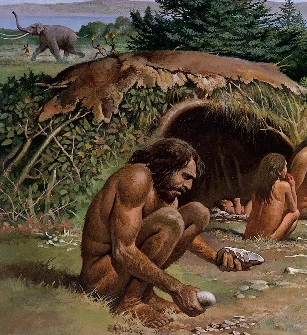
Reconstruction painting showing an Early Neanderthal Man.

Reconstruction painting showing an Early Neanderthal Man.

<em>Neanderthal</em> performance, National Museum Cardiff

The first live performance of Neanderthal at the National Museum Cardiff, February 2009.

Neanderthal remains dating back 230,000 years have been found at Pontnewydd Cave, Denbighshire in Wales. The teeth and stone tools provided the inspiration for composer Simon Thorne to create a soundscape, Neanderthal, to play in the galleries at Amgueddfa Cymru to bring otherwise silent displays to life

Neanderthals were an evolutionary dead-end, although modern humans such as ourselves shared a common ancestor with them some 600,000 years ago. They have the same inner ear and vocal structures as us, and therefore had the ability to create and hear sounds. It is possible, however, that Neanderthal brains worked in very different ways from ours. The links between different parts of the brain might not have been as fluid as they are in ours. They might not have been able to form language as a way to communicate.

Neanderthals might have had a better capacity than us to communicate and to express themselves through song. The soundscape Simon has created is based on the voice and recordings of natural sounds recorded during a visit to Pontnewydd Cave. These include the drips from the cave roof and the river flowing in the valley bottom. The sounds a Neanderthal heard would have included the communication of animals and bird song. Neanderthals would have made sounds themselves too. These would have included the chipping of stone tools; when flint is knapped (or struck) an unflawed nodule rings with a bright sound and the knapper knows whether the flint is suitable for making the flakes needed to create a stone toolkit. Neanderthals could use their voices; perhaps they sang their way through their landscapes and used sound to communicate to one another while hunting.

Neanderthal is pure imagination. However, it is based on science and helps to bring an otherwise silent museum display to life in new and exciting ways.

Article by: Elizabeth Walker, Curator of Palaeolithic and Mesolithic Archaeology

The Neanderthal soundscapes:


Download
  • [1mb, MP3]


Download
  • [64kb, MP3]