Sunday 8th July Chris Owen, 8 July 2007 Contributed by CAROLINEToday’s open day was a great success, there were many visitors to the site, of all ages. It was good to see familiar faces of those who had visited in previous year(s). The visitors brought good fortune to the site- marvellous sunshine; something which has been greatly missed this year at Llanmaes!We would like to thank those who cam to the site firstly for bringing us good weather and secondly for allowing us to share our excitement and interest of the past with a keen audience. We hope to see you again next year!
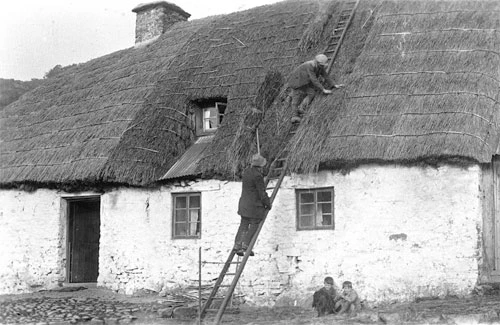
The disappearance of the rural Welsh cottage 6 July 2007 Mud walls and thatched roofs Today, hardly any rural cottages erected since before the middle of the eighteenth century survive in Wales — it was generally believed that the poor simply could not afford materials good enough to last. New research suggests that this is not the case. In fact, cottages were built with great ingenuity and attention to detail, using the best materials available locally. Examination of Welsh cottages and the study of contemporary surviving accounts by Amgueddfa Cymru have concluded that it was a lack of maintenance and, above all, changing fashions brought about by the Industrial Revolution that led to their disappearance. Sustainable construction Transporting materials cost money so traditional builders were expert at exploiting their local environment in a sustainable way. Cow dung, for instance, provided fertilizer for the fields, was used in the making of clay flooring, added to help bind cottage walls and also as a fire-retardant for chimneys made of woven wattle. Earth and turf As the poor could not afford bricks, cottage walls were built from stone, earth or timber. They used whatever they could most readily and cheaply get. In western lowland areas of Wales — Anglesey, Llŷn and west Wales — that was often earth. Few earth cottages survive in Wales today; many more can by found in the drier areas of England. In the very wet uplands, many turf-walled cottages were built, as turf lasted much longer than earth. Thatched roofs Up until the development of the great slate quarries of north Wales in the 19th century, and the coming of railways, thatch was a very common material. Today, very few thatched roofed buildings survive compared to in England. Four different thatching techniques were common in Wales; only one still survives today in eastern Wales. In west and north Wales the top coat of thatch was formed of knotted handfuls of straw thrust with a forked implement into a thick underthatch layer. The underthatch itself was often laid on a woven wattle foundation. In the most exposed areas, the roof could be held down by a network of ropes pegged to the walltop, or held down by heavy stones. Chimneys of straw and wattle Cottage floors were often earth or mud. Partitions could be made of woven wattle or straw rope, covered with daub. The smoke hood above the chimney-stack was also often of daubed wattle, as was the chimney stack itself; no wonder that so many of these cottages were destroyed by fire. But however sustainable the building materials used in these cottages, they fell prey to changes in society, and to fashion. Changing fashions With the growth of the Industrial Revolution, and the importation of food from abroad, more and more people left the countryside, most of them cottage dwellers. More and more cottages, too, became the property of great estates, who began building larger homes for their workers. It was often easier to demolish the early cottages than it was to give them a second storey or to adapt them. Today, traditional early cottages are rare survivals, and all the best remaining examples are listed as being of special architectural importance.
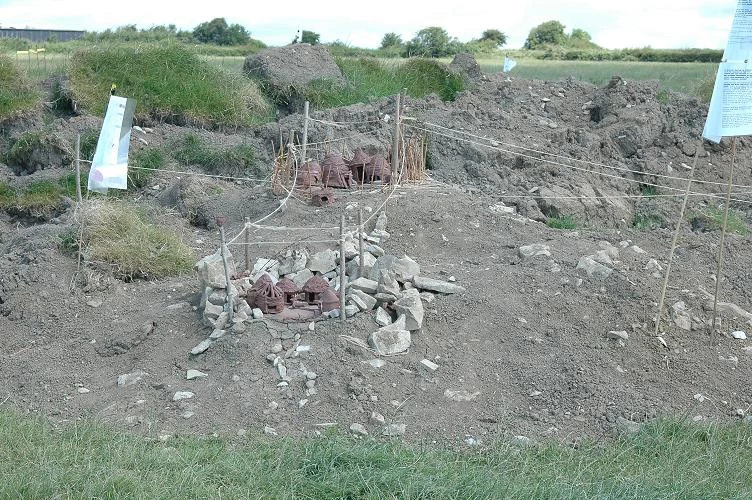
Friday 6th July Chris Owen, 6 July 2007 Contributed by CAROLINE and pupils of LLANTWIT MAJOR COMPREHENSIVE SCHOOLThe students visited the site as a geography field trip. However, it also it also covered subjects such as art, science, biology and history. Today the students were making clay huts replicating Iron Age Roundhouses. The students were shown around the site and shown post holes and a hearth forming a roundhouse as inspiration for their Iron Age roundhouses of clay.Last year (then in year 6 of primary school) the same students visted the site, looking at the spoil heap and sieving for finds. Today they were learning more in depth about the structural elements of Iron Age roundhouses, particularly their entrances and the positioning of the hearth in the centre of the roundhouse.The weather was particularly bad and a temporary hut was constructed using posts and tarpaulin. Unfortunately the archaeologists weren’t so lucky and had to continue digging in the rain while the comprehensive students made clay huts under shelter…Site visit was 2 hours long, involved a site tour and creative tasks. The students from this year’s year 7 are hoping to come again when in year 8.
Thursday 5th July Chris Owen, 5 July 2007 Contributed by CAROLINE and the pupils of ARCHDEACON JOHN LEWIS PRIMARY SCHOOLThe children have been working on a School Performance entitled “Rainbow people.” Today they performed to the archaeologists while they were on tea break. It is a story which is both appropriate for today and for societies in the past. The story taught us that race and religion is irrelevant that people can still be friends despite these small differences. The story is appropriate in the context of Llanmaes, with evidence of both Roman and Iron Age occupation. The inhabitants of Llanmaes would have been a mixture of Romans and natives and potentially integrated, hopefully relatively peacefully.The piece was performed twice, the first was narrated by the teacher and several of the school children.The children chant while banging buckets with wooden spoons:‘Green people are happy, blue people are sad Green people are good, blue people are bad’ (and vice versa for the blue people)To further strengthen the story’s connection with the excavation, the children played on buckets- a vital accessory for an archaeologist!The green people and the blue people disliked each other and were ignorant of each others ways and believed themselves to be better than others. However, when a younger member of the green group was hurt and helped by a young blue person, and the favour was later returned, the two young people realised the idiocy of disliking those from the other group. The younger generation taught the rest of society that they are wrong and that all people are equal and worthy of friendship and co-operation.The children then performed the story through the medium of dance accompanied by a musical score composed by a Welsh musician.The children were asked some questions about their performance and the archaeology at Llanmaes."What was the performance trying to teach us and how is it relevant to the Llanmaes excavation?"Emma“The play teaches us that friendship and working together is important. The performance of the Rainbow People helps to show that.”Hywel“The dig is like the play because the archaeologist work together, teamwork is important and they are unselfish like the people did at the end of the story.”Olivia“The play is like the dig because the archaeologists found places in their heart that made them want to work together as a team and not to be an outsider.”William2“The archaeologists like the Rainbow people came together as a group and formed bonds of friendship.”Ashton“The Rainbow People didn’t like each other nor did the Romans and the Celts until they joined together and worked together. The Romans came to the Celts land and had to get along with one another.”William2“The Celts and the Romans at first fought and bullied each other just and warred with one another, just as the Green and Blue people did.”"What message would you give to the Celts and the Romans?"James“Don’t be enemies.”William2“Don’t be nasty.”Hywel“It doesn’t matter if you are a different colour or follow a different religion, we are all one and are part of the same human family.”James“No one is better than anyone else.”Ashton“No one is really bad.”William2“Wealth is unimportant, Even if your people’s possessions seem nicer than other peoples’ it doesn’t make you better than them. The Romans had better weapons and pottery but are not better than the Celts.”"What did you think of the excavation? What did you like most about visiting an archaeological dig?"Olivia“I was excited, especially because they find lots of things.”William2“Amazed.”Hywel“I was frightened at the beginning, it’s a strange new place. But then interested after having looked around and learning about what is really happening.”Fabbio“It’s interesting to see what they did years ago.”Emma“I liked the dogs”"Would you like to be an archaeologist? Why?"William2“I would like to be an archaeologist because I like the Romans”Hywel “I’d like to be an archaeologist so that I could find out what happened before Jesus Christ.” William1“In one way yes I’d like to be an archaeologist because you get to find out what happened before Jesus Christ, in another way no I would not like to be an archaeologist because you can hurt yourself.” (even though he plays rugby)Josh“You can hurt yourself if you’re an archaeologist because sharp objects are dangerous”James“I don’t want to be an archaeologist because it takes too long to dig and is very hard work”Grace“To be an archaeologist you need lots of patience”Hywel“I’d like to be an archaeologist to be famous and in a magazine.”William2“I’d like to find out what the Romans had.”Olivia“The farmer is also famous because he has an archaeological dig on his farm.”James“I’d like to be an archaeologist because it is really exciting”

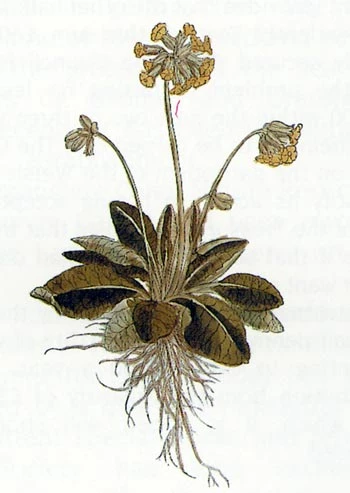
Early herbals - The German fathers of botany John R. Kenyon, 4 July 2007 Amgueddfa Cymru has a number of pre-1701 books in the Museum's Library, including two incunables (books printed before 1501) of Pliny's writings on natural history from 1481 and 1487. The cowsip as depicted in Fuchs's De Historia Stirpium Part of an early German herbal annotated in Welsh and English, once in the possession of Morris Owen. There are also a number of 16th- and 17th-century 'herbals' in the collection. Among these are examples of the works of three men who have been described as the 'German fathers of botany', namely Hieronymous Bock (1498-1554), Otto Brunfels (1489-1534) and Leonhard Fuchs (1501-1566). Herbals Printed herbals give details of plants along with what illness each one could cure. What made the work of these three men stand out in particular is that many of the descriptions and illustrations of the flowers in their books were, on the whole, based on first-hand evidence in the field, and not copied from other writers. Hieronymous Bock (1498-1554) As Bock's herbal of 1539 was unillustrated, it forced him to provide detailed and accurate descriptions. The Museum holds a later, illustrated edition, from 1552. Although the opening pages are missing, the main body of the text is complete, along with fine hand-coloured illustrations. Most of the woodcuts simply show the plants themselves, but occasionally birds and man are shown, such as the rather crude depiction of the effects on eating a fig! Otto Brunfels (1489-1534) The work of Otto Brunfels in the Library is the second volume of Herbarum Vivae Eicones (1531). The title translates as 'living picture of plants' and the author was one of the first to turn to nature itself as the source of his illustrations for a book. Leonhard Fuchs (1501-1566) The Library holds two books compiled by Fuchs, namely De Historia Stirpium (1542) and Plantarum Effigies (1549). Although only some of the descriptions of the plants are by Fuchs, the majority being taken from other books, it is the quality of the illustrations that makes this herbal one of the great books of the 16th century. The Plantarum Effigies is a pocket-sized version of the 1542 volume to be used in the field; it has very little text, apart from an index to the plants depicted, and with each woodcut the name of the plant is given in three or more languages, usually five (Greek, Latin, French, Italian and German). Other great herbals of the same period are housed in the Library of Amgueddfa Cymru, notably the works of Rembert Dodoens (1516-1585) and John Gerard (1545-1612). Rembert Dodoens (1516-1585) Dodoens' herbal was published in Flemish in 1554. The Museum holds the first English edition of 1578 translated by Henry Lyte, including new material which Dodoens himself had sent to Lyte for incorporation in the new edition. John Gerard (1545-1612) One of the most famous herbals written in English is Gerard's The Herball (1597). Head gardener to many properties in and around the London area, Gerard was also responsible for the gardens of William Cecil, Lord Burghley, Elizabeth l's Secretary of State and Lord Treasurer, and it was to Cecil that Gerard dedicated his great work. The Library has a copy of the 1633 edition, along with the original work itself. Other herbals in the collection include an incomplete German example dating to the first half of the 16th century. It was once in the possession of a Morris Owen of Caernarfonshire who added in ink, around 1767, the names of the various plants in Welsh; the English equivalents are also given in most cases. This book, and the other herbals, remain of great interest to this day, and are examined in particular by those who study the history of botany and pharmacy, as well as by students of the history of the printed book.