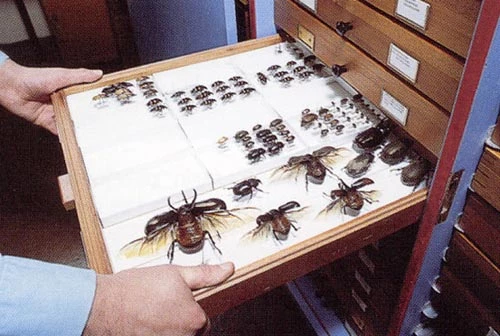
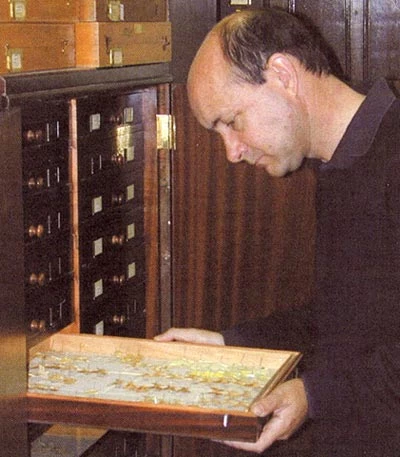
Building the most important Welsh insect collection in Britain 11 April 2007 The death of Joan Morgan, in Bangor in 1998, ended a remarkable life in entomology [the study of insects] and resulted in a major acquisition of more than 50,000 specimens for Amgueddfa Cymru. Mike Wilson, head of entomology at Amgueddfa Cymru inspecting the Bangor collection Changes to teaching in British universities over the last thirty years has resulted in many teaching collections being gradually broken up or discarded. Sometimes, these important university teaching collections have been built up over many years by dedicated individuals interested in teaching and research. Joan Morgan Joan Morgan moved to Bangor in 1953, teaching full-time at the University College, Bangor. For over forty years she was an enthusiastic field worker, collecting thousands of specimens, particularly from north Wales, building up an impressive insect collection at the university. The collection's importance cannot be over-emphasized. It provides evidence of many species at many locations, along with reference material and around 60,000 card based records. On retirement, Joan Morgan continued to maintain and add to the collection. After her death, the college agreed that the collection should be transferred to Amgueddfa Cymru. The collection contains around 50,000 specimens, mostly British, and covers all groups of insects, including an excellent representation of specimens from north Wales. After a quarantine period in a freezer the specimens were successfully integrated into the entomology collections at the Museum. This helped the Museum create the most important collection of Welsh insects in Britain. It is a very valuable resource for research by scientists worldwide.
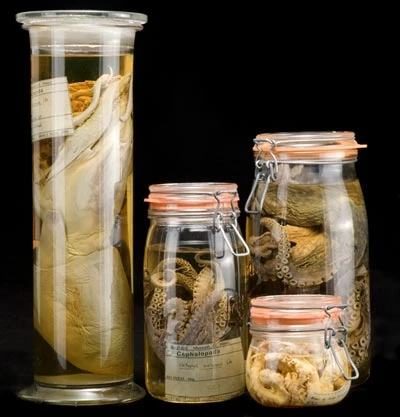
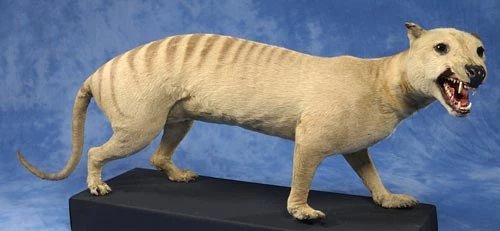
Looking after DNA in Natural Science Collections 5 April 2007 Fluid preserved specimens over a hundred years old and are a potential source of DNA studies. The Extinct Tasmanian Wolf. DNA extracted from the skin of Museum specimens has been used to study the relationship of the Tasmanian Wolf to other marsupial animals. Historic insect collections are a valuable source of future genetic studies. The growing crisis in the world's biodiversity has created new demands on the biological collections held in museums. In addition, modern techniques are allowing us to look at our collections in new ways such as analysis of DNA (Deoxyribonucleic acid). It is now possible to extract and read the DNA from museum specimens but this can depend on how they have been stored and preserved. Irreplaceable collections Over three million biological specimens are housed at Amgueddfa Cymru. As the pressure on our natural environment increases, these collections are becoming an ever more important resource. Many of the species collected are now either extinct or so highly endangered that further collection is not possible. Many of these specimens are irreplaceable and vital in helping us understand biodiversity and climate change. Preserving biological material can be very difficult. Biological material, including DNA, decays rapidly. Chemical treatments are aimed at preventing this decay, allowing the long-term preservation of biological specimens. Early preservation Preserve museum specimens date back over 300 years. Initially only dry and inert specimens could be preserved. Alcohol was first used in the 17th Century, formaldehyde (formalin) was introduced in the 19th Century. These methods enabled a wide range of specimens to be preserved - but were developed before DNA was known about. It can be very difficult to obtain DNA from specimens preserved using formalin. Other chemicals, such as ethanol (alcohol), are useful in the preservation of both the specimen and its DNA. Using DNA from the collections DNA can be used in many areas of study, such as work on evolution, species identification, and ecology. DNA studies at Amgueddfa Cymru include: Researching Hunter snails from East Africa and using DNA to study how they are related to each other. Freshwater pearl mussels are highly endangered in Wales. Museum researchers are using DNA to look at the genetics of the remaining populations to help in their conservation. Lichens are an important aspect of biodiversity, but difficult to identify. DNA is being used to help identify lichens. DNA - a fragile resource Unfortunately DNA can be damaged in many ways. Following the death of an organism, DNA molecules break down very quickly. This means that careful and quick conservation of specimens is needed to ensure the preservation of the DNA as well as the specimen as a whole. The museum is involved in researching methods of DNA preservation. One method is storage in -80°C freezers or liquid nitrogen. Some museums have already set up frozen-tissue banks, but these methods are expensive. Ongoing research aims to improve our understanding of the effects of these treatments, helping us keep our specimens DNA intact for the future.