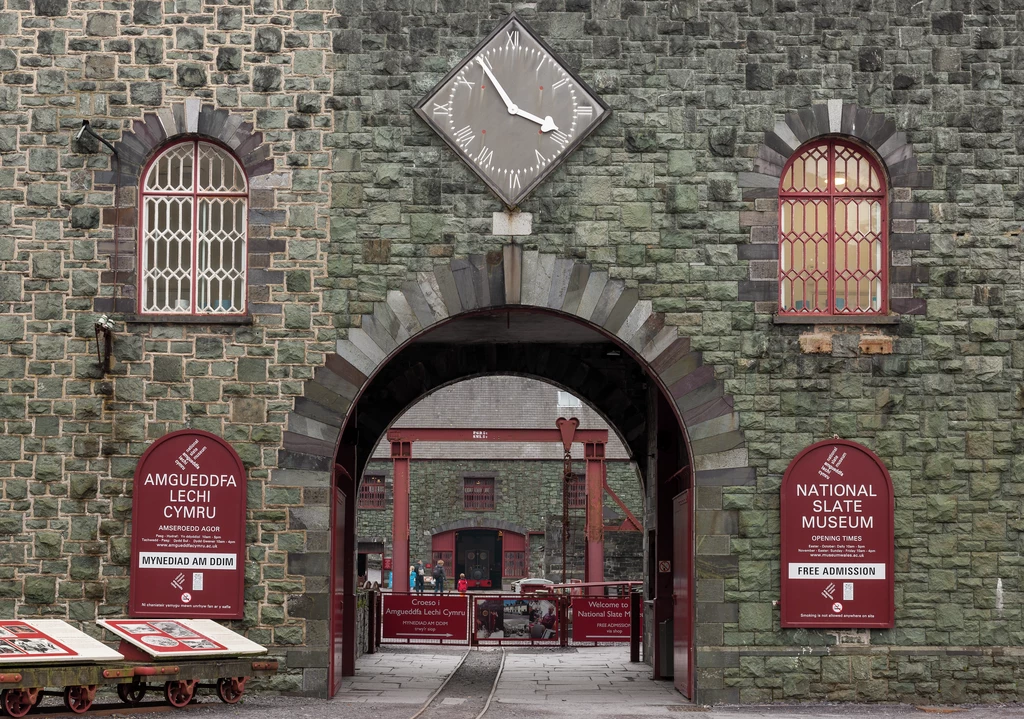
The old clock at the National Slate Museum in Llanberis, north Wales
22 February 2007

The clock above the entrance to the Welsh Slate Museum
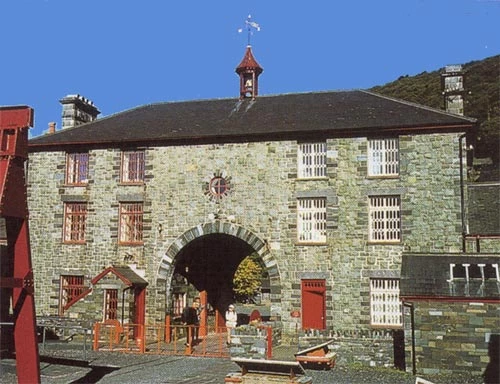
A distinctive feature of the National Slate Museum building is the diamond-shaped face of a clock on the front of the Museum. On the roofline above it is a small pagoda-like structure containing a bell and hammer, connected to the clock by a wire rope.
The mechanism is installed on the second floor of the building. It was manufactured in Shropshire but it is not possible to read the date. Early photographs of the building, erected in 1870, do not show the clock, so it was probably not installed until the mid-1890s
Timekeeper for quarry explosions
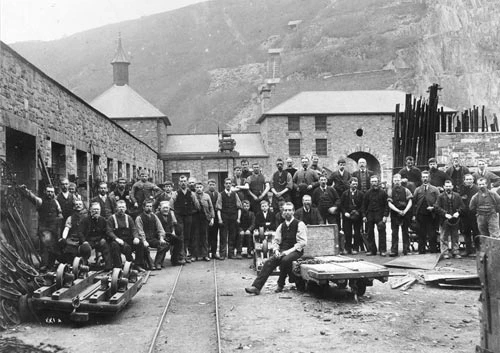
The Museum is located within the Victorian workshops of the Dinorwig Quarry. The clock helped ensure the trains taking slate from the quarry to the Company's port at Port Dinorwic were always on time. The clock was more than simply a timekeeper for the workshops though. At some stage in its life, a series of electrical connections were added. At set intervals the clock transmitted an electrical signal to other parts of the Quarry's large site. This was to ensure that blasting happened on time. Such systems were usually marketed as 'pulsynetic clocks'. They were sold by well-known makers such as Gent, Leicester. At Dinorwig, however, a home-made, reliable solution was produced.
100-year-old graffiti
A power supply was required to provide the electrical signals. This was supplied via wet cells, or accumulators, stored alongside the clock. One of the discoveries made when renovating this part of the building, in the mid-1990s, was the original graffiti on adjacent walls and panels noting the dates of battery charges. On June 10, 1909, for example, Willie Owen Williams and George Hughes charged the batteries.
Cleaning the clock
Although well cared for over the years, by 2001 the clock required specialist attention. J.B. Joyce and Company, the manufacturers, were still in existence. They were established at Whitchurch in Shropshire, and are still there over three hundred years later. Unfortunately, they have no records of individual clocks manufactured, but were prepared to visit the Museum to inspect the clock. The mechanism ended up being returned to the Joyce workshops where it was cleaned and serviced. The clock was then reassembled, brought back to the Museum and commissioned. Today the clock works smoothly and to a good degree of accuracy.
Village timekeeper
At a time when few people possessed watches, the clock installed in the Dinorwig Quarry workshops was a timekeeper for its surrounding community, with its bell being audible to most of those living in and around Llanberis. To quote one local author:
'Torrai ar y distawrwydd yn nhrymder nos, a chlywyd aml i glaf yn cwyno yn y bore,"Chysgis i ddim gwerth neithiwr - clywed yr hen gloc yn taro pob awr nes iddi 'leuo"'
(It relieved the silence of the depth of night, and quite frequently one would hear of those who were unwell complaining the next morning, "I didn't sleep well last night - I could hear the old clock striking each hour until it dawned".)
The old clock continues to measure the passage of time into the 21st century at Llanberis.