: Mining & Extraction

Welsh miners digging for victory on the Western Front

Edward Besly, 1 October 2009

The trenches of World War 1

Medals awarded to Captain (later Major) Arthur Edwards.

Military Cross (1915), 1914 Star, British War Medal and Allied Victory Medal awarded to Captain (later Major) Arthur Edwards.

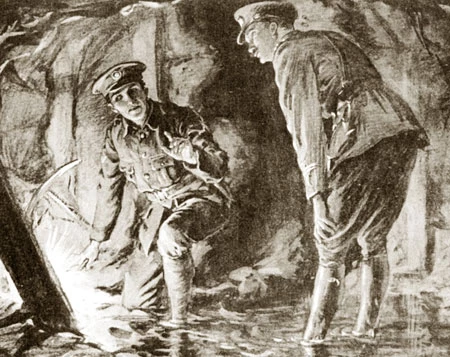
Artists' impressions of Edwards' mining exploits

Artists' impression of Edwards' mining exploits. From Deeds that Thrill the Empire, by courtesy of Dix Noonan Webb.

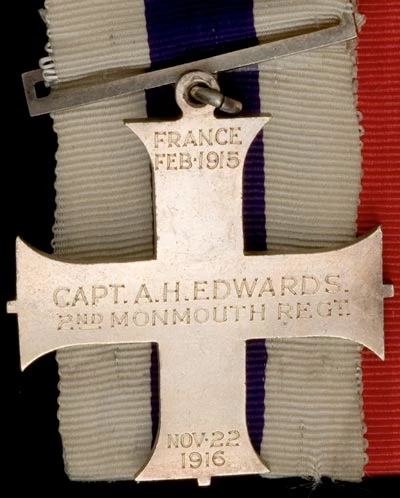
Details of the award engraved on the back.

Many recipients of the Military Cross arranged to have details of the award engraved on its back.

Captain Arthur Edwards from Blaenafon in south Wales oversaw the explosion of the first British mine on the Western Front in March 1915.

The First World War (1914-18) is famous for the trench warfare of the Western Front in France and Flanders. Huge armies faced each other in horrible conditions, preparing for the next big battle intended to break the stalemate.

Tunnelling and mining on both sides formed a significant part of this trench warfare, as each side tried to gain an advantage. Tunnels were dug underneath "no man's land" and under the enemy's trenches. They were then packed with explosives and detonated.

The dry chalk of the Somme was especially suited to mining, but it was also possible to mine in the sodden clay of Flanders. The experience and skills of Welsh miners played an important part in the construction of these mines.

Fighting the war underground

It was all started by Captain Arthur Edwards, a mining engineer who served in the 2nd Battalion of the Monmouthshire Regiment. In December 1914 the 4th Divisional Mining Party was formed, under Edwards' command.

In March 1915, after two months of tunnelling under enemy lines, the tunnels were evacuated, packed with explosives and detonated. The huge explosion caused buildings above ground to be destroyed — the tunnels were under buildings that were being used by enemy snipers.

On another occasion, German miners, tunnelling in one direction, broke into allied tunnels being dug in the opposite direction, resulting in fierce hand-to-hand fighting underground.

A Badge of Honour

In June 1915 Captain Arthur Edwards was awarded the Military Cross, a newly introduced decoration for captains and junior officers. He was also twice mentioned in despatches for gallant and distinguished service. He served through the War, including the first day of the Battle of the Somme (1 July 1916) before being badly wounded by a gas shell in June 1918.

His medals were acquired by Amgueddfa Cymru in 2006. 

Article by: Edward Besly, Numismatist, Department of Archaeology & Numismatics. Amgueddfa Cymru.

The Miners' Strike - 1984-85

23 September 2009

The coal industry underwent great changes following nationalisation in 1947. Considerable investment was ploughed into the industry by the government allowing new equipment and mining techniques to be introduced. Until the mid 1950s, levels of employment and production remained steady but, with the decline in the demand for coal and the challenge from Middle East oil, 50 collieries were closed in south Wales between 1957 and 1964.

During the 1970s, the industry was hit by two major strikes. In 1972 Conservative Prime Minister Edward Heath caved in when the miners went on strike for more pay. When another miners' strike began in 1974, Mr Heath called a snap general election hoping to rally public support against the miners. But the public vote went against him resulting in victory for the Labour Party.

By the 1980s the British coal industry was one of the safest and most efficient in the world. However, the new Conservative government under Margaret Thatcher wanted to make industry more efficient by slimming down what they regarded as unprofitable industries. Under her leadership, many former state run industries like gas, water and the railways were transferred to private sector ownership i.e. they were privatised. British Telecom was the first service provider to be 'de-nationalised' in 1984, followed by many others in subsequent years. At the same time she wanted to weaken the power of the trade union movement which she believed had become too powerful. This agenda put the Conservative government on a collision course with the National Union of Mineworkers (NUM). Incidentally, the NCB became British Coal in 1987, in readiness for privatisation which occurred in 1994.

Download the PDF here [3.3MB]

Dinorwig '69: End of the line for one of the largest slate quarries in the world

22 August 2009

End of the line

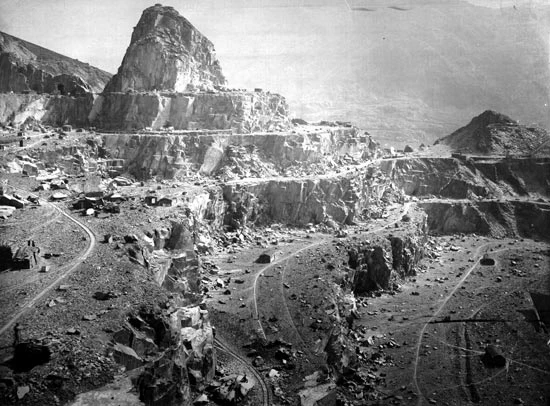
Black and white photograph of Dinorwig Quarry

Dinorwig Quarry. With the dawn of the Industrial Revolution slate was used to cover the roofs of factories and houses throughout Britain, mainland Europe as well as towns in North America and other parts of the world.

On 22nd August 1969 silence came to Dinorwig Quarry. After almost 200 years of hard toil, the quarry was closed and the men were sent home for the last time.

Not only did 350 men lose their jobs but a quarrying community and a way of life that had existed since the 1780's changed forever.

Everyone in the area had lived in the shadow of Dinorwig Quarry all their lives. Everyone had a father, grandfather, husband, uncle or brother who had worked there. A century earlier, closure would have been unimaginable. Dinorwig was one of the two largest slate quarries in the world ‐ and, along with its neighbour at Penrhyn, Bethesda, could produce more roofing slates in a year than all other combined slate mines and quarries world-wide.

Old quarrying methods

This is a clip from the first audio film in Welsh, Y Chwarelwr (The Quarryman), made in 1935. There is no sound in this piece as only some of the film survived, and the sound was recorded on disks separate from the film itself. © Urdd Gobaith Cymru.

Why did the quarry close?

Quarrymen at Dinorwig Quarry.

Quarrymen at Dinorwig Quarry.

Dinorwig Quarry's demise didn't happen overnight. Things hadn't been going well for a number of years for various reasons:

  • there was less demand for slate in the UK during the 20th century;
  • Welsh slate was expensive compared to roofing tiles and slate from overseas;
  • the quarry owners were competing against one another for a share of a fairly small market;
  • Dinorwig Quarry hadn't been developed effectively. The slate that was easy to get at had been quarried by the 60s and investment was needed to develop further. The quarry owners didn't have the money for this investment. One of their mistakes was to invest heavily in Marchlyn Quarry, but this part of the mountain didn't make them any money. There was no slate worth working there at all;
  • by the late 1960s, the quarry depended on orders from France to survive. In July 1969, these orders stopped. The final nail in the coffin.

By the 1960s, the slate industry in general was facing an uncertain future.

What next?

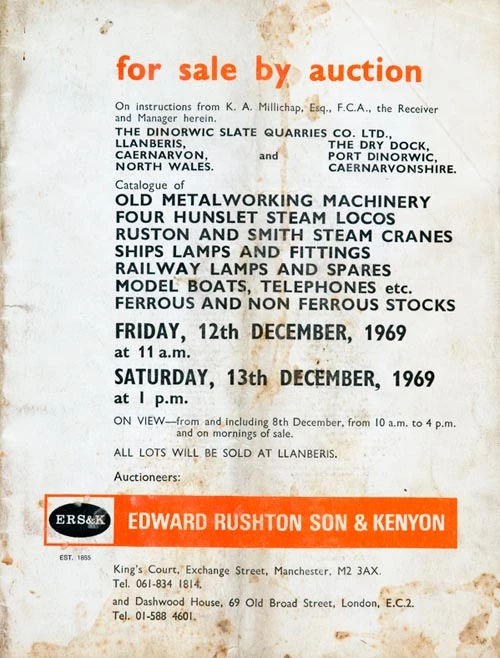
Dinorwig Quarry auction catalogue

Dinorwig Quarry auction catalogue. December 1969

Many of the 350 who lost their work found other jobs, some locally, at Ferodo and Peblig Mills, others further afield at Dolgarrog, Trawsfynydd and Holyhead. Others went even further to find work — to Corby, the relatively new steel town in Northamptonshire.

October and December, 1969 saw the auctions — selling off anything and everything that was worth carrying from the workshops. Fortunately for us, here at the Museum, Hugh Richard Jones, Dinorwig Quarry's Chief Engineer, ensured that not everything was sold. With the help of like-minded visionaries, he was instrumental in ensuring that the water wheel wasn't broken up and taken away and in preserving the machinery in the workshops.

Three years following the closure of Dinorwig Quarry, in 1972, the National Slate Museum was opened at Gilfach Ddu, and Hugh Richard Jones became its first manager.

Minerals first discovered in Wales

Tom Cotterell, 29 June 2009

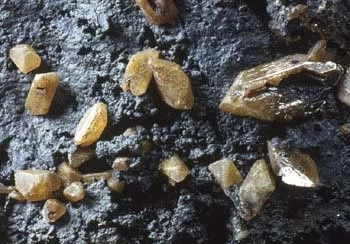
Anglesite

Anglesite crystals up to 10 mm in length from the type locality at Parys Mountain, Anglesey. Photo M.P. Cooper.

brookite

A 20 mm wide crystal of brookite from the type locality at Prenteg, Gwynedd. Photo M.P. Cooper

cymrite

Scanning electron micrograph of prismatic cymrite crystals from the type locality at Benallt mine, Rhiw, Pen Llŷn, Gwynedd.

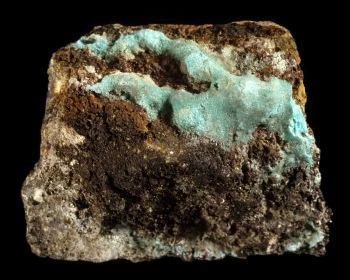
dickite

Powdery dickite coating dolomite from the type locality at Trwyn-Bychan, Anglesey. Photo M.P. Cooper

namuite

The type specimen of namuwite from Aberllyn mine, Betws-y-coed, Gwynedd.

Over 430 different mineral species occur in Wales, approximately ten percent of all those known. Eleven minerals were first discovered in Wales and have been named after famous Welsh geologists, mineralogists, places and even the Museum itself. These are:

  • anglesite
  • banalsite
  • brammallite
  • brinrobertsite
  • brookite
  • cymrite
  • dickite
  • lanthantite-(ce)
  • namuwite
  • pennantite and
  • steverustite

Brookite, an oxide of titanium, was first discovered in north Wales in around 1809. It was named in 1825 in honour of the British crystallographer and mineralogist, Henry James Brooke (1771-1857) by the French mineralogist Armand Lévy.

In 1783 Reverend William Withering described a new species, plumbum (lead) mineralized by vitriolic acid and iron, occurring in, "immense quantity in the island of Anglesea". The name, anglesite, was later proposed for lead sulphate by the French mineralogist Francois Sulpice Beudant in 1832, in recognition of the original locality, and this name has been used ever since.

In 1930 a new clay mineral dickite was named in honour of the Scottish metallurgical chemist, Allan Brugh Dick (1833-1926) who had published a detailed account of its properties on material from Trwyn-Bychan, Anglesey.

Another clay mineral, brammallite, named after Alfred Brammall (1879-1954), formerly of the Department of Geology, Imperial College, London, was described in 1943 from Llandebie, Carmarthenshire.

During the 1940s extensive research was carried out at the manganese mines at Rhiw, Llŷn Peninsula, Gwynedd, where several new species were discovered at the Benallt mine. The first, banalsite, was named from its composition, barium (Ba), sodium (Na), aluminium (Al), silicate (Si).

The famous Welsh naturalist Thomas Pennant (1726-1798) was recognised in 1946 with a manganese chlorite mineral, pennantite. A new hydrated barium feldspar was named cymrite for Wales in 1949.

In 1982, a new zinc copper sulphate hydroxide hydrate was identified on an old museum specimen collected from the Aberllyn mine, near Betws-y-coed. It was given the name namuwite after the National Museum of Wales where the specimen is housed. The naming of a mineral after an institution is now considered inappropriate, but the name stands, making this a very unusual mineral.

In 1985 a new cerium-dominant lanthanite from Britannia mine on Snowdon, was described and named lanthanite-(Ce) .

A new clay mineral found near Bangor in Gwynedd was named brinrobertsite in 2002, in honour of Brinley Roberts of the University of London, who has published widely on the geology of North Wales.

The latest mineral to be discovered in Wales is a rare lead thiosulphate formed within mine dumps at a number of sites in Central Wales. It was named steverustite, in 2009, in honour of its discoverer, Steve Rust, a micromineral collector who has dedicated much of his life to identifying unusual post-mining minerals in the Central Wales Orefield.

To find out more about these and other Welsh minerals look at Amgueddfa Cymru's

Mineralogy of Wales website.

How coal cooled the climate 300 million years ago

Christopher Cleal, 1 June 2009

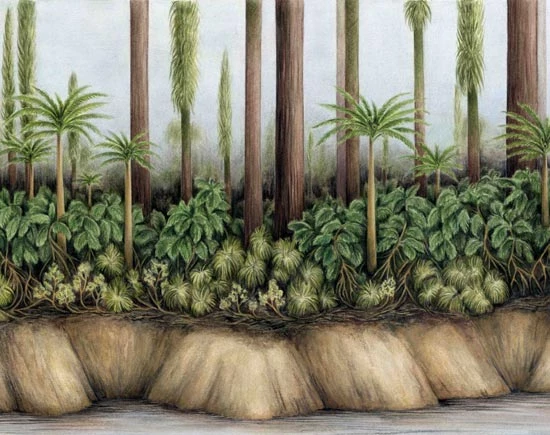
Reconstruction of the levee of a river that flowed through the tropical wetlands 300 million years ago

Reconstruction of the levee of a river that flowed through the tropical wetlands 300 million years ago. The plants growing on these levees are often found as fossils in the rocks associated with coals in Wales. Painting: Annette Townsend.

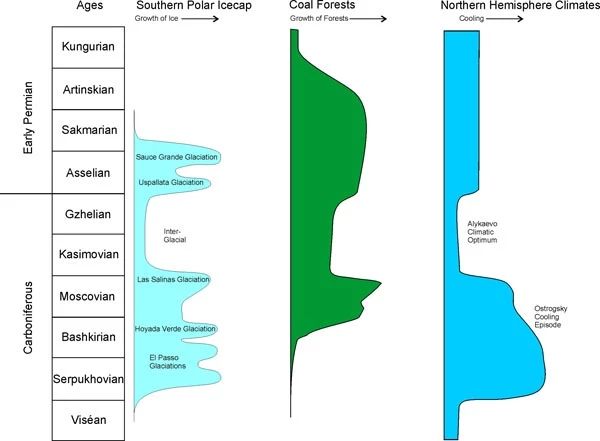
Coal Forests varied with time

A comparison of how the area of coverage of the Coal Forests varied with time with evidence of changing climate in late Carboniferous and early Permian times.

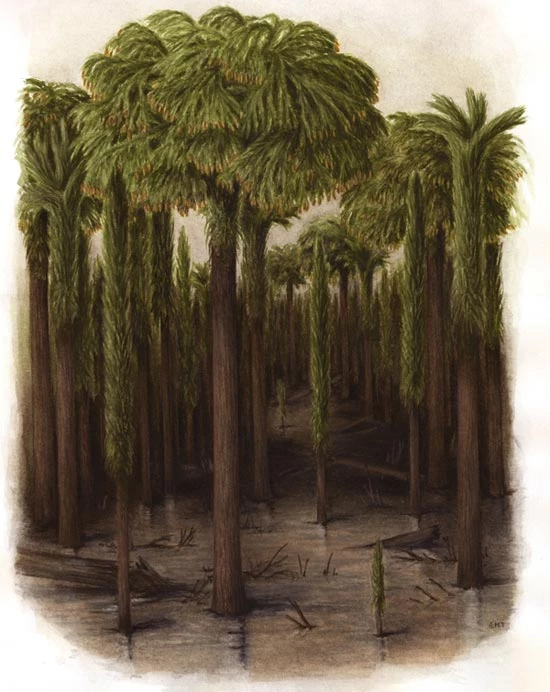
Reconstruction of giant lycophytes growing in tropical wetlands of Wales, about 300 million years ago.

Reconstruction of giant lycophytes growing in tropical wetlands of Wales, about 300 million years ago. Note that there are plants in different stages of their life-cycle. Painting by Annette Townsend.

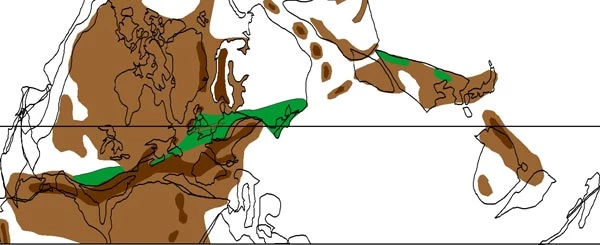
A map of the tropical lands about 300 million years ago

A map of the tropical lands about 300 million years ago, showing mountains (dark brown), lowlands (light brown) and wetlands where peat was being deposited (green).

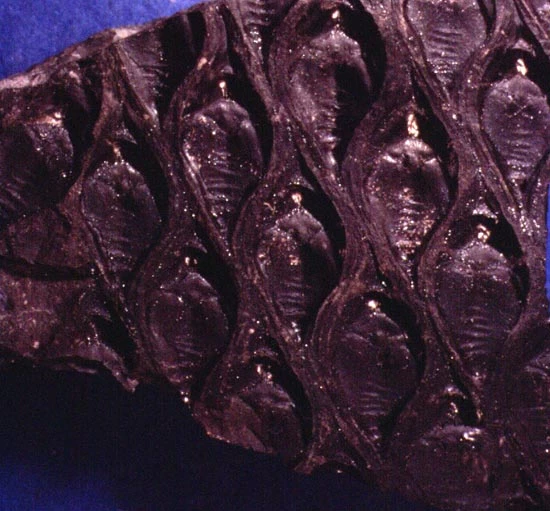
Bark from the trunk of a Late Carboniferous giant lycophyte

Bark from the trunk of a Late Carboniferous giant lycophyte, found at the Risca Colliery in south Wales. The diamond-shaped structures on the surface, which are about 1cm long and 0.5cm wide, are where the leaves were originally attached.

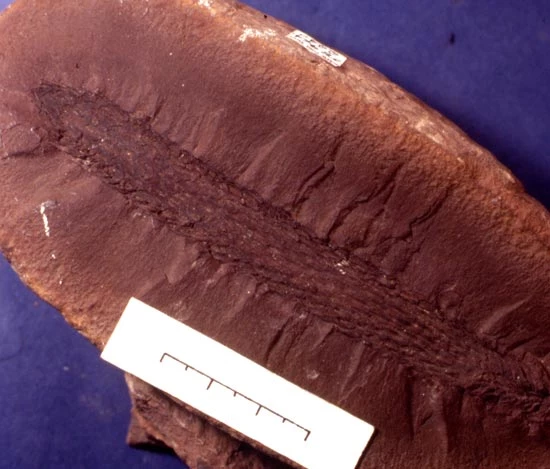
A cone from a Late Carboniferous giant lycophyte

A cone from a Late Carboniferous giant lycophyte, found in an ironstone nodule in south Wales. These cones produced spores. The scale is marked in centimetres.

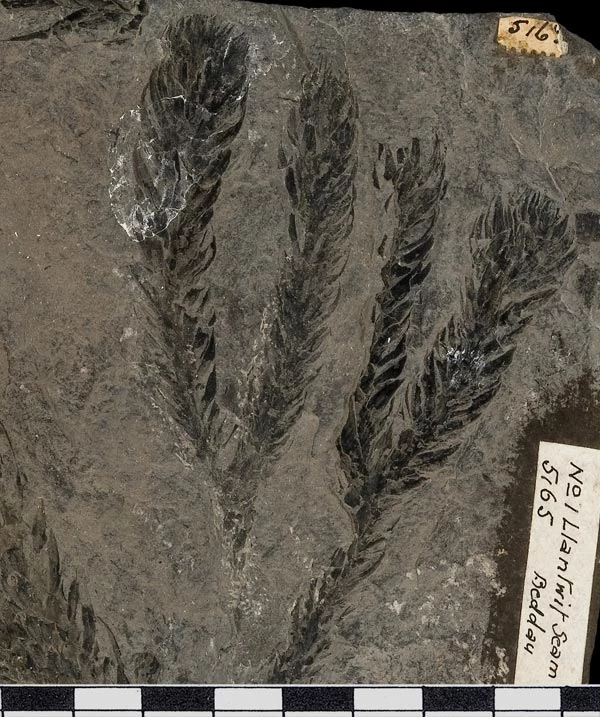
The leafy shoot of a giant lycophyte from the Upper Carboniferous Llantwit Beds of Beddau, south Wales.

The leafy shoot of a giant lycophyte from the Upper Carboniferous Llantwit Beds of Beddau, south Wales.

South Wales has the best-exposed coal-bearing rocks in Europe. Scientists at Amgueddfa Cymru are leading an international team of specialists investigating how the formation of this coal affected the composition of the ancient atmosphere.

What is coal?

Coal is what is left of peat when it has been compressed and heated, so that virtually all that remains is carbon.

The coalfields in Wales are the remains of part of a wetland forest that extended over large areas of the tropics, about 300 million years ago (the Late Carboniferous Period). These are known as the Coal Forests.

There is also evidence of extensive ice cover over much of the land around the southern pole at this time. This is in fact the only other time in the geological past, other than the last 2 million years or so, when there has been this combination of extensive tropical forests and polar ice. Looking at the Late Carboniferous world therefore provides valuable insights into how plants, climate and atmosphere might be interacting in our present-day world.

Plants of the Coal Forests

The Coal Forests were quite different from anything growing today. The main plants were tree-like lycophytes ('club mosses') that could grow up to 50m tall.

Unlike a modern tree, most of the trunk of these giant lycophytes did not consist of wood, but of soft cork-like tissue (periderm). This allowed the plants to grow to their full size in as little 10 years.

Also unlike modern trees, when these lycophytes had reached their full size, they reproduced by producing cones, and then died.

Life, death and carbon

Because these plants grew so quickly and then died, vast quantities of peat accumulated on the forest floor. This eventually formed the coal found in the coalfields of Wales and other parts of Europe, as well as North America and China.

All plants obtain carbon for growth from the atmosphere. These forests are thought to have been responsible for extracting nearly a hundred thousand-million tonnes (100 gigatonnes) of carbon from the atmosphere every year, and would have had a profound influence on the composition of the atmosphere during Carboniferous times.

The contraction of coal forests and global warming

The Coal Forests habitats remained essentially stable for about 10 million years. Then they contracted in size, probably due to changes in drainage patterns in the wetlands where they grew.

This coincided with a marked increase in global temperatures. Most notable was a significant contraction of the ice sheet in the southern polar regions, which has been recognized in the rocks of both Australia and Argentina.

It seems that the contraction of the Coal Forests caused the amount of carbon (as CO2) to build up in the atmosphere, and that this caused temperatures to increase through a greenhouse effect.

South Wales Coalfield

There are Late Carboniferous coalfields across Europe, North America and China. However, the South Wales Coalfield is particularly important as it shows one of the most complete successions of rocks in which the remains of the Coal Forests are preserved. It has also yielded an excellent fossil record of plants, as well as of animals including insects, spiders and freshwater molluscs.

It is also one of the few places in Europe where these rocks are exposed at the surface. In most other places, the geology of these coal deposits has to be investigated in underground mines — an increasingly difficult thing to do as mines are progressively closing.

The geological record of the South Wales Coalfield has therefore played an important role in developing our understanding of the evolution of the Coal Forests, especially through the work of Welsh geologists such as Emily Dix and David Davies in the 1920s and 1930s.

More recently, scientists at Amgueddfa Cymru have been investigating how the south Wales forests changed in composition with time. This has been done by looking at changes in species diversity in the plant fossil record, and at the evidence from pollen and spores extracted from the rocks.

This suggests that the Coal Forests were remarkably stable habitats for most of the time they existed in south Wales, at least until they contracted and caused the increase in global temperatures.

Further reading

  • Cleal, C. J. & Thomas, B. A. 1994. Plant fossils of the British Coal Measures. Palaeontological Association, London.
  • Cleal, C. J. & Thomas, B. A. 2005. Palaeozoic tropical rainforests and their effect on global climates: is the past the key to the present? Geobiology, 3, 13-31.
  • Thomas, B. A. & Cleal, C. J. 1993. The Coal Measures forests. National Museum of Wales, Cardiff.