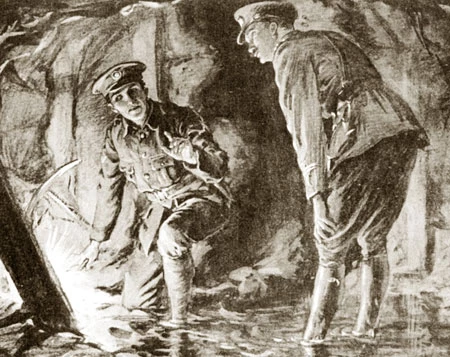
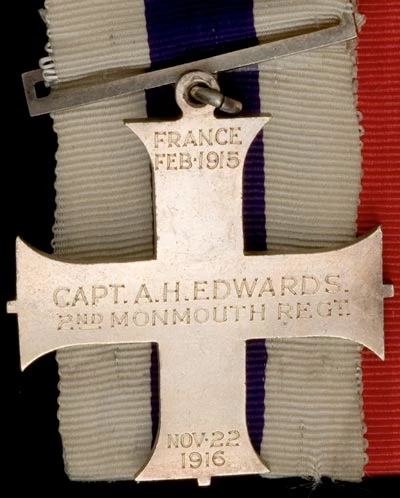
Welsh miners digging for victory on the Western Front Edward Besly, 1 October 2009 The trenches of World War 1 Military Cross (1915), 1914 Star, British War Medal and Allied Victory Medal awarded to Captain (later Major) Arthur Edwards. Artists' impression of Edwards' mining exploits. From Deeds that Thrill the Empire, by courtesy of Dix Noonan Webb. Many recipients of the Military Cross arranged to have details of the award engraved on its back. Captain Arthur Edwards from Blaenafon in south Wales oversaw the explosion of the first British mine on the Western Front in March 1915. The First World War (1914-18) is famous for the trench warfare of the Western Front in France and Flanders. Huge armies faced each other in horrible conditions, preparing for the next big battle intended to break the stalemate. Tunnelling and mining on both sides formed a significant part of this trench warfare, as each side tried to gain an advantage. Tunnels were dug underneath "no man's land" and under the enemy's trenches. They were then packed with explosives and detonated. The dry chalk of the Somme was especially suited to mining, but it was also possible to mine in the sodden clay of Flanders. The experience and skills of Welsh miners played an important part in the construction of these mines. Fighting the war underground It was all started by Captain Arthur Edwards, a mining engineer who served in the 2nd Battalion of the Monmouthshire Regiment. In December 1914 the 4th Divisional Mining Party was formed, under Edwards' command. In March 1915, after two months of tunnelling under enemy lines, the tunnels were evacuated, packed with explosives and detonated. The huge explosion caused buildings above ground to be destroyed — the tunnels were under buildings that were being used by enemy snipers. On another occasion, German miners, tunnelling in one direction, broke into allied tunnels being dug in the opposite direction, resulting in fierce hand-to-hand fighting underground. A Badge of Honour In June 1915 Captain Arthur Edwards was awarded the Military Cross, a newly introduced decoration for captains and junior officers. He was also twice mentioned in despatches for gallant and distinguished service. He served through the War, including the first day of the Battle of the Somme (1 July 1916) before being badly wounded by a gas shell in June 1918. His medals were acquired by Amgueddfa Cymru in 2006. Article by: Edward Besly, Numismatist, Department of Archaeology & Numismatics. Amgueddfa Cymru.
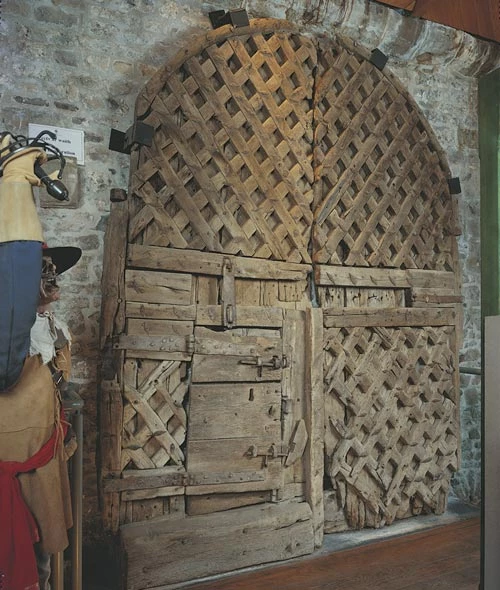
Castle Studies in Wales (and beyond) John R. Kenyon, 1 April 2009 Chepstow Castle © Cadw, Welsh Assembly Government (Crown Copyright) Wooden gates at Chepstow Castle dating from the 1190s, making them probably the oldest castle doors in Europe. © Cadw, Welsh Assembly Government (Crown Copyright) Dolforwyn Castle from the air. © Cadw, Welsh Assembly Government (Crown Copyright) The ruins of Dolforwyn Castle. © Cadw, Welsh Assembly Government (Crown Copyright) Dolwyddelan Castle. © Cadw, Welsh Assembly Government (Crown Copyright) The development of medieval studies was a significant aspect of archaeology after World War 2, and work on castles was a prominent feature of these studies. For those wanting to discover the facts about medieval castles in Wales, then a book that was published in 2008 is for you. This is Castles, Town Defences and Artillery Fortifications in the United Kingdom and Ireland: a Bibliography 1945-2007 (Donington: Shaun Tyas), compiled by John R. Kenyon. However, much work had been done on castles long before 1945, although our understanding of these monuments has altered over the years. Because of the fine examples of castles to be seen in Wales, castle studies in this country have played an important role in the way that our research on these buildings has evolved over the last 150 years or so. The great stone castles of Wales George Thomas Clark has been described as the founding father of the castle studies. He was an engineer who worked under the great I. K. Brunel on both the Great Western and the Taff Vale railways in the 1830s. From the 1850s he was managing the Dowlais ironworks in Glamorgan, and well placed to indulge himself in examining the castles of Wales, on which he wrote numerous papers, later collected in book form. His theories on the origin of the earthworks of the first Norman castles in England and Wales, notably the castle mounds or mottes, such as that can be seen at Cardiff Castle, were soon shown to be wrong by later researchers, such as Ella Armitage. Nevertheless, a considerable amount of his work on the great stone castles of Wales and elsewhere is still of value. The Bibliography 1945-2006, with its 740 pages, indicates just how popular castle studies, both academic and popular, have been since 1945. Worth noting is the excavation of the first Montgomery castle, known as Hen Domen [Old Mound], from 1960 to 1992, as this has given us a fascinating picture of what this earth-and-timber castle in the Welsh Marches would have looked like in the twelfth century. The oldest castle doors in Europe Other recent research has helped us change our understanding of the development of certain features to be found at some of the great stone castles. One of the best examples of this concerns Chepstow in south-east Wales. The introduction of rounded twin-tower gatehouses, such as the outer gate at Chepstow, has in the past been seen as a development from the about the 1220s. However, the wooden gates that hung in the gatehouse until 1962, and which are now on display inside the castle, have been dated through the analysis of the tree rings (dendrochronology) to the 1190s, making them probably the oldest castle doors in Europe. Elsewhere, excavation and conservation of a number of the castles of native Welsh lords have been undertaken, for example at Dinefwr and Dryslwyn in Carmarthenshire. Dolforwyn in Powys, the last castle to be built by Llywelyn ap Gruffudd, prince of Wales (d. 1282), has been totally uncovered, and the results of the work at all three castles have appeared in popular guidebooks and academic reports.
Foreign workers in the Welsh coalfields 6 March 2008 Post War miner shortage Group of Slovenians at Oakdale Training Centre 1948. Following the Second World War, the demand for coal was high and generally rising. Post-war recovery and growth demanded cheap and abundant energy that could only come from coal. There was an urgent need to recruit more miners. One source for these was among the thousands of Europeans who had to flee their home countries during the War. Although Britain desperately needed these men they were not always welcomed with open arms and there was much resistance from local National Union of Mineworkers' lodges. There was more disquiet when the recruitment of Italians began in 1951, and things were no better when the National Coal Board tried to recruit among Hungarian refugees after the 1956 revolution. By this time another group had already entered the coal field. In 1954 the German mining engineering group, Thyssen UK, came to work in south Wales, bringing some of their own countrymen with them. As with today's immigrants, these 'foreign workers' faced much initial suspicion, which arose partly from ignorance and partly from the fear of unemployment among the local population. These young men came to Britain after years of hardship, danger and tragedy. "All Poles" Nyk Woszczycki (2nd from left) in a group celebrating his friend Joe Hughes's retirement from Britannia Colliery Many left the coal industry as soon as they could, many even left Britain, but the ones who stayed earned a lasting reputation for toughness and hard work. Even though they came from many countries they tend to be regarded as 'all Poles' by the Welsh miner. They married local girls and settled down; on their living room walls can often be found photographs of their children and grandchildren, who have been brought up as Welsh. Many of these have gained university degrees; some have won sporting honours for Wales. In spite of their pride in their original homelands, most now regard themselves as Welsh. In turn, Wales should be proud of them and the part they have played in her history. This article forms part of a magazine in the series 'Glo' produced by Big Pit National Coal Museum. Download the complete magazine here:
Tales from down under - memories from Ray Isted, Bevin Boy collier 4 January 2008 Recollections by Raymond George Isted, Bevin Boy in Roseheyworth Colliery 1943—9 Raymond George Isted, Bevin Boy, Roseheyworth Collier 1943 — 1949 I was born in Herstmonceux in East Sussex; I left school at 14 and worked in a factory making automotive parts. When I reached 18, I was called up and sent to Brighton for a medical, I wanted to join the army although to be honest I would have been quite happy stopping at home! "I was actually balloted to go into the mines and sent to Oakdale Training Centre. I lodged with a Mrs Jones in Risca along with Wyndham Jones, a cockney who had relations in Abertillery. We trained for six weeks at Oakdale (Wyndham proved to be 'like a woman' on the shovel) and then sent to Roseheyworth Colliery. We had to wear our own clothes at work, mine were supplied by my parents, and I used to send them back to Sussex every week by my mother for washing. She used to say 'I would rather my Raymond go to the army than the pit' — she thought it was all terrible, thought that Welsh people lived in caves. "After a while I worked with Sid Fox on a heading where we were filling 13 or 14 drams a shift — Sid used to give me around £3 'knocking money'. When Sid went on the sick I worked the road with Gerald Williams. "Gerald introduced me to Phyllis on a night out — I was shy and couldn't dance so that was the only way to do it in those days. But it ended up that she was the only girl I ever went out with and we've been married for 58 years this August (2005). We had a quiet wedding, both my parents were ill and couldn't come and there was no one else from my side of the family there. We went to Weston Super Mare for the honeymoon. My new wife didn't want to settle in Eastbourne so we stopped in Wales. It was always 'Hello Ray' every ten minutes in Wales - in Eastbourne you could walk around for six months and no one would talk to you! "I worked for 6 years in the pits. I remember an overman pointing me out to someone and saying 'You see this boy here? A Bevin Boy and still working here — we can't get him from here!' I even picked up the accent a bit although that was to stop me getting ribbed about my Sussex accent. I feel more Welsh than my wife does now!" This article forms part of the magazine 'Glo', produced by Big Pit National Coal Museum.
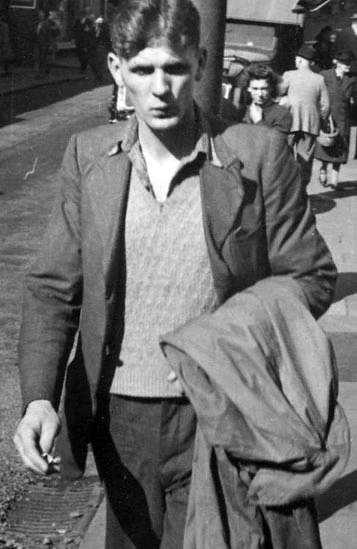
Tales from down under - memories from Bevin Boy colliers 4 January 2008 Being a Bevin Boy in Cwm Colliery by Mel Harris. Mel Harris, Bevin Boy, Cwm Colliery 1944-1947. I had done many jobs since Ernest Bevin forced me into the coalmine rather than the RAF. I had worked with a repairer and a haulier, with a shot firer, as a rider with journeys of drams — always reluctant, uninterested and rebellious. "Now I was on the coal face with a senior collier who was also chairman of the miners' lodge — the union leader at the colliery... As the days passed, I watched him at work, noticing how neat and careful he was in everything he did. To the uninitiated the work of the collier appears rough and ready but it is really skilled and, at times, almost aesthetic. The care taken to keep floor, face and top of the stent well trimmed, the posts and cross pieces in line and the pride taken in leaving the stent neat and tidy at the end of the shift... "Although working hard with Mr David — never called him anything else — my feeling about coal mining did not change. All my friends wore the uniform of one of the Forces and serving overseas, whilst I was in civilian clothes with no uniform provided except boots and helmet. I was on meagre rations, a very small wage and open to accusations of cowardice. Various attempts to get re-assigned to military posts were thwarted so that future prospects seemed bleak. "In this feeling of despair I continued to work alongside Mr David and gradually he brought me some peace and resolution of my attitudes. I began to see him as a role model for a balanced and more optimistic view of life. He was a poorly educated, very intelligent man with clear views on rights and responsibilities. Once I asked him how, in his role as lodge chairman, he dealt with the payment agreements with the manager. He told me 'I will see that he keeps to his side of the agreement — and if any of my men break it they will answer to me.' "I still hated being a Bevin Boy but he helped me to look at it as an experience which would benefit me in later life." This article forms part of the Glo publication by Big Pit: National Mining Museum. Download here Recollections by Raymond George Isted, Bevin Boy in Roseheyworth Colliery 1943—9 Raymond George Isted, Bevin Boy, Roseheyworth Collier 1943 — 1949 I was born in Herstmonceux in East Sussex; I left school at 14 and worked in a factory making automotive parts. When I reached 18, I was called up and sent to Brighton for a medical, I wanted to join the army although to be honest I would have been quite happy stopping at home! "I was actually balloted to go into the mines and sent to Oakdale Training Centre. I lodged with a Mrs Jones in Risca along with Wyndham Jones, a cockney who had relations in Abertillery. We trained for six weeks at Oakdale (Wyndham proved to be 'like a woman' on the shovel) and then sent to Roseheyworth Colliery. We had to wear our own clothes at work, mine were supplied by my parents, and I used to send them back to Sussex every week by my mother for washing. She used to say 'I would rather my Raymond go to the army than the pit' — she thought it was all terrible, thought that Welsh people lived in caves. "After a while I worked with Sid Fox on a heading where we were filling 13 or 14 drams a shift — Sid used to give me around £3 'knocking money'. When Sid went on the sick I worked the road with Gerald Williams. "Gerald introduced me to Phyllis on a night out — I was shy and couldn't dance so that was the only way to do it in those days. But it ended up that she was the only girl I ever went out with and we've been married for 58 years this August (2005). We had a quiet wedding, both my parents were ill and couldn't come and there was no one else from my side of the family there. We went to Weston Super Mare for the honeymoon. My new wife didn't want to settle in Eastbourne so we stopped in Wales. It was always 'Hello Ray' every ten minutes in Wales - in Eastbourne you could walk around for six months and no one would talk to you! "I worked for 6 years in the pits. I remember an overman pointing me out to someone and saying 'You see this boy here? A Bevin Boy and still working here — we can't get him from here!' I even picked up the accent a bit although that was to stop me getting ribbed about my Sussex accent. I feel more Welsh than my wife does now!" This article forms part of the Glo publication by Big Pit: National Mining Museum. Download here