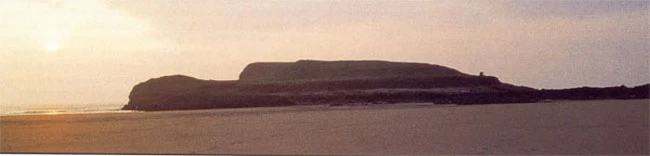
Stone Age Man on Burry Holms, Gower, South Wales 17 April 2007 Burry Holmes, Gower. As the last ice sheet retreated from Wales 12,000 years ago, plants, trees and animals and people slowly started to return. By the start of the Early Mesolithic, or Middle Stone Age period, 10,000 years ago, woodland had started to re-establish itself and hunter-gather humans had moved into the region. Burry Holms Archaeology Today, Burry Holms is a tidal island situated on the northern end of Rhossili Bay, Gower, Swansea. The island has a lot of archaeology including a Mesolithic site, a Bronze Age burial mound, an Iron Age fort with a deep defensive ditch and bank, and the remains of a settlement founded in the 11th century and abandoned during the 17th century. Amgueddfa Cymru decided to investigate Burry Holms further as we hold a little understood collection of stone tools from work undertaken on the island in the 1920s. Mesolithic discoveries A scientific survey and excavation was undertaken at the area of the island where the Mesolithic finds are believed to have been found. Working on a tidal island were challenging with just five hours working-time on the island. However, this short digging day allowed time to process all the finds and samples as they were collected. A number of stone items washed in from the surrounding higher parts of the island were found in one patch of sand deposited by wind during the Middle Ages. Finds such as these are very difficult to age, but some yellow glass beads have been dated as Iron Age, and, therefore, matching up with the Iron Age fort on the island. Stone Age Tools Below these sands was a layer of buried soil containing evidence of stone tools and spears of Mesolithic age. A column of sediment from the complete sequence of deposits was removed and tested for pollen grains, which will supply environmental evidence for the landscape during the Mesolithic and later periods at Burry Holms. In addition, large pieces of charcoal found from Mesolithic layer were sent for identification of the tree species and radiocarbon dating. Life on Burry Holms in the Stone Age By studying the evidence discovered with the collections held at the Museum, an interpretation for the Mesolithic site on Burry Holms can be suggested. The twenty-two small stone spears found at the site have been identified as microliths. Microliths are small stone points only found in the Mesolithic period, and were attached to a handle and used as hunting and fishing spears. One of the microliths has an impact fracture at its tip suggesting that it was broken during use. It is possible that its Mesolithic owner took the damaged spear to Burry Holms where he discarded the broken microlith and made a replacement for his spear before going off hunting or fishing again. There is a good supply of flint and stone at the area, ideal for the manufacture of sharp tools. The variety of objects discovered clearly shows that stone tools were being produced at the site. Most of the microliths discovered are Early Mesolithic, but three appear to be of Late Mesolithic appearance. During the Early Mesolithic period the sea level was much lower than it is today meaning that Burry Holms would not have been an island at that time, but a distinctive inland hill. In many ways this site would have been an ideal place for Mesolithic people to have established a camp or settlement. The hilltop shelter from the winds and the prominent position would have been ideal for scanning the surrounding landscape for prey to hunt and the nearby River Loughor a source of fish for their diet. Unfortunately, due to the acidic soils, bones have not been preserved at the site, so the remains of their meals and indeed the remains of the people themselves, as well as any of their bone or wooden tools, will not have survived.
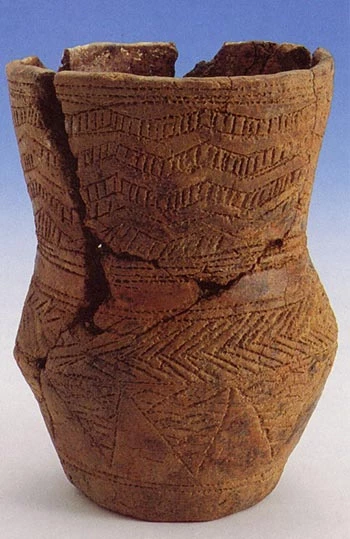
The Llandaf Beaker Man - An Early Bronze Age grave at Llandaf 12 April 2007 The Llandaff Beaker. In 1992, renovations at a house in the Llandaf area of Cardiff uncovered an unusual stone slab buried by river sands and silts. Beneath the slab was a long bone and clay pot. The pot turned out to be a beaker - a decorated clay vessel, fashionable in western Europe some 4,000 years ago, during what is known as 'the Beaker Period'. The beaker may originally have contained mead, beer or some other special brew. The stone slab marked the position of a grave. With the cooperation and encouragement of the owners, the Department of Archaeology and Numismatics conducted an excavation in the driveway to their house, to re-expose the grave and fully excavate its contents. The enclosing cist, constructed of slabs of the local Radyr Stone, was unusual in that it was the form of a lean-to, its capstone resting at an angle of 30° contrasting with more conventional box-like, beaker cists. Little of the skeleton remained. The expectation had been to find a crouched skeleton typical of the Beaker period, but only fragments of the cranium (the top of the skull) and limb bones survived. Additional grave-goods were unearthed, a bronze awl (a pointed tool for making holes, as in wood or leather) and a flint flake - objects that would have been buried alongside the person to be used in the 'next world'. Awls are usually associated with female burials. Analysis of the sediment filling the grave may explain the unusual form of the cist and why only part of the skeleton was preserved. The presence of graded water-lain sediments within the grave suggests disturbance and erosion of the burial by flood water. Today the river Taff flows close by and property where the grave was discovered is built on the former floodplain of the river.
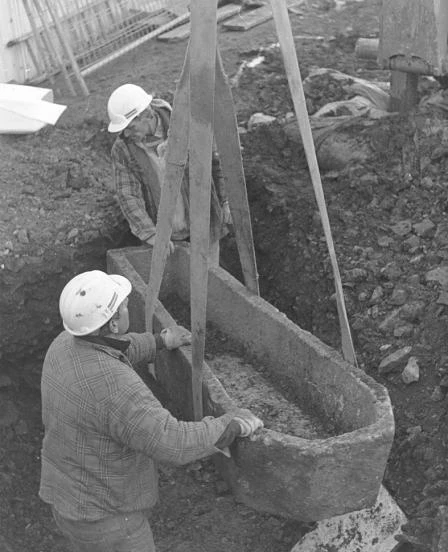
The Undy Roman coffin 5 April 2007 The Undy Coffin during excavation in 1996. The coffin was donated to Amgueddfa Cymru by David Mclean Homes Ltd. The Undy Coffin being raised for transportation. Inside surface of the coffin showing the tool marks of a pick and mason's point. Image © G. Lock. The Undy Coffin. In the 3rd or 4th century AD a young woman was buried in a stone coffin at Undy, Monmouthshire. 1600 years later her grave was rediscovered. In 1996 workmen unearthed a coffin while digging foundations for new houses at Undy, Monmouthshire. Following their discovery the site was investigated by archaeologists, but it remains uncertain whether this was a lone burial of part of a small cemetery. The coffin contained the skeleton of a young, right handed, adult, probably female, aged between 25 and 34 years old. The cause of her death is unknown, but radiocarbon dating revealed she was buried in the late 3rd or 4th century AD - when the Romans occupied Wales. Although no grave goods were found, her burial suggests that she was a relatively wealthy woman, someone who could afford a stone coffin and a proper burial. Burial rather than cremation Burial in this manner had not always been the norm in Roman society. Until the late 2nd century AD most people were cremated; their ashes often being buried in a glass or pottery vessel. However from this time burial traditions began to change. New ideas about the afterlife required that the body be buried 'intact'. These ideas were due to influences from the eastern part of the Empire, including the rise of Christianity, with belief in bodily resurrection. The coffin was an optional feature. The poor might be buried in a grave without a coffin. Coffins were produced in a range of materials including wood, lead and stone. The Undy Coffin is made of Bath Stone, a light creamy coloured limestone which is soft and easily worked when first quarried, but hardens on exposure to the air. This stone is found in the region around the spa town of Bath, England (known to the Romans as Aquae Sulis, which translates as "The Waters of Sulis"). This area is some 20 miles (35km) south-east of Undy. The Roman stonemasons who made it used a very similar range of tools to their modern counterparts. The surface of the Undy coffin preserves these toolmarks, including those made by adze-hammers, chisels, picks and masons points. The direction of the toolmarks indicates that the mason was left-handed. Background Reading "Tools and Techniques of the Roman Stonemason in Britain" by T. F. C. Blagg. In Brittania, vol. 7, p152-72 (1976). "Stone Coffins of Gloucestershire" by R. N. Willmore. In Transactions of the Bristol and Gloucester Archaeological Society, vol. 61, p135-77 (1939).
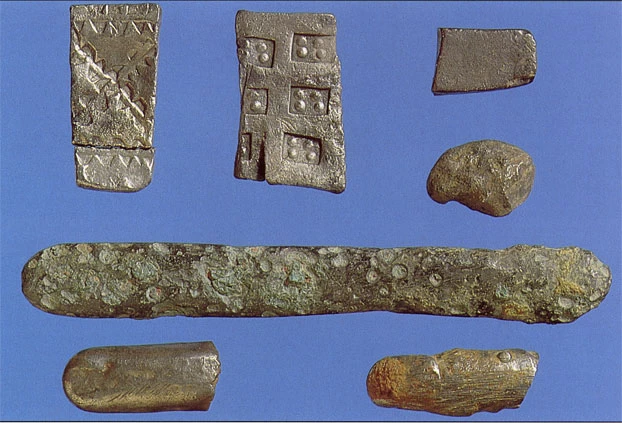
When the Vikings invaded North Wales 2 April 2007 Historical records tell us of a series of terrifying attacks by Viking invaders on the coasts of Britain, France and Ireland in the last decade of the 8th century. Archaeological evidence show that these invaders may not have been as brutal as records claim. The first recorded raid on Wales occurred in 852, and we know of attacks by Vikings on Anglesey and Gwynedd from 854 onwards. Rhodri Mawr, ruler of Gwynedd (844-78), led resistance to these early onslaughts, killing the Danish leader Gorm in 855. In 903 Vikings came to Anglesey after being driven out of Dublin. According to both Irish and Welsh records they failed to gain a foothold in Wales, and sailed on to Chester. Again in 918, Anglesey was ravaged by Vikings. Frequent attacks occurred on the island during the second half of the 10th century on the island; Olaf of Dublin built a castle known as 'Olaf's Castle' or 'Castell Bon y Dom' about the year 1000. This one-sided historical record of Vikings terrorising the land has now been transformed by archaeology. Viking contact was certainly hostile and brutal at times, but often opportunist. In some areas, they rapidly settled as peaceful farmers, and archaeology has provided evidence for them as colonisers, merchants, and skilled craftsmen. The nature of Viking settlement in Wales remains one of the mysteries of early medieval archaeology, none more so than on Anglesey. This is emphasised when the Viking measurement of 'a day's sail' is plotted from the Isle of Man, Dublin, Chester and the Wirral, for they all intersect in Anglesey waters. 10th-century fragments of silver ingots and arm-rings The Vikings name Anglesey Physical evidence of the Vikings in Wales is even less definite. Certainly, we know that the Vikings were familiar with Anglesey because of the place-names of Scandinavian origin which have been given to prominent coastal features as navigational aids: Onguls-ey itself, traditionally thought to incorporate a personal name - presumably a Viking leader, The Skerries, Piscar, Priestholm (prestaholmr) and Osmond's Air near Beaumaris, from Asmundr & eyrr, a gravel bank near the sea. Uncovering evidence of Vikings in Wales For a more realistic picture of Viking Wales, we have to turn to archaeology. Most Viking silver found in Wales has been discovered in coastal areas. St Deiniol's monastery in Bangor has produced two hoards, one dated to around 925, and a small group of coins deposited about 970. The Bryn Maelgwyn hoard of coins near Llandudno was deposited in the mid-1020s, and may be Viking booty rather than local savings; and a remarkable hoard of five complete Viking silver arm rings of were found in the 19th century at Red Wharf Bay, Anglesey. The Viking Age settlement at Llanbedrgoch One of the most intriguing archaeological sites belonging to the Viking period is to be found at Llanbedrgoch , Anglesey and research by Amgueddfa Cymru has helped reveal the nature of Viking Age life which has puzzled scholars for decades.