Who was King Arthur? 26 April 2007 King Arthur has a strong link to Wales, but how much is known of the man and his times? King Arthur has evolved into a legend. Tales and romances celebrated the king and his court in the imaginative literature of Europe. Did Arthur really exist? What was he like? To find answers, it is necessary to look at two equally important sources of information: historical texts and archaeology. When did King Arthur live? The first mention of Arthur is thought to be a reference in a line from the poem, 'Y Gododdin', the earliest known work of literature in Welsh. The poem is from the 6th century, when much of western Britain (Wales, northern England and southern Scotland) spoke Welsh; the earliest surviving written form of the poem dates to the 13th century. The reference to Arthur in this source may be no earlier than the 9th century, but it demonstrates the fame of Arthur among the Welsh at this time. The most important of the historical texts is the Historia Brittonum, the 'History of the Britons', which gives the earliest written record of Arthur who 'fought against them [the Saxons] with the kings of the Britons but he himself was leader [Duke] of Battles', winning twelve battles. The earliest version of this history is dated about AD829-830. The Annales Cambriae, or 'Welsh Annals', probably compiled in the mid 10th century, record the date of one battle, the Battle of Badon in AD518, and Arthur's death at Camlann in AD537-9. This suggests that if Arthur was indeed an historical figure, he probably lived in the 6th century. Page from a 13th-century copy of the Book of Aneirin. The Book of Aneirin records an attack by the British on the Saxons at Catterick (Yorkshire). Although the poem was written in the 6th-century, the reference to Arthur which it contains may have been added later. [Image © Cardiff Library] Where is King Arthur buried? Early Welsh literature has many wondrous tales which form an important part of the Arthurian tradition. There are portrayals of Arthur in anonymous Welsh poetry found in 13th and 14th century manuscripts. In one of the poems of the Black Book of Carmarthen, Englynion y Beddau ('The Stanzas of the Graves'), Arthur's grave is described as a great wonder because no one knows where it is located. The greatest of the Welsh Arthurian prose tales is Culhwch ac Olwen. An English translation of this and eleven other Welsh tales appeared for the first time in the 19th century, publication The Mabinogion. Four other tales in this collection focus on Arthur - the 'romances' of The Lady of the Fountain (or Owain), Peredur, and Geraint son of Erbin, together with the Dream of Rhonabwy which presents a satirical view of Arthur and his world. Map showing distribution of places mentioned in this article Archaeology The second key source of information about Arthur is archaeology. Archaeological evidence for contact between Wales, Cornwall and the Saxon World takes many forms - from metalwork manufactured in an Anglo-Saxon style discovered in south-east Wales, to the distribution of early medieval pottery imported from the Continent and the shores of the Mediterranean. Excavations at Dinas Powys, a princely hillfort near Cardiff occupied between the 5th and 7th-centuries, has informed us about the nature of a high status site in south Wales at this time. This site is contemporary with others like South Cadbury in Somerset and Tintagel in Cornwall (both with their own Arthurian traditions). Pieces of glass from Dinas Powys (Vale of Glamorgan), a fort occupied between the 5th and 8th-centuries. These fragments come from vessels made in continental Europe. They illustrate the extent of trade between Wales and the wider-world at this time. Caerleon's Roman amphitheatre The Roman amphitheatre at Caerleon has been known as the site of King Arthur's court since the 12th century, but is there any evidence to prove this was the case? In AD1405, the French army, which had landed at Milford Haven to support Owain Glyn Dŵr in his uprising against the English Crown, reached Caerleon in South Wales. Here they visited 'King Arthur's Round Table'. According to a French source (Chronique Religieux de St Denys), the French visited 'The Round Table' of Arthurian legend. The Round Table was in fact the Roman amphitheatre of the legionary fortress of Isca. Geoffrey of Monmouth had identified Caerleon as the court of King Arthur in his fictional epic, the 'History of the Kings of Britain' in 1136. This identification, close to the area of his upbringing, has been described as 'the fruits of a lively historical imagination playing upon the visible remains of an imposing Roman city'. Some of Roman Isca was still standing in the 13th century. Caerleon soon appeared in popular Welsh and French writings by Dafydd ap Gwilym, Chrétien de Troyes and others as 'Arthur's Court', sealing this identification. Caerleon Roman amphitheatre. [Image © Steve Burrow] Arthur's Stone Some half dozen Welsh Stone Age megaliths are called 'Arthur's Stone', and his name has also been given to an Iron Age hillfort on the Clwydian Range, Moel Arthur, near Denbigh. According to one tradition, King Arthur and his knights lie sleeping in a cave below Craig y Ddinas, Pontneddfechan, in south Wales. Maen Ceti, on Gower, south Wales. The massive capstone of this prehistoric burial chamber is known as Arthur's Stone. The king's ghost is said to emerge occasionally from beneath it. Background Reading Arthur in Medieval Welsh Literature by Oliver James Padel. Published by University of Wales Press (2001). Arthur's Britain. History and Archaeology AD367-634 by Leslie Alcock. Published by Harmondsworth (1971). The Arthur of the Welsh. The Arthurian Legend in Medieval Welsh Literature by Rachel Bromwich, A. O. H. Jarman and Brynley F. Roberts. Published by University of Wales Press (1991). The Gododdin translated by A. O. H. Jarman. Published by Gomer Press (1988). The Mabinogion, translated by Jeffrey Gantz. Published by Penguin (1976).
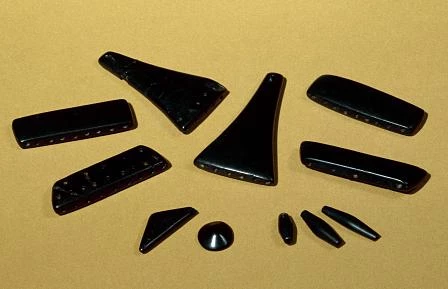
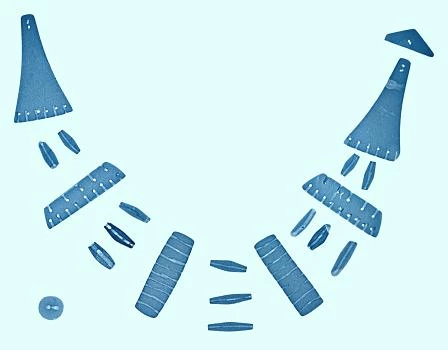
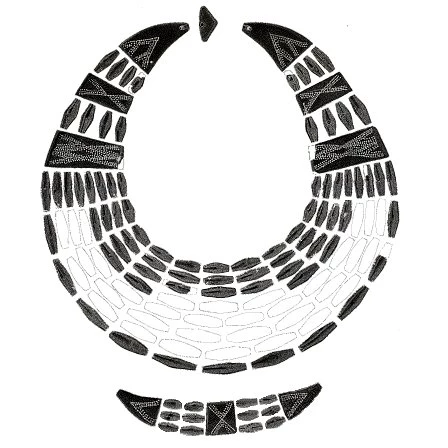
The Pen y Bonc necklace 26 April 2007 The Pen y Bonc necklace (Anglesey). Image © the Trustees of the British Museum. Xero-radiograph of the Pen y Bonc necklace. Image © the Trustees of the British Museum. Jet necklace from East Kinwhirrie, Angus (Scotland). Image: Helen Jackson for the National Museums of Scotland. Gold lunula from Co. Kerry, Ireland. Image © Trustees of the British Museum. Queen Victoria had a fascination with the black semi precious stone 'Jet' following the death of her husband, Prince Albert in 1861. The use of this stone has a much longer history as this 4,000 year old necklace from Anglesey shows. Important burial In 1828 a grave was discovered at Pen y Bonc, near Holyhead on Anglesey. Accounts of this discovery are incomplete, but the grave was dated to around 4,000 years. The person who was buried must have been important as the grave was cut into bare rock. A number of black beads and buttons were discovered in the grave. Unfortunately, most of the items were lost soon after the discovery, but some surviving pieces are now in the collections of the British Museum. These pieces form a crescent-shaped necklace of beads and spacer plates. Objects such as these are usually found with female burials. Jet necklace from East Kinwhirrie, Angus (pictured) shows the shape of a complete spacer plate necklace, and illustrates how some of the finest examples were decorated. A necklace made of coal Most of the beads and plates in the Pen y Bonc necklace are made of 'lignite' (fossilised wood). However, one bead and the surviving button are made of jet, a material found 300km (186 miles) away to the north-east, at Whitby (North Yorkshire). Jet is a dense black variety of lignite only found in a few parts of Europe. Only parts of this necklace survive. It is possible that this was all that was buried since Bronze Age jet necklaces are often found incomplete. Alternatively, parts of the necklace may have been made of materials which have since rotted away, or possibly pieces were lost when it was excavated. Manufacturing jet necklaces was a skilled job. The many strands of the necklace were suspended using spacer plates through which holes were bored to carry the strings. This delicate work was probably carried out using a bow-drill and a piece of bronze wire. In the case of the Pen y Bonc necklace some of the holes have been bored lengthways through the plates. But in order to increase the number of strands on one side of the plate, holes have been drilled at one end to allow new strings to be tied in. Unlike many types of gem, jet is warm to the touch and is relatively easy to shape; it also takes a very high polish. Today it looks rather like shiny plastic, but during the Bronze Age it must have appeared strange and unusual. Jet also has unusual electrostatic properties (when rubbed it can attract hair and other light materials) that might have been seen as magical in prehistoric Britain. Treasured jewellery The jet pieces in the Pen y Bonc necklace were heavily worn suggesting that they were treasured items that had been kept for many years. In contrast, the parts of the necklace that were made from local materials were less worn - suggesting that they were newer replacements for broken or damaged pieces of jet. Objects made of jet were popular throughout Britain during the Early Bronze Age (2300-1500BC), however, after this period its use declined. When the jet necklace from Pen y Bonc was discovered in the 19th century, the jet being mined at Whitby was just beginning a revival, thanks in large part to Queen Victoria's obsession with black mourning garments after the death of Prince Albert in 1861. Gold Lunula Gold lunula also date to the Early Bronze Age and are often decorated in a similar way to jet necklaces. However, whereas jet necklaces are usually found with burials, lunula are not found with the dead. Perhaps jet suggested death and gold represented life in the minds of people 4,000 years ago. Background Reading 'The Welsh 'jet set' in prehistory' by Alison Sheridan and Mary Davis. In Prehistoric ritual and religion by Alex Gibson and Derek Simpson, p148-62. Sutton Publishing (1998). 'Investigating jet and jet-like artefacts from prehistoric Scotland: the National Museums of Scotland project' by Alison Sheridan and Mary Davis. In Antiquity (2002) vol. 26, p812-25.
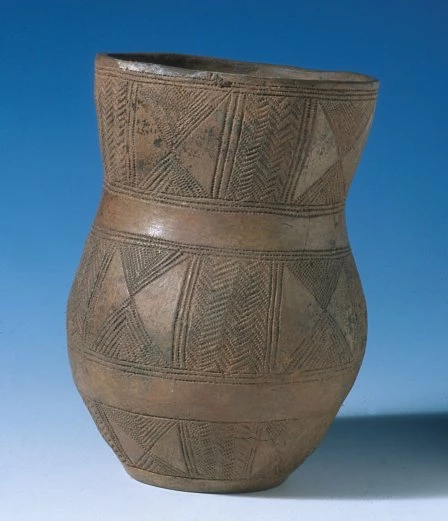
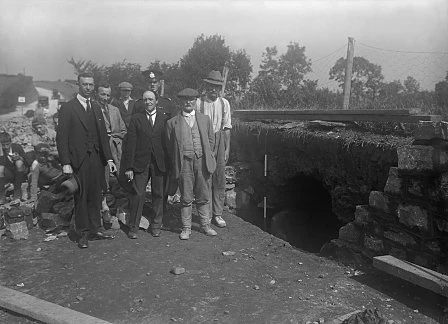
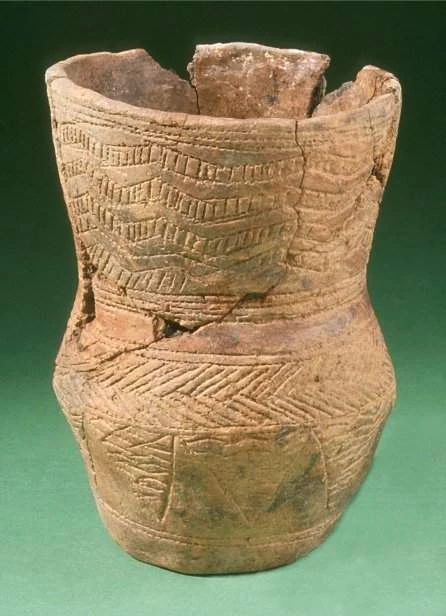
The Beaker Folk of south Wales 26 April 2007 The Naboth Vineyard Beaker, Llanharry (Rhondda Cynon Taff). Discovery of the Beaker grave near Llanharry in 1929 (grave next to striped pole). Another example of a Beaker, this time from a cist containing a female burial, discovered in 1991 in Llandaff (Cardiff). The burial was also accompanied by a bronze awl, an artefact commonly found with Beakers. A new style of pottery appeared in Britain 4,000 years ago, but was it brought by invaders or did it evolve as a local fashion statement? This finely decorated pot, known as a 'Beaker', was made about 4,000 years ago by an early community living in south Wales. At this time pots were handmade and fired in bonfires. It was found in September 1929 by workmen preparing a new road between Llanharan and Llanharry. This object is known as the "The Naboth Vineyard Beaker". The Beaker had been placed in a stone-lined grave (or cist), beneath a circular mound of earth known as a barrow. The grave also contained a crouched skeleton of a man about 1.7m tall (5 foot 9 inches) and under 35 years old. From this, and many other discoveries like it, it looks like these Beakers were very special pots, being placed beside someone when they were buried. Their shape suggests that they were drinking vessels. They possibly containing offerings of alcohol to accompany people into the afterlife. In fact, when found, this beaker contained "slimy stuff" - could this have been the rotted remains of a funeral offering? - unfortunately, it was washed out before archaeologists could retrieve and analyse it. This Beaker was made by rolling clay into long strips joined together at the ends to form rings that were smoothed to give the vessel shape. When the clay had dried a little, the vessel was polished (burnished) with a blunt tool, possibly of bone. Decoration was added with a toothed tool resulting in a distinctive pattern reminiscent of textile or worked leather. Finally, the Beaker was fired, giving it a rich, mottled, orange-brown colour. Beaker pots and Beaker burials became common across much of Europe between 2800-2000BC. They are often found with daggers, flint arrowheads, and items of gold, amber, jet and bone. In the past, it was believed that Beakers belonged to an innovative people, called the "Beaker Folk", who migrated around Europe and invaded Britain, bringing their artefacts with them. Recently, an alternative theory has been put forward. This sees the Beaker phenomenon as a spread of common ideas or fashions across Europe, rather than a spread of people. The Beaker fashion was adopted by the people of Britain, as a result of contact and trade with Continental Europe. In Wales, few early Beaker burials are known, and those that have been radiocarbon dated tend to be from 2300-1800BC. Beaker settlements are very rare. Background Reading "A Beaker-burial from Llanharry, Glamorgan" by V. E. Nash-Williams. In Archaeologia Cambrensis, vol. 85, p402-5 (1930). Guide catalogue of the Bronze Age collections by H. N. Savory. Published by National Museum of Wales (1980). Prehistoric Wales by F. Lynch, S. Aldhouse-Green and J. L. Davies. Sutton Publishing (2000).
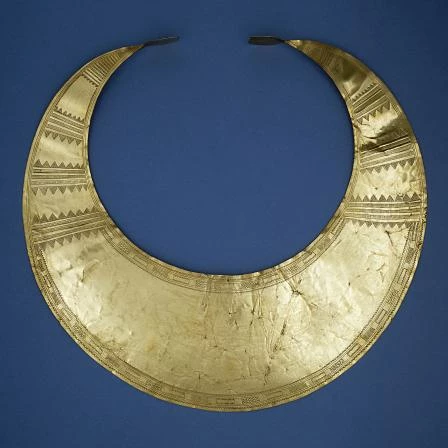
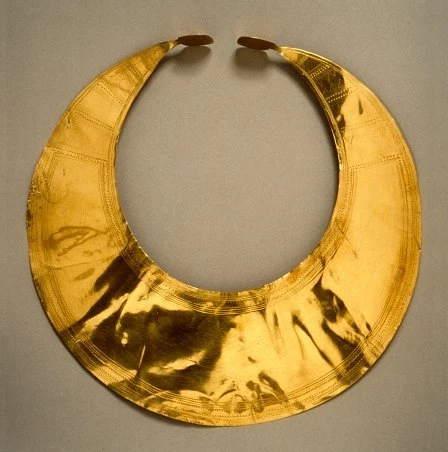
Stunning gold relic unearthed in Gwynedd 26 April 2007 Llanllyfni lunula. Weighing 185.4g (6.5 ounces) and measuring 24cm (9.5 inches) in diameter. This crescent-shaped ornament probably originated as a single rod shaped ingot and was expertly hammered into shape. The intricate decoration of zig-zags, lines and dots was then added using a fine pointed tool and a copper or bronze punch. These designs are very similar to those used to adorn pottery made at this time. Reconstruction of a lady wearing a gold lunula from Llanllyfni, (about 2000BC). Gold was one of the first metals to be used in Wales, along with copper and alloys such as bronze. The use of gold for jewellery and ornamentation has been a common theme since the earliest times. This stunning decorated object is one of the earliest gold artefacts to have been found in Wales and dates to the beginning of the Bronze Age (2400-2000BC). Yellow leaf sticking from the ground It was found a few miles from Llanllyfni (Gwynedd) on Llecheiddior-uchaf Farm near Dolbenmaen in about 1869. A farmer noticed what he took to be a yellow laurel leaf sticking out of some peat. Later, unsatisfied with this explanation, he returned to the site and uncovered the crescent-shaped object of gold. The Llanllyfni lunula Known as a 'lunula' after its crescent-shape (luna = moon in Latin), objects like this have been found in Scotland, Cornwall, and north-west France, with as many as 90 being discovered in Ireland. Lunula are generally found in isolated locations, away from ancient settlements and, like the Llanllyfni example, they have often been discovered by chance. It has been argued that they were intended to be worn around the neck as breast plates, although the lack of wear on the gold suggests that they were only rarely used - possibly they were the symbol of a priest or were used in the rituals of a community. The gold in the Llanllyfni lunula may come from a Welsh source, for example the Dolgellau gold belt, or north-west of Llandovery, but as so many have been discovered in Ireland, the suspicion is that it was traded as a raw material across the Irish Sea. Background Reading 'Bronze Age gold in Britain' by J. P. Northover. In Prehistoric gold in Europe by G. Morteani and J. P. Northover. Published by Kluwer (1993). Bronze Age goldwork of the British Isles by J. J. Taylor. Cambridge University Press (1980). 'Objects mostly of prehistoric date discovered near Beddgelert and near Brynkir station' by W. J. Hemp. In Proceedings of the Society of Antiquaries of London, 2nd series, vol. 1, p166-83 (1918).
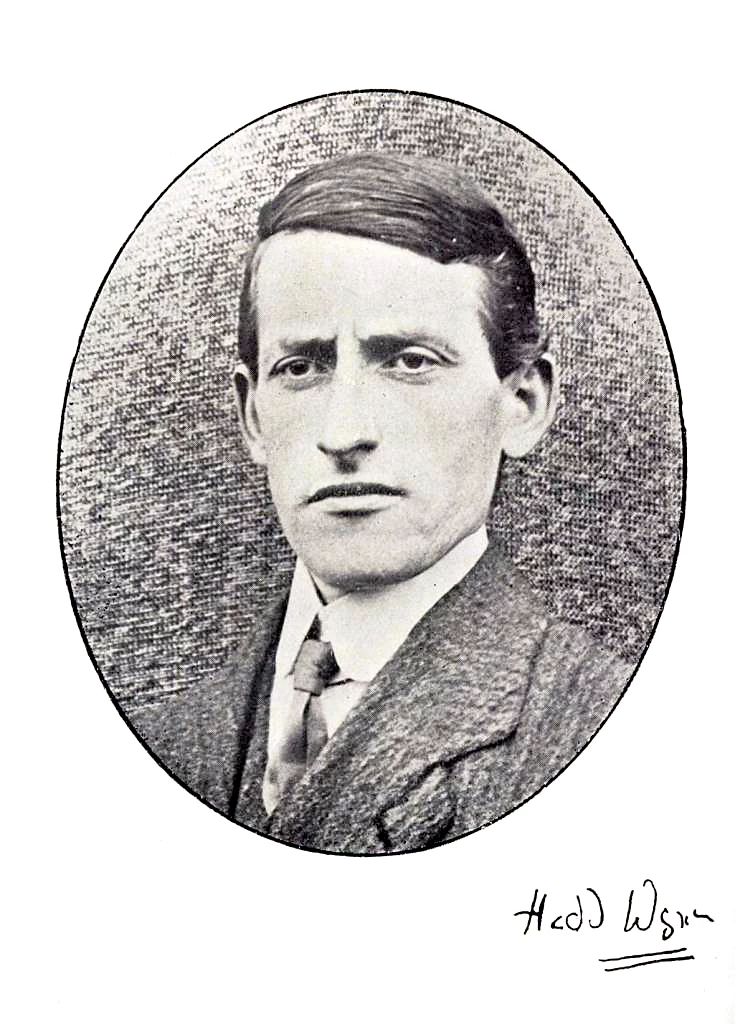
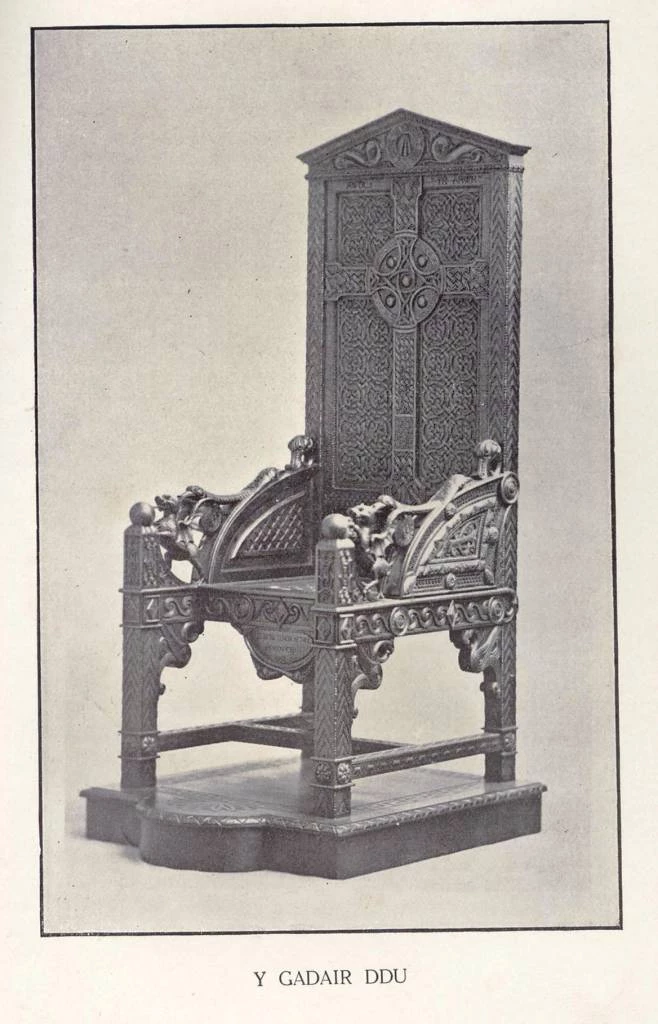
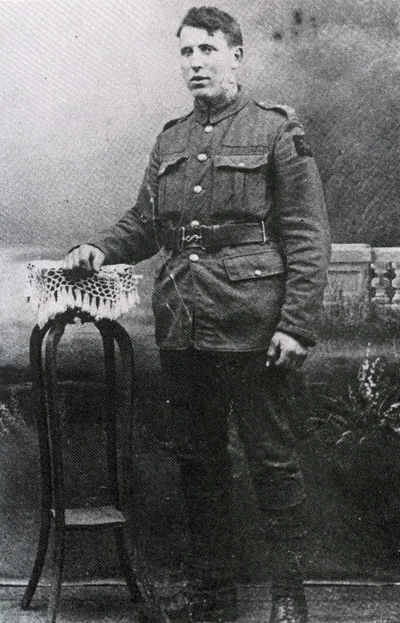
Welsh bard falls in the battle fields of Flanders 25 April 2007 "It was the last day of July, you see. The first day of probably the biggest battle that ever took place. The battle of Passchendaele". (Simon Jones, 1975). Over a quarter of a million Welshmen enlisted to fight in the First World War. Among them was the poet Ellis Humphrey Evans of Trawsfynydd, better known under his bardic name of Hedd Wyn. He was dispatched for active service in 1917. Just a few months later he was dead - killed in battle on the fields of Flanders. The Black Chair Six weeks later he was posthumously awarded the chair at the National Eisteddfod at Birkenhead for his poem Yr Arwr (The Hero) which he had completed shortly before his death. The chair itself was draped in black during the chairing ceremony, and has since been known as the Y Gadair Ddu (The Black Chair). By the age of 28 he had won four Eisteddfod chairs for his poetry. Ellis Humphrey Evans (Hedd Wyn; 1887 - 1917) The Black Chair Witness account Mr Simon Jones of Aberangell, Mid Wales, served in the same regiment as Hedd Wyn, and witnessed his falling on the field of battle. Hear or read his account, as recorded by St Fagans National Museum of History in 1975: AWC 4763. Recorded: 26.9.1975, by Robin Gwyndaf. AWC 4764. Recorded: 26.9.1975, by Robin Gwyndaf. "It was the last day of July, you see. The first day of probably the biggest battle that ever took place. The battle of Passchendaele. And we were going over the top at half past four. We started over Canal Bank at Ypres, and he was killed half way across Pilckem (Ridge). I've heard many say that they were with Hedd Wyn and this and that, well I was with him as a boy from Llanuwchllyn and him from Trawsfynydd. I saw him fall and I can say that it was a nosecap shell in his stomach that killed him. You could tell that. You couldn't stay with him - you had to keep going, you see. When did you see him last, to speak to him? Oh, it's difficult to say. Perhaps I spoke to him that morning, because if I saw him get killed, I must have been near to him. I remember well that we had an officer leading us called Newman, Lieutenant Newman. He was going in front of me, and I saw him fall on his knees and grab two fistfuls of dirt. Well there was nothing but dirt there, you see - the place was all churned up. He was dying, of course. What did you do? Could you do something when you saw Hedd Wyn... ? Nothing at all. No. There were stretcher bearers coming up behind us, you see. There was nothing - well, you'd be breaking the rules if you went to help someone who was injured when you were in an attack. Your business was to keep going. How did you feel when you saw your friend fall? Well I'll tell you straight. To be honest, you had no time to sympathise because you didn't know whether you'd be in the same situation as him in a couple of yards." Simon Jones in the First World War "I saw him fall and I can say that it was a nosecap shell in his stomach that killed him. You could tell that. You couldn't stay with him - you had to keep going, you see". (Simon Jones, 1975). Lost generation Hedd Wyn was one of 32,000 soldiers to be killed in the attack on Pilckem Ridge. The devastated village of Passchendaele itself was not captured until 6 November, 98 days after the start of the battle. This slow advance over little more than five miles of ground was achieved with the loss of 310,000 Allied and 260,000 German lives. The Black Chair remains a potent symbol of the devastating impact of the First World War on communities throughout Wales, and the unfulfilled potential of a whole generation of young Welsh men.