: Bronze Age

Uncovering our Collections: Half a Million Records now Online

26 March 2018

As we reveal half a million collection records for the first time, we look at some of the strangest and most fascinating objects from National Museum Wales Collections Online.

This article contains photos of human skeletal fragments.

The Biggest

We have some real whoppers in our collections - including a full-size Cardiff Tram and a sea rescue helicopter - but the biggest item in our collection is actually Oakdale Workmen's Institute.

Built in 1917, the Institute features a billiard room, dance hall and library - and is nowadays found in St Fagans National Museum of History.

Photograph from 1908 showing Horace Watkins in a very early, precarious-looking monoplane

Horace Watkins testing his monoplane in 1908

Many of the buildings in St Fagans are part of the national collection - meaning they have the same legal status as one of our masterpiece Monets or this coin hoard. The buildings are dismantled, moved, rebuilt - and cared for using traditional techniques, by the museum's legendary Historic Buildings Unit.
 

The Oldest


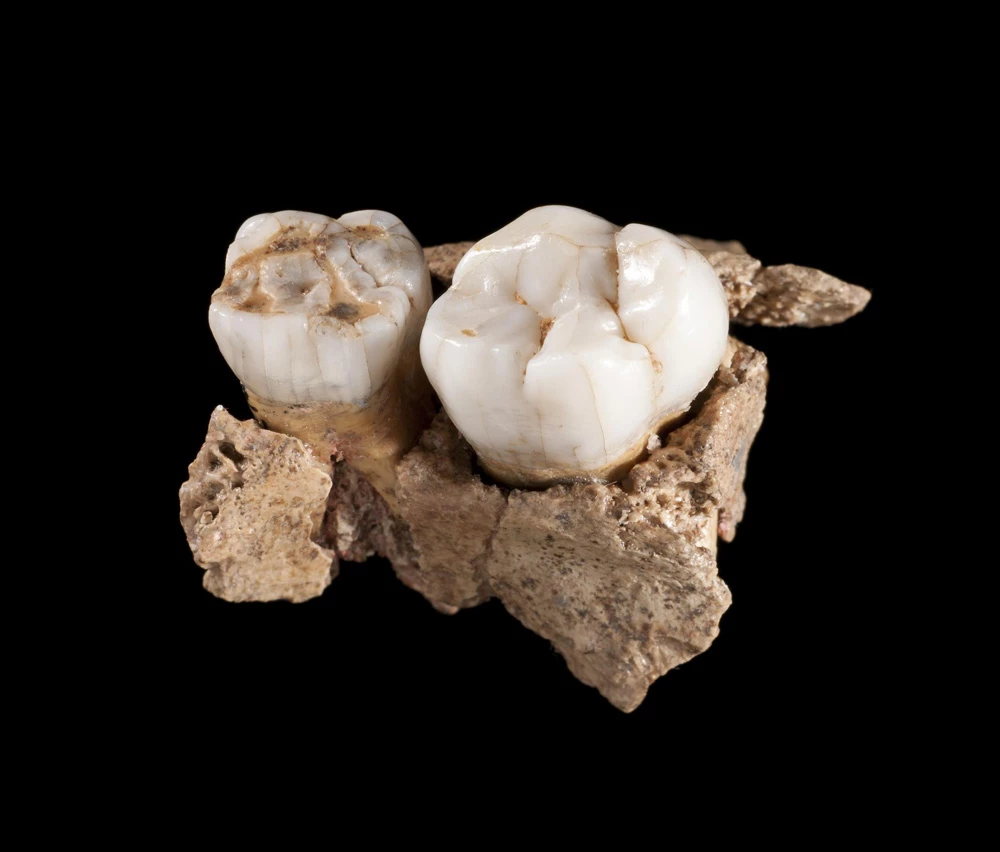
photograph of two teeth, belonging to a Neanderthal boy aged 8

The oldest human remains ever discovered in Wales

These teeth belonged to an eight year-old Neanderthal boy - and at 230,000 years old, they are the oldest human remains in Wales.

They were discovered in a cave near Cefn Meiriadog in Denbighshire, along with a trove of other prehistoric finds, including stone tools and the remains of a bear, a lion, a leopard and a rhinocerous tooth.

These teeth are among some of the incredible objects on display at St Fagans National Museum of History
 

The Shiniest

People in Wales have been making, trading and wearing beautiful treasures from gold for thousands of years - like this Bronze Age hair ornament and this extremely blingy Medieval signet.


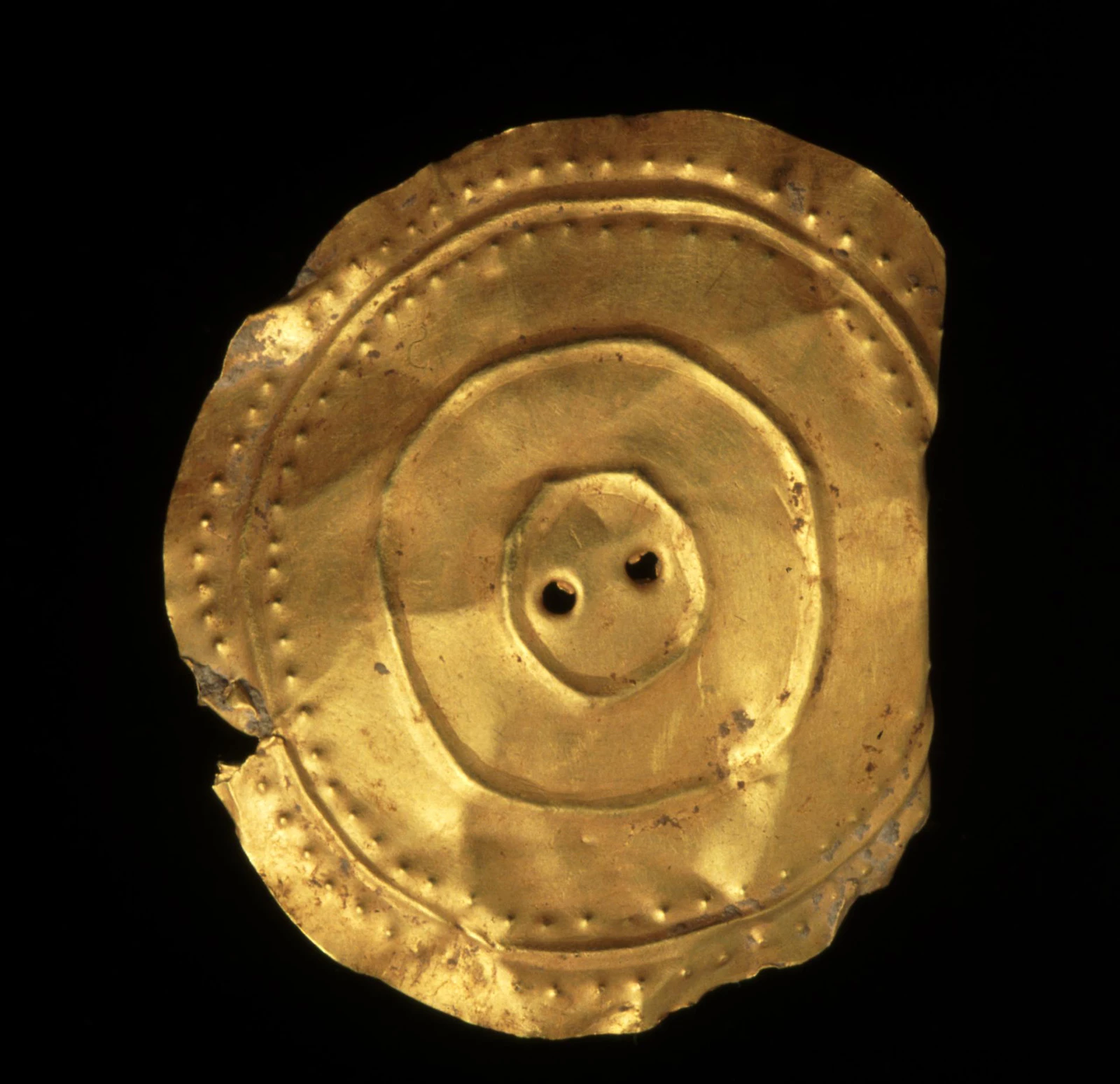
photograph of gold disc with repousse design

At around 4000 years old, this sun disc is one of the earliest and rarest examples of Welsh bling

One of the earliest examples of Welsh bling is this so-called 'sun disc', found near Cwmystwyth in Ceredigion.

Current research suggests that these 'sun discs' were part of ancient funeral practice, most likely sewn onto the clothes of the dead before their funerals. Only six have ever been found in the UK.
 

Most Controversial

At first glance, an ordinary Chapel tea service - used by congregations as they enjoyed a 'paned o de' after a service. A closer look reveals the words - 'Capel Celyn'. The chapel, its graveyard and surrounding village are now under water.


Photograph showing a cup and saucer with 'Capel Celyn' and a ribbon scroll design

Capel Celyn, in the Tryweryn Valley, is now underwater

Flooded in 1965 by the Liverpool Corporation, the Tryweryn valley became a flashpoint for Welsh political activism - creating a new generation of campaigners who pushed for change in how Welsh communities were treated by government and corporations.

Curators from St Fagans collected these as an example of life in Capel Celyn - to serve as a poignant reminder of a displaced community, and to commemorate one of the most politically charged moments of the 20th century in Wales.
 

Honourable Mention: an Airplane made from a Dining Room Chair

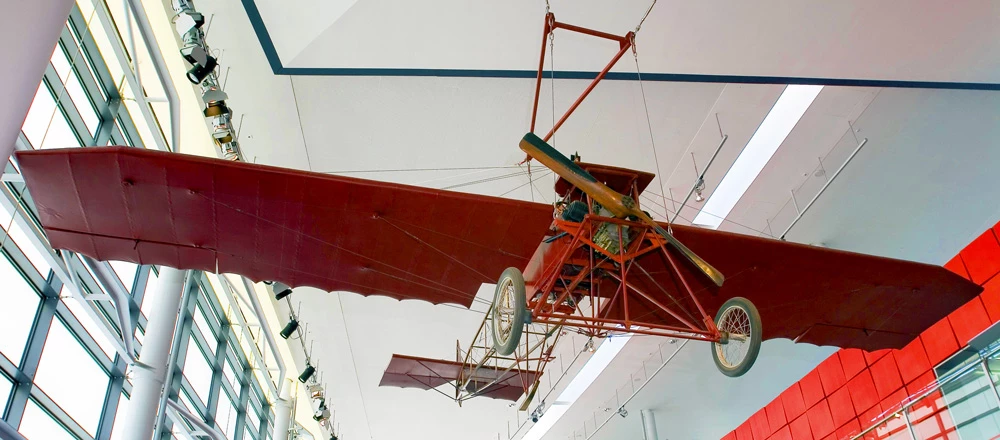
Made from a dining room chair, piano wire and a 40 horsepower engine, the Robin Goch (Red Robin) was built in 1909 - and also features a fuel gauge made from an egg timer.


photograph of a small, early twentieth century airplane with red wings

The Robin Goch (Red Robin) on display at the National Waterfront Museum

Its builder, Horace Watkins, was the son of a Cardiff printer - here he is pictured with an earlier, even more rickety version of his famous monoplane.
 

Photograph from 1908 showing Horace Watkins in a very early, precarious-looking monoplane

Horace Watkins testing his monoplane in 1908

Our collections are full of stories which reflect Wales' unique character and history. The Robin Goch is one of the treasures of the collection, and is an example of Welsh ingenuity at its best.

Half a Million Searchable Items

The launch of Collections Online uncovers half a million records, which are now searchable online for the first time.

“Collections Online represents a huge milestone in our work, to bring more of our collections online and to reach the widest possible audience.

It’s also just the beginning. It’s exciting to think how people in Wales and beyond will explore these objects, form connections, build stories around them, and add to our store of knowledge." – Chris Owen, Web Manager
 

Search Collections Online

Plans for the future

Our next project will be to work through these 500,000 records, adding information and images as we go.

We'll be measuring how people use the collections, to see which objects provoke debate or are popular with our visitors. That way, we can work out what items to photograph next, or which items to consider for display in our seven national museums.

Preparing and photographing the collections can take time, as some items are very fragile and sensitive to light. If you would like to support us as we bring the nation's collections online, please donate today - every donation counts.


Donate Today


We are incredibly grateful to the People's Postcode Lottery for their support in making this collection available online.
 

The Late Bronze Age hoard from Trevethin: A Tale of Axes and Spears

Matthew Guiseppe Knight, 16 September 2017

The Trevethin Hoard, Torfaen

The Trevethin Hoard, Torfaen

The upper blade of the broken South Wales axe.

The upper blade of the broken South Wales axe.

Imagine the scene. You’re out walking in a field. You have your trusty metal-detector in hand, sweeping backwards and forwards across the ground as you walk. A steady rhythmic beep emits with each step. Suddenly the machine starts beeping more frequently. Something lies beneath the ground. You crouch down to dig, to see what you’ve found. As you dig you start to reveal an ancient axehead…

This was the story for metal-detectorist, Gareth Wileman in November 2014. Over a couple of weeks Gareth uncovered a Late Bronze Age hoard comprising three bronze socketed axeheads and two bronze spearheads in close proximity in the Community of Trevethin, Torfaen.

Recognising the significance of the find, Gareth promptly contacted Mark Lodwick, the Finds Co-ordinator for Portable Antiquities Scheme Cymru, who was able to investigate the hoard findspot. The hoard was buried around 3000 years ago (between 950-800 BC) during the Late Bronze Age. This period is a time when large amounts of metalwork, including weapons and tools, were hoarded and buried in various locations in the landscape.

What’s in the hoard?

While the objects in the hoard may be broadly classed as ‘axeheads’ and ‘spearheads’, each object represents a distinctive type, that we can use to inform our understanding of how different objects were traded in the Bronze Age. Of particular interest is the socket of a ‘South Wales’ socketed axe that was buried within the hoard. The cutting edge was deliberately removed in the Bronze Age. One of the other axes has also been deliberately damaged. These axes have three vertical ribs on both faces and are particularly common in… you guessed it, South Wales!

Conversely, one of the spearheads is relatively rare. It is referred to as a ‘lunate opening spearhead’ due to two semi-circular holes in the middle of the blade. The tip of this spearhead has broken off and part of the socket has broken off, which may also have been deliberate.

Why does the hoard matter?

The Trevethin hoard was found in an area where Bronze Age activity was previously unknown. It adds to a growing volume of Late Bronze Age material found across Wales. Gathering or hoarding objects and burying them is a widespread tradition in the Late Bronze Age, but reasons behind this are uncertain.

Combinations of weapons, such as spears, and tools, such as axes, are common in Late Bronze Age hoards. These categories should not be taken too seriously though; an axe can be a deadly weapon too, while some spearheads might have been ceremonial items. The combination of different objects may represent a single person’s collection of objects. Alternatively, it may reflect several people coming together to bury objects that were important to the local area. We will probably never know exactly what is represented in the Trevethin hoard.

The rare ‘lunate opening’ spearhead

The rare ‘lunate opening’ spearhead.

The only complete axe in the hoard

The only complete axe in the hoard

One axe was found broken with lots of smaller fragments

One axe was found broken with lots of smaller fragments.

Excavating the hoard was very muddy!

Excavating the hoard was very muddy!

To Break or Not To Break

In the Trevethin hoard, the blades of two of the axes appear to have been deliberately removed. The spearheads display similar intentional damage. However, the third axe was left complete. Why was this? And where are the missing pieces?

It’s possible that the pieces are still out there, waiting to be found. However, deliberately destroying objects in hoards was common. Certain parts of objects were selected for burial – in this case the socket end of the axes – while others were excluded (the cutting edge). In other hoards, we sometimes only find axe blades and no sockets. The part of the object that was included may have been important.

Including complete objects also has significance. At Trevethin, the complete axe was sharpened and probably used before it was buried. It still would have been functional, so why abandon a useful, usable tool? It is possible the axe was used over many years and was significant to its owners, which made it suitable for burial.

It’s important to think of these items as both functional and symbolic objects.

Understanding the Bronze Age

Archaeology is about understanding people in the past. The Trevethin hoard offers a valuable insight into the Bronze Age in this area of Wales, where previously no prehistoric material was known. It shows that Bronze Age communities were present and engaging with their objects in mysterious ways we might only speculate. Every find helps us understand the broader picture, and the Trevethin hoard is an important step towards this.

Notes and Acknowledgements

This hoard was responsibly reported through Portable Antiquities Scheme Cymru and is now proudly on display at Pontypool Museum where it can be enjoyed by all members of the public. It was acquired with funding from the Saving Treasures: Telling Stories Project. More details on how the hoard was investigated, as well as a conversation with the finder, Gareth Wileman, can be found here.

Thanks to Adam Gwilt (Principal Curator: Prehistory at National Museum Wales) and Mark Lodwick (Finds Coordinator: PAS Cymru) for allowing me access to an unpublished report on the hoard.

The Swansea Bay Dagger

Abigail Dickinson and Roqib Monsur, 21 June 2017

The Swansea Bay Dagger

In 1971, Architecture student Paul Tambling was blissfully unaware of perhaps the biggest archaeological discovery that he would ever make in his lifetime and how finding the Swansea Bay dagger (as it is now known) would have an impact on his life.

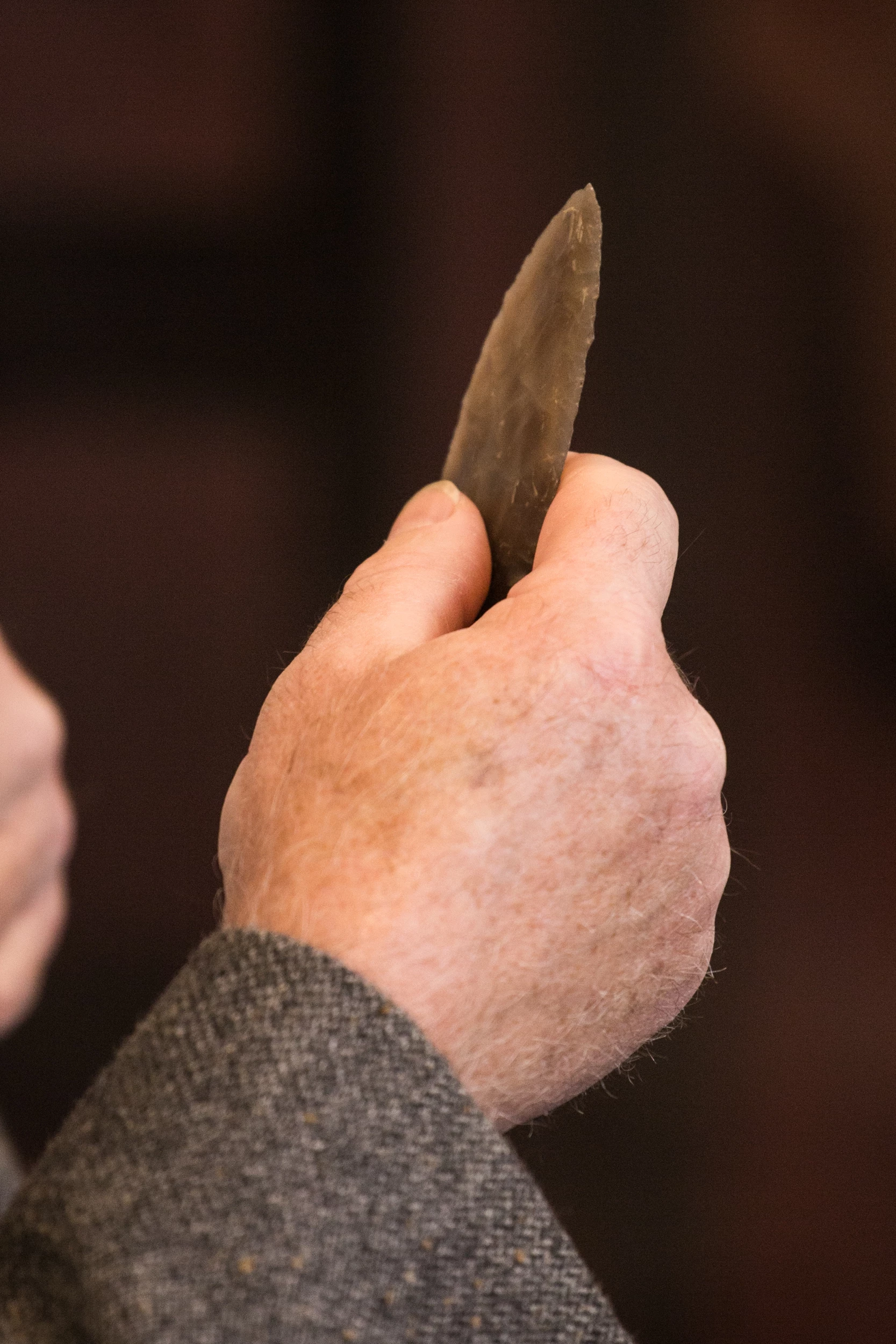
While walking along Swansea beach Paul and his partner Angela noticed what appeared to be a piece of flint poking out of the sand. What they had discovered purely by chance, was in fact, a ‘4200 year old flint dagger’.

Paul told us: “When I picked up the dagger I was mystified as to how the dagger would have got there in the first place especially as flint does not naturally outcrop anywhere in Wales. Also, the flint was in an immaculate condition and did not appear to have been adversely affected by the action of the sea. I regard it as not only a great work of art but also a very skilled piece of workmanship and I find that it gives me great inspiration when I am designing buildings, where I am also constantly aiming to achieve such a level of craftsmanship”.

Almost 46 years later, and still in possession of the dagger the couple keep the item close to their hearts and believe it to be a unique symbol of their lasting relationship.

Paul said: “During and since my student days the flint has moved with me in an old envelope over six times and there were periods of my life when I actually thought that I had lost it. Nevertheless, since I recently discovered its huge historic importance, the flint in rarely out of my sight”

The flint has now been identified as a ‘Beaker Folk Dagger’ dating from the early Bronze Age, around 2250 to 2000 years BC which makes it around 4200 years old. In its day it carried great symbolic relevance as it would have accompanied high status burials to be with the deceased in the afterlife. There are a small number of other daggers that have been found in Wales but none are of the quality of the Swansea Bay dagger. The greatest number of daggers of this period have been found in South East England.

The Beaker Dagger has its huge archaeological and symbolic value, but what does it mean to Paul and Angela as a family?

“This dagger represents the span of our married life. I found it 3 years before we got married and it’s an object that provides us with a special and lasting reminder of those wonderful weekends spent in Swansea all those years ago and binds us together. It was a magical time which just can’t be repeated.”

Paul and Angela Tambling, who run an architectural consultancy practice based in Brecon, had been unaware of the importance of the dagger but since its archaeological relevance has come to light they are constantly told by experts how lucky they were to find such an important object and in such an un-expected location. “I suppose luck is on my side” said Paul “I was lucky to marry Angela and lucky to find the dagger while with Angela.”

Paul told us that he instinctively knew that it was a marvellous object as soon as he picked it up but couldn’t work out whether it was a dagger or a spear head. Through the years Angela has been continually saying to him. “Why don’t you go and find out?” After much badgering Paul finally decided to visit Brecknock Museum only to find, when he got there, that it was closed for extensive restoration work.

The Swansea Bay Dagger

In early 2016 the couple attended a demonstration of flint knapping in Cyfarthfa Museum, Merthyr Tydfil, given by Phil Harding of Time Team. It was here, after speaking with Phil that the true importance of the dagger become apparent and Phil advised that this object of archaeological importance should be recorded and the find reported to Amgueddfa Cymru – National Museum Wales. Soon after, the couple were contacted by, and subsequently met with, Mark Lodwick the Portable Antiquities Scheme Finds Co-ordinator for Wales at Amgueddfa Cymru.

When Mark explained the significance of the dagger Paul said: “The hairs on the back of my neck were standing up when I was told about the layers of significance of the dagger and the fact that I was in the possession of something that somebody has made 4200 years ago”.

Paul continued “I held this object in my hand reflecting on the fact that I had previously treated it with a kind of disrespect since 1971, storing it in an old envelope in the back of a drawer somewhere.”

Since meeting with Phil Harding and Mark Lodwick attention in the dagger has increased dramatically and this has prompted both Paul and Angela to take a greater interest in both archaeology and the Beaker Folk.

Currently there are no plans for a museum to acquire the Swansea Bay dagger as the item belongs to Paul and Angela but they have made every effort, with the help of Mark Lodwick, to make the importance of the dagger known to the public.

3,000 year old Irish gold from North Wales

26 April 2007

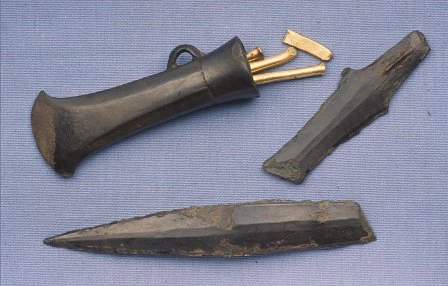
The hoard of Bronze Age artefacts recovered by metal detectorists near Wrexham.

The hoard of Bronze Age artefacts recovered by metal detectorists near Wrexham.

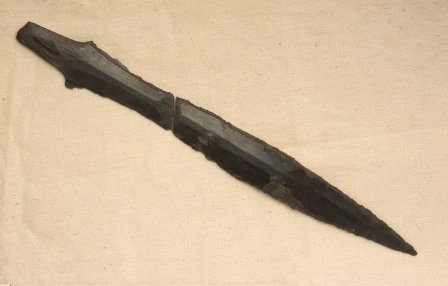
The bronze knife, found in two fragments. The edges of the blade were heavily notched, perhaps suggesting it had been used for some time before burial.

The bronze knife, found in two fragments. The edges of the blade were heavily notched, perhaps suggesting it had been used for some time before burial.

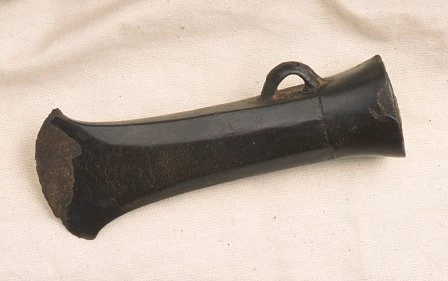
The bronze axe, the socket of which contained the fragments of two or more gold bracelets.

The bronze axe, the socket of which contained the fragments of two or more gold bracelets.

The fragments of bracelets, probably made from Irish gold.

The fragments of bracelets, probably made from Irish gold.

In 2002 a number of Bronze Age items were discovered near Wrexham, North Wales. Amoung the finds were a bronze knife, an axe head, and four fragments of gold bracelets. All were made between 1000-800BC and show links between Wales and Ireland during the Bronze Age.

The knife is of a type used throughout southern England and Ireland, and its shape mirrors much larger swords that were in use at this time. However, it is the first of its kind to be found in Wales.

The bronze axe head has a socket at one end, to which a wooden handle would have been attached, as well as a loop through which leather or twine would have been threaded to keep them together. It appears, however, that the axe head was buried without its handle since four fragments of gold bracelets were found stuffed into the socket. These valued finds include two terminals (end pieces) of a bracelet type most commonly used in Ireland, and are probably made of Irish gold.

These artefacts would probably have belonged to a person of considerable social standing since few people at this time would have had access to Irish gold and such finely worked tools. Quite why their owner decided to part with them will never be known for certain, although it is likely that they were buried as an offering to the gods.

The discovery adds valuable detail to our understanding of life in Wales 3,000 years ago. A time when leaders dressed to impress by wearing gold bracelets and hair ornaments, and a person's role within society was broadcast by the tools and weapons worn, the appearance of the horse they rode and the quality of a feast hosted.

Though most people in Wales were settled farmers and herders at this time, finds like the hoard from Wrexham show us that these small communities were part of large trading networks that linked Wales with Ireland. Evidence that our ancestors had more on their minds than food, farming and survival.

These items form part of the collections of Wrexham County Borough Museum.

The Pen y Bonc necklace

26 April 2007

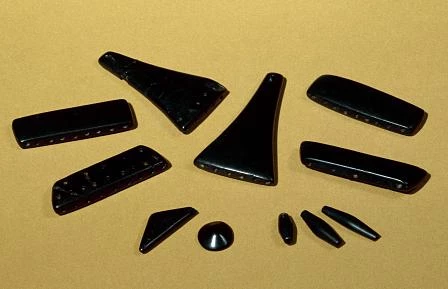
The Pen y Bonc necklace (Anglesey). Image © the Trustees of the British Museum.

The Pen y Bonc necklace (Anglesey). Image © the Trustees of the British Museum.

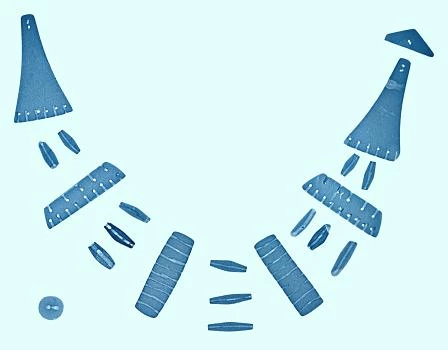
Xero-radiograph of the Pen y Bonc necklace. Image © the Trustees of the British Museum.

Xero-radiograph of the Pen y Bonc necklace. Image © the Trustees of the British Museum.

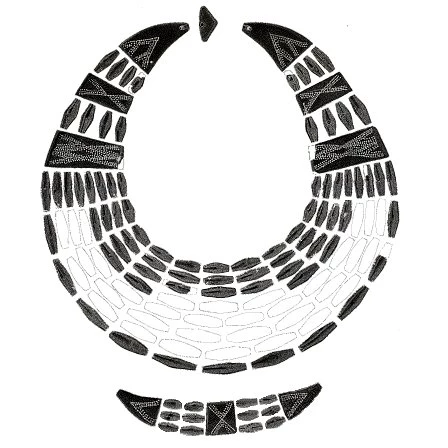
Jet necklace from East Kinwhirrie, Angus (Scotland). Image: Helen Jackson for the National Museums of Scotland.

Jet necklace from East Kinwhirrie, Angus (Scotland). Image: Helen Jackson for the National Museums of Scotland.

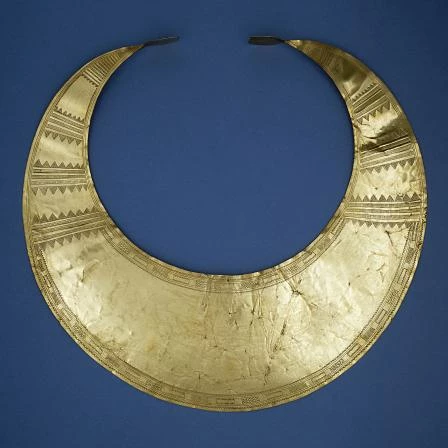
Gold lunula from Co. Kerry, Ireland. Image © Trustees of the British Museum.

Gold lunula from Co. Kerry, Ireland. Image © Trustees of the British Museum.

Queen Victoria had a fascination with the black semi precious stone 'Jet' following the death of her husband, Prince Albert in 1861. The use of this stone has a much longer history as this 4,000 year old necklace from Anglesey shows.

Important burial

In 1828 a grave was discovered at Pen y Bonc, near Holyhead on Anglesey. Accounts of this discovery are incomplete, but the grave was dated to around 4,000 years. The person who was buried must have been important as the grave was cut into bare rock. A number of black beads and buttons were discovered in the grave.

Unfortunately, most of the items were lost soon after the discovery, but some surviving pieces are now in the collections of the British Museum. These pieces form a crescent-shaped necklace of beads and spacer plates. Objects such as these are usually found with female burials. Jet necklace from East Kinwhirrie, Angus (pictured) shows the shape of a complete spacer plate necklace, and illustrates how some of the finest examples were decorated.

A necklace made of coal

Most of the beads and plates in the Pen y Bonc necklace are made of 'lignite' (fossilised wood). However, one bead and the surviving button are made of jet, a material found 300km (186 miles) away to the north-east, at Whitby (North Yorkshire). Jet is a dense black variety of lignite only found in a few parts of Europe.

Only parts of this necklace survive. It is possible that this was all that was buried since Bronze Age jet necklaces are often found incomplete. Alternatively, parts of the necklace may have been made of materials which have since rotted away, or possibly pieces were lost when it was excavated.

Manufacturing jet necklaces was a skilled job. The many strands of the necklace were suspended using spacer plates through which holes were bored to carry the strings. This delicate work was probably carried out using a bow-drill and a piece of bronze wire. In the case of the Pen y Bonc necklace some of the holes have been bored lengthways through the plates. But in order to increase the number of strands on one side of the plate, holes have been drilled at one end to allow new strings to be tied in.

Unlike many types of gem, jet is warm to the touch and is relatively easy to shape; it also takes a very high polish. Today it looks rather like shiny plastic, but during the Bronze Age it must have appeared strange and unusual. Jet also has unusual electrostatic properties (when rubbed it can attract hair and other light materials) that might have been seen as magical in prehistoric Britain.

Treasured jewellery

The jet pieces in the Pen y Bonc necklace were heavily worn suggesting that they were treasured items that had been kept for many years. In contrast, the parts of the necklace that were made from local materials were less worn - suggesting that they were newer replacements for broken or damaged pieces of jet.

Objects made of jet were popular throughout Britain during the Early Bronze Age (2300-1500BC), however, after this period its use declined.

When the jet necklace from Pen y Bonc was discovered in the 19th century, the jet being mined at Whitby was just beginning a revival, thanks in large part to Queen Victoria's obsession with black mourning garments after the death of Prince Albert in 1861.

Gold Lunula

Gold lunula also date to the Early Bronze Age and are often decorated in a similar way to jet necklaces. However, whereas jet necklaces are usually found with burials, lunula are not found with the dead. Perhaps jet suggested death and gold represented life in the minds of people 4,000 years ago.

Background Reading

'The Welsh 'jet set' in prehistory' by Alison Sheridan and Mary Davis. In Prehistoric ritual and religion by Alex Gibson and Derek Simpson, p148-62. Sutton Publishing (1998).

'Investigating jet and jet-like artefacts from prehistoric Scotland: the National Museums of Scotland project' by Alison Sheridan and Mary Davis. In Antiquity (2002) vol. 26, p812-25.