Transport & Maritime

Richard Trevithick’s steam locomotive

15 December 2008

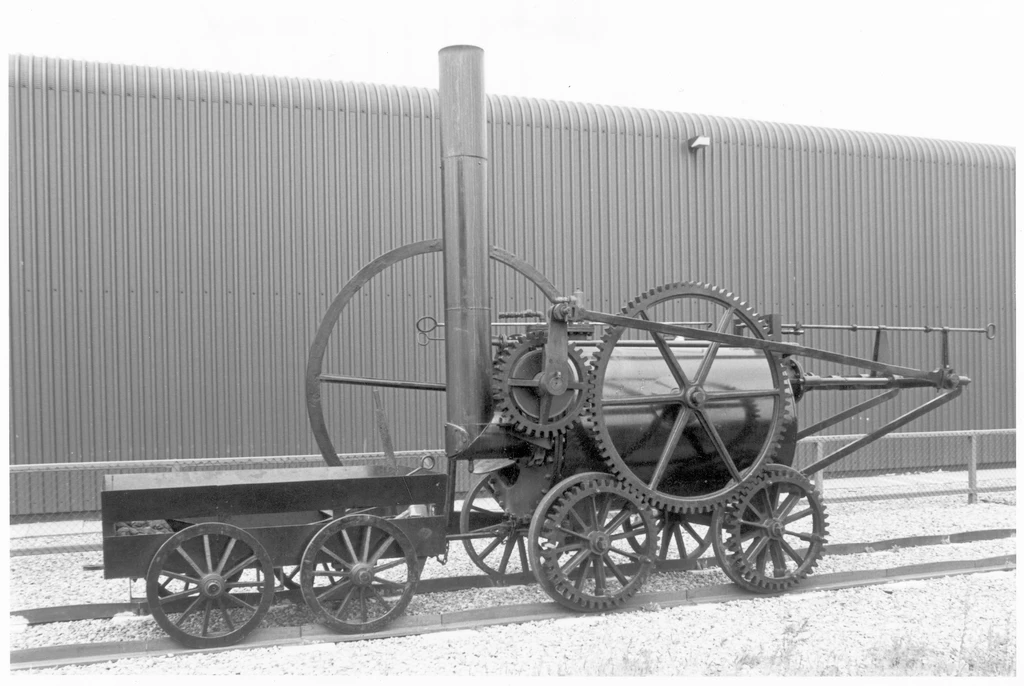
The replica locomotive

The replica locomotive in its present home, the National Waterfront Museum.

The Penydarren loco

On 21 February 1804, the world’s first ever railway journey ran 9 miles from the ironworks at Penydarren to the Merthyr–Cardiff Canal, south Wales. It was to be several years before steam locomotion became commercially viable, meaning that Richard Trevithick and not George Stephenson was the real father of the railways.

In 1803, Samuel Homfray brought Richard Trevithick to his Penydarren ironworks at Merthyr Tydfil in South Wales. Homfray was interested in the high pressure engines that the Cornishman had developed and installed in his road engines.

He encouraged Trevithick to look into the possibility of converting such an engine into a rail-mounted locomotive to travel over the newly laid tramroad from Penydarren to the canal wharf at Abercynon.

Crawshay’s wager

It would appear that Trevithick started work on the locomotive in the autumn of 1803 and, by February 1804, it was completed. Tradition has it that Richard Crawshay, owner of the nearby Cyfarthfa ironworks, was highly sceptical about the new engine, and he and Homfray placed a wager of 500 guineas each with Richard Hill (of the Plymouth ironworks) as to whether or not the engine could haul ten tons of iron to Abercynon, and haul the empty wagons back.

The first run was on 21 February, and was described in some detail by Trevithick:

‘...yesterday we proceeded on our journey with the engine, and we carried ten tons of iron in five wagons, and seventy men riding on them the whole of the journey... the engine, while working, went nearly five miles an hour; there was no water put into the boiler from the time we started until our journey’s end... the coal consumed was two hundredweight’.

Unfortunately, on the return journey a bolt sheared, causing the boiler to leak. The fire then had to be dropped and the engine did not get back to Penydarren until the following day.

This gave Crawshay reason to claim that the run had not been completed as stipulated in the wager, but it is not known if this was ever settled!

The engine was, in fact, too heavy for the rails. Later, it would serve as a stationary engine driving a forge hammer at the Penydarren works.

Replica locomotive

The replica locomotive on display in the Museum today was built working from Trevithick’s original documents and plans (now in the National Museum of Science and Industry). It was inaugurated in 1981 and, ironically, presented the exact same problem as the original engine – it too broke the rails on which it ran!

We cannot overestimate the importance of Trevithick’s locomotive. In 1800, the fastest a man could travel over land was at a gallop on horseback; a century later, much of the world had an extensive railway system on which trains regularly travelled at speeds of up to sixty miles per hour. This remarkable transformation, a momentous occasion in world history, was initiated in south Wales in that February of 1804.


The Penydarren locomotive – Steaming Days

A short film documenting the yearly steaming of Richard Trevithick’s replica locomotive at the National Waterfront Museum, Swansea.

When Welsh ships sailed the seas

6 July 2007

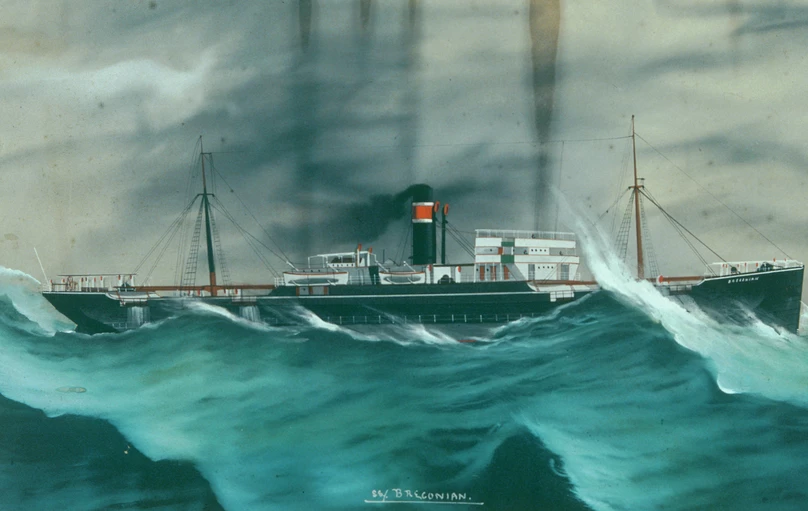
Painting of the Breconian.

Painting of the Breconian

The Breconian

The Breconian was built in 1906; she was registered in Aberystwyth and was sailed by Welshmen across the oceans of the world for thirty years. Her portrait, one of the industrial paintings of ships in Amgueddfa Cymru's collection, reveals a fascinating insight into days gone by.

Ship Paintings

The industrial collections house some 250 ship paintings. Few of these could be described as fine art, but they do provide an invaluable archive of Welsh maritime history. Most of these paintings are the work of Mediterranean 'pierhead painters' who, for a small sum, would produce simple colourful pictures of a vessel for the owner, captain or crew members.

Originally, they were painted in pairs, one painting of the vessel on a calm sea and the other in a storm. What these paintings lack in artistic quality is made up for by their technical accuracy. These paintings became objects of pride and sentiment, as much to the ship's owner as to the captain's wife.

A ship with a new design

The painting of the Breconian is an unsigned storm-scene portrait. The steamship was built for John Mathias & Sons of Aberystwyth. She was unusual in that she had been built with a new, narrower deck, the turret-deck, superimposed upon the vessel's hull, extending from stem to stern. This new design made the vessel more profitable to operate. The design was so successful that 429 turret-deckers were built between 1892 and1911.

The company that owned the Breconian began back in 1869 when John Mathias, an ambitious Aberystwyth greengrocer, decided to venture into shipowning, buying the schooner Miss Evans.

In 1883 he moved from sail to steam, forming the Glanrheidol Steamship Company Limited. By the time that the Breconian joined the Mathias fleet, the business had been grandly renamed the Cambrian Steam Navigation Company Limited, with the seven ships of the line being named, rather unusually, after public schools. This led to seamen at Cardiff giving the company the nickname of 'the College line'.

The Breconian, named after Christ College, Brecon, was the only vessel named after a Welsh school; the others being Etonian, Harrovian, Rugbeian and so on.

Coal out, grain home

Like most tramp steamers of the period, the Breconian would have sailed chiefly in the so-called 'coal out, grain home' trades, taking coal from south Wales across the world and returning with a cargo of cereals. She was manned mainly by Welshmen; in 1911, her master was Captain David Jones of Aberystwyth and 20 of her 28 strong crew came from Welsh coastal towns and villages.

In 1917, The Breconian was sold to the Tyneside Line Limited of Newcastle and in 1926 she was sold on to a Genoese shipowner, Giovanni Bozzo, who renamed her Lorenzo Bozzo after his son. Six years later she was broken up. Today, only the painting remains to remind us of just one aspect of the flourishing Welsh maritime enterprise and the capable Welsh seamen who sailed the world's oceans.

A new lease of life for Cambrian Railways Coach No.238

4 July 2007

The coach before work began

The coach before work began

The interior of the main part of the coach

The interior of the main part of the coach

The completed coach

The completed coach

A 19th-century railway coach has been at the centre of one the largest conservation and reconstruction programmes undertaken by Amgueddfa Cymru.

19th-century passenger railways

At the end of the 19th century, Cambrian Railways covered much of mid-Wales. Unlike the lines in south Wales, whose main purpose was to carry iron and coal from the valleys the short distance to the coast, Cambrian Railways provided long-distance passenger services. They connected coastal resorts such as Aberystwyth to the large cities of Liverpool, Manchester, Birmingham and London.

Quality and luxury

In comparison to today's trains, passenger coaches in the 19th century were quite complicated. Coach No.238 had a small luggage compartment at one end, then two first-class compartments and four third-class compartments. There were three toilets, one allocated to first-class use only. To make sure there was no mixing of classes, the corridors for first and third-class compartments were on opposite sides of the coach.

Coach No.238 was built in Birmingham in 1895 to very high standards, its original plans stating: “Interior panelling of polished sycamore framed with walnut wood and gold lined”.

From luxury coach to hollow shell

The coach entered service in 1895 and was used mainly between Aberystwyth and Manchester before finally being withdrawn in 1939. During the Second World War it was converted into a wireless van. Later it was put into storage before being transferred to Amgueddfa Cymru in 1991 by which time the coach was essentially a hollow shell.

The Museum decided to restore one first-class and one third-class compartment at either end of the coach, with the rest of the space to be used for groups of visitors. A special canopy was constructed to house the coach, allowing the restoration to go ahead even in bad weather.

Restoration of the coach

Work began with re-roofing the coach, then replacing the floor with 'tongue and groove' planks. The first-class compartment was found to have one set of planks laid at 45 degrees to the body of the coach, with a top layer laid at 90 degrees to the lower layer. Apparently this gave a quieter ride for the first-class passengers. Next to be renewed were the external panelling and mouldings, then the internal partitions and seat frameworks, all following the original plans. Such was the attention to detail that the metal brackets supporting the luggage rack were copied from an original with replicas being made in the brass foundry at the National Slate Museum in Llanberis.

The coach originally had 14 coats of paint; fortunately, modern paints do not require such methods. The lower half of the coach is finished in Cambrian Green, with an original sample of paint used to produce the appropriate shade.

Finishing touches

The coat-of-arms of the Cambrian Railway Company and the Prince of Wales feathers provided the finishing touches. These were taken from originals that were photographed, scanned and laser printed to provide identical copies.

The glory of this coach will serve as a reminder of the halcyon days at the beginning of the 20th century when people travelled from all over England to visit Cardigan Bay.

Iron Frames and Wooden Wheels - The Bicycle Collection at Amgueddfa Cymru

16 May 2007

Over the past few years, increasing emphasis on fitness and green issues have helped give the bicycle a new lease of life. Today bikes are available in a wide range of styles and prices, but the first bicycles to be produced were extremely expensive and very difficult to ride.

The first bicycle designs

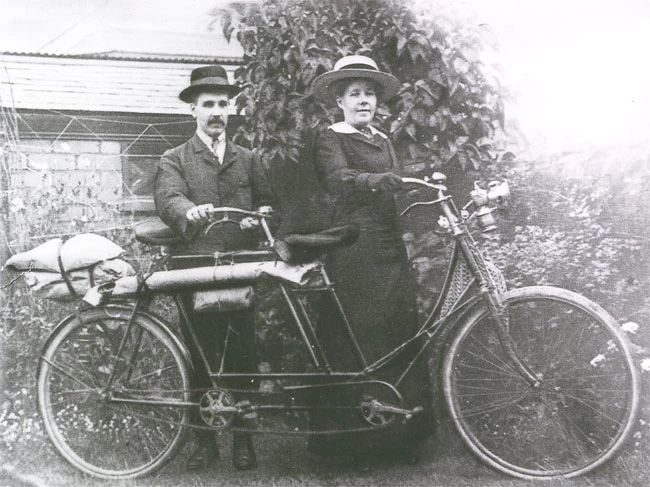
A Cardiff couple on a lady-front tandem. The man, a piano tuner, was blind.

A Cardiff couple on a lady-front tandem. The man, a piano tuner, was blind.

Bikes called High Ordinaries, later known as Penny farthings were particularly uncomfortable and required the rider to have very long legs, in order to reach the pedals.

In the 1870s the new cycle owners formed exclusive clubs, had caps emblazoned with their badges and wore military-style cycling suits. Although women initially steered clear of bicycles many became enthusiastic tri-cyclists, choosing more stable three wheeled varieties and special clothing designed for safety and comfort. Pleated skirts allowed more freedom of movement and the more modest individuals often wore breeches beneath their skirts.

There was a bicycle boom in the 1890s. New models were appearing almost weekly and new factories making bicycles opened up all over the country. The development of the safety bicycle, with chain-driven wheels of equal size, meant cycling was no longer restricted to tall athletic men. As cycling became more common cyclists' dress became less strange and men stopped wearing their cycling suits and began simply to wear their everyday clothes.

Because women were initially riding men's bicycles for which skirts were totally unsuitable, the Rational Dress Society and many cycling clubs encouraged them to wearing of a form of knickerbockers known as 'rationals'. The 'rationals' were not flattering and made their wearers objects of public ridicule. This proved too much for most women and by the turn of the 20th century most women had stopped wearing them.

As mass production brought bicycle prices down, the working classes grasped the opportunity to own their own transport. Bicycles replaced the pony and trap for the country postman, helped policemen cover large areas and speeded up shop deliveries. There were even experiments with bicycle-driven fire engines.

Local ironmongers and suppliers of agricultural goods began to sell bikes and many local blacksmiths became experts at repairing them.

The evolution of the bicycle

The desire for speed had a great effect on bicycle design. As the wheels of the early bikes were directly driven by the pedals, the only way to increase the speed was to make the wheels bigger. There were some models produced with a wheel diameter of 62 inches which weighed approximately 50 pounds. Other efforts to increase speed by reducing the weight of the machines resulted in bicycles which were only 22 pounds, needless to say they were very unsafe.

Bicycle racing

Long distance road races, such as London to John O'Groats, captured public interest and helped increase the popularity of cycling. However, as speeds increased, accidents became more and more frequent and eventually the police put a stop to racing on public highways. Controlled racing over selected courses of 50 to 100 miles were then organised by the National Cyclists Union. Road races, like the Tour de France, did not really catch on here until the early 1950s. The first Tour of Britain race, which later became known as the Milk Race, took place in 1951.

Track racing, on the other hand, was one of the original sports of the 1st Olympiad in 1896. World Championships were held in track racing from 1892, although women's events were not introduced until 1958.

Bicycles in the Museums collections

The earliest bicycle in the museum's collection is called a 'boneshaker'. It dates from around 1865, has an iron frame, wooden wheels and iron tyres, and is said to be the first of its kind in Cardiff. The collection also includes a country-made wooden 'boneshaker' copied from the manufactured type and built by a local craftsman. As well as the boneshakers, the museum also has Raleigh bikes from the 1930s, World War II roadsters, a 1938 New Hudson tandem and a sociable tricycle produced in the 1880s.

The wreck of the Ann Francis

8 May 2007

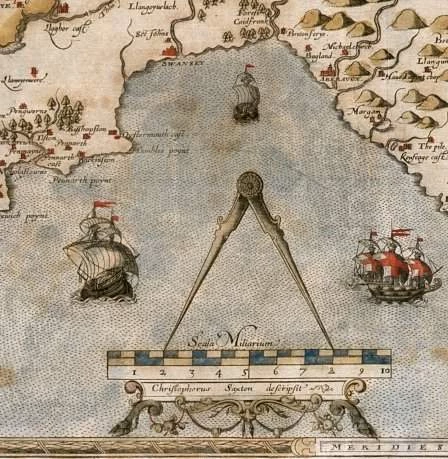
A detail of Christopher Saxton's Map of Glamorgan, 1578

A detail of Christopher Saxton's Map of Glamorgan, 1578, showing the coastline from Oxwich on Gower (left) to Margam (upper right).

Spanish gold and silver coins of Ferdinand and Isabella (1479-1504)

Spanish gold and silver coins of Ferdinand and Isabella (1479-1504). Coins continued to be minted in their names long after their deaths, until the 1550s.

Talers: large silver coins from Germany.
Talers

: large silver coins from Germany. This group includes issues of the Electors of Saxony, Counts of Stolberg, Langraves of Leuchtenberg and the cities of Cologne and Herford. The modern word 'Dollar' originates from Talers

A gold San Vicente of John III of Portugal (1527-57); the reverse (right side of image) depicts the saint holding a martyr's palm and a model ship.

A gold San Vicente of John III of Portugal (1527-57); the reverse (right side of image) depicts the saint holding a martyr's palm and a model ship.

Navigational dividers from the wreck of the Ann Francis.

Navigational dividers from the wreck of the Ann Francis.

Spanish coins, navigational tools and a whistle- are these the remains of the 16th-century vessel, the Ann Francis?

For many years, coins and other objects have been found on Margam Beach in Glamorgan. Many are of relatively recent date, but there is a noticeable concentration of coins dating from the middle of the 16th century.

Most of these coins are silver: of Ferdinand and Isabella of Spain and from a number of states of the German Holy Roman Empire. There are a few copper coins of John III of Portugal (1521-57) and even two spectacular gold coins - one Spanish and one Portuguese. Throw in sets of navigational dividers, lead sounding weights and a bosun's call (whistle) and what have you got? A shipwreck.

Most of the coins date from the 1530-1557. It is known that a French ship was lost in December 1557 at Oxwich on the Gower, 21km (14 miles) to the west - but is there no suitable wreck closer to Margam?

Well, a 16th-century wreck is known at Margam, but not in 1557. On 28 December 1583, the Ann Francis, the newest and biggest ship belonging to the King's Lynn merchant Francis Shaxton, ran aground on Margam Beach.

The ship was promptly plundered by the local inhabitants, until agents of the local landowners restored order and themselves laid claim to the goods. In due course Shaxton learnt of his ship's fate and after lengthy legal battles recovered some of his goods - anchors, cannon, cables and money.

Usually, coins are a good pointer to the dates of wrecks, so why do they suggest a much earlier date here? One answer, of course, may be that there really was a separate wreck at Margam in 1557, though we have no other evidence for one. But it is known that the Ann Francis carried a lot of money, probably the proceeds of selling a cargo of grain in Spain and/or Portugal.

The coins, of types that were by now obsolete, acted simply as silver bullion, which in normal circumstances would have been taken to the Mint in London to be converted into coin of the British realm. The ship lost its way on the return leg of the voyage and the silver never made it to London.

Background Reading

'Wreck de Mer and dispersed wreck sites: the case of the Ann Francis (1583)' by M. Redknap and E. Besly. In Artefacts from Wrecks edited by M. Redknap, p191-208. Published by Oxbow Books (1997).