After the Crit Room Sara Huws, 28 September 2015 This is a void appreciation post.It's not often that we have a lot of time to reflect on what we do, because there's always so much to do. So, before I jump into venue hire revamps; finishing off a piece of prep for this Women's Archive Wales conference and helping with new 'suggest an event' pages, let's look into the murky abyss and just take a minute to breathe. Nice, no? [The Sea's Edge, Arthur Giardelli]Since 'keeping busy' is the other Welsh national sport, it's not for everyone - but I'm a firm believer in taking stock, staying still for a minute, and listening. There'll always be a call: an email that's fallen down the back of the sofa, a book you've been meaning to pick up, or a colleague you'd like to make more time for will pop upstairs and say hi.Evaluation and Taking StockWe're in transition as a department - welcoming two new team members this week - and have been working, quite separately and like the clappers recently, on various projects, on web, galleries, social, governance, research and planning.Graham, who heads the Content Team (and who I will now be calling Captain Content if he lets me), has been taking part in a cross-sector project looking at evaluation and taking stock, called Let's Get Real. Last week, he braved their Crit Room in Brighton, where he presented our work for open criticism and questioning. Curiously scary.The results of the crit have been a real encouragement - I had been worrying about the size of our twitter network, since the time cost of keeping everyone trained up is ever growing for me. But, we were encouraged to see it as a sign that we're a healthy, tweeting organisation.I am really trying to believe them.Feedback from the Crit RoomSelf-deprecation aside, I'm quietly happy with how we're working as a network, and really chuffed to see people really run with the new skills they've acquired on social media. In fact, while totting up some numbers for an unrelated report last week I saw we'd passed a great milestone - as a network, we now have over 125,000 followers on twitter alone. I know it's not just a numbers game, but there's something reassuring about those great, neat, empty 000s in a row.The Crit Room also had great words of encouragement for Chris, who's built all the foundation for the website redesign (and much more besides), and the rest of the team - namely that our digital offer was 'highly rewarding, rich and satisfying'. I can't stop thinking of coffee when I read those words. Speaking of which: time to stop blogging about stopping now, and start stopping for a cuppa.
Fragile? Art & Craft Workshops for People Living With Dementia Jennifer Dudley, 24 September 2015 Teacups & MemoriesThe Exhibition: Fragile? Fragile? is an exhibition of contemporary ceramics at National Museum Cardiff, showcasing the beauty and variety of contemporary ceramics practice. The exhibition explores the artistic and expressive possibilities of clay as a material, including the contradiction between two of its innate qualities – durability and fragility. The exhibition includes items from the National Museum’s collection, shown alongside exciting new ceramic installations made especially for this exhibition. Dementia-friendly workshops – Free! But limited availability so please book in advanceOn October 1st we will be running a day of free workshops for people living with dementia and their carers, with activities inspired by the Fragile? exhibition. The workshops will be relaxed and friendly. No previous experience is required for any of the activities. Tea and biscuits will be provided and chatting is encouraged! Some sessions may be photographed, so that we have a record of our activities, but you can always ‘opt out’ of being photographed. Workshop schedule Explore the exhibition, 11am-1pm. Maximum 10 people - please book in advanceIn the morning, we will take a spotlight tour of some objects in the Fragile? exhibition. You will not be given a full tour of the whole exhibition as it is quite large! There will be tea, cake, and music with different ceramic items available for you to touch, hold and chat about. A family member, friend or helper is very welcome to attend with you.Lunch, 1 – 2pm. Maximum 20 people – please book in advanceWe would love for you to join us for lunch if you have taken part in either or both of our sessions. Family members, friends and helpers are also invited.Teapots and Clay pots, 2pm-4pm. Maximum 10 people – please book in advanceIn this fun, hands-on session led by artist Jess Midgley, you can have a go at modelling and pattern making with clay. A family member, friend or helper is very welcome to attend with you.To enquire or book a place please email Jennifer.Dudley@museumwales.ac.uk
Making a photographic collection accessible - Part 1 Mark Etheridge, 17 September 2015 Staff at Amgueddfa Cymru work across a number of different departments. These departments do not work in isolation, but staff work together to look after the collections preserved for the people of Wales.The industry and transport photographic collections comprise over 206,000 images, covering all aspects of Welsh industrial, maritime and transport activity. One of the greatest treasures held within this rich collection is the Hansen Collection, which comprises of 4,569 negatives (two-thirds glass, and a third film) of ships mainly at Cardiff. These were taken by members of the Hansen family between 1920 and 1975. They provide an amazing photographic record of shipping activity at the port during those years. You can find out more about the history of this collection by reading this article from 2011.One of our main aims is to make all the collections we look after more accessible. When we purchased the Hansen Collection in 1979, the first stage in the process of making the collection available was to compile a catalogue. Initially a handwritten catalogue was produced which could be consulted in the photographic research room. Then in 1996 the catalogue was published under the title “the Hansen Shipping Photographic Collection” making the contents of this collection available to a wider audience. A few years ago I worked on converting this catalogue into a digital format so that it could be placed on the museum website. It is now available for anyone to search, and find vessels they are interested in. The online catalogue has greatly improved access to this collection, and we have had enquires from all over the world because of it. People might be researching a particular ship and are looking for an image of it. A family member might have worked on the vessel and so someone might be interested in seeing what the ship looked like.Following placing the catalogue online the next stage has been to input information on each negative onto our collections management database. A number of staff are currently involved in this, including myself and staff working in the History & Archaeology and Collections Services departments. We have so far put just over 1,500 negatives onto the system. It is a long process, especially as we are repacking the collection into conservation grade packing as we go along. As well as preserving the collection and making information on the collection available, we also need to digitise each negative. This will provide us with a record shot, meaning that we can minimize the handling of the original. This is especially important as so much of the collection is made up of fragile glass plates. We have made a start on this, and have so far digitsed 572 negatives. Our intention is now to continue this work and digitise the remainder of the collection.We will be doing a series of blogs on various aspects of the process to make this collection accessible, and will be blogging on cataloguing and adding the collection to our database, repacking the collection, and the digitisation process. Check back to see how we are getting on with this important photographic collection.Mark Etheridge Curator: Industry & Transport Follow us on Twitter - @IndustryACNMW
Chinese Jades at Amgueddfa Cymru Penelope Hines (Temporary Curator of Applied Art), 14 September 2015 Jade is a tough translucent material that can be made into ornaments, ceremonial weapons and ritual objects. For more than 7 millennia Jade has had a high cultural significance in China and throughout history craftsman used innovative design, technical skills to produce a great variety of objects from diverse categories in jade. The Material The Chinese term for jade "Yu" can be used to reference to any stone of beauty or value; such as agate or turquoise, which possess the five following values: Smooth texture Hardness Dense structure Translucency Variant hues However when we discuss the term "Jade" (particularly in a western museum) we are specifically discussing either of two different minerals; nephrite and jadeite. The mineral jadeite arrived relatively late to china (around the end of the 18th century) therefore the majority of what is considered to be a Chinese jade is nephrite. Jades of Amgueddfa Cymru All animals carved during the Ming and Qing dynasty came with auspicious meanings and good wishes directed to the viewer. The majority of the collection at National Museum Cardiff are such objects. Duck (NMW A 50761) This duck looks as if it is swimming. The lotus on its back and in its back are to bring the owner good fortune. Combination of the simple forms and fine details makes it typical of the late Ming period. Buffalo (NMW A 50764) Buffalo were used in houses to repress evil spirits. However due to it role pulling a plough it has also become a symbol of spring and agriculture. Those lying with their head tuned could indicate the world being at peace. Swan / Goose (NMW A 50767) We are unsure whether this is a swan or a goose, in ancient Chinese culture the swan was the heavenly version of a goose, though both are sacred animals. Lion (NMW A 50787) Lions aren’t native to china but became known through the spread of Buddhism. Usually in jade they are represented in the manner of a dog. Though more commonly they are seen in porcelain and at rest. This is a good example of jade as a material being used as a display of wealth. Water Dropper (NMW A 50777) The water dropper was used to support the treasures of the studio such as the brush, ink, paper and ink stone. These pieces were used as early as the 13th century however were for more widely known during the Ming and Qing period. The collection of Chinese jade in Europe was scarce before the 19th century. Really it seems to have started after the exhibition of jades at the crystal palaces great exhibition. The first pieces to enter the collection were for the turner house collection presumably acquired by the galleries 1st patron John Pike Thomas in the 1800’s. Primarily though, they come from the David Bertram Levinson bequest in 1967. Little is known about the provenance of the jade but it’s likely they are all from the 1800s and 1900's. Article written up from talk given on Chinese Jades, 15th May 2015. Bibliography Books Lin, J C S. The Immortal Stone: Chinese Jades from the Neolithic Period to the Twentieth Century. The Fitzwilliam Museum, (Scala Publishers, 2009). Wilson, M. Chinese Jades, (V&A Publications, 2004). Articles/ Chapters Nichol, D. 2010. Chinese Jade from the National Museum of Wales Collection. National Museum of Wales Geological Series No 2x, 000pp. Websites Amgueddfa Cymru Art Collection Online
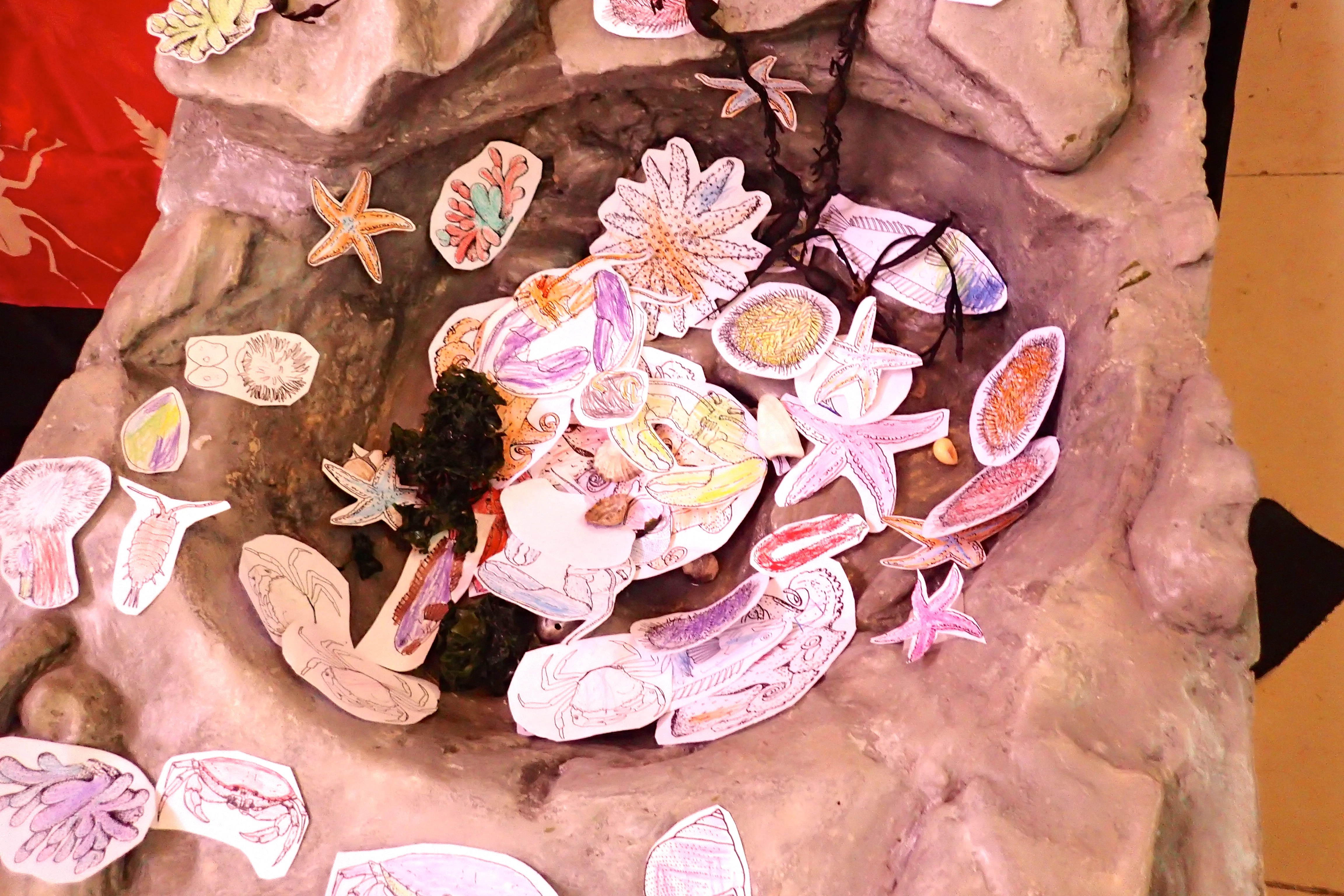
I Spy...Nature Competition Winners 2015 Katie Mortimer-Jones, 10 September 2015 The Natural Sciences Department at National Museum Cardiff have once again taken their 'I Spy...Nature' Pop-up museum to the Capitol Shopping Centre in Cardiff during this year's summer holidays. Our younger visitors were encouraged to utilise their drawing skills to draw some of the fantastic specimens from Amgueddfa Cymru Collections on display as part of a drawing competition. Examples were fossils, minerals, marine creatures, flowers and bugs from all around the world. We had some fantastic entries and it was extremely difficult to pick the winners. However, after much deliberation we eventually managed to pick a 1st, 2nd and 3rd place in three age categories (under 6, 6-9 and 10-13 years). Due to the fact that it was so hard to choose winners we also selected a couple of highly commended drawings.Each winner will receive a natural history inspired prize from the Museum's shop and will receive a special behind the scenes tour of the museum to find out what museum scientists do and where we house the museum's natural history collections, which comprise of over 3 million specimens.We very much look forward to welcoming our prize-winners and their families to the museum.