Tea, Cake and Collections: ReEngage Tea Parties at National Museum Cardiff and St Fagans National Museum of History

Loveday Williams, 31 July 2023

“Re-engage provides vital, life-enhancing social connections for older people at a time in their lives when their social circles are diminishing.”

https://www.reengage.org.uk/   

For over a decade we have been working with ReEngage (formerly Contact the Elderly), hosting regular tea parties at some of our museums for older people experiencing loneliness and isolation.

The first tea parties took place at National Museum Cardiff, initially 4 times a year, but as the group grew this increased to 8 parties per year, hosted between National Museum Cardiff and St Fagans National Museum of History.  

The tea parties enable group members to visit the museums in a safe and supported way, meet their friends, make new social connections and spend time exploring the museums collections through engaging activities and talks with members of staff. And there’s always plenty of tea and cake!  

During this time, we have built strong links with the group members and Jane Tucker, the group leader. Ahead of the tea parties we have conversations with Jane to make sure we are aware of any accessibility, mobility and other needs within the group to ensure we can tailor the sessions accordingly.  

Here Jane tells us a little more about how the tea parties started and her role in supporting the group:

“I started volunteering with Re-engage (or Contact the Elderly as it was then) in March 2013 as a driver.

On a visit to St Fagans (funnily enough) in approximately 2017, I happened to see Marion Lowther who, at the time, was the Re-Engage organiser for Wales.  She told me she had a group of about 6 guests but no coordinator.  At the time they were only meeting 4 times a year as the only host available was National Museum Cardiff, hence why we are called the Cardiff Museum group.  I volunteered to take over the group and have managed to get more hosts and more guests.  The Museums are always a favourite of the group because you always provide interesting talks and activities.  

As you know a lot of our ladies are quite frail and are unable to leave their homes unaccompanied.  The visits to the Museum are a real highlight for them and we are so grateful for your continued support.” (Jane Tucker, ReEngage Group Leader).

In March of this year the group visited National Museum Cardiff for a session all about the current BBC 100 Exhibition, exploring the 100 year history of the BBC in Wales. 

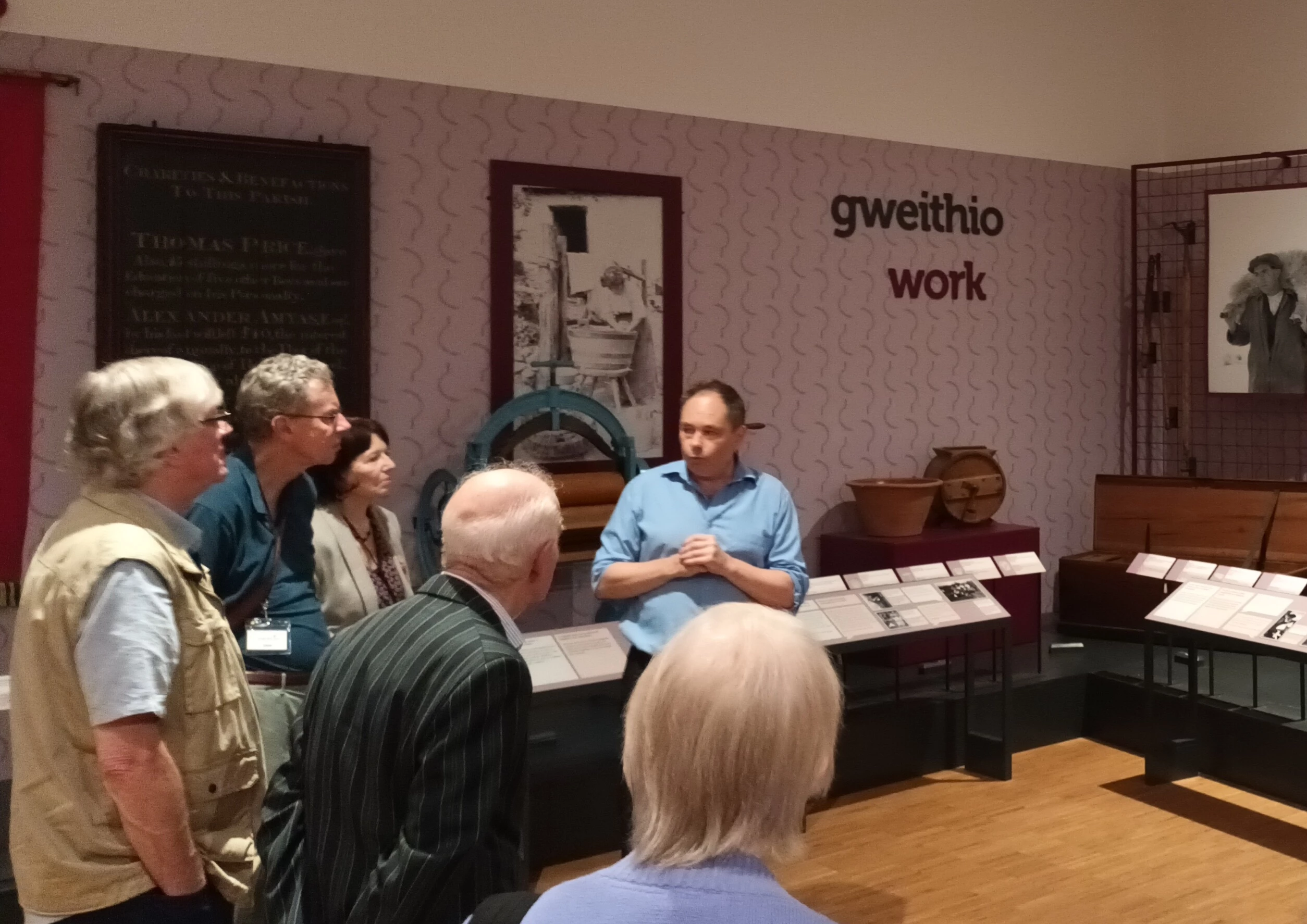
The session was run by two members of the museum learning team, Jo and Louise. They used fun informal quizzes to highlight the exhibition content in a comfortable setting, as navigating the exhibition itself would have been challenging for the group members. Jo ran a TV picture quiz focussed on TV in the 60’s and 70’s and Louise ran a short TV theme tune quiz. 

Jo and Louise said “The group enjoyed chatting about their memories and there was lots of reminiscing about visits to the museum with children and grandchildren. They really enjoyed their tea!” 

Jane said following the visit “the talk we had at National Museum Cardiff was great, when the 2 hosts were playing music from old television programmes and adverts.  Our guests had lots of fun trying to recognise the tunes and then talking about the old programmes.”

The groups last visit to St Fagans took place in May 2023, facilitated by two members of the St Fagans learning team, Hywel and Jordan.

Jordan explains: “After introducing them to the site we gave a talk about the ‘Cynefin’ work being developed in our school learning programme, using the Wales is... gallery, exploring individual senses of identity and how we can use objects to support the sharing of these stories. Then, we discussed the groups’ personal understandings of their ‘Cynefin’, using handling objects from the museum collection to spark memories and conversation. Handling objects like the darning mushroom, pre decimalisation coinage and green shield stamps, proofed to be popular talking points for the group, encouraging them to shared stories of living in Wales and other parts of the world, their experiences of using everyday objects like this and changes over time.”

Here’s what some of the group members said about taking part following the session:  

“Most enjoyable afternoon at St Fagans Museum. It is lovely to see other people to chat with as I spend a lot of time alone.  It’s really appreciated.” (Anne)

“I really enjoyed the talk about the museum and the work they are doing.  Sundays can be really lonely so having a Re-Engage tea is such a joy and something to look forward to.” (Rita)

“Handling the objects at the Museum was really fun as well as informative. It gets your brain working and brings back memories.” (Hazel)

We’ll be welcoming the group back to St Fagans this summer to take part in some traditional yarn crafts inspired by our textile collections. Then they’ll be returning to National Museum Cardiff this autumn autumn.  

The museum learning team and group members alike always look forward to the tea parties. Over the past 10 years they have grown to become a key fixture in our wider Health and Wellbeing programme. Long may they continue!  

With thanks to all the ReEngage group members for sharing their stories, thoughts and feedback. Looking forward to seeing you next time!

Installing The Lost Words - Partnership in Action

Lisa Childs, 28 July 2023

In June of this year Ulrike Smalley, Aled Williams and I travelled to Trawsfynydd, Gwynedd, to assist in the installation of Geiriau Diflanedig -The Lost Words at Yr Ysgwrn. This shared exhibition is the result of a partnership between Amgueddfa Cymru, Pembrokeshire Coast National Park Authority and Awdurdod Parc Cenedlaethol Eryri. 


Celebrating the relationship between language and the natural world, and the spark of imagination that can spring from it, this display of works on paper together with a small number of items could not be better suited to its location. Yr Ysgwrn’s cultural centre, housing a gallery, café and learning space sits in the stunning landscape of Eryri. A converted stable, it is part of the farmstead that was the home of Ellis Humphrey Evans, better known by his bardic name, Hedd Wyn. 

Raised a farmer, Ellis was encouraged in his poetry writing by his parents.  He won his first bardic chair aged 20 and would win a further four before his death nine years later on the Western Front. He died never knowing that he had achieved his ambition of winning the chair at the National Eisteddfod. The beautifully carved oak chair was transported by train and then horse and cart to his childhood home, where it has remained on public display ever since. Hedd Wyn remains a symbol of that lost generation of men who went to war and never returned. His former home, however, has remained a place of discovery, education and sometimes pilgrimage for those wanting to know more about his life and of the things he held so dear.

Hedd Wyn was often inspired by the beauty of his natural surroundings. The images created by artist Jackie Morris in Geiriau Diflanedig -The Lost Words draw on much of that same beauty, celebrating its presence and lamenting its potential loss. Her watercolour and goldleaf paintings focus on objects and creatures from nature including the magpie, conker, otter and wren, and are truly beautiful. The artworks are accompanied by poems written by Robert MacFarlane and translated into Welsh by Mererid Hopwood. 

Before our team could begin installing Geiriau Diflanedig -The Lost Words, the original stone walls of the gallery were faced with painted MDF board to hang the 25 works. Aled and Ulli discussed and organized the layout while I condition checked the items. With some assistance from Naomi and Kevin at Yr Ysgwrn, the works and the accompanying poetry panels were positioned and hung, sealed open-top school desks laid out with objects from the natural world, overhead lights adjusted, mirror plates covered and painted, vinyls adhered, floors swept, glass polished, and giant wicker dragonflies suspended from the ceiling.

We repeated the process at Oriel Y Parc gallery and visitor centre in St Davids in Pembrokeshire, where the other half of the exhibition is installed with the addition of specimens from Amgueddfa Cymru’s natural history collections.

If you are heading to North or West Wales over the next 9 months, please take the time to visit these sites. You will not be disappointed.

Beginning my journey into science, starting 450 million years ago!

Manus Leidi (PTY Student), 27 July 2023

Everyone has that favorite Christmas from their childhood, I bet you can picture yours now. Mine was when I was about eight years old. I woke up to find a small rectangular present underneath my pillow, not then realizing the butterfly effect this present would have on my life. Most kids that age would be wishing for Lego or superhero figures, and I did love Lego at that age, yet this present was none other than BBC’s Walking with Dinosaurs series. I was hooked like a bee is to pollen, getting more and more lost in the land before time, the animals of today paling in comparison to the monsters that used to stalk our planet, wondering if one day I’d be able to discover and name my own.

Unfortunately, this dream was put on hold as I dealt with my terrible teenage years.  Impressing my peers became the centre of my life and being the dinosaur/science kid was not going to cut it. Once I had left school for college and grown up, considerably, I went back to my original passion, studying Biology at A level and then moving to a biology undergraduate degree at Cardiff University. 

Though I have studied biology for many years, I still had no actual experience in doing real scientific work. So, when the opportunity to partake in a professional training year (PTY) arose, I reached out with both arms. I applied for a placement at Amgueddfa Cymru-Museum Wales in Cardiff, and after a few weeks I embarked on a project with the Natural Sciences staff in the museum. This is where my journey into the scientific world begins, working on animals that perished over 450 million years ago.

The day I started my project in the museum felt a bit like a first swimming lesson, nervous but excited at the same time. Luckily for me I was put under the tutelage of the wonderful Lucy McCobb, a paleontology curator who had a vast knowledge and understanding of the time and fossils I would be working on. My first few weeks of the project were spent organizing nearly a thousand fossils by species, so that they could be transferred into drawers for easier access. The collection of fossils I had been assigned to work on was called the Sholeshook Limestone collection. These fossils were collected in South-west Wales by an amateur collector called Patrick McDermott, who graciously donated them to the museum so they could be further studied. 

My project over the year would be to curate the collection, organizing and documenting it, as well as to help identify a possible new species. The animals I would be focusing on from this collection are a group of archaic, marine arthropods known as trilobites. These creatures are some of the earliest known fossils, first appearing around 520 million years ago in the Cambrian period and lasting almost 300 million years, before going extinct with 90% of all other life in the end Permian mass extinction. 

But why trilobites? Most people overlook the arthropods of today in favour of more impressive animals. Trilobites, however, have proved vitally important to scientists in the study of evolution. Firstly, trilobite fossils are one of, if not the most, abundant fossils of their age. This is due to trilobites being amazingly successful as a class, having a hardened exoskeleton which they moulted off regularly and many species living in shallow coastal environments, both features that increase chances of fossilization massively. In fact, they have been so useful that entire evolutionary studies have been conducted on them, such as Peter Sheldon's important study of over 15000 trilobites from mid Wales in the 1980s, which resulted in an eye-opening paper shedding light on evolutionary trends based on trilobites. Excited by my prior reading, and especially the prospect of helping discover a novel species, I was eager to begin my project. 

Once all the fossils were sorted, my first task was to select the best specimens from each species to photograph. Photographing the specimens is very important as this will eventually allow them to be uploaded online and in turn, become accessible to many more people, including scientists and the public alike. 

Once this was all completed, it was time for my favourite part of my project so far, helping discover a new species! This has always been a lifelong dream of mine, although when younger I did hope I’d discover the biggest dinosaur ever, and I couldn’t wait to get started. I gathered all the fossils of the suspected new species; each specimen, over 250 in total, needed to be worked on in a number of ways. First, they had to be sorted according to which part of the body it represented.  Luckily trilobite exoskeletons tend to break into consistent parts (head, thoracic segments, tail) so this part was not too difficult. Second came the most time-consuming part, examining their features in detail under the microscope, making observations and taking multiple measurements of each specimen - like the initial sorting, this process took a few weeks but was vital, as these measurements are used to distinguish our species from others in the genus.

Once all the raw data were collected, along with Lucy, we compared our species with every other known species in the genus. This was not as easy as it first seemed.  The well-known species were rather quick to distinguish based on their different features, however, some species are not even given full species names, as only one poorly preserved fossil has been found. Comparing these fragmentary fossils to our species was taxing, especially when the papers some of these species were figured in are from the 1800’s or written in Russian! 

I am hopeful that this paper will be finished and submitted to a scientific journal before I begin my third year of my university degree. I believe this will be a huge help to make me more desirable to future employers. As well as curating and writing this paper, the museum has also given me other opportunities to help develop my scientific skills. This September, in fact, I will be presenting a poster on the project at the Paleontological Association annual conference, which I am beyond excited to do. 

Another area the museum has helped me develop is science communication. I was given the opportunity to produce trilobite spotter sheets to help the Welsh public in their fossil hunting. This involved me finding local and well-preserved fossils in the museum’s collections to photograph, laying these images out on the sheets, and working with Lucy to draft text about them. I was then able to present these sheets at a public outreach event, After Dark: Science on Show, where Lucy and I ran a stand, promoting the museum’s spotter sheets and inviting people to play a board game, which showed them how difficult it is for fossils to form. 

Having the opportunity to work in the museum has further solidified my passion for natural science, as well as giving me the tools to progress in the field post degree. I feel I have finally taken my first steps into the scientific world, rather than simply learning about other peoples’ discoveries. Being able to say that I have published scientific work before even graduating from university and knowing I can work with fellow peers in my workplace who have said they have appreciated me being here (they could be lying), has given me great self-confidence. I cannot stress how important doing a year in industry has been for me and would recommend it to any other student. The insight and experience it will give you will in my opinion completely influence your future decision making. I implore any student with the opportunity to take a training year to ask yourself, do you actually know what it will be like or have any experience working in your field? If the answer is no, then a training year should be a MUST!

Finally, I would like to thank Lucy, Caroline and Jana, as well as all the staff in Natural Sciences that have helped me this year. I feel prepared to take my next steps into science and that’s all because of the help everyone has given me. 

The Welsh Hat - Then and Now

Niamh Rodda, 27 July 2023


collection of 13 different miniature hats

Miniature hats from 1860s by Welsh hatter, John Evans. The Welsh Hat is in middle row, centre.

        Hats are often political. Though it would be understandable for someone to assume that they are made to protect someone from inclement weather, it does not take a lot of thought to see that they are often much more. From a red Make America Great Again’ baseball cap, to the bonnet rouge of the French Revolution, to any number of military hats, hats are regularly used to indicate which side you are on.  Hats, along with all fashion, are used in a huge variety of ways to communicate with others and can tell us a variety of information: nationality, gender, interests, and identity. The hat specifically is often associated with group identity; in a crowd of people the hat can be a key identifier and if worn collectively can create a striking vision. The Welsh Hat does just this, its tall black crown and stiff brim, traditionally worn by Welsh woman creates a distinct and eye-catching look that has long been used as a symbol of Welshness.

Before The Welsh Hat

There is a prevailing myth that the Welsh hat and national costume was a Victorian invention, as part of imagined Welsh heritage and yet there are plenty of accounts going back a century earlier that tell us otherwise. The Victorians may have curated a specific version of Welsh dress and cemented the idea of it as Welsh National Costume but the clothes themselves, including the hat, had indeed been around for much longer.

Before the Welsh Hat was Welsh, it was just a hat. High crowned styled hats made of felt or beaver fur were once popular across many countries. Men and woman across Britain in the latter half of the Elizabethan period, wore such hats for travelling and riding, and a wider brimmed version of the hat, ‘cavalier style, was then adopted by the middle class in the mid-part of the 17th century. At this time hats were an important status symbol. Beaver fur was the quality material used to felt hats, but felting the fur was difficult and costly and from 1670, the product was often imported from America. Samuel Pepys notes in his diary, in 1661, that a beaver hat had cost him 45 shillings. From around 1640 to 1660 a version of the beaver hat with a tall, tapered crown known as a sugarloaf became popular and looked very similar to what we would think of as the Welsh hat today. Today hats of this style are heavily associated with the Puritans and pilgrims to America, for its simple, unadorned design. Thus, even 400 years ago, the hat was steeped in meaning, from wealth and class, to political and religious leanings.

Us and Them

While the black Sugarloaf hat, along with other features that we today associate with Welsh National costume, were common across Europe and America in the 17th century, it is in the 18th century that we see a divergence in style. While elsewhere fashion trends moved on, these older looks appear to be retained by the Welsh peasantry. As fashion changed rapidly in the later half of the 18th century, this rejection of the new styles (be it intentional or through financial necessity) resulted in a notable difference in dress by the Welsh lower classes, from their English counterparts. This is documented through numerous accounts of English travellers that commented on the difference in clothing between the English and Welsh, among which are descriptions of a tall black hat worn by women. 

a watercolour landscape scene with a large group of 18th century working woman, children, and horses.

Painting by Julius Caesar Ibbetson, Newcastle Emlyn Costumes, 1792

Julius Caesar Ibbetson was an English painter who created a number of works depicting scenes of Welsh life at the end of the 18th century. Through these works, a distinct image of Welsh working-class women can be seen. The paintings depict an attire which is different from what was fashionable dress throughout Europe during the 1790s, and almost all the works include women wearing what we can think of as an early variation of the Welsh hat. 

In the work Newcastle Emlyn Costumes from 1792, all 14 women from the scene, as well as 2 children, are depicted wearing almost identical, black brimmed hats. While the hats may be shorter and less rigid from what we think of today as the Welsh hat, there is still a clear resemblance in style. In the inscription beneath the watercolour, Ibbetson writes peculiar drefs and costume of the peasantry, in the district around Newcastle Emlyn in Pembrokeshire. Here the English painter highlights that to him, the dress of women in Wales is distinctly different peculiarfrom English standards of dress. These outfits also have clear similarities to what one would think of as the Welsh national costume today, with their striped and checked patterns, and their shawls and aprons. In addition to its distinctive look, what is remarkable is the hats uniformity across all the wearers. At this time there was a large variety of styles in hats, bonnets, caps, turbans, hair accessories, wigs and hair styles and a huge choice in frippery to be added including flowers, ribbons and feathers. However in the works of Ibbetson, we see a singular black and unadorned style.

The striking uniformity of the Welsh dress was not lost on the Welsh, rather it became a strategic symbol of collective power. Famously it is even said to have helped defeat invading military powers. In 1797, French warships descended on Pembrokeshire in what is known as the Battle of Fishguard. Numerous reports document how hundreds of Welsh women in red shawls and black beaver hats, flanked the coastline behind the British military; creating the illusion from afar that they too were soldiers, and so leading to the unconditional surrender of the invading force. Thus the Welsh national dress as a symbol of strength and unity, and part of proud Welsh heritage, was embedded into the nations history.

National Costume

watercolour of Victorian women wearing tradtional welsh dress and hats

1931 Postcard reproductions of "Dull-wisgoedd Cymru/Cambrian Costumes" by Lady Llanover in 1834 (cropped)


Over the course of the 19th century, the Welsh hat along with the rest of the Welsh dress, would shift into an even more defined style. Previously, the Welsh hat was by no means the only hat being worn, partially as they were more expensive than other felt or straw hats. There were also many local variations on the Welsh hat; the tall hat was popular in larger towns such as Cardiff, Bangor and Carmarthen, while lower, flat-topped straw hats were popular in the Gower, as they allowed woman to carry cockle-baskets on their head and were better suited to the windy climate. But over the century, the hat would be consolidated into the more singular, standardised and uniform look that we think of today as the Welsh hat.

Lady Llanover (1802 to 1896) was the influential philanthropist who greatly influenced the uptake of traditional Welsh dress and worked tirelessly to promote Welsh language and culture. She wrote extensively on the matters of Welsh costume, as well as producing a series of illustrations on the subject and it is from her that we get the tradition of wearing the national costume on St Davids Day.  While Lady Llanover certainly did not invent the Welsh national dress, she worked hard to bring it from the confines of the working class, into upper class society, even so far as to insist that guests to her parties were to wear the national costume.

In 1832 the then Princess Victoria (not yet queen) and her mother visited North Wales and on their carriage ride wore Welsh hats, when passing through Bangor in compliment to the fair maids of Cambria'. Thus by this point we can see the complete transition from the traditional working wear of the peasantry, to the fashionable National costume for all classes. It is in that century then, that the hat and national dress becomes smart formal wear. Women chose to wear their best costume when selling their goods at market, as well as on Sunday to Church and Chapel. Throughout the 19th century, many Eisteddfod competitions would even have a prize for best Welsh hat. In this century, the Welsh hat has become a point of national pride. The 19th century writer, Marie Trevelyan, writes in an account of West Wales in 1893,There the tall beaver hat is still worn by some of the prettiest and most handsome woman of the principality. Very spick and span these woman look”.

It is hard to pinpoint when the Welsh hat fell out of authentic regular use, due to the tremendous popularity of the image of the Welsh Lady. By the mid 19th and 20th century there was a transition from genuine regular attire, to a costume of Welshness for public events and in the tourism trade. The Image of Welsh National Dress became a prolific theme in postcards, souvenirs, and tourism in the Welsh seaside towns. Thus people continued to wear the Welsh Hat but its meaning had once again shifted.

A Hat For Everyone

 Throughout the centuries, the use of the Welsh hat, like a swinging pendulum, shifted backwards and forwards in style from peasantry to royalty. Class was not the only cultural boundary that the hat crossed. The hat has also defied the boundaries of gendered clothing. During the 17th and 18th century, this style of hat was largely considered to be a man’s hat, socially acceptable for women only in the context of riding and traveling (acts which themselves were often seen as male activities) and yet in Wales, this binary was seemingly being ignored. In the 18th century, there were many English accounts of Welsh women described dressing in a peculiar’ manner, and stating that they wore mens hats. Mary Yorke, a traveler to Wales in 1774, attended a service at St Davids Cathedral and noted seeing an old woman with a kerchief over her head and a hat like a mans”. Despite this, during the following 19th and 20th century, the Welsh hat had become an item strongly associated with Welsh womanhood. 

Despite the Welsh hats’ tradition as a piece of Welsh womens clothing, more and more it is a piece which defies the binary, with contemporary queer artists in particular using the hat in their work as a national symbol, that can be worn by anyone. Thus, the hat that likely originated as a man’s hat in the 17th century, and was subsequently adopted by women, once again alludes a gender binary in its wearers today.  And so as the pendulum of fashion swings from one end of the spectrum to the other, so today we see it starting to swing back.

This dynamic relationship between the Welsh, clothing, and gender is nothing new. In the 1800s, girls who worked in the mines dressed in boys clothing, including trousers, to be able to crawl through the mines. While the infamous Rebecca Riots saw men dressed in womens clothing in violent protest, and as mentioned previously, Welsh women were mistaken as British military at the Battle of Fishguard. The Hat itself is in many ways is an androgynous item, its smooth black and angular features are much closer to many typical male items of dress such as a suit and top-hat, then much traditional female attire. Its angular features often sit juxtaposed with the frilly and lacy white cap underneath. This is perhaps partly why it makes for such an interesting subject for many queer artists today.

three figures wear oversized welsh hats. the hats have cut out peep holes for the wearers eyes to peer through.

Photograph of performers from the Contemporary Dance group Qwerin. Photograph credited to Sioned Birchall.

In the contemporary dance performance group Qwerin, directed and choreographed by Osian Meilir, performers fuse traditional Welsh folk dance with the energy of the queer nightlife. The performers wear an adapted form of the national dress, complete with exaggeratedly large Welsh hats, which hang over and obscure much of the performers face, leaving them to peer out through cut out holes in the crown of the hat. These costumes, designed by Becky Davies, tell a striking visual story. In a quote from Meilir on the performance they say:

The hat creates a looming presence, making our appearance sinister and mysterious. The hats, a symbol of Welsh culture, become the very things that restricts us from physically moving forward into more vigorous and joyful dancing. By removing these hats we shed away the years of shame, burden and oppression, cutting ties with social expectations and constrictions. However, reuniting and greeting the hats towards end of the work is an act of acceptance, an acceptance of our own identity. We welcome these hats back into our arms as a symbol of progression, unity, harmony and change; moving together into a new future, a queer Wales.

In other words, the hat has become a symbol of an old Welsh Culture, but a symbol that rather than being allowed to slip away, can be reinvigorated with the zeitgeist of a new era of Welsh identity.

The Psychology of Hats

The Hat sits in a prominent position on the wearer, it frames the face and is often seen in the peripheries of the wearers view. This means they can become powerful tools in the way we view ourselves. The Fashion editor and prolific hat wearer Isabella Blow said on the subject of hats"Fashion is a vampiric thing, it's the hoover on your brain. That's why I wear the hats, to keep everyone away from me. Blow touches on the sometimes oppressive societal demands of fashion and conformity and how it can play on the mind; as an antidote to this, the hat performs the role of a mental and physical shield. The brimmed hat creates and demands a physical distance between people, while psychologically doing the same, creating a distinct difference between wearer and non-wearer. In essence, a hat has the potential to create a sense of separation and independent identity between the wearer and the other. This may provide some insight into the success of the Welsh hat, like a protective shield, it symbolises the protection of one’s Welsh culture and heritage.

 Finally In another quote from Blow, the intrinsic sense of identity associated with the hat is reinforcedI don't use a hat as a prop, I use it as a part of me. If I am feeling really low, I go and see Philip (Treacy), cover my face, and feel fantastic”.  Thus how one dresses effects not just how others view you, but how we view and feel about ourselves. If clothing is an extension of ourselves, then loving the clothing we wear has the potential to help us view ourselves differently. For the Welsh hat it can be a symbol of strength, nationality, and pride. For wearers of the Welsh Hat today, whether it be a St Davids Day celebration, as part of dance costume, at Eisteddfod, or just for fun, allow wearing the Hat to help you feel fantastic and to connect you with 400 years of history and Welsh heritage.


Reference / Further Reading

  • British Vogue, Isabella Blow, Bibby Sowray. 4 November (2011)

  • Folk life, Welsh Peasant Costume, F. G. Payne. volume II (1964) 

  • Textile history, Welsh peasant dress-workwear or national costume?, Christine Stevens. 33 (I) (2002)

  • The costume accessories series, Hats, Fiona Clark. (1982)

  • Welsh Costume, Ken Ethridge. (1958)

  • Women in Welsh History, Derek Draisey.(2004)

  • Women's Headdress and Hairstyles in England from A.D.600 to the Present Day, Georgine de Courtais.(1986)

Web links

Spring Bulbs for Schools winners visit St Fagans National Museum of History

Penny Dacey, 10 July 2023

Model Church in Wales Primary from Carmarthen were this year’s Wales winners for the Spring Bulbs for Schools Investigation. Schools who participated in the project planted bulbs in October, took daily weather readings from November to March, monitored their plants and recorded their flowering dates and heights and uploaded all this data to the Amgueddfa Cymru website. 

The prize for the winning Wales school each year is a trip to one of Amgueddfa Cymru's seven museums, with coach hire and activities. This year Model Church in Wales Primary elected to visit St Fagans National Museum of History. The day included a Sustainability Trail that involved exploring some of the museum’s historic buildings and a Mindful Bug Hunt, where we explored some of the museum’s beautiful gardens.

We were extremely lucky on our Mindful Bug Hunt, which involved being attentive to our surroundings and watching, listening, and smelling intently. We saw emerald green and sapphire blue damselflies dancing above the water at the fishponds, and many little fish darting about beneath the surface. Some were lucky enough to catch a glimpse of a grass snake as it slithered into the water and away. 

We saw busy bumble bees and colourful butterflies pollinating sweet-smelling plants like Lavender. We saw and heard long legged grasshoppers in the undergrowth of the flower beds, along with ladybirds, aphids, ants, beetles, centipedes, snails, earwigs, and woodlice. We ducked as a giant dragonfly fed on insects above our heads, diving at us repeatedly. 

We watched and listened as solitary bees buzzed around a mound in the lawn, burrowing new homes into the soil. We saw hundreds of baby garden spiders burst out of their egg sack and scatter throughout a hedge. 

We watched water boatmen swim leisurely past the stone footbridge, and water snails beneath feeding slowly on algae. We watched the familiar wild ducks, the stately Canadian geese and all their young chicks as they carried about their business along the water’s edge. 

We identified different plants and trees and saw how many of us it took to surround the entire width of the 400-year-old Oak tree. We were each immersed in the present and in wonder at it.

Model Church in Wales Primary have shared the following photos with us to depict their day at the museum. 

Model Church in Wales Primary at St Fagans National Museum of History

Model Church in Wales Primary at St Fagans National Museum of History

Model Church in Wales Primary at St Fagans National Museum of History

Model Chuch in Wales Primary at St Fagans National Museum of History

Model Church in Wales Primary at St Fagans National Museum of History

Model Church in Wales Primary on their Mindful Bug Hunt

Model Church in Wales Primary on their Mindful Bug Hunt

Model Church in Wales Primary on their Mindful Bug Hunt