To Paint a Mistress - two views on Fair Rosamund

Artists have viewed love and adultery very differently at various times in history. Here we look at two very different approaches to "Fair Rosamund", Henry II's mistress, by Dante Gabriel Rossetti (1861) and John William Waterhouse (1916).

The Legend

Fair Rosamund - Dante Gabriel Rossetti (1861)

Fair Rosamund (Dante Gabriel Rossetti, 1861) appears here behind a balustrade in the royal manor of Woodstock. The sitter, Fanny Cornforth, was a frequent model of Rossetti's. She became his housekeeper after the death of his wife Elizabeth Siddall in 1862. 1861. Oil on canvas.

King Henry II (1154-1189) was married to Eleanor of Aquitaine. He also had a mistress, called Rosamund. According to legend, Henry built Rosamund a palace that could only be reached through a maze. He used a red cord to find his way through the maze and alert Rosamund to his arrival. Eleanor discovered the maze and followed the cord to find her husband's mistress, and murdered her. She offered her the choice of drinking poison or being stabbed.

In reality, Rosamund was not murdered by Eleanor; she retired to a convent where she died in 1176. Eleanor had an excellent alibi for the time of Rosamund's death - she was in prison for treason. Henry had her locked up for supporting their sons in an uprising against him, as seen in the film The Lion in Winter.

Dante Gabriel Rossetti

In Rossetti's version only Rosamund is represented, and the only reference to the story is the red cord. The balustrade on which Rosamund leans is decorated with hearts topped with a crown, in reference to her position as the King's mistress. The rose in her hair refers to her name. The model for this work was Fanny Cornforth, a prostitute who Rossetti met in 1858, and who became his mistress. Rossetti depicts Rosamund as unoccupied; she has no purpose other than to wait for her lover's arrival. Her dress is impractical and revealing, as it slips from her shoulders. She wears decadent jewellery, her face is flushed and her hair is loose. Here we see the stereotypical Victorian concept of the mistress as a non-productive, sexual woman.

John William Waterhouse

Fair Rosamund - John William Waterhouse (1916)

Fair Rosamund - John William Waterhouse (1916). The sympathetic treatment that Waterhouse gives to Rosamund is an example of how medieval adultery was often viewed as essentially thwarted love.
1916.
Oil on canvas.

Waterhouse provides an almost opposite depiction of Rosamund in his work, painted 50 years later. In this image we see a fully covered Rosamund kneeling, hands as if in prayer, gazing out of the window awaiting her lover's approach, having abandoned work on her tapestry. The work has the feel of sanctified, married love and not adultery. Waterhouse depicted Rosamund wearing a crown, maybe as an indication that it is not Rosamund's position in the King's affection that Eleanor found threatening but her challenge as a rival queen. If we look away from Rosamund we can see the curtain being parted by Eleanor, the wronged wife, about to enter with murderous intent. Depicting the build up to an event, usually a fatal encounter, was common practice in Victorian art. Here, Waterhouse sets the scene, allowing the audience to imagine the consequences.

The sympathetic treatment Waterhouse gave Rosamund is an example of how medieval adultery was sometimes viewed as essentially thwarted love, for example in the stories of Guinevere and Lancelot or Tristam and Isolde. Marriages in medieval times were made as political alliances rather than love matches. So, when love occurred it inspired sympathy. However, this certainly was not the view taken by Victorian society or by the government. The Irish politician Charles Parnell, for example, was forced out of his position as leader of the Irish Parliamentary Party in 1890 when it became known he had an affair with a married woman.

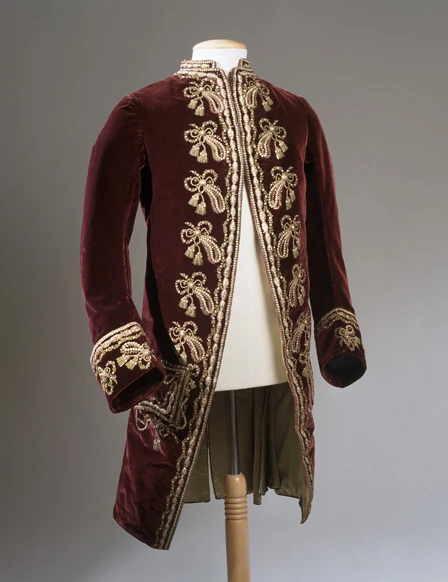
Elaborate embroidered suit surviving from the 1770s

Velvet suit dating from 1770

Velvet coat embroidered with silks and gold sequins.

Velvet coat embroidered with silks and gold sequins.

One of the most important piece of 18th century men's clothing in Amgueddfa Cymru's collections is a velvet suit dating from 1770. It belonged to Sir Watkin Williams-Wynn of Wynnstay, an extremely rich and well-known patron of the arts. His clothes reflected his lifestyle.

Sir Watkin Williams-Wynn

Sir Watkin Williams-Wynn (1749-1789) of Wynnstay bought elaborate velvet suits in France and Italy while making the Grand Tour in 1768-9. During the 1770s he bought clothes from many London tailors, hosiers and lace-makers, spending around £1,000 a year on suits alone - a huge sum at the time.

Gold sequins and silver thread

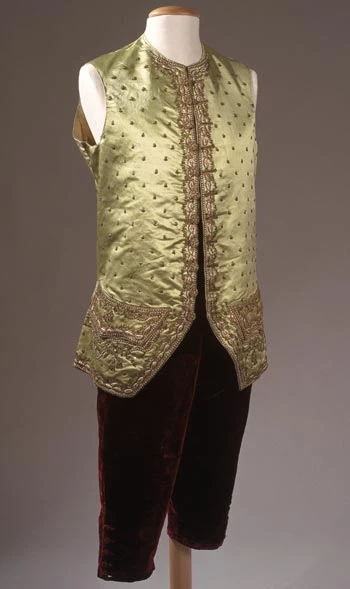
The plum-coloured velvet coat is embroidered with silks and gold sequins. The matching waistcoat and breeches were made at a slightly later date. The Museum also bought a fine red wool coat of similar date, decorated with silver thread embroidery.

Sir Watkin put on a considerable amount of weight as he grew older, and perhaps this is why the suit survived in such excellent condition.

Lavish embroidery

The suit coat has a cutaway front and short stand-up collar. It is lined with green silk satin to match the fabric of the waistcoat. The waistcoat has green silk satin fronts and a paler silk plain weave lining and back. Like the suit, the embroidery is of gold purl, metal sequins and floral ribbon. The work is very fine.

The suit was probably produced in a London tailor's workshop. This would have employed the best craftsmen, with a number of professional, male, embroiderers.

It is very likely that the red wool coat was made in the same workshop, as the embroidery also consists of gold and silver sequins and metal purl and silk threads, with similar motifs of bows, swags and tassels.

Grand clothes for grand occasions

Matching waistcoat and breeches

Matching waistcoat and breeches

These clothes were so expensive that they could have been worn at the royal court. In Wales, Sir Watkin could have worn such clothes at his coming of age party in 1770. This was legendary in its lavishness and size, with 15,000 guests and three coaches of cooks sent from London. A hall was built especially for the occasion, later incorporated into the main building at Wynnstay, with bedrooms added on above. The food eaten at the party included some 30 cows, 50 pigs, 50 calves, 80 sheep, 18 lambs, 37 turkeys and 421 pounds of salmon. This could help explain Sir Watkin's later size! Five years later, in 1735, King George III appointed Sir Watkin to be Lord Lieutenant (the King's representative) for Merioneth.

The Edwinsford Sofa - spectacular embroidery spends a month in deep freeze

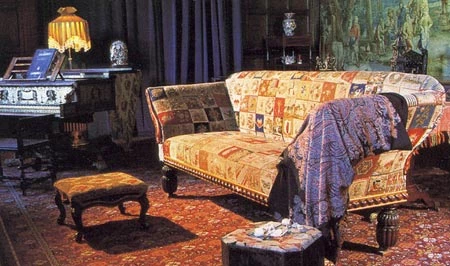
In 1998 Amgueddfa Cymru purchased furniture from the Edwinsford estate, near Talley, Llandeilo. The largest and most spectacular piece is a unique embroidered sofa from 1845. Conserving this proved to be a fascinating and challenging project, included dismantling, rebuilding and even freezing the object for a month.

The sofa contains several individually embroidered squares of wool and silk decorated with metal threads and beads, illustrating original Berlin wool-work designs. The squares form four separate panels along with carved wooden mouldings around the lower edge and carved scroll panels over the arm fronts.

Conserving the sofa

The Edwinsford sofa - The reverse side of the back panel before removal of the labels and cleaning.

The reverse side of the back panel before removal of the labels and cleaning.

At first glace, it was clear that a lot of repair would be needed if the sofa was to be displayed, as it was dirty, worn and shabby. Many seams had ripped and a moth infestation had destroyed much of the delicate embroidery. In order for each panel of canvas-work to be conserved properly, it had to be removed from the framework.

The mouldings were removed easily. However, instead of the usual upholstered technique, the sofa was made up of four individually upholstered sections, covered in the canvas work panels, and then screwed and bolted together. Approximately 300 tacks had to be carefully removed without ripping the canvas work — although they had already made rusty holes in the fabric.

A sofa decorated by guests

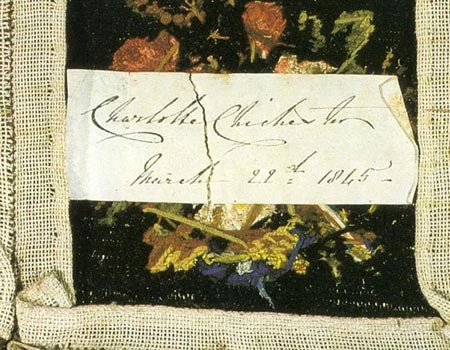
The Edwinsford sofa - One canvas square was dated on the reverse 'Charlotte Chichester March 22nd 1845'

One canvas square was dated on the reverse 'Charlotte Chichester March 22nd 1845'

The dismantling process uncovered a fascinating story. As the tacks were removed, paper labels started to drop out from behind the canvas work, each label bearing a someone's name. The names showed who had embroidered each square. Apparently, visitors to Edwinsford had embroidered the squares, and the sofa was designed to display this work.

After careful documentation of the labels, each canvas-work square was cleaned with washing solutions and solvents according to the dyes present. Each panel was then supported on undyed linen to strengthen the fabric and make the finished sofa more stable. Fine nylon net was applied around the frayed edges.

A month in deep freeze

In case there might be still live moth eggs in the sofa, each section was double-wrapped and sealed in polythene, and then frozen for a month.

Putting the sofa back together

The Edwinsford sofa

Much of the upholstered furniture on display in the withdrawing room of St Fagans Castle comes originally from Edwinsford Estate, Camarthenshire.

A method of re-attaching the cleaned canvas panels had to be found. It was important not to staple directly through the canvas-work, and to limit the number of staples put into the already damaged wooden carcass. It was equally important to be able to remove the panels without damage, should this be necessary in the future.

To achieve this, cotton tape was stapled to the wooden frames along the original tack hole lines. Staples were positioned approximately every 15cm to provide a rigid base to which the panels could be sewn using a curved needle. The inner edges of the arms and back had to be stitched first and then screwed and bolted back in position. The outer edges could then be stitched in place.

After treatment, the remaining sections of the sofa were replaced, using the original screws and nails wherever possible. Treatment of the paper labels will allow future study and display.

The sofa is on display in St Fagans Castle.

Chwefror 14, 2007

Diwrnod gwyn, prysur oedd diwrnod Teilo Sant ddydd gwener diwethaf (Chwefror 9), wel, tan amser cinio o leiaf, pan gaewyd yr Amgueddfa oherwydd Yr Eira.

Pleser prin yw cael eich taflu allan o'r Amgueddfa Hanes Genedlaethol, ac felly 'roedd cynulleidfa'r gwasanaeth yn lwcus iawn! Gobeithio y cawsant siwrne saff yn ôl i Bontarddulais, er gwaetha'r lluwchio.

Hwn oedd y gwasanaeth cynta i mi ei drefnu, ac roedd hi'n fwy o hwyl nag oen i'n ddisgwyl - ac yn wers nad oes unrhyw faint o drefnu dyfal a pherswadio yn gallu curo'r tywydd. Roedd y gwasanaeth yn wych - rhaid i mi gyfadde mod i dan deimlad am eiliad fach yn ei ystod (gormod o amser lan yn y goedwig 'ma, falle!). Ond o ddifri - braf oedd gweld y lle'n llawn, ac mae'n ysgogiad i drefnu gweithgareddau tebyg yn fwy aml yn y dyfodol.

Prin iawn oedd yr amser i ddal fy ngwynt ar ôl yr eira - roedd rhaglen lawn o weithgareddau ar hyd y penwythnos, a dwi'n dechrau tridie o sesiynau gwisg Tuduraidd heddiw. Lot o hwyl - ond anghyfforddus yw teipio mewn staes, felly mi ai yn ôl at fy nghaban rwan!