Painting Medieval Myths from Rome and Britain

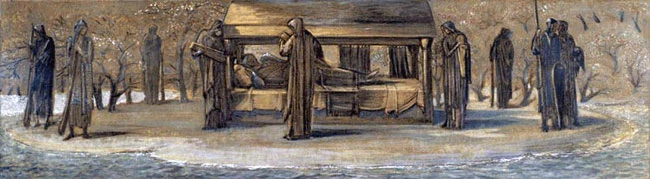
Two different medieval myths are represented in two works by the 19th century artist Sir Edward Burne Jones. The Wheel of Fortune (1882) and Arthur at Avalon (1890) are both in the collections of Amgueddfa Cymru.

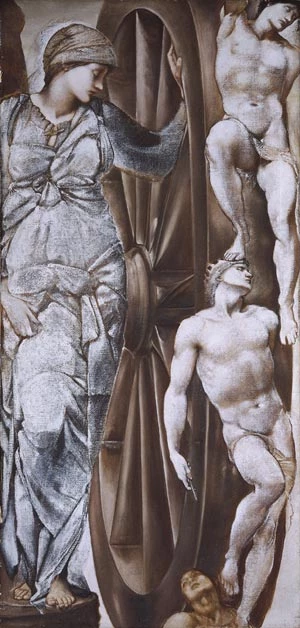
Wheel of Fortune, Burne Jones

This unfinished painting of about 1882 depicts the medieval theme of the wheel of fortune, which lifts or abases man as it is turned by the goddess Fortuna. The drawing of the nudes and the drapery of the goddess reveal the artist's careful study of Michelangelo.
Burne Jones.
Oil on Canvas.

The Wheel of Fortune is based on Roman mythology. For the Romans, the goddess Fortuna represented luck. However during the Middle Ages the idea of the wheel of fortune evolved from the writings of Boethius, a 6th century Christian martyr. In The Consolation of Philosophy, he wrote that the random turns life could take were all part of God's divine will and that man must accept the twists and turns of fortune.

It has long been a tradition in art to show gods as being larger than humans, and here Burne Jones represents Fortune as larger than the humans, who she turns on her wheel. He does show her blindfolded, as was usual, but with her eyes closed. Traditionally, the wheel has four figures on it. They represent four stages of life: "I shall reign", "I reign", "I have reigned" and "I have no kingdom". Burne Jones only depicted three figures on the wheel, but he maintained the idea of a reign by placing a crown on the head of the central figure.

The feminist author Camille Paglia has described this work as a sadomasochistic tableau, with "Fortuna turning her torture wheel of beautiful young men, languid with limbs stretched in sensual suffering". Although the men are accepting of their fate, how much choice do they have? The limbs are not so much stretched in sensuality but as an indication that you ascend by climbing over someone else and this in turn will happen to you. This is something Burne Jones felt personally. In 1893 he wrote "My Fortunes wheel is a true image, and we take our turn upon it, and be broken upon it."

But to wider Victorian society, where industrial fortunes meant one could rise in wealth and class and the British Empire was the most powerful in the world, this notion of rise and fall would have touched a nerve. If you are on top of the wheel, the next turn might place you at the bottom.

Burne Jones painted another myth with Arthur at Avalon. This myth is taken from Thomas Malory's famous poem of 1470 Morte d'Arthur ('The Death of Arthur'). Arthurian legends were popular with artists for many reasons. They were well known to the public and they contained brave knights, thwarted lovers and femmes fatales. Unlike the classical world, these heroes were Christians and, most appealingly, they were rooted in British history. Greece and Rome were all very well but a local hero was more likey to inspire future empire builders.

In Arthur at Avalon Burne Jones shows the scene of Arthur's death. After being mortally wounded in battle by Mordred (his son by his half sister), Arthur is taken to the Isle of Avalon in an attempt to heal his wounds. The name Avalon ("Afallon" in Welsh, meaning the isle of apples) perhaps related to the tree of knowledge, and it was believed to be a magical place. In the background of the painting we can see trees with blossom that could be apple trees. Authur ordered Sir Bedivere to give his sword Excalibur to the Lady in the Lake, but when Bedivere returned Arthur was gone. This has been taken to mean that Arthur might not be dead, only sleeping until he is needed again. The Arthurian legend not only continued to be a source of interest to artists throughout the 19th century, but continues to inspire artists, writers and film-makers today.

Arthur At Avalon, Burne Jones, 1890
Arthur At Avalon, Burne Jones, 1890
From a complete farmhouse to a tiny matchstick: looking after the Social History collections at St Fagans

The Social History collections of Amgueddfa Cymru are housed at St Fagans. As it is an open-air museum, the objects range from historic re-erected buildings to small, fragile objects in an air-conditioned store. They vary in size from matches to four-poster beds, and can be as fragile as delicate Victorian shell ornaments or as robust as inscriptions carved on large stone blocks.

A basket from the domestic collections

A basket from the domestic collections illustrating how simple surface cleaning can have a dramatic affect on an object's appearance.

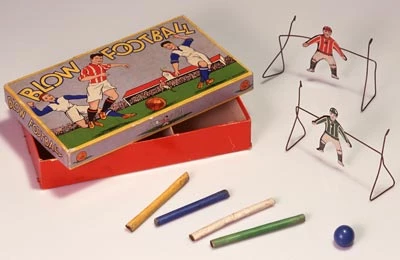
A game is made out of three types of paper as well as metal, plastic, pigments and paints

Simple objects can be quite complex. This game is made out of three types of paper as well as metal, plastic, pigments and paints.

Single objects can often be made of more than one material. This means that parts of the objects need different preservation techniques. Conservators have to assess new objects to stablise them, and items in the stores have to be regularly checked.

Conserving for the future

All objects in the Museum's collections need to be structurally sound and chemically stable if they are to survive. The first stage of treating any object is to examine it closely to see if it is complete. If it is dirty, we have to assess whether the dirt is important to the history of the object. When considering damage, it is important to understand whether the damage happened during manufacture or through use.

Conserve the old original or display a fully restored object?

These days, visitors do not expect every object to be "perfect". This means that we can focus on preserving what remains rather than restoring what has been lost. It also means that important information about manufacture and use is not hidden or destroyed.

Having recorded an object's condition, we then apply relevant treatments. In some cases, further decay can be prevented or at least slowed by repackaging the object in acid-free materials and storing or displaying it at the correct temperature and relative humidity. When objects sensitive to fading (for example objects with dyes and pigments) are put on display, they can be displayed in reduced light.

Social History objects can be made from almost anything, and nearly always use a variety of materials. Even if an artefact is entirely made out of wood, several different woods might have been used.

Before conserving the object, we have to carry out tests to make sure that none of the solvents we use dissolve any part of the object. Whatever the treatment used, its application is kept to a minimum. Repairs should never obscure any details on the original object. We use a rule that a specimen should appear complete from a distance of 6 ft 6 ins., but the repairs can be seen on close examination.

All aspects of this work are recorded. This means that the full history of the object is always available for reference. It also increases the information we have about the ageing of modern materials, as all treatment dates are recorded.

The final stage of treating any object is to make sure that it enters or returns to a suitable environment, and that anything likely to cause decay or damage is minimised or removed. Monitoring the environment and regularly checking for pests are essential.

As museum collections expand, so does the conservation work required. This has increased the emphasis of preventative conservation, for example, where a large number of objects can benefit from a small change in the environment or working practice. By revisiting the way objects are displayed and stored, we hope to move towards sustainable conservation.

Two grand portraits by Joshua Reynolds

The two wives of Sir Watkin Williams-Wynn

Sir Watkin Williams-Wynn and Henrietta Somerset

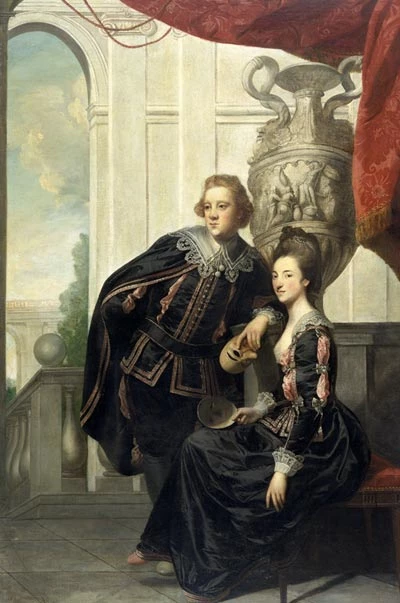
Sir Joshua Reynolds (1723-1792), Sir Watkin Williams-Wynn, with his wife Lady Henrietta Somerset. The couple married on 11 April 1769 and she died in July the same year.

Sir Joshua Reynolds (1723-1792) is a major figure in British art. One of his most enthusiastic patrons was the wealthy Welsh landowner Sir Watkin Williams-Wynn (1749-1789). By the late 1760s Sir Watkin's income allowed him to spend massively on building projects and works of art.

In 1769 Sir Watkin married Lady Henrietta Somerset, a daughter of the 4th Duke of Beaufort. It was a short marriage, as Henrietta died three months later. Her mother-in-law's wedding gift to Henrietta was a magnificent silver-gilt toilet service made by Thomas Heming in 1768.

Sir Watkin Williams-Wynn and Henrietta Somerset

Reynold's first portrait for Sir Watkin, Sir Watkin Williams-Wynn and Henrietta Somerset, shows the young couple life-size in matching black and pink costume. They hold theatrical masks in a curtained architectural setting, beside a massive vase.

The vase is of a type that appears in a number of Reynolds' portraits. It is copied from a 17th century engraving by G.B. Galestruzzi after Polidoro da Caravaggio.

The sitters are wearing costume associated with the portrait painter Anthony Van Dyck, which was fashionable from the 1740s to the 1770s. Black Van Dyck costume was unusual for women, and it would have been unusual for a couple to wear colour co-ordinated clothes, except for a masquerade.

Henrietta is shown in an attitude common in Reynolds' portraits of women, taken from his master Thomas Hudson. Sir Watkin is shown with a melancholy expression, in a pose in keeping with his short, stout build.

The picture was presumably begun as a marriage portrait, although the black costume suggests that it was completed as a memorial portrait.

Charlotte Grenville with her children

Charlotte Grenville and her children

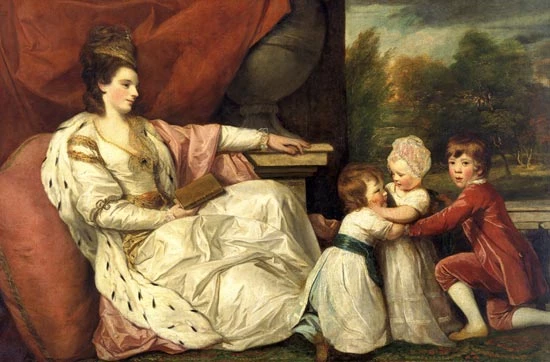
Sir Joshua Reynolds (1723-1792). Charlotte Grenville, Sir Watkin Williams-Wynn's second wife and her children.

The second portrait, Charlotte Grenville and her children, shows Sir Watkin's second wife. Charlotte Grenville (1754-1830) was a member of one of the great governing families of 18th century Britain. She was the eldest daughter of George Grenville (1712-1770) who was Prime Minister in 1763-5. They married in 1771, two years after Henrietta's death.

The painting shows her accompanied by her three eldest children. Their apparent age suggests that this portrait was painted around 1778.

This composition recalls early 16th century Venetian paintings of the Rest on the Flight with St John the Baptist. The children's position in the picture echoes the group at the right of Titian's Vendramin Family (National Gallery), which Reynolds knew well. Lady Charlotte's costume is in the Turkish fashion and her pose derives from the pastel portraits Ladies in Turkish dress by Jean-Etienne Liotard. Charlotte Grenville and her children is one of Reynolds' most sumptuous portraits of the 1770s, when he was at the height of his powers.

Both portraits probably cost Sir Watkins around £315 each. Painted in the Grand Manner, they express the qualities Reynolds admired most in High Renaissance art. They also demonstrate the cultural ambitions of Sir Watkin Williams-Wynn and his wives.

For over two centuries, the portraits remained with the Williams-Wynn family, before being purchased by the Museum in 1998. The Museum holds a spectacular group of works from Sir Watkin's collection, including major paintings by Batoni and Mengs, and silver and furniture designed by Robert Adam.

Sir Charles Jackson’s unique collection of silver

In 2000, Amgueddfa Cymru learned that hundreds of pieces of rare silver, which had been on loan to the Museum since it first opened its doors, were to be sold.

The items, some of which date back to the 16th century, are from the collection of Sir Charles Jackson (1849-1923), a Welsh lawyer and businessman. Luckily, after much negotiation and fundraising, they were finally secured for the Museum with considerable help from the National Heritage Memorial Fund, the National Art Collections Fund and the Worshipful Company of Goldsmiths.

So why is this collection so important?

Sir Charles Jackson (1849-1923)

Sir Charles Jackson (1849-1923)

Sir Charles Jackson

Sir Charles Jackson was born in Monmouth. He became part of a group of collectors and antiquarians that included Robert Drane, T. H. Thomas and Wilfred de Winton. Together they influenced the development of the Cardiff Museum. They also played a role in making sure the National Museum of Wales would be located in Cardiff.

Remarkable treasures

Some of the objects collected by Jackson are of outstanding aesthetic quality. Rare items include an early 14th century acorn-top spoon, which is one of the very first hallmarked pieces of English silver, and a complete set of 'apostle' spoons (twelve apostles and the 'Master') from 1638.

The most important item is probably a two-handled cup in the 'auricular' style (a 17th century ornamental style based on parts of the human anatomy, particularly the human ear, after which the style is named) associated with the Dutch silversmith Christian van Vianen, who worked for the court of Charles I. Hallmarked 1668, this cup is one of a handful of London-made pieces in this distinctive style. The maker's mark remains unread, but could be either George Bowers or Jean-Gerard Cooques, both goldsmiths to the court of Charles II.

Inspirational rarities

Two-handled cup and cover, London 1668

Two-handled cup and cover, London 1668

Unusual, inspirational pieces in the collection include one of the earliest known silver wine tasters, a 17th century Catholic chalice made in Cork that can be taken apart for concealment, and an inkstand in the form of a library globe. The collection's range of more common objects, such as salt cellars and cream jugs, shows the evolution of shapes over time, and tells us a lot about social customs, particularly relating to dining. The astonishing sequence of spoons contains almost every type made over a period of 400 years.

Unique academic value

Although the collection contains many rare and beautiful objects, the principal reason for keeping it intact is its unique academic value.

Jackson's two principal publications, English Goldsmiths and their Marks (1905) and The Illustrated History of English Plate (1911), are the foundation of modern silver scholarship. In them Jackson relied heavily on his own collection to illustrate marks and the development of styles over time. He corresponded with all the major collectors of his day, and his collection sums up knowledge of historic silver in Britain in the early 1900s. It is therefore a unique reference source and remains the subject of regular enquiries from silver specialists all over the world.

The Jackson collection also complements and enriches the Museum's own outstanding collection of historic silver, much of which is associated with the historic governing families of Wales. The acquisition, after eighty years of display, of half the Jackson collection, and the likelihood that the rest will one day follow, helped the Museum develop its role as the home of one of Britain's principal study collections of historic silver.

Background Reading

Andrew Renton, 'Sir Charles Jackson (1849-1923)' in Silver Studies - the Journal of the Silver Society, vol 19 (2005), 144-6

A grand cup made from solid Welsh gold

Welsh Gold

Solid gold cup

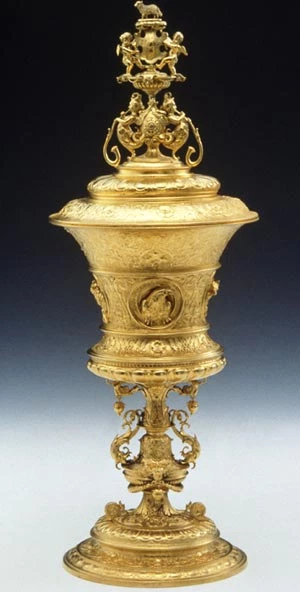
The solid gold cup made from a design on a drawing in the British Museum of a cup given by King Henry VIII to Queen Jane Seymour in 1536. Cup and cover, 22 carat gold, R & S Garrard & Co, London 1867-68. Height: 39.8 cm (15 ''/16 in).

Welsh gold is very rare. The wedding rings of today's British Royal family are made from it. The largest object made of Welsh gold is a copy of a cup Henry VIII gave to one of his wives.

The richest family in Wales

The cup was made in 1867 for the Williams-Wynn family of Ruabon in Denbighshire, using gold from their own mine. At the time, they were the richest family in Wales. They were well known for their wealth, which they spent on grand houses, expensive paintings and silver, much of which is now at the Museum.

The Welsh Gold Rush

While many people know of the California gold rush of 1848, few know that, a few years later, there was a Welsh gold rush. In 1862 gold was discovered in Merioneth and, soon after, Sir Watkin Williams-Wynn (1820-1885) opened the Castell Carn Dochan mine on his land. The mine produced most of its gold between 1865 and 1873.

Payment in Gold

Sir Watkin was paid a large royalty for the gold mined, and he was paid with his own gold ingots. However, he was rich enough not to need this income, and could treat this gold as a novelty.

A Cup of Solid Gold

Some of this gold was used to make a magnificent cup. The cup is nearly 40cm high and made of 22-carat gold. It is inscribed "MADE OF GOLD THE ROYALTY FROM CASTELL CARNDOCHAN MINE 1867" and hallmarked by R & S Garrard and Co., Haymarket, London. It is ornate, in the style popular in the early Renaissance period. It stands on a circular foot, and the stem is flanked by flower heads, dolphins and bells. The cup is inscribed with several family mottoes: eryr eryrod eryri ('the eagle of the eagles of Snowdonia'), y cadarn ar cyfrwys ('the strong and the sly'), bwch yn uchaf ('the ram is on top') and cwrw da yw allwedd calon ('good beer is the key to the heart'). The tall lid has the Williams-Wynn arms, including a young ram on top, supported by a pair of cherubs.

A Royal Design for Henry VIII

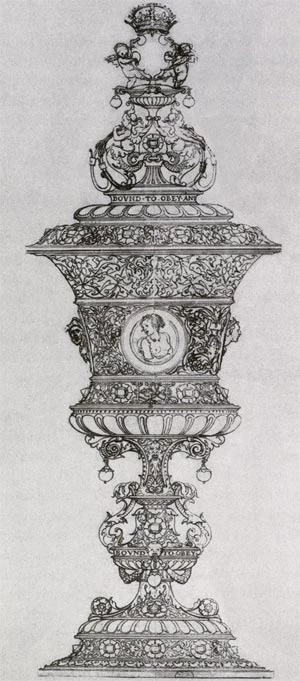
The original design for the cup given to Queen Jayne Seymour in 1536-37

The original design for the cup given to Queen Jayne Seymour in 1536-37 in the British Museum. Hans Holbein the Younger, pen and ink on paper. Copyright British Museum, London

The makers of the cup based the design on a drawing in the British Museum of a cup King Henry VIII gave Queen Jane Seymour in 1536. This cup was set with diamonds and pearls. Jane Seymour's cup was melted down on the orders of King Charles I in 1629, when he was desperate for cash.