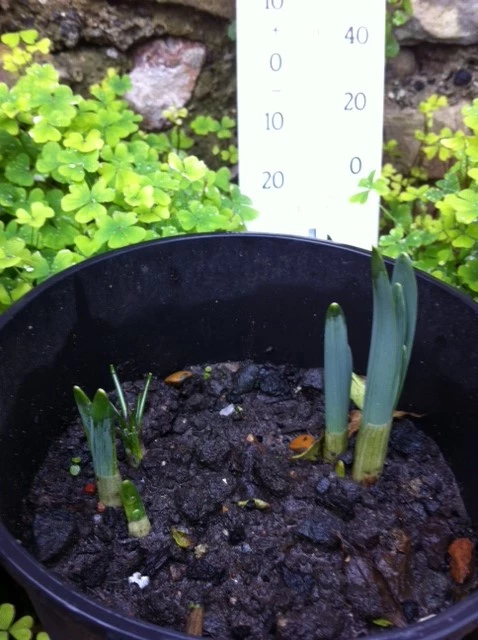
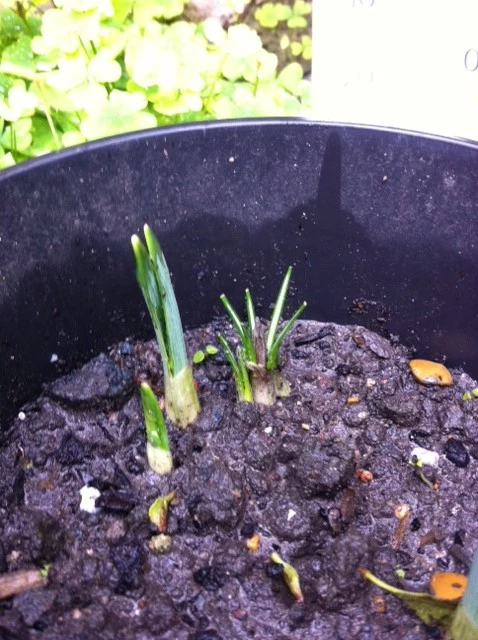
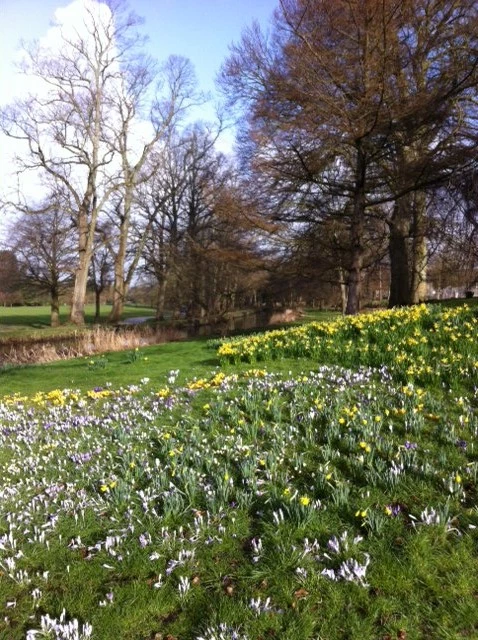
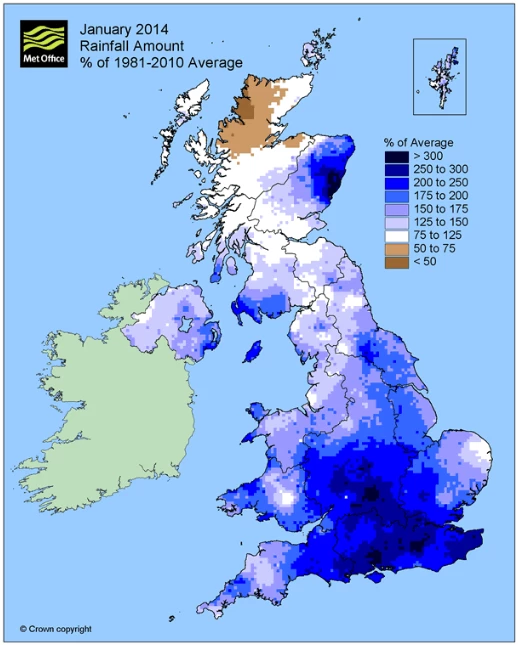
1st flower records for England and Wales! Catalena Angele, 14 February 2014 Fantastic news bulb buddies, we have our first flower records!Carnforth North Road Primary School in Lancashire, England were the first school to send in flower records. Their first crocus opened on the 4 February.Raglan VC Primary School in Monmouthshire, Wales were the first Welsh school to send in flower records. Their first crocus opened on 7 February.Well done to both these schools for sending in your flower records!Archbishop Hutton's Primary School in England have also reported that the crocuses that they have planted in the ground have started to flower. Plants in the ground often flower sooner than ones in pots, has anyone else noticed this?These flower records are much earlier than last year, when the first crocuses were reported on the 1 March. Why do you think this might be?If we look at the results from the Spring Bulbs Project in previous years, flowering has been earlier in years with higher rainfall, warmer temperatures and more hours of sunshine. Why not have a think about what the weather has been like where you live? Do you think this year’s weather will help your flowers to grow?Your questions, my answers:Ysgol Terrig: Our bulbs are now growing above the soil. Prof P: Fantastic new Ysgol Terrig, hopefully it won’t be long until you start to see flowers.Glyncollen Primary School: we are very exited because are bulbs are going to open soon. next week we are going to measure them. Prof P: Great investigating Glyncollen, have fun with your measuring.Manor Road Primary School (Lancashire): It rained a lot and it was very cold and windy. It has not been minus yet. Prof P: I haven’t recorded a minus temperature in Cardiff either.Stanford in the Vale Primary School: We have had alot of rain recently but the bulbs continue to grow bigger and bigger. Prof P: It certainly has been very very rainy, I hope you haven’t had any flooding.Greyfriars RC Primary School: Me and D. are watering the plants really well. We enjoyed it alot. D: I am really enjoying the bulbs. My one is called xdox and pop. It was supposed to be xbox and pop. Thank you enjoyed this week. Prof P: What funny names for your plants! Very imaginative.Freuchie Primary School: The children were really excited on Monday 27th January when they realised that 40mm of water had been collected over the weekend! Prof P: Wow - that really is a lot of rain!Woodplumpton St. Anne's Primary School: We are very excited because the first shoots are beginning to appear. It has been very wet but so far the temperature has not dropped below zero. We wonder if this is unusual. Prof P: Great question Woodplumpton! I have had a look back over our weather data for previous years and it looks like this is not that unusual. The average daytime temperature for the month has only dropped below zero once in the 8 years we have been running the Spring Bulbs investigation. This was in December 2011 when there was heavy snow. I do think it has been less cold this January than in previous years. I look forward to receiving the weather data from all the schools so I can compare all the data in my Spring Bulbs Report!Newport Primary School: Horrible wet weather most of the week. Prof P: The trouble with the rain is that it gets in the way of playtime doesn’t it?Manor Road Primary School (Lancashire): The weather has been cold, wet and windy this week. We have spotted our first shoots peeping through in our pots though. Prof P: It seems like your bulbs don’t mind the wet weather too much.Chatelherault Primary School: Bad news some people have been pulling out our bulbs but some are growing. And we have had a lot of rain and sun. Prof P: Oh no! I’m sorry to hear that someone has disturbed your bulbs. I hope that the ones that are left will be okay. Sun and rain are the perfect combination to make them grow!Many ThanksProfessor Plant
A Window into the Industry Collections Mark Etheridge, 29 January 2014 We have had a number of interesting objects coming into the Industry collections since my last Blog. Here are just a few.This wooden full hull ship model is of the m.v. Innisfallen. The Innisfallen was built in 1969 to inaugurate British & Irish Line’s Swansea to Cork ferry service. She was eventually sold to Corsica Ferries and then to Sancak Lines, Turkey. After a number of name changes she was broken up in 2004. The commemorative plate below was manufactured by Ceramic Arts in 1989. It commemorates both the National Justice For Mineworkers Campaign, 5th Anniversary of 1984-85 strike, and the centenary of the National Union of Mineworkers. This illuminated address was presented to Harry Brean by the workmen of the Risca Collieries for bravery during the “Gob Fire” at the Old Black Vein Colliery between July 12th and August 9th 1918. Presented towards the end of the First World War, it is interesting to note that the address states that “the Coal Mines produce their Great Heroes no less than the Battlefield”. The address is of a standard format that was printed by the Western Mail Ltd., Cardiff, and then hand illuminated. Note that his name is spelt incorrectly on address! The object below we believe to be a calendar mount. It was printed on tinplate by Metal Box Company Limited in Neath, c.1960. The image is of a painting by the artist Harold Forster. The original oil on board painting depicts the hot strip mill at Abbey iron and steel works in Port Talbot and dates to 1955. The original painting is in our collection and details of this work and others by Harold Forster can be seen on our Images of Industry online catalogue - http://www.museumwales.ac.uk/industry/images/?action=search&search_type=artist_title&artist=forster&title= Mark EtheridgeCuratorial Assistant (Industry)
Collections Review at Carmarthen Museum Katie Mortimer-Jones, 27 January 2014 On Friday, Adrian Plant and I, along with Christian Baars, took part in a Collections Review at Carmarthen Museum as part of the Esmee Fairbairn ‘Linking Natural Science Collections on Wales’ project. The museum, was in a lovely old house, the old Bishop’s Palace, just outside Carmarthen. We spent the day in the natural history store, systematically going through all of the boxes to see what was in each one and assess it’s condition and potential importance. As not all of it had been accessioned even the curators were not sure what might be there and we had a very interesting time never knowing what might be in the next box. Amongst the specimens we found were a collection of weaver birds’ nests and a ‘vasculum’ (metal box containing botanical specimens) containing an old seed collection along with the original bill of sale. Hopefully, some of these specimens may now find their way out to public display at some point in the future. Blog by Teresa Darbyshire
Dydd Santes Dwynwen Katie Mortimer-Jones, 24 January 2014 To celebrate Dydd Santes Dwynwen we have searched our Natural History Collections at the Museum for some love related specimens:The True Heart Cockle, found on reef systems in the Indo-Pacific.Fioled Bêr/Sweet Violet (Viola odorata), which represents faithful love in the language of flowers.The Purple Heart Urchin (Spatangus purpureus), a large heart-shaped urchin often found buried in sands and gravels. This is one of the specimens on display in the Life in the Sea Gallery.Or for an alternative Dydd Santes Dwynwen, how about the Love-lies-bleeding plant (Amaranthus caudatus). This example was collected in Roath Park, Cardiff back in 1924 and is now in the National Welsh Herbarium at National Museum Cardiff.More information on Dydd Santes DwynenPost by Sally Whyman, Jennifer Gallichan and Katie Mortimer-Jones
Exploring Insect Diversity in Thailand Katie Mortimer-Jones, 16 January 2014 (Searching for the ‘missing millions’) To an explorer of biodiversity, especially invertebrate biodiversity, tropical forests remain largely unknown and unmapped territory. I study the insect Order Diptera (flies), and while some 150,000 species have already been found and described world-wide, perhaps 2-10 million (maybe more!) remain completely unknown to science and a large proportion of these will undoubtedly be found in tropical forests. As Principal Curator of Entomology, much of my research effort is devoted to finding and describing the ‘missing millions’ (taxonomy), understanding how and where they evolved (phylogeny and biogeography) and investigating the roles they play in modern ecosystems (ecology).One of my favorite areas to work in is southeast Asia, particularly Thailand where my studies have already described about 70 new species of fly in the group known as Empidoidea (dance-flies and their allies). I recently began a project with Wichai Srisuka, my colleague in the Entomology section of the Queen Sirikit Botanic Garden in Thailand, in which we are using Malaise traps (a tent-like structure into which insects fly and can be trapped) to sample dance-flies and other insects on two of Thailand’s highest mountains; Doi Inthanon and Doi Phahompok. The samples collected will no doubt contain many new species for me to describe for the first time and should also yield valuable data on how communities of insects on the mountains vary with altitude. The summit slopes of Doi Phahompok and Doi Inthanon are covered in a type of thick luxurious wet forest known as Moist Hill Evergreen in which many endemic species occur (an endemic species is one entirely confined to a particular locality). Our earlier results suggest that although these two mountains are only 150km apart and have many similarities in their fly fauna, both have many endemic species on them too. By comparing the degree of ‘endemicity’ on the two mountains we hope to better understand some of the historical processes that gave rise to the exceptional biodiversity of these areas.When scientists try to identify geographical areas of conservation importance they like to map not only diversity (essentially, how many different species there are) but also endemicity. Knowing exactly where biodiversity and endemicity hotspots are enables conservation planners to better target their efforts. In the tropics, knowledge of diversity and endemicity is largely confined to a few groups of plants and vertebrates. Unfortunately, these creatures represent only a small fraction of the variety of life so prioritizing conservation efforts using them alone is imperfect. Furthermore, measures of plant and vertebrate variety are not effective surrogates of invertebrate diversity whereas knowledge of invertebrate diversity does in fact tell us much about that of other animals and plants. We are slowly starting to produce maps of invertebrate endemicity which we hope will provide better tools to help conservation authorities in Thailand prioritize their conservation efforts.Dr Adrian Plant