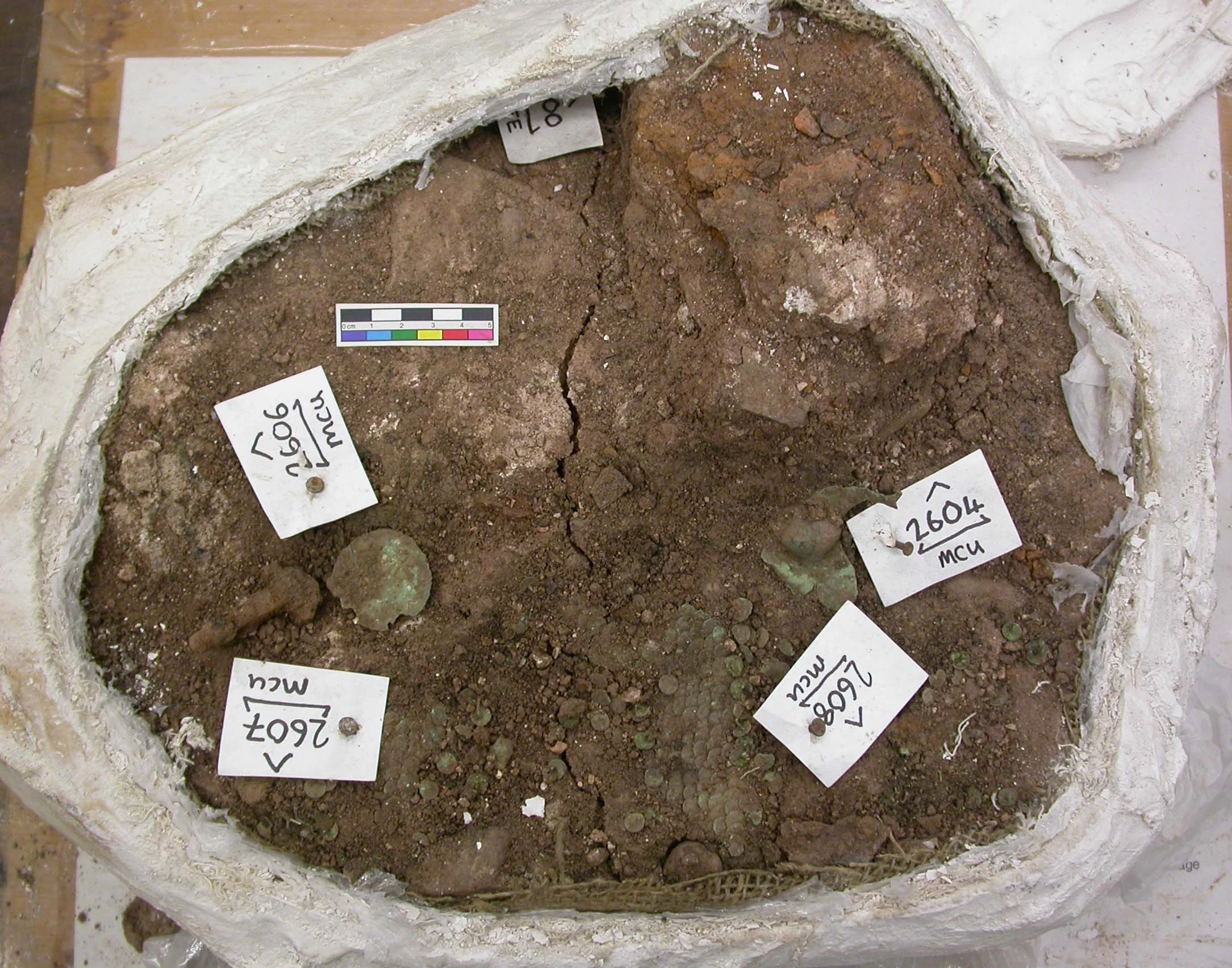
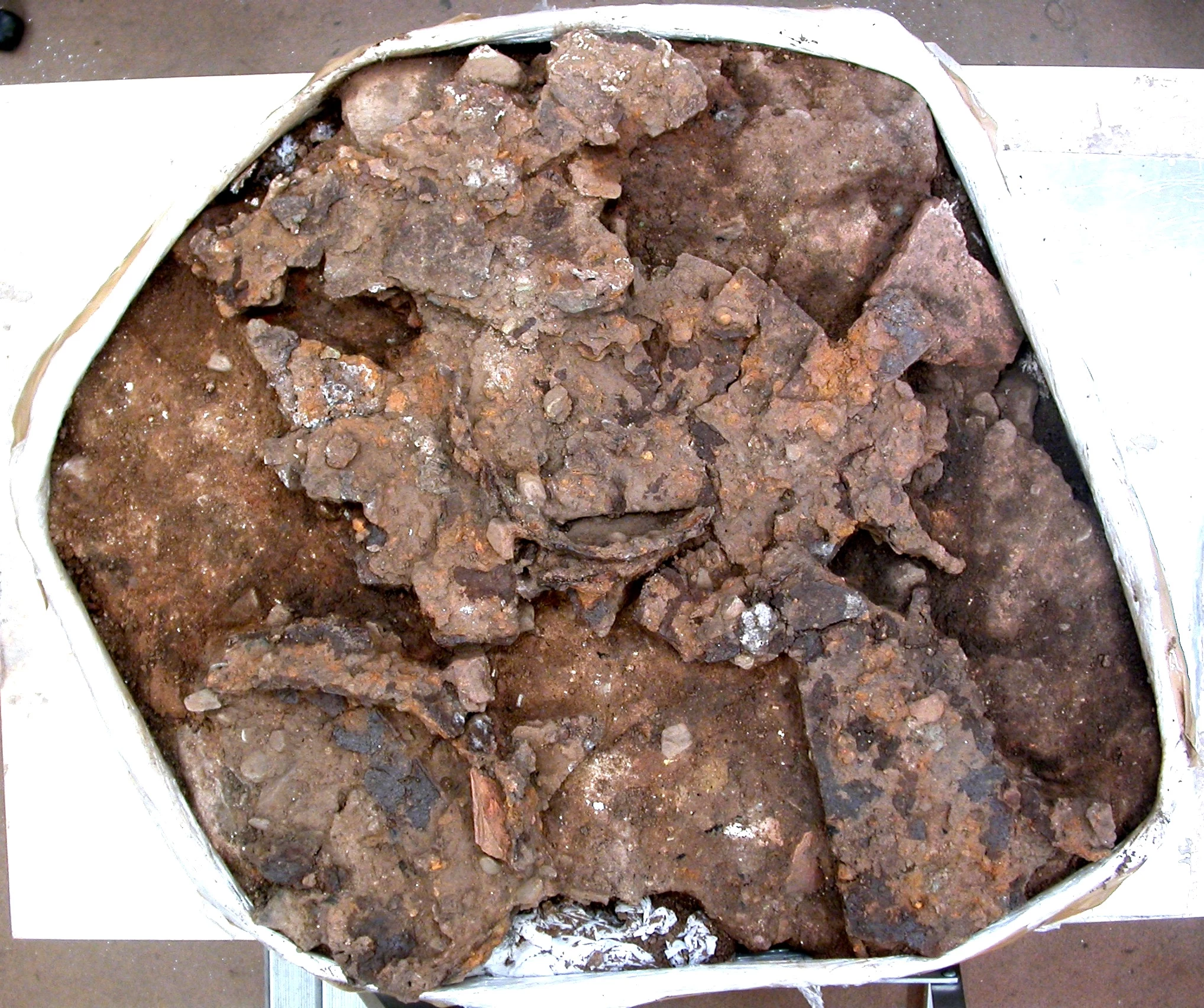
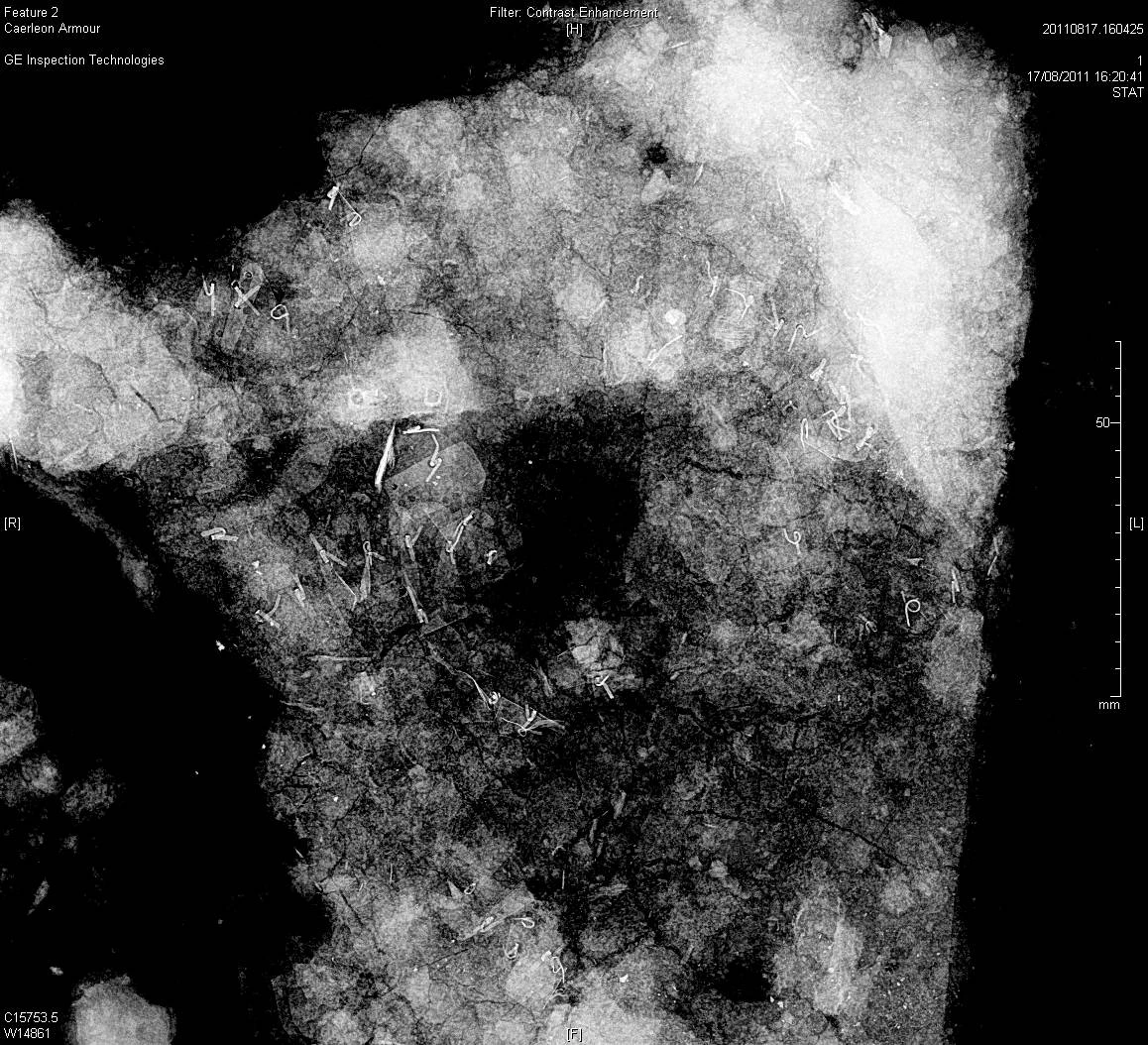
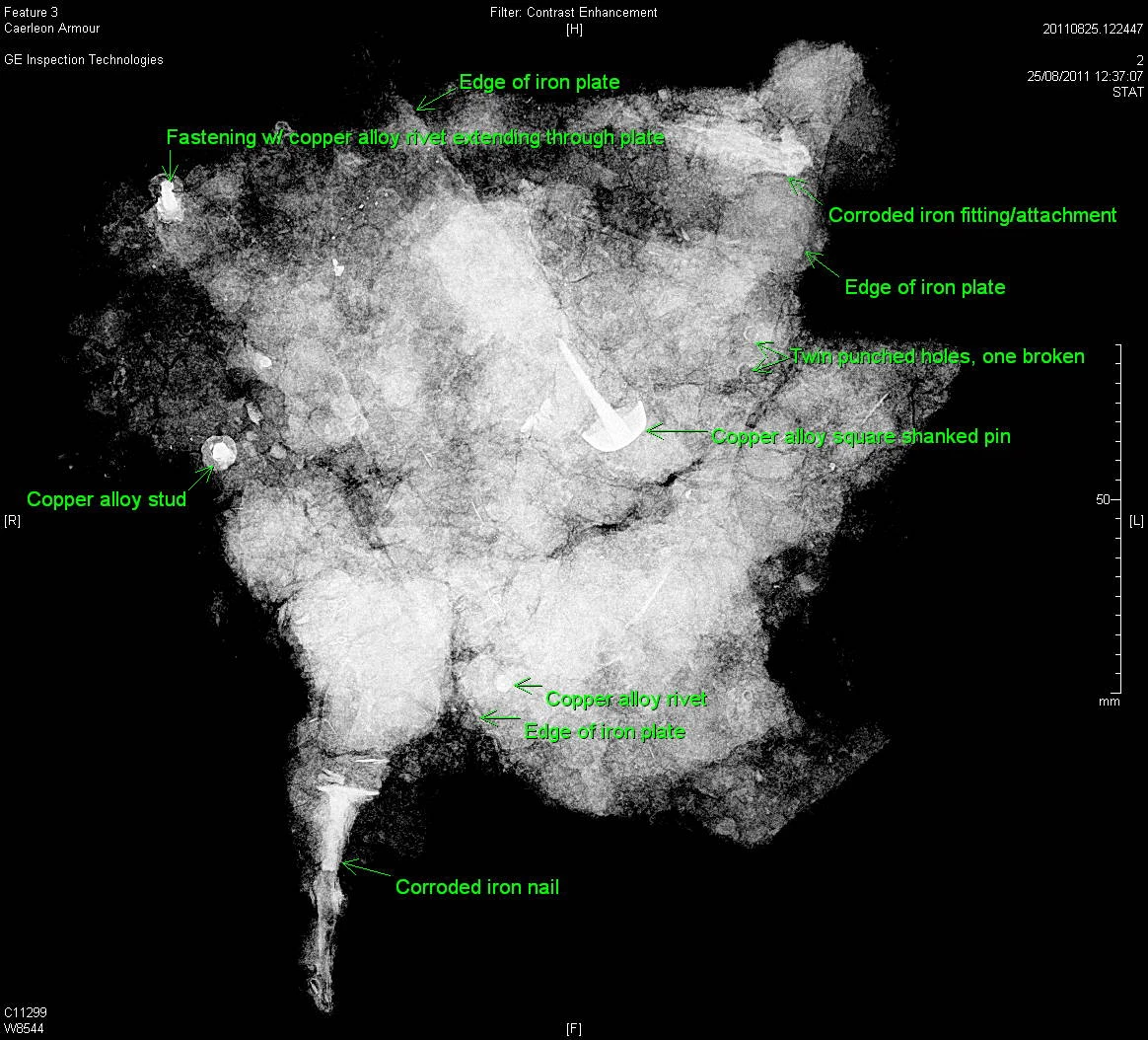
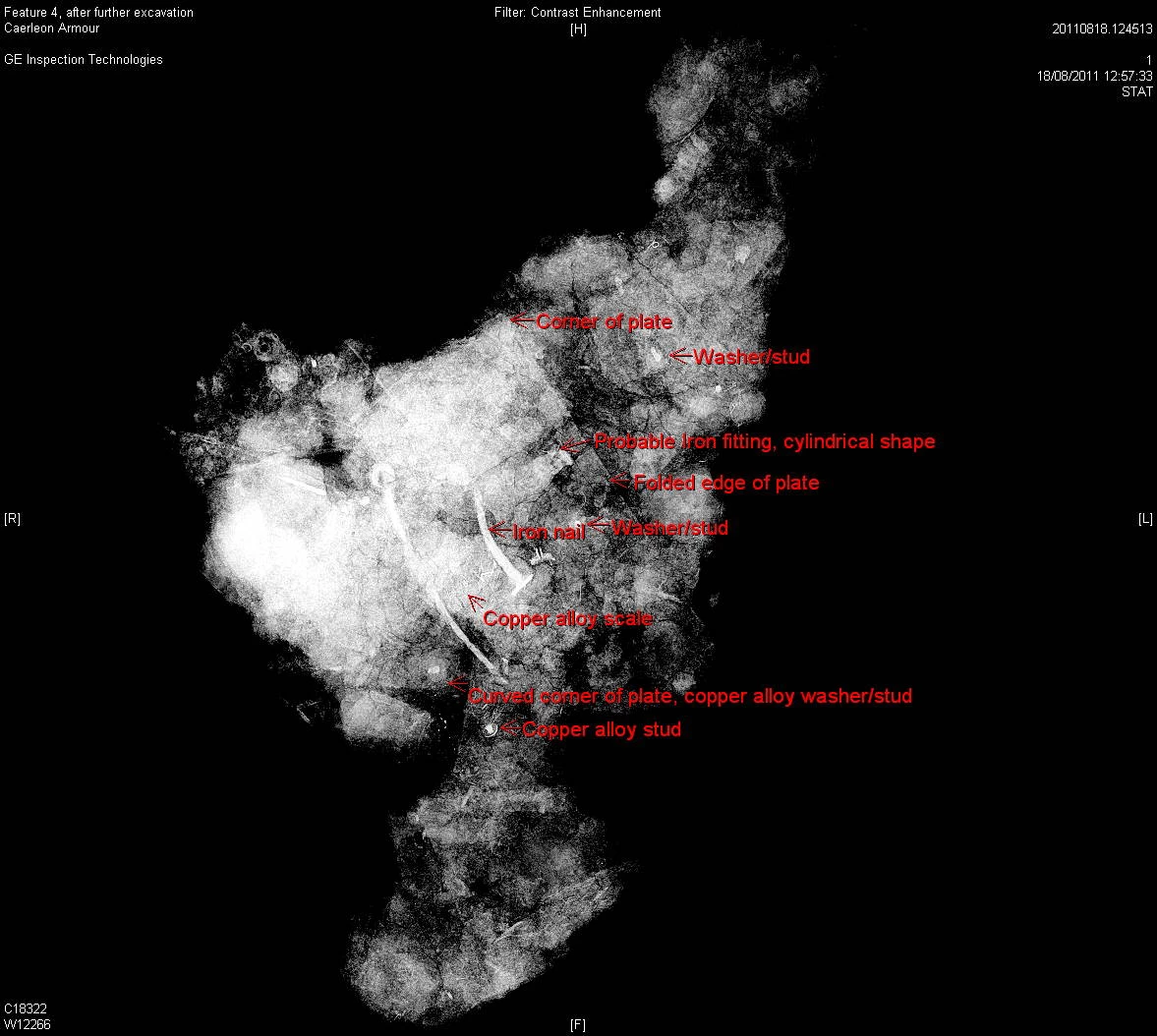
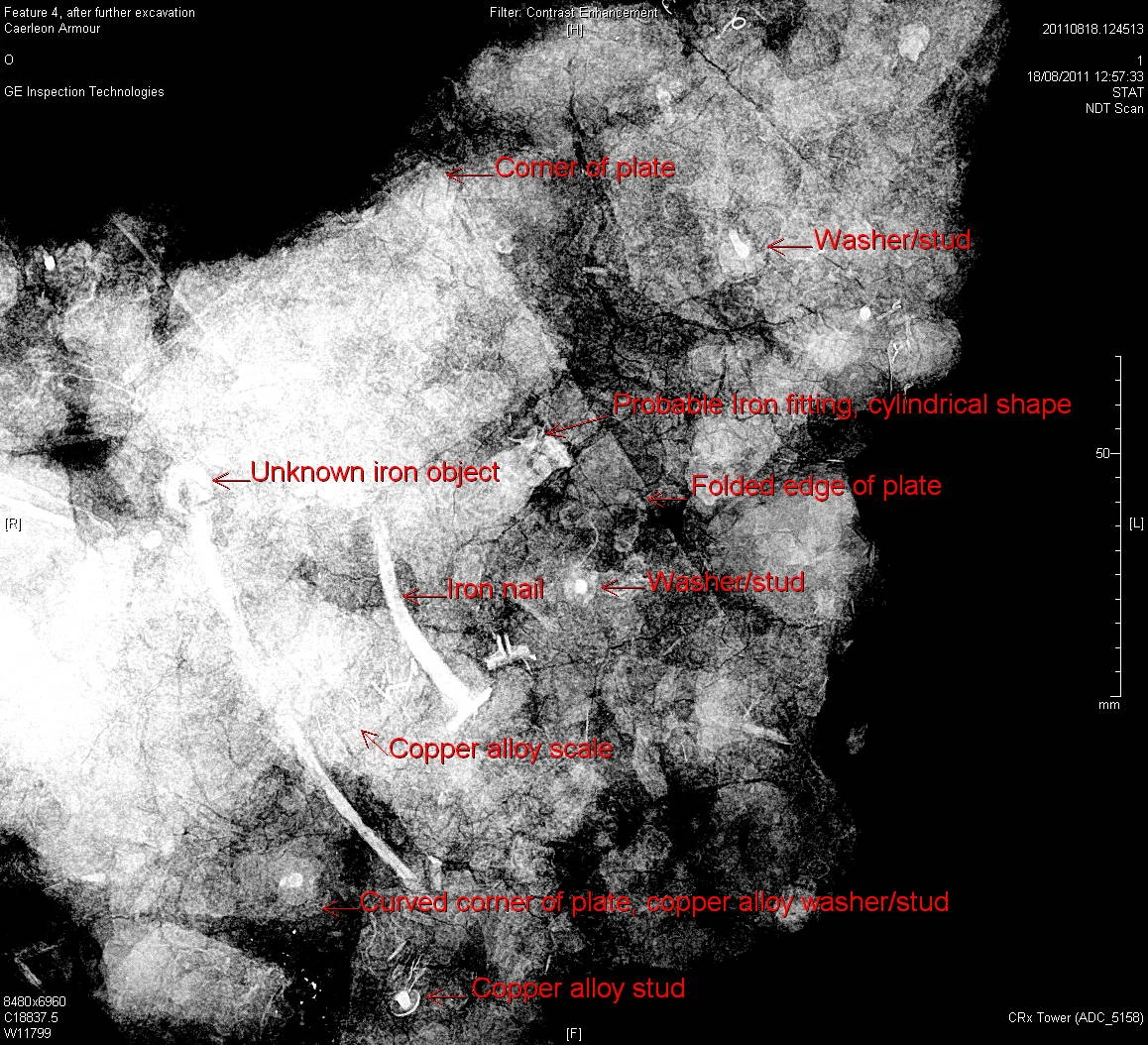
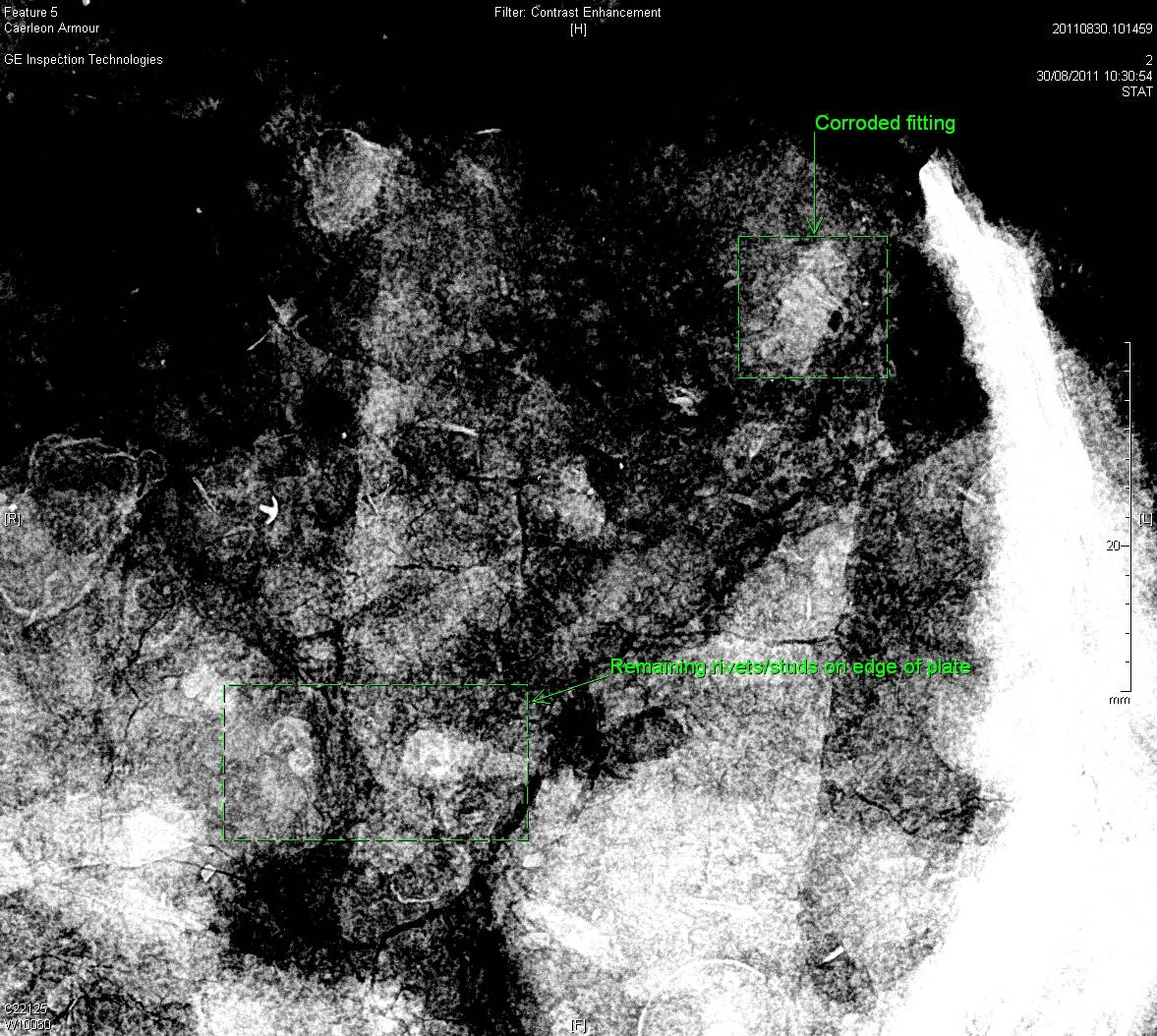
Caerleon Armour: Feature 5 and the Shoulder Plate 26 October 2011 This blog entry discusses the last area of the large soil block to be micro-excavated; feature ‘5’, located in the middle of the block. The position of the other ‘features’ (F1, F2, F3 and F4) in relation to this central one can be seen in the annotated photograph of feature 5, and plates with two identifiable edges have been outlined in various colours to guide the reader’s interpretation of this area. As with ‘feature 4’, feature 5 encompasses a large cluster of over-lapping iron plate, which have deteriorated significantly. In the centre is what looks like a shoulder plate (judging by the degree of curvature) lying on its side and seen in profile.The third photograph show the back of the shoulder plate; you can clearly see how neat the corner of this plate is (despite the condition of the metal), and as with a plate in the previous entry, the corner of the plate looks rounded. Excitingly, a copper alloy rivets rests at the plate’s edge. Readers will have noticed that few copper artefacts or armour components have been recovered from the soil block assemblage overall- the armour (at least that which has been partially excavated) was efficiently stripped of copper fittings and pieces prior to deposition.The fourth photograph illustrates the depth of the archaeology. Additionally, behind the main shoulder plate (outlined in yellow), is what I think is a second plate from the shoulder area of the cuirass (outlined in green). These plates were probably connected to each other in antiquity by the internal leather strapping, and it looks like their relationship has been preserved in the soil. Detecting the shorter edges of the second plate is difficult, as the heavily corroded plate has disappeared into a mass of blended of soil and iron corrosion products.Beneath the first shoulder plate lies a distinctive plate with a good, clean edge (last photograph- as before, the shoulder plate is outlined using a dashed yellow line). This plate bears lumps of brighter orange corrosion products and given their relative size and positioning, I believe that these protuberances are all that remains of the interior fittings which would have held the leather attachments.This entry marks the end of the micro-excavation stage of this conservation project: however, a huge amount of work remains to be completed before the contents of this soil block can be fully understood. As I have repeatedly mentioned, only x-rays will be able to provide us with a clearer idea of the exact condition of the iron artefacts, and of unseen objects beneath those excavated. The next stage will be to deconstruct the block into smaller blocks, of a size that will fit in the x-ray machine camber. The easiest way to complete this will be to essentially block lift the separate ‘features’ from the large soil block.
Micro-excavation of Caerleon Armour: Overlapping Plates and Curved Corners 25 October 2011 This is a very short entry today, introducing feature ‘4’ of the block- a mass of overlapping plate. It has been difficult in this area to detect the edges of separate plates, and few diagnostic features have appeared. The first two photographs show the ‘feature’ overall (remember that the boundaries of this area are arbitrary constructions), and as in the previous post, I have included annotated and unannotated photographs.The ‘profile’ of feature 4 can be made out in the third photograph. You can clearly see the burial deposit the lorica is resting on here- a real rubbish layer of soil, stones, bone and tile. This room was clearly neglected long before the dumping of the military items.The fourth and fifth photographs show areas labelled as ‘1’ and ‘2’ on the overall annotated photograph. These plates are slightly more distinguishable than most in this cluster, and are recognizably plates of a lorica segmentata cuirass. These plates have straight edges, and in the case of plate ‘2’, two parallel edges, which can be measured (this plate is 7.5 cm in width) - these are important dimensions for curators, who can compare these measurements with those of lorica plates from other Roman sites, and work out where on the cuirass they might have come from.Finally, one of the most interesting artefacts to come out of this feature is the plate shown in the sixth photograph, labelled as ‘3’ on the overall shot. It measures 7 cm in width and has a curved corner- this is great to find, as the corners of lorica plates were slightly rounded for comfort’s sake. Thus far, this is the only plate uncovered in this whole assemblage with this trait.
Continued Excavation of Roman Armour: Problems with Corrosion 21 October 2011 This blog entry discusses the third section of the large soil block to be excavated: for ease of identification and documentation I have called this area ‘Feature 3’. This label will be important in the future, after I have deconstructed the block and need to be able to keep track of the position of groups of artefacts within this large assemblage. This instalment discusses a relatively small area of the block, with the main focus resting not so much on the lorica plates present, but on the corroded remains of fittings attached to them.As here we are chiefly looking at vague shapes, I felt that it was important for this entry to include both annotated and un-annotated versions of photographs, so readers can come to conclusions without my interference. The first photograph is an image of this third part overall, and the second photograph includes arrows and boxes indicating particular areas of interest examined in this entry. The third photograph has been included to give the reader an idea of the depth of the archaeological artefacts, the thickness of the iron plate, and an impression of the poor condition of the remains.In order to introduce the ‘fittings’, a short note on the corrosion processes that have taken place in these blocks is most definitely necessary. The more I excavate and study this block the more I realise that the different components of the lorica segmentata have corroded in dissimilar ways. The exposed plate has a firm, dark magnetite surface, on top of which are localised areas of powdery, orange corrosion. I believe this second, more disruptive type of corrosion product (an iron oxide), are the remains of iron rivets and fittings.I think there are two reasons for the fittings to have corroded in a different way to the iron plate: firstly, as a result of being in contact with the leather strap which would have run vertically the length of the inside of the cuirass- the release of acetic acid by the leather could have jumpstarted corrosion. Secondly, the fittings could have corroded more quickly than iron plate, given the greater amount of working and energy required to create there more complicated shapes. The fourth photograph I think illustrates my theory quite clearly: here we are looking at rivets, belonging to two overlapping plates (which could well be in this position because they were neighbouring plates on the cuirass when in use, and at the time of deposition), that have corroded more drastically than the plate. I believe, given their shape and positioning these were rivets and washers holding the leather straps, and we are looking at the interior side of the plate.Working on the above theory, the fifth photograph shows a detail photograph of the area enclosed within the dashed red box and marked with a ‘1’ on the main annotated overview. I believe this lumpy feature, clearly different in colour and texture to the plate underneath, is again the remains of rivets and washers holding the internal leather straps in place. You can see here how an iron component can corrode in such a way as to increase in physical size: the resulting ‘object’ is larger than the item really was in antiquity.The sixth and seventh photographs show another area of plate with corroded fittings (and in the corner, a copper alloy rivet).Here we can see a rectangular feature (outlined in the seventh photograph), which I believe is essentially iron corrosion, holding the shape of a now non-existent leather strap.An x-ray will hopefully provide more information about these ephemeral features, though detecting areas of corroded and degraded material (which will have a low density) on a background of denser archaeological artefacts and burial deposit, could be difficult.
Taking stock Sara Huws, 14 October 2011 What a season it's been. Thanks to the presence of the 'Making History 1500-1700' exhibition, we've been able to push the boat out a little bit for our Tudor and Stuart events, aided by a small army (and an actual Regiment) of re-enactors, social historians and volunteers. Our volunteers! Not really, it's the Winchester Regiment of the English Civil War Society... We've been visited by pipers, skinners, barber-surgeons, nurses, herbalists, musketeers, pikemen, a Tudor beauty expert, an Elizabethan noblewoman and her maid, timber trebuchet-testers, longbowmen, feasters, revellers, rebels, preachers and even children suffering from plague! Some had never been to St Fagans before, and so I hope we'll see them again. I'm absolutely shattered but delighted to have learned so much during such a busy time of year. The Tudor Tailors busy at work My favourite sessions of the season were 'Tudor Tastes', in which social historians Sally Pointer, Suzanne Churchill and I tried out some bona fide 1500s recipes, on the hearth in Hendre'r Ywydd Uchaf. We ate very well but I must admit I'm glad we didn't get round to cooking the Turnip Pudding this time around. See, from some angles, and when obscured by a basket-handle, even a pig's bladder can be beautiful Close second to our 'Tudor Tastes' session were my foray into sporting history, exploring all sorts of extinct and frankly lethal sport with young people from Wales, Poland, Germany and France. The sessions were simultaneously translated into three languages - having been a linguist in a previous life, I was amazed at how we managed to share so much with each other as a group. Unfortunately, my Welsh wrestling demonstration skills weren't quite up to scratch; but helpfully, the pig's bladder ball gave us plenty to talk about. See, from some angles, and when obscured by a basket-handle, even a pig's bladder can be beautiful There are so many other sessions I'd love to put on my podium - but there's not a lot of time to dwell on them. This afternoon, we prepare to start the whole process again, as we fill the calendar for 2012 and 2013. I've got a few ideas up my sleeve - I'll let you know if they make the grade!
Continued excavation and investigation of blocklifted lorica segmentata 13 October 2011 Just a short blog entry today, describing the completed excavation of another area of the soil block, and some of the interesting features that have cropped up.This section of the block is composed of what appears to be two flat lorica plates, one lying at a 45 degree angle to the other. Note the length of the straight edge of plate; I believe that this plate will be one of the large plates that came across the middle of the cuirass. I have included annotations indicating small areas of potential importance, such as the corroded remains of fittings (see red arrows), which stand proud to the surface of the plates. The gap between the plates, which shows how damaged and broken the edges of the lorica set really are, can be seen in the second picture.I have found another fragment of plate with a rolled edge (see third photograph), though the roll itself is much narrower in comparison with that exposed within the girth hoop (refer to previous blog entry). The fragment itself is also a little too small to detect any curvature or to easily extrapolate a larger shape, but could this fragment be part of a plate (the breast or backplate) that would have been in contact with the wearer’s neck? All comments and opinions regarding this little hypothesis are welcome.I have included a macro shot of a small cylindrical item: whilst this may be physically unimpressive, I believe that this could be the iron pin that would have been drawn through a lobate hinge, holding the shoulder plates together.As mentioned above, obvious fittings that are immediately identifiable still haven’t been found, and careful excavation has only managed to produce vague shapes of what is essentially metal corrosion. I have included in the last photograph a view of an area of probable lorica attachments and fittings, though only a very good quality x-ray will be able to make any sense of these lumpy features.As a last aside, I thought I should provide a brief explanation for the condition of the buried lorica segmentata. Readers may have noticed how exposed finds lack the thick crusts of rust and voluminous corrosion products typical of a lot of archaeological iron objects: this is most likely because the thin iron plates corroded extremely quickly, with the iron leeching into the soil. Whilst this does mean that I will not have to spend hours removing powdery iron corrosion in order to reach a more certain surface on the iron, it also indicates that the remaining ‘object’ is more of a pseudomorph lying on top of the soil: this is why the ‘plate’ most often does not respond to the pull of a magnet. This level of deterioration will have implications for the eventual conservation treatment of the armour, as I may be unable to extract the iron plates (which have very little physical integrity), from the soil.