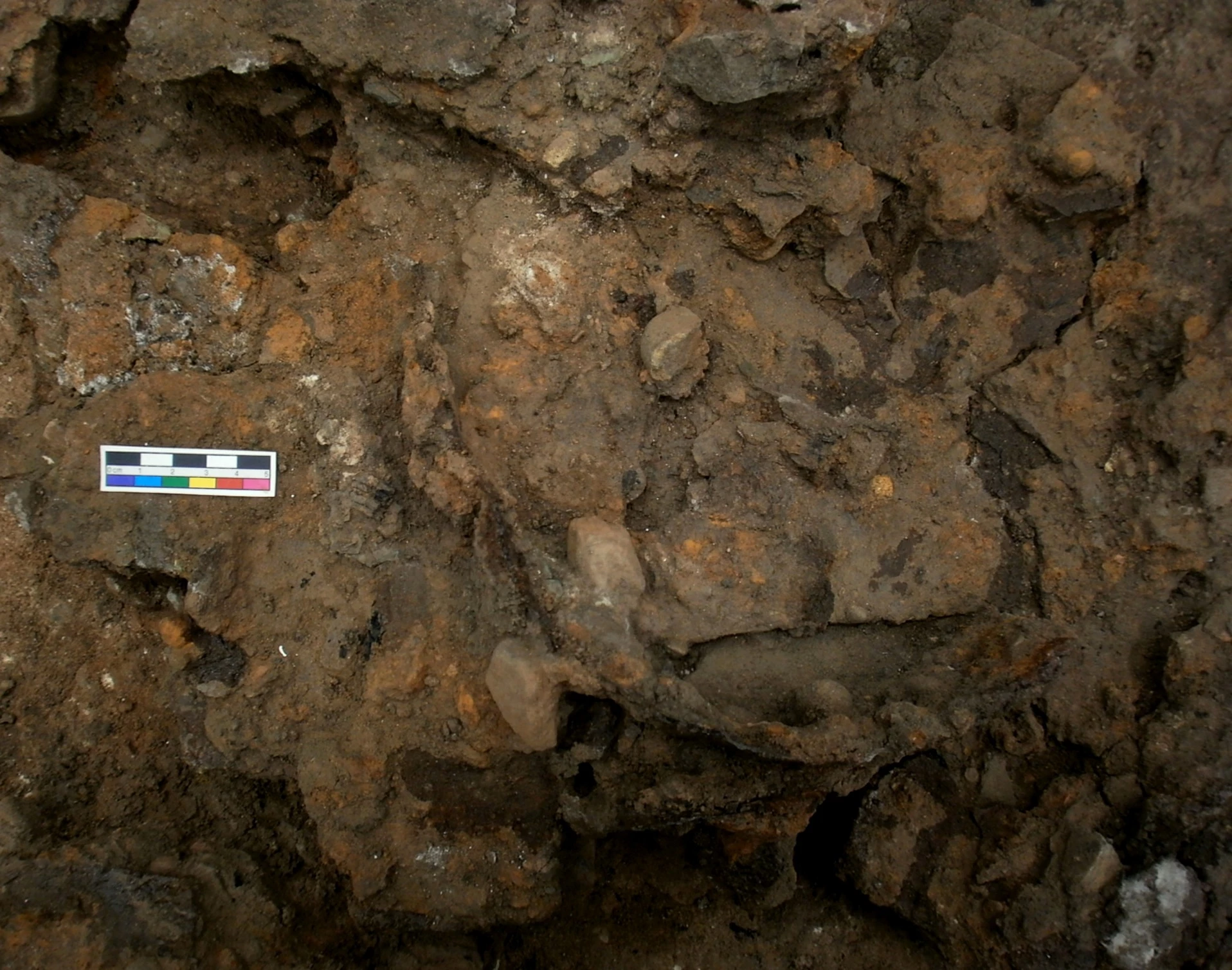
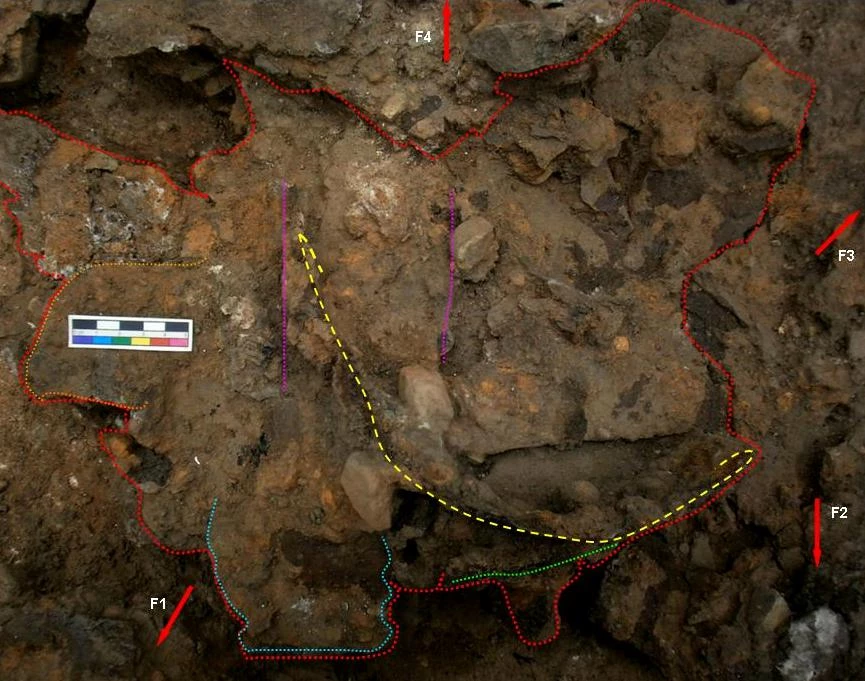
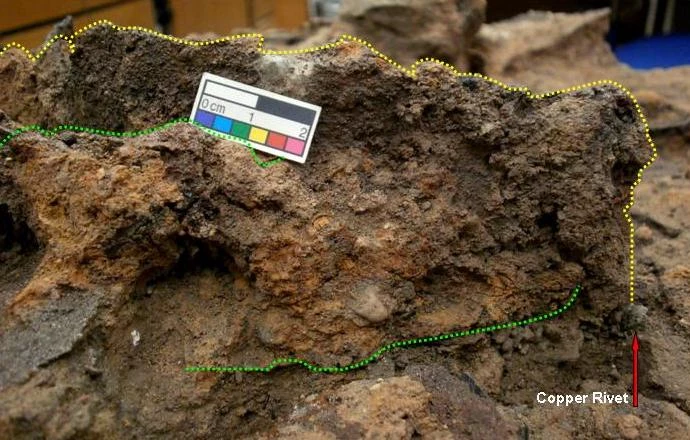
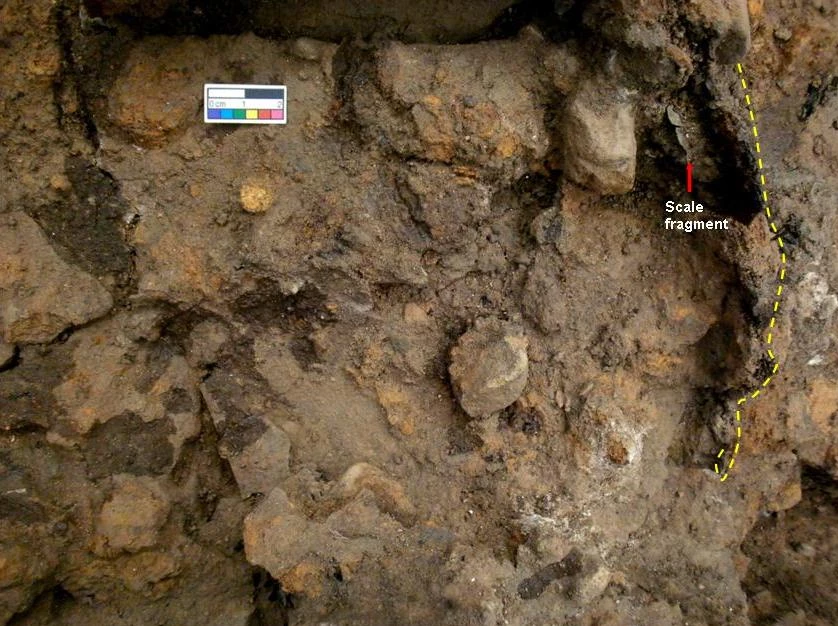
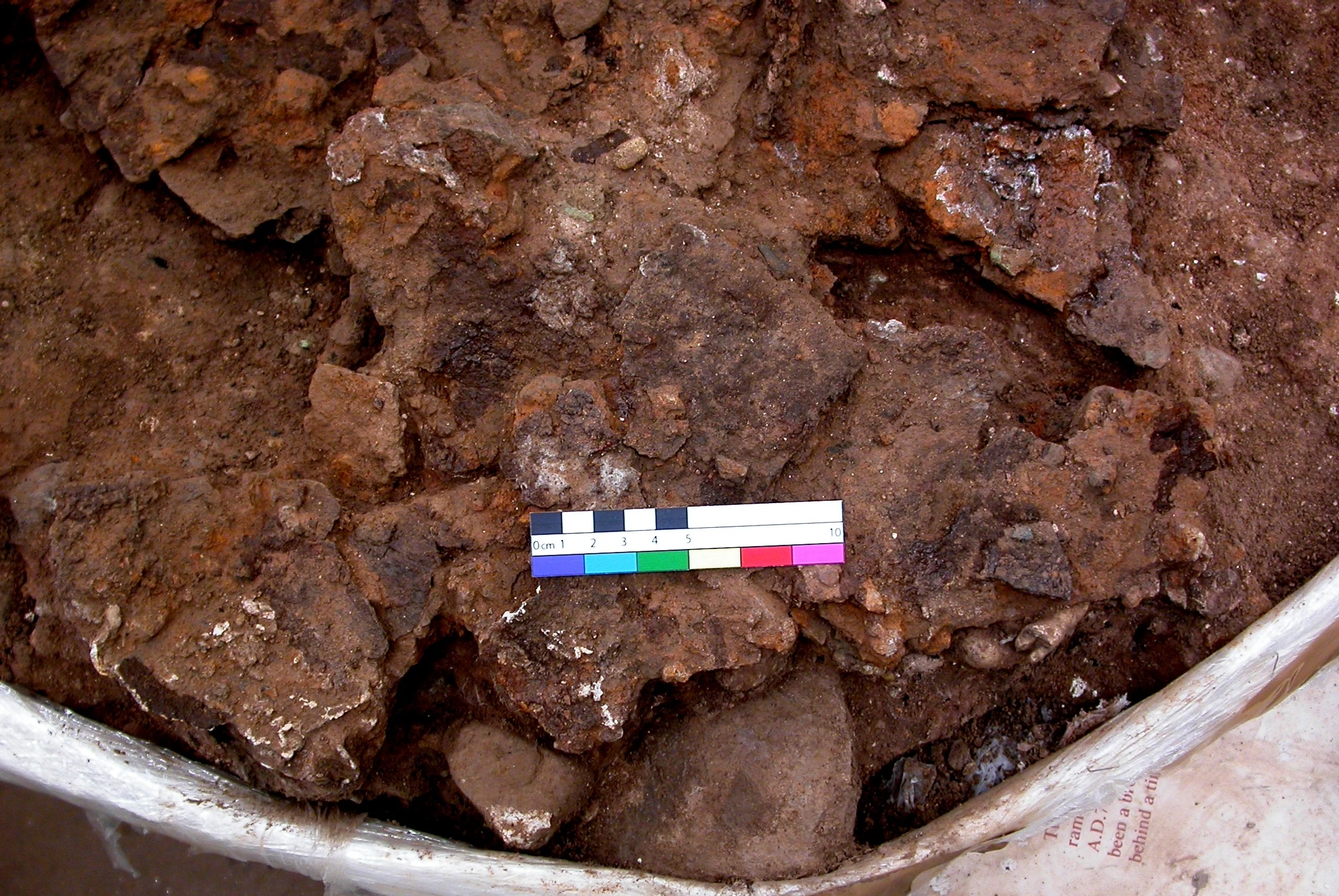
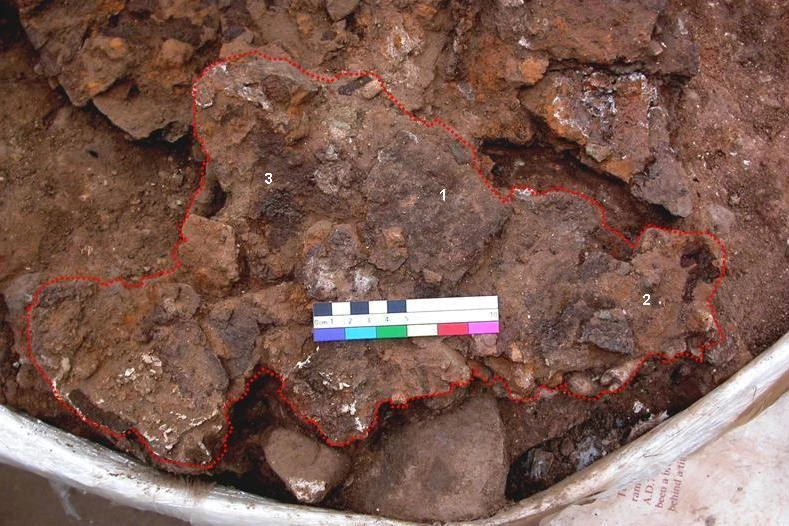
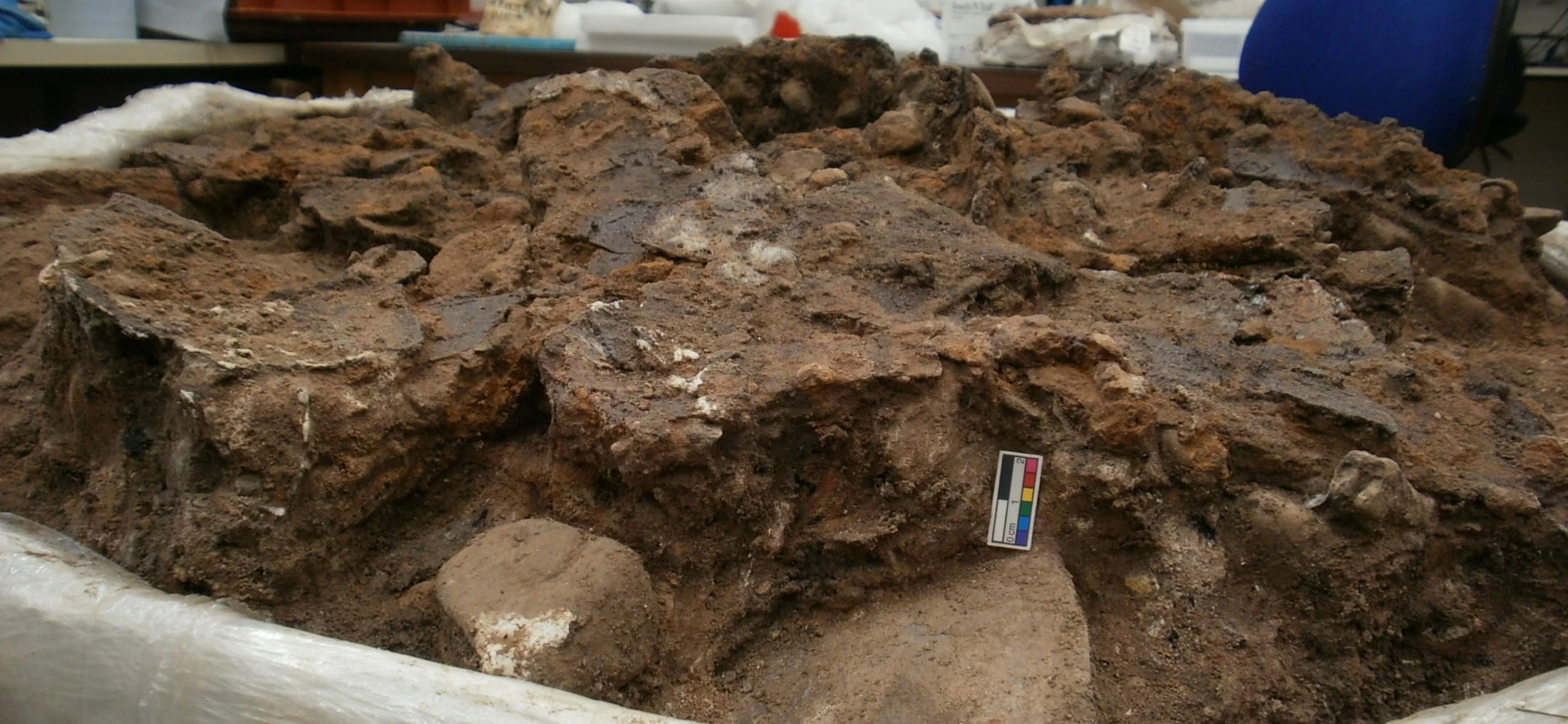
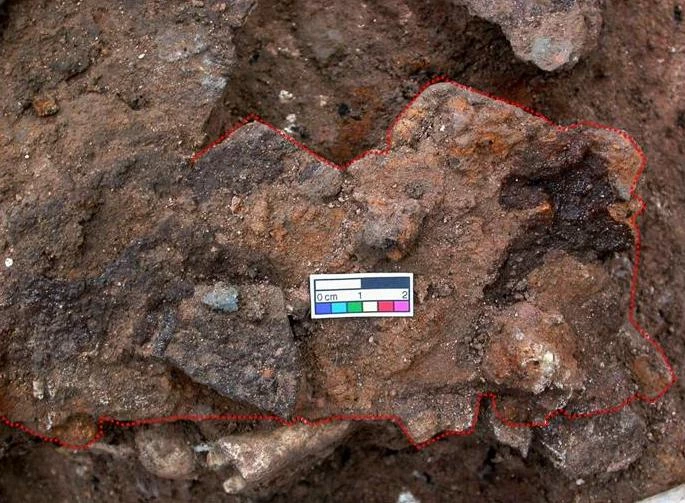
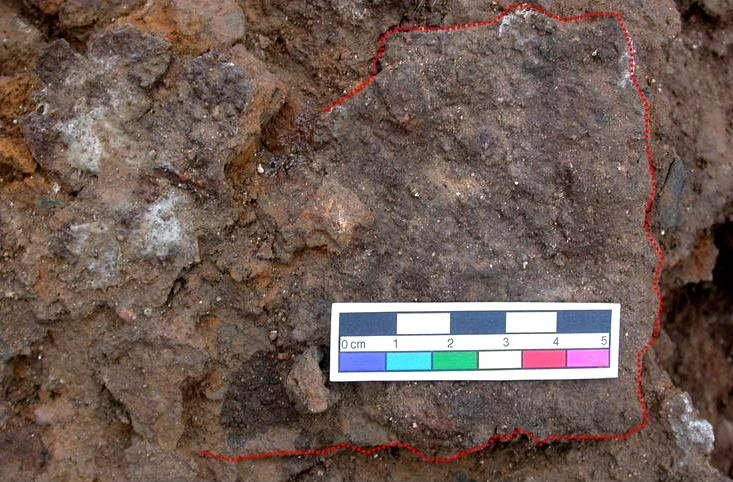
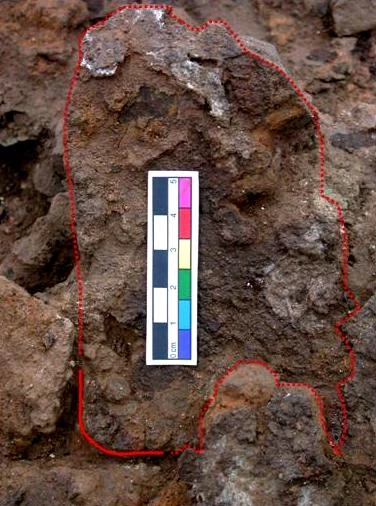
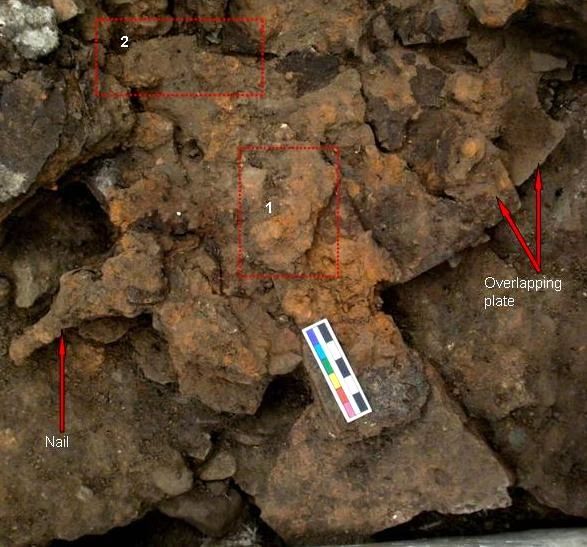
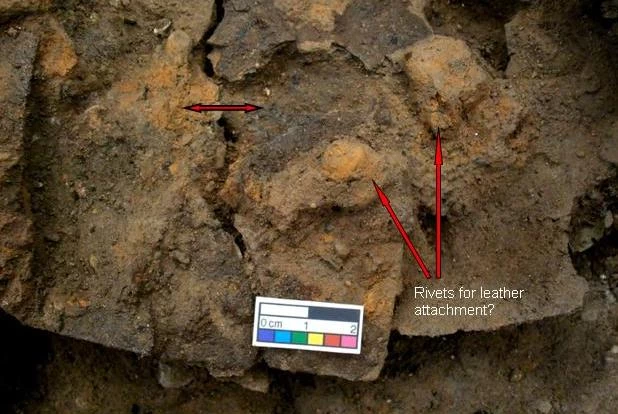
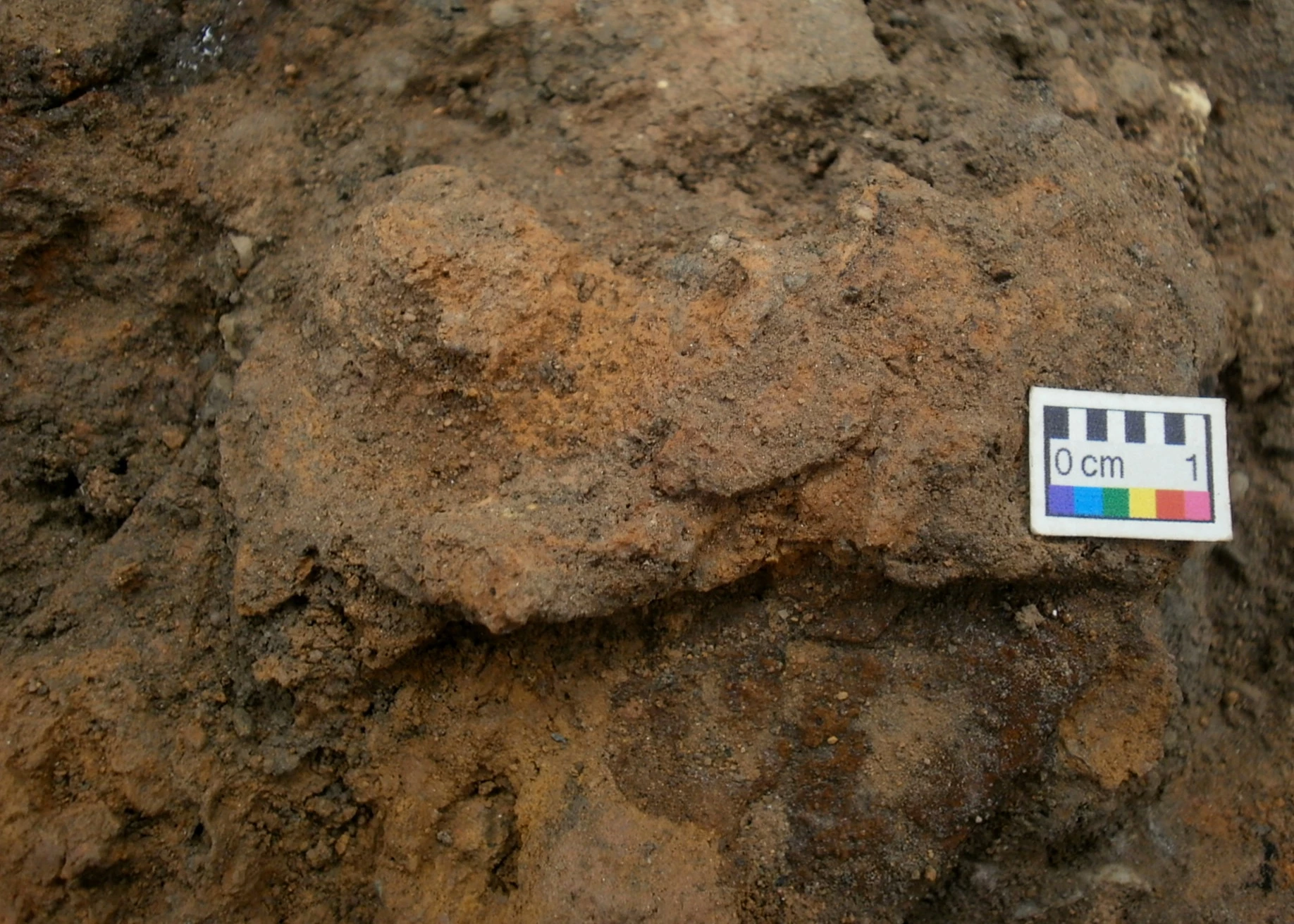
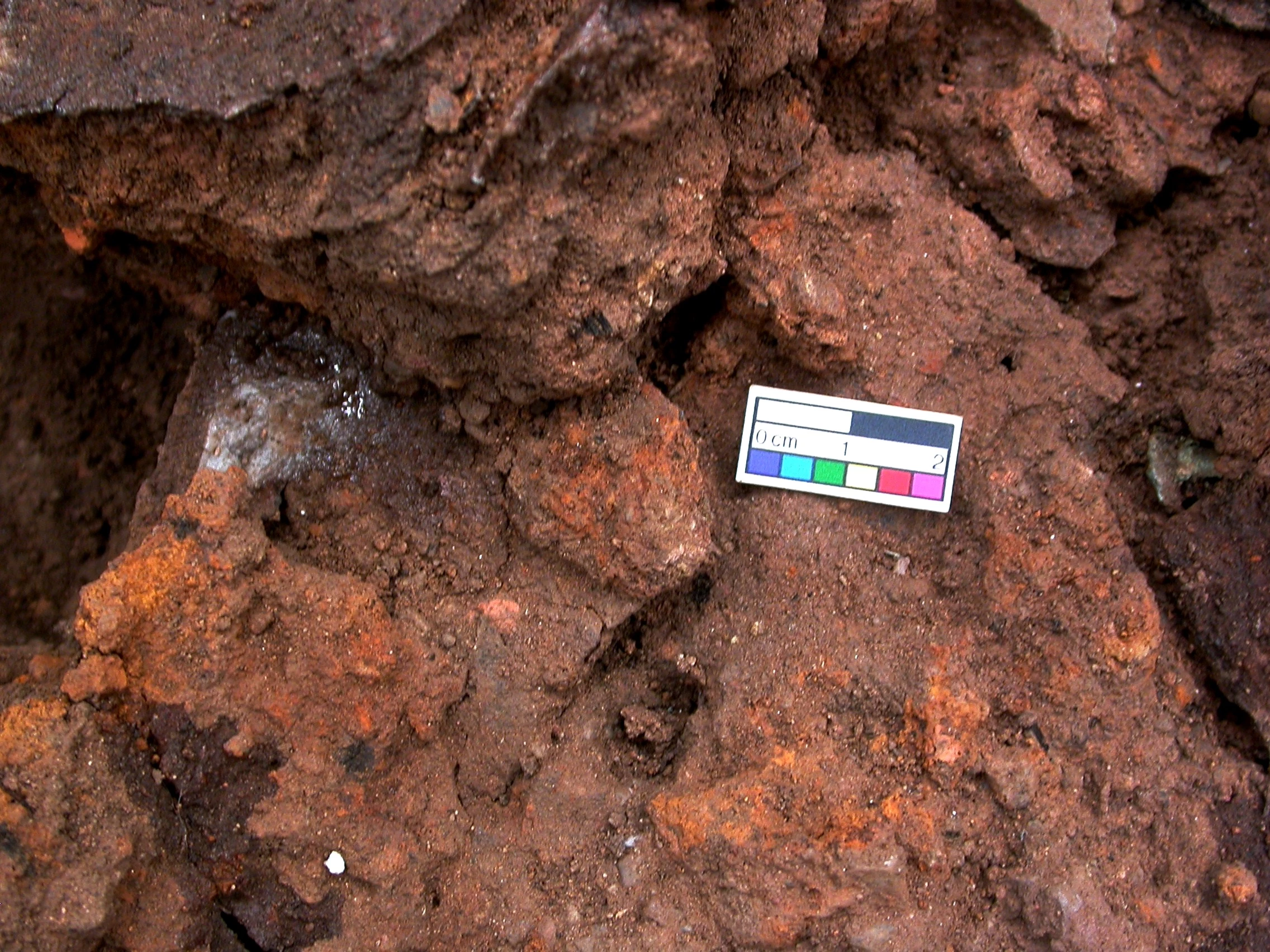
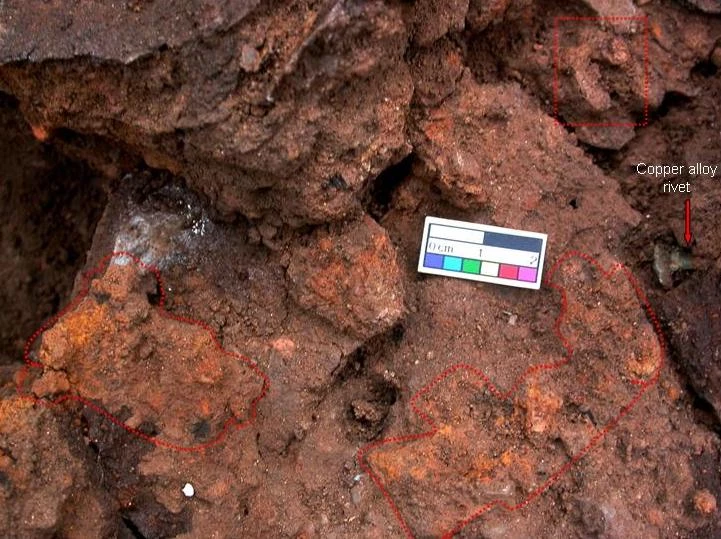
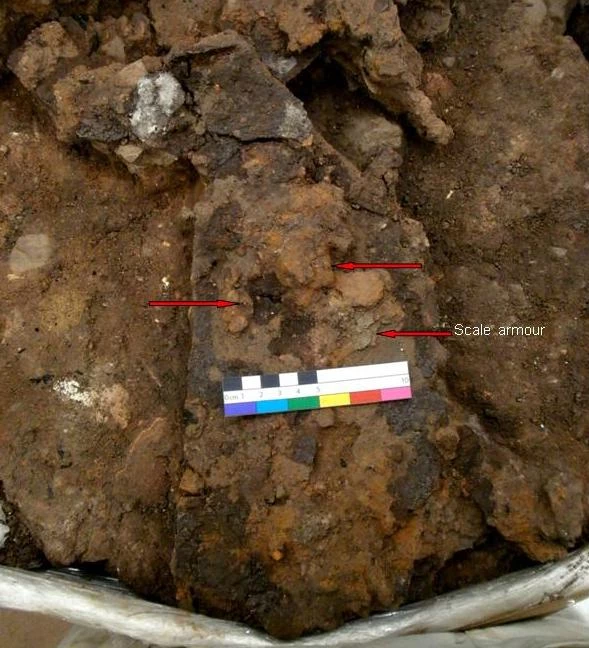
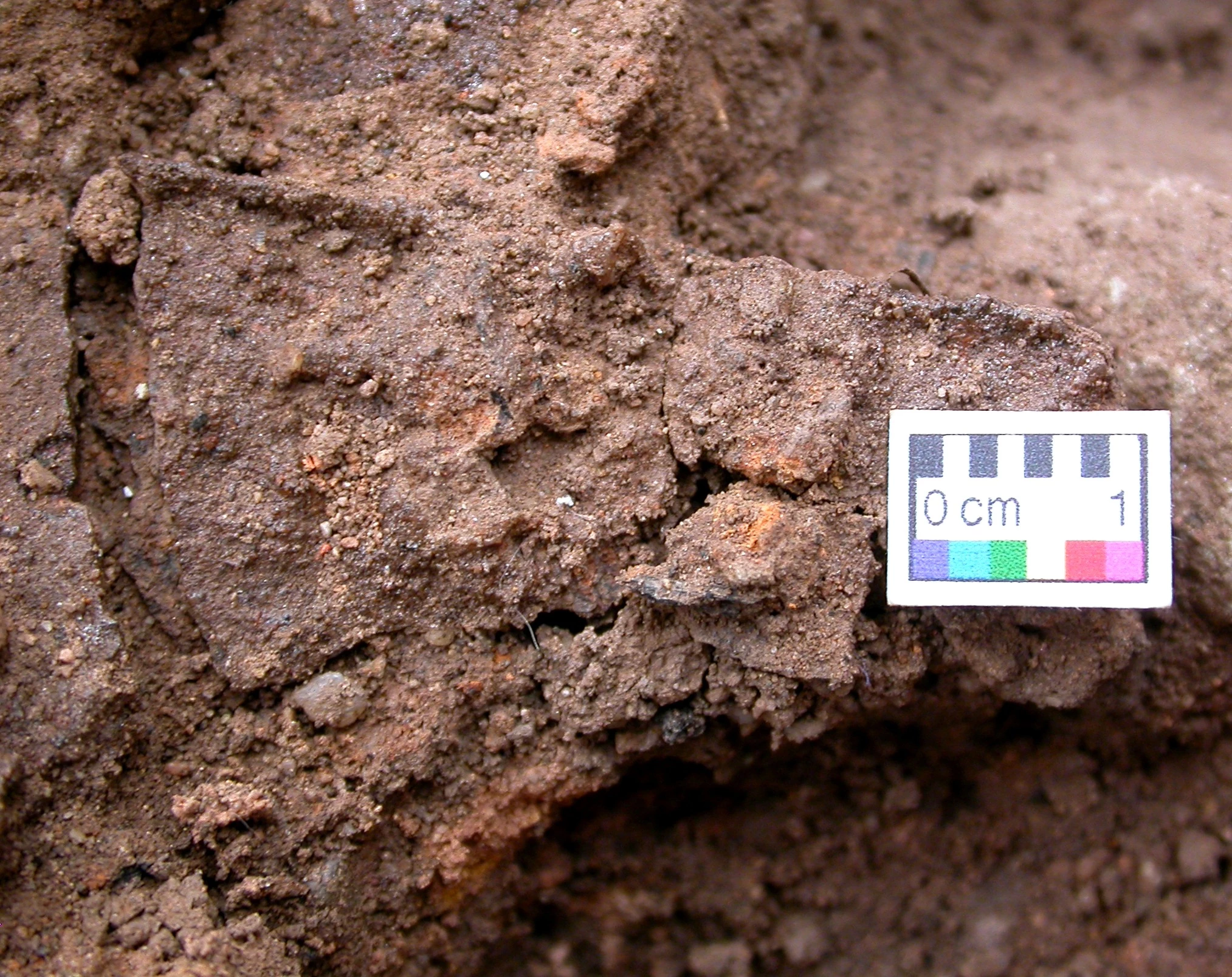
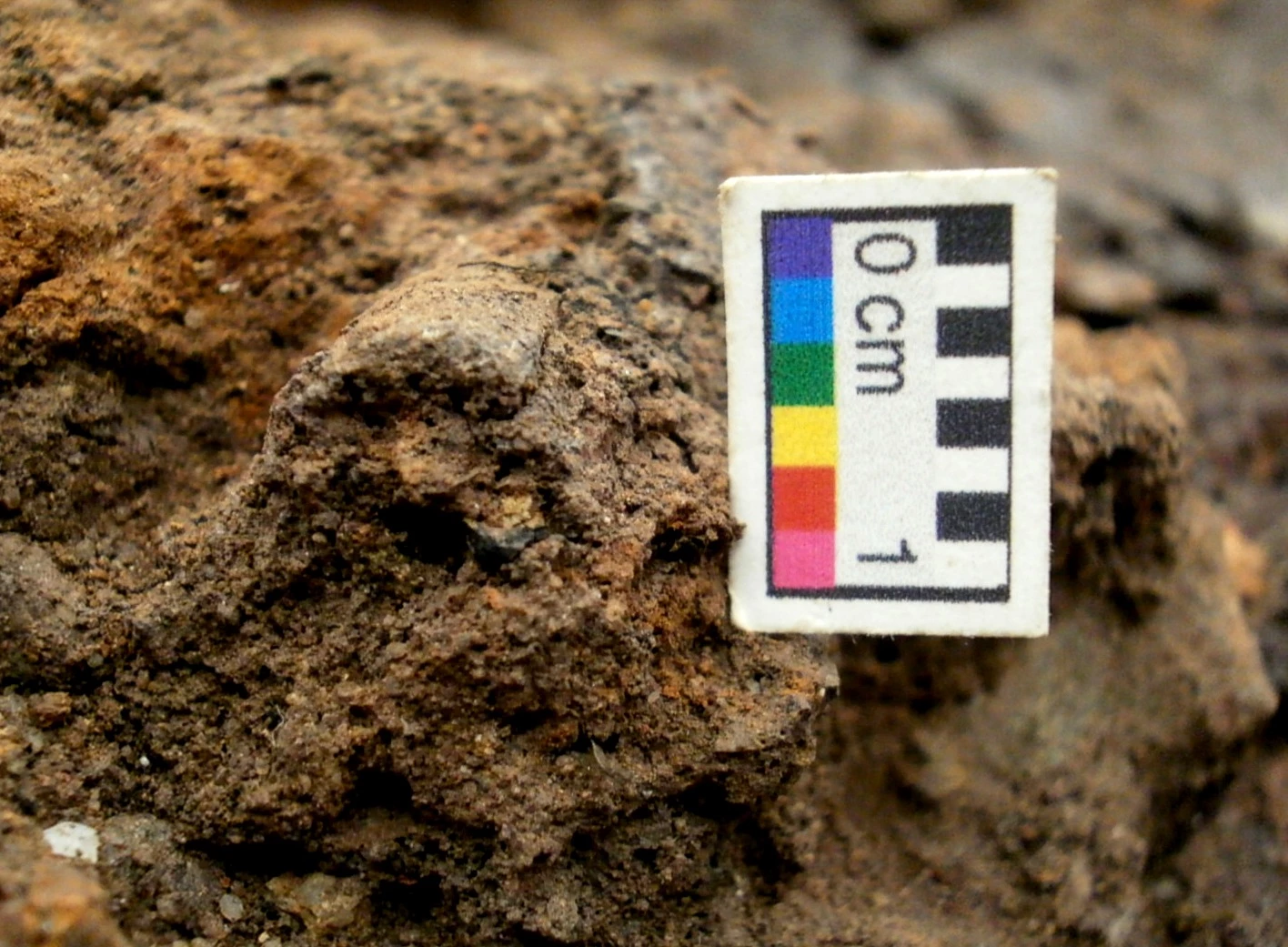
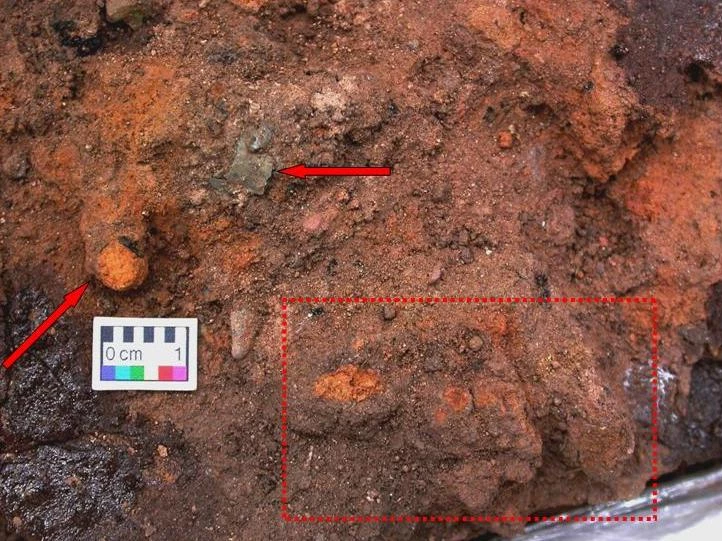
Excavating a Girth Hoop 5 October 2011 To the right is an image of the lorica segmentata girth hoop, complete with a copper alloy tie ring, after excavation in the conservation laboratory. The general shape of the hoop, which is lying on its side, can be discerned, and it is obvious that the plate is broken in several places. I had hoped to be able to see how the solid tie ring interacted with the girth hoop, but unfortunately too little of the iron plate remains in a stable enough state to remove enough of the obscuring soil currently supporting it. An x-ray of this area of the block will show the complete shape of the tie ring, and hopefully how it is attached to the plate. To reiterate, I am excavating the artefacts in this soil block in the same way that archaeologists do in the field, and am coming across the same extraneous stones, silty-soil and common artefacts such as ceramic building material and animal bone contained within the burial deposit that are found on the average archaeological site. As the stones, tile, etc, do underlie so much of the fragile iron plate, I will not remove them at this stage, though I am aware they could be covering more artefacts. Within the hoop further broken plates can be seen, most notably a flat plate with a rolled edge: this is one of the few plates that can at this early stage be attributed to a specific area of the cuirass; the only plates with rolled edges were the lowest girth hoop above the hip, and the breast and back plates. Given the flat nature of this plate, it is most likely the lowest girth hoop. To give readers an idea of the depth of the archaeological remains in the soil block, I have included photographs of the back of the girth hoop, as well as a photograph showing the interior. Of interest in the third photograph is part of a plate held to the back of the girth hoop by corrosion and burial products, and how thin the lorica plate with a rolled edge is in the fourth. Not all artefacts excavated in this area of the soil block can be as easily identified as the plate with the rolled edge; some of the iron has suffered greatly, and only vague shapes in the soil can be distinguished. Removing soil from the surfaces of these mineralized objects has been challenging, as I have to be careful not to take away any burial deposit that might contain corrosion that may be part or all that is left of the archaeological object. I have not recovered as many fittings, such as buckles, rivets, washers and studs as those found on cuirasses from other Roman sites, and it will be these attachments, and their position on the body armour, that will be very important when trying to work out which plates were breastplates, backplates, shoulderguards, etc. As expected, I have not found many of the valuable copper alloy fittings which could have been removed for re-use during and after the occupation of the fortress by military forces, although I have found possible iron components, harder to spot given the corroded nature of the metal. For example, in the last photograph, the red arrows are pointing towards vague rectangular shapes slightly proud of what is an extremely fragmentary lorica plate; these might be the remains of fittings. Again, only high quality x-radiography will provide us with an image which might allow curators to make an identification of what these deteriorated artefacts are. The hoop and other items will remain in place until the rest of the block has been excavated, when deconstruction will take place.
The Battle of St Fagans Sara Huws, 18 August 2011 We welcomed the English Civil War Society last weekend, to explore the Battle of St Fagans, which took place near the museum in 1648. They brought with them not only a fair amount of weaponry (as you'd expect), but an amazing number of skills and objects to demonstrate. I think a list would be a bit boring, so here are some photo higlights from the week-end. Thanks to Alcwyn Evans for taking the photos, I was busy protecting the church from reforming zealots! Settling in for a day of spinning at Cilewent farm Setting up camp in Abernodwydd field Fire! A re-enactor family. The smaller members of the group did an excellent job too! Pikemen waiting for the call to battle A nobleman in St Fagans Castle, in 1640s costume.
Block Blog: Primary Investigations 9 August 2011 At this juncture in the investigation of this block-lift, I am making every effort to outline the relationships (if any) between artefacts. As can be see in the first photograph, plenty of small pieces of iron plate, often with no telling association with larger plates, emerge as soil is scraped away. Aside from photographing their position for future reference, and examining them for signs of the remains of fittings, impressions of textile or leather, there is not much that can be done with these anonymous fragments. Moreover, these fragments often overlie more interesting and coherent features, and so I am generally removing these: I will most likely x-ray these in large batches at a later date. As you can tell by the annotations, I’ve begun to get a good idea of the fragile nature of the fragmentary, corroded copper and iron artefacts mixed in the burial deposit, and have begun to grasp how difficult lifting the larger pieces of lorica will be.So far I have had limited success at recovering any ‘true edges’ of the iron armour, as most of the vulnerable thin plate has been broken. Finding edges greatly improves our chances of identifying plates, and where two edges have been found, dimensions such as the width of the plate can give us an idea of which part of the lorica cuirass the plate comes from. It also helps us to make educated comparisons with examples of Roman armour found from other sites. For instance, the iron plate recovered in the second photograph has a width of 6.5 cm across, dimensions similar to those recorded for the armour fragments found amongst the Corbridge Hoard, and from the Austrian site, Carnuntum. It also has the very corroded remains of two copper alloy rivets, which improves our understanding of how the cuirass was constructed and held together.As I work I am keeping the surface of the soil block wet, by spraying it with deionised water. This prevents the soil from drying out too much, separating, and breaking the iron remains as it falls into chunks. As most of the iron is in such a poor condition, consolidation with a removable acrylic adhesive, such as Paraloid B72 (ethyl methacrylate copolymer) is a must (which is why in some photographs the iron surface appears to have a dark sheen to it). Whilst excavating an area of the block to the left of the photograph, I came across an exciting, (and sadly, very degraded) find: copper alloy wrapped around a thin iron plate. It can be seen in-situ in the photograph to the right, and after excavation in the photograph below. Sadly, as not much of the object has been recovered, a firm identification of this piece hasn’t been reached yet, though further excavation might yield more clues.Readers may have noticed that I have begun to clean the outside of what is most likely a girth hoop. The exposed iron plate is 1mm in thickness, and the hoop is broken in several places, that I can see from the surface. When focusing on this feature, I will have to be careful to remove enough soil and other burial debris to reveal the curved plate’s shape, whilst maintaining the earthy support until I am ready to remove the that section of armour from the soil block. The next blog entry will focus on describing the results of excavations in this area, which includes a copper-alloy tie loop, still associated with the iron plate.
Lots of talk, for some very small numbers Mari Gordon, 8 August 2011 Ok, so we had the iPad moment. What’s changed? Lots. The iPad itself was, in truth, disappointing for publishers. Beautiful, sure, but not very helpful. It wasn’t multifunctional and it wasn’t backward compatable with much stuff either (I can’t be the only person still using OS 10.4?) But, like Apple’s previous offers, it was a gamechanger. It established the tablet as a device, despite many people, myself included, wondering if anyone really wanted Job's 'third device'. Apple then let other manufacturers come up with their own versions, the best of which is probably Samsung’s Galaxy, and quietly went home to improve their own model. Having established the tablet, and just in time to catch the secondary wave of adopters, out comes iPad 2. With improved functionality and more features (camera – two, actually), it still passes itself off as the most desirable tablet, even if it’s not necessarily the best. With iPad 2 and the iPhone, Apple has now firmly entered the mainstream consumer market. In losing the geek factor, what has it gained? Well, turnover, and profit, obviously. While Apple’s top-quality combined hardware/software model of Macs retains its market-leading position in the creative industries, the iPods, Ipads and iPhones are now thoroughly high-street, even with their top-end price tags.However, part of this trajectory has been the strategic downplaying of the iPad’s e-reader function, which is what publishers were most excited about. Instead, the iPad focuses on portable, sleek, seamless acces to the web and email – truly, a big iPhone, but also ready and waiting for Web 3.0.In terms of e-readers the iPad moment just didn’t happen. This has left Amazon’s Kindle as market leader, even though it only reads Amazon’s own e-book file format (although there are rumours Amazon will soon be allowing US publishers to submit e-books in the industry-standard e-Pub format). Amazon introduced the Kindle in 2007, by 2010 in the US Amazon were selling more Kindle books than hardbacks; today Amazon sells more Kindle books than hardback and paperback put together. At the moment it’s selling 105 Kindle books for every 100 print books, and three times more Kindle books than this time last year. In the UK, where the Kindle store has only been open a year or so, Amazon are selling twice as many Kindle books as hardbacks.What can we learn from this? Remember, the Amazon figures only apply to their own sales, of Kindle books, which can only currently be read on a Kindle device. What’s happening across the rest of the bookselling industry? The true picture for the UK is that sales of e-books are currently 2.5% of all book purchases; interestingly, they peaked at 3% over Christmas (did you get an e-book in your stocking?!) Adult fiction is still the most popular category, at 5.4% of all purchases; men and women are buying e-books equally, and the age group 55-64 makes up over a quarter of e-book buyers.This 2.5% seems like a tiny figure for us all to be worrying so much about, especially as the value of the sales is low – about 1.6%. I still can't wait to have a go though.
Special Event Tomorrow: Behind the Scenes with the Acts of Union Sara Huws, 21 July 2011 Tomorrow, you are invited to come and join us for unprecedented behind-the-scenes access to the most important document in Welsh legal history: The Acts of Union.Parts of the document have left London for the first time since 1536, and are on display in our 'Making History 1500-1700' exhibition. They have been recalled from their recess, and will be going back to the Parliamentary archives soon. In light of this, we are calling an emergency debate of our own!Figures from Welsh life will be leading the afternoon, including: Suzy Davies - Conservative AM for South Wales West, Shadow Minister for Welsh Language and Culture Mark Drakeford - Labour AM for Cardiff West Dafydd Ellis Thomas - Plaid Cymru MP for Dwyfor-Meirionydd, Chair of the Assembly Commission Vaughan Hughes- Commentator and Broadcaster Nia Powell - Lecturer in Welsh History, University of Bangor Baroness Jenny Randerson - Welsh Liberal Democrat Member of the House of Lords Eirug Salisbury - Bard and Commentator Rev John Walters - Vicar of St Teilo's Church, Pontarddulais We'll be exploring the role of the Acts of Union in the 21st Century, as well as the controversies they still raise. You're welcome to join us, as the day winds its way around many of Museum Wales' most iconic spaces - including St Teilo's Church at St Fagans: National History Museum.Period music, light refreshments, after-hours access, simultaneous translation and a chance to explore the Act of Union up close are included, free of charge.Meet at National Museum Cardiff foyer at 1.50pm tomorrow, as the afternoon session will take place in the Reardon Smith Lecture Theatre at 2pm.This will be followed by a trip to St Fagans to see the document 'in the flesh', and to look at contemporary objects from our 'Making History' exhibition. A discussion will be held in St Teilo's Church, looking at the broader European context of life in Wales under Henry VIII.Please call Heledd Fychan on (029) 20 57 3268 to reserve a place, as they are limited.You will need to provide your own transport to St Fagans for the 'behind the scenes' session. Buses Nos 32 and 322 depart from Stand D2 in the City Centre, to St Fagans at regular intervals.