Collections & Research

A Museum Beekeeper's Diary 2015

Benjamin Evans, 3 June 2015

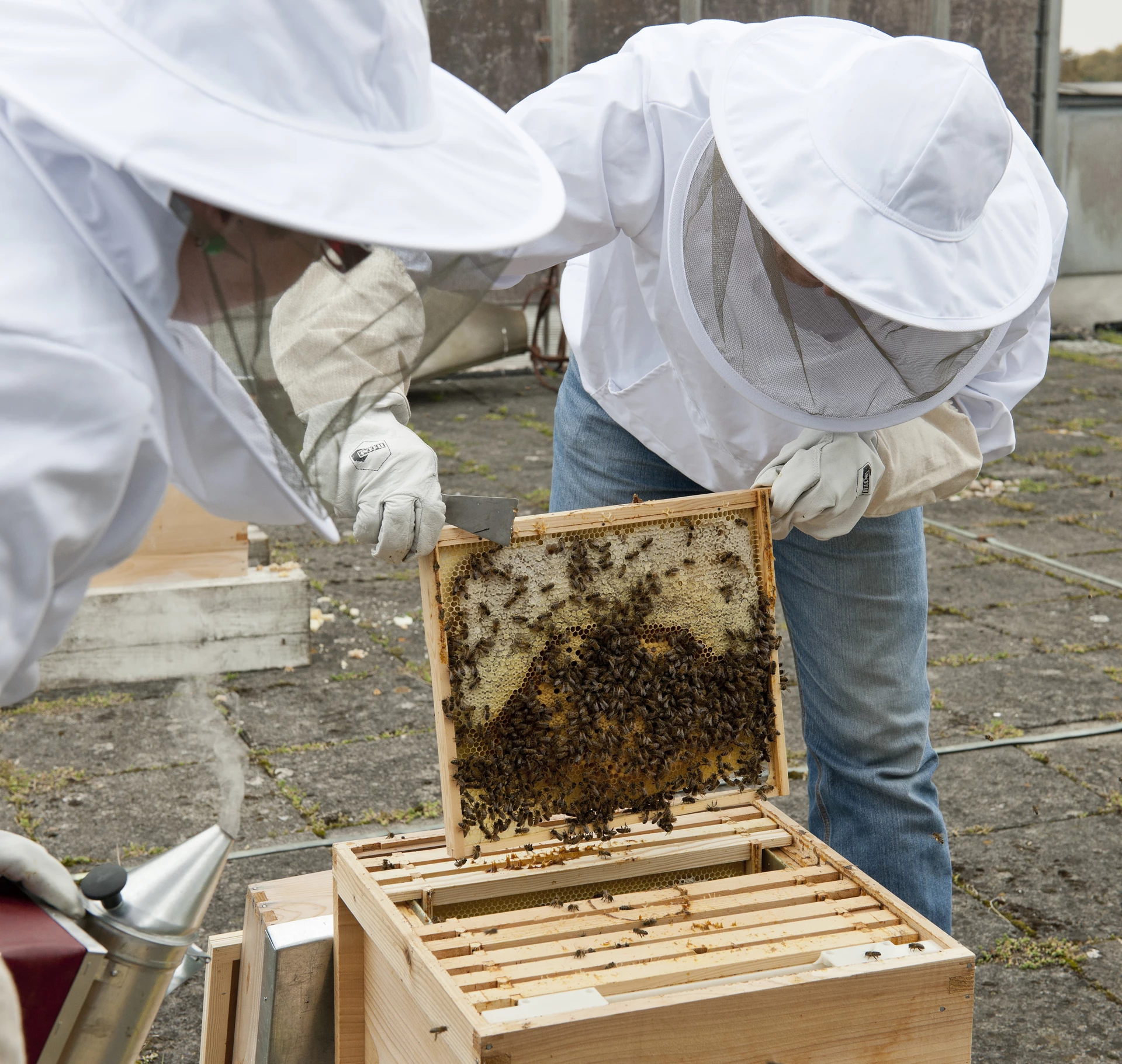
Back in August 2014 the National Museum Cardiff received its two newly bred colonies of honeybees.  Due to the timing of the bee keepers training and the specific needs for colonies to be bred on Deep National frames the bees arrived much later in the season than we were anticipating.  The two new “nucs” (nuclei of bees) were rehomed in new hives situated on the roof of the Museum where there is adequate space for the beekeepers to work safely and have adequate shelter from the worst of the weather. From the outset we realized that production of honey wasn’t likely to be an option in the first year with the bees putting all their efforts into building their numbers and storing adequate reserves to see them through the Welsh winter months. During September and October the bees worked hard gathering nectar and storing honey for the months ahead however even from the outset it was immediately clear that one hive was far more productive that the other. The bees in our better hive probably tripled in numbers, whereas the bees in the other hive were sulking! In late September both the hives were treated for parasitic Varroa mites and we were all astonished that so many mites were present in two relatively new colonies. Along with the Varroa treatment the bees were fed. We placed frame feeders inside the hives and fed invert syrup (a sugar syrup where the sucrose sugar has already been split into glucose and fructose thus allowing the bees to expend less energy metabolizing it). The feeding seemed to be going well until in early October approximately 600+ bees from the weaker of the two hives drowned in the feeder. This occurrence is unusual but not completely unheard of, however our sulking colony was further weakened by this unfortunate incident. Fearing for the weaker of the two colonies we readied the hives for the winter and closed them up until the spring.

The winter itself wasn’t a particularly cold one and by mid February colleagues were reporting that they had seen bees in the gardens around the museum. Reports from maintenance staff using the roof suggested that both colonies had survived and on the warmer days, were out foraging in the parks surrounding the museum. Robin and I made our first very provisional inspection on a warm sunny day in mid March. We opened the hives and took a look at the numbers of bees inside. Since the air temperature really wasn’t all that high we opted not to remove frames of bees and potentially chill any unhatched brood so instead we just observed and noted the level of activity and numbers of bees in the hives without disturbing them. The difference between the two hives was shocking! The stronger hive had 6 or 7 full frames of bees while the other had only 1 full frame! Despite the less strong hive having plentiful reserves of honey we made an immediate decision to start feeding the colony in an attempt to strengthen and hopefully resurrect it.

 In the last week of March (26th) our beekeeping mentor, Pete from Natures Little Helpers, came to do our first proper inspection.  We went through the strong hive finding the queen looking healthy and laying eggs just as she should be. The numbers of bees in this hive was already growing and the hive was filling up quickly. The weaker hive was very different, Pete initially suspected that the queen might not be present but a quick inspection of the brood area of the hive suggested that eggs were being laid and that a mated queen was present. The hunt for the queen commenced and since we didn’t have lots of bees to look through we eventually found her. She was a new queen, different to that when we got the colony and had never been marked. Our other queen carries a lovely green spot on her back making her quite obvious, however finding this unmarked queen was quite a task. What we noticed immediately was that some of the cells contained not one egg as you’d normally expect but two or three. Pete explained that this sometimes happens when there are not enough worker bees in the colony to prepare brood cells ready for the queen. These multiple laid cells were not going to be viable and ultimately no bees would result from that those eggs. In order to help this weaker colony we decided to try and reinforce the worker bee numbers by moving some frames of unhatched and juvenile bees from our rapidly growing strong hive into the weeker hive. It seems incredible that this is possible but apparently the new bees will become accustomed to the new scent of their adopted queen and switch their allegiance. We carefully, making sure not to move the queen, moved one good full frame of unhatched brood from the centre of our strong hive into the centre of the weaker hive. We then installed a homemade contact feeder  (made from a jar with a perforated top), which in the absence of syrup we filled with honey.

Our weekly inspections then began on good warm days when the wind wasn’t too strong! Keep posted for further updates from our Museum's Beekeepers.

Chick on the nest

Katie Mortimer-Jones, 3 June 2015

A peregrine chick has been spotted in the nest on the clock tower of City Hall Cardiff. It appears that there is only one chick this year but after last year's breeding failure this is great news.

Why not follow how the chick gets on by watching our Peregrine cam on National Museum Cardiff or follow up dates via the @CardiffCurator Twitter page.

WW1 flag day badges - a blog by volunteer Lydia Griffiths

Elen Phillips, 2 June 2015

To celebrate Volunteers' Week, Lydia Griffiths, a volunteer and Youth Forum member at Amgueddfa Cymru, talks about her research into British charity and voluntary action during the First World War through studying a collection of Flag Day badges at St Fagans National History Museum.

Voluntary action made a significant contribution to the First World War, not only in the numbers of soldiers who volunteered to fight but also the civilians on the Home Front who donated food and clothing in addition to providing medical and financial support. As part of my Art History Degree at the University of Bristol, I embarked on a dissertation to research a collection of Flag Day badges at St Fagans National History Museum and discovered a fascinating legacy of British voluntary action that can be traced to the present day.

Flag Day badges consist of paper and sometimes silk flags attached to metal pins that were simple to produce and sold for as little as a penny. They tended to be sold on specific days and in addition to being easily adapted to suit any cause, they were quickly and efficiently produced offering the contributor the opportunity to display their commitments to the war effort by simply purchasing and wearing a Flag Day badge. Many thousands of volunteers contributed to the war effort by selling and producing these badges which generated an impressive amount of money. It has been estimated that during the First World War, the Red Cross alone raised £22 million - the equivalent to £1.75 billion today - which included the selling of Flag Day badges.

The collection of Flag Day badges at St Fagans could be regarded as social signifiers indicative of a nation committed to supporting and helping those in need, a trend that continues today. There are hundreds of flags in the collection and all have their own specific purpose and underlying story, such as those that reference St Dunstan’s Day, a charity based in London which was set-up to help the blinded soldiers which is still functioning today under the title Blind Veteran UK. There are also many Red Cross related Flag Day badges and some bear the words ‘Our Days’ that reference a day dedicated specifically to fundraising for the Red Cross which has been described as the equivalent to our modern day Comic Relief and Children in Need.

Personally, I found the Russian Flag Day badges featuring the symbol of the Red Cross the most inspiring as they were established by a London based Russian Petroleum Scientist, Dr Paul Dvorkovitz, who wanted to improve the allied relationship between Russia and Great Britain. The archives in the Imperial War Museum currently have all his telegrams and diaries and they reveal that he proposed the idea that British towns across the country could hold ‘Russian Days,’ where Russian themed Flag Day badges would be sold to generate funds for the Russian war effort and in return certain Russian cities would hold similar English or British Flag Days to raise funds for Britain. In Wales, Welsh newspapers from the period report that many Russian Flag Days were held in Swansea and Cardiff which is why they appear in the collection at St Fagans. Nationally the movement raised £50,000 in 1916 that prompted the Tsarina to send a telegram to The Times newspaper thanking the British for their generosity.

Since the Great War, voluntary action and charities have emerged as hugely significant assets to British society and their importance has certainly not wavered. Without the work of volunteers many institutions across the country would struggle to survive and it is interesting to note that many of today’s volunteers could be viewed simply as following in the footsteps of our ancestors from the First World War who took it upon themselves to volunteer to fight, fundraise and work to ensure a better future for their country.     

Happy Volunteers Week!

LYDIA GRIFFITHS @lydiabranweng

References:

Adrian Gregory, The Last Great War: British Society and the First World War (Cambridge, 2008)

Carol Harris, '1914-1918: How charities helped to win WW1' Third Sector

Imperial War Museum Archives

Peter Grant, Philanthropy and Voluntary Action in the First World War (New York, 2014)

The Times Newspaper Archives

Wi-Fi Audio Tour using Museum Visitors' Mobiles

David Thorpe, 31 May 2015

A lot of people wander around exhibitions with phones in their pockets or handbags. We decided to utilise this idea and serve up a Wi-Fi audio tour for the Chalkie Davies: the NME Years exhibition (9 May - 6 September 2015) - the museum has a web-server and there is Wi-Fi broadcasting in the exhibition gallery, allowing us to give it a whirl. 

  • We wanted to give access to the maximum number of people with phones from this decade (HTML5 compatible devices). 
  • We didn’t want an ‘app' because it creates a lot of hoops for developers and the museum to jump through, plus visitors probably don't want excessive fuss when entering an exhibition especially as they might only use it for five minutes in total. 
  • We didn’t want to bring in traditional audio tour guides because of the hire price for the museum and we weren't going to ask the visitors to pay, as it's free entry to the exhibition.
  • We might want to use it again and would hope to do so with the minimum amount of technical fuss.

Free Wi-Fi but not sitting a Coffee Shop

Once the visitor has connected to the free Wi-Fi audio tour ‘Chalkie' the Wi-Fi capture software will direct them to the correct web page with the name of the exhibition and a choice of languages (see picture 1). All is going well. 

Language Choice

The english audio tour was written and recorded by Chalkie Davies and his team - it provides his personal insights into each of the photographs on display and some back stories. The welsh audio version was recorded in-house by Rhodri Viney (recording and editing) and Telor Gwyn (voice), using the Chalkie Davies translated transcript.

Choose a Number between One and Nine

The visitor is given a choice of nine numbers, each matching a number on the gallery wall which refers to a selection of photographs (see picture 2). Once the person selects one of these numbers the audio tour begins...

"Listen To What The Man Said"

For the best experience the visitor should have headphones, but it's not the end of the world if they don't, they can still listen through their devices' built-in speaker, although this can look and feel a little awkward. Alternatively they could hand over £1.50 for headphones in the museum shop downstairs.

If they don’t want to walk around with a mobile phone protruding from their head, or leave the exhibition and come back in again to buy headphones downstairs, or find that their mobile phone has a low battery percentage - there is a printed version of the audio tour available within the gallery. They are the same words.

A Perfect Circle

I used to have an analogue watch, but I left it accidentally next to the squash courts in the University - if anyone picked it up, could they hand it back please? Anyway, time can be measured within a circle. I like circles, so I built a large circle to indicate the progress of the audio track playing. The animated graphic uses SVG (Scalable Vector Graphics), which meant the page avoided the usual graphical software - it's all written in code: HTML5, javascript and CSS [Well, I find it mildly exciting] (see picture 3 and 4).  

Pressing the circle will pause the audio. If the visitor listening to the audio tour wants to change to another number they can press the ‘Home’ button and the page will scroll up to the nine numbered keypad again. Another loop, of sorts…and repeat.

Before we go any further, maybe we could pause for a short film clip...  

Additional Details You Might Enjoy 

  • The gallery has a capacity of 40 people at one time.
  • There are two Wi-Fi hubs at each end of the gallery broadcasting wireless-N.
  • A web-server streaming the audio.
  • Each of the audio tracks are compressed to less than 2MB (MP3).
  • It takes less than ten seconds to download the whole MP3 on a iPhone 5S and the audio plays almost immediately.
  • We’ve tested it with various phones including one of the first Android audio HTML5 compatible phones (Gingerbread 2.3.6 ~ circa 2011) and Windows 8 phones.
  • If the device is not capable of displaying a SVG there is a fallback to similar looking GIFs.

Media Monitoring

The web-server records each time a track is requested. Therefore, we will have some data to indicate how much the audio tour is being used - thinking about it, we shoud gather additional information about the type of browser requesting the audio (it's a closed network so we can't involve Google Analytics, which is the usual goto reference for 'what kind of computer has visited the website recently'). We will monitor things during the exhibition and conduct evaluation once it has closed. 

Dyddiadur Kate: Bwydo’r boblogaeth

Elen Phillips, 29 May 2015

Ym Mawrth 1915, agorwyd gwersyll i garcharorion rhyfel yn y Frongoch, gerllaw’r Bala. Mewn blog blaenorol, fues i’n trafod ymateb Kate a’r wasg leol i ddyfodiad yr Almaenwyr i Sir Feirionnydd. Er gwaetha’r gofid cychwynol, erbyn canol 1915 penderfynwyd y dylid defnyddio’r carcharorion er budd yr ymgyrch rhyfel. Yn wyneb prinder llafur, ym Mehefin 1915 rhoddod Ynadon Penllyn ganiatad i’r carcharorion weithio ar ffermydd cyfagos:

Yr ydym ni Ynadon Dosbarth Penllyn, yn dymuno datgan ein barn y bydd prinder llafurwyr amaethyddol yn y dosbarth yn ystod y cynhauaf agoshaol, a gorchwyl ereill, ac felly yn dymuno datgan ein barn mai da fyddai i’r awdurdodau milwrol ganiatau i’r Germaniaid sy’n garcharorion yn Frongoch gael eu llogi at wasanaeth ffermwyr y dosbarth. Yr Adsain 22 Mehefin 1915

Yn ôl Robin Barlow, bu dros 1,000 o garcharorion Almaenaidd o’r Frongoch yn gweithio ar ffermydd yr ardal. Wrth chwilota drwy wefan Papurau Newydd Cymru Arlein, daw hi’n amlwg nad menter leol yn unig oedd hon. Er enghraifft, mae’r Denbighshire Free Press yn nodi’r canlynol yn Nhachwedd 1919:

REPATRIATION OF GERMANS: On Monday, the 24th October, all the Germans prisoners at Bathafarn Hall, with the exception of ten left behind to clean up, were returned to the Migrating Camp at Fron Goch, near Bala, and the others have since followed. Captain Bennet, camp commandant for Denbighshire, who has been in charge at Bathafarn, reports that farmers testify to the very good work done on farms by the prisoners.

Ond pam fod angen cymorth y carcharorion ar ffermydd ardal y Bala? Yn ei dyddiadur, mae Kate eisoes wedi nodi ymadawiad Robert Daniel Jones o’r Derwgoed. Ymunodd ef â’r Ffiwsilwyr Brenhinol Cymreig ym Mawrth 1915. Roedd Bobbie Penyffordd wedi ymrestru yn Awst 1914, a chyn diwedd 1915 roedd o leiaf dau arall o gymdogion Kate wedi ymuno â’r lluoedd – Tomi’r Hendre ac Ivor Erwfeirig.

Erbyn 1916, roedd y Bwrdd Masnach yn amcangyfrif fod gweithlu amaethyddol Cymru a Lloegr wedi gostwng 33% ers dechrau’r rhyfel (nid yw’r ffigwr hwn yn cymryd menywod i ystyriaeth). Yn ogystal â’r prinder llafur, daeth bwydo’r boblogaeth yn boen meddwl wrth i’r rhyfel lusgo yn ei flaen. Roedd gaeaf 1915 a gwanwyn 1916 yn ddychrynllyd o oer a gwlyb, ac fe gafodd hyn effaith andwyol ar gynhaeaf y flwyddyn honno. Ar ben y cwbl, roedd si ar led fod yr Almaenwyr yn cynllunio i dargedu mewnforion gyda’u llongau tanfor. O ganlyniad i hyn oll, ymatebodd y llywodraeth drwy annog y boblogaeth i dyfu cnydau a bod yn ddyfeisgar gyda chynhyrchu bwyd. Mae’r fowlen siwgr hon o gasgliad yr Amgueddfa yn cynnwys neges o anogaeth gan David Lloyd George:

I HAVE NO HESITATION IN SAYING THAT ECONOMY IN THE CONSUMPTION & USE OF FOOD IN THIS COUNTRY IS A MATTER OF THE GREATEST POSSIBLE IMPORTANCE TO THE EMPIRE AT THE PRESENT TIME

Mae modd gweld rhagor o wrthrychau sy’n gysylltiedig â bwyd ac amaethyddiaeth yn ystod y Rhyfel Byd Cyntaf ar ein gwefan.