: Portable Antiquities Scheme (PAS Cymru)

Stumped by a Spoon

Matthew Guiseppe Knight, 20 September 2017

Vibrant discussions are a usual part of the Saving Treasures project and the Amgueddfa Cymru archaeology department.

But I’m not sure we’ve ever had one about a spoon before.

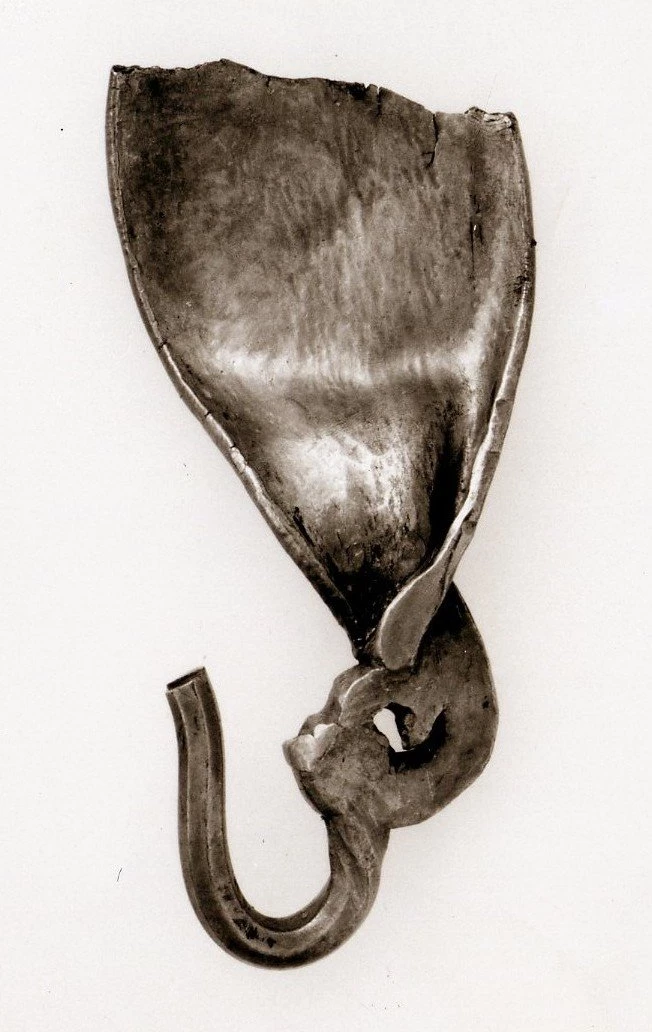
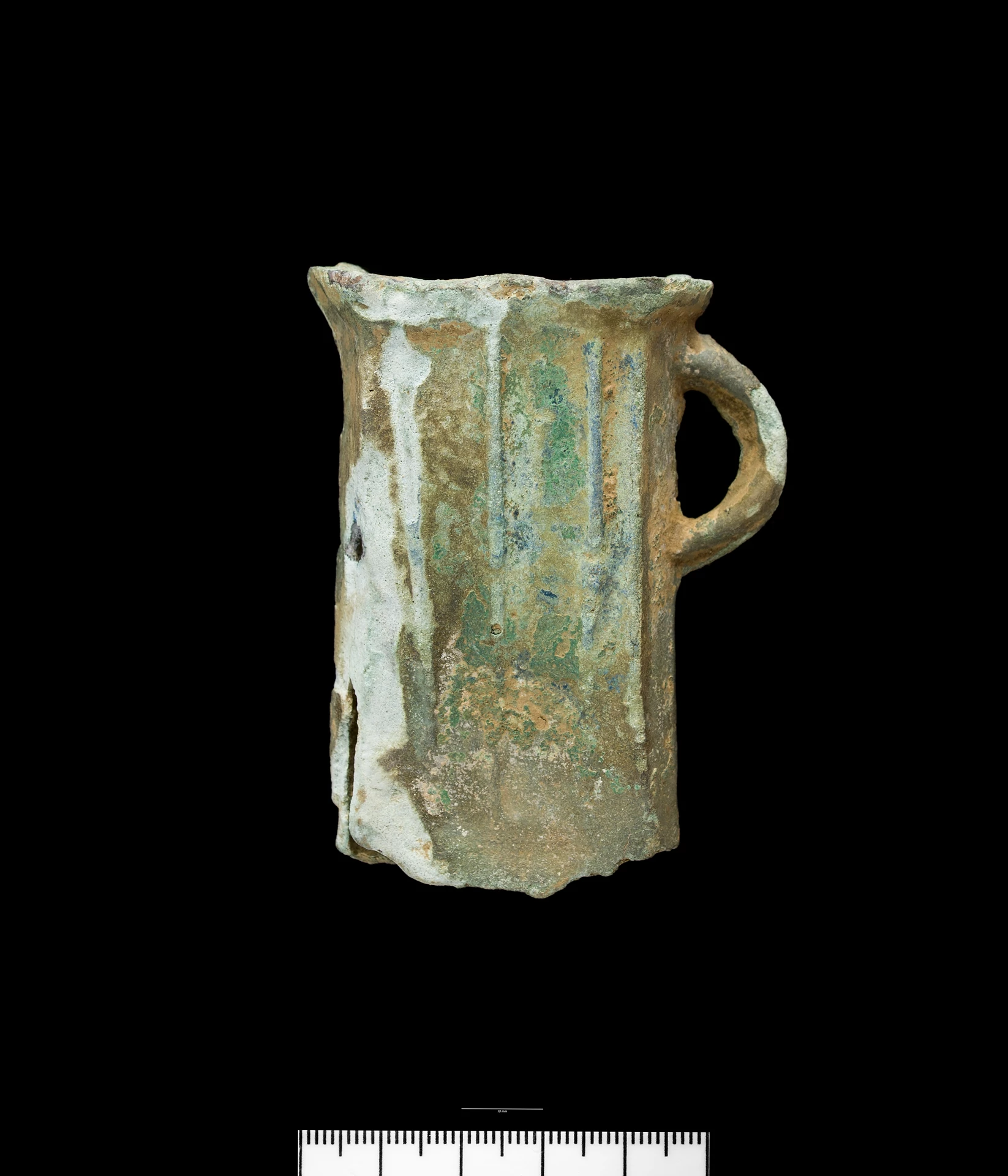
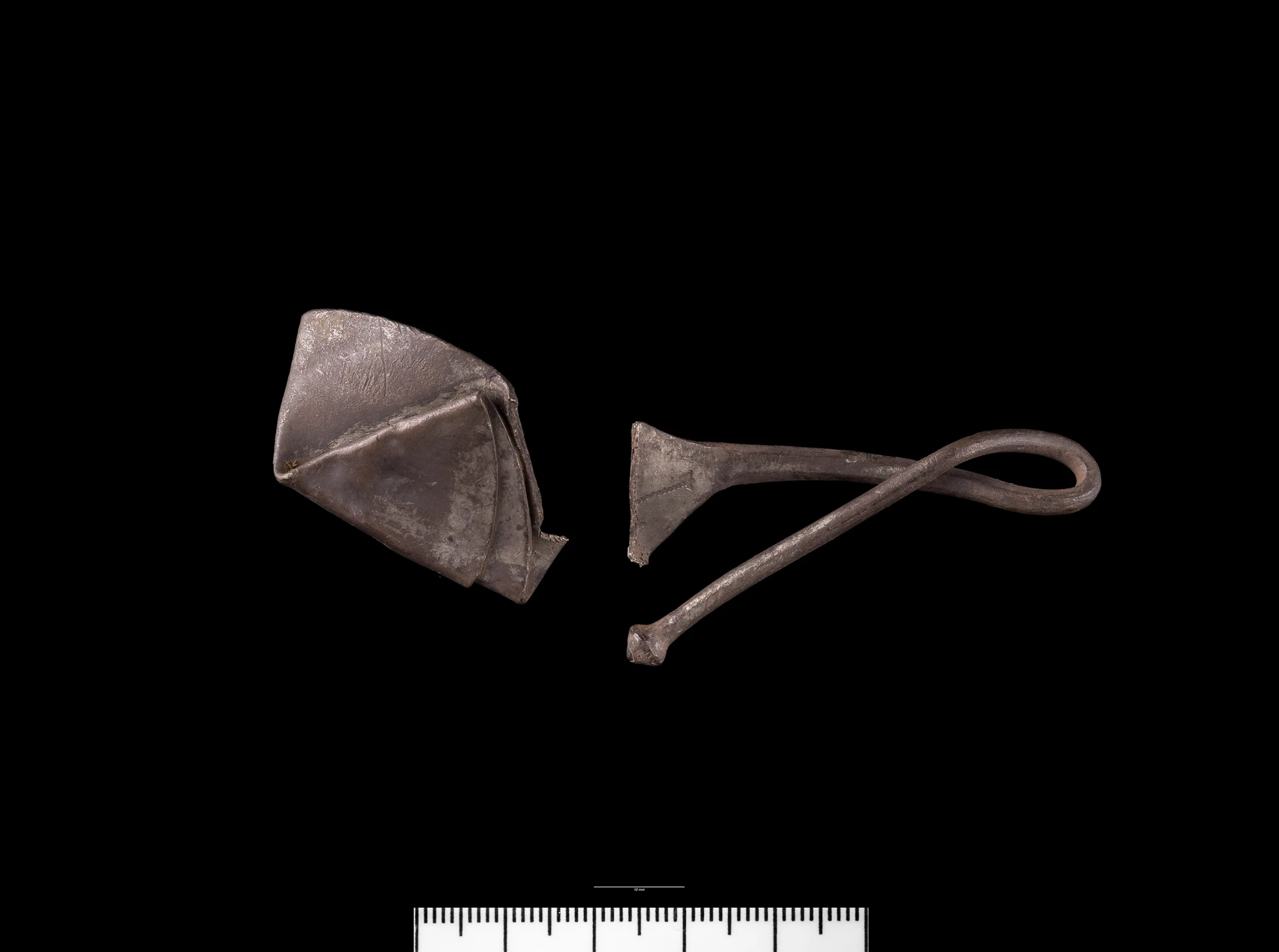
In 2015, a Medieval silver spoon was brought into National Museum Wales; it was found while metal-detecting around Pembroke and can be dated to about the 15th century. The spoon has a rough engraved cross on the underside of the bowl and is in two pieces.

The handle, or stem, has been bent and twisted round, while the bowl has been folded in half and then in half again.

The question bugging us is: why?

Why deform this spoon so greatly?

The deliberate destruction and deformation of objects is not unknown in the Medieval period, though presently we can’t find any parallels for this object.

Many silver coins were, however, damaged for various reasons.

Folding a coin in half, for instance, had a ritualistic function; it was often performed as part of a vow to a saint to cure an affliction or ailment. The coin would then be taken and placed at a shrine. However, Portable Antiquities Scheme data shows that many appear to have been lost or buried in seemingly random locations.

So, we wondered, could the spoon have served a similar function?

Medieval silver spoons were often considered intimate possessions that were carried around much of the time. Dr. Mark Redknap at Amgueddfa Cymru has suggested the engraved cross may represent an ecclesiastical ownership mark. The deliberate destruction of a personal item may have held some significance to the owner, much as a prized possession would today.

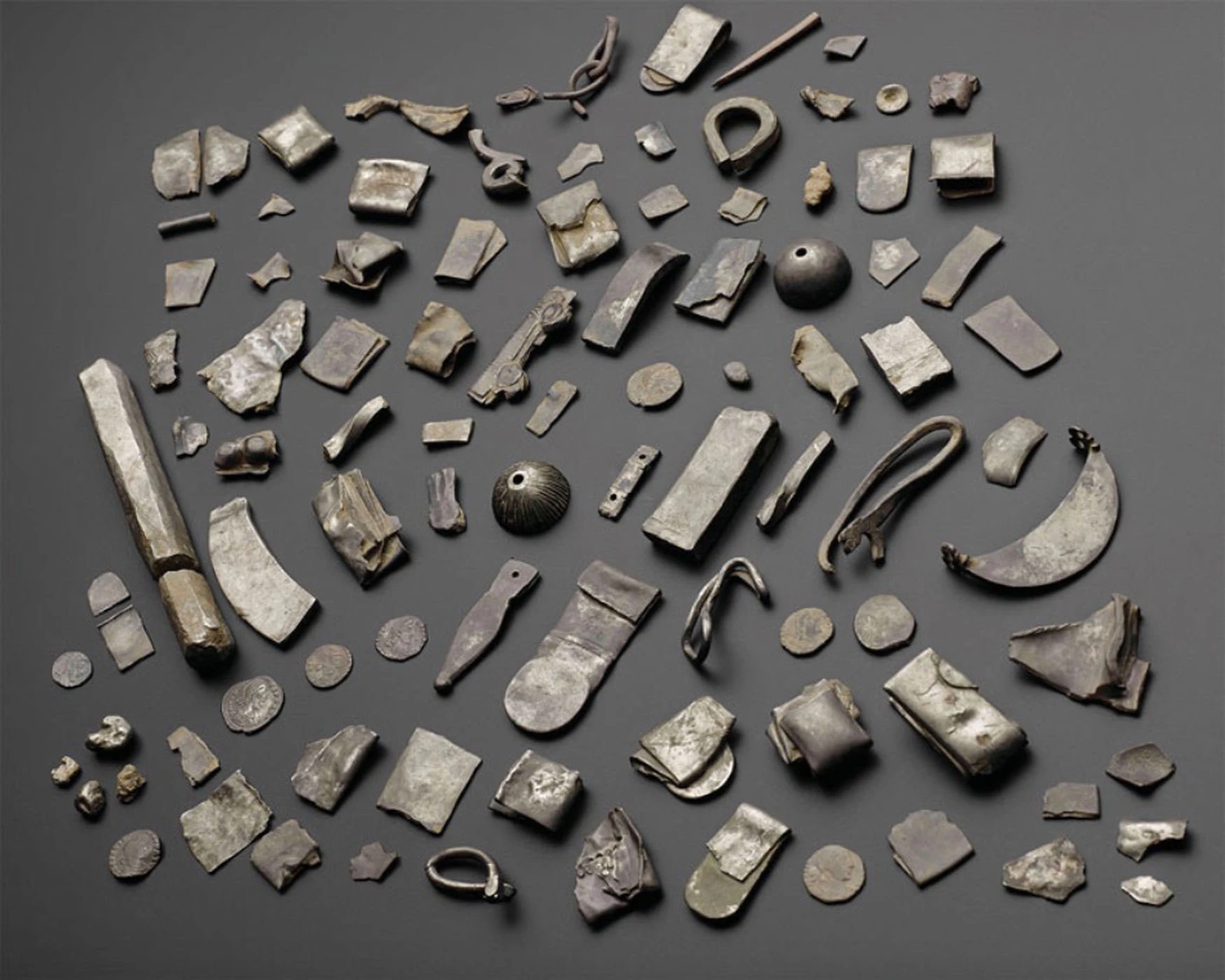
Another explanation is that this represents material intended for the crucible, to be remelted and recast into another object. The breaking and recycling of objects is well-known since the Bronze Age. Viking hacksilver involved silver objects chopped and broken either for recasting purposes or as a form of currency, exchanging fragments based on weight.

Fragments of silver spoons are in fact known from hacksilver hoards from Gaulcross, Scotland, and Coleraine, Northern Ireland.

Of course, the Pembroke spoon was buried nearly a 1000 years later than the hacksilver hoards so it cannot strictly be compared. Nonetheless, it is reasonable to think the spoon was broken, folded and twisted into small, compact pieces that would fit more comfortably within a crucible.

We might not find many broken spoons because they were remelted into other objects. The weight of the spoon would comfortably produce other common Medieval objects, such as finger rings, mounts, and pendants.

We will probably never know the reason behind the destruction of this spoon. But it’s always nice to speculate.


Notes and Acknowledgements

The spoon was recently declared Treasure following the Treasure Act 1996 and will be acquired by Milford Haven Museum through the Saving Treasures: Telling Stories project. The full record for the object can be found here: https://finds.org.uk/database/artefacts/record/id/860650

My sincere thanks must go to everyone who engaged with our call for ideas on what this object represents on Twitter. In particular, I’d like to thank Sue Brunning for directing my attention to the hacksilver hoards mentioned in-text.

The Late Bronze Age hoard from Trevethin: A Tale of Axes and Spears

Matthew Guiseppe Knight, 16 September 2017

The Trevethin Hoard, Torfaen

The Trevethin Hoard, Torfaen

The upper blade of the broken South Wales axe.

The upper blade of the broken South Wales axe.

Imagine the scene. You’re out walking in a field. You have your trusty metal-detector in hand, sweeping backwards and forwards across the ground as you walk. A steady rhythmic beep emits with each step. Suddenly the machine starts beeping more frequently. Something lies beneath the ground. You crouch down to dig, to see what you’ve found. As you dig you start to reveal an ancient axehead…

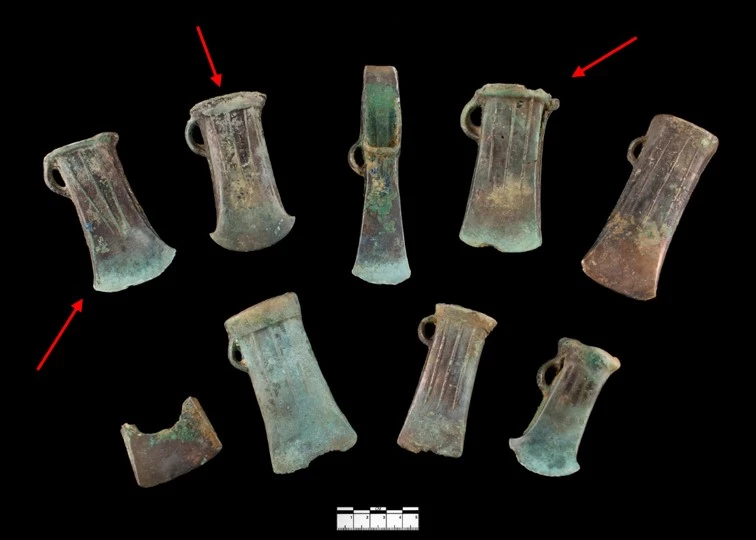
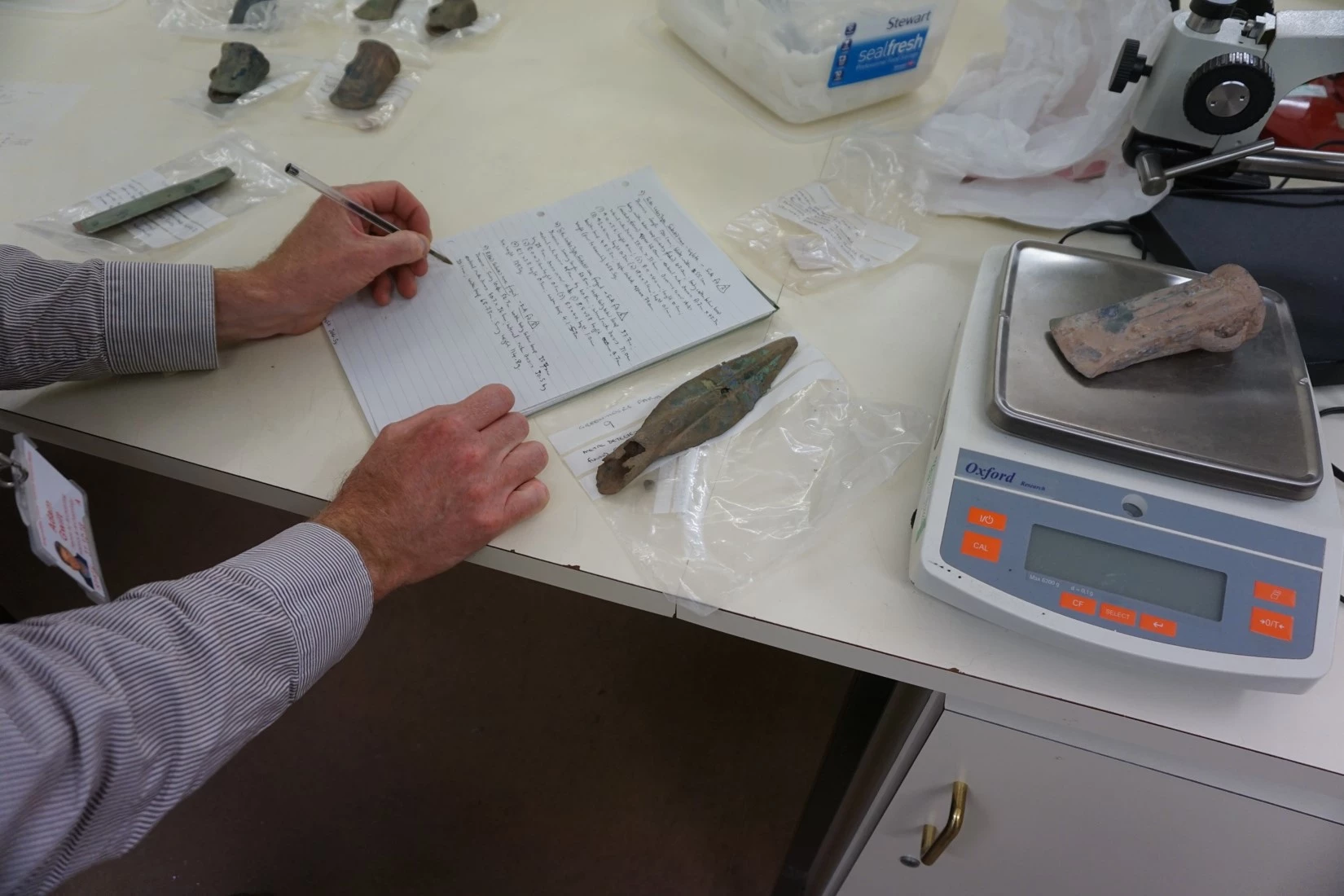
This was the story for metal-detectorist, Gareth Wileman in November 2014. Over a couple of weeks Gareth uncovered a Late Bronze Age hoard comprising three bronze socketed axeheads and two bronze spearheads in close proximity in the Community of Trevethin, Torfaen.

Recognising the significance of the find, Gareth promptly contacted Mark Lodwick, the Finds Co-ordinator for Portable Antiquities Scheme Cymru, who was able to investigate the hoard findspot. The hoard was buried around 3000 years ago (between 950-800 BC) during the Late Bronze Age. This period is a time when large amounts of metalwork, including weapons and tools, were hoarded and buried in various locations in the landscape.

What’s in the hoard?

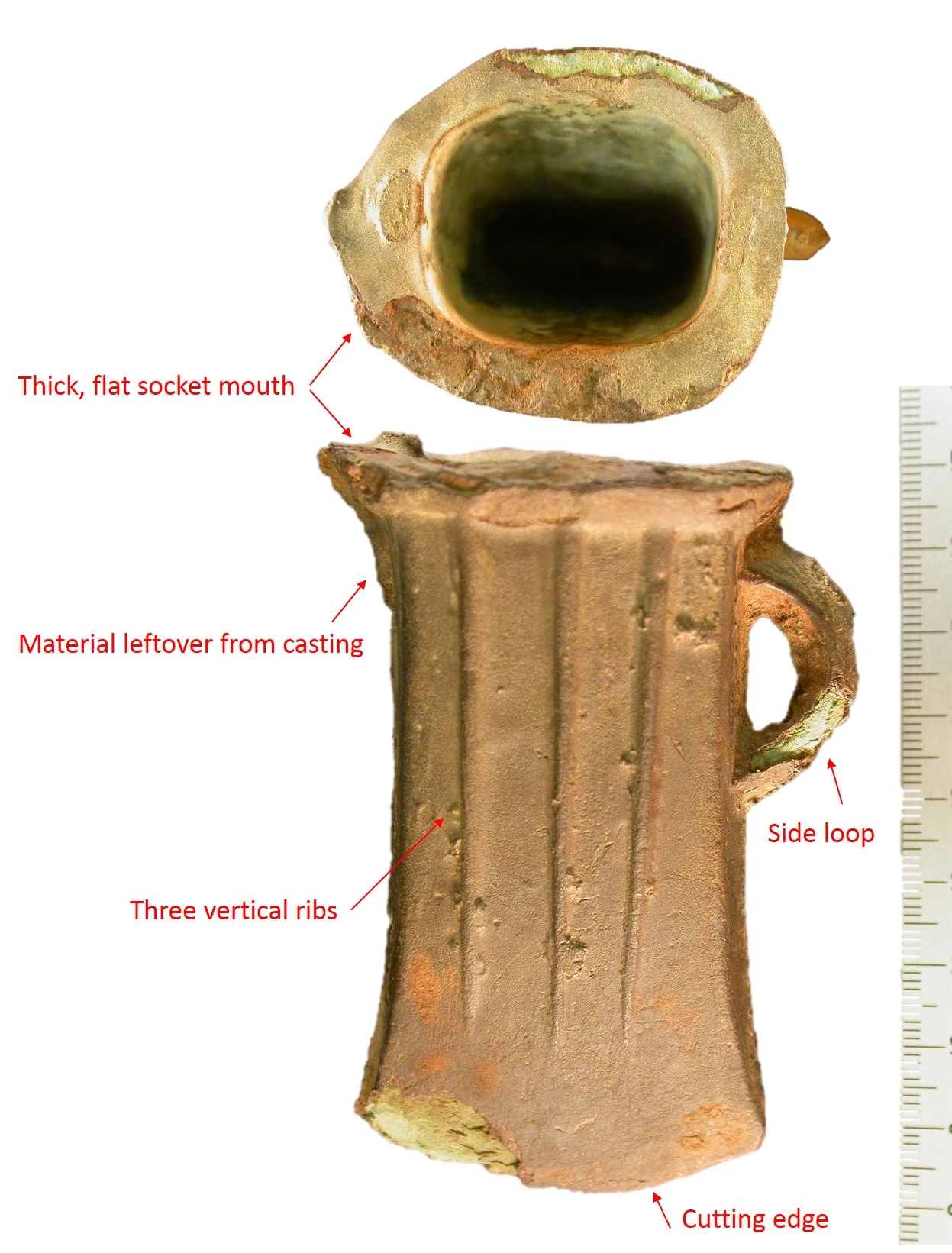
While the objects in the hoard may be broadly classed as ‘axeheads’ and ‘spearheads’, each object represents a distinctive type, that we can use to inform our understanding of how different objects were traded in the Bronze Age. Of particular interest is the socket of a ‘South Wales’ socketed axe that was buried within the hoard. The cutting edge was deliberately removed in the Bronze Age. One of the other axes has also been deliberately damaged. These axes have three vertical ribs on both faces and are particularly common in… you guessed it, South Wales!

Conversely, one of the spearheads is relatively rare. It is referred to as a ‘lunate opening spearhead’ due to two semi-circular holes in the middle of the blade. The tip of this spearhead has broken off and part of the socket has broken off, which may also have been deliberate.

Why does the hoard matter?

The Trevethin hoard was found in an area where Bronze Age activity was previously unknown. It adds to a growing volume of Late Bronze Age material found across Wales. Gathering or hoarding objects and burying them is a widespread tradition in the Late Bronze Age, but reasons behind this are uncertain.

Combinations of weapons, such as spears, and tools, such as axes, are common in Late Bronze Age hoards. These categories should not be taken too seriously though; an axe can be a deadly weapon too, while some spearheads might have been ceremonial items. The combination of different objects may represent a single person’s collection of objects. Alternatively, it may reflect several people coming together to bury objects that were important to the local area. We will probably never know exactly what is represented in the Trevethin hoard.

The rare ‘lunate opening’ spearhead

The rare ‘lunate opening’ spearhead.

The only complete axe in the hoard

The only complete axe in the hoard

One axe was found broken with lots of smaller fragments

One axe was found broken with lots of smaller fragments.

Excavating the hoard was very muddy!

Excavating the hoard was very muddy!

To Break or Not To Break

In the Trevethin hoard, the blades of two of the axes appear to have been deliberately removed. The spearheads display similar intentional damage. However, the third axe was left complete. Why was this? And where are the missing pieces?

It’s possible that the pieces are still out there, waiting to be found. However, deliberately destroying objects in hoards was common. Certain parts of objects were selected for burial – in this case the socket end of the axes – while others were excluded (the cutting edge). In other hoards, we sometimes only find axe blades and no sockets. The part of the object that was included may have been important.

Including complete objects also has significance. At Trevethin, the complete axe was sharpened and probably used before it was buried. It still would have been functional, so why abandon a useful, usable tool? It is possible the axe was used over many years and was significant to its owners, which made it suitable for burial.

It’s important to think of these items as both functional and symbolic objects.

Understanding the Bronze Age

Archaeology is about understanding people in the past. The Trevethin hoard offers a valuable insight into the Bronze Age in this area of Wales, where previously no prehistoric material was known. It shows that Bronze Age communities were present and engaging with their objects in mysterious ways we might only speculate. Every find helps us understand the broader picture, and the Trevethin hoard is an important step towards this.

Notes and Acknowledgements

This hoard was responsibly reported through Portable Antiquities Scheme Cymru and is now proudly on display at Pontypool Museum where it can be enjoyed by all members of the public. It was acquired with funding from the Saving Treasures: Telling Stories Project. More details on how the hoard was investigated, as well as a conversation with the finder, Gareth Wileman, can be found here.

Thanks to Adam Gwilt (Principal Curator: Prehistory at National Museum Wales) and Mark Lodwick (Finds Coordinator: PAS Cymru) for allowing me access to an unpublished report on the hoard.

Bronze Age South Wales Axes

Matthew Guiseppe Knight, 12 September 2017

The Bronze Age is full of different types of objects.

The discovery of metal about 3500 years ago meant new objects could be made or redesigned.

One such object is the axe. For thousands of years people across the world had been making axes out of stone. Bronze Age axeheads were then made out of metal in different shapes and sizes.

By the Late Bronze Age (1100-800 BC), axes were made with sockets, which allowed for the insertion of a wooden haft/handle. Often they had loops to secure the haft with binding, such as leather strips.

In South Wales, a specific form of axe seems to have been very popular and has been named the ‘South Wales axe’.

These axes have thick, flat socket mouths and a loop on one side. They are often heavy and poorly made. There are three raised ‘ribs’ on both faces of the axe. These are sometimes parallel and sometimes converging.

Hundreds of these axes have been found buried in Wales, either on their own or in large hoards of objects. Sometimes they are complete and sometimes they are broken; the reasons for this are uncertain.

An example has recently been found in the Trevithen Hoard, Torfaen, and is currently on display at Pontypool Museum.

South Wales axes have also been found across England, and as far away as northern France.

This implies these products were traded and exchanged over long distances.

The function of these axes is unclear. These axes may have been left in a rough condition because they were used in agricultural activities, such as cutting roots and breaking plough soil.

Whatever the reason they appear to have formed an important part of the Late Bronze Age in South Wales. As more are discovered, archaeologists will continue to gain insights into these objects.


Day of Archaeology at Amgueddfa Cymru National Museum Wales

Sian Iles and Matthew Guiseppe Knight, 28 July 2017

Happy Day of Archaeology everyone!

Today, the 28th July 2017, is the annual online event in which archaeologists from across the country blog about archaeology. The idea is to showcase the diversity of the subject and highlight what individuals are doing on and around this day.

This year we’ve badgered people from across the museum to contribute posts on who they are and how they engage with archaeology through their various research and projects and on a daily basis.

We have been amazed by the positive response, not just from within History and Archaeology but from a whole range of disciplines. The topic of posts thus ranges from prehistoric Cardiff to botany to archaeological curation to snails! It really shows how broad and varied archaeology truly is, beyond the traditional view of woolly jumpers, beards, and whips (though it has been known!)

These posts are all hosted on the external site: www.dayofarchaeology.com and links to blogs from our staff are listed below and will be added to throughout the day.

We hope you enjoy!

Adam GwiltAn Archaeological Curator’s Day / Diwrnod ym mywyd Curadur Archaeolegol

Dr. Rhianydd Biebrach The Saving Treasures: Telling Stories Project

Dr. Ben RowsonSnails at Snail Cave, and elsewhere in Wales

Jonathan Howells - From Housing to History and Archaeology

Kristine Chapman - Rare Books from the National Museum Wales Library

Sarah Parsons - Photographing Archaeology

Dr. Heather PardoeHarold Augustus Hyde’s Contribution to Welsh Archaeology

Dr. Elizabeth WalkerContemplating and communicating the Palaeolithic landscapes of Wales

Sian IlesMarvellous medieval tiles-public engagement at Amgueddfa Cymru-National Museum Wales

Matt KnightA Day in the Life of an Archaeology Intern / Diwrnod ym mywyd Archaeolegydd preswyl


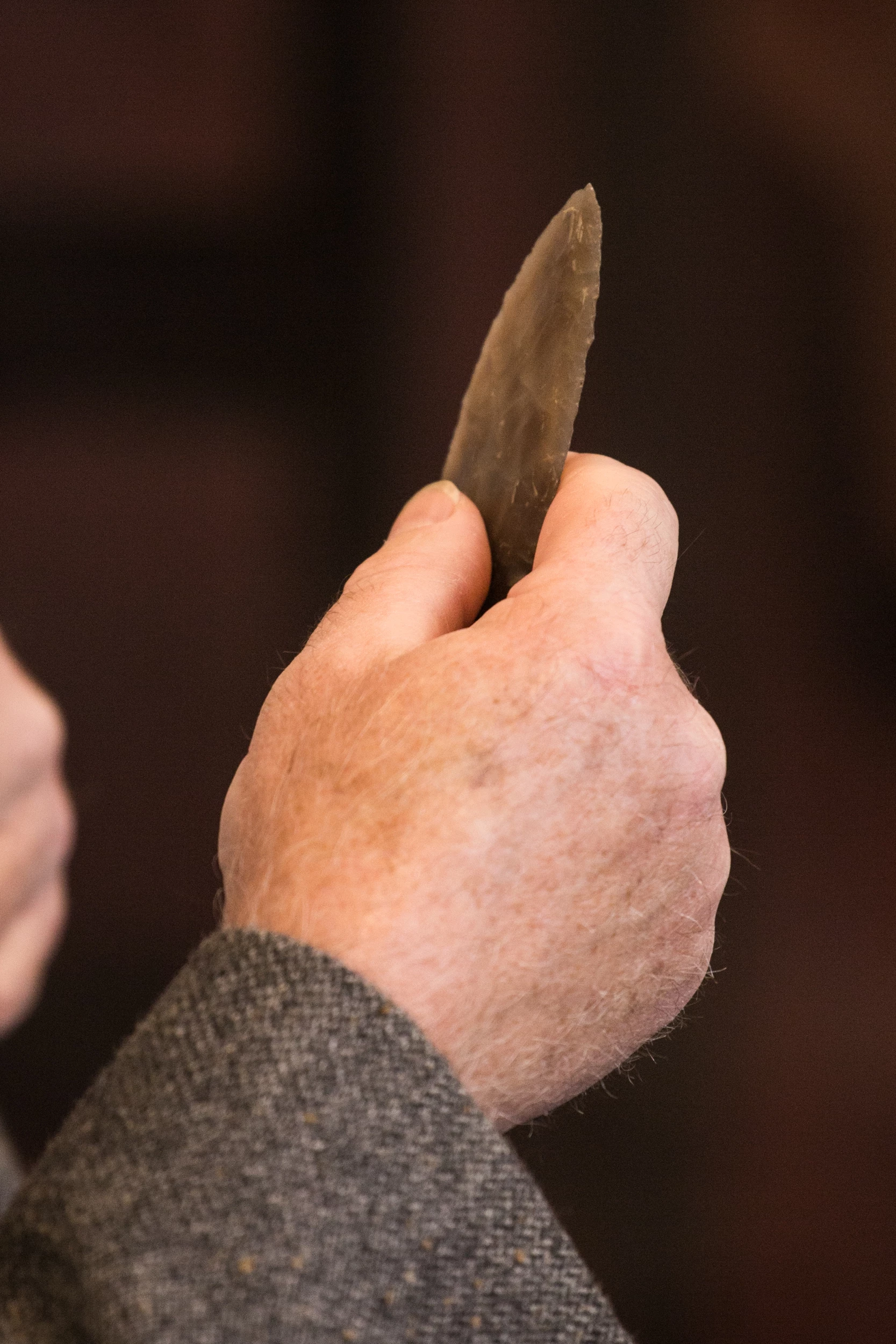
The Swansea Bay Dagger

Abigail Dickinson and Roqib Monsur, 21 June 2017

The Swansea Bay Dagger

In 1971, Architecture student Paul Tambling was blissfully unaware of perhaps the biggest archaeological discovery that he would ever make in his lifetime and how finding the Swansea Bay dagger (as it is now known) would have an impact on his life.

While walking along Swansea beach Paul and his partner Angela noticed what appeared to be a piece of flint poking out of the sand. What they had discovered purely by chance, was in fact, a ‘4200 year old flint dagger’.

Paul told us: “When I picked up the dagger I was mystified as to how the dagger would have got there in the first place especially as flint does not naturally outcrop anywhere in Wales. Also, the flint was in an immaculate condition and did not appear to have been adversely affected by the action of the sea. I regard it as not only a great work of art but also a very skilled piece of workmanship and I find that it gives me great inspiration when I am designing buildings, where I am also constantly aiming to achieve such a level of craftsmanship”.

Almost 46 years later, and still in possession of the dagger the couple keep the item close to their hearts and believe it to be a unique symbol of their lasting relationship.

Paul said: “During and since my student days the flint has moved with me in an old envelope over six times and there were periods of my life when I actually thought that I had lost it. Nevertheless, since I recently discovered its huge historic importance, the flint in rarely out of my sight”

The flint has now been identified as a ‘Beaker Folk Dagger’ dating from the early Bronze Age, around 2250 to 2000 years BC which makes it around 4200 years old. In its day it carried great symbolic relevance as it would have accompanied high status burials to be with the deceased in the afterlife. There are a small number of other daggers that have been found in Wales but none are of the quality of the Swansea Bay dagger. The greatest number of daggers of this period have been found in South East England.

The Beaker Dagger has its huge archaeological and symbolic value, but what does it mean to Paul and Angela as a family?

“This dagger represents the span of our married life. I found it 3 years before we got married and it’s an object that provides us with a special and lasting reminder of those wonderful weekends spent in Swansea all those years ago and binds us together. It was a magical time which just can’t be repeated.”

Paul and Angela Tambling, who run an architectural consultancy practice based in Brecon, had been unaware of the importance of the dagger but since its archaeological relevance has come to light they are constantly told by experts how lucky they were to find such an important object and in such an un-expected location. “I suppose luck is on my side” said Paul “I was lucky to marry Angela and lucky to find the dagger while with Angela.”

Paul told us that he instinctively knew that it was a marvellous object as soon as he picked it up but couldn’t work out whether it was a dagger or a spear head. Through the years Angela has been continually saying to him. “Why don’t you go and find out?” After much badgering Paul finally decided to visit Brecknock Museum only to find, when he got there, that it was closed for extensive restoration work.

The Swansea Bay Dagger

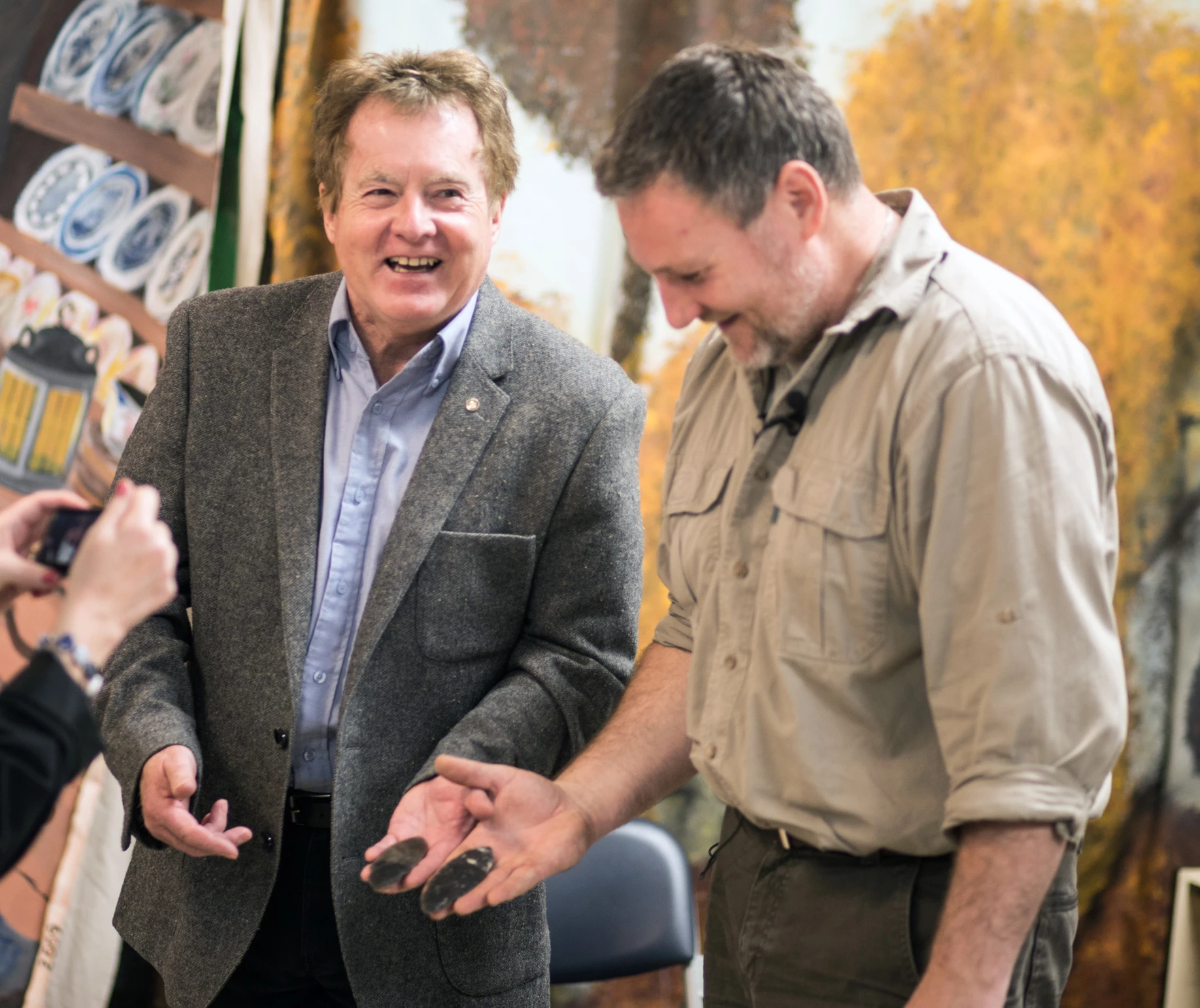
In early 2016 the couple attended a demonstration of flint knapping in Cyfarthfa Museum, Merthyr Tydfil, given by Phil Harding of Time Team. It was here, after speaking with Phil that the true importance of the dagger become apparent and Phil advised that this object of archaeological importance should be recorded and the find reported to Amgueddfa Cymru – National Museum Wales. Soon after, the couple were contacted by, and subsequently met with, Mark Lodwick the Portable Antiquities Scheme Finds Co-ordinator for Wales at Amgueddfa Cymru.

When Mark explained the significance of the dagger Paul said: “The hairs on the back of my neck were standing up when I was told about the layers of significance of the dagger and the fact that I was in the possession of something that somebody has made 4200 years ago”.

Paul continued “I held this object in my hand reflecting on the fact that I had previously treated it with a kind of disrespect since 1971, storing it in an old envelope in the back of a drawer somewhere.”

Since meeting with Phil Harding and Mark Lodwick attention in the dagger has increased dramatically and this has prompted both Paul and Angela to take a greater interest in both archaeology and the Beaker Folk.

Currently there are no plans for a museum to acquire the Swansea Bay dagger as the item belongs to Paul and Angela but they have made every effort, with the help of Mark Lodwick, to make the importance of the dagger known to the public.