: Ceramics, Sculpture & Craft

Chinese Jades at Amgueddfa Cymru

Penelope Hines (Temporary Curator of Applied Art), 14 September 2015

Jade is a tough translucent material that can be made into ornaments, ceremonial weapons and ritual objects. For more than 7 millennia Jade has had a high cultural significance in China and throughout history craftsman used innovative design, technical skills to produce a great variety of objects from diverse categories in jade.

The Material

The Chinese term for jade "Yu" can be used to reference to any stone of beauty or value; such as agate or turquoise, which possess the five following values:

  1. Smooth texture
  2. Hardness
  3. Dense structure
  4. Translucency
  5. Variant hues

However when we discuss the term "Jade" (particularly in a western museum) we are specifically discussing either of two different minerals; nephrite and jadeite. The mineral jadeite arrived relatively late to china (around the end of the 18th century) therefore the majority of what is considered to be a Chinese jade is nephrite.

Jades of Amgueddfa Cymru

All animals carved during the Ming and Qing dynasty came with auspicious meanings and good wishes directed to the viewer. The majority of the collection at National Museum Cardiff are such objects.

Duck (NMW A 50761)

Duck (NMW A 50761)

This duck looks as if it is swimming. The lotus on its back and in its back are to bring the owner good fortune. Combination of the simple forms and fine details makes it typical of the late Ming period.

Buffalo (NMW A 50764)

Buffalo (NMW A 50764)

Buffalo were used in houses to repress evil spirits. However due to it role pulling a plough it has also become a symbol of spring and agriculture. Those lying with their head tuned could indicate the world being at peace.

Swan / Goose (NMW A 50767)

Swan / Goose (NMW A 50767)

We are unsure whether this is a swan or a goose, in ancient Chinese culture the swan was the heavenly version of a goose, though both are sacred animals.

Lion (NMW A 50787)

Lion (NMW A 50787)

Lions aren’t native to china but became known through the spread of Buddhism. Usually in jade they are represented in the manner of a dog. Though more commonly they are seen in porcelain and at rest. This is a good example of jade as a material being used as a display of wealth.

Water Dropper (NMW A 50777)

Water Dropper (NMW A 50777)

The water dropper was used to support the treasures of the studio such as the brush, ink, paper and ink stone. These pieces were used as early as the 13th century however were for more widely known during the Ming and Qing period.

The collection of Chinese jade in Europe was scarce before the 19th century. Really it seems to have started after the exhibition of jades at the crystal palaces great exhibition.

The first pieces to enter the collection were for the turner house collection presumably acquired by the galleries 1st patron John Pike Thomas in the 1800’s. Primarily though, they come from the David Bertram Levinson bequest in 1967. Little is known about the provenance of the jade but it’s likely they are all from the 1800s and 1900's.

Article written up from talk given on Chinese Jades, 15th May 2015.

Bibliography

Books

Lin, J C S. The Immortal Stone: Chinese Jades from the Neolithic Period to the Twentieth Century. The Fitzwilliam Museum, (Scala Publishers, 2009).

Wilson, M. Chinese Jades, (V&A Publications, 2004).

Articles/ Chapters

Nichol, D. 2010. Chinese Jade from the National Museum of Wales Collection. National Museum of Wales Geological Series No 2x, 000pp.

Websites

Amgueddfa Cymru Art Collection Online

Shirley Jones and the Red Hen Press

John R. Kenyon, 18 April 2013

Shirley Jones, <em>Nocturne for Wales</em> (1987). Cwmparc Colliery, Rhondda Valley. (c). Shirley Jones

Shirley Jones, Nocturne for Wales (1987). Cwmparc Colliery, Rhondda Valley. (c). Shirley Jones

Shirley Jones, <em>Llym Awel</em> (1993). A raven picking at the dead after a battle. (c) Shirley Jones

Shirley Jones, Llym Awel (1993). A raven picking at the dead after a battle. (c) Shirley Jones

Shirley Jones, <em>A Thonnau Gwyllt y Môr / And the Wild Waves of the Sea</em> (2011). Worm's Head, Gower. (c) Shirley Jones

Shirley Jones, A Thonnau Gwyllt y Môr / And the Wild Waves of the Sea (2011). Worm's Head, Gower. (c) Shirley Jones

An 'artist's book' is defined as one created or conceived by an individual artist. Some of the best contemporary examples from Wales are the works of Shirley Jones.

Born in the Rhondda Valley, and after studying English literature at the university in Cardiff, Shirley Jones undertook courses in printmaking in the early 1970s, with advanced study in printmaking at Croydon Art College in Surrey in 1975-6. She set up her own studio and began to produce her own books in 1977, and from 1983 she took the name Red Hen Press. In 1994 she moved back to Wales and established her studio in Llanhamlach, near Brecon.

Shirley Jones's books are virtually all her own work, the text often her own poems and recollections, or translations from the Welsh and even Old English, all printed on hand- or mould- made paper. The books may be bound and also housed in tailor-made boxes, all created by well-known binders. Her first productions appeared in very small numbers. For example, her first work, as a student, was Words and Prints, which appeared in 1975 and ran to just six copies. Twelve copies of the second book, Windows (1977), were produced and the third, The Same Sun, (1978), ran to twenty-five copies. Greek Dance (1980) appeared in an edition of forty, and most of Shirley Jones's later works appeared in editions of twenty-five to anything up to fifty copies. The particular attraction of her books is the illustrations, whether aquatints, etchings or mezzotints.

There has always been a great demand for Red Hen Press books in the United States of America, where over sixty institutions hold copies of Shirley Jones's books, with thirteen holding ten or more titles. In the United Kingdom, eleven institutions collect her work, including Brecknock Museum & Art Gallery, with ten or more titles held by the British Library, the National Library of Wales and Amgueddfa Cymru. Copies are also to be found in libraries and universities in Australia, Canada, Germany, Ireland, the Netherlands and South Africa.

Amgueddfa Cymru's Library began to take note of the Red Hen Press in 1999, when it acquired Nocturne for Wales (1987), Llym Awel (1993), Falls the Shadow (1995) and Etched in Autumn (1997). The Library has acquired all her work since that date, and later purchased two of Shirley Jones's earlier books: Five Flowers for my Father (1990) and Two Moons (1991).

Thirty copies were produced of A Thonnau Gwyllt y Môr / And the Wild Waves of the Sea (2011). The book has an introductory essay and includes three aquatints and two mezzotints of the coasts and islands of Wales that accompany the poems. Of the other titles, Etched Out (2003) is the story of the people of the Epynt area of Breconshire who were moved from their homes during the Second World War, as the land was required for the military. The names of fifty farms are recorded on a pull-out mezzotint, with some of the figures depicted being based on images in St Fagans National History Museum. Some of the paper used was custom-made, making use of the red soil of the Epynt.

One of Shirley Jones's most dramatic images is to be found in Two Moons, and this mezzotint, one of nine, is to be seen on the cover of the book published to mark thirty years of the Red Hen Press: Shirley Jones and the Red Hen Press: a Bibliography, compiled by Ronald D. Patkus, Vassar College, University of Vermont (2013).

William Goscombe John (1860-1952)

Oliver Fairclough, 10 December 2011

Morpheus
Morpheus

Sir William Goscombe John (1860 - 1952)

Icarus
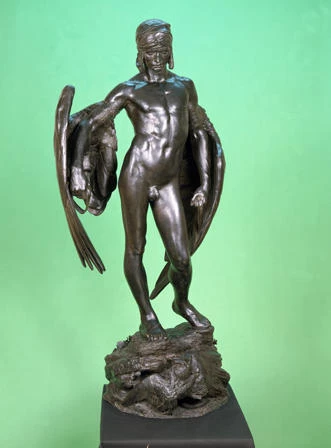
Icarus

Sir Alfred Gilbert (1854 - 1934)

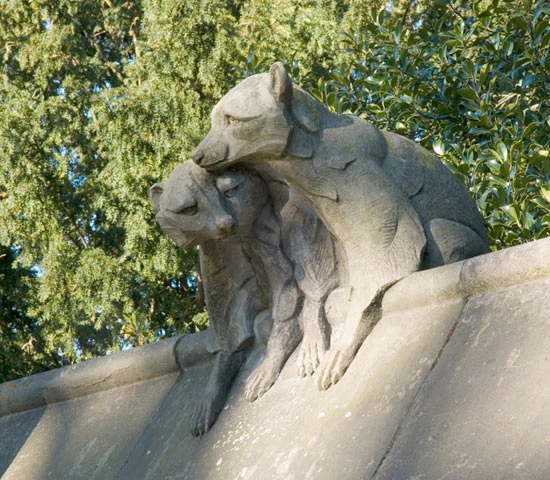
Cardiff Castle's Animal Wall

In 1881, William Goscombe John assisted in creating the sculptures for Cardiff Castle's Animal Wall

Edwardian Wales, newly wealthy from coal, iron and steel, provided rich opportunities for a sculptor. William Goscombe John's public monuments can be found all over Wales, but nowhere more than in his native Cardiff. He also modelled the prize medals still awarded by the National Eisteddfod today.

Making his way

He was born William John in Cardiff in March 1860. He assumed the name Goscombe from a Gloucestershire village near his mother's old home. His father Thomas John was a woodcarver in the workshops set up by Lord Bute for the restoration of Cardiff Castle. William joined his father at the age of 14, while also studying drawing at Cardiff School of Art.

In 1881 he went to London as a pupil assistant to Thomas Nicholls, the sculptor responsible for the Castle's Animal Wall. He continued his studies at the Kennington School of Art and, from 1884, at the Royal Academy Schools, where he was taught naturalistic modelling in clay in the French manner introduced in London in the 1870s by Jules Dalou.

He was an outstanding student, and travelled widely. He spent a year in Paris, including a period in Rodin's studio. In 1890 he returned to London and settled in St John's Wood.

His sculpture Morpheus, shown in the Paris Salon of 1892, clearly shows Rodin's influence.

The 'New Sculpture'

British sculptors of John's generation were trying to make sculpture more dynamic through the vigorously naturalistic representation of the human body. They represent the final flowering of a sculptural tradition that had its roots in the Renaissance, and was revitalised by Rodin and his contemporaries in mid nineteenth-century France. John followed the success of Morpheus with a statue of John the Baptist for Lord Bute, and by a group of life-size nudes including Boy at Play and The Elf. These show complete mastery of anatomical form.

By the end of the 1890s Goscombe John had firmly established himself, exhibiting his work both nationally and internationally. He was beginning to win big public commissions and in the years leading up to the First World War he was extremely busy.

Wales and the Empire

Although based in London, John was careful to position himself as Wales's national sculptor. In 1916 he contributed the central marble figure St David Blessing the People to a group of ten figures made for Cardiff City Hall. He also received commissions for portraits from the leading Welshmen of the day. John may have built his career on local patronage, but he attracted work from across the Empire, such as his tomb in Westminster Abbey to Conservative Prime Minister Lord Salisbury, and his equestrian statue of King Edward VII in Capetown.

His first major public sculpture was the King's Regiment memorial (1905) in the centre of Liverpool, incorporating soldiers from the regiment's history, including the vast Drummer Boy, which is his best-known work.

The Welsh and the Imperial came together in the commission for the regalia for the investiture of the future Edward VIII as Prince of Wales at Caernarfon Castle in 1911. John designed a crown, a ring, a sceptre and a sword that contained a 'Welsh' iconography of dragons, daffodils and Celtic interlace.

John had little sympathy with what he termed the 'Easter Island' style of modern sculpture, with its emphasis on direct carving in stone. Critical opinion was already beginning to leave him behind by 1914, but the First World War tragically brought new commissions for memorials, including many in Wales.

Goscombe John and the National Museum

Goscombe John was one of the founding fathers of Amgueddfa Cymru. He served on the governing Council for over forty years, and played a major role in establishing the future direction of the art collection. As well as a complete representation of his own work, his gifts to the Museum included work by many of his fellows in the New Sculpture movement, among them the primary cast of Alfred Gilbert's Icarus, and by many other artists he admired.

Drinking punch in the eighteenth century

Rachel Conroy, 28 January 2011

Silver punch ladle with mahogany handle

Figure 1: Silver punch ladle with mahogany handle, by Dorothy Mills and Thomas Sarbitt, London, 1752-3.

Silver gilt punch bowl 1771-2

Figure 2: Silver gilt punch bowl designed by Robert Adam and made by Thomas Heming, London, 1771-2.

Punch was first drunk in Britain in the 1650s. This was around the same time that tea, coffee and hot chocolate became available. By the turn of the eighteenth century, it was an incredibly popular drink.

Making punch

Punch was made using a mixture of expensive imported ingredients. The alcohol content was provided by rum or brandy, to which sugar, citrus fruit, spices – usually grated nutmeg – and water were added.

The Punch Bowl

Using an elegant ladle, punch was served from large communal bowls into individual glasses (Figure 1). One of the most important punch bowls in Amgueddfa Cymru’s collection is that designed by Robert Adam for Sir Watkin Williams-Wynn (Figure 2). It was commissioned to celebrate the success of Sir Watkin's horse, Fop, at the Chester Races and would have been displayed prominently on the sideboard at his fashionable London home.

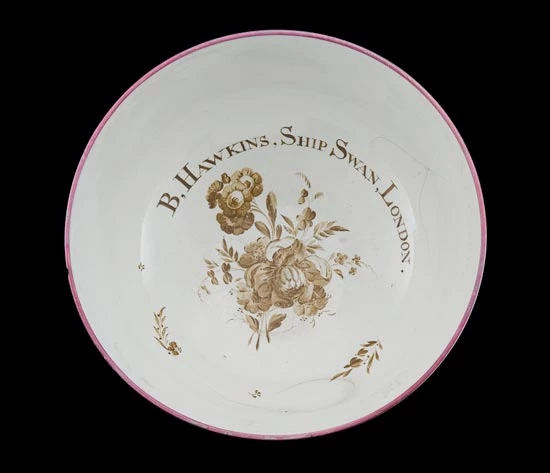
Punch was often drunk at gatherings of clubs and societies, usually held in taverns, coffee houses, or special punch-houses (Figure 3). These were almost exclusively attended by men. Drinking punch seems to have been a highly sociable act that strengthened social ties. A letter published in 1736 describes this eloquently:

"…we hope nothing will ever hinder a Man drinking a Bowl of Punch with his Friend, that’s one of the greatest pleasures we enjoy in the Country, after our labour.

Earthenware punch bowl by the Cambrian Pottery, Swansea, about 1800-1810

Figure 3: Earthenware punch bowl by the Cambrian Pottery, Swansea, about 1800-1810. It is inscribed 'B, HAWKINS, SHIP SWAN, LONDON', suggesting it was used at a tavern or punch-house.

Delftware punch bowl inscribed 'Edward Jones Scoole Master 1751'

Figure 4: Delftware punch bowl inscribed 'Edward Jones Scoole Master 1751', probably Liverpool, 1751.

Large salt-glazed stoneware goblet

Figure 5: Large salt-glazed stoneware goblet, possibly by Mortlake, c. 1794-5.

Punch bowls were made to commemorate special events; they were decorated with the names of guilds or societies, or masculine symbols such as ships. An interesting example in Amgueddfa Cymru’s collection is inscribed ‘Edward Jones Scoole Master 1751’ (Figure 4). It has a painting of a school teacher and his pupils reading together. It is easy to imagine such a personal object being commissioned by Edward Jones, or perhaps given to him as a gift.

Raucous and uncivilised parties:

During the first half of the eighteenth century, there was widespread alarm about the dangers of alcoholism, particularly resulting from the widespread availability of cheap, home-distilled gin. Excessive punch drinking was often associated with bad behaviour.

Excessive drinking in general was often linked with moral decline, and punch parties were usually satirised by contemporary artists as raucous and uncivilised. William Hogarth’s A Midnight Modern Conversation, published in 1732/33, is perhaps the best known illustration of a punch party. It was immensely popular and was soon reproduced on punch bowls and other vessels for consuming and serving alcohol (Figure 5).

Eighteenth century binge drinking

Old Bailey records often support the linking of excessive punch drinking with unsociable, even criminal behaviour. This includes stealing expensive punch bowls from public houses and people’s homes and sharing a bowl of punch with a victim before swindling them.

From around the 1750s, punch also began to be served from porcelain and earthenware punch-pots. These are very similar in form and sometimes in decoration to teapots, but are much larger (Figure 6). Unlike open punch bowls, punch pots enabled the drink to be served in a controlled manner by one person – just like tea. This mediated form of serving might have been considered more civilised and refined than communal punch bowls, where people could help themselves and easily drink to excess.

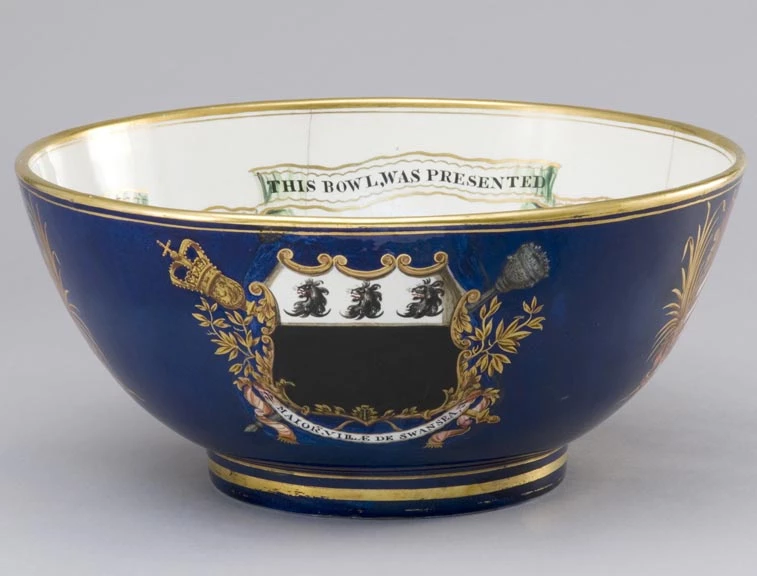
Punch drinking was at its most popular during the mid-eighteenth century, but it continued to be enjoyed into the nineteenth century. A fine earthenware punch bowl was made for John Richardson by the Cambrian Pottery in 1845, the same year that he served as Mayor of Swansea (Figure 7). Interestingly, he commissioned the bowl as a birthday gift for his infant grandson and it is decorated with several Richardson coats of arms. Part of the inscription reads ‘GAILY STILL OUR MOMENTS ROLL, WHILST WE QUAFF THE FLOWING BOWL’.

Soft-paste porcelain punch pot

Figure 6: Soft-paste porcelain punch pot, Derby, 1760-2

Earthenware punch bowl by the Cambrian Pottery

Figure 7: Earthenware punch bowl by the Cambrian Pottery, Swansea, 1845.

References:

Harvey, Karen. 'Barbarity in a tea-cup? Punch, domesticity and gender in the eighteenth century', Journal of Design History, 21 (3) (2008), pp. 205-21.

(unknown) 1736 A collection of all the pamphlets that were written pro and con on the British distillery, whilst the act for laying a duty upon the retailers of spirituous liquors, and for licensing the retailers thereof, was depending in Parliament. London. Eighteenth Century Collections Online. Web. 12 Jan 2010. http://galenet.galegroup.com/servlet/ECCO

http://www.oldbaileyonline.org

When tea-drinking was a fashionable, expensive habit

Rachel Conroy, 25 June 2010

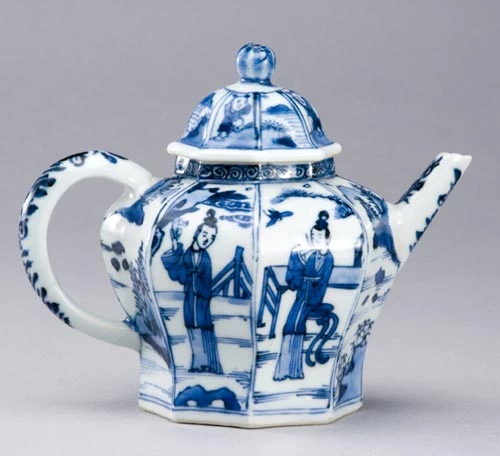
Chinese porcelain teapot, c. 1700-20

Figure 1: Chinese porcelain teapot, c. 1700-20

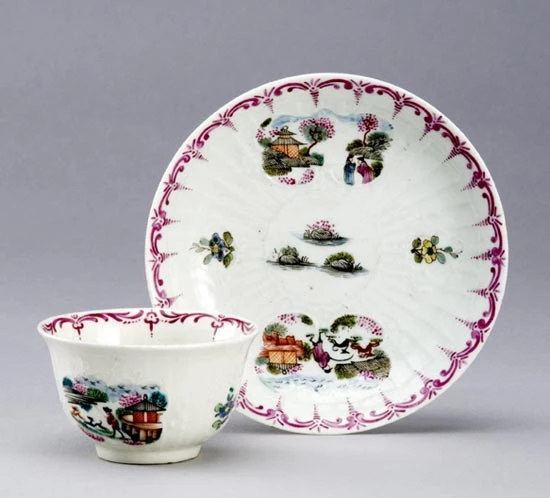
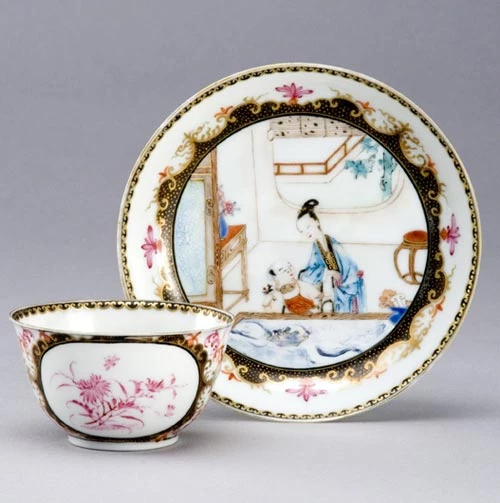
Chinese tea bowl and saucer, c. 1760-70

Figure 2: Chinese tea bowl and saucer, c. 1760-70

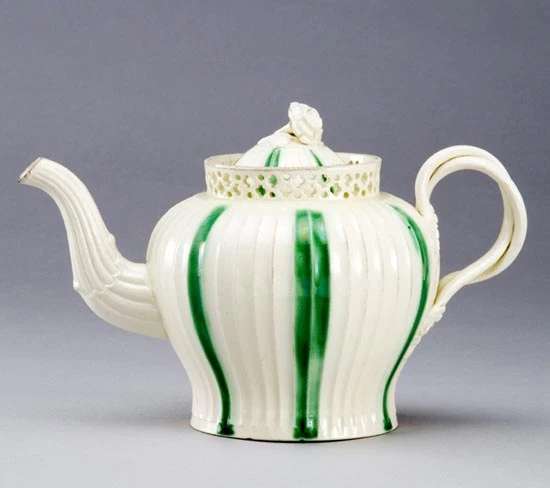
Creamware teapot, Leeds Pottery, c. 1775

Figure 3: Creamware teapot, Leeds Pottery, c. 1775

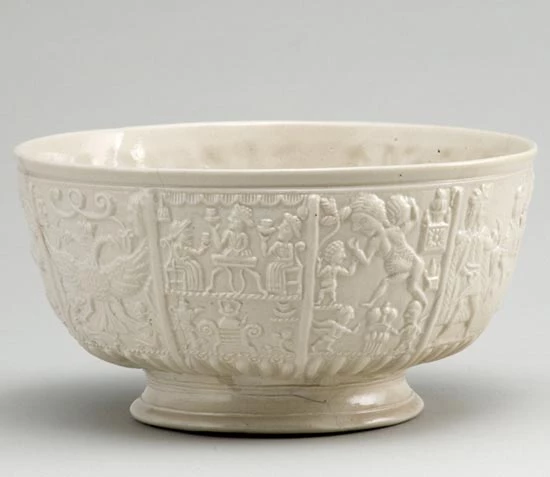
Slop bowl, Staffordshire, 1740s

Figure 4: Slop bowl, Staffordshire, 1740s

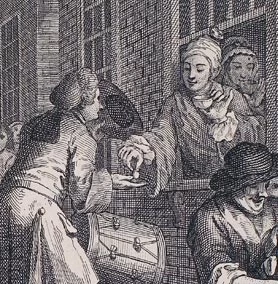
Detail of William Hogarth, 'Industry and Idleness: The Industrious 'Prentice Married', 1747

Figure 5: Detail of William Hogarth, 'Industry and Idleness: The Industrious 'Prentice Married', 1747

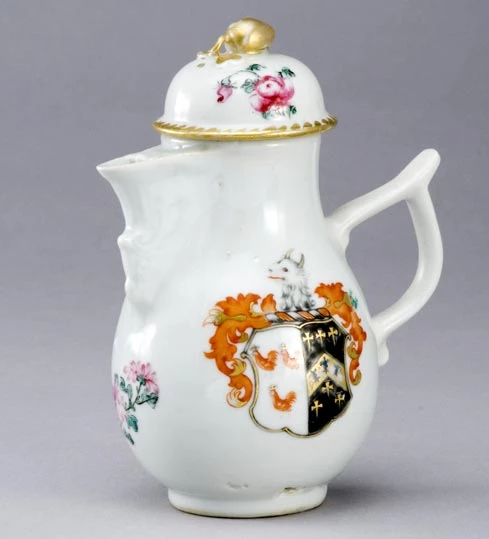
Cream jug, Chinese porcelain, c. 1771.

Figure 6: Cream jug, Chinese porcelain, c. 1771. Part of a tea service made for Penry Williams (1714-1781) of Penpont, Brecon

Porcelain tea bowl and saucer, Worcester, 1755-8

Figure 7: Porcelain tea bowl and saucer, Worcester, 1755-8

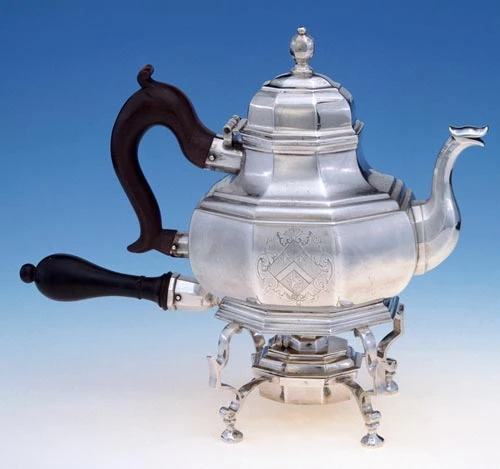
Tea kettle, stand and spirit lamp by Robert Watts, 1711-12.

Figure 8: Tea kettle, stand and spirit lamp by Robert Watts, 1711-12.

In the eighteenth century tea-drinking was a highly fashionable activity for the wealthy upper classes.

Tea was first imported into Britain from China in the mid-seventeenth century by the East India Company. At first it was considered as something of a novelty and was promoted for its health-giving properties.

Green tea

The most common tea was bohea, a type of black tea, but green tea was also popular. At first it was drunk weak and without milk, after the Chinese tradition. Later, milk or cream and sugar were added.

Teapots and (locked) teachests

Only the wealthy could afford tea. It was kept in locked teachests that were controlled by the lady of the house. Domestic servants received a tea allowance as part of their wages.

The eighteenth century saw an explosion in tea-related consumer goods, and there are many fine examples in the applied art collection at Amgueddfa Cymru. At first these were made from very expensive materials, particularly imported Chinese porcelain and silver (figs 1 & 2). Later, the production of cheaper ceramics and silver plate allowed the middle classes to follow the fashions of the very wealthy (fig. 3).

Drinking tea became more commonplace in the late eighteenth century. The abolition of import duties in 1784 meant it became recognized as an important part of the diet for the poor.

Taking afternoon tea

Entertaining friends by hosting afternoon tea was an important part of women's lives. The selection of objects for the tea table was crucial. Visiting England in 1784, the Duc de Rochefoucauld commented that tea drinking provided "the rich with an opportunity to display their magnificence in the matter of tea-pots, cups and so on" (cited in Clifford 1999: 161).

Guests were expected to conform to certain modes of behaviour and good manners, which included sticking to polite topics of conversation such as the arts, theatre and music.

Tea bowls

For most of the eighteenth century tea was drunk in the Chinese style, from a bowl without a handle. These were also known as "tea dishes" or "basons". A wonderful slop bowl, which was used at the table for rinsing dregs from used tea bowls, depicts three women enjoying tea together (fig. 4). The bowls are usually shown being held with the fingers at the rim and thumb under the base (fig. 5).

Chinese exports

Chinese porcelain teapots and bowls were exported along with the tea. They were prized for their translucency and white surface and were collected fanatically.

Chinese porcelain manufacturers began to make tea-related objects purely for the European market, such as teapot stands, milk jugs, sugar basins, spoon trays and slop bowls (figure 6). Once they had uncovered the secrets of producing porcelain, Chinese teawares were widely reproduced by Continental and English factories (fig. 7).

Kettles and urns

Teapots were filled by hot-water kettles on grand stands or smaller table-top versions, with burners to keep the water hot (fig. 8). The kettles were eventually replaced in about the 1760s by tea urns heated by charcoal burners and, from the 1770s, with heated iron bars that slotted into a "sleeve" inside the urn (fig. 9). These "tea kitchens" or "tea fountains" allowed people to help themselves at less formal gatherings such as breakfast. The most elaborate examples also had additional urns for coffee and hot water.

Moral and physical decline

Eighteenth-century attitudes towards tea-drinking were quite mixed and contradictory. The obsessive collection of teawares was criticised by social commentators, with women being the most frequent target. Furthermore, afternoon tea was often claimed to be no more than an opportunity for women to spread malicious gossip or boast about themselves. A satirical poem, The Tea-Table, by 'Moses Oldfashion' was published in Mist's Weekly Journal in 1722:

"...Chief Seat of Slander! Ever there we see
Thick scandal circulate with right Bohea.
There, source of black'ning Falshoods! Mint of Lies!
Each Dame th'Improvements of her Talent tries,
And at each Sip a Lady's Honour dies".

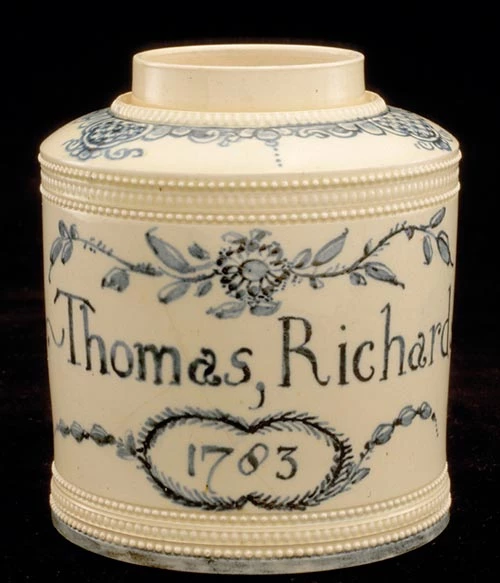
Although at first tea was thought to have many health benefits, some commentators began to fear its popularity could cause physical decline. In 1753 Mr Andree described the dangers of "intemperate", excessive tea drinking, describing it as "pernicious", worsening epilepsy and causing hysteric fits. He also tells of a young girl who had been eating tea for a number of weeks, causing her to suffer facial palsy and convulsions (fig. 10).

Thankfully, these objections did not diminish the British public's desire for tea and it has remained an important part of daily life. Although tea-drinking today is generally a far less formal affair than during the eighteenth century, it continues to be enjoyed and shared by millions of people everyday.

References

Andree, John. Cases of the epilepsy, Hysteric Fits, and St. Vitus's Dance, with the process of cure: interspersed with practical observations. To which are added, cases of the bite of a mad dog, and a method that has been found successful. The second edition, with emendations and additions in the introduction, and some new cases and Inspections of Dead Bodies (1753). London: printed for W. Meadows and J. Clarke, in Cornhill. Eighteenth Century Collections Online. Web. 12 Jan 2010. http://galenet.galegroup.com/servlet/ECCO

Clifford, Helen. 'A commerce with things: the value of precious metalwork in early modern England', in M. Berg and H. Clifford (eds.) (1999) Consumers and Luxury: Consumer Culture in Europe 1650-1850, pp. 147-169. Manchester: Manchester University Press.

Oldfashion, Moses. 'The Tea-Table', in (author unknown) A collection of miscellany letters, selected out of Mist's Weekly Journal (1722): 224-227. London: printed by N. Mist, in Great Carter-Lane. Eighteenth Century Collections Online. Web. 12 Jan 2010. http://galenet.galegroup.com/servlet/ECCO

Article author: Rachel Conroy. Assistant Curator - Applied Art

Tea jar or canister, Swansea, 1783

Figure 10: Tea jar or canister, Swansea, 1783

Tea jar or canister, Swansea, 1783

Figure 10: Tea jar or canister, Swansea, 1783