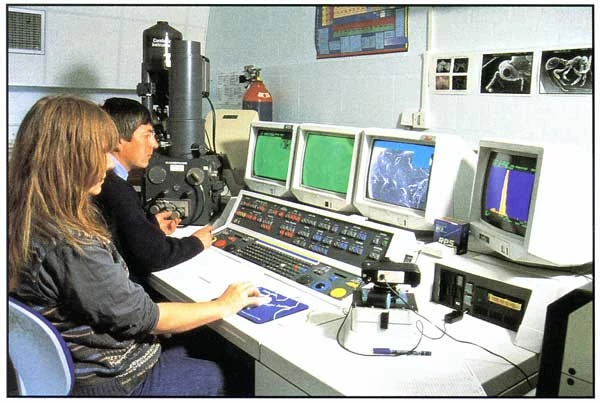
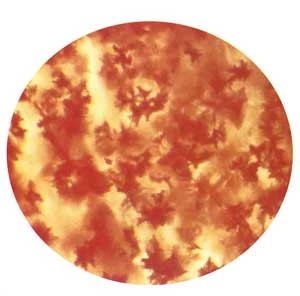
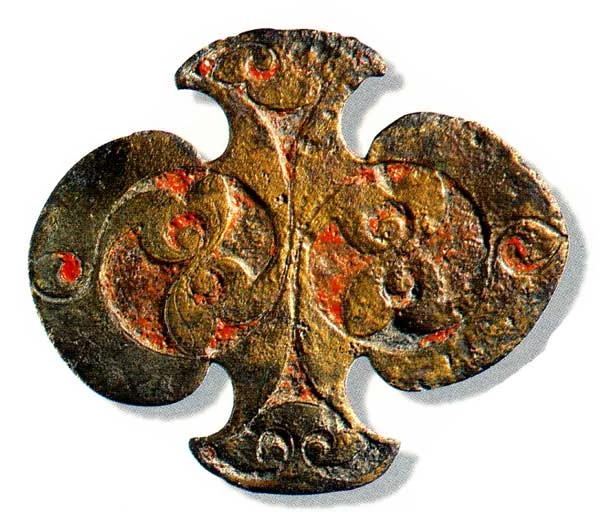
Celtic Art - Origins and Myths 2 April 2007 The Celts The Late Iron Age harness piece from Alltwen Study of 'Celtic' art styles on metalwork helps us to understand the peoples of the Iron Age in Europe. La Tène art, as it is more properly known, was used across Europe, from the late 5th century BC onwards. This was a form of art uniquely different from that of the classical Mediterranean world, employing natural forms in a free-flowing style. Early La Tène styles were thought to have been made by the Celts, a people who shared common languages, societies and similar pagan religious beliefs. Recently, this view has been challenged; experts today believe that similar metalwork styles show that this art form was passed on across cultures and not necessarily retained within one common ethnic identity. Wales has many fine metalwork discoveries decorated in La Tène art styles, examples of which are housed at National Museum Cardiff. Glass enamels Analysing the samples using an Scanning Electron Microscope A technique mastered by British metalworkers from the 3rd century BC onwards was the application of red 'enamel' to decorated metalwork. It is in fact a type of glass applied by cutting pieces to shape; the pieces were then carefully heat softened and finally pressed into the metalwork. A specimen decorated with La Tène art, with red enamelling, has been discovered at Alltwen near Pontardawe (Neath Port Talbot) and purchased for Amgueddfa Cymru. The discovery raises questions about Welsh enamelled and decorated artefacts from the Iron Age. How similar (or different) were the metal and glassworking traditions in north and south Wales? Did the Severn Estuary act as a barrier, or as a cultural focus for metalworkers between south Wales and south-west England during the later Iron Age? How do these 'enamels' (glasses) decay? Removing samples for analysis Crystals of cuprite within the glass matrix The items chosen for the study include a piece of horse-harness from Cardiff, the Snowdon Bowl (Gwynedd) with its cat-like motif, and selected horse equipment from the Seven Sisters Hoard (Neath Port Talbot), in addition to the Alltwen find. Tiny samples of enamel were taken from the artefacts; these were mounted and polished on microscope slides. Analyses of samples were conducted using a Scanning Electron Microscope and X-ray analysis. Additionally, the structure of the enamels was studied, through transmitted and incidental light, using a polarising light microscope. Results from the analysis show 'soda-lime' glass, containing large amounts of lead and copper. These are responsible for the brilliant red colour and the opacity of these glasses. Their manufacture is technically advanced and can only be produced by careful control of both the ingredients of the glass and the furnace conditions. Results show that enamelled artefacts from south Wales match reasonably well with those from south-west England; however the enamel on the Snowdon bowl from north Wales is markedly different from the others. This suggests differences in the manufacture of these glasses across different regions of Wales.
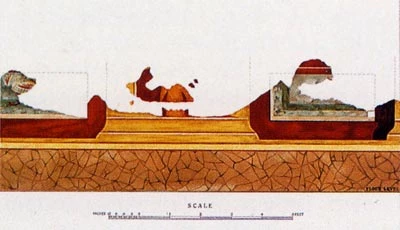
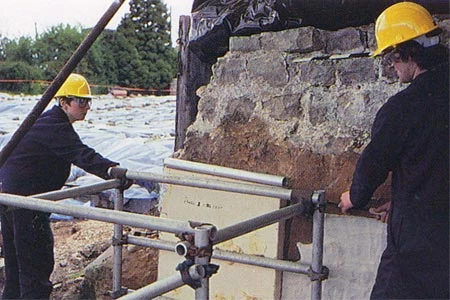
Fine fresco wall painting removed for conservation 30 March 2007 Watercolour by F.G. Newton, 1905 Removing one of the panels In 1988, archaeological excavations of the council chamber in the basilica (assembly hall) of the Roman town at Caerwent revealed a fine wall painting that has since been removed for conservation and display. The painted plaster or fresco, 5m long and 1m high, was still attached to the south wall of the chamber. It had been previously recorded in watercolour by F. G. Newton in 1905, and had been covered over again. The fresco shows an architectural perspective, with yellow pillars above a brown veined pink dado. A dark brown area in the central pillar may be part of a decorated panel, possibly containing the torso of a man. It was decided to remove the fresco to prevent further deterioration as the plaster was extremely fragile. After carefully covering the delicate artwork with muslin and glue, the painting was cut into five panels. Each enclosed in specially-designed boxes. A variety of saws and chisels were used to separate the painted plaster from the wall. Since access to the back of each panel was restricted to its top edge and one side, this process was difficult, needing extreme patience and ingenuity. It took a total of nine days to remove the painting, with the subsequent conservation and rebacking taking several years, the fresco is now conserved and stored at the National Museum, Cardiff. Background Reading: Caerwent Roman Town by R.J. Brewer. Published by Cadw (2006).
A Fistful of Dollars 30 March 2007 Silver 8-reales, or 'Pillar Dollar', Mexico, 1741. While the Museum's numismatic (coin) collections contain mostly coins from Britain, it also includes representative groups of overseas coins, which helps put the evolution of British coinage in its international context. The dollar, today one of the world's dominant currencies, has its origins late in the 15th century. New discoveries of silver and developments in mining technology increased European output of the metal dramatically and central European states started producing large coins in silver which were equal in value to the gold coins of the day. The name 'dollar' derives from the St Joachimsthaler Guldengroschen struck by the counts of Slik in Central Europe around 1520. As 'Thaler' became the generic name for crown-sized silver coins of the German states, the English term 'dollar' had started to appear by the early 17th century. The enormous numbers of Spanish dollars produced in their colonies of Mexico and South America ('pieces of eight') came to be traded all over the world, and they set the standard for the silver currencies of many emerging nations in the 18th and 19th centuries.
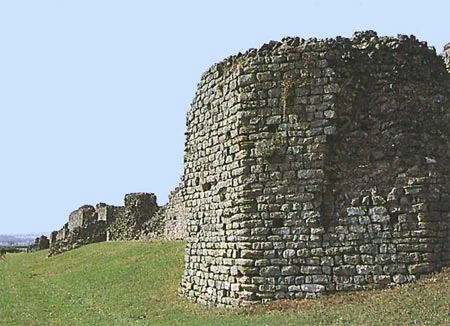
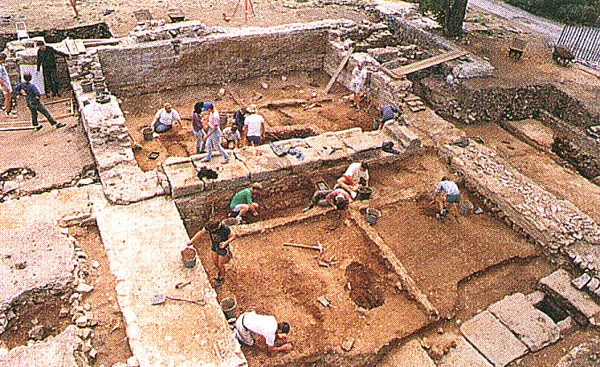
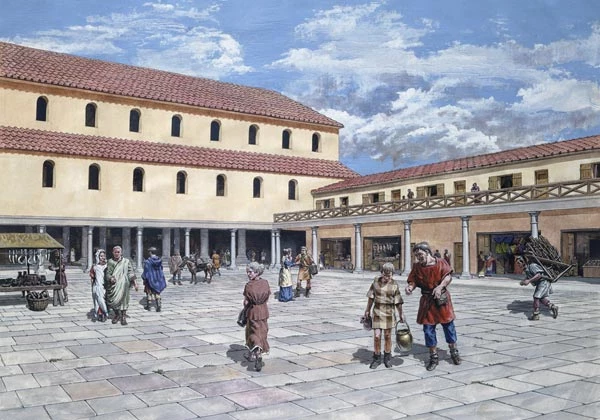
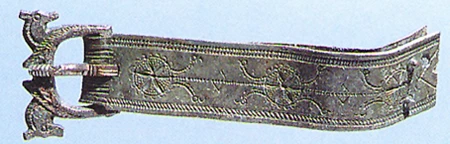
The Grand Forum-basilica at Caerwent 30 March 2007 Caerwent: the south wall and towers The small village of Caerwent, near Chepstow in south Wales, was once the administrative capital of the Silures, the Celtic tribe occupying south-east Wales. Only two Roman towns are known to have existed in Wales: Carmarthen (Maridunum) and Caerwent (Venta Silurum). Between 1984 and 1995 Amgueddfa Cymru - National Museum Wales undertook a programme of research excavations to improve knowledge of the early development of Caerwent. Earlier excavations had only revealed the tops of the buildings, therefore only providing a view of the late Roman town. The Forum-basilica Like every Roman town, at the centre was the forum (market-place) and adjoining basilica (assembly hall).Even before excavation some of the walls stood as much as 2m above ground-level, having been incorporated into 19th century farm-buildings. The forum-basilica was first explored in 1907 and 1909. Almost the whole plan of the building was recovered, but there was no firm indication as to when it was first erected. The more recent excavations uncovered parts of this impressive building for display and unravelled its structural history. The forum, a rectangular open market-place surrounded on three sides by rooms, was entered from the main street through an archway. A paved piazza provided space for temporary stalls to be set-up on market days. The ranges of rooms, which were set behind a covered colonnade, served as shops, taverns and offices. Above these, there would probably have been a second storey, perhaps with a terrace and more rooms. The basilica comprises a great hall and a rear range of rooms. The great hall would have been used for large public meetings and ceremonies. Excavations of the east end of the great hall of the basilica, with the drain in the foreground As is generally the case, the great hall consisted of a nave and two aisles divided by colonnades supporting a clerestory, like that of a great church. The walls carrying the columns had foundations almost 2m deep. The great stone columns, all carved from local sandstone, reached a height of 9m. It has been calculated that the basilica must have been over 20m high. In the centre of the rear range of rooms was the aedes, or shrine, where statues of the Emperor and civic deities would have stood. The floor was raised above those of the rest of the basilica, giving it some prominence. The room to the west of the aedes served as the curia or council chamber. Its south wall survives to a height of some 2m and carries painted plaster with an architectural design. In its later history, mosaic panels adorned the floor of this room. On either side of the mosaics were channels, with corresponding grooves in the plaster on the south wall. These carried the timber framework of the benches on which the councillors of the tribal assembly would have sat. Stone bases of a stepped wooden dais occupied the east end of the room from which the local magistrates would have presided over meetings of the council. Beneath the floor of the basilica, was a box-drain which carried rainwater collected in the gutters surrounding the forum piazza. Massive blocks of local sandstone, some weighing more than a ton, were used for the sides and capping of the drain, while the base was paved in roofing tiles. A semi-circular inspection hole, cut in one of the capstones, gave access to the drain to clean it out. Reconstruction of the forum-basilica. (Cadw, Crown Copyright) This great building was erected in the earlier part of the 2nd century A.D. The work must have placed a severe strain on resources and finance as the forum-basilica were among the largest buildings constructed in Britain before the great cathedrals of the Middle Ages. In the late 3rd century, the basilica appears largely to have been rebuilt. The roof of the great hall was stripped and the columns dismantled. As part of this reconstruction, the walls were strengthened and the floors were raised, probably as a result of subsidence. Structural problems may have existed from the outset, for two very large pits had been dug through the earliest floors to inspect the foundations. Buckle and plate of a late fourth century belt found on the site of the basilica. The buckle is adorned with confronting dolphins and outward facing horses heads. The basilica continued to function as the administrative centre until the 330s, but at that time the nature of the occupation changed. Numerous hearths were found in the nave, indicating that the great hall was being used for small-scale industrial activity. Some twenty or thirty years later the basilica was demolished, however coins struck in the 390s show continued activity on the site. The nature of this late occupation, when the rest of the town was slipping into decay and ruin, is uncertain. The excavations at Caerwent have unravelled much of the history of this massive building, and the features described have been observed nowhere else in Britain. Background reading Caerwent Roman Town by R.J. Brewer. Published by Cadw (2006)