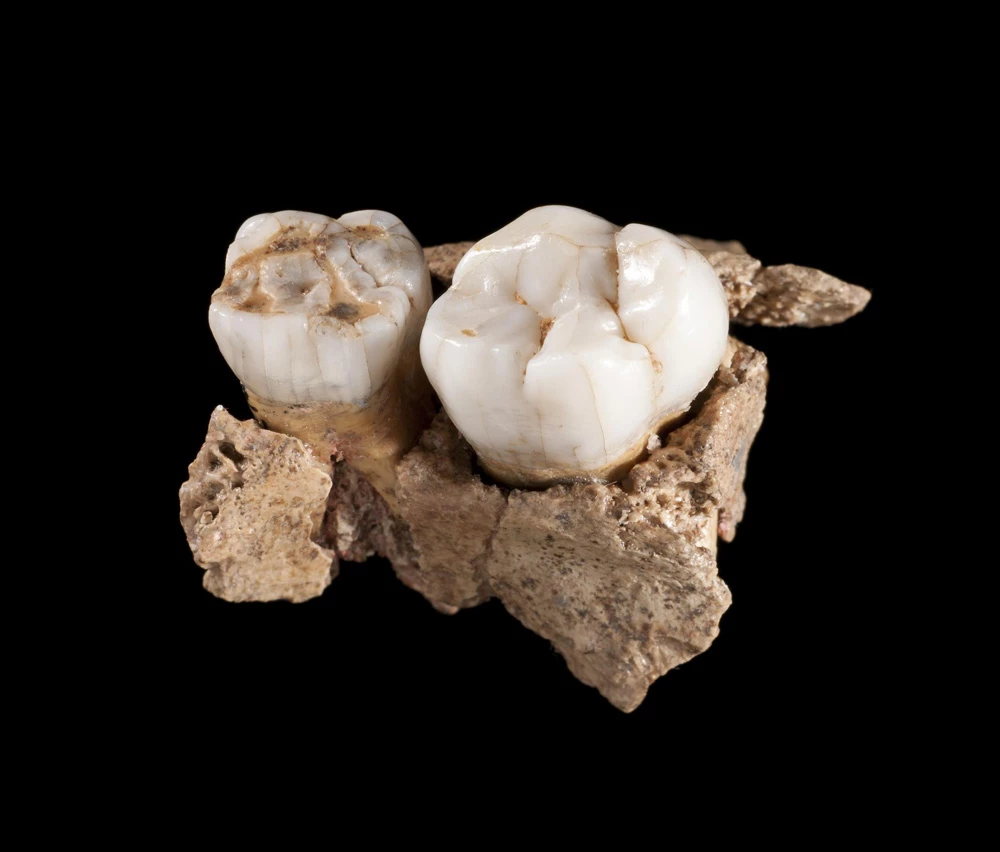
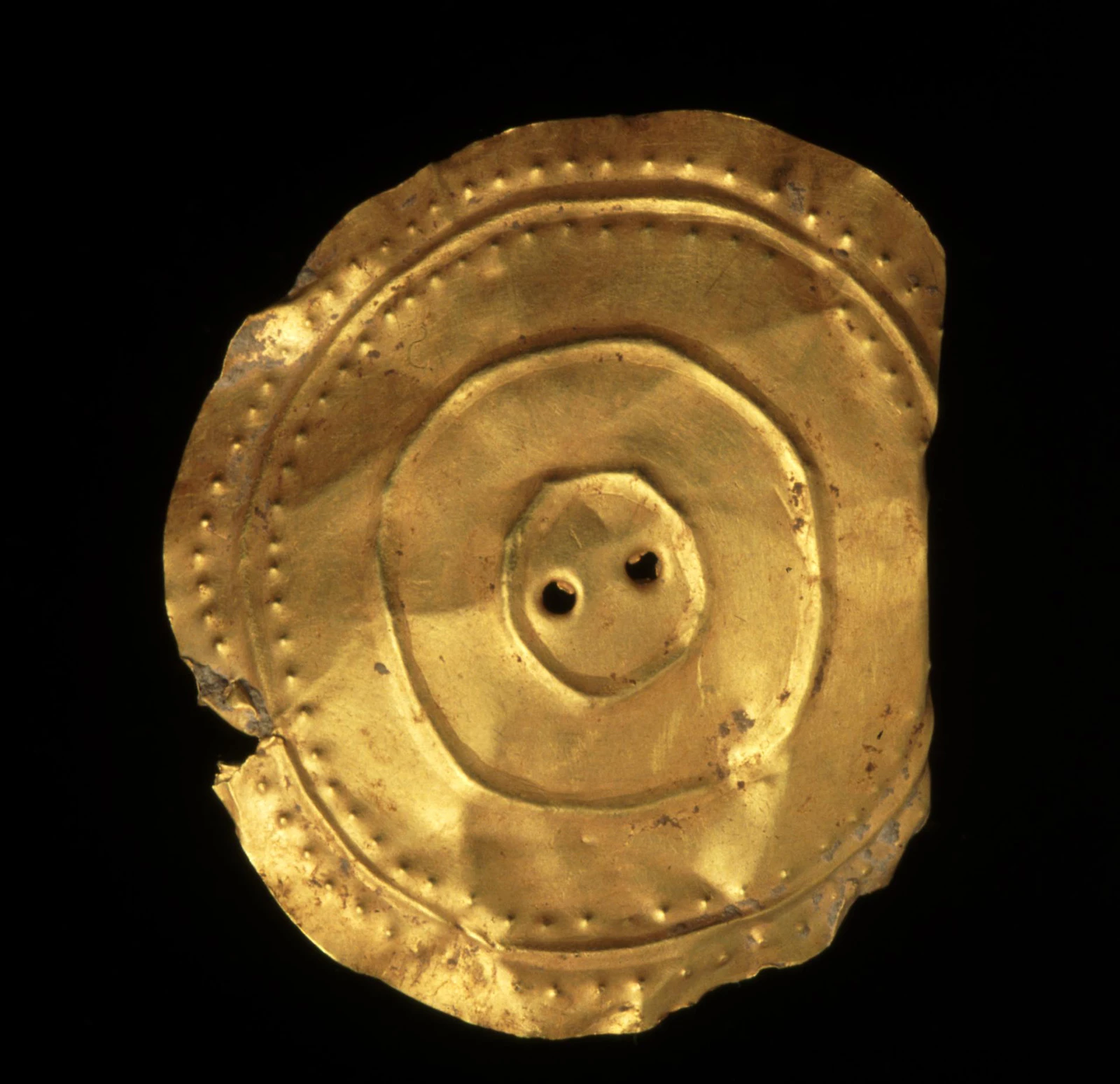
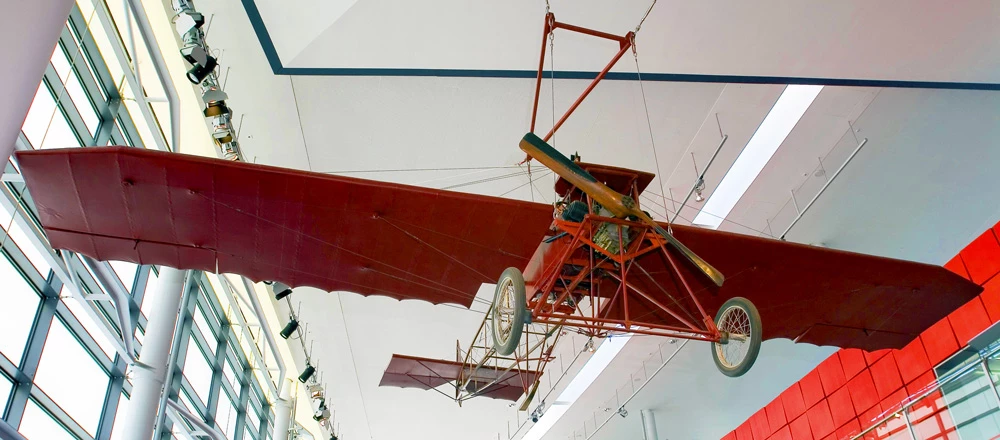
Uncovering our Collections: Half a Million Records now Online 26 March 2018 As we reveal half a million collection records for the first time, we look at some of the strangest and most fascinating objects from National Museum Wales Collections Online. This article contains photos of human skeletal fragments. The Biggest We have some real whoppers in our collections - including a full-size Cardiff Tram and a sea rescue helicopter - but the biggest item in our collection is actually Oakdale Workmen's Institute. Built in 1917, the Institute features a billiard room, dance hall and library - and is nowadays found in St Fagans National Museum of History. Horace Watkins testing his monoplane in 1908 Many of the buildings in St Fagans are part of the national collection - meaning they have the same legal status as one of our masterpiece Monets or this coin hoard. The buildings are dismantled, moved, rebuilt - and cared for using traditional techniques, by the museum's legendary Historic Buildings Unit. The Oldest The oldest human remains ever discovered in Wales These teeth belonged to an eight year-old Neanderthal boy - and at 230,000 years old, they are the oldest human remains in Wales. They were discovered in a cave near Cefn Meiriadog in Denbighshire, along with a trove of other prehistoric finds, including stone tools and the remains of a bear, a lion, a leopard and a rhinocerous tooth. These teeth are among some of the incredible objects on display at St Fagans National Museum of History The Shiniest People in Wales have been making, trading and wearing beautiful treasures from gold for thousands of years - like this Bronze Age hair ornament and this extremely blingy Medieval signet. At around 4000 years old, this sun disc is one of the earliest and rarest examples of Welsh bling One of the earliest examples of Welsh bling is this so-called 'sun disc', found near Cwmystwyth in Ceredigion. Current research suggests that these 'sun discs' were part of ancient funeral practice, most likely sewn onto the clothes of the dead before their funerals. Only six have ever been found in the UK. Most Controversial At first glance, an ordinary Chapel tea service - used by congregations as they enjoyed a 'paned o de' after a service. A closer look reveals the words - 'Capel Celyn'. The chapel, its graveyard and surrounding village are now under water. Capel Celyn, in the Tryweryn Valley, is now underwater Flooded in 1965 by the Liverpool Corporation, the Tryweryn valley became a flashpoint for Welsh political activism - creating a new generation of campaigners who pushed for change in how Welsh communities were treated by government and corporations. Curators from St Fagans collected these as an example of life in Capel Celyn - to serve as a poignant reminder of a displaced community, and to commemorate one of the most politically charged moments of the 20th century in Wales. Honourable Mention: an Airplane made from a Dining Room Chair Made from a dining room chair, piano wire and a 40 horsepower engine, the Robin Goch (Red Robin) was built in 1909 - and also features a fuel gauge made from an egg timer. The Robin Goch (Red Robin) on display at the National Waterfront Museum Its builder, Horace Watkins, was the son of a Cardiff printer - here he is pictured with an earlier, even more rickety version of his famous monoplane. Horace Watkins testing his monoplane in 1908 Our collections are full of stories which reflect Wales' unique character and history. The Robin Goch is one of the treasures of the collection, and is an example of Welsh ingenuity at its best. Half a Million Searchable Items The launch of Collections Online uncovers half a million records, which are now searchable online for the first time. “Collections Online represents a huge milestone in our work, to bring more of our collections online and to reach the widest possible audience. It’s also just the beginning. It’s exciting to think how people in Wales and beyond will explore these objects, form connections, build stories around them, and add to our store of knowledge." – Chris Owen, Web Manager Search Collections Online Plans for the future Our next project will be to work through these 500,000 records, adding information and images as we go. We'll be measuring how people use the collections, to see which objects provoke debate or are popular with our visitors. That way, we can work out what items to photograph next, or which items to consider for display in our seven national museums. Preparing and photographing the collections can take time, as some items are very fragile and sensitive to light. If you would like to support us as we bring the nation's collections online, please donate today - every donation counts. Donate Today We are incredibly grateful to the People's Postcode Lottery for their support in making this collection available online.
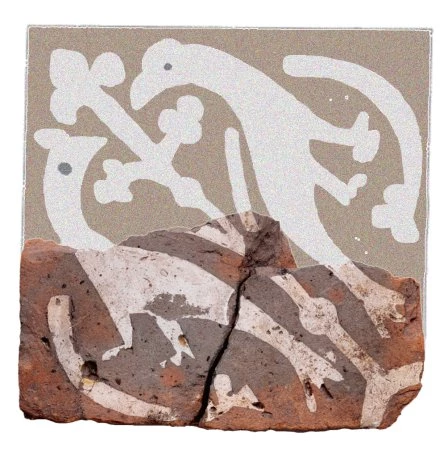
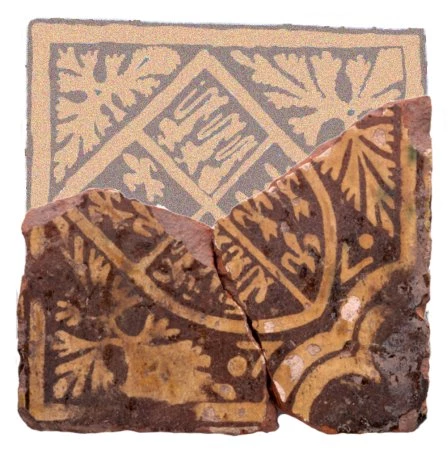
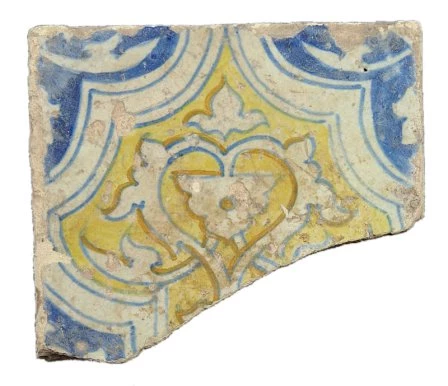
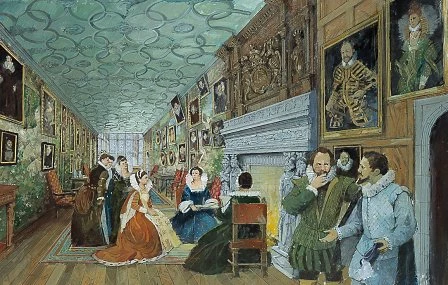
The decorated floor tiles from Raglan Castle 6 September 2007 Raglan Castle. The castle's fortifications, including the Great Tower shown at the centre of this view, were established in the 15th century. Image: Cadw (Crown copyright). Late 13th to early 14th-century tile of the Wessex School from the chapel at Raglan. 15th-century Malvern-school tile used at Raglan. 16th-century maiolica tile from the chapel floor laid by Earl William, probably before 1572. Reconstruction of life at Raglan Castle in the 16th century, at the time of the Third Earl of Worcester. Image: Cadw (Crown copyright). Three centuries of fashion and design can be seen in a collection of decorated floor tiles found during building works at Raglan Castle in 1947. In 1549 William Somerset (1526-1589) succeeded to his father's position as third Earl of Worcester and owner of Raglan Castle. From this base in south-east Wales he launched a career that was to see him thrive at the courts of Edward VI (1547-53), Mary (1553-58) and then Elizabeth I (1558-1603). He is buried in Raglan parish church. Such a prominent figure lived a lifestyle that suited his high social standing, and we can see this aspiration in the extensive remodelling that he undertook of the fortress-mansion he had inherited. He set about an extensive programme of modernisation that affected all parts of the castle and its grounds: the hall and accommodation were improved, kitchen and service areas upgraded, a long gallery was introduced and gardens created in Renaissance style. The Castle's furnishings were also updated with items that reflected contemporary European fashion. This is illustrated in the chapel at Raglan. Raglan Chapel The chapel at Raglan dates from at least the 13th century. It had a floor of thick red earthenware tiles with decoration inlaid into its surface using a contrasting colour. Such two-colour tiles often had designs of shields and monograms, over which a clear glaze would be fired. These tiles were the height of fashion in the mid-14th century. About 1460, these tiles were replaced with two-colour tiles of bright yellows and golden browns. This must have provided a rich backcloth for the treasures of the chapel. However, these designs were not to the taste of Earl William. He preferred the fashionable products of the Spanish Netherlands, and used his considerable wealth to purchase tin-glazed earthenware tiles painted in a polychrome style that was popular in the Renaissance period. The result was a dramatic transformation of the chapel, lightening its interior and adding delicacy to its decoration. Sadly, the abandonment of Raglan in the wake of the English Civil War has left few traces of the other changes that Earl William made to the interior furnishings of his castle. We are left instead to speculate on the luxury he must have brought to it, and to reflect on the transient nature of that wealth, surviving as it does in a small collection of painted floor tiles and a handful of other items. Guide to the Tiles Late 13th- to early 14th-century tile of the Wessex School from the chapel at Raglan. It shows two birds feeding from a central tree. Tiles with this design were also used at nearby Tintern Abbey and White Castle. 15th-century Malvern-school tile used at Raglan. The Latin text reads 'May the peace of Christ be amongst us always. Amen'. 16th-century maiolica tile from the chapel floor laid by Earl William, probably before 1572. These tiles were probably imported from the Spanish Netherlands, perhaps Antwerp, where maiolica production had been established in the early 16th century. Background Reading Raglan Castle by J. R. Kenyon. Cadw (2003). 'The chapel at Raglan Castle and its paving tiles' by J. M. Lewis. In Castles in Wales and the Marches by J. R. Kenyon and R. Avent, pp.143-60. University of Wales Press (1987). The medieval tiles of Wales by J. M. Lewis. Amgueddfa Cymru (1999).
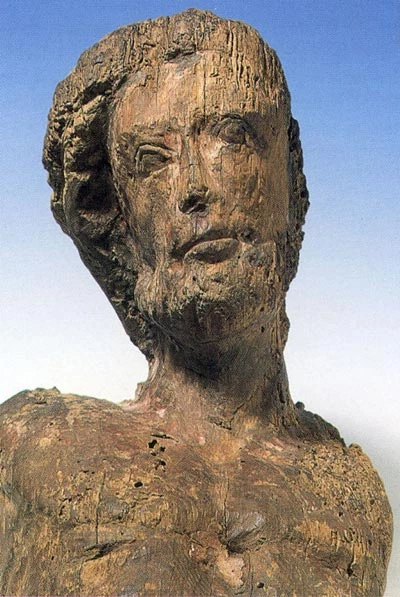
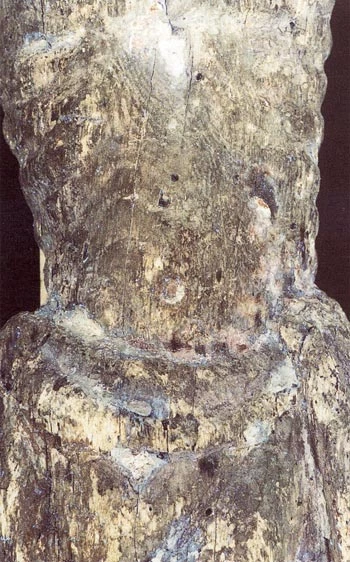
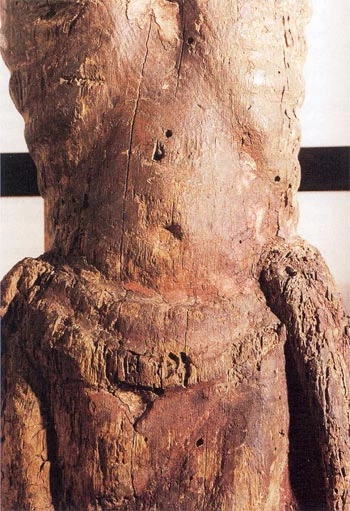
Wooden crucifix originally sparkled with gold 4 September 2007 The crucifix figure from Kenys Inferiour, Monmouthshire Detail of the head of the crucifix figure. Detail of the torso and loin-cloth in UV light. Detail of the torso and loin-cloth in reflected light. Scientific examination of a crucifix of the Middle Ages from Kemeys Inferior, south Wales reveals that the wooden object seen today was once richly decorated in vibrant colours and magnificent gold leaf. In 1850, the remains of a carved wooden figure of Christ were discovered in the church of Kemeys Inferior, a few kilometres east of Caerleon, south Wales. An object of exceptional importance Before the Reformation of the 16th century (when England and Wales officially turned from being a Catholic nation to a Protestant one), such figures of Christ were common throughout England and Wales and the Kemeys Christ is the most complete example of only a handful of medieval fragments to survive in Britain, and so is of exceptional importance. Fragments of the Kemeys Inferior figure were found, 'together with skulls and bones', in 'the blocked up rood-staircase' during repairs and alterations to the church in about 1886. It was transferred in 1930 to Amgueddfa Cymru. Although the figure was thought to be from the 14th century, arguments supporting this have never been set out in detail. Dating the figure relies on comparing other sculptures, and it is now thought to be from the late 13th century. Made in Wales Owing to the rarity of surviving figures in Britain from this period it is necessary to study objects from the continent for further clues. For example, late 13th-century crucifix figures from Sweden share several similar characteristics, whereas the 14th-century Christ from Mochdre, Denbighshire, the only comparable wooden figure from Wales, is quite different. The Kemeys Christ was more than likely to have been made in England or Wales. Investigation and analysis of the crucifix Very little of the colour that once covered the wooden figure can be seen today, but routine work done by Amgueddfa Cymru in 1999 led to in-depth investigation of the surface of the object. The figure was X-rayed and viewed under ultra violet (UV) and infra-red (IR) light before being examined under the microscope. This revealed the original colour scheme, with differences between the torso and the arms, previously considered to have been later additions. Vivid and rich colours In contrast to its present condition, the Kemeys Christ originally boasted a vivid and richly coloured appearance as was popular throughout the Middle Ages. Great care was taken in decorating the figure. When new, it would have shone with gold leaf. Examination of the figure has revealed considerable evidence of polychromy (use of many colours), and, like other examples of medieval sculpture, over-painting. Although little colour survives on the arms, the right arm does have two layers, which may suggest replacement of the left arm either during the first half of the 16th century or even earlier. At least three layers of painting have been detected, though the dating of each is problematic. The secondary colour scheme appears to have included gilding on the hair; gold, red and blue on the inside of the loin-cloth; dark brown and black details on the face; a green crown of thorns; and flesh tones in pale pink, with red emphasising the wounds. Stunning polychrome work like this would have been standard on such an important sculpture. The Kemeys figure clearly represents Christ on the cross, who is portrayed alive, with his eyes still open. The Kemeys Christ is a rare survival of pre-Reformation devotional figures once common in the British Isles. With the original height of about 94 cm, this powerful image of Christ's suffering would have been widely seen and prayed to, and formed a purposeful part of everyday life.
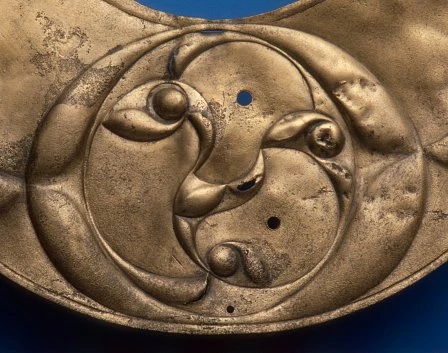
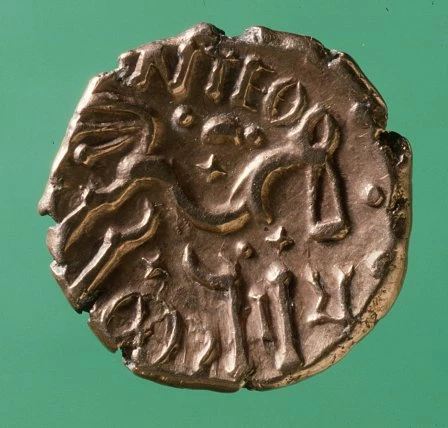
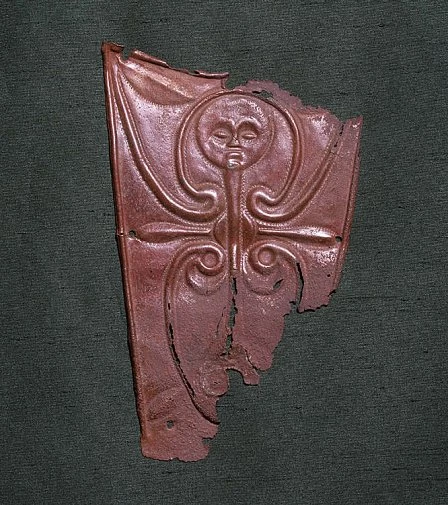
Celtic Art in Iron Age Wales 3 May 2007 Crescentic plaque from Llyn Cerrig Bach, Anglesey. Celtic coin from Tintern, Monmouthshire. Plaque from Tal-y-Llyn, Gwynedd, thought to date to the 1st century AD. Ox-head bucket fittings found at Little Orme, Conwy. Celtic Art Celtic art reflects the way Iron Age people interpreted the world around them. The designs they used help us understand how they viewed themselves, their environment and their gods. The Celtic art found in Wales is part of a much wider tradition in Britain and Europe, often called La Tène art, which developed during the Iron Age from about 500BC. The earliest example from Wales is the Cerrig-y-Drudion bowl which was found in 1924 in a stone-lined grave in the county of Conwy. It is one of the few decorated artefacts from Britain to date to the 4th century BC and was probably made by British craftsmen influenced by Continental traditions. Many more decorated objects are known from about 200BC, by which time Britain had developed its own distinctive style. British craftsmen continued to produce swords, daggers, spears, brooches and horse equipment, but also other objects such as tankards, mirrors and spoons. Symbolic designs Particular motifs and designs are introduced and often repeated, reinforcing their meaning. Archaeologists interpret these as symbolic and powerful with religious connotations. For example the three-fold character of the triskele (a three-legged design radiating from a centre) may represent the relationships between the living, the dead and the gods or the ongoing cycle of birth, life and death. The crescentic plaque from Llyn Cerrig Bach (pictured) is decorated with an elaborate triskele, each limb ending with a trumpet and raised circle that suggests a stylised bird head. Stylised representations of people and animals become more common after 100BC with faces often hidden within complex patterns. Human heads surrounded by a flowing plant-like design can be seen on plaques from the Tal-y-Llyn hoard while a variety of cows, horses, boars and birds adorn a wide range of other artefacts. Ox head escutcheons (bucket-fittings) have been found in Wales (pictured - the Little Orme (Conwy) hoard also contained two Roman trumpet brooches, indicating that this Celtic style continued in use after the Roman conquest), showing the stylised characteristics and flowing lines of native British artistic styles. Mythical beasts are also hinted at, for example in the imaginatively constructed horse-cow heads that ornament the Capel Garmon firedog. Celtic designs did not disappear with the Roman conquest, but continued to influence art. A bronze trulleus (saucepan) from Coygan Camp in Carmarthenshire was repaired with a sheet of metal sometime in the 3rd century AD. It was not decorated with a typical Roman design, but with a triskele motif, showing a continuing appreciation of Celtic art. Background Reading Early Celtic art in Britain and Ireland by Ruth and Vincent Megaw. Published by Shire Archaeology (1986).
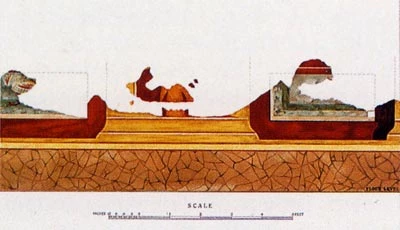
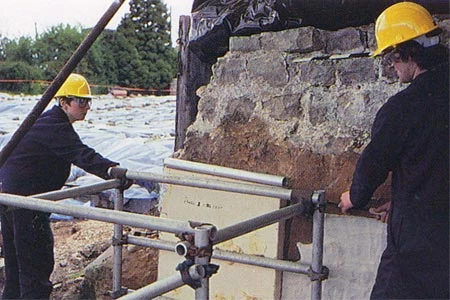
Fine fresco wall painting removed for conservation 30 March 2007 Watercolour by F.G. Newton, 1905 Removing one of the panels In 1988, archaeological excavations of the council chamber in the basilica (assembly hall) of the Roman town at Caerwent revealed a fine wall painting that has since been removed for conservation and display. The painted plaster or fresco, 5m long and 1m high, was still attached to the south wall of the chamber. It had been previously recorded in watercolour by F. G. Newton in 1905, and had been covered over again. The fresco shows an architectural perspective, with yellow pillars above a brown veined pink dado. A dark brown area in the central pillar may be part of a decorated panel, possibly containing the torso of a man. It was decided to remove the fresco to prevent further deterioration as the plaster was extremely fragile. After carefully covering the delicate artwork with muslin and glue, the painting was cut into five panels. Each enclosed in specially-designed boxes. A variety of saws and chisels were used to separate the painted plaster from the wall. Since access to the back of each panel was restricted to its top edge and one side, this process was difficult, needing extreme patience and ingenuity. It took a total of nine days to remove the painting, with the subsequent conservation and rebacking taking several years, the fresco is now conserved and stored at the National Museum, Cardiff. Background Reading: Caerwent Roman Town by R.J. Brewer. Published by Cadw (2006).