: Gems & Precious Metals

Exquisite Roman treasure gives up its secrets

9 May 2007

The leopard cup.

The leopard cup. 11.5cm (4.5 inches) tall.

Detail of the leopard handle

Detail of the leopard handle, showing its finely worked features and silver spots.

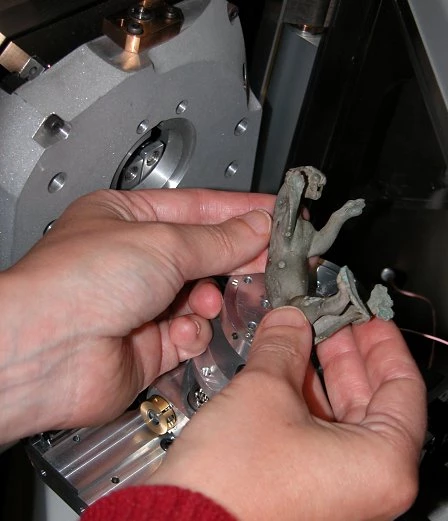
Leopard cup being placed in the Scanning Electron Microscope.

Leopard cup being placed in the Scanning Electron Microscope.

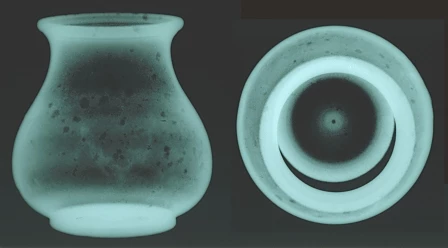
X-rays of the cup.

X-rays of the cup.

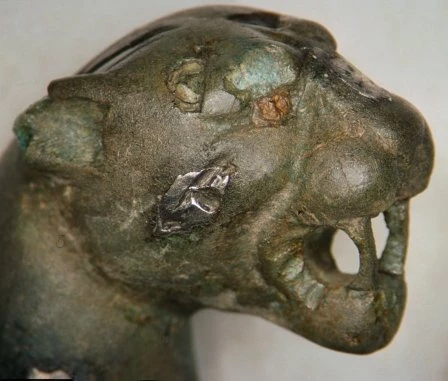
Microphoto of the leopard's face.

Microphoto of the leopard's face.

Discovered in 2003, this exquisite Roman vessel has been the subject of detailed study at Amgueddfa Cymru - National Museum Wales.

The bronze cup is one of the finest Roman vessels to have been found in Wales. It was discovered by Mr Gary Mapps near Abergavenny (Monmouthshire). It was reported to the Portable Antiquities Scheme, enabling the finds spot to be investigated.

Excavation of the site revealed that the cup had been placed upside down in a small pit containing a cremation. This cremation was part of a cemetery beside a Roman Road some distance from the mid 1st to early 2nd century fort at Abergavenny (Roman Gobannium). There is also a growing amount of evidence for a civilian settlement dating from the 2nd to 4th centuries in the neighbourhood of this cemetery.

The cup displays craftsmanship of a high standard and it was almost certainly manufactured in Italy during the 1st century AD. Very similar cups have been found at the doomed city of Pompeii, which was destroyed after the eruption of Vesuvius in AD79.

X-rays of the cup revealed that it was first cast in a mould using leaded bronze. Lead was added to help the molten bronze (principally copper and tin) flow more easily and improve the quality of the casting. Once this casting had been made the vessel was turned on a lathe with the use of a sharp cutting tool to produce its final shape.

The cup's decorative handle depicts a leopard which, in Roman mythology, appears as the draught-beast and companion of Bacchus, the god of wine. His worship involved feasting, drinking, music and dancing. Leopards, captured in both Africa and Asia, were also popular with the Romans for display and fighting in the amphitheatre arena.

The leopard handle was made separately using 'lost wax' casting. The first process was to make a wax model of the leopard. A clay mould was formed around the model and then heated to run off the wax. Leaded bronze was poured in to fill the space left by the wax and, after cooling, the mould was broken to remove the bronze handle.

Further work was undertaken on the finished casting: for example the tail and canine teeth, originally cast thicker, were cut away to form finer features. The spots were also chiselled out from the body after casting and inlaid with silver. The leopard was then attached to the cup using solder. The leopard's eyes, measuring about a millimetre in diameter, were also inlaid. Analysis of the remaining traces of inlay indicate that the eyes may have been of amber.

It is unknown whether the cup belonged to a member of the Roman army, or a native Briton from the nearby civilian settlement. Whichever is the case, this 1st century cup was a costly import and probably belonged to someone of status, who cherished it sufficiently to want it buried with them on their death.

Background Reading

Things Fall Apart: museum conservation in practice. National Museum Wales Books, 2006

3,000 year old Irish gold from North Wales

26 April 2007

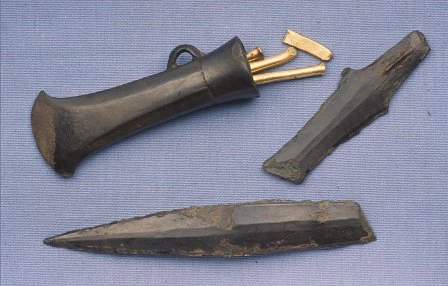
The hoard of Bronze Age artefacts recovered by metal detectorists near Wrexham.

The hoard of Bronze Age artefacts recovered by metal detectorists near Wrexham.

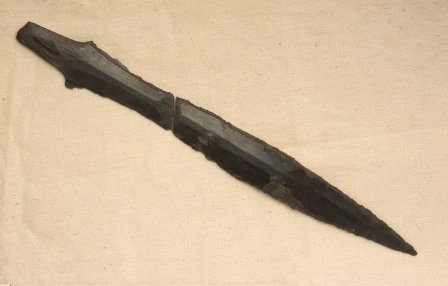
The bronze knife, found in two fragments. The edges of the blade were heavily notched, perhaps suggesting it had been used for some time before burial.

The bronze knife, found in two fragments. The edges of the blade were heavily notched, perhaps suggesting it had been used for some time before burial.

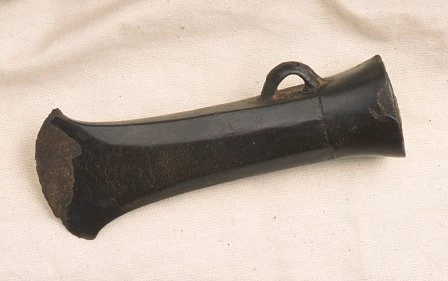
The bronze axe, the socket of which contained the fragments of two or more gold bracelets.

The bronze axe, the socket of which contained the fragments of two or more gold bracelets.

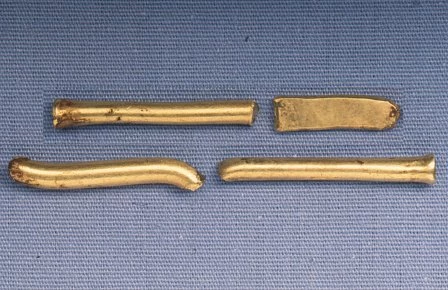
The fragments of bracelets, probably made from Irish gold.

The fragments of bracelets, probably made from Irish gold.

In 2002 a number of Bronze Age items were discovered near Wrexham, North Wales. Amoung the finds were a bronze knife, an axe head, and four fragments of gold bracelets. All were made between 1000-800BC and show links between Wales and Ireland during the Bronze Age.

The knife is of a type used throughout southern England and Ireland, and its shape mirrors much larger swords that were in use at this time. However, it is the first of its kind to be found in Wales.

The bronze axe head has a socket at one end, to which a wooden handle would have been attached, as well as a loop through which leather or twine would have been threaded to keep them together. It appears, however, that the axe head was buried without its handle since four fragments of gold bracelets were found stuffed into the socket. These valued finds include two terminals (end pieces) of a bracelet type most commonly used in Ireland, and are probably made of Irish gold.

These artefacts would probably have belonged to a person of considerable social standing since few people at this time would have had access to Irish gold and such finely worked tools. Quite why their owner decided to part with them will never be known for certain, although it is likely that they were buried as an offering to the gods.

The discovery adds valuable detail to our understanding of life in Wales 3,000 years ago. A time when leaders dressed to impress by wearing gold bracelets and hair ornaments, and a person's role within society was broadcast by the tools and weapons worn, the appearance of the horse they rode and the quality of a feast hosted.

Though most people in Wales were settled farmers and herders at this time, finds like the hoard from Wrexham show us that these small communities were part of large trading networks that linked Wales with Ireland. Evidence that our ancestors had more on their minds than food, farming and survival.

These items form part of the collections of Wrexham County Borough Museum.

The Pen y Bonc necklace

26 April 2007

The Pen y Bonc necklace (Anglesey). Image © the Trustees of the British Museum.

The Pen y Bonc necklace (Anglesey). Image © the Trustees of the British Museum.

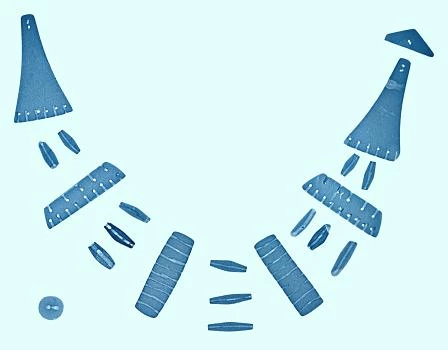
Xero-radiograph of the Pen y Bonc necklace. Image © the Trustees of the British Museum.

Xero-radiograph of the Pen y Bonc necklace. Image © the Trustees of the British Museum.

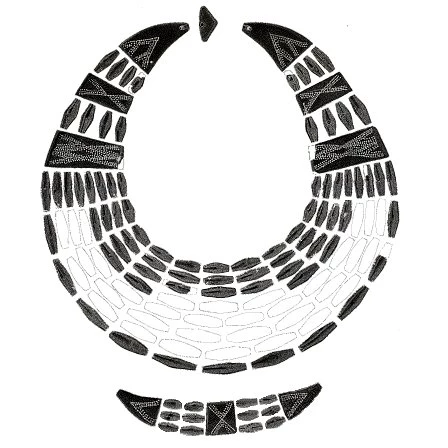
Jet necklace from East Kinwhirrie, Angus (Scotland). Image: Helen Jackson for the National Museums of Scotland.

Jet necklace from East Kinwhirrie, Angus (Scotland). Image: Helen Jackson for the National Museums of Scotland.

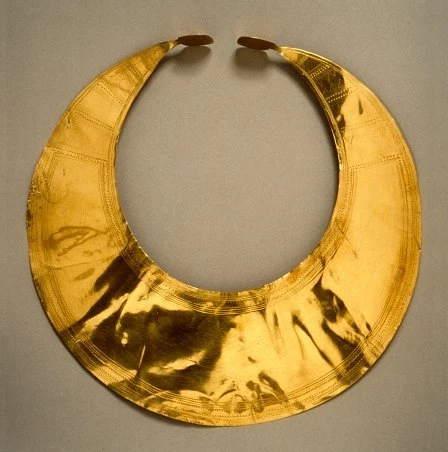
Gold lunula from Co. Kerry, Ireland. Image © Trustees of the British Museum.

Gold lunula from Co. Kerry, Ireland. Image © Trustees of the British Museum.

Queen Victoria had a fascination with the black semi precious stone 'Jet' following the death of her husband, Prince Albert in 1861. The use of this stone has a much longer history as this 4,000 year old necklace from Anglesey shows.

Important burial

In 1828 a grave was discovered at Pen y Bonc, near Holyhead on Anglesey. Accounts of this discovery are incomplete, but the grave was dated to around 4,000 years. The person who was buried must have been important as the grave was cut into bare rock. A number of black beads and buttons were discovered in the grave.

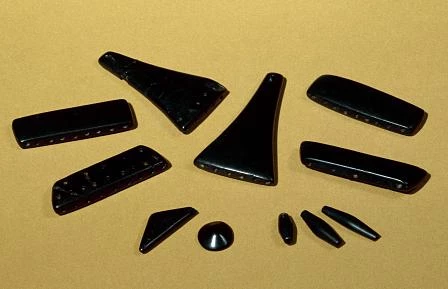
Unfortunately, most of the items were lost soon after the discovery, but some surviving pieces are now in the collections of the British Museum. These pieces form a crescent-shaped necklace of beads and spacer plates. Objects such as these are usually found with female burials. Jet necklace from East Kinwhirrie, Angus (pictured) shows the shape of a complete spacer plate necklace, and illustrates how some of the finest examples were decorated.

A necklace made of coal

Most of the beads and plates in the Pen y Bonc necklace are made of 'lignite' (fossilised wood). However, one bead and the surviving button are made of jet, a material found 300km (186 miles) away to the north-east, at Whitby (North Yorkshire). Jet is a dense black variety of lignite only found in a few parts of Europe.

Only parts of this necklace survive. It is possible that this was all that was buried since Bronze Age jet necklaces are often found incomplete. Alternatively, parts of the necklace may have been made of materials which have since rotted away, or possibly pieces were lost when it was excavated.

Manufacturing jet necklaces was a skilled job. The many strands of the necklace were suspended using spacer plates through which holes were bored to carry the strings. This delicate work was probably carried out using a bow-drill and a piece of bronze wire. In the case of the Pen y Bonc necklace some of the holes have been bored lengthways through the plates. But in order to increase the number of strands on one side of the plate, holes have been drilled at one end to allow new strings to be tied in.

Unlike many types of gem, jet is warm to the touch and is relatively easy to shape; it also takes a very high polish. Today it looks rather like shiny plastic, but during the Bronze Age it must have appeared strange and unusual. Jet also has unusual electrostatic properties (when rubbed it can attract hair and other light materials) that might have been seen as magical in prehistoric Britain.

Treasured jewellery

The jet pieces in the Pen y Bonc necklace were heavily worn suggesting that they were treasured items that had been kept for many years. In contrast, the parts of the necklace that were made from local materials were less worn - suggesting that they were newer replacements for broken or damaged pieces of jet.

Objects made of jet were popular throughout Britain during the Early Bronze Age (2300-1500BC), however, after this period its use declined.

When the jet necklace from Pen y Bonc was discovered in the 19th century, the jet being mined at Whitby was just beginning a revival, thanks in large part to Queen Victoria's obsession with black mourning garments after the death of Prince Albert in 1861.

Gold Lunula

Gold lunula also date to the Early Bronze Age and are often decorated in a similar way to jet necklaces. However, whereas jet necklaces are usually found with burials, lunula are not found with the dead. Perhaps jet suggested death and gold represented life in the minds of people 4,000 years ago.

Background Reading

'The Welsh 'jet set' in prehistory' by Alison Sheridan and Mary Davis. In Prehistoric ritual and religion by Alex Gibson and Derek Simpson, p148-62. Sutton Publishing (1998).

'Investigating jet and jet-like artefacts from prehistoric Scotland: the National Museums of Scotland project' by Alison Sheridan and Mary Davis. In Antiquity (2002) vol. 26, p812-25.

Stunning gold relic unearthed in Gwynedd

26 April 2007

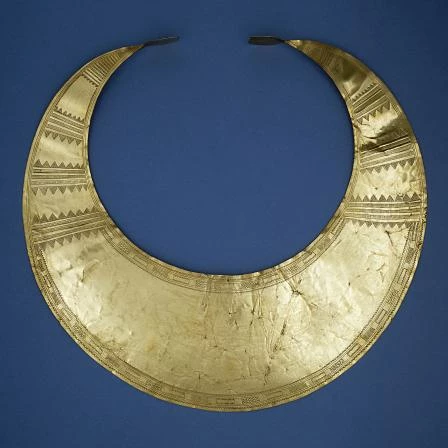
Llanllyfni lunula.

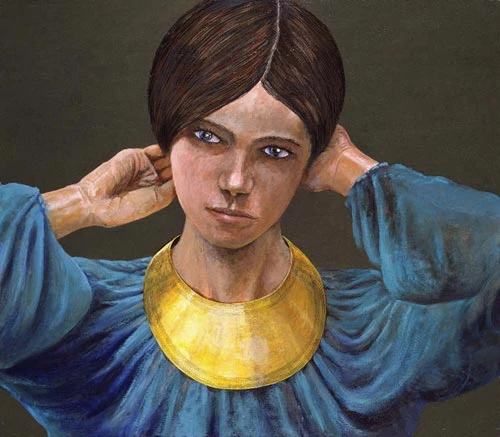
Llanllyfni lunula. Weighing 185.4g (6.5 ounces) and measuring 24cm (9.5 inches) in diameter. This crescent-shaped ornament probably originated as a single rod shaped ingot and was expertly hammered into shape. The intricate decoration of zig-zags, lines and dots was then added using a fine pointed tool and a copper or bronze punch. These designs are very similar to those used to adorn pottery made at this time.

Reconstruction of a lady wearing a gold lunula

Reconstruction of a lady wearing a gold lunula from Llanllyfni, (about 2000BC).
Gold was one of the first metals to be used in Wales, along with copper and alloys such as bronze. The use of gold for jewellery and ornamentation has been a common theme since the earliest times.

This stunning decorated object is one of the earliest gold artefacts to have been found in Wales and dates to the beginning of the Bronze Age (2400-2000BC).

Yellow leaf sticking from the ground

It was found a few miles from Llanllyfni (Gwynedd) on Llecheiddior-uchaf Farm near Dolbenmaen in about 1869. A farmer noticed what he took to be a yellow laurel leaf sticking out of some peat. Later, unsatisfied with this explanation, he returned to the site and uncovered the crescent-shaped object of gold.

The Llanllyfni lunula

Known as a 'lunula' after its crescent-shape (luna = moon in Latin), objects like this have been found in Scotland, Cornwall, and north-west France, with as many as 90 being discovered in Ireland.

Lunula are generally found in isolated locations, away from ancient settlements and, like the Llanllyfni example, they have often been discovered by chance.

It has been argued that they were intended to be worn around the neck as breast plates, although the lack of wear on the gold suggests that they were only rarely used - possibly they were the symbol of a priest or were used in the rituals of a community.

The gold in the Llanllyfni lunula may come from a Welsh source, for example the Dolgellau gold belt, or north-west of Llandovery, but as so many have been discovered in Ireland, the suspicion is that it was traded as a raw material across the Irish Sea.

Background Reading

'Bronze Age gold in Britain' by J. P. Northover. In Prehistoric gold in Europe by G. Morteani and J. P. Northover. Published by Kluwer (1993).

Bronze Age goldwork of the British Isles by J. J. Taylor. Cambridge University Press (1980).

'Objects mostly of prehistoric date discovered near Beddgelert and near Brynkir station' by W. J. Hemp. In Proceedings of the Society of Antiquaries of London, 2nd series, vol. 1, p166-83 (1918).

Metal detector discoveries from Monmouthshire: Two spectacular treasure finds

16 April 2007

In 1998 two separate but significant discoveries were unearthed by metal detectorists in Monmouthshire - a unique hoard of roman coins from Rogiet and a gold ring from Raglan. Both finds were significant and fine examples of treasure that are now in the collections of Amgueddfa Cymru.

The Treasure Act of 1997

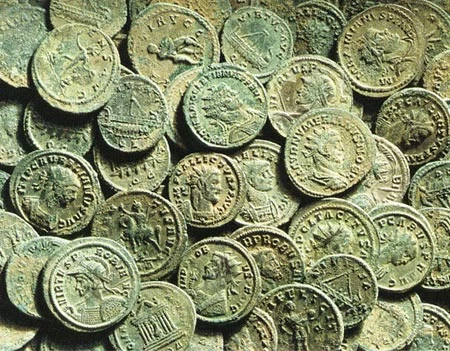
The Rogiet hoard, as found.

The Rogiet hoard, as found.

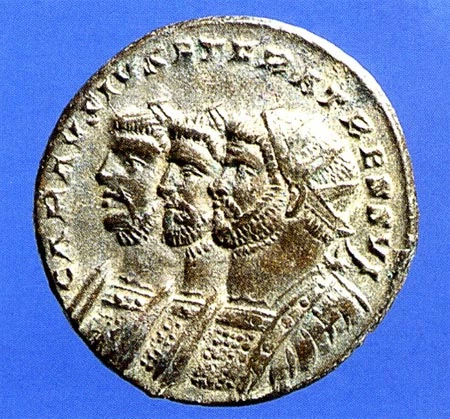
'Carausius and his brothers' (Rogiet hoard)

'Carausius and his brothers' (Rogiet hoard)

The Treasure Act of 1997 covers certain classes of coins and precious metal objects found in England and Wales and has extended legal protection to single objects of gold and silver and to virtually all coin hoards. The new regulations have provided improved protection for certain categories of newly-found antiquities, and better opportunities for preserving these for the public benefit.

Since the act came into force, staff from Amgueddfa Cymru have handled numerous finds, including the spectacular discoveries of an unique hoard of Roman coins from Rogiet and a massive gold signet ring from Raglan.

One of the finest hoards of roman coins ever found in Wales

In September 1998, thousands of Roman coins from the third century AD were discovered by Colin Roberts at Rogiet, Monmouthshire. This was one of the finest hoards ever recorded from Wales and were declared treasure in December 1998.

The 3,750 coins had been buried, possibly in a wooden box, around AD 295-6 (we believe this to be the date since there were no coins later than this in the box) and span a forty-year period, with twenty-two emperors represented, a sign of the political instability of the times.

Political trouble

Their deposit, and the owner's failure to recover them, probably relate to this military and political instability. At the same time, however, the currency of the Roman empire was going through major change. In AD 294-5, new gold, silver and copper alloy coins were introduced to uniform designs and standards empire-wide.

The hoard is made up of an unusual composition for a British find as the coins found in it were not circulated in great numbers here. The hoard is significant as it contains a number of faulty issues of the 260s, and also because it contains over 750 coins of the two individuals who declared themselves Emperor in Britain, Carausius (287-93) and Allectus (293-96). These are not often found in hoards and contain rare denominations representing a variety of warships.

Also included in the hoard is a particularly fine specimen, perhaps the best in existence, of a classic rarity of the Romano-British coinage series. In around 292, Carausius seems to have wanted official appreciation from the emperors Diocletian and Maximian, issuing coinage in their names as well as his own. He even depicted himself with the others on a single design, with the slogan 'Carausius and his brothers'. The feeling was not shared, and within a year Carausius was gone, murdered by his minister Allectus.

An ornate gold ring from Raglan

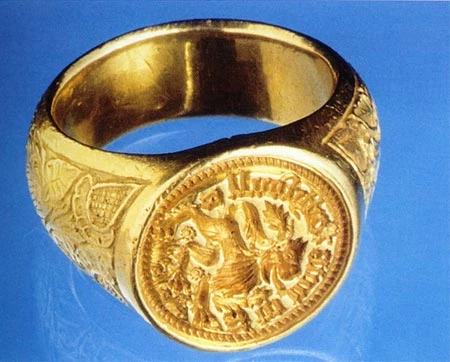
The Raglan Ring

The Raglan Ring

In the same year as the Roman coins were unearthed at Rogiet, a massive and ornate gold signet ring was found near Raglan, Monmouthshire, by Ron Treadgold, and was also declared treasure. The ring has a circular bezel engraved with a design of a lion on a bed of flowers, within a single cable border with the legend: to yow feythfoull or feythfoull to yow and initials W A either side of the lion.

The finest example of late medieval gold jewellery to be found in Wales

The shoulders of the ring are decorated with flowers and leaves and is significant for the study of late medieval rings as very close comparisons exist in the engraving on the gold episcopal ring of John Stanbury, Bishop of Hereford (1452-1474), a mid 15th century cross from Winteringham, Lincolnshire and a gold ring from Godstow Priory, Oxfordshire. The Raglan ring is likely to date from the middle or third quarter of the 15th century, and is perhaps the finest example of late medieval gold jewellery ever to be found in Wales.

The ring's owner

The original owner of the seal has yet to be identified, though the finding of the ring near Raglan and initials W A make William Herbert, first Earl of Pembroke (executed after the battle of Banbury during the Wars of the Roses, in 1469) a possibility. He married Anne Devereux, and the initials might stand for William and Anne.

The size of the ring suggests that it was worn by a man, and the inscription may be regarded as a sign of faithfulness to his wife. Herbert was one of two men referred to as the 'chosen and faithful' to the new king, Edward IV, and on Edward's coronation he was ennobled. However, the identification of the ring as that of William Herbert is not proven and other names are possible.

At present, all that we can safely say is that the ring was a mark of rank, and probably belonged to an important officer or visitor to Raglan during the second half of the 15th century.