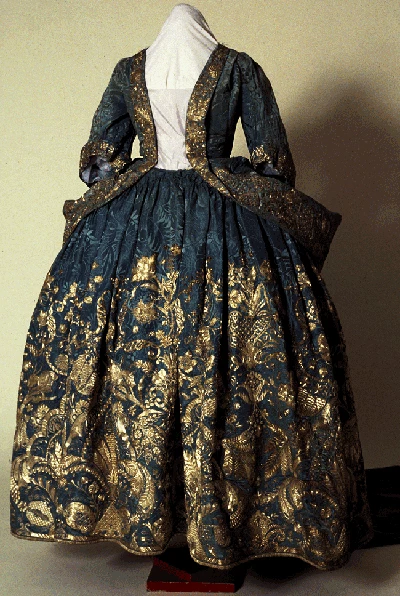
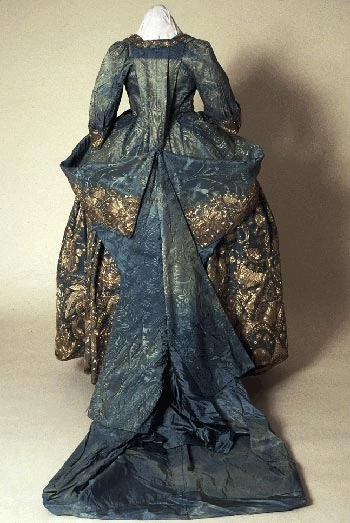
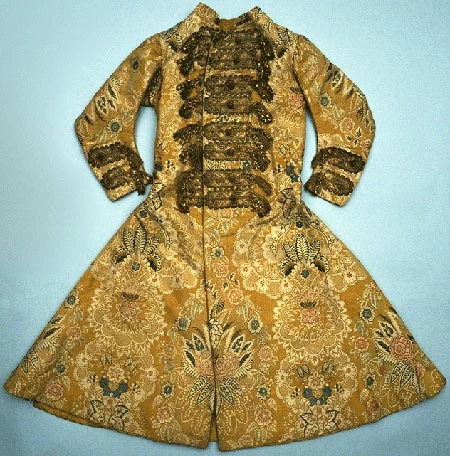
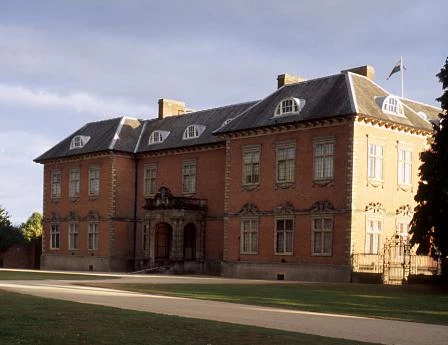
Glitz and glamour - the outstanding costumes of the the Tredegar Collection 11 April 2007 Tredegar House and Park. The house and grounds are now in the ownership of Newport County Council. Many rooms have been restored and are open to the public. Image © Steve Burrow. Silver embroidered blue damask court mantua (an open fronted gown with an elaborate train), made between about 1730-40. This is a very grand robe which would have been worn for presentation at court. This coat was probably worn by Sir William Morgan. It is of yellow lace pattern silk, dated to about 1725, and is of either English or French origin. For glitz and glamour, look no further than the Tredegar Collection. This impressive collection of 18th century costume was presented to the Museum in 1923 by Courtenay Morgan, also known as Lord Tredegar. The items belonged to his rich ancestors who wanted to flaunt their wealth and power. Each garment was designed to dazzle. Although the Morgans owned Tredegar House near Newport, they spent most of their time in London. For the gentry, the capital was the place to be. Pleasure gardens, operas and assemblies - their lives revolved around socializing. A royal debut The Tredegar costumes were probably made in London, using the finest woven damasks and brocaded silks you could buy. The most elegant dress in the collection dates from around mid-1720s. The grandness of this open fronted blue gown - often called a mantua - suggests that it was made for a young lady's royal debut. The detailing is elaborate and elegant, both on the front and the back.The gown was much longer originally, but a large section was cut off during the 1800s, supposedly for a fancy dress party. Whalebone corsets Gowns like this one were very awkward to wear. To achieve the exaggerated look, women wore wide hoop petticoats to increase the width of their skirts. They also wore tight corsets stiffened with whalebone under their dresses. Corsets encouraged good posture by squeezing the upper body into shape. Style was more important than comfort. This yellow brocaded frockcoat was made in the early 1720s. The floral design is typical of the period, so is the bright yellow colour. Further reading: M. R. Apted, 'Social Conditions at Tredegar House, Newport, in the 17th and 18th Centuries', The Monmouthshire Antiquary 3:2 (1972-3), pp. 124-54. Janet Arnold, 'A Court Mantua of c. 1740', Costume: Journal of the Costume Society 6 (1972), pp. 48-52. Avril Hart & Susan North, Historical Fashion in Detail: The 17th and 18th Centuries (London: V & A Publications, 1998).
A Fistful of Dollars 30 March 2007 Silver 8-reales, or 'Pillar Dollar', Mexico, 1741. While the Museum's numismatic (coin) collections contain mostly coins from Britain, it also includes representative groups of overseas coins, which helps put the evolution of British coinage in its international context. The dollar, today one of the world's dominant currencies, has its origins late in the 15th century. New discoveries of silver and developments in mining technology increased European output of the metal dramatically and central European states started producing large coins in silver which were equal in value to the gold coins of the day. The name 'dollar' derives from the St Joachimsthaler Guldengroschen struck by the counts of Slik in Central Europe around 1520. As 'Thaler' became the generic name for crown-sized silver coins of the German states, the English term 'dollar' had started to appear by the early 17th century. The enormous numbers of Spanish dollars produced in their colonies of Mexico and South America ('pieces of eight') came to be traded all over the world, and they set the standard for the silver currencies of many emerging nations in the 18th and 19th centuries.
Distinguished Service - campaign & gallantry medals 30 March 2007 The medal collections of Amgueddfa Cymru Silver 'Forlorn Hope' badge 1643 — this would have been sewn onto a sash or tunic. South Africa Medal 1877-79: '1428 Pte E. Jones 2.24th Foot'. Sergeant Evan Jones, c.1917. He was born in Ebbw Vale in 1859 and enlisted in the Monmouth Militia in 1874, joining the 24th Foot in 1877. He served in South Africa, where on 23 January 1879 he was one of the tiny garrison that held Rorke's Drift against a massive Zulu attack. He later served in the Mediterranean, India and Burma, and remained in uniform with various units until 1920. He died in Welshpool in 1931. The British medal collections of Amgueddfa Cymru were formed back in the 1920s thanks to gifts from two men. In 1922, Colonel Sir William Watts donated his collection of 105 British naval and military medals, and in 1923 W. Lisle Bowles made generous gifts of similar medals. From these, the Museum gained a representative collection of British military campaign medals, from the battle of Waterloo (1815), the first engagement for which all who took part received a medal, to the Great War of 1914–18 and beyond. However, only a small number of these military and gallantry medals had any Welsh associations. In more recent years, therefore, occasional purchases and donations have concentrated on these two categories, our stated policy being to collect medals 'relating to the deeds of Welsh people'. 'Forlorn hope' The earliest military award in the collection is a badge for the 'Forlorn Hope', dating from the English Civil War and awarded to selected troops who acted as vanguards. This was a Royalist award introduced in 1643 by Thomas Bushell, a mining engineer and master of the mint at Aberystwyth. Civilian Heroes The Albert Medal was introduced in 1866, at first awarded for gallantry at sea, but extended to the saving of life on land in 1877 to reward the heroes of Tynewydd Colliery, Rhondda, for the successful rescue of five colleagues trapped by flooding for nine days deep underground. Several Albert Medals relating to this incident are in the Museum's collection. When the Edward Medal was created in 1907 for gallantry in mines and quarries, one of the first two awards went to a Welshman, Henry Everson, of Penallta Colliery; the medal was donated to the Museum by his son in 1978. From Albert to Edward to George In December 1971, the Albert and Edward Medals were withdrawn, to be replaced by the George Cross. Of those who elected to exchange awards, seven chose that their previous medals be donated to the Museum. Two of these, Gordon Bastian and Eynon Hawkins, held the Albert Medal for gallantry at sea, having rescued fellow crewmen in torpedoed ships in 1943. Three 'land' Albert Medals are those of Walter Cleall; Cardiff policeman Kenneth Farrow, who attempted to save a small boy from drowning; and Margaret Vaughan, who as a schoolgirl saved a boy caught by the rising tide at Sully Island, near Barry, from drowning. Edward Medals were given to Bert Craig (Mountain Ash, 1922) and Thomas Thomas (Brynamman, 1933). Heroism and Great Gallantry In 1990, the Museum acquired three George Medals with Welsh connections. The George Cross and George Medal were created in 1940, primarily as a response to the increased exposure of civilians to great danger during the Blitz. On 19 August 1940, the Royal Naval fuel depot at Llanreath, Pembrokeshire, was bombed and burned for seventeen days, destroying over thirty million gallons of oil. This was the biggest fire ever known in Britain. Norman Groom was one of 650 firemen who fought the blaze and one of three Cardiff men to receive the George Medal. Thomas Keenan, a nightwatchman, removed an incendiary bomb from the top of a tank containing 300,000 gallons of petrol at a depot in Ferry Road, Cardiff, on 2 January 1941. The awards highlighted here form just the tip of a historical iceberg. Unlike those of any other country, Britain's campaign medals and most of its gallantry awards have, since the early 19th century, been impressed with the name (and for military awards the number, rank and unit) of their recipients. Even the millions of campaign stars and medals of the Great War of 1914–18 were individually named, though those of the Second World War were issued unnamed, presumably to save costs. Most medals are, therefore, starting points for historical research into the lives of individuals.
Sir Charles Jackson’s unique collection of silver 19 February 2007 In 2000, Amgueddfa Cymru learned that hundreds of pieces of rare silver, which had been on loan to the Museum since it first opened its doors, were to be sold. The items, some of which date back to the 16th century, are from the collection of Sir Charles Jackson (1849-1923), a Welsh lawyer and businessman. Luckily, after much negotiation and fundraising, they were finally secured for the Museum with considerable help from the National Heritage Memorial Fund, the National Art Collections Fund and the Worshipful Company of Goldsmiths. So why is this collection so important? Sir Charles Jackson (1849-1923) Sir Charles Jackson Sir Charles Jackson was born in Monmouth. He became part of a group of collectors and antiquarians that included Robert Drane, T. H. Thomas and Wilfred de Winton. Together they influenced the development of the Cardiff Museum. They also played a role in making sure the National Museum of Wales would be located in Cardiff. Remarkable treasures Some of the objects collected by Jackson are of outstanding aesthetic quality. Rare items include an early 14th century acorn-top spoon, which is one of the very first hallmarked pieces of English silver, and a complete set of 'apostle' spoons (twelve apostles and the 'Master') from 1638. The most important item is probably a two-handled cup in the 'auricular' style (a 17th century ornamental style based on parts of the human anatomy, particularly the human ear, after which the style is named) associated with the Dutch silversmith Christian van Vianen, who worked for the court of Charles I. Hallmarked 1668, this cup is one of a handful of London-made pieces in this distinctive style. The maker's mark remains unread, but could be either George Bowers or Jean-Gerard Cooques, both goldsmiths to the court of Charles II. Inspirational rarities Two-handled cup and cover, London 1668 Unusual, inspirational pieces in the collection include one of the earliest known silver wine tasters, a 17th century Catholic chalice made in Cork that can be taken apart for concealment, and an inkstand in the form of a library globe. The collection's range of more common objects, such as salt cellars and cream jugs, shows the evolution of shapes over time, and tells us a lot about social customs, particularly relating to dining. The astonishing sequence of spoons contains almost every type made over a period of 400 years. Unique academic value Although the collection contains many rare and beautiful objects, the principal reason for keeping it intact is its unique academic value. Jackson's two principal publications, English Goldsmiths and their Marks (1905) and The Illustrated History of English Plate (1911), are the foundation of modern silver scholarship. In them Jackson relied heavily on his own collection to illustrate marks and the development of styles over time. He corresponded with all the major collectors of his day, and his collection sums up knowledge of historic silver in Britain in the early 1900s. It is therefore a unique reference source and remains the subject of regular enquiries from silver specialists all over the world. The Jackson collection also complements and enriches the Museum's own outstanding collection of historic silver, much of which is associated with the historic governing families of Wales. The acquisition, after eighty years of display, of half the Jackson collection, and the likelihood that the rest will one day follow, helped the Museum develop its role as the home of one of Britain's principal study collections of historic silver. Background Reading Andrew Renton, 'Sir Charles Jackson (1849-1923)' in Silver Studies - the Journal of the Silver Society, vol 19 (2005), 144-6
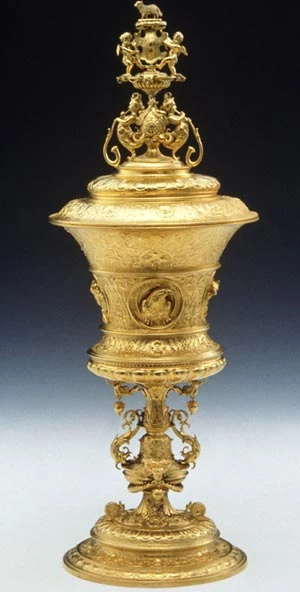
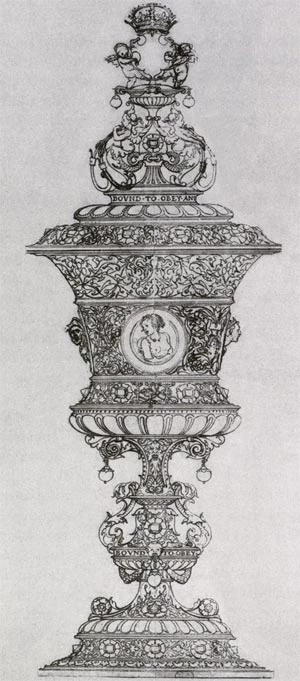
A grand cup made from solid Welsh gold 19 February 2007 Welsh Gold The solid gold cup made from a design on a drawing in the British Museum of a cup given by King Henry VIII to Queen Jane Seymour in 1536. Cup and cover, 22 carat gold, R & S Garrard & Co, London 1867-68. Height: 39.8 cm (15 ''/16 in). Welsh gold is very rare. The wedding rings of today's British Royal family are made from it. The largest object made of Welsh gold is a copy of a cup Henry VIII gave to one of his wives. The richest family in Wales The cup was made in 1867 for the Williams-Wynn family of Ruabon in Denbighshire, using gold from their own mine. At the time, they were the richest family in Wales. They were well known for their wealth, which they spent on grand houses, expensive paintings and silver, much of which is now at the Museum. The Welsh Gold Rush While many people know of the California gold rush of 1848, few know that, a few years later, there was a Welsh gold rush. In 1862 gold was discovered in Merioneth and, soon after, Sir Watkin Williams-Wynn (1820-1885) opened the Castell Carn Dochan mine on his land. The mine produced most of its gold between 1865 and 1873. Payment in Gold Sir Watkin was paid a large royalty for the gold mined, and he was paid with his own gold ingots. However, he was rich enough not to need this income, and could treat this gold as a novelty. A Cup of Solid Gold Some of this gold was used to make a magnificent cup. The cup is nearly 40cm high and made of 22-carat gold. It is inscribed "MADE OF GOLD THE ROYALTY FROM CASTELL CARNDOCHAN MINE 1867" and hallmarked by R & S Garrard and Co., Haymarket, London. It is ornate, in the style popular in the early Renaissance period. It stands on a circular foot, and the stem is flanked by flower heads, dolphins and bells. The cup is inscribed with several family mottoes: eryr eryrod eryri ('the eagle of the eagles of Snowdonia'), y cadarn ar cyfrwys ('the strong and the sly'), bwch yn uchaf ('the ram is on top') and cwrw da yw allwedd calon ('good beer is the key to the heart'). The tall lid has the Williams-Wynn arms, including a young ram on top, supported by a pair of cherubs. A Royal Design for Henry VIII The original design for the cup given to Queen Jayne Seymour in 1536-37 in the British Museum. Hans Holbein the Younger, pen and ink on paper. Copyright British Museum, London The makers of the cup based the design on a drawing in the British Museum of a cup King Henry VIII gave Queen Jane Seymour in 1536. This cup was set with diamonds and pearls. Jane Seymour's cup was melted down on the orders of King Charles I in 1629, when he was desperate for cash.