The design of the Clock Tower at Cardiff Castle
The commission to rebuild Cardiff Castle provided Burges with an unprecedented opportunity to realise his ideas on a grand scale. Bute’s unparalleled wealth, his love of travel and his romantic passion for the Middle Ages made him the ideal patron for Burges. As leading Burges expert J Mordaunt Crook has written, ‘Cardiff was the commission of a lifetime: the chance of creating a dream castle for Maecenas himself.’
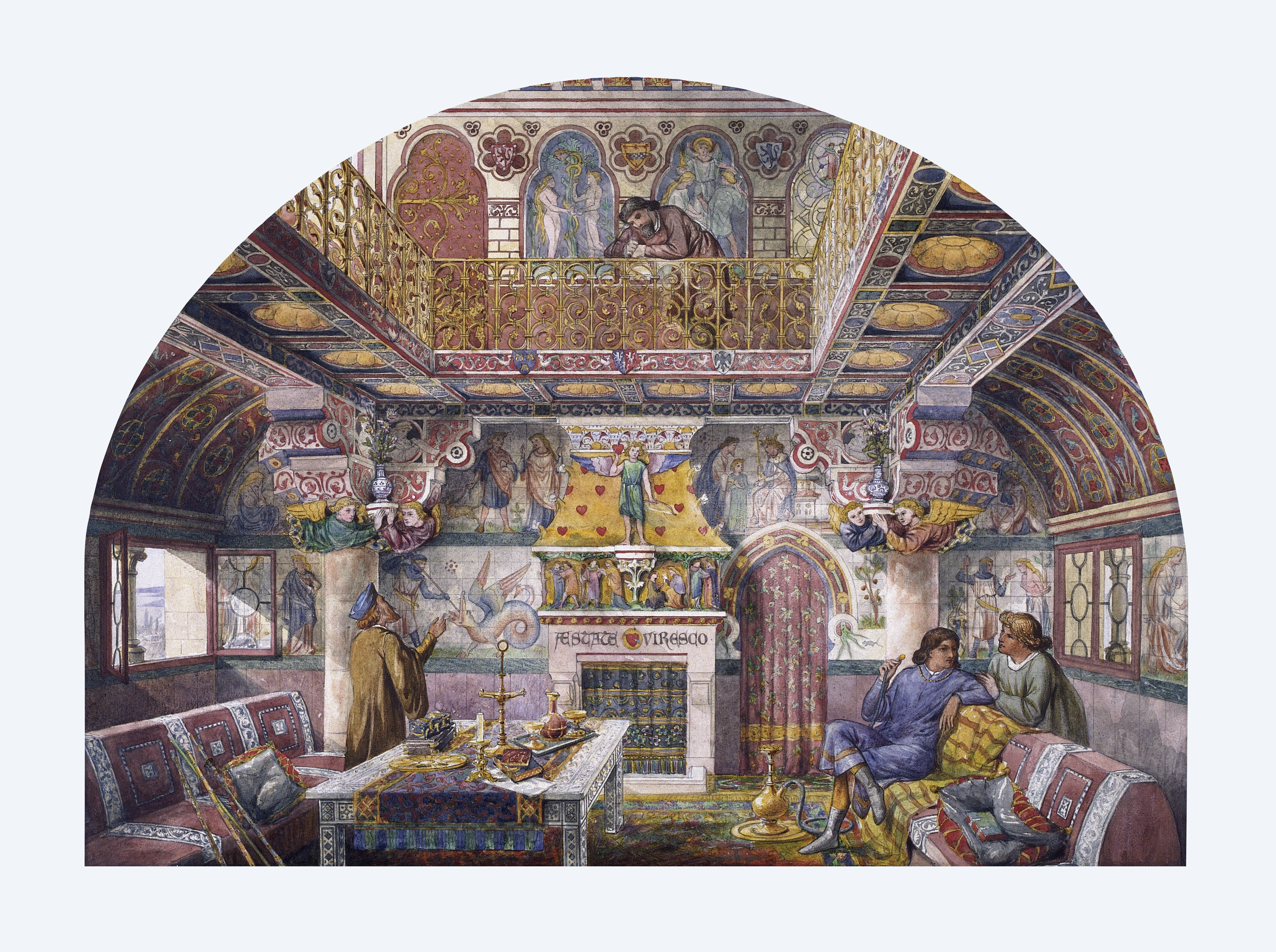
The Clock Tower is the most prominent element of Burges's Cardiff Castle and created a sensation when the architect revealed his design at the Royal Academy in 1870. Each apartment was richer than the one below and it culminated in the galleried Summer Smoking Room, probably the finest example of Burges’s fantasy architecture. It was (also in Mordaunt Crook’s words) ‘a veritable skyscraper among palaces. A skyscraper, moreover, clad in the garments of progressive eclecticism.’
The guiding iconographic theme of the Clock Tower is time. The Summer Smoking Room's decorative scheme is inspired by astronomy, illustrating the divisions of Time and the organisation of the Cosmos.
Its tiled floor, modelled on tiles before the high altar in Westminster Abbey, depicts the five continents, the Holy City, and the life cycle of the birds and beasts of the earth. The chimneypiece is carved with the amusements of summer, love in particular. A frieze of painted tiles illustrates the legends of the zodiac, with subjects such as Apollo and Cupid, Castor and Pollux, and Europa and the Bull.
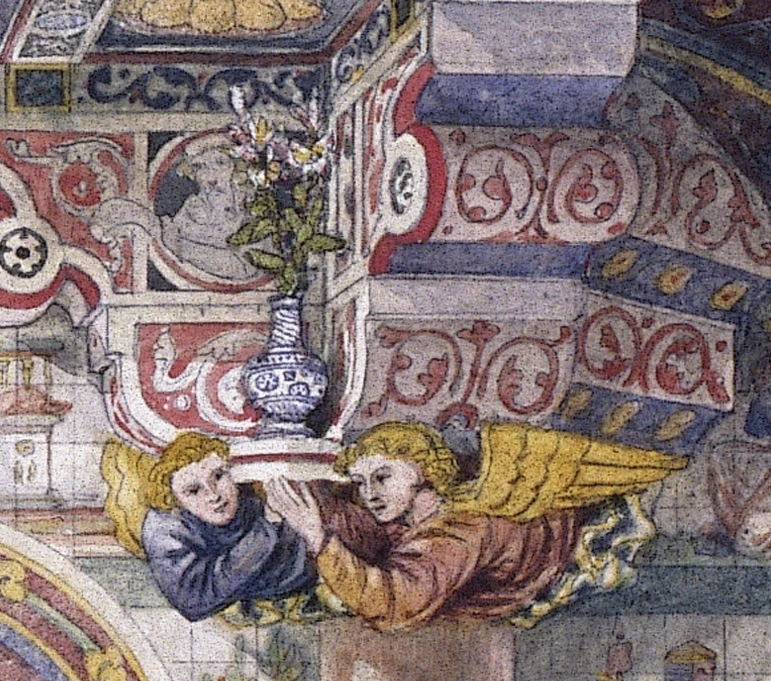
Paintings around the walls by Frederick Weekes represent seventeen different types of metal and in the spandrels astronomers of the past. In the centre hangs a sun-burst chandelier in the form of Apollo. Between the ribs of the dome are figures of the four elements – earth, fire, air, water – while in the four corners are giant carved anthropomorphic corbels depicting the eight winds of Greek mythology, such as Africus, Auster and Zephyrus. Also designed by Burges, the furniture included luxurious ottomans and inlaid chairs of Jacobean shape and Romanesque decoration. This all typifies Burges’s richly eclectic and allusive approach.
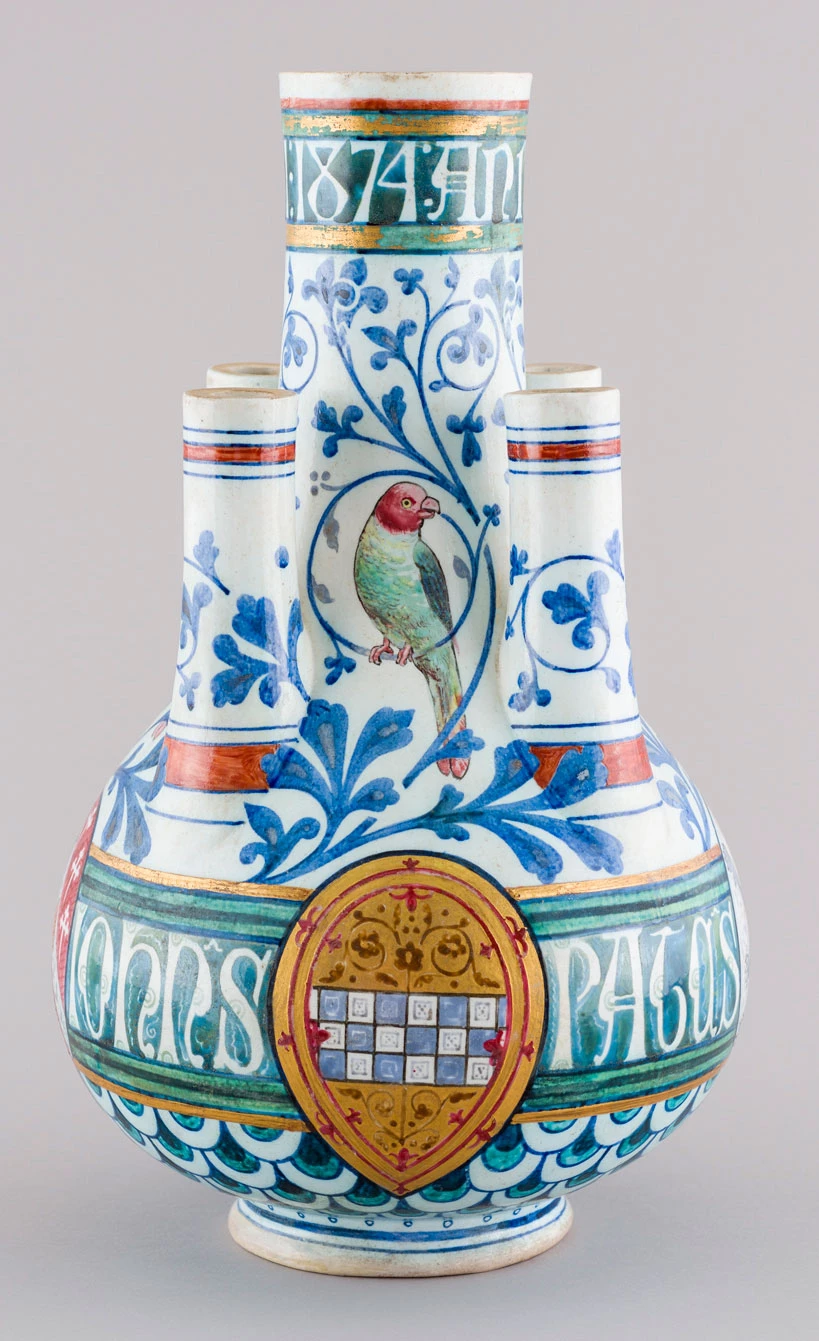
Designed to sit as bright highlights in each corner of the room on the carved stone corbels depicting the winds, the set of four tulip vases was an integral part of this amazingly theatrical whole. Axel Haig’s watercolour of about 1870 illustrating Burges’s original vision for the Summer Smoking Room (in Amgueddfa Cymru’s collection) depicts vases in the corners different to the form eventually produced and more generic in character. Comparison with the completed vases shows that Burges subsequently expended special care and imagination on their design to make them play an active role in his concept for the room.
Their decorative details contributed to the room’s themes and helped to animate the space. The colours – blue, green, gold and ochre – reflect those elsewhere in the room, such as the orange and blue of the upholstery of the ottomans, while the armorials echo those around the base of the gallery. More particularly, the parakeets – love-birds, an especially favourite motif of Burges – develop the theme of love, echoing the parakeets carved and painted in the hands of the sculpted figure of Amor perched on the chimney hood as well as on the hood itself and painted in roundels on the underside of the room’s gallery.
The design and decoration of the vases are an imaginative admixture of sources as varied as mediaeval architecture and illuminated manuscripts, Italian Renaissance maiolica, Dutch Delft pottery and Chinese porcelain. This wide range of allusions was all part of the intellectual games Burges enjoyed playing with the Marquess of Bute.
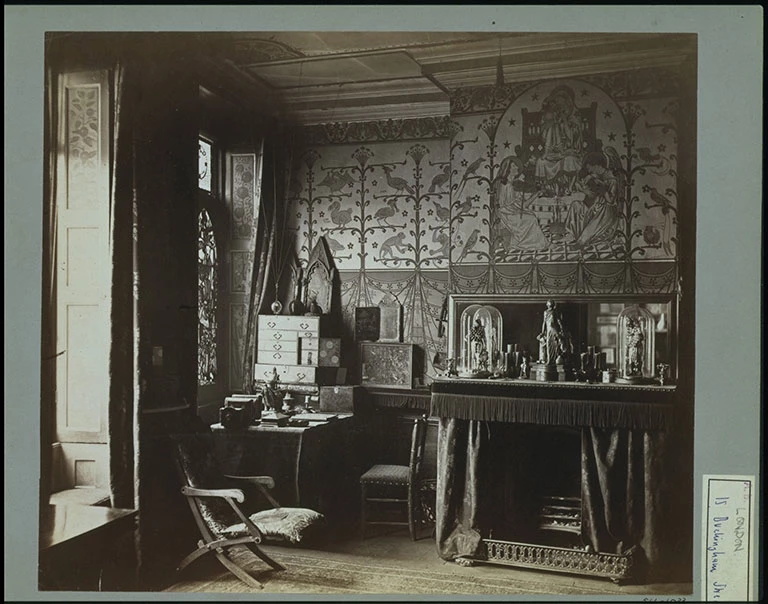
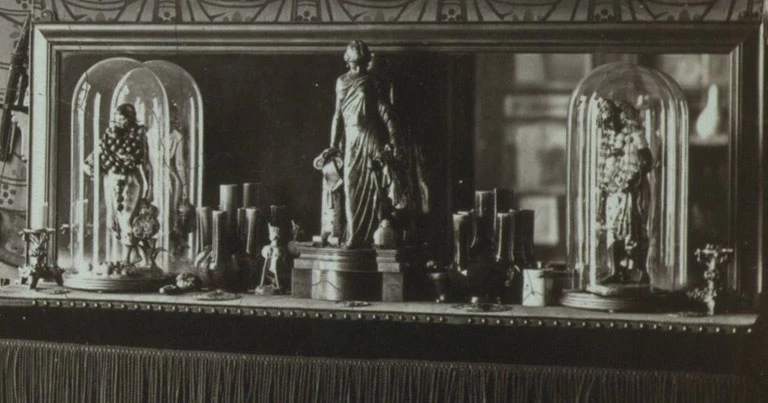
Drawings of vases of similar form appear in Burges’s ‘Vellum Sketchbook’ (Royal Institute of British Architects collection), one in particular annotated ‘this is a pot of glass / in which you put flowers’ and probably based on a glass water sprinkler typical of Catalonia in about 1550-1650. Another source of inspiration for the form was the multi-spouted ceramic flower vases made in Iran both in the 12th century and in the Savafid period (1500-1722). Closest of all are multi-necked Chinese porcelain vases of the late 18th and 19th centuries, a rare form of which two examples can be seen in photographs of Burges's chambers at 15 Buckingham Street, London, in the 1870s.