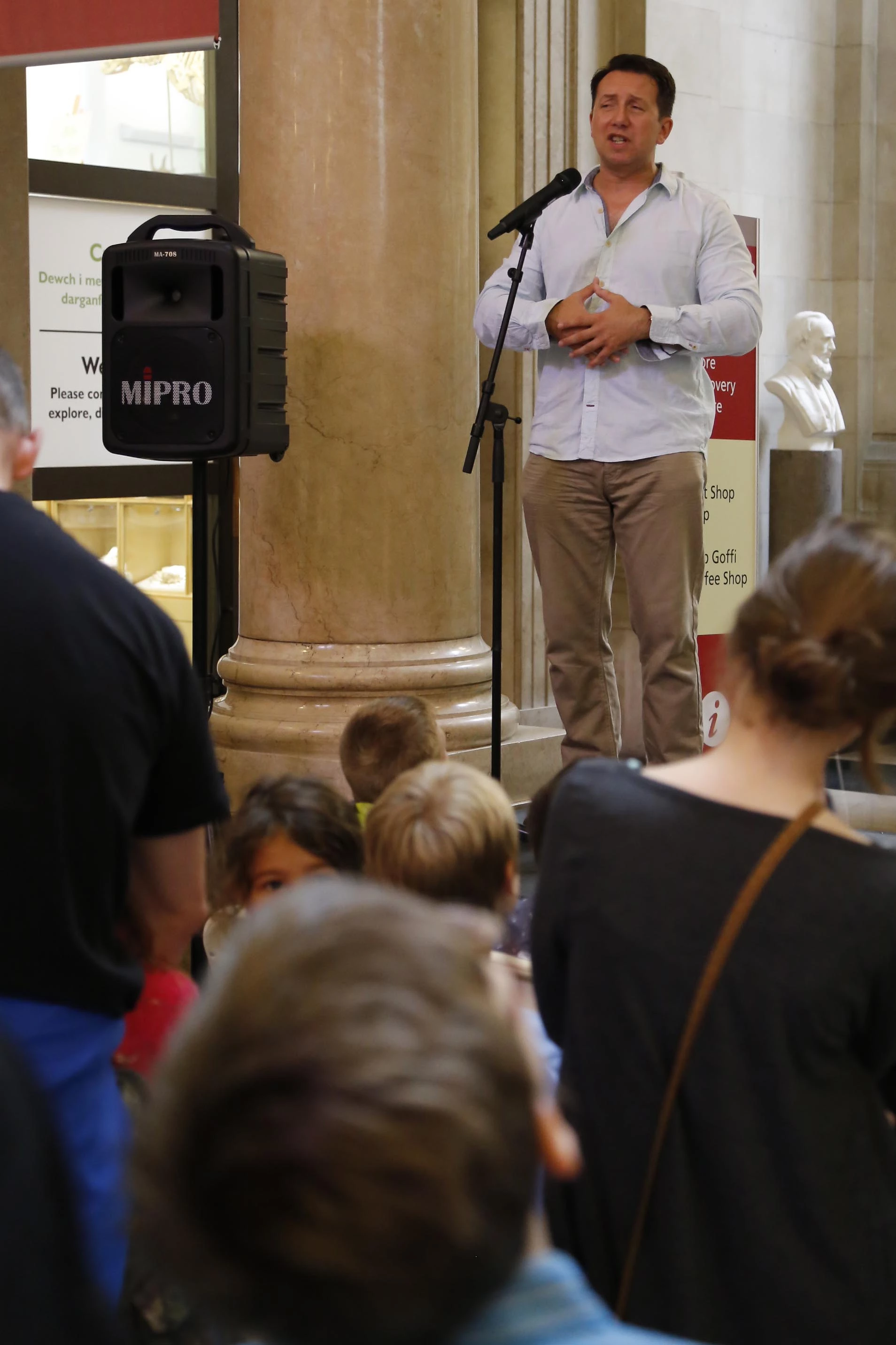
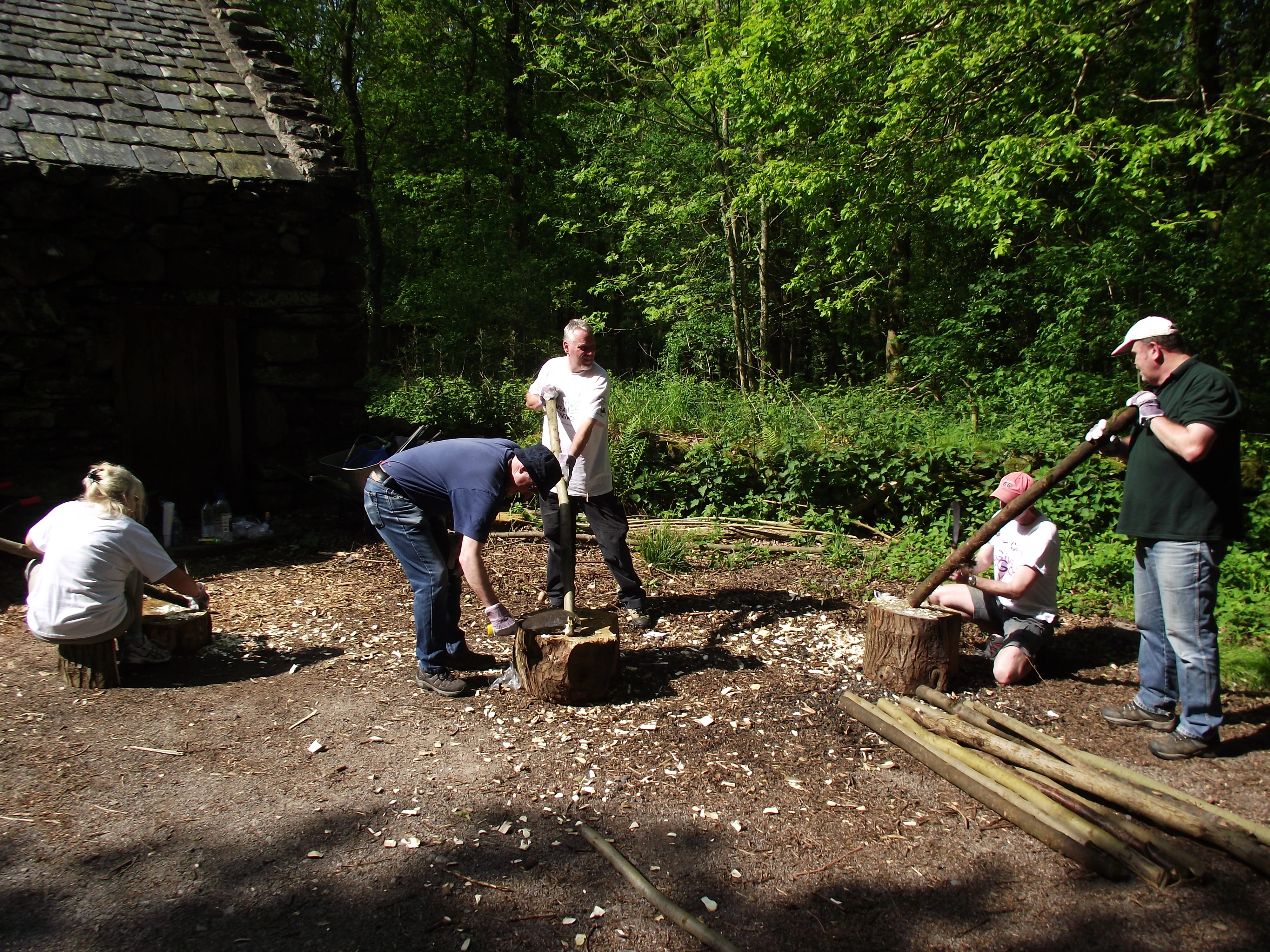
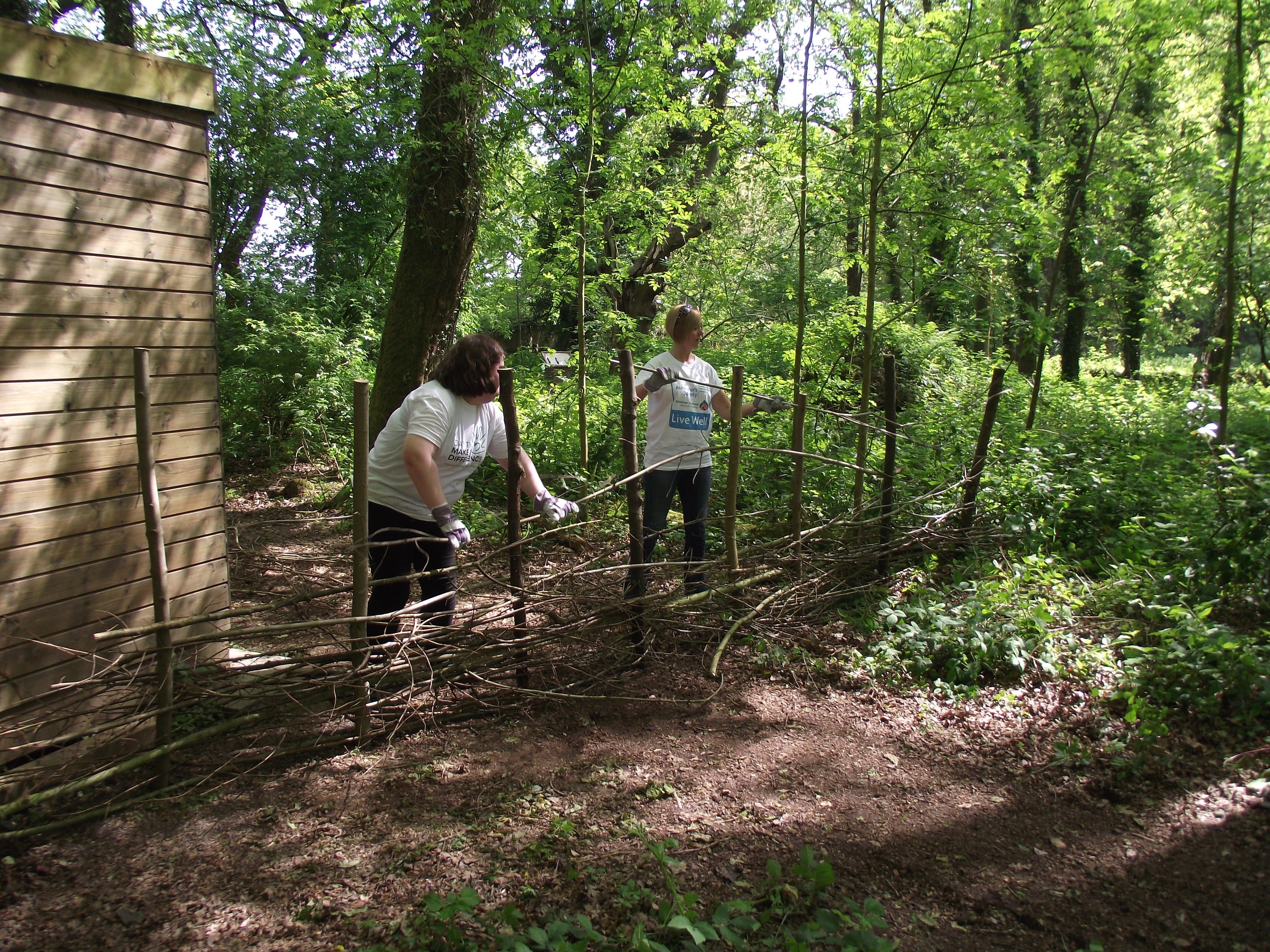
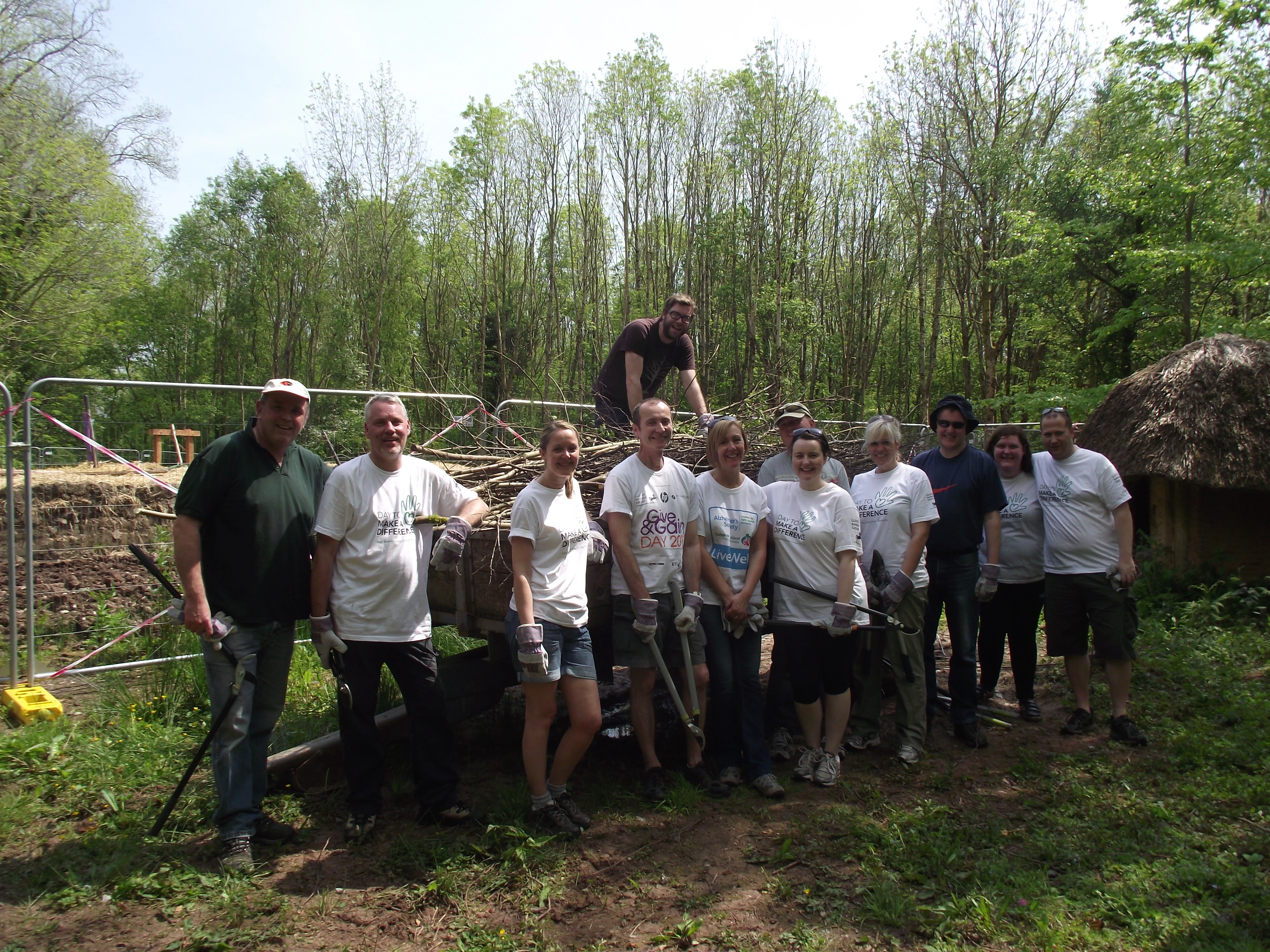
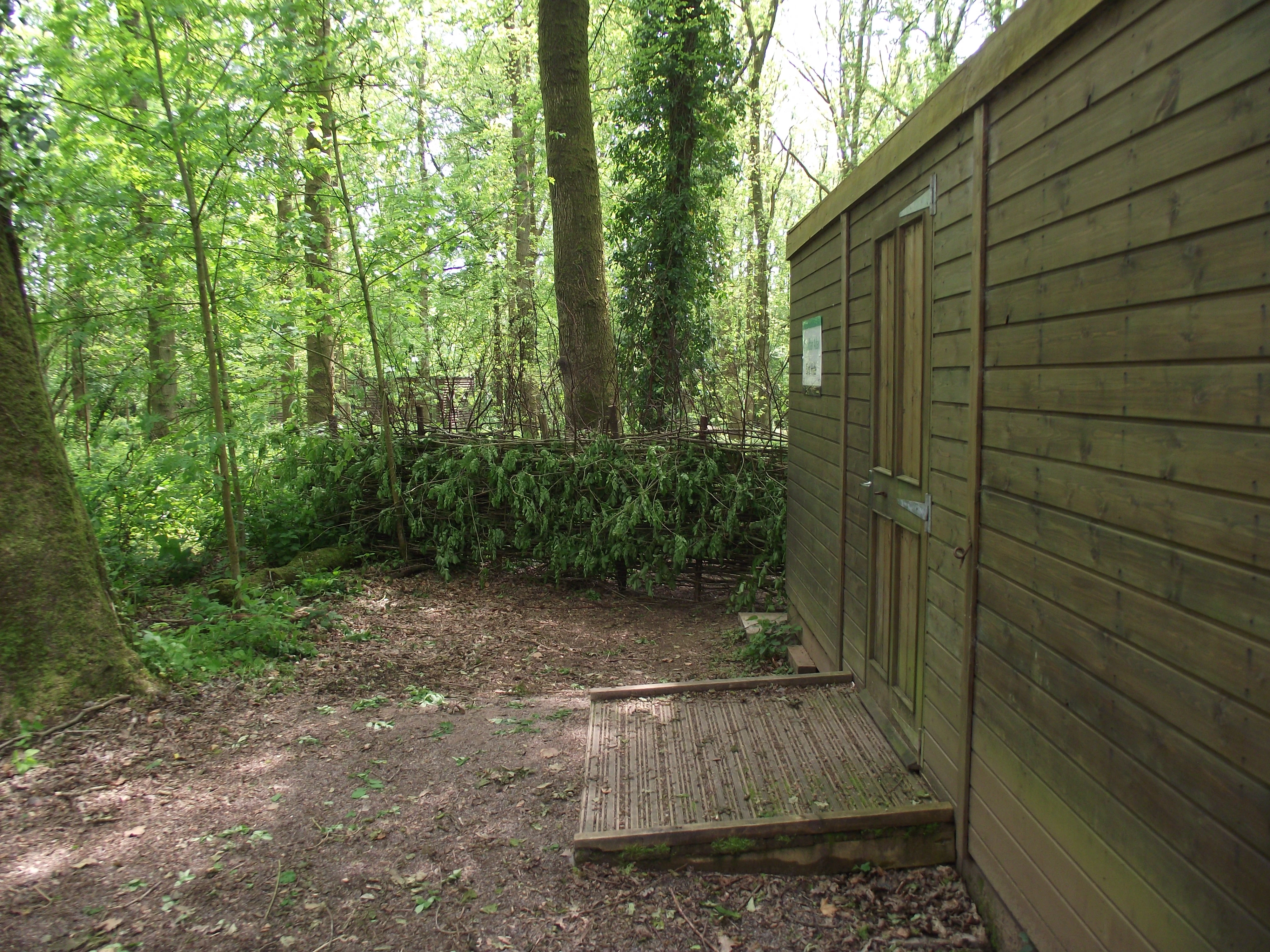
Give and Gain Day 2014 Hywel Couch, 19 May 2014 Last week, as part of Give and Gain Day 2014, we had 50 volunteers from the Lloyds Banking Group helping with a number of projects here at St Fagans. Some helped with the Gardening Department, some helped the Historic Buildings Unit while some assisted with a project alongside the Alzheimer’s Society. Myself and Bernice had the help of 11 volunteers to build a dead hedge in the woodlands near the bird hide.We had been planning on building a dead hedge in near the bird hide for a while, for a number of reasons. A dead hedge would act as a screen for approaching the bird hide, meaning that birds on the feeders would be less likely to be scared by the approaching visitors. A dead hedge also acts as a wildlife corridor, giving cover to a wide variety of wildlife as they move through the woodlands. Visitors had also begun cutting through the woodland, and one section of the dead hedge was to act as a deterrent meaning visitors would be more likely to stick to the paths.The first task of the day was the sharpening of the fence posts. The posts are needed for structure and need to be driven firmly into the ground. Creating the sharp end obviously makes this much easier. After creating pilot holes, the poles were then driven into the ground using a sledge hammer. Once the posts were in place, we could then begin to assemble the dead hedge.A dead hedge is built up of dead woodland material. Over the past couple of weeks I have been asking the gardeners and farmers here to help by collecting any trimmings and off cuts and delivering these to the bird hide for use in this project. Everyone was incredibly helpful, and we ended up with a vast pile of material… or so I thought. Dead hedging takes a lot of material, so along with some of the volunteers I headed into the woods to do a bit of clearing to gain more material.After lunch, we headed up into the woods near the site of Bryn Eryr, the Iron Age farmstead currently being built. This area has previously been cleared so there was a lot of cut material for us to collect. This was loaded into a trailer and taken over to the bird hide. The afternoon finished with us using this material to finish the dead hedge. As an artistic final touch, we used some lime cuttings to add extra height and a certain je ne sais quois to the finished hedge.As these pictures show, the day was a huge success! The weather could not have been better and I think everyone enjoyed themselves. The 2 sections of dead hedge we wanted to build got done, and I’ve already earmarked some projects for future volunteers! The amount of work done in a day was incredible, it would have taken me and Bernice a lot longer to do without the help of the volunteers. A huge thank you to everyone who helped us and the other projects too!
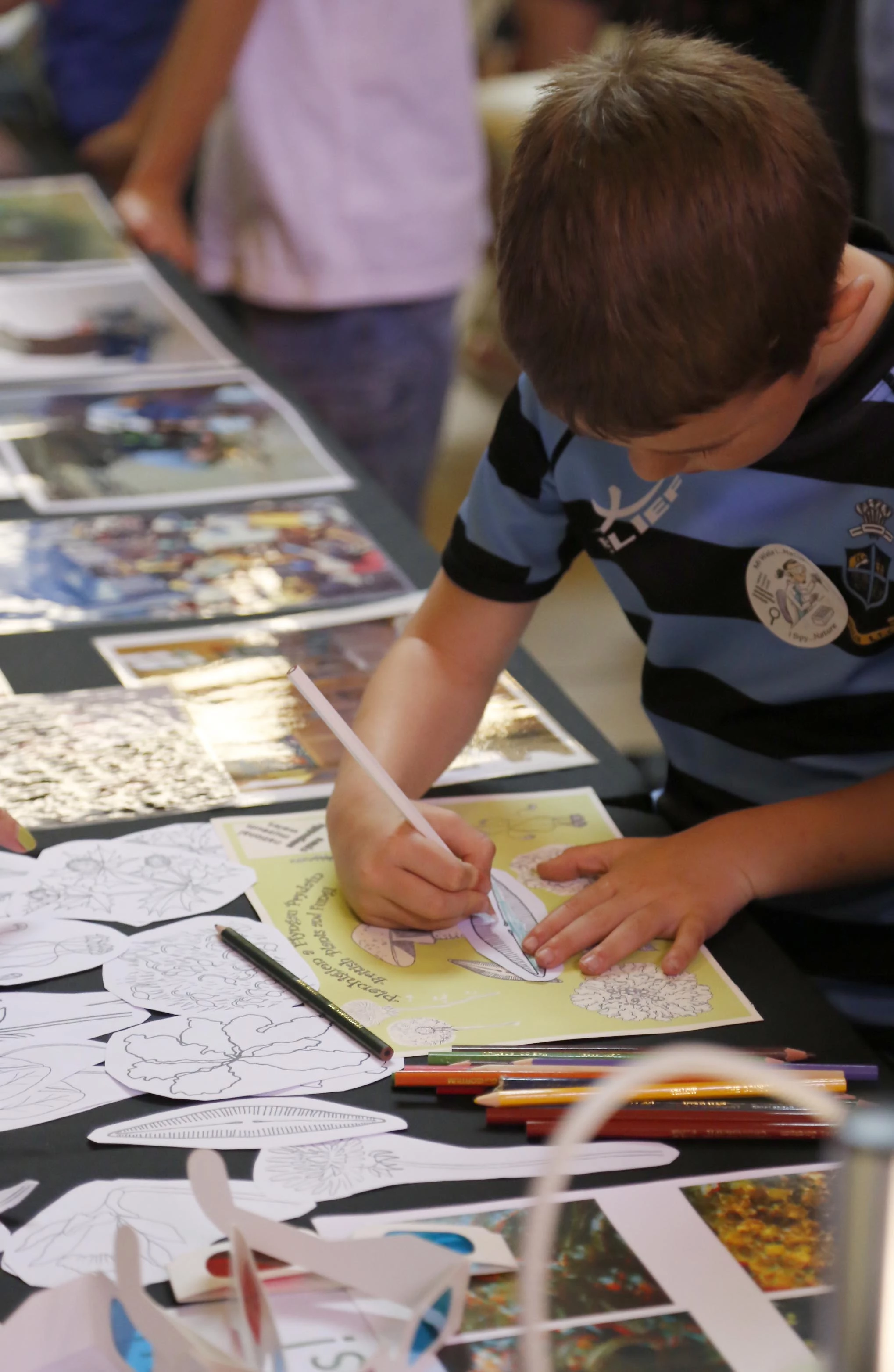
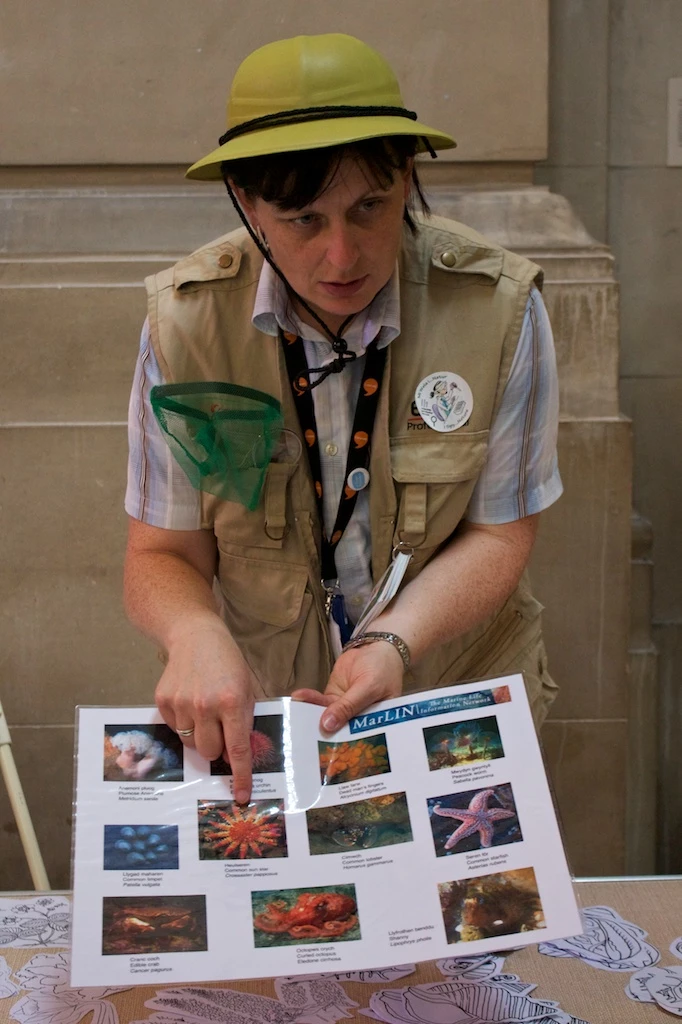
National Science and Engineering Week Katie Mortimer-Jones, 21 March 2014 Yesterday, Natural Sciences Staff took part in the 'Meet the Pollinators' Event run by First Campus, a partnership between higher education institutions, further education colleges and schools in South East Wales. The event was part of National Science and Engineering Week and was attended by approximately 100 Year 9 pupils from six schools. The pupils had the opportunity to speak to the curators and find out about 'a day in the life of museum scientists'.
The Participatory Forums Penny Dacey, 25 February 2014 The Informal Learning ForumInformal Learning in this context refers to learning outside of the school curriculum. The group consists of representatives from organizations across Wales that facilitate adult and family learning. Most members had previous knowledge of the project having participated in workshops during the planning stage. This group have agreed a remit of work which includes; helping to develop a programme of activities that appeals to people of varied background and ability and reviewing gallery content to ensure we provide appropriate interpretive methods for these audiences.As a result of this Forum a group of adult learners from the Workers Educational Association (WEA) participated in interpretation workshops in July. The workshops provided an opportunity for the group to give their views on items intended for the ‘Wales is’ gallery. Objects studied at close hand included a tailors quilt and artefacts dating from the First World War. The sessions were facilitated by curators working directly with the objects – ensuring that the feedback gleaned has a direct impact on their work.
Bryn Eryr Farm - How to become an Iron Age Carpenter Penny Hill, 9 January 2014 As Steve said in his last blog posted in December, we’ve started work on growing the thatch for our new Iron Age farm. Alongside this work we’ve also been giving a lot of thought to the objects that will go inside the houses. Far from being primitive, these replica objects will reflect the high level of knowledge and skill possessed by people who lived in Bryn Eryr over 2000 years ago. One of the first tasks is to furnish the round houses with all those essential objects that no self-respecting Iron Age household could do without, such as plates, bowls, utensils, buckets , storage containers, shelves, barrels, weaving looms, beds, just to name a few.In this period all these items were made from wood, but we have a problem, wood deteriorates quickly in the ground so objects made from this material rarely survive. However, we think we can find out more about the wooden objects they would have had by studying the carpentry tools available at this time. These were made from iron and because of this have survived in greater abundance. Ancient iron-work is often much underrated as it doesn’t look very attractive, but when trying to recreate everyday life the information domestic ironwork objects can provide is invaluable.The first stage of making the replicas was to search the archaeological collections for any original Iron Age carpentry tools. Much to my delight we had quite a lot of material and could virtually recreate a whole tool kit from examples found throughout Wales. Our Bryn Eryr tool kit will therefore consist of an axe, adze-hammer, gouge, chisels, files, drill bits and numerous wedges from small to large. Timber in the Iron Age was divided up by splitting with wedges rather than cutting with a saw. Saws did exist, but were small, similar to modern pruning saws today. An Iron Age household would be equipped with a wide range of tools for a variety of purposes. Some of these objects appear strange to us today, but others are quite familiar. A 2,000 year old chisel found in the Roman fort of Brecon Gaer and a gouge from the Hill Fort at Castell Henllys wouldn’t look out of place in a carpenter’s tool kit today.Once our tool kit had been compiled from the examples in the collection, the next step was to make working replicas that could be used by our craftspeople to recreate the objects for Bryn Eryr.Careful conservation of the original tools had preserved some of the original surfaces. Marks on these surfaces enabled our blacksmith 2000 years later to work out how they were made and reproduce the replicas as accurately as possible. The replicas are recreated in wrought iron like the originals, which is much softer than the steel used today, so it will be interesting to see how these tools perform? Will we be able to produce a decent cutting edge, how quickly will this edge dull and how often will it need to be sharpened?Making the tool heads is only half the story, these tools can’t be used without handles! None of the originals survive and from the shape of some tools we just can’t pop modern handles on them. We know our tools once had wooden handles, because in some cases the deteriorating iron around the socket had made a cast of the wood surface before the handle disappeared. Using a combination of this information and some surviving material from elsewhere, plus the expertise of our own carpenters and estate workers, we managed to reproduce handles to complete the tools.Now all we have to do is see if they work! More importantly have we still got the expertise to use these tools properly? Hopefully by using them we’ll gain an insight into the skill of our Iron Age carpenters. I’m sure they would be laughing themselves silly if they could see our efforts today, but we have to start somewhere!So, how did our tools perform? Its early days, but everyone including our craftspeople are impressed. They appear to be performing well, we even managed to split a large piece of timber with our wedges. It probably explains why so many of these wedges end up in our collection, they tend to get lost inside the timber during splitting and fall to the ground where they are difficult to spot!We hope to undertake more experimental work to assess the performance of these tools, so keep watching this space, but in the mean time we have to crack on, there’s the contents of a roundhouse to make!
Starting work on our new Celtic Village Steve Burrow, 20 December 2013 As many regular visitors to St Fagans will know, our much-loved Celtic Village was closed earlier in the year. Twenty years seems to be about the normal life-span for reconstructed Iron Age roundhouses – the timbers decay and they begin to get a bit wobbly after that. To replace it we're going to be building a new reconstruction based on a 2,000 year old Iron Age farmstead on Anglesey called Bryn Eryr, and just recently we reached a really exciting milestone along the way.The Bryn Eryr roundhouses consisted of two buildings built side-by-side. Their walls were made of packed clay (probably mixed with grit and straw, like Wales's traditional clom-built houses) and the roofs were thatched. We've had a lot of discussions about what we should use to thatch them. Naturally the roofs of the original buildings haven't survived, but we do know that its Iron Age owners had access to spelt – an early form of wheat – because charred grains were found at the site. From there the argument goes, if they were harvesting spelt grains to make their bread they also had their hands-on a useful thatching material, spelt straw.So, we thought, St Fagans is surrounded by farm land, we've got an excellent farming team, and lots of enthusiasm, why not try to grow a crop of spelt ourselves and see whether we can thatch our next Iron Age farmstead with it?There are a lot of uncertainties involved in this, many things can go wrong between the idea and the harvesting but St Fagans is part of an EU collaboration which encourages just this kind of experimental research. So thanks to the OpenArch project, with its Culture programme funding, and a lot of advice from experts in the field (apologies for the pun), we've decided to give it a go.A few months ago we ploughed 3.4 hectares (8.4 acres) just outside the main museum site. This looks like an enormous area when you're stood beside it, but we're told this is what we need in order to produce enough straw to thatch two large roundhouses.With the ploughing done, our Learning Team organised an opportunity for school groups to come out and see what we were up to. This was followed by the museum's archaeologists bringing together a team of volunteers who walked the area in search of any artefacts that may have been turned up by the plough. The finds from this have yet to be analysed but already we can see that the area had been visited by prehistoric hunter-gatherers, a 13th-century traveller who lost some loose change, and many other more recent people.And then it rained, and rained and rained. Our spelt seed arrived and was placed in a barn, and still it rained. I was beginning to get very worried. It's all very well having a plan to grow a crop of Iron Age wheat, but that's not going to happen if the seed stays in sacks. Then a few weeks the weather cleared up, the ground dried sufficiently and we finally got a chance to plant.Then we waited… Would anything happen? Had we left it too late? Would frosts / rain / snow put a stop to our plans? Happily not! Last week we found the first seeds had germinated. I’m going out to the field again today to check on its progress. Will the shoots be showing? Have we got the spacing of the seed right? Will the rabbits leave it alone? Will it grow tall? I feel like an expectant father all over again.