
Ordinary heroes in extraordinary times Sioned Williams, 3 April 2020 Collections Online: Nurse's Apron Collections Online: Certificate Collections Online: Certificate The current health crisis has prompted a call for volunteers to support the NHS and plans are underway to convert large venues into field hospitals. Over a century ago, similar preparations were taking place all over Britain in anticipation of the outbreak of the First World War. In 1909 the British Red Cross Society had joined forces with the Order of St John to form the Voluntary Aid Detachment scheme. Detachments (known as VADs) were to provide support and services to military hospitals. They were organized at county level and members included men and women who carried out a range of voluntary positions. The first VAD in Wales was formed at St Fagans, Cardiff in November 1909. At that time, Countess Plymouth from St Fagans Castle was the President of the Glamorgan branch of the British Red Cross Society. Soon after, detachments were formed across Wales, bringing the total to 32 by September 1910. From thereon the work started in earnest, recruting and training members and converting buildings into hospitals. On 24 September 1910, over 200 men and women from the newly formed VADs in Glamorgan gathered at St Fagans Castle grounds. The main purpose of the day was to recruit more volunteers, particularly amongst young women. Demonstrations were also carried out on the day, such as how to treat patients in the field using first aid and only limited basic equipment. Such events became a regular occurance at St Fagans Castle in the years leading up to the war. Detachments would meet at least once a month and members (also known as VADs) would gain experience by volunteering in hospitals. Women VADs were taught first aid, home nursing, hygiene and cooking while men were trained in first aid in-the-field and stretcher bearing. VADs had to pass exams to receive their first aid and home nursing certificates. Some of the VADs were dispatched to hospitals across Britain but most would volunteer within their own communities, such as at St Fagans. Due to a lack of hospitals, all sorts of buildings were offered for use to the Red Cross – from village halls to mansions. These were converted into auxiliary hospitals of about 30 beds that would support a nearby military hospital. In 1916 Earl and Countess Plymouth of St Fagans Castle offered their large Banqueting Hall in the grounds of the Castle to be converted into an auxiliary hospital. By the outbreak of the First World War in August 1914, the work of the VADs had ensured preparations were in place to deal with the first casualties returning from war. From thereon many more volunteers were recruited and trained. In all, 90,000 volunteers worked at home and abroad during the war, playing a crucial part in caring for the sick and wounded. Over the coming weeks, we’ll be posting more about some of the volunteers who worked at the St Fagans VAD Red Cross hospital.
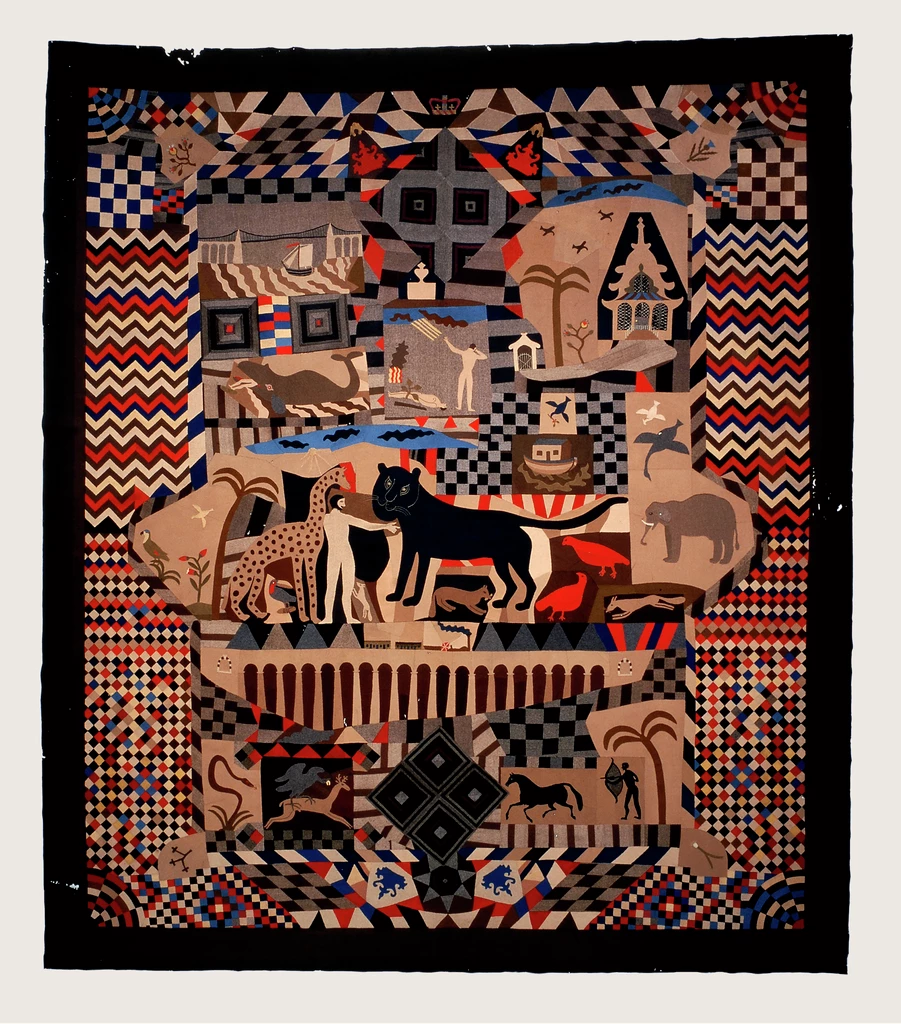
The Wrexham Tailor’s Quilt, 1842–52 Elen Phillips, 2 March 2020 Wrexham Tailor’s Quilt, 1842–52 Collections Online: Patchwork Bedcover Amgueddfa Cymru – National Museum Wales is home to over two hundred examples of quilting and patchwork. This vast collection includes a wide variety of styles and techniques, ranging in date from the early 1700s to the present day. The Wrexham Tailor’s Quilt is probably one of the most well-known patchworks produced in Wales. Made by James Williams – a military master tailor from 8 College Street, Wrexham – its design is unlike any other in the Museum’s collection. The quilt’s background is a pieced composition of diamond patches, chevrons, squares and rhomboids. Biblical scenes dominate the centre – Adam naming the animals, Jonah and the Whale, Noah’s Ark with a dove bearing an olive branch, and Cain and Abel. Other figurative motifs include Thomas Telford’s Menai Suspension Bridge (opened in 1826), a Chinese pagoda, and Cefn Viaduct, complete with a crossing steam train. Details are picked out through embroidery in silk thread. Meticulously pieced, James Williams made his quilt by recycling a variety of felted woollen cloths, possibly off-cuts of broadcloth from military uniforms. In total, it consists of 4,525 separate pieces of cloth, butt-joined with overcast stitches worked from the reverse. Examples of this type of inlaid (‘intarsia’) patchwork found in museum collections are usually the work of professional tailors. The technique requires a high degree of skill and the use of thick cloth that does not fray to accommodate the oversewing required. According to family history, James Williams spent a decade completing the piece, the work being done in his leisure hours between 1842 and 1852. The quilt soon became an exhibition piece; it was displayed at the Art Treasures Exhibition in Wrexham in 1876, at the Palace of Arts in Wembley in 1925, and to much public acclaim at the Wrexham National Eisteddfod of 1933. Census returns for the Wrexham area suggest that James Williams was born in 1818. His tailoring establishment appears in numerous trade directories from the 1850s onwards. He died in 1895, leaving his son to inherit the family business. Forty years after his death, the economic depression of the 1930s prompted Williams’s grandson to sell the quilt to the Museum, stating that “it has always been my wish that the quilt should be sent to [the] National Museum of Wales so as my fellow countrymen should have the opportunity to admire a work of art that today could not be done if you were to pay the most skilful craftsman £1 a minute to do”.
Dre-fach Felindre and the Woollen Industry 20 February 2020 A New Way of Life The woollen mill factories produced shirts, underwear and blankets. These proved particularly popular with the workers of the south Wales coalfields. By the 1890s there were over 250 woollen factories in west Wales with 23 in Dre-fach Felindre and the surrounding area. The growth of woollen mills and factories gave birth to a new way of life. The woollen mills remained the largest employer in the area until the 1980s. “Since the inhabitants of the village of Dre-fach Felindre relied entirely on industry rather than agriculture, their outlook became much more akin to inhabitants of the industrial valleys of South Wales, with whom they had constant trading contracts, than of their agricultural neighbours” J. Geraint Jenkins, Welsh Craft: Dre-fach Felindre and the Woollen Industry (2005) Looking down to Ty-Cornel Felindre, c.1920 The village of Felindre Land of song Bands and choirs became an important part of life in Dre-fach Felindre. As the mills flourished the local population grew. Workers formed choirs and bands. Some, like the celebrated Silver Band led by Albert Evans, won many titles. Many competed in annual local and national competitions, known as Eisteddfodau. The Bargoed Teifi Mixed Choral Society was particularly successful, taking first prize at the Carmarthen National Eisteddfod in 1911. The choir received a hero’s welcome when they returned to Dre-fach Felindre. Local eisteddfodau were held in many villages throughout Wales. Dre-fach Felindre’s Eisteddfod was no small event. In 1897 the choir competition, for example, was `for choirs numbering no less than 100 voices`! Dyffryn Bargod Temperance band, 1909 Bargod Teifi Choir, 1922 Built on faith Churches and chapels were an important focus for the community. Many new chapels were built in the industrial areas of Wales to accommodate the growing population. Bethel Chapel in Dre-fach was expanded in 1840 to meet the needs of the burgeoning population. The Lewis family, owners of Cambrian Mills, were deacons in Bethel Chapel. The gas engine at Cambrian Mills provided the electricity for the Chapel! Wealthy mill owners often invested money in their places of worship. Religion was viewed by some as a means of maintaining a disciplined workforce. Social prestige was never too far away; the choice and size of some gravestones reflected a person’s standing and income. This can clearly be seen in St Barnabas graveyard. Penboyr Church Entertainment Shift patterns provided opportunities for shared leisure time. The mill workers often formed sports teams. At Dre-fach Felindre these included the Bargoed Rangers football team and a women’s football team. In 1922 the Red Dragon Hall was built in Dre-fach Felindre. Similar to the Workingmen’s Institutes of the South Wales valleys, it provided a focus for the village’s social life. The hall was used for dances, plays, concerts, billiards and card games. Johnny Lewis of Cambrian Mills donated £8,000 to building a new Red Dragon hall in 1964. The land on which the local park, Parc Puw , is now situated was also donated to the people of Dre-fach Felindre by Johnny Lewis. Bargod Rangers First League Champions after the Second World War Drefach Felindre hockey team, 1930-31 Carnival queen, c.1950s Shops and local business Dre-fach Felindre became a bustling village with a variety of outlets to meet the needs of the growing population. At one time the village had three pubs, a shoe shop, butter making business, blacksmith, a tailor’s shop and a general stores. These businesses were in many ways dependent upon the success of the woollen industry. The decline of the woollen mills after the First World War left many unemployed and forced some families to leave the area in search of work. John Jones Cabinet Maker, Gwalia House, Felindre, 1916 William Hindes, Felindre, 1920 Strikes and social unrest The 1880s saw the growth of unions with calls to improve working conditions. Factory workers in Dre-fach Felindre organised a strike in 1889 over poor pay. The strike lasted for seventeen weeks. After the strike the Carmarthen Journal, a local newspaper, suggested ways of developing better working relationships between owner and worker. The Journal encouraged the mill owners to invest in their workers’ education and support the building of a reading room. In 1890 a Reading Room was completed. 520 men and women weavers, from the parishes of Llangeler and Penboyr, formed a Labour Union in 1900. Dyffryn Woollen Mill staff, c.1890 Handloom and spinning, c.1870 Conflict The uniforms of the soldiers were made of flannel during the First World War. The factory mills at Dre-fach Felindre worked twenty four hours a day to keep up with the orders for flannel from the War Office. This new demand brought back prosperity to the area. During the Second World War American soldiers were stationed at Dre-fach Felindre. Some disused factories were used as barracks. The American GIs are remembered fondly by the community for giving gifts of chocolate to local children. A prisoner of war camp was established in nearby Henllan for Italian prisoners. They were sent to work in the local community. They turned one of the camp huts into a chapel and used dyes from the woollen mills to paint frescos on the walls. First World War soldiers from the parish Home Guard, Felindre, 1940-45 Mrs Nesta Morgan, 1912- 2003 Nesta Morgan worked at Cambrian Mills between 1927 and 1965. Nesta’s father was Mr John Davies, the first manager of Cambrian Mills. They lived next door to the mill at Clungwyn. He worked at Cambrian Mills for 58 years. Following his retirement he still helped out in the mill until he died just before his 100th birthday. When Cambrian Mills burnt down in 1919, Nesta was on holiday with her parents in Llanwrtyd Wells. It happened to be her 7th birthday. She remembers her parents receiving a telegram and their upset on hearing the news. When they returned to Dre-fach Felindre the apples on the apple tree in their garden had cooked in the heat of the fire. When Nesta worked at the mill there were around 80 people working there. She worked in the sewing room and carried out mostly piecework. By the age of 18 she was sewing aprons and belts and then spent 10 years in the cutting room and was put in charge of the sewing room. Nesta remembers annual day trips from Cambrian Mills for the employees. They travelled by bus to places such as Builth Wells, Llandrindod Wells and Neath. They had lunch out and these were happy occasions. Nesta Morgan and sewing room staff Cambrian Mills
Caernarfon Blankets: History, Design, and the Debate Behind a Welsh Icon Mark Lucas, 17 January 2020 Introduction to Caernarfon BlanketsCaernarfon blankets have been described as an oddity in Welsh textiles; the National Wool Museum at Dre-fach Felindre has a couple of examples of this blanket in its collection.What Makes Caernarfon Blankets Unique?These Caernarfon blankets are made up of three pieces; the most obvious is the middle piece. On this piece are the words ‘Cymru Fydd’ (Wales to be) underneath a picture of Aberystwyth College, and under a picture of Caernarfon Castle the words ‘Cymru Fu’ (Wales that was). Above and beneath these pictures are two dragons and three leeks; the rest of the quilt is then covered with leeks and daffodils in full bloom.Origins and Historical BackgroundThe origins of the original design are disputed by scholars. Ann Sutton, a leading authority on Welsh textiles, credits the original blanket to weaver John Roberts of Caernarfon; he is said to have presented the blanket to the Prince of Wales (the future Edward VII) on a visit to Caernarfon to open the water works in 1876. Welsh historian D. G. Lloyd Hughes disputes this as he states the water works in Caernarfon were opened in 1868 not 1876, and as the blankets show Aberystwyth College with the extension that was not completed until 1872. The Prince of Wales did not visit Caernarfon again until 1894; he accredits the design to Pwllheli Woollen Mill who patented the design in February 1895. There is a picture of the staff from Pwllheli Woollen Mill holding a Caernarfon blanket from the 1890s. There are other claimants to the original design, most notably Edward Davies-Bryan, whose great-granddaughter says he commissioned Pwllheli Woollen Mill to produce a blanket commemorating Aberystwyth college in the early 1890s as he was a former student and a great benefactor to the college.Debates Around the Design and AttributionThe last Caernarfon blanket was produced in 1969 at Trefriw Woollen Mill to commemorate the investiture of the Prince of Wales at Caernarfon Castle. A recent donation to the National Wool Museum may have finally answered this debate: it is an early hand-woven blanket that is similar to the other blankets and is made up of two pictures of Caernarfon Castle and no picture of Aberystwyth College. The donor said the blanket belonged to her great-grandparents from Denbigh, North Wales, and they passed away in the 1890s. Could this be the type of blanket that was presented to the Prince of Wales in 1868?
Underground Bible Ceri Thompson, 30 October 2019 Mynydd Newydd Colliery was situated about three miles to the north west of Swansea. It commenced working in 1843 and was initially owned by the Swansea Coal Company. In 1844 an explosion killed five workmen and seriously injured several others. After this explosion the workmen came together and discussed how to protect themselves from further deaths. They decided to hold prayer meetings underground before starting work. They approached the colliery management who were enthusiastic about the idea and allowed them to construct a chapel in the workings. After they had constructed the chapel in the Five Feet Seam, they bought the first Bible which was carried underground and used in the first meeting at half past six on the morning of the 18th August 1845. After this a meeting was held every Monday morning. By 1859 a new Bible was purchased as the original was by now falling apart due to the dampness of the workings. The new Bible was kept in a box in the engine room near the chapel to help keep it in better condition. However, on one occasion, the ‘preacher’ got over excited and banged his fist down on the Bible and broke the binding scattering the pages over the floor of the chapel. A new Bible was presented by a visiting Scottish medical man, Dr McRitchie, in 1899. In the same year a Journalist from the Sunday magazine visited the colliery and described the underground chapel: "The coal has been worked out of the seam to the left (of the roadway) till a chamber about 16 yards long by 6 yards wide has been formed. The walls are formed, in parts, of small rough pine logs, through which the splendid thick coal seam out crops to the view, here and there. The roof is somewhat menacingly close overhead, but it is of hard, smooth clift and has been whitened with lime, so it looks like an artificial ceiling. As you enter you observe that the chapel is timbered with pit props on either side, and furnished with rude plank seats placed at equidistance between the props." There was room for a congregation of around a hundred and a high wooden desk formed a pulpit. The colliery was deemed to be ‘gas free’ and lighted candles were arranged around the chapel for illumination. In 2019 the last Bible used in the underground chapel was donated to Big Pit. This Bible was purchased in 1904 and contains the following inscription: ‘To the prayer meeting service held in the Five Foot (seam) at Mynydd Newydd Colliery every Monday morning when the works is working. This work commenced on 28th November 1904. Dated August 9th 1915.’ In 1924, after the colliery changed owners and closed down for a short while, a Prayer Meeting Festival was held. A programme for the event was printed with the title: ‘A list of Hymns for the Preaching Festival Service Mynydd Newydd Colliery To celebrate 80 years of Prayer Meetings Underground.’ It would be interesting to find out if any of these programmes still exist. In 1929 the Radio Times carried an article on the underground chapel and an underground service was broadcast by the BBC on Sunday October 13th. Mynydd Newydd Colliery closed temporarily in 1932 but re-opened by the Mynydd Newydd Colliery Company in 1935 when it employed 76 men. The colliery was finally closed by the National Coal Board in 1955. The donor’s grandfather, worked in the colliery and when it was closing he went down to the chapel to look for the Bible. There had also been a hymn book but only the Bible was still there which he brought out of the pit. His son, John Moelwyn Thomas who worked in Garn Goch Colliery, inherited the old Bible and took it around Miners’ Galas and other events. This important piece of Welsh social and industrial history was donated to Big Pit by the Thomas family in 2019. This particular Bible is the 1904 one, and the last one to be used in Mynydd Newydd. Strangely enough, a different Bible was pictured in the National Museum’s publication ‘Welsh Coal Mines’ (now out of print) and captioned as the Bible used underground. However, that particular Bible is not the same as the one the Museum now holds so may have been an earlier one. If that is the case, there must be another Mynydd Newydd Bible still in private hands.